Instytut Lotnictwa was expected to fly its new IS-2 two-seat light helicopter prototype in 1999.
1980->
Główny Instytut Lotnictwa I-23
Instytut Lotnictwa flew the prototype I-23 four-seat lightplane in October 1998, for deliveries from 1999
Globe Aircraft Corp / Bennett Aircraft Corp
Formed originally as the Bennett Aircraft Corporation to manufacture aircraft from Duraloid, a new type of bonded plywood. Produced twin-engine eight-seat monoplane, the BTC-1, about 1940. Company reorganized and renamed Globe Aircraft Corporation in 1941. First design under new name was the GC-1 Swift, a two-seat light monoplane with retractable landing gear and Continental engine. Development stopped by war, but produced postwar from 1945. Company built also Beech 18s for U.S. Government during Second World War.
Global Helicopter Technology Huey 800
Global Helicopter Technology Inc was founded 1987, offers the Huey800 as a retrofit installation for the Bell UH-1 H helicopter, based on a replacement LHTEC T801 turboshaft engine, offering much-extended range.
Glassic Composites LLC
1997: 15435 Daton Pike, Box 716 Sale Creek, TN 37373, USA.
Aircraft builder
Glasflugel 304 / 402
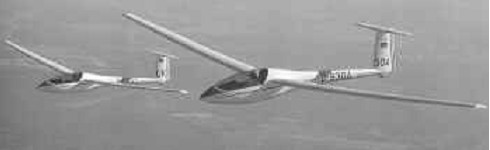
Intended to succeed the Mosquito B, the 15m span Glasfliigel 304 single-seater is a new design very similar to the Mosquito, work on which began in the autumn of 1979 by a team under Martin Hansen.
Construction is of glassfibre, with no carbon-fibre employed, although the 304/17 (now known as the Glasflugel 402), which has detachable wing tips to give a span of 17m, has largely carbon-fibre wing tips. It employs a new 16.4% thickness/chord ratio wing profile developed by Akaflieg Braunschweig and extensively tested and refined on a Mosquito. It features Glasflugel trailing edge dice brakes and interconnected variable camber flaps, a parrallogram control stick, T-tail with fixed stabilizer and elevator, and automatic connection on assembly of all flight control. The fuselage is similar to the Mosquito’s but with a more pointed nose; the monowheel is retractable. The instrument panel can be tipped up, together with the front-hinged upwards opening canopy, with which it is integral, to allow the pilot more unobstructed entry. Up to 253lb of water ballast can be carried.
The prototype, D-9304, first flew on 10 May 1980. Production of the 304 started in the spring of 1981.
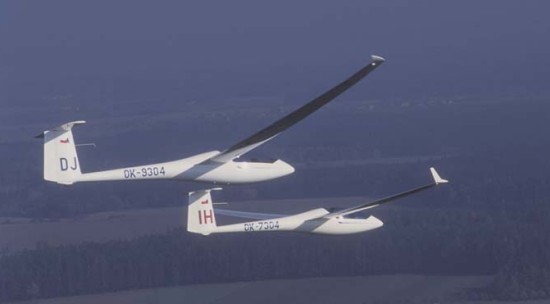
HPH Ltd. took over the original molds and drawings for glider Glasflugel 304 from Mr. George Brauchle in 1998.
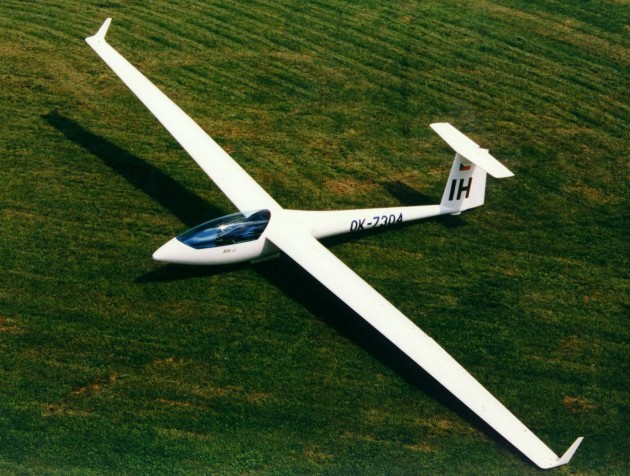
Glasflugel 304
Wing span: 15m / 49.2ft
Wing area: 9.88sq.m / 106.3sq.ft
Length: 21 ft 2in
Height: 4 ft 5.5 in
Empty Weight: 235kg / 518lb
Payload: 215kg / 298lb
Gross Weight: 450kg / 992lb
Wing Load: 45.55kg/sq.m / 9.3lb/sq.ft
Water Ballast: 115kg / 254lb
Aspect ratio: 22.78
Max speed: 156 mph (smooth air)
L/DMax: 43.1 at 116 kph / 63 kt / 72 mph
Min sinking speed: 2.26 ft/sec at 58 mph
Airfoil: HQ 10-1642
Seats: 1
No. Built: 62
Glasflugel 304 CZ
Wing span: 15m / 49.2ft
Wing area: 9.88sq.m / 106.35sq.ft
Empty Weight: 235kg / 518lb
Water Ballast: 115kg / 253.5lb
Aspect ratio: 22.78
L/DMax: 44
MinSink: 0.68m/s
Glasflugel 304C
Wing span: 15m
Wing area: 9.9sq.m
Empty Weight: 235kg
Gross Weight: 450kg
Wing Load: 45.45kg/sq.m
Water Ballast: 115kg / 253.5lb
Aspect ratio: 22.8
MinSink: 0.57 m/s @ 77 kph
402
Span: 55 ft 9.25 in
Length: 21 ft 2in
Height: 4 ft 5.5 in
Wing area: 114 sq ft
Aspect ratio: 27.3
Empty weight: 518lb
Max take-off weight: 992lb
Max speed: 156mph (smooth air)
Min sinking speed: 2.26ft/sec at 58mph
Best glide ratio: 43:1 at 72mph
Glasflugel H.201 Standard Libelle
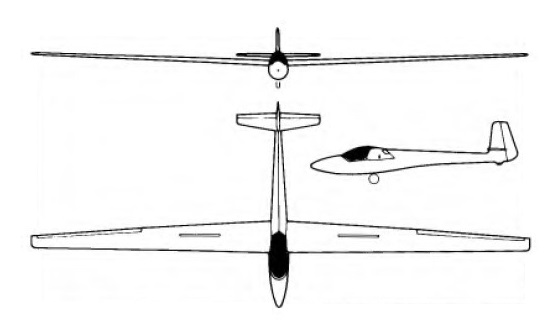
Designed by Wolfgang Hűtter and Eugen Hanle, the Standard Libelle is a version of the Open Class H 301 Libelle with modifications to meet the Standard Class requirements; these consisted of removing the flaps and tail braking parachute, fitting a fixed instead of retractable monowheel and raising the height of the canopy. A new Wortmann wing section is featured and terminal velocity dive brakes are fitted. The canopy has a catch that enables the front to be raised by 25mm in flight to provide a blast of ventilating air if required, instead of the more conventional small sliding panel. The Standard Libelle is of similar glassfibre construction to the H 301 Libelle, and likewise has provision for 110 lb of water ballast in the wing leading edge.
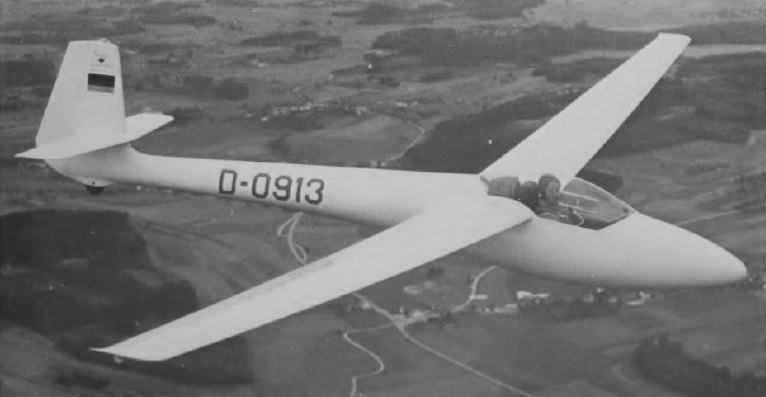
The H 201 Standard Class version prototype first flew in October 1967. It originally had a fixed landing gear; but with a change in the Standard Class rules, a retractable gear (H 201B) became standard. The B model features larger upper surface dive brakes, a larger stabilizer for better low-speed handling, PVC foam filler for the wing ( instead of balsa) to increase durability and profile accuracy, and (as an option) a water ballast system (50 kg. /100 lb.) with lighter gross weight.
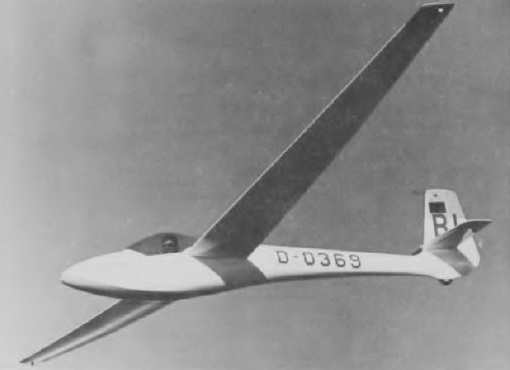
A total of 601 being built.
One flown by Per-Axel Persson of Sweden, winner of the 1948 World Championships, came second in the Standard Class at the 1968 World Championships at Leszno in Poland. In 1970 Sue Martin of Australia set a womens world Out & Return record with a flight of 656 km / 407.64.
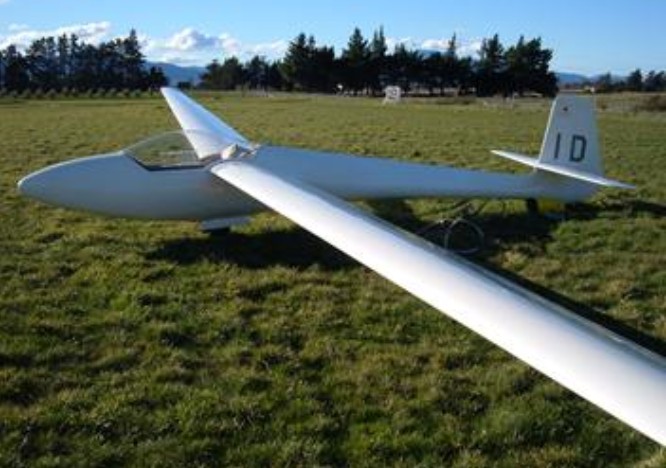
Standard Libelle H 201
Wing span: 15m / 49.2ft
Wing area: 9.85sq.m / 106sq.ft
Empty Weight: 185kg / 408lb
Payload: 164kg / 362lb
Gross Weight: 349kg / 770lb
Wing Load: 29.44kg/sq.m / 6.07lb/sq.ft
Water Ballast: 50kg / 110lb
Aspect ratio: 23
MinSink: 0.55 m/s / 1.8 fps / 1.07 kt
L/DMax: 38 85 kph / 46 kt / 53 mph
Seats: 1
Airfoil: Wortmann
Structure: fiberglass
H 201B
Span: 49 ft 2.5 in / 15.0 m
Length: 20 ft 4 in / 6.2 m
Height: 4 ft 4 in / 1.31 m
Wing area: 105.5 sq ft / 9.8 sq.m
Aspect ratio: 23.0
Wing section: Wortmann FX-66-17A-11-182
Empty weight: 408 lb / 185 kg
Max weight: 772 lb / 350 kg
Water ballast: 110 lb / 50 kg
Max wing loading: 7.31 lb/sq.ft / 35.7 kg/sq.m
Max speed (smooth air): 155 mph / 135 kt / 250 km/h
Max rough air speed: 135 kt / 250 km/h
Stalling speed: 33.5 kt / 62 km/h
Min sinking speed: 1.96 ft/sec / 0.60 m/sec at 46.5 mph / 40 kt / 75 km/h
Best glide ratio: 38:1 at 53 mph / 46 kt / 85 km/h
Glasflugel
Hofener Weg D-72582 Grabenstetten, Germany.
Glider builder
Glaser-Dirks DG-800
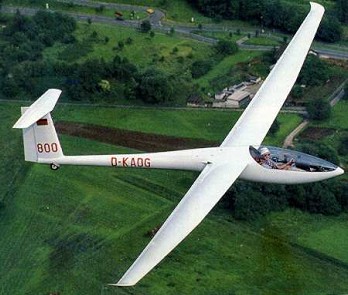
Models of the DG-800, which first flew in 1991, have been developed including the unpowered DG- 800S, the Rotax powered DG-800A and the liquid cooled buried engine configuration of the 800B substantially reduces noise emissions. Each model comes either with a one piece 18 m. wing or a 15 m wing with tip extensions increasing the span to 18 m. The engine in the DG-800 A is a 32 kW/ 43 bhp. Rotax 505A.
Later 800Bs are fitted with an Oehler Solo liquid cooled two-cycle engine with automatic fuel- injection.
DG-800 18m
Wing span: 18m / 59ft
Wing area: 11.81 sq.m / 127sq.ft
Empty Weight: 338kg / 745lb
Payload: 187kg / 412lb
Gross Weight: 525kg / 1157lb
Wing Load: 44.45 kg/sq.m / 9.11lb/sq.ft
Water Ballast: 100kg / 220lb
L/DMax: 50 110 kph / 59 kt / 68 mph
MinSink: 0.50 m/s / 1.63 fps / 0.99 kt
Seats: 1
Aspect ratio: 27.42
Airfoil: Boermans DU-89-138/14, root; DU-92-137/14 tip
Structure: CFRP/AFRP/GFRP
Engine: 37 kW/51 bhp MidWest AE 50 or 40 kW/55 bhp Oehler Solo 2625
DG-800 15m
Wing span: 15m / 49.2ft
Wing area: 10.7sq.m / 115sq.ft
Empty Weight: 224kg / 736lb.
Payload: 191kg / 421lb.
Gross Weight: 525kg / 1157lb
Wing Load: 44.45kg/sq.m / 9.11 lb/sq.ft
Water Ballast: 100kg / 220lb
L/DMax: 45 116 kph/ 63 kt/ 72 mph
MinSink: 0.59 m/s / 1.92 fps. / 1.14 kt
Seats: 1
Aspect ratio: 21.07
Airfoil: Boermans DU-89-138/14, root; DU-92-137/14 tip
Structure: CFRP/AFRP/GFRP
Engine: 37 kW/51 bhp MidWest AE 50 or 40 kW/55 bhp Oehler Solo 2625
DG-808C 15m
Wingspan: 15 m (49.2 ft)
Wing area: 10,68 sq.m (115.0 sq.ft)
Aspect ratio: 21,07
Fuselage length: 7,055 m (23.1 ft)
Fuselage height: 1,434 m (4.7 ft)
Empty weight with parting (full instruments): 334 kg (736lb)
Wing loading with 80 kg payload: 38,8 kg/sq.m (7,95 lbs/sq.ft)
Water ballast wings (option): 100 lt(26.4 US gal)
Max. Weight of the normal version: 525 kg (1156lb)
Max. Wing loading: 49,2 kg/sq.m (10.1 lbs/sq.ft)
Max. Speed vne: 270 kph (146 kt)
Stall speed with 80 kg (176 lbs) payload: 72 kph (39 kt)
Best glide ratio at max. weight: 1:45 at 116 kph (63 kt)
Min. Sink at 400 kg (881 lbs): 0,59 m/s (116 ft/min) at 80 kph (43 kt)
Engine: SOLO 2625, 39kW/53hp
Reduction gearing: 3:1
Fuel tank fuselage: 22 lt(5.8 US gal)
Fuel tank wing (Option) : 2 x 10 lt(2×2,5 US gal)
Take-off distance 15m (50 ft) obst. weight 450 kg / 992 lbs): 200m (656ft)
Climb rate (weight 450 kg / 992 lbs): 4,5 m/s (885 ft/min)
DG-808C 18m
Wingspan: 18 m (59.0 ft)
Wing area: 11,81 sq.m (127.0 sq.ft)
Aspect ratio: 27,43
Fuselage length: 7,055 m (23.1 ft)
Fuselage height: 1,434 m (4.7 ft)
Empty weight with parting (full instruments): 338 kg (745lb)
Empty weight no parting (full instruments): 335 kg (738lb)
Wing loading with 80 kg payload: 35,1 kg/sq.m (7,19 lbs/sq.ft)
Water ballast wings (option): 100 lt(26.4 US gal)
Max. Weight of the normal version: 525 kg (1156lb)
Max. Wing loading: 44,5 kg/sq.m (9,1 lbs/sq.ft)
Max. Speed vne: 270 kph (146 kt)
Stall speed with 80 kg (176 lbs) payload: 68 kph (37 kt)
Best glide ratio at max. Weight about: 1:50 at 110 kph (59 kt)
Min. Sink at 400 kg (881 lbs): 0,50 m/s (98 ft/min) at 76 kph (41 kt)
DG-808S
Wingspan: 15 m (49.2 ft)
Wing area: 10,68 sq.m (115.0 sq.ft)
Aspect ratio: 21,07
Fuselage length: 6.86 m (22.5 ft)
Fuselage height: 1.39 m (4.56 ft)
Empty weight (full instruments): 256 kg (564lb)
Wing loading with 80 kg payload: 32.4 kg/sq.m (6.62 lbs/sq.ft)
Waterballast wings: 120 lt/174 lt/239 lt (31.7 USG /46.0 USG /63.2 USG)
Waterballast in fin tank: 6 lt(1.6 USG)
Max. weight: 570 kg (1255lb)
Max. wing loading: 53.4 kg/sq.m (11 lb/sqft)
Max. speed VNE: 270 kph (146 kt)
Stall speed with 80 kg (176 lbs) payload: 66 kph (35.5 kt)
Best glide ratio at max weight: 1:45 at 116 kph (63 kt)
Min. sink at 400 kg (881 lbs): 0,55 m/s (108 fpm) at 75 kph (40 kt)
DG-808S (without winglets)
Wingspan: 18 m (59.0 ft)
Wing area: 11,81 sq.m (127.0 sq.ft)
Aspect ratio: 27,43
Fuselage length: 6.86 m (22.5 ft)
Fuselage height: 1.39 m (4.56 ft)
Empty weight (full instruments): 262 kg (578lb)
Wing loading with 80 kg payload: 29.4 kg/sq.m (6.02 lbs/sq.ft)
Waterballast wings: 120 lt/174 lt/239 lt(31.7 USG /46.0 USG /63.2 USG)
Waterballast in fin tank: 6 lt(1.6 USG)
Max. weight: 600 kg (1321lb)
Max. wing loading: 50.8 kg/sq.m (10.4 lb/sqft)
Max. speed VNE: 270 kph (146 kt)
Stall speed with 80 kg (176 lbs) payload: 63 kph (34 kt)
Best glide ratio at max weight: 1:50 at 110 kph (59 kt)
Min. sink at 400 kg (881 lbs): 0,47 m/s (92 fpm) at 72 kph (39 kt)
Glaser-Dirks DG-600
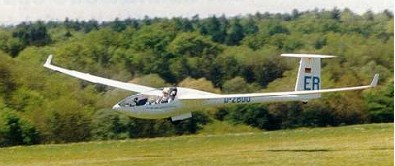
The successor to the DG-202/DG-400, the unpowered 15 m. racing class DG-600 first flew in 1987, followed by the mast mounted self- launching DG-600M in 1989.
The fuselage is based on that of the DG-400, but with a more slender tailboom. The wing has a thin section with fully span flaperons. Approach control is by the top surface double panel Schemmpp-Hirth type airbrakes. There is also a fin ballast tank which carries 7 kg / 15.4 lb of water.
The 600 came with four different wingtip configurations- conventional 15 m, 15 m with winglets, conventional 17 m. and swept back 18 m.
The DG-600/18 and DG-600/18M named Evolution have gross weight of 480 kg/ 1,058 lb and 440 kg/ 970 lb respectively. In the 600M, main ballast is reduced to 120 kg/ 265 lb.
DG-600 17M
Wing span: 17m / 55.7ft
Wing area: 11.59sq.m / 124.75sq.ft
Empty Weight: 255kg / 562lb
Payload: 270kg /595lb.
Gross Weight: 525kg / 1157lb
Wing Load: 45.3kg/sq.m / 9.27lb/sq.ft
Water Ballast: 180kg / 397lb
MinSink: 0.50 m/s / 1.64 fps / 0.97 kt
L/DMax: 46 83 kph/ 45 kt/ 52 mph
Aspect ratio: 24.9
Airfoil: HQ-37 on tips
Seats: 1
Structure: CFRP/ aramid

