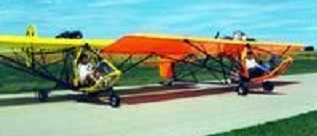
Golden Circle Air T-Bird II / Tierra

An LSA two seat kit aircraft was available as a tail dragger or with tri-gear. A highwing tube and fabric pusher, it takes about 100 hours to build with pre-sewn colored fabric. Stressed to +6 -4 G.
Price 2009: 18320 US$

Engine: Rotax 584, 65 hp
Hp range: 65-114
Length: 18 ft
Wingspan: 36 ft
Wing area: 194 sq.ft
Stall: 35 kt / 40 mph / 64 kmh
Cruise: 61 kt / 70 mph / 113 kmh
VNE: 96 kt / 110 mph / 177 kmh
Range: 160 sm
Empty Weight: 259 kg / 572 lbs
MTOW Weight: 1016 lbs
Fuel cap: 12 USG
Climb Ratio: 800 fpm
Glide Ratio: 7-1
Take-off distance (50ft obstacle): 350 ft / 107 m
Landing distance (50ft obstacle): 350 ft / 107 m
Seats: 2

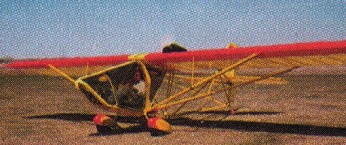
Golden Circle Air T-Bird 1

First flown in 1983, the LSA T-Bird 1 tube and fabric kit plane was available with tail dragger or tri-gear.
A highwing pusher that takes about 100 hour to build with pre-sewn colored fabric. Stressed to +6 -4 G.
In 1997 the engine lees kit was US$8992. The price in 2009 was US$12410 for the kit.
It was available in four engine sizes.

Engine: Rotax 503, 52 hp.
Speed max: 90 mph.
Cruise: 65 mph.
Range: 100 sm.
Stall: 27 mph.
ROC: 900 fpm.
Take-off dist: 70 ft.
Landing dist: 120 ft.
Service ceiling: 10,000 ft.
Fuel cap: 5 USG.
Weight empty: 272 lbs.
Gross: 572 lbs.
Height: 6 ft.
Length: 18 ft.
Wing span: 31.75 ft.
Wing area: 154 sq.ft.
Seats: 1.
Landing gear: tail wheel.
Glide Ratio: 7-1
Take-off distance (50ft obstacle): 160 ft / 49 m
Landing distance (50ft obstacle): 150 ft / 46 m

Engine: Rotax 447,28 hp
Cruise: 60 mph
Stall: 26 mph
Range: 120 sm
Rate of climb: 600 fpm
Takeoff dist: 75 ft
Landing dist: 100 ft
HP range: 28-65
Fuel capacity: 12 USG
Empty weight: 285 lb
Gross weight: 600 lb
Length: 18 ft
Wing span: 32 ft
Wing area: 154 sq.ft
Seats: 1
Cockpit width: 28 in
Landing gear: nose or tail

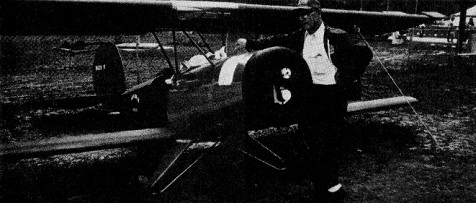
Golden Age Aircraft Waco II

Strut and wire-braced biplane, modeled after classic Waco cabin air¬craft of ‘30s. Welded 4130 steel airframe, 2.8 oz. Ceconite covered. Three-axis stick and rudder controls. Aluminum ribs and spars. LANDING GEAR: Spring-type, inflated tires, brakes, wheel pants. Available complete, ready to fly. Instruments include altimeter, compass, electric tach and clock, CHT, EGT, Hobbs meter, Terra 4-channel radio, shoulder and seat belts.

Engine: ROTAX 36 hp.
Wing area 161 sq.ft.
Empty weight, 238 lbs.
Vne 80 mph.
Takeoff roIl 160ft.
Climb rate 550 fpm.
Stall speed power off 23 mph.
Top speed (controlled by prop) 63 mph.

GM V90

Cycle: 4 stroke
No cylinders: Vee 2
Bore: 97 mm
Stroke: 76 mm
Compression: 8.5
Displacement: 1122 cc
Cooling: air / oil
Ignition: electronic
Reduction: Poly-V belt 2.3/1
Weight: 57 kg
Max pwr: 70 hp at 5800 rpm
Max torque: 131 Nm at 4200 rpm
Price 1998: 89 000 000 L

Gluhareff EMG-300

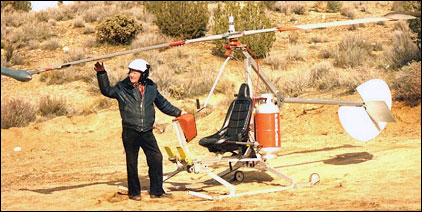
Mr. Gluhareff pioneered the use of liquid propane as a fuel for jet engines and a series of ultra-light portable one-man-helicopters, MEG-1X, MEG-2X and MEG-3X which were designed and built by his own company, Gluhareff Helicopters Corporation. All of which were powered by the G8-2 Pressure Jet Engine on the blade tip and test flown by Eugene M. Gluhareff.
In 1972 Mr. Gluhareff returned to research and design under his own company name of EMG Engineering in Gardena, California. There he continued his work on the G8-2 Pressure Jet Engines which ranged from five pounds of thrust to 700 pounds of thrust.
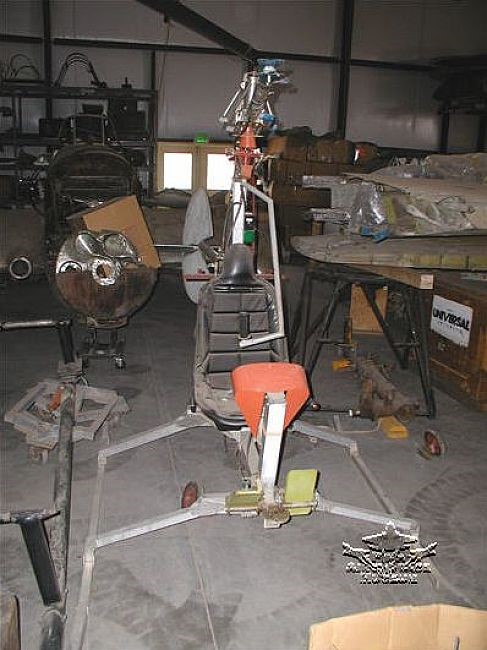
Mr. Gluhareff designed, built and tested his own one-man tip jet helicopter, the EMG-300 in the early 90’s. Its successful test flight marked the realization of Mr. Gluhareff’s lifelong dream to design what he called a “Flying Motorcycle”.
The EMG-300 was his last design before his death in 1994, it had completed an initial series of test flights, but was not completely tested at the time of his death.

EMG-300
Engine: 2 x G8-2-20H jet engines 10kg of thrust each
Fuel: liquid propane
Fuel capacity: 70 litres
Rotor diameter: 7.3m
Fuselage length: 4.57m
Height: 2.1m
Empty weight: 109kg
Take-off weight: 208kg
Maximum speed without canopy (est.): 112km/h
Maximum speed with canopy (est.): 193km/h
Range: 280km
Endurance: 2.5hr

Gluhareff

Eugene M. Gluhareff was born in St. Petersburg, Russia in 1916 immigrating to the United States with his family via Finland in the early 1920’s.
An Aeronautical Engineer graduate of Rensselaer Polytechnic Institute in Troy, New York, he is a jet engine and helicopter designer and inventor. His extensive experience was acquired over many years of association with leading companies in the fields of design, research and development.
He has been a part of helicopter development since its beginning in 1940 with Sikorsky Aircraft Corporation in Bridgeport, Connecticut as a primary design engineer and project engineer. He worked directly under Mr. Igor I. Sikorsky and Mr. Igor A. Sikorsky, Chief of Aerodynamics. It was there he invented and developed the Pulse Jet Engine, a one-man single bladed jet helicopter which he test flew himself and also a Delta Wing Convertiplane for the United States Airforce.
In 1950 he moved to California and joined the American Helicopter Company in Manhattan Beach as a project engineer on a pulse jet powered helicopter (Top Sergeant). He was promoted to Chief of Preliminary Design and there designed the XH-26 One-Man-Jet Helicopter for the U.S.A.F.. Following this term with American Helicopter, he worked with Rotorcraft Corporation in Glendale, California as Design Engineer and was engaged in the redesign of a rocket powered one-man-helicopter for the U.S. Navy.
Eugene Gluhareff established a development company in 1952 to carry out research into pressure-jet powered light helicopters.
It was during this time that Mr. Gluhareff pioneered the use of liquid propane as a fuel for jet engines and a series of ultra-light portable one-man-helicopters, MEG-1X, MEG-2X and MEG-3X which were designed and built by his own company, Gluhareff Helicopters Corporation. All of which were powered by the G8-2 Pressure Jet Engine on the blade tip and test flown by himself.
In the early sixties, he was employed by the U.S. Navy at the Naval Ordinance Test Station in China Lake, California as an Aerospace Engineer FS-14 and Project Engineer on Rotary Drones. In 1964 he joined the Douglas Aricraft Company, Missile and Space Division as Design Engineer Scientist on the S-4 stage of the Saturn Rocket used on NASA’s Apollo Project. During this time he participated in the launching of four Saturns. Later he worked at McDonnel Douglas Aircraft in Long Beach, California as a Senior Design Engineer in Advanced System for Special Projects researching and testing rocket engines. There he became a specialist in the design of rocket stabilization systems for ejection seats and capsules.
In 1972 Mr. Gluhareff returned to research and design under his own company name of EMG Engineering in Gardena, California. There he continued his work on the G8-2 Pressure Jet Engines which ranged from five pounds of thrust to 700 pounds of thrust. To further promote the study of aerodynamics and jet propulsion, Mr. Gluhareff designed and placed in universities throughout the country the Gluhareff GTS-15 Teaching Stand. He also had the G8-2 Pressure Jet Engine displayed as a working exhibit in the California Museum of Science and Industry in Los Angeles. The G8-2 Jet Engine had the honor of gracing the cover of Mechanics Illustrated in May of 1973 and again in January 1975 in the Jet Powered Go-Kart.
Mr. Gluhareff designed, built and tested his own one-man tip jet helicopter, the EMG-300 in the early 90’s. Its successful test flight marked the realization of Mr. Gluhareff’s lifelong dream to design what he called a “Flying Motorcycle”. He had several patents issued and applied for, for his inventions. Some of which are the G8-2 Jet, Valveless Pulse Jet, Portable and One-Man Helicopters, Flying Platform, Rotorcar, Convertiplane, Rocket Stabilization Unit and others.