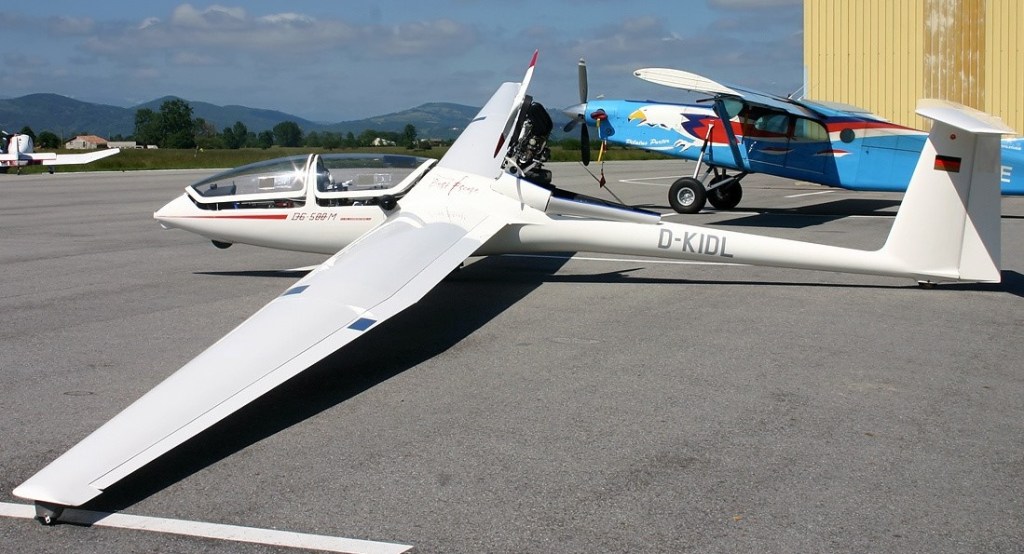
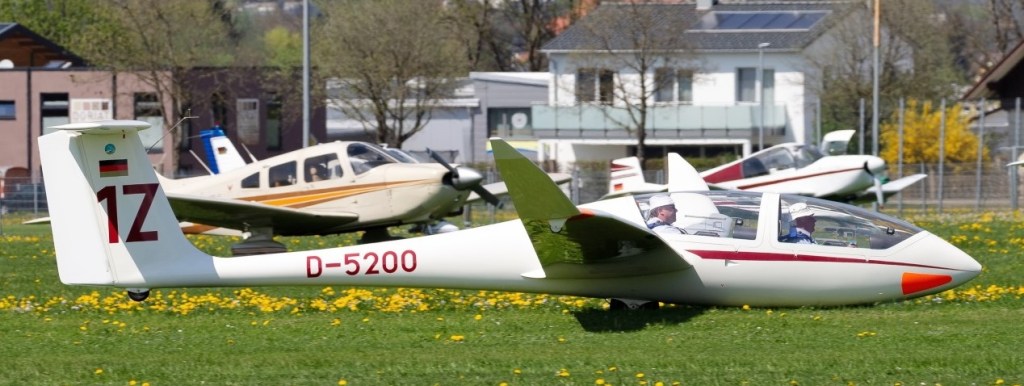
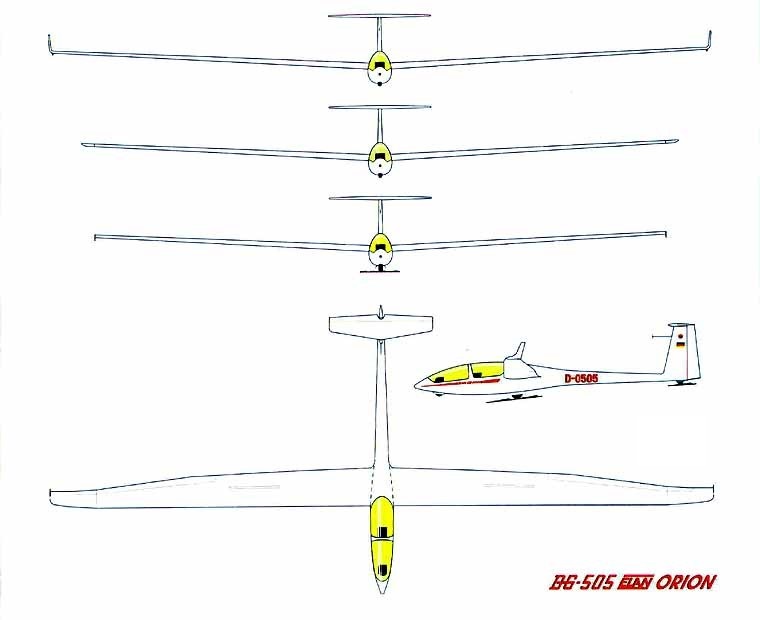
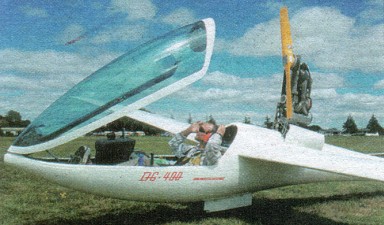
The DG-505 Elan Orion is a two seat glider for training, high performance flying and aerobatics. It can perform basic training, fly a speed triangle with 20 m span, 160 liters of water ballast and a glide ratio of 44 and train aerobatics with 17.2 m span. The designation DG-505 marks the development of the DG-500 and features various major improvements, in particular the cockpit space was increased to enable pilots up to 2 m to fly from either seat.
18 m wing tips for flying characteristics equal to the DG-505 Elan Trainer are available as an option. Operators who own already a DG-505 Elan Trainer can use the Orion with 18 m span without different flying characteristics.
With the standard wing tip extensions the wingspan can be increased to 20 m for high performance and competition flying.
The winglets at the 20 m tips make possible almost as good a performance as with 22 m wingspan (comparison flights with a 22 m DG-505 showed that at same wing loading there is only a performance decrease of 3 % although the wingspan is reduced by 10%). In addition the winglets which are permanently installed to the wing tip extensions improve the excellent handling qualities. The sweep back of the wing tip extensions provides further improvement of low speed performance and handling, both important benefits for thermalling.
Variation: Windward Performance Perlan I
Wingspan: 18.0 m./ 59.1 ft Wing area: 16.6 sq. m. / 178.6 sq.ft Aspect ratio 19.52 Airfoil Wortmann FX-73-K-170/20 root; -170/22 tip. Water ballast 160 kg / 353 lb Structure CFRP/GFRP. Crew: ½
DG Flugzeugbau DG505 Elan Orion Wingspan: 20 m Max T/O weight: 750 kg Glide ratio: 44 Cruise speed: 110 km/h Max speed: 270 km/h Crew: 2
Wingspan: 22.00 m./ 72.2 ft Wing area: 8.29 sq.m./ 196.8 sq.ft Aspect ratio 19.52 Airfoil Wortmann FX-73-K-170/20 root; -170/22 tip. Aspect Ratio: 26.5 Length: 8.66m Height: 1.66m Empty Weight: 550Kg Gross Weight: 825Kg Water ballast 160 kg / 353 lb Min Sink: 0.58m/s Glide Ratio: 44 Stall speed: 80Km/h VNE: 270Km/h G: 5.3/-2.65 Structure CFRP/GFRP. Crew: ½
The DG-500 comes in a number of sizes which all share the same basic fuselage. The 500T Elan Trainer, which first flew in 1989 has an unflapped 18 m. wing without provision for water ballast; retractable gear is an option. The front cockpit design has been purposely made similar to that of the DG-300 Club. The higher performance versions (DG-500-22 Elan and DG-500 M) have a 22 m flapped wing and are, respectively, unpowered and self-launch models. The powered model (DG- 500M) has been liquid cooled Rotax powerplant on an electrically retracting pylon, digital engine instrumentation (DEI) and water ballast reduced to 100 kg 220 lb, and comes with an optional steerable nosewheel. The DEI, which has instrumentation in both cockpits, shows rpm, temperatures, pressures and fuel quantity as well as controlling the amount of fuel injected by the electronic fuel system. Engine retraction is automatic once the propeller has been stopped and centred. All 22m ships, which have a four piece wing, have retractable gear as standard. Performance of the 500M is similar to the 500/22 Elan, but empty and gross weights are 565 kg/ 1,246 lb and 825/1,819 lb respectively. All developed with 3 different sets of wingtips; 17.2 m for aerobatics, 18 m and (with winglets) 20 m. A flapped unpowered development of the DG-500/22 Elan. Known as the DG-500/20 Elan Winglets, has been designed for the German 20 m two-place contest class. This has the 750 kg/ 1,653 lb gross weight of the DG-500/22, and a wing loading of 45.0 kg/sq.m./ 9.22 lb/sq. ft. Manufacture of the DG-500 is partly by Elan in Slovenia.
The DG400 is a single-seater motor glider version of the DG202, with a dorsally-mounted 43hp Rotax engine driving a tractor airscrew and electrically retractable backwards into the fuselage.
Fuel capacity is 4.5 Imp gallons, with optional extra fuel tanks in each wing. Detachable wing tips can be fitted to the DG400/15 to increase the span to 17m for Open Class competition, in which form it becomes the DG400/17. Without the tip extensions, the 15 m version carries 20 kg / 43 lb more payload, but with higher sink rate (0.60 m/s / 1.97 fps / 1.17 kt ) and lower L/D (41).
The DG400 prototype first flew in May 1981 in the hands of Walter Binder, and first production deliveries were planned for December 1981.
B. Brunzil of Switzerland raised the world 500 km speed triangle record to 170.06 kph/ 91.8 kt/ 105,7 mph flying a DG-400.
DG-400/15 Span: 49 ft 2.5 in Length: 23 ft 0 in Empty weight: 595 lb Max take-off weight: 1,058 lb Sink rate: 0.60 m/s / 1.97 fps / 1.17 kt L/D: 41
DG-400/17 Span: 55 ft 9 in Length: 23 ft 0 in Empty weight: 610 lb Max take-off weight: 992 lb
Gerhard Glaser, owner of a civil engineering business, and Diplom Ingenieur Wilhelm Dirks, founded the Glaser-Dirks Flugzeugbau GmbH company. In 1972, they built their first glider, the DG-100. Glaser-Dirks produced 105 DG-100 and another 222 units have been produced later at the Elan factory. In 1977 the 15-meter class sailplane DG-200 entered the market. In 1978 the DG-200 was updated with 17-meter wingtip extensions. The DG-200/17 is one of the most sought-after gliders on the secondhand market. By 1980 Glaser-Dirks pushed into carbon fiber construction with the DG-200/17C motorglider. The DG-400 followed the next year and quickly became one of the best-selling motorgliders of all time. In 1983, version DG-300 Club Elan was designed to replace the DG-100 in the production line, and the fully aerobatic version DG-300 Elan Acro contributed to its popularity. The DG-300 is still in production; up until today 484 DG-300s have been delivered. In 1987 the two-seat DG-500 made its first flight, and the motorized DG-500M followed only 4 weeks later. Next came the 15m class sailplane DG-600. In 1989 a motorized self-launching version, the DG-600M followed. The latest product family is the DG-800, which was optimized for 18m span with wing flaps and equipped with modern wing sections designed by L.M. Boermans from the TU Delft. In May 1993, the self-launching version DG-800A and the pure sailplane DG-800S made their maiden flights. In 2003 Glaser-Dirks Flugzeubau changed their name to DG Flugzeubau GmbH. March 96 brought news of the company’s crash. Wolff and Glaser sold the remaining company capital, in a completely empty and deserted production hall. Gerhard Wolff joined the company as a partner. Rolladen-Schneider has had to go into receivership, and DG Flugzeugbau did not take over the liabilities in 2003, but only the rights to build the gliders and use the brand name. The Wolfgang Dallach Company collapsed and on 1 August 2008 DG Aircraft GmbH took over support of the Dallach “Fascination”, “Evolution”, “Sunwheel” and all derivatives. Wolfgang Dallach was working for DG Aircraft as a freelancer since 2006.
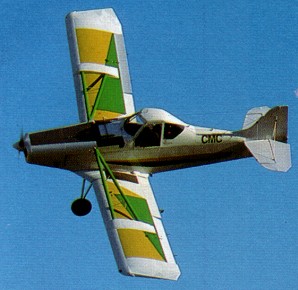
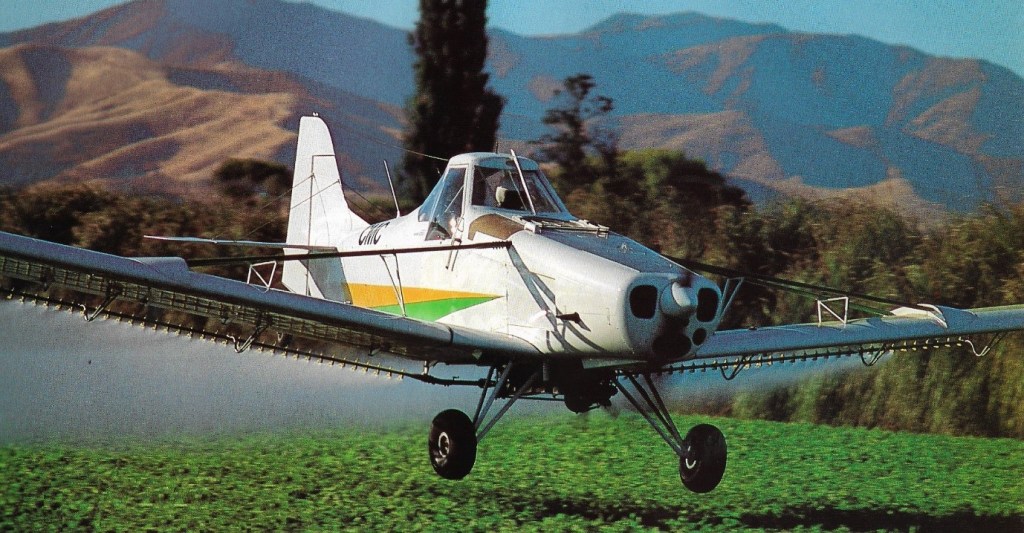
The Fatman was developed to improve on the PA-25 Pawnee by Peter Furlong and George Morgan. Gippsland Aeronautics began to rework the original Piper concept in 1983 and today only three components have commonality with the old familiar design interchangeable lift struts, undercar¬riage legs and engine mounts. Originally flying on a Pawnee Supplementary Type Certificate, after some fifteen interim prototypes the GA-200 achieved a type certificate of its own. Built and tested to FAR 23 specs, the 260 hp Lycoming 0 540 powered GA¬200 can haul a genuine 1500 cwt off and onto some confined spaces.
The GA¬200 featured a kevlar 180 litre fuselage fuel tank, however the company was offering an inboard (223 litre) wing fuel system as well as a further option with both fuselage and wing tanks, providing a six and a half hour endurance. No parts of the fuel system are installed forward of the firewall with the exception of the carburetor.
GA-200
All metal wings house fuel tanks with fuel gauges mounted in the wings. Normal tank venting is outboard on the wings. The leading edge of each wing is made of five nonstructural sections. Both wings have airscoops that pressurise both wings and fuselage to keep fertiliser dust out and eliminate the possibility of spray contamination. The bottom rudder slants up so – in the event that a tailspring breaks – the rudder will not sustain damage. The undercarriage is not the same as a Pawnee, having been beefed up using Fletcher mainwheels and the safety straps are now top mounted. The top leg attachment bolts are easily accessible from the outside of the airframe. The fuselage is of welded 4130 chrome moly steel tube – the high wear and tear area where the hopper outlet is fitted being of stainless steel. The hopper outlet is unique – the same base is used for both spray or solids, and doesn’t detract from aircraft performance or dump capability. The header tank features its own sight glass right in front of the pilot and holds enough fuel for about 15 minutes.
Fitted with two seats, the GA 200 has a superficial resemblance to its older brother but is in fact both shorter and wider. Engineered out of the design are the cooling problems common to the Pawnee and the 1930s vintage rag wing aerofoil. The fabric covered steel tube fuselage and all metal winged aircraft is fitted with an 800 litre hopper and has been designed and built to be extremely “fieldworthy”.
Federal Aviation Administration Type Acceptance Certificate No.98/14 was granted to the GA200C in the Restricted Category on 9 September 1998 at the original maximum take-off weight of 1315 kg. Type acceptance at the increased MCTOW of 1524 kg was granted on 17 February 1999, based on validation of CASA Certificate of Type Approval number 83-6.
GA-200 ZK-CMC pilot Ray Patchett
The GA200C is a development of the original GA200 at the instigation of the NZ agent. It has a larger volumetric capacity hopper (1050 litres), and associated with that a revised fuselage structure and a fuel injected 300 hp engine with constant speed propeller. The GA200C incorporates the Option 1 extended wing tips as standard and has a modified fuel system with gravity fed sump tank. Initially certification was achieved at the same weights as for the GA200 and at the same 250 hp in the standard category. Gippsland subsequently certificated the GA200C at a higher weight and with a slight increase in structural speeds. (To provide for the possible installation of an IO-580 engine.) The changed airworthiness limitations were originally going to be applied to a proposed GA200C-1 model, but that designation has now been dropped.
The GA200C Type Certificate Holder since Revision 9 dated 08.08.2006: GA200 Pty Ltd.
The last production example of the GA200 Series was serial number 200C-0345.
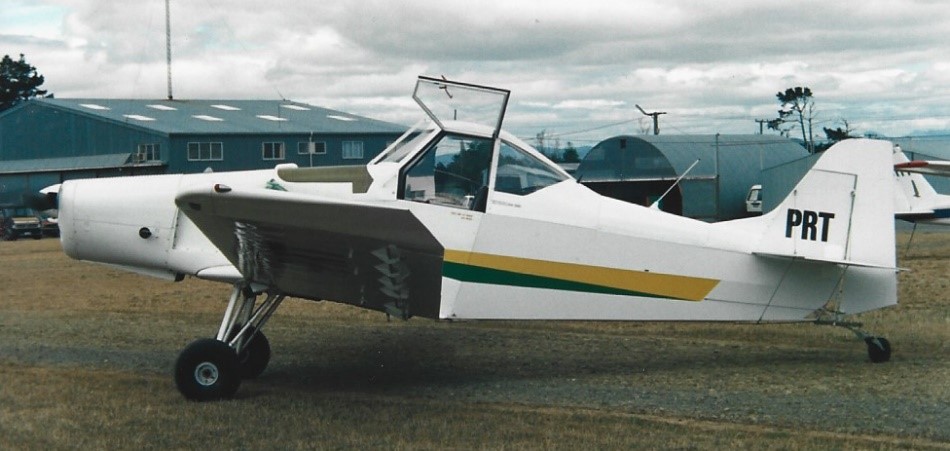
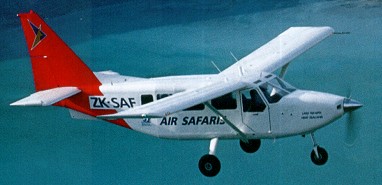
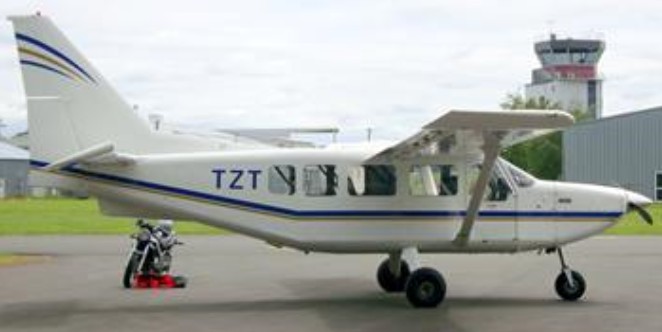
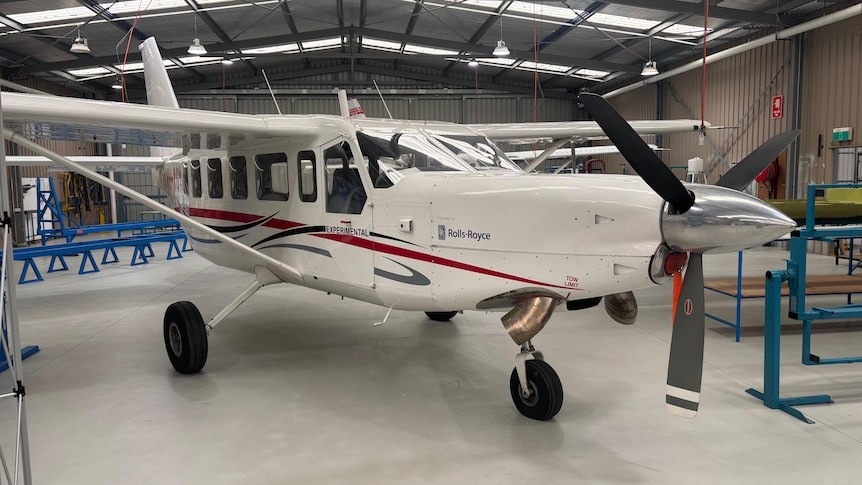
Designed by Peter Furlong to be between the Cessna Caravan and 206. Design work had begun in earnest in early 1994, with the first aircraft (VH-GAV and later re-registered as VH-PTR), powered by a 250 hp Textron Lycoming 0-540, making its maiden flight on 3 March 1995. On 7 February 1996, this air¬craft was destroyed during spinning trials. A second airframe was completed to a major component stage for static testing and a third, VH-ZGI, became the second flying prototype. The second prototype was first flown in August 1996 with a 300-hp Textron Lycoming IO-540K-lAS engine. Flight testing was completed by No-vember 1998 after a total of 350 hours had been collectively flown by the two aircraft. The basic simplicity of the aircraft’s non-turbo engine, automatic fuel management system, manual flaps, no cowl flaps, large cabin area with centre aisle, and useful centre of gravity range serve a utility role. It is of a strut braced high wing design, using the same wing as the GA 200, with a fixed undercarriage. It is of an all metal stressed skin construction which is fully corrosion protected. Up to eight passengers can be carried with entry gained by a large sliding door on the port side. The cabin floor has a quick release mechanism to permit rapid conversion between passenger and cargo roles or combi configuration.
The second prototype was re-registered VH-XGA in January 1999 and provisional type certification was achieved in early 1999, followed by full certification on 10 October 2000. The first production Airvan (004) was assembled in November 2000 and delivered to Air Fraser Island in Australia on 22 December 2000 as VH-RYT. The first export aircraft was 008, which was delivered to Maya Island Air in Belize, Central America, in late 2001 as V3-HGJ. Planned is a 2.4-metre-long, 18 cu.ft underbelly cargo pod that can carry 400 lbs (180 kg). The pod is able to be retrofitted.
In July 2005 the Airvan was awarded EASA European certification. Gippsland had delivered about 80 Airvans by the end of July including the last of 16 for the US Civil Air Patrol.
In August 2006 the 100th GA8 was handed over to Missionary Aviation Fellowship. Several engine variants were under evaluation. These include a 320-hp version of the Lycoming IO-580, a turbo-charged Lycoming TIO-540, a diesel version powered by the Thielert TAE 135 turbo diesel or the French SMA engine, and a turbine example powered by the Rolls-Royce Allison 250 BT7F. The consideration of a turbine-powered Airvan has meant a study into a stretched 10-seat turbine version, aimed at paramilitary and special mission applications. The Australian Civil Aviation Safety Authority (CASA) certified the GA8 Airvan for IFR flight. Certification work was also undertaken on an under belly cargo pod for the aircraft. The 18 cu ft pod will allow a total increase in weight lift of 180 kg and accommodate items up to 2.4 metres in length.
Mahindra agreed to pay about $40 million for a controlling stake in two small Australian aviation companies, Gippsland Aeronautics and Melbourne-based component maker Aerostaff Australia.
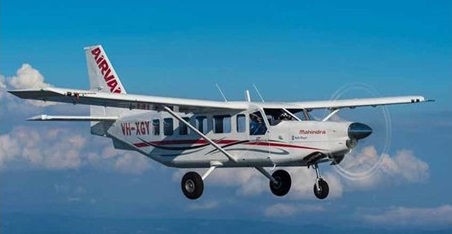
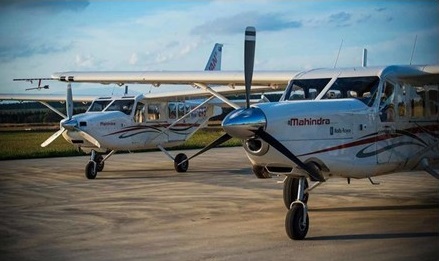
Mahindra Airvan 10
Developed by Mahindra Aerospace, the Airvan 10 10-seat single-engine turboprop received U.S. and Australian certification in 2017. With a price of around $1.7 million, it is targeted as a competitor to pricier turboprops, namely the Cessna Caravan and Quest Kodiak.
The Airvan 10 was planned to cost around $1.7 million and provide competition for turboprops like the Cessna Caravan and Quest Kodiak. The market introduction for the new turboprop was being supported by GippsAero, a Mahindra subsidiary in Australia and the original designer of the airplane.
GA-8 Airvan & Airvan 10
The Rolls-Royce M250-powered model, with a useful load of 2,300 pounds (1,400-pound full-fuel payload) and cruise speed of 145 ktas, is a follow-on to the piston-powered eight-seat Airvan 8, which Mahindra’s aircraft business unit in Australia produces. Certified in more than 42 countries, over 220 Airvan 8s were in service.
By 2025 more than 260 of the Airvans operating in 43 countries around the world.
The company employed up to 180 local people to send one GA8 Airvan out the factory door every two weeks in 2025.
Gippsland Aeronautics was established by George Morgan and Peter Furlong in Gippsland, Australia, in 1984.
Approved manufacture and maintenance facility established in 1971. Also developed and offers piston-engined GA-200 Fatman single/two-seat agricultural aircraft with an 800-liter hopper (first flown March 1991) and the AGTrainer as dual-control training model, plus latest GA-8 Airvan piston-engined 8/9-seat general-purpose utility monoplane suited to operations from unprepared and short airstrips (first flown March 1995). Latrobe Valley, Australia. The name changed to GippsAero Pty Ltd as of 6 May 2010.
Mr Mahindra, vice-chairman and managing director of the $7 billion conglomerate that bears his family’s name, aspired to turn the group’s aerospace arm into an Indian version of the Brazilian Embraer. The Mahindra brand is better known for its tractors and utility vehicles, and building a regional jet is a complex and time consuming business that usually starts with the production of much smaller turbo prop aircraft. To speed up the process Mahindra agreed to pay about $40 million for a controlling stake in two small Australian aviation companies, Gippsland Aeronautics and Melbourne-based component maker Aerostaff Australia.
Gippsland Aeronautics, based in Victoria’s Latrobe Valley and maker of the popular 8-seat GA8 Skyvan utility plane, planed to beef up its range with an updated 18-seat version of the controversial Australian-made Nomad twin turbo-prop. It bought the rights to the Nomad’s type certification in 2008.
The company was bought back by the founding family in 2023.
The company employed up to 180 local people to send one GA8 Airvan out the factory door every two weeks in 2025.
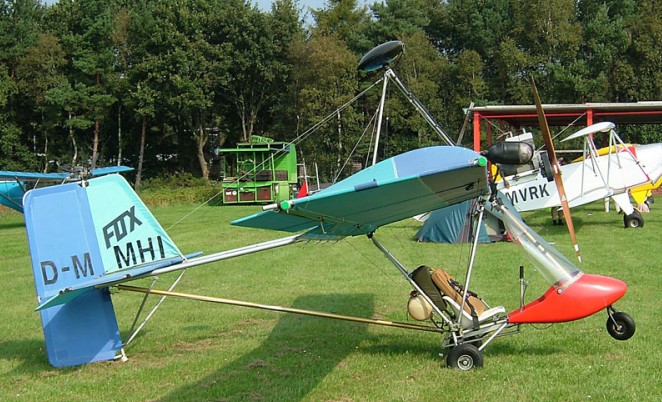
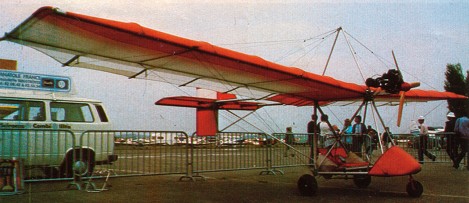
The Fox was designed by Hans Gigax in Switzerland in 1982. Single seat single engined high wing mono-plane with conventional three axis control. Wing has unswept leading edge, swept for¬ward trailing edge and tapering chord; cruci¬form tail. Pitch control by elevator on tail; yaw control by fin¬-mounted rudder; roll control by half span ailerons; control inputs through stick for pitch/roll and pedals for yaw. Wing braced from above by kingpost and cables, from below by cables; wing profile double surface. Undercarriage has three wheels in tricycle formation; suspension on all wheels. Push right go right nose-wheel steering connected to yaw control. Hand actuated brake on nosewheel. Aluminium tube framework, with pod. Engine mounted at wing height driving tractor propeller. The Fox single seater made its first flight in December 1982 and underwent a programme of test flights with the intention of obtaining certification in West Germany. It was only a prototype. Rigging and derigging take 20 minutes and when folded it is transportable on a roof rack. The noise measured on the ground with the machine flying at 492ft (150m) with the motor at maximum power is 58dB; West German regulations stipulate 60 dB maximum.
Ikarus C-22 Fox
Evektor-Aerotechnik also is marketing the braced high-wing two-seat Fox (a variant of the German Ikarusflug Eurofox, with Evektor of the Czech Republic having undertaken important design work, and Aeropro of Slovakia building airframes for Fox and Eurofox).
The single-seater Comco-Ikarus Fox D is a first generation micro-light aircraft. The single-seat Sherpa I was the first motorised Ikarus micro-light aircraft and entered serial production in 1982. In 1983, the single-seater Sherpa I was replaced in production by the Fox D, an open single-seater constructed out of aluminium tube covered with sailcloth. The nose of the plane is made out of glassfibre composite as used by the 2-seater Sherpa II. The prop of the Fox D is driven by a Göbler-Hirth F263 engine.
Length overall 15.6 ft, 4.75 m. Height overall 8.7ft, 2.65m. Wing span 33.1ft, 10.10m. Chord at root 4.8ft, 1.45 m. Chord at tip 4.5ft, 1.36m. Dihedral 3deg. Sweepback 0deg. Tailplane span 10.1ft, 3.08m. Fin height 5.5 ft, 1.69 m. Total wing area 142 sq.ft, 13.2 sq.m. Total aileron area 12.7 sq.ft, 1.18 sq.m. Fin area 5.1 sq.ft, 0.47 sq.m. Rudder area 5.5 sq.ft, 0.51 sq.m. Tailplane area 18.2 sq.ft, 1.69 sq.m. Total elevator area 10.5 sq.ft, 0.98 sq.m. Wing aspect ratio 7.7/1. Wheel track 5.1 ft, 1.54 m. Wheelbase 4.7 ft, 1.40 m. Nosewheel diameter overall 12 inch, 30 cm. Main wheels diameter overall 12 inch, 30 cm. Engine: Hirth 383 cc, 22 hp at 4200 rpm. Propeller diameter and pitch 55 x 28 inch, 1.40 x 0.70 m. Belt reduction, ratio 1.5/1. Max static thrust 166 lb, 75 kg. Power per unit area 0. 15 hp/sq.ft, 1.7hp/sq.m. Fuel capacity 2.6 US gal, 2.2 Imp gal, 10.0 litre in main tank; 2.6 US gal, 2.2 Imp gal, 10.0 litre in res. Empty weight 190 lb, 86 kg. Max take off weight 442 lb, 200 kg. Payload 252 lb, 114 kg. Max wing loading 3.11 lb/sq.ft, 15.2kg/sq.m. Max power loading 20.1 lb/hp, 9.1kg/hp. Load factors; +6.0, 3.0 ultimate. Max level speed 53 mph, 85 kph. Never exceed speed 81 mph, 130 kph. Max cruising speed 47 mph, 75 kph. Economic cruising speed 31 mph, 50 kph. Stalling speed 24 mph, 40 kph. Max climb rate at sea level 400ft/min, 2.0m/s. Take off distance 82ft, 25m. Landing distance 33ft, 10m. Range at average cruising speed 171 mile, 275 km.
Comco Ikarus C-22 Fox Stall: 23 kt / 27 mph / 43 kmh Cruise: 49 kt / 56 mph / 90 kmh VNE: 65 kt / 75 mph / 120 kmh Empty Weight: 204 kg / 450 lbs MTOW Weight: 390 kg / 860 lbs Climb Ratio: 700 ft/min / 4 m/s Take-off distance (50ft obstacle): 660 ft / 200 m Landing distance (50ft obstacle): 660 ft / 200 m
Ikarus Comco Ikarus C 22 Empty weight: 185 kg Wing span: 10.4 m Wing area: 15.2 sq.m Fuel capacity: 40 lt Engine: Rotax 582, 64 hp MAUW: 400 kg Seats: 2 Max speed: 145 kph Cruise speed: 130 kph Minimum speed: 55 kph Climb rate: 5 m/s Fuel consumption: 14 lt/hr Price (1998): 33 000 DM
Ikarus Comco Ikarus C 22 Empty weight: 185 kg Wing span: 10.4 m Wing area: 15.2 sq.m Fuel capacity: 40 lt Engine: Rotax 582, 64 hp MAUW: 400 kg Seats: 2 Max speed: 145 kph Cruise speed: 130 kph Minimum speed: 55 kph Climb rate: 5 m/s Fuel consumption: 14 lt/hr Price (1998): 33 000 DM
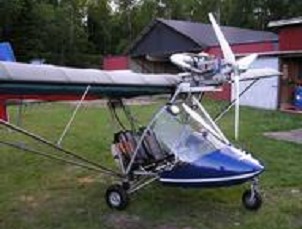
Hans Gigax developed his Sherpa using experience acquired with the earlier Microstar, the two machines sharing a similar configuration and technology. The Sherpa made its first flight as a single seater in May 1982 and the two seater took to the air in July of the same year. Since then both have been put into production by the West German Ikarus company, under which heading we give greater detail. Briefly, however, the Sherpas are provided with a cage where the tubes form a double triangular structure ensuting excellent rigidity whilst offering considerable passive security. The aircraft also exhibits the peculiarity of having been designed from the start to be usable either as a single seater, with the seat fitted in the central position, or as a two seater, its frame being large enough to be fitted either with a double bench seat or two separate seats, the pro¬totype being equipped with a central stick. Single seat single engined high wing mono¬plane with conventional three axis control. Wing has unswept leading and trailing edges, and constant chord; cruciform tail. Pitch control by elevator on tall; yaw control by fin mounted rudder; roll control by one third ¬span ailerons; control inputs through stick for pitch/roll and pedals for yaw. Wing braced from above by kingpost and cables, from below by cables; wing profile double ¬surface. Undercarriage has three wheels in tricycle formation with additional tailskid; rubber suspension on nosewheel and suspension on main wheels. Push right go-¬right nosewheel steering connected to yaw control. Optional brake on nosewheel. Alumi¬nium tube framework, without pod. Engine mounted at wing height driving tractor prop¬eller. A manufacturer of hang¬-gliders for many years, Ikarus has just acquired the licence to produce and sell the Sherpa designed by the Swiss Hans Gigax. The first Sherpa single seater flew for the first time in May 1982 and Hans made the first flight with the Sherpa two-¬seater on the way to the amateur constructors convention at Brienne le Chateau in France at the end of July 1982. The prototype used a Konig SD570 four¬ cylinder engine of 570cc, but this was aban¬doned on the commercial versions. Instead, Ikarus chose to fit its single seater, the Sherpa I, with a twin cylinder Hirth 263R 383cc engine developing 22hp. By February 1983, Ikarus had already delivered eleven machines and in March at the Friedrichshafen show the firm announced orders for 200 machines. The Sherpa I options include electric starter (with alterna¬tor and battery) and a package allowing the single seater to be transformed into a two ¬seater. This package contains a second seat fitted with belts, dual controls, and the Hirth 438cc engine and costs an extra DM2150. Though very similar to the Sherpa I, the Sherpa II differs by the addition of a second seat, dual controls (on production models), structural reinforcements and a more powerful engine. Otherwise few changes are needed, as the Sherpa was designed from the outset to be a two seater. The Sherpa II can be turned back into a single seater in a few minutes and uses the Hirth 438cc engine developing 42hp. Following three pre production models built during the first quarter of 1983, produc¬tion started. A pod and instrument panel are optional.
Sherpa I Length overall 16.2 ft, 4.95 m. Height overall 9.3ft, 2.82m. Wing span 34.4ft, 10.50m. Constant chord 5.2 ft, 1.60 m. Sweepback 0deg. Tailplane span 9.8 ft, 3.00 m. Total wing area 169 sq.ft, 15.7 sq.m. Wing aspect ratio 7.0/1. Wheel track 5.9 ft, 1.80 m. Wheelbase 4.3 ft, 1.30 m. Engine: Hirth 263R, 22hp at 4200rpm. Propeller diameter 55 inch, 1.40 m. Toothed belt reduction, ratio 1.8/1. Max static thrust 143 lb, 65 kg. Power per unit area 0.13hp/sq.ft, 1.4hp/sq.m. Fuel capacity 3.4 US gal, 2.8 Imp gal, 13.0 litre in main tank; 3.4 US gal, 2.8 Imp gal, 13.0 litre in res. Empty weight 221 lb, 100 kg. Max take off weight 475 lb, 215kg. Payload 254 lb, 115kg. Max wing loading 2.81 lb/sq.ft, 13.7kg/sq.m. Max power loading 21.6 lb/hp, 9.8kg/hp. Load factors; +6.0, 3.0 ultimate. Max level speed 56 mph, 90 kph. Never exceed speed 68 mph, 110 kph. Max cruising speed 50 mph, 80 kph. Economic cruising speed 37 mph, 60 kph. Stalling speed 24 mph, 40 kph. Max climb rate at sea level 300 ft/min, 1.5 m/s. Min sink rate 400 ft/min at 31 mph, 2.0 m/s at 50 kph. Best glide ratio with power off 7/1. Take off distance 200ft, 60m. Landing dis¬tance 130 ft, 40 m. Range at average cruising speed 93 mile, 150km.
Sherpa II Engine: Hirth 263R, 22hp at 4200rpm. Propeller diameter 55 inch, 1.40 m. Toothed belt reduction, ratio 1.8/1. Max static thrust 143 lb, 65 kg. Power per unit area 0.13hp/sq.ft, 1.4hp/sq.m. Length overall 16.2 ft, 4.95 m. Height overall 9.3ft, 2.82m. Wing span 34.4ft, 10.50m. Constant chord 5.2 ft, 1.60 m. Sweepback 0deg. Tailplane span 9.8 ft, 3.00 m. Total wing area 169 sq.ft, 15.7 sq.m. Wing aspect ratio 7.0/1. Wheel track 5.9 ft, 1.80 m. Wheelbase 4.3 ft, 1.30 m. Fuel capacity 3.4 US gal, 2.8 Imp gal, 13.0 litre in main tank; 3.4 US gal, 2.8 Imp gal, 13.0 litre in res.
Engine: Hirth 276R, 42 hp at 4200 rpm. Propeller diameter 63 inch, 1.60 m. Toothed belt reduction, ratio 1.8/1. Max static thrust 232 lb, 105 kg. Power per unit area 0.25 hp/sq.ft, 2.7 hp/sq.m. Length overall 16.2 ft, 4.95 m. Height overall 9.3ft, 2.82m. Wing span 34.4ft, 10.50m. Constant chord 5.2 ft, 1.60 m. Sweepback 0deg. Tailplane span 9.8 ft, 3.00 m. Total wing area 169 sq.ft, 15.7 sq.m. Wing aspect ratio 7.0/1. Wheel track 5.9 ft, 1.80 m. Wheelbase 4.3 ft, 1.30 m. Fuel capacity 3.4 US gal, 2.8 Imp gal, 13.0 litre in main tank; 3.4 US gal, 2.8 Imp gal, 13.0 litre in res. Empty weight 254 lb, 115kg. Max take off weight 662 lb, 300kg. Payload 408 lb, 185 Max wing loading 3.91 lb/sq.ft, 19.1 kg/sq.m. Max power loading 15.8 lb/hp, 7.1 kg/hp. Load factors; +6.0, 3.0 ultimate. Max level speed 50 mph, 80 kph. Max cruising speed 44 mph, 70kph. Economic cruising speed 37mph, 60kph. Stalling speed 26mph, 42kph. Max climb rate at sea level 400 ft/min, 2.0 m/s. Min sink rate 400ft/min at 31mph, 2.0m/s at 50 kph. Best glide ratio with power off 7/1. Take off distance 150ft, 45m. Landing distance 115ft, 35m. Range at average cruising speed 93 mile, 150 km.
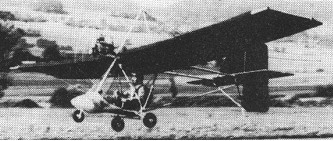
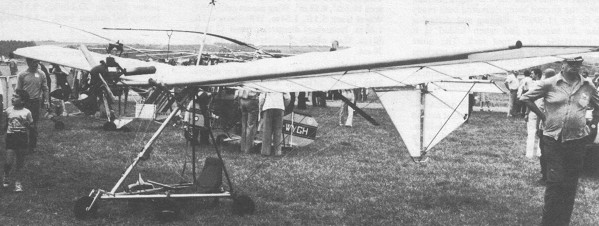
Single seat single engined high wing mono¬plane with conventional three axis control. Wing has unswept leading and trailing edges, and constant chord; cruciform tail. Pitch control by elevator on tail; yaw control by fin mounted rudder; roll control by spoilers; control inputs through stick for pitch/roll and pedals for yaw. Wing braced from above by kingpost and cables, from below by cables; wing profile 80% double surface. Undercarriage has three wheels in tricycle formation with additional tailskid; no suspension on nosewheel and steel spring suspension on main wheels. Push right go right nosewheel steering connected to yaw control. No brakes. Aluminium tube framework, without pod. Engine mounted at wing height driving tractor propeller. Leading edges of the wing are stiffened with polyester under the Dacron covering. Designed and built by Hans Gigax, the Microstar, which made its first flight at the beginning of 1981 and was shown by Hans at the annual homebuilders’ meet at Brienne le Chateau in France. The machine went on sale in 1982 from ASW, which has ceased to produce aircraft in Switzerland at the beginning of 1983. The Microstar was directly involved in a fatal accident in West Germany in 1982 which led the maker to stiffen its empennage by two additional tubes. Having acquired the licence to build and sell the single seater Microstar as designed by Hans Gigax, the ASW company embarked in 1982 on the production of several examples as the Microstar Mark I. The distribution seems to have been very small, but at least one Microstar was exported to France, bought by the French agent of the Swiss parent company.
Length overall 17.1ft, 5.20m. Wing span 33.6ft, 10.20m. Constant chord 4.4ft, 1.32 m. Sweepback 0 deg. Total wing area 145 sq.ft, 13.4 sq.m. Wing aspect ratio 7.8/1. Engine: Konig SC430, 24 hp at 4200 rpm. Propeller diameter 43 inch, 1.09 m. No reduction. Max static thrust 132 lb, 60 kg. Power per unit area 0.17 hp/sq.ft, 1.8 hp/sq.m. Fuel capacity 5.3 US gal, 4.4 Imp gal, 20.0. Empty weight 154lb, 70kg. Max take off weight 441 lb, 200 kg. Payload: 287 lb, 130 kg. Max wing loading: 3.05 lb/sq.ft, 14.9 kg/sq.m. Max power loading 18.4 lb/hp, 8.3kg/hp. Load factors: +6.0, 3.0 ultimate. Max level speed 50 mph, 80 kph. Never exceed speed 68 mph, 110 kph. Max cruising speed 44 mph, 70 kph. Economic cruising speed 24mph, 40kph. Stalling speed 17 mph, 28 kph. Max climb rate at sea level 250ft/min, 1.5m/s. Take off distance 65ft, 20m. Landing distance 50ft, 15 m. Service ceiling 11,480 ft, 3500 m.