flew several prototype test gyroplanes of increasing size and sophistication during the 1990s. Based on proof-of-concept Hawk One (N4379X) first flown 26 September 1992; design started April 1996 and prototype two-seat H2X (N4412X) first flew 4 February 1997. The H2X was later converted to three-seat Hawk III standard. The Hawk III multipurpose cabin gyroplane was capable of vertical (jump) take-off. First deliveries had been due June 1998, but design changes to H2X and later Hawk III in October 1998 resulted in Hawk 4.
Hawk H2X Engine: one 335kW Geschwinder V-8 aluminium liquid-cooled engine, derated to 261kW at 2.500rpm Propeller: Hartzell three-blade constant-speed.
GBA was founded in 1986 by David Groen and his brother, Jay Groen. GBA’s Corporate Headquarters are located in Salt Lake City, Utah, USA, with its manufacturing facility on the same site. GBA also operates a flight test and R&D facility in Buckeye, Arizona, near Phoenix. Since its inception, GBA has been involved in an extensive research program in the design, engineering, development, testing and marketing of gyroplane and gyrodyne aircraft. Groen Brothers Aviation, Inc. (GBA) is engaged in the business of designing and developing new high performance gyroplanes and gyrodynes using advanced technology and modern aerospace design methods. The Groen brothers realized that the collective pitch controlled rotor system developed for helicopters could be applied to a gyroplane. This innovation would substantially improve a gyroplane’s ability to achieve vertical takeoff and landing, as well as dramatically improve performance in both high speed flight and safe low and slow flight. GBA has three U.S. Patents and several International Patents relating to the variable pitch rotor system they developed. With such improvements the gyroplane could become a safe, economical and versatile aircraft with appeal to a broad range of markets. Based on this insight, the Groens decided in 1986 to enter the market and to design their first gyroplane. Following the successful flight of a proof-of-concept aircraft in 1987, the Groens designed, manufactured and flew several prototype test gyroplanes of increasing size and sophistication during the 1990s. Each of these gyroplanes were typically ultra-short take-off and landing (USTOL) aircraft that demonstrated that gyroplanes could be significantly easier to fly and maintain than a helicopter, would have significantly less maintenance down time and therefore much higher mission readiness, and would be safer than either airplanes or helicopters. By 1999 Groen Brothers Aviation had designed and manufactured their first piston-engine version of the four-seat Hawk 4 Gyroplane. In July 2001, Groen announced plans to move to a new 18.580sq.m facility at Phoenix, Arizona. The plant was intended to become operational by end 2002 and have the capacity to produce four aircraft per day, however this has lapsed. In August 2001 the company concluded a joint venture with Al-Obayya Corporation to produce and market gyroplanes in Saudi Arabia. However, economic downturn of late 2001 resulted in 85 of 130-strong workforce being laid off. Earlier plans for Chinese assembly also appear to have lapsed. In February, 2003, Groen Brothers Aviation formed American Autogyro, to produce gyroplanes for the “kit-built” market.
The 1995 Grob G-850 Strato 2C high-altitude and long-duration atmospheric/ stratospheric/ climatic research aircraft with a unique compound propulsion system using two turbocharged piston engines and two gas generators, was first flown March 1995. Featuring an extremely long span wing of composite construction, one aircraft was built in the 1990s, but was abandoned despite setting a world altitude record for piston engined aircraft on its last flight.
Engines: 2 x 300kW Teledyne Continental TSIOL-555 piston Max take-off weight: 13350 kg / 29432 lb Empty weight: 6650 kg / 14661 lb Wingspan: 56,50 m / 184 ft 9 in Length: 23,97 m / 75 ft 6 in Height: 7,76 m / 23 ft 12 in Wing area: 145.00 sq.m /1560.77 sq ft Cruise speed: 520 km/h / 323 mph Ceiling: 26000 m / 85300 ft Range: 18100 km / 11247 miles
The Grob/E-Systems/AlliedSignal Egrett was a surveillance aircraft developed in Germany in the 1980s by an international partnership. It was intended to fill a joint Luftwaffe-USAF requirement for a high-altitude, long-duration surveillance platform for treaty verification and environmental monitoring.
Germany’s Grob Aircraft, teamed up with E-Systems and Garrett AiResearch, both in the United States. The name EGRETT comes from a combination of the three companies’ names.
Grob G 520 EGRETT II
According to the publicly available accounts, the official purpose of the program, which the U.S. Air Force reportedly nicknamed Senior Guardian, was to provide a cheaper alternative to the U-2 Dragon Lady spy plane for both treaty verification and environmental monitoring purposes. In the 1980s, the United States and the Soviet Union were negotiating the terms of what would become the Intermediate-Range Nuclear Forces Treaty (INF) and the Treaty on Conventional Armed Forces in Europe (CFE). INF entered force in 1988, while CFE did not go into effect until 1990. Both required robust verification methods.
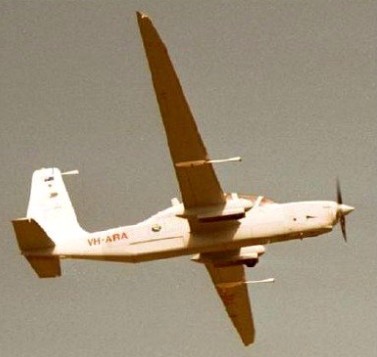
The turboprop-powered G-520 Egrett and Strato 1 high-altitude and long-duration research platforms are capable of carrying different electronic payloads in 12 separate compartments (first flown June 1987 in G-500 Egrett form.
Grob and the rest of the team ultimately built total of five aircraft in various versions, starting with the prototype D 450 EGRETT, followed two more D 500 EGRETT II aircraft.
The contractors then modified the D 500s into the final G 520 configuration before building a third of these pre-production planes. Finally, Grob produced a two-seat G 520T trainer version.
A two-seat Grob 520T
The German manufacturer claims its G 520NG variants has the “lowest operational cost in class.”
The aircraft with its composite airframe was able to carry more than 2,000 pounds of sensors and equipment in any of 12 separate, modular bays, five of which lined the bottom of the fuselage. There was enough room there for turreted day- and night-vision cameras, as well as synthetic aperture radars and other gear.
The G 520 could fly this equipment to an altitude of 50,000 feet. The aircraft has a very narrow cord wing with a span of just more than 108 feet. Depending on the exact load out and flight profile, the plane reportedly could have a range of more than 1,500 miles or loiter over a particular area for up to eight hours.
In the end, the existing prototypes filtered out onto the open market through the original partners. In 1995, Raytheon bought E-Systems, ultimately renaming it as their Intelligence, Information and Services division. The company’s flight test outfit continued flying at least one EGRETT II for some time afterward, providing support to NASA’s Airborne Science Program. According to the Federal Aviation Administration, this aircraft, N520DM, apparently passed to Bear Defense circa 2012.
The D 450 EGRETT aircraft is also still in the U.S. civil registry, listed as N520EG, and property of a company called Gentran Corporation. This Omaha, Nebraska-based “trucking company” has one employee, according to publicly available records. Spotters caught this all-white aircraft in California in 2012 and it does not appear to match the one flying in Indiana earlier in July 2017.
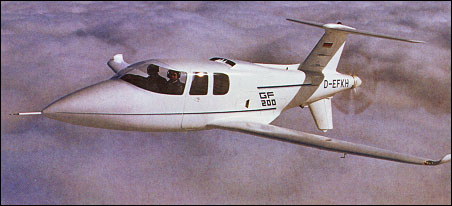
The GF 200 pusher piston-engined and pressurised 4/5-seat lightplane was first flown in November 1991.
Engine: 1 x 233kW Teledyne Continental TSIOL550 turbocharged flat-six Take-off weight: 1600 kg / 3527 lb Wingspan: 11.00 m / 36 ft 1 in Length: 8.70 m / 28 ft 7 in Height: 3.42 m / 11 ft 3 in Cruise speed: 370 km/h / 230 mph Ceiling: 7625 m / 25000 ft Range: 1850 km / 1150 miles Crew: 2 Passengers: 4
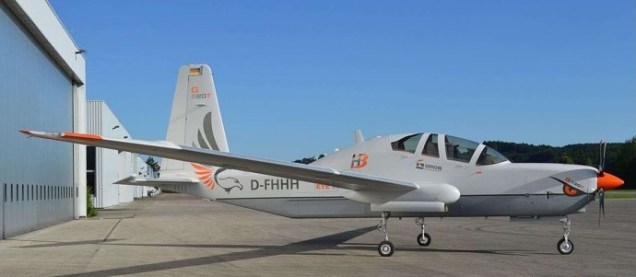
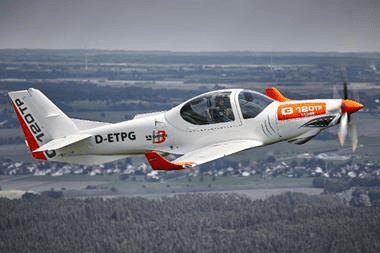
The 1999 Grob G 120A is a two seated training and aerobatic low-wing aircraft with a carbon composite airframe. It is based on the Grob G 115TA training aircraft and is specially designed for military and civil pilots training.
G120TP
In 2025 the Royal Canadian Air Force (RCAF) planned to operate 23 G120TPs under the designation CT-102B Astra II. To be based at CFB Moose Jaw in Saskatchewan, they will serve as a basic flight instruction platform, succeeding Canada’s Grob CT-120A (G120A) trainers.
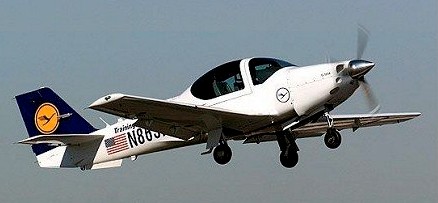
The prototype Grob G-116 was a four seat, composite 200 hp Lycoming powered single. A four-seat version of the Grob G.115, the G 116 first flew on 29 April 1988 (D-EGRF), and was certificated in 1989.
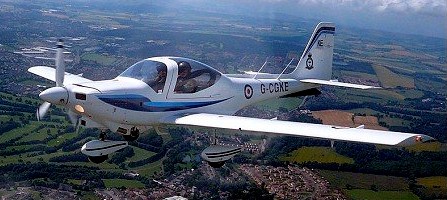
By 1990 the G 115 had orders totalling more than 100 since production began in 1987. The two-seat, side-by-side light aircraft makes extensive use of composite materials in its construction and the resulting smooth finish gives low drag and high efficiency. The production G 115-C is powered by a single 150 hp (112 kW) Lycoming O-320-E2A piston engine driving a constant speed propeller. The Royal Navy Flying Grading Flight operate the G.115D as the Heron. Ninety-nine G.115E (at Tutors) were purchased for Air Cadets and University Air Squadrons in the UK. The E variant with a 3-blade variable pitch propeller is in Royal Air Force service as an elementary flying trainer.
G 115C Engine: 150 hp (112 kW) Lycoming O-320-E2A Propeller: constant speed
G.115D / Heron
G.115E Engine: 1 x 134kW / 180 hp Textron Lycoming AEIO-360-B1F Prop: Hoffman 3 blde CSU Max take-off weight: 990 kg / 2183 lb Empty weight: 690 kg / 1521 lb Wingspan: 10,00 m / 33 ft 10 in Length: 7,79 m / 23 ft 12 in Height: 2,82 m / 7 ft 7 in Wing area: 12,21 sq.m / 129.17 sq ft Max. speed: 270 km/h / 168 mph Cruise speed: 230 km/h / 143 mph Initial climb rate : 1399.61 ft/min / 7.11 m/s Service Ceiling: 4875 m / 16000 ft Range: 1250 km / 777 miles Crew: 2
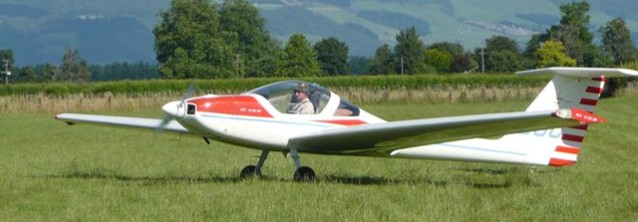
Designed by Burkhart Grob GmbH, the two seat Grob 109 motor glider features side by side seating and fixed tail dragger undercarriage with a steerable tail wheel. The fuselage and wings are made of industrial carbon fibre and glass fibre composites with air brakes. Glass Reinforced Plastic (GRP) is the main structural material with Carbon Fibre for the T-tailplane and rudder. Hard foam sandwiched between fibreglass cloth is used for stringers and formers in the fuselage as well as many other applications.
Grob’s G 109 has the ability to shed its wings, tailplane and elevators to enable it to be neatly packaged for transportation in a suitable road-borne trailer. Each wing has a tapered tongue that extends through the centre section to lock into the opposite wing root rib. The ailerons and air brakes are operated through push-pull control rods. The horizontal tailplane is fitted atop the fin and the quick connect fittings for the elevator and trim tab are fitted. The Limbach L 2000 EB lA engine is rated at 59kw/80hp at 3,400 rpm. The engine has a single Slick magneto, twin Stromberg carbs with “pancake” sport air filters, Motorola alternator and a Hoffman feathering propeller with START (take-off and climb) and CRUISE pitch settings.
The 17.5 Imp gallon fuel tank is behind the cockpit and filled from above the left wing trailing edge. There are GRP skids/tie down points under each wing tip and the engine cooling air exits from fixed louvers in the bottom cowl.
The glassfibre monocoque fuselage has frames and longerons, while the low wing has a glassfibre roving main spar and a glassfibre/epoxy resin sandwich skin; there are aluminium air brakes in the upper wing surfaces. The fixed undercarriage has Scheibe hydraulic brakes on the spatted main wheels, and the tailwheel is steerable. The pilots sit under a one-piece forward-opening canopy and, after some flight testing, this was fitted with a central frame, while changes made to the undercarriage included moving the main wheels further back so as to unload the tailwheel, the main wheel struts being of steel. Wing span was increased from the original 15m (49ft 2.5in) to 54ft, the empty weight was increased and the motor cowling and wing roots were aerodynamically refined.
The prototype, D-KBGF, made its first flight on 14 March 1980, and the Grob G 109 was certified to JAR 22 in March 1980.
The prototype of the G.109B two-seat, side-by-side motorglider first flew in March 1983 as a version of the original G. 109, with increased span. The GROB G109B is a two-seat motor glider with T-type stabilizer, fixed landing gear and airbrakes. It is classified as a TMG (Touring Motor Glider). It was designed by Burkhart Grob GmbH and features side by side seating as well as a classical tail-dragger undercarriage with a steerable tail wheel. The fuselage and wings are made of industrial carbon-fibre and glass-fibre composites. The G109B’s engine was made by Grob (GR 2500) and is an aircooled 4-stroke flat engine. In 1983 a Grob G109B motorglider extended the gliding world altitude record to 6,406m (21,018ft) and the gliding world altitude gain record to 5,042m (16,544ft). Powered by a 75 hp (56 kW) Limbach engine, the G 109B in RAF service is known as the Vigilant T Mk 1 with the self-launching Volunteer Gliding Schools of the ATC and CCF. The Royal Air Force ordered the last 54. Although production of this motorglider ceased in 1986, during 1990, Burkhart Grob Luft-und Raumfahrt was building between 70 and 100 more G.109Bs to meet a number of orders – including from the RAF. A total of 322 of the G109 and 322 of the G109B aircraft were built from 1983 through to 1990.
In 1983 a Grob 109B extended the gliding world altitude record to 6406m / 21,018 ft and the gliding world altitude gain record to 5042 m / 16,544 ft.
1926: Company foundation in Munich Aviation work began in 1971 and has since built many thousands of motorgliders, lightplanes and other aircraft. 1974: Foundation of aircraft plant in Mattsies Burkhart Grob Flugzeugbau GmbH built the Schempp-Hirth Standard Cirrus under licence during 1972-75. Recent aircraft include the G 103 Twin III and G 109 series of gliders/motorgliders, piston-engined G 115 two-seat lightplane (some versions suited to training and aerobatics; first flown November 1985), GF 200 pusher piston-engined and pressurised 4/5-seat lightplane (first flown November 1991, turboprop-powered G-520 Egrett and Strato 1 high-altitude and long-duration research platforms capable of carrying different electronic payloads in 12 separate compartments (first flown June 1987 in G-500 Egrett form), and the most recent G-850 Strato 2C high-altitude and long-duration atmospheric/ stratospheric/ climatic research aircraft with a unique compound propulsion system using two turbocharged piston engines and two gas generators (first flown March 1995).