France
Orion four-seat composites monoplane, with pusher propeller aft of tail, produced by Jean Grinvalds 1982. Plans and access to moulds later made available from Club Orion.
1980->
Griffon Lionheart
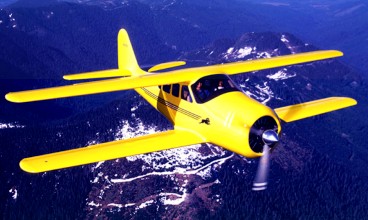
Developed for flying enthusiasts as a “kit” aircraft and designed to make the building process pleasant, fun, and memorable, the Lionheart is an elegant and spirited, 220+ mph, six place, long-distance cruiser. Its design is inspired by the classic Beech Staggerwing and features a fuel capacity of 180 gallons with a range of around 1450nm, payload around 2,000 pounds, and stall characteristics in the mid-fifty knot range. The aircraft’s primary structure consists of high-temperature glass and carbon composites molded in precision production tooling. Lionheart’s powerplant is the reliable and powerful 450HP Pratt & Whitney R-985 Wasp Jr. Radial engine.
The fuselage is about 20 feet long from firewall to rudder post making Lionheart a cabin class aircraft that can be constructed in a relatively small space. Interior cabin volume and seating is similar to the Malibu but wider at the shoulders. A small aisle exists between the first two rows of seats and cabin access/egress is via a single split door between the mid and rear seats on the left side of the fuselage (ala Malibu and Staggerwing).
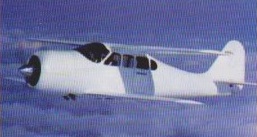
Lionheart accommodates 6 full size, FAA 170 lb passengers and is designed with a 5200 lb gross weight at +6,-3 G limit loads. Following structural testing the gross weight is increased for +4.4, -2.2 G limit loads (utility category). With an estimated empty weight of 3100 to 3300 lbs, Lionheart has a payload of about 2000 lbs. Just about right for the wife and kids… and lots of fuel.
Dual control sticks are designed for the pilot and co-pilot seats. Ailerons and elevator are pushrod actuated while the rudder is cable operated. The four ailerons and flaps of the upper and lower wings are interconnected at the wing roots via cables. With the exception of the landing gear attachment fittings, the upper and lower wings are identical.
Lionheart uses a fully retractable conventional (taildragger) landing gear. The mains use pressurized gas for spring and damping while the tailwheel is sprung via a gas charged air/oil cylinder. Retraction is accomplished using electro-hydraulics. Landing gear track and wheelbase are both wider and longer than the stock Staggerwing, so ground handling is improved.
Lionheart prototype N985L flew for the first time Sunday morning, July 27, 1997.
Chuck Cianchette of Palmyra, Maine, built the first customer-built Lionheart, first flying in 2000.
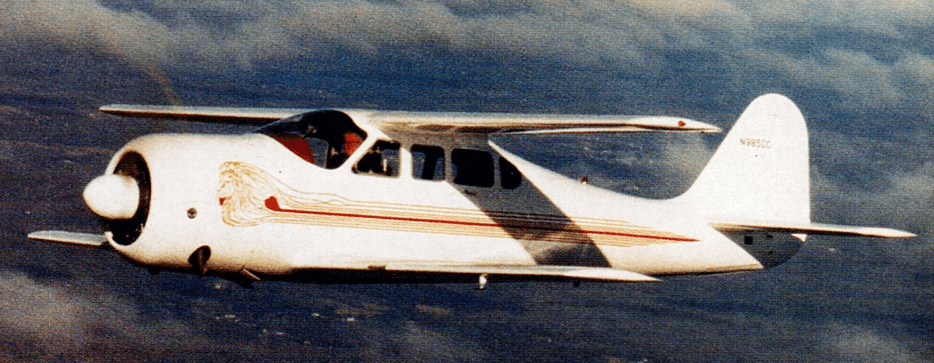
In 2009 the Lionheart was out of production.
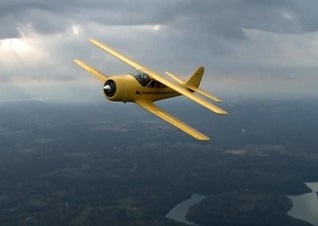
Top speed: 230 mph
Cruise: 210 mph
Stall: 56 mph
Range: 1500 sm
Rate of climb: 2500 fpm
Takeoff dist: 800 ft
Landing dist: 1400 ft
Service ceiling: 20,000 ft
Engine: Pratt & Whitney R-987, 450 hp
HP range: 350-600
Fuel capacity: 160 USG
Empty weight: 2900 lb
Gross weight: 5200 lb
Height: 8 ft
Length: 26.6 ft
Wing span: 31 ft
Wing area: 238 sq.ft
Seats: 7
Landing gear: retract/tail
Engine: Pratt & Whitney
Wing span: 9.45 m
Wing area: 21.9 sq.m
MAUW: 1905 kg
Empty weight: 1043 kg
Fuel capacity: 530 lt
Max speed: 370 kph
Cruise speed: 322 kph
Minimum speed: 98 kph
Climb rate: 15 m/s
Seats: 6
Fuel consumption: 12 lt/hr
Kit price (1998): $89,900
Griffon Aerospace Inc
1997: 920 Yarbrough Rd, Harvest, AL 35749, USA.
Established in 1994 in Huntsville, Alabama, home of Marshall Space Flight Center and Redstone Arsenal, Griffon has successfully built upon its pioneering tradition to become a technology leader in the small business arena. The President and CEO is Mr. Larry A. French, an Aerospace and Mechanical Engineer with more than three decades of design and management experience. Experiencing steady growth in sales, revenue, and personnel, the company is continually expanding and diversifying in both the private and governmental sectors of the market. We aim to provide superior services and value to our customers, advancement opportunities for our employees, and superior returns to our stockholders.
First flew in 1997 the seven-seat, reverse-stagger Lionheart cabin biplane, offered as a kit.
In 2009, Griffon was focused on three core businesses: defense and commercial composite specialty parts, air vehicle design, and manufacturing and prototyping. Each provides the company with the capabilities it needs to build on its strength as an innovator and to prosper in a highly competitive economy.
Grif Spy
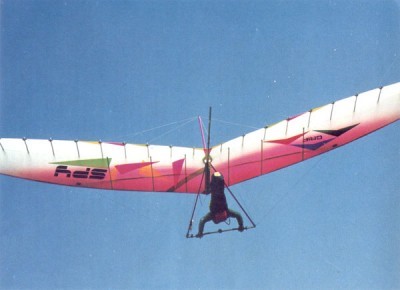
A 1993 hang glider.
SPY 14
Wing area: 14 m²
Wing span: 10.45 m
Aspect ratio: 7.8
Hang glider weight: 30 kg
Minimum pilot weight: 50 kg
Maximum pilot weight: 70 kg
Nose angle: 127°
SPY 15
Wing area: 14.8 m²
Wing span: 10.8 m
Aspect ratio: 7.8
Minimum pilot weight: 65 kg
Maximum pilot weight: 95 kg
Nose angle: 127°
Grif H2000
A 1995 hang glider for Intermediate pilots.
H2000 14
Wing area: 14.5 m²
Wing span: 9.2 m
Hang glider weight: 22 kg
Minimum pilot weight: 45 kg
Maximum pilot weight: 65 kg
Minimum speed: 25 km/h
Maximum speed: 85 km/h
Packed length: 4.58 m
Packed length short: 3.57 m
Number of battens: 17
Nose angle: 120°
H2000 15
Wing area: 15.5 m²
Wing span: 9.6 m
Hang glider weight: 24 kg
Minimum pilot weight: 65 kg
Maximum pilot weight: 90 kg
Minimum speed: 25 km/h
Maximum speed: 85 km/h
Packed length: 4.81 m
Packed length short: 3.8 m
Number of battens: 17
Nose angle: 120°
H2000 16
Wing area: 16.5 m²
Wing span: 10 m
Hang glider weight: 28 kg
Minimum pilot weight: 85 kg
Maximum pilot weight: 110 kg
Minimum speed: 25 km/h
Maximum speed: 85 km/h
Packed length: 5.04 m
Packed length short: 4.03
Number of battens: 19
Nose angle: 120°
H2000 Biplace
Wing area: 18.8 m²
Wing span: 10.9 m
Hang glider weight: 31 kg
Minimum pilot weight: 100 kg
Maximum pilot weight: 160 kg
Minimum speed: 28 km/h
Maximum speed: 85 km/h
Packed length: 5.49 m
Packed length short: 4.13 m
Number of battens: 21
Nose angle: 120°
Grif Trainer
In 1998 Grif were making two microlight wings; the Spyder and the Trainer
Grif Spyder
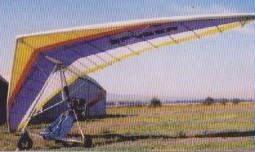
In 1998 Grif were making two microlight wings; the Spyder and the Trainer. The Spyder trike was made under subcontract and marketed under the Grif name.
Spyder trike
Empty weight: 172 kg
Wing span: 10.35 m
Wing area: 14 sq.m
Fuel capacity: 40 lt
Engine: Rotax 503, 48 hp
MAUW: 400 kg
Seats: 2
Max speed: 120 kph
Cruise speed: 90 kph
Minimum speed: 42 kph
Fuel consumption: 12 lt/hr
Price (1998): 6 800 000 L
Grif EOS
A 1997 hang glider for advanced pilots.
EOS 13
Hang glider circa 1998.
Wing area: 13.3 sq.m
Wing span: 9.7 m
Nose Angle: 127 deg
Hang glider weight: 27 kg
Packed length: 5.48 m
Packed length short: 3.8 m
Number of battens: 27
Pilot weight: 45-70 kg
Minimum speed: 28 km/h
Maximum speed: 100 km/h
Price (1998) 7100000 Lr
EOS 14
Hang glider circa 1998.
Wing area: 14 sq.m
Wing span: 10.1 m
Hang glider weight: 30 kg
Nose Angle: 127 deg
Pilot weight: 65-80 kg
Minimum speed: 28 km/h
Maximum speed: 100 km/h
Packed length: 5.67 m
Packed length short: 3.99 m
Number of battens: 31
Price (1998) 7100000 Lr
EOS 15
Hang glider circa 1998.
Wing area: 14.7 sq.m
Wing span: 10.5 m
Nose Angle: 127 deg
Hang glider weight: 30 kg
Packed length: 5.85 m
Packed length short: 4.08 m
Number of battens: 31
Pilot weight: 80-110 kg
Minimum speed: 28 km/h
Maximum speed: 100 km/h
Price (1998) 7100000 Lr
Grif
Italo Graziani and Nazzareno Sivestrini started business around 1989.
1998: Via Galileo, Galilei Loc Paolo, I-01030 Castel Sant’Elia (VT) Italy
Via Galieli snc, Dom.Fisc. Piazza G.Rossini 4
01030 Castel Sant`Elia (VT), Italy.
Hang glider builder
Grega GN-1 Aircamper
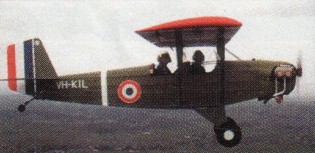
Designed by John W. Grega, as a modernized version of the 1920’s Pietenpol Aircamper two-seat parasol-wing monoplane, first flown 1963 and available in plans form (plus some components) as the GN-1 Aircamper.
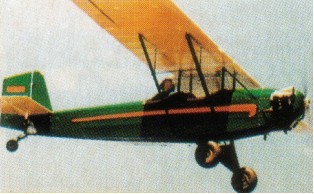
Engine: Continental C-65, 65 hp.
HP range: 65-90.
Speed max: 115 mph.
Cruise: 87 mph.
Range: 400 sm.
Stall: 25 mph.
ROC: 500 fpm.
Take-off dist: 300 ft.
Landing dist: 300 ft.
Service ceiling: 12,000 ft.
Fuel cap: 12 USG.
Weight empty: 650 lbs.
Gross: 1100 lbs.
Height: 6.8 ft.
Length: 18.1 ft.
Wing span: 29 ft.
Wing area: 145 sq.ft.
Seats: 2.
Landing gear: tail wheel.

