Developed the tandem two-seat supersonic leadin/ fighter conversion trainer versions of the Chengdu J-7, as the JJ-7 or FT-7 for export. First JJ-7 flew in July 1985, and latest lengthened F-7P variant entered service with Pakistan in 1996.
1980->
Guimbal Cabri G2
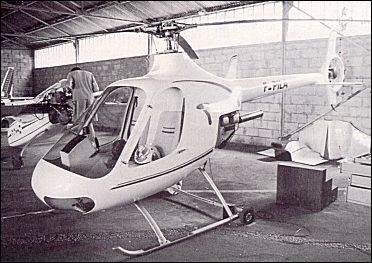
The Guimbal Cabri G2 is a two-seat single-reciprocating-engine-powered light helicopter. The two-seat Cabri G2 light helicopter was designed by Bruno Guimbal, a Eurocopter engineer, and the prototype (F-PILA) made its first flight at Marseille-Marignane in April 1992.
Powered by a 150hp Lycoming, the main structure is carbon composite construction, and it uses a three bladed soft-inplane main rotor with carbon composite blades. The tail rotor is a fenestron design using seven injection moulded blades. Energy attenuating carbon composite seats of Guimbal’s own design are installed. The helicopter has conventional unassisted flight controls and largely conventional analogue instrumentation but uses its own design of electronic monitor for all engine functions.
An STC embodied on the engine is held by Guimbal and comprises a Plasma electronic ignition with variable timing to replace the RH retard-capable magneto, and also a compact oil filter housing.

Development continued at Aix-en-Provence with restricted DGAC certification being issued on 18 April 1994.The helicopter is the first light helicopter to be type certificated (Type Certificate R.145) by EASA against CS27.
Type Acceptance Certificate No. 11/21B/20 was granted on 22 June 2011 by New Zealand CAA.
Guggenmos Superwing
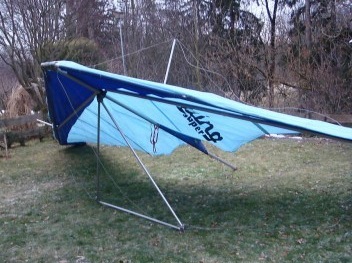
A 1981 hang glider.
Guggenmos E-7
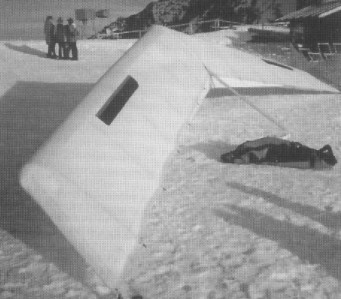
The E 7 by Joe Guggenmos (ex World HG Champ) at first glance looks similar to the Exxtacy, however it has a tapered wing (both chord and D-Cell cross section) using separate right and left moulds. It has control bar activated spoilers, is 152 sq.ft, 10.43 aspect, 39ft span, spoilers and flaps fold up with the glider, 18.5ft (5.6m) long in the bag and weighs just 68 lbs (31 kg). Joe claims a glide of over 17:1, a sink rate of 137 ft/min and handling better than other rigids. The spoilers are mounted at the high point of the airfoil, pre empting any nose up movement when they are deployed.
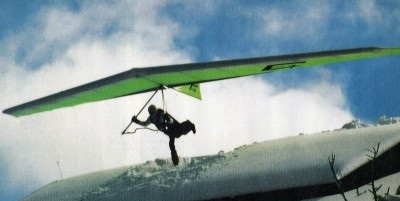
The E 7 carbon fibre rigid wing was first built in August 1998 and he has been flying and testing it ever since. It was DHV certified and in production at the Guggenmos factory in Germany.
Wing area: 13.8 m²
Wing span: 11.9 m
Hang glider weight: 32 kg
Minimum speed: 30 km/h
Number of battens: 12
Guggenmos Bullet RCS Topless
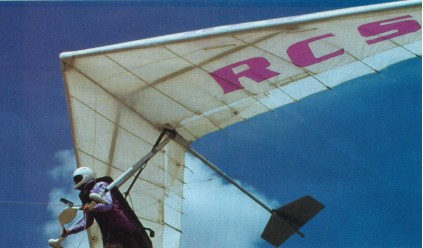
Joe Guggenmos makes the Bullet glider series and the RCS Topless. In 1997 Guggenmos equipped his topless RCS with anti-vortex wingtip fairings.
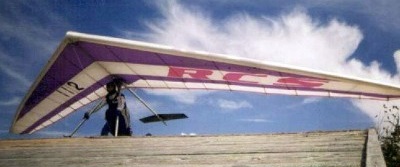
Bullet RCS
Hang glider circa 1998.
Wing area: 13.2 sq.m
Certification: DHV 2-3
Pilot weight: 70-98 kg
Wing span: 10.9 m
Nose Angle: 133 degs
Aspect ratio: 3
Price (1998) 10800 DM
Bullet RCS
Wing area: 13.2 m²
Wing span: 10.9 m
Aspect ratio: 3
Hang glider weight: 32 kg
Minimum pilot weight: 70 kg
Maximum pilot weight: 98 kg
Nose angle: 127°
Bullet RCS-M
Hang glider circa 1998.
Wing area: 11.3 sq.m
Certification: DHV 2-3
Pilot weight: 62-79 kg
Wing span: 10.15 m
Nose Angle: 130 degs
Aspect ratio: 9
Price (1998) 10800 DM
Bullet RCS M
Wing area: 11.3 m²
Wing span: 10.15 m
Aspect ratio: 9
Hang glider weight: 30 kg
Minimum pilot weight: 62 kg
Maximum pilot weight: 79 kg
Minimum speed: 32 km/h
Number of battens: 29
Nose angle: 127°
Guggenmos Bullet
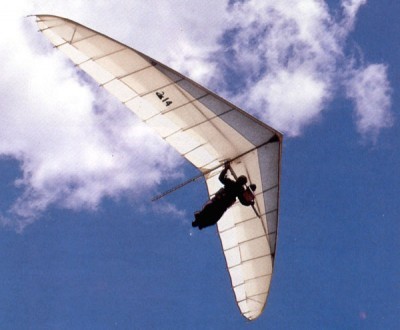
Joe Guggenmos makes the Bullet glider series and the RCS Topless. The Bullet C was a 1984 hang glider for Advanced pilots.
The Bullet Competition appeared in 1984.
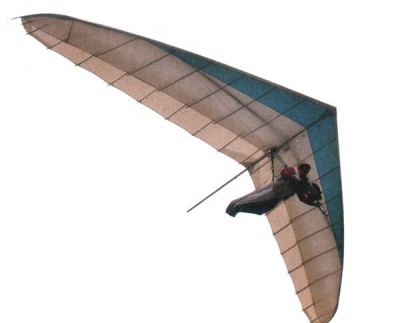
Guggenmos realized that the 2 meter extra wingspan of the Bullet 12 were not very efficient, so he designed afterwards a cut down version of it with a 10 meter wingspan, the Bullet Cut.
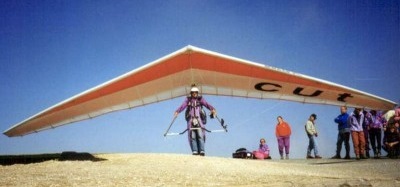
The Bullet Easy was a 1985 version.
The Bullet Novum was for Intermediate pilots.
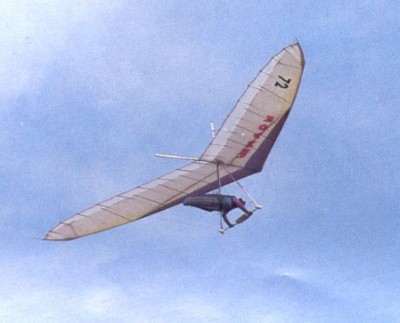
The Bullet Racing is a 1983 version.
The Bullet SP is an intermediate glider. The SP is difficult to land because of very narrow flare window. It is stiff to fly but rises beautifully in thermals.
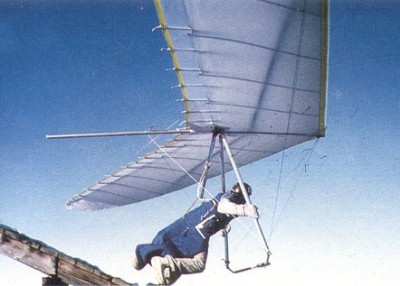
Bullet C 14
Bullet C 16
Hang glider circa 1998.
Wing area: 16 sq.m
Certification: DHV 2-3
Pilot weight: 65-104 kg
Wing span: 10.7 m
Nose Angle: 132 degs
Aspect ratio: 7.2
Price (1998) 8400 DM
Bullet C 85
Bullet C 150
Wing area: 15.2 m²
Wing span: 11 m
Aspect ratio: 8.6
Hang glider weight: 28 kg
Bullet C 160
Wing area: 16 m²
Wing span: 9.68 m
Aspect ratio: 5.85
Hang glider weight: 25 kg
Minimum pilot weight: 60 kg
Maximum pilot weight: 85 kg
Packed length: 5.6 m
Packed length short: 4 m
Number of battens: 28
Nose angle: 127°
Bullet Cut
Hang glider circa 1998.
Wing area: 13.2 sq.m
Certification: DHV 2-3
Pilot weight: 72-97 kg
Wing span: 10.9 m
Nose Angle: 133 degs
Aspect ratio: 9
Price (1998) 8600 DM
Bullet Cut
Wing area: 13.2 m²
Wing span: 10.9 m
Aspect ratio: 9
Hang glider weight: 28 kg
Minimum pilot weight: 72 kg
Maximum pilot weight: 97 kg
Packed length: 6.1 m
Packed length short: 4.1 m
Number of battens: 31
Nose angle: 127°
Bullet Cut S
Hang glider circa 1998.
Certification: DHV 2-3
Pilot weight: 62-79 kg
Wing span: 10.15 m
Nose Angle: 130 degs
Aspect ratio: 9
Price (1998) 8400 DM
Bullet Cut S
Wing area: 11.3 m²
Wing span: 10.15 m
Aspect ratio: 9.3
Hang glider weight: 28 kg
Minimum pilot weight: 55 kg
Maximum pilot weight: 75 kg
Packed length: 5.8 m
Packed length short: 3.9 m
Number of battens: 26
Nose angle: 127°
Bullet Novum
Hang glider circa 1998.
Wing area: 14.9 sq.m
Certification: DHV 3
Pilot weight: 68-98 kg
Wing span: 10.5 m
Nose Angle: 130 degs
Aspect ratio: 7.4
Price (1998) 8300 DM
Bullet Novum
Wing area: 14.9 m²
Wing span: 10.5 m
Aspect ratio: 7.4
Hang glider weight: 26 kg
Minimum pilot weight: 68 kg
Maximum pilot weight: 96 kg
Packed length: 5.6 m
Packed length short: 4 m
Number of battens: 28
Nose angle: 127°
Bullet SP 11
Hang glider circa 1998.
Wing area: 12.3 sq.m
Certification: DHV 3
Pilot weight: 60-85 kg
Wing span: 10.9 m
Nose Angle: 133 degs
Aspect ratio: 9.9
Price (1998) 8300 DM
Bullet SP 11
Wing area: 12.3 m²
Wing span: 10.3 m
Aspect ratio: 9.9
Hang glider weight: 26
Minimum pilot weight: 60 kg
Maximum pilot weight: 85 kg
Packed length: 5.7 m
Packed length short: 3.9 m
Number of battens: 30
Nose angle: 127°
Bullet SP 12
Wing area: 13.8 m²
Wing span: 12 m
Aspect ratio: 10.4
Hang glider weight: 31
Minimum pilot weight: 70 kg
Maximum pilot weight: 94 kg
Packed length: 6.2 m
Packed length short: 4.2 m
Number of battens: 31
Nose angle: 127°
Guggenmos
1998: Fussenerstrasse 29, D-87600 Kaufbeuren, GERMANY
Hang glider builder
Guerpond Autoplan
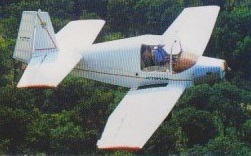
The Guerpond Autoplan is an all-wood tandem microlight aimed at the amateur constructor. The large tailplane allows a large CoG range. Engines of up to 64 hp can be used.
Engine: Rotax 462, 52 hp
Wing span: 8.60 m
Wing area: 17.50 sq.m
MAUW: 420 kg
Empty weight: 230 kg
Fuel capacity: 50 lt
Max speed: 150 kph
Cruise speed: 130 kph
Minimum speed: 50 kph
Climb rate: 4 m/s
Seats: 2
Fuel consumption: 15 lt/hr
Guerpond, Maurice
1998:
Leqs fines Oseilles
F-41150 Chaumon sur Loire
France
LSA builder
Guangzhou Orlando Helicopters Ltd
Joint Chinese/U.S. company formed 1985 to assemble Panda, as Chinese version of Orlando OHA-S-55 Bearcat.

