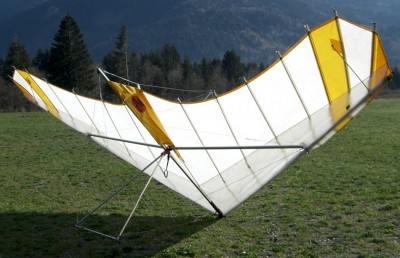
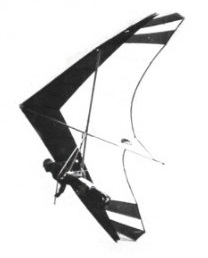
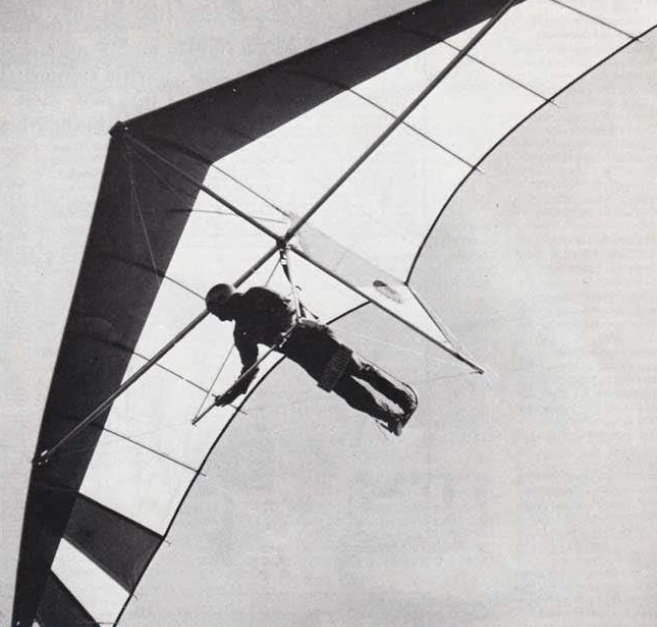
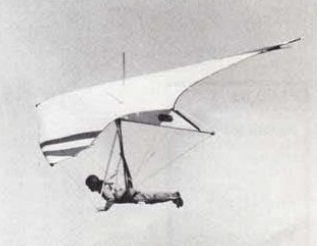
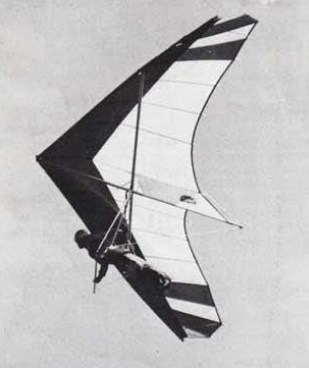
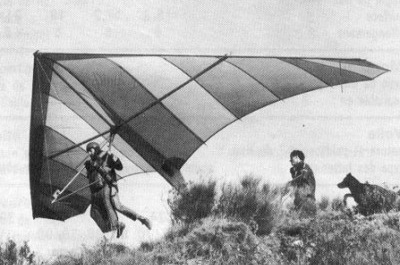
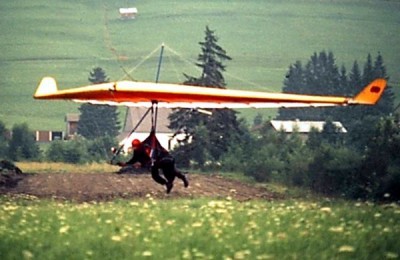
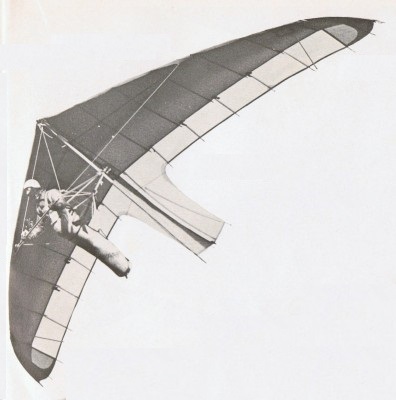
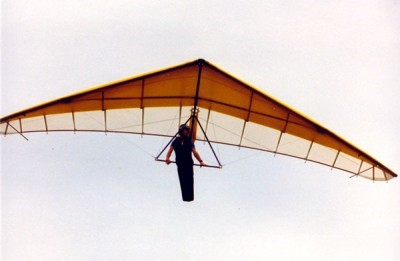
The 1979 Vulcan was designed to supercede the Super Scorpion. It is much like a Super Scorpion to look at but has a higher aspect ratio, much tighter sail and more double surface. Unlike other fourth generation machines, the Vulcan does not use preformed battens. Performance is not quite as good as the other machines of this generation, although min-sink is as good as its predecessor and the top speed much improved.
1979 Vulcan
Handling is very pleasant although there is a delay between pulling the bar in and the glider speeding up, this is probably due to the huge control frame. The size of the control frame also makes ground handling tricky but with any wind the glider is easily launched with the harness straps tight.
The 1980 Vulcan has high performance and especially penetration. The 128° nose angle, a hyper-tensioned trailing edge, a 30% lower leading edge sleeve and a highly worked sail give it a very high speed range. Molded umbrella folding, an original system of transverse link – leading edge and intelligent hooking of the cables below the nose make it simple and very fast assembly.
The Vulcan was the first hang glider that gained a C of A before release to the public. The high aspect rato and low twist wing gives good penetration for competition and coss-country. The cross boom is moved into the slower moving air closer to the sail reducing drag, as does the lack of deflexors. For de-rigging, a sliding centre box leaves the cross booms permanently attached to the leading edges. A removable king post prevent tangled wires.
Very light on all axes, but what inertia! In fact this lightness was given artificially by trapezoidal uprights of 1,80m which facilitate efforts. Very good in thermal, but bad to shave the walls. The big model was so much surfaced that it supported the bi.
Unfortunately maneuverability has decreased considerably but the finishing is impeccable and the sail impeccable.
1979 Vulcan Leading edge: 19 ft 8 in Span: 34 ft 5 in Nose angle: 180 deg Aspect ratio: 8:1 Root chord: 9 ft 2 in Sail area: 184 sq ft Aspect ratio 6.45 Packed length: 20 ft Knockdown length: 14 ft Weight: 57 lb Pilot weight range: 11.5-17 st Strength rating: 1575 lb Price: £640.00
1980 Vulcan Wing area: 17.1 m² Aspect ratio: 6.5 Hang glider weight: 26 kg Minimum pilot weight: 70 kg Maximum pilot weight: 100 kg Packed length short: 3.9 m Nose angle: 127°
The 1984 Hiway Hang Gliders Explorer glider had wire for the leading edge. They had pitch problems when the wire flipped at low angles of attack.
Wing area: 14.5 m² Wing span: 10.4 m Aspect ratio: 7.45 Hang glider weight: 32 kg Minimum pilot weight: 57 kg Maximum pilot weight: 89 kg Packed length short: 3.2 m Nose angle: 136°
Designed by Bill Pain for Hiway and Joe Binns helped with test flying. The 1st prototype was a 135, then the 145 which flew and handled really well. Then the 150 which never worked. It was originally just a research vehicle but Hiway pushed to have it developed
Hiway cancelled the project. Binns brought prototypes.
Joe Binns did take the 3rd or 4th prototype to the 1982 XC Classic in Owens Valley. Owens had crashed and bent a leading edge without realising it so it did not perform well.
The 135 handling was a compromise between high performance and handling, both of which demanded critical handling techniques. The carbon fibre tensioners on the wingtips were designed and rigged such that washout and trailing edge flexibility were minimal. Consequently, turning her into a strong thermal would demand huge effort and concentration. Max gliding to the next lift would require very precise attitude setting or performance would be seriously degraded. It proved to be a very sturdy machine and would wingover past 90deg without any nasty frighteners.
The larger version was very docile but had very little to offer in performance. The larger machine was more awkward to rig, having had a detachable ‘A’ frame, was infinitely more manageable in all conditions though struggled to make the most of available lift. It was less competitive than the 135. It only flew it a handfull of times.
Alan Monks bought the ‘Yellow Budgie’ from Paul Farley back in ’84’ for a hundred and fifty quid and considered it the best money ever spent at the time. It was exceptionally difficult to hook into a big thermal and could be a handful in turbulence. However she’d go up well once established in lift but the sink rate would let her down in the transit. In smooth air she handled like a dream and was very controllable and inherent stability in all axes was dead positive. The budgie faded into retirement in 89/90 and was stored under-cover for a number of years before released to the hang glider museum. The 135 model was donated to the hang glider museum based in Weston-Super-Mare, Somerset, in 2000 or there abouts by Alan Monks.
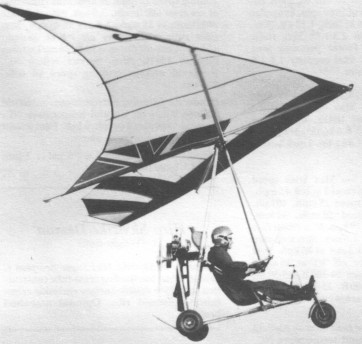
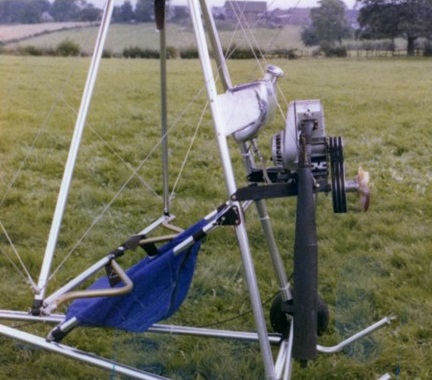
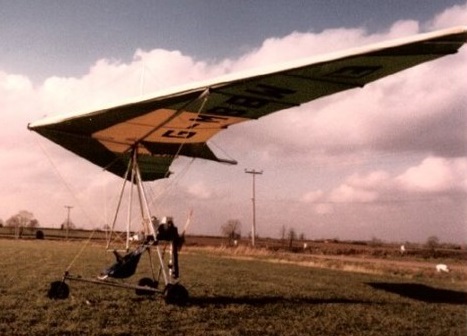
The Skytrike was the first British produced trike unit; allied to Hiway’s simple but effective Super Scorpion wing, (usually in the larger ‘C’ size). Designed by Frank Tarjanyi, the Skytrike/Super Scorpion C was introduced in 1979, the combination of a single surface wing and 10 hp did not exactly make for high performance and its pilot weight range was distinctly limited, but the basic formula was obviously right. The power shortage was solved by the introduction of Robin engines, in which form the trike unit was dubbed Skytrike Mk II, with the Valmet engined version being known retrospectively as the Mk I. Two versions of the Mk II were offered, a single cylinder 250 cc version which usually retained the Super Scorpion wing, and a twin cylinder 330 cc version which typically is flown with the Hiway Demon wing.
Hiway Skytrike with Valmet 160 (courtesy Job Chithalan)
Hiway’s next move was an attempt to retain the performance of the 330 cc version but save some weight, by using the small but powerful liquid cooled Hiro Delta MkI engine to produce the Hiro Skytrike trike unit. The result was an aircraft with an impressive performance for its engine size, due partly to the elimination of drive belts in favour of integral reduction gearing. Moreover, the liquid cooling allowed the inclusion of an effective carburettor anti icing system. Other than the engine, the only significant change to the trike unit was the replacement of the front wire by a strut.
Despite these qualities, the Hiro Skytrike found few buyers in a market which was becoming enamoured with the smoothness and reliability of the 330 cc Robin. It was not helped by the Skytrike’s growing reputation for poor detail engineering. Having made the initial great leap to power, it seemed that the company’s heart had returned to soaring; the marketing and detail development of the Skytrike were neglected and the company’s resources concentrated instead on a radical new hang glider called the Explorer. When this was received less than rapturously by the hang gliding world, it spelt the end of the company. In 1983 Hiway Hang Gliders Ltd was in liquidation.
160cc Valmet engined Hiway Skytrike with Flexiform Hilander wing (1981)
The Mk.II 330/Demon wing has floating cross tube construc¬tion with 75% double surface enclosing cross¬tube; pre formed ribs, and optional nosewheel brake.
Mk.I Engine: Valmet, 10 hp at 5000 rpm. Propeller diameter and pitch 54 x 30 ft, 1.37 x 0.76 m. V belt re¬duction, ratio 2.8/1. Max static thrust 75 lb, 34 kg. Power per unit area 0.05 hp/sq.ft, 0.5 hp/sq.m. Fuel capacity 2.1 US gal, 1.8 Imp gal, 7.9 litre. Wing span 33.5 ft, 10.21 m. Mean chord at 5.9 ft, 1.80 m. Total wing area 198 sq.ft, 18.4 sq.m. Wing aspect ratio 5.7/1. Empty weight 1251b, 57kg. Max take off weight 286 lb, 130kg. Payload 161 lb, 73kg. Max wing loading 1.44 lb/sq.ft, 7.1 kg/sq.m Max power loading 28.6 lb/hp, 13.0 kg/hp. Max level speed 26 mph, 42 kph. Never exceed speed 40 mph, 64kph. Max cruising speed 22mph, 35kph. Economic cruising speed 22mph, 35kph. Stalling speed 17 mph, 27 kph. Max climb rate at sea level 100 ft/min, 0.5 m/s. Min sink rate 190 ft/min at 21 mph, 1.0 m/s at 34 kph. Best glide ratio with power off 8/1 at 22 mph, 35 kph. Take off distance 150 ft, 45 m Land¬ing distance 70 ft, 20 m Range at average cruising speed 51 mile, 83 km.
Mk.II 250/Super Scorpion C Engine: Robin EC25PS, 18 hp at 7000 rpm. Propeller diameter and pitch 52 x 31 inch, 1.32 x 0.79 m. V belt reduction, ratio 2.3/1. (Early aircraft used a 54×24 inch propeller with reduction ratio 2/1.) Max static thrust 1301b, 59kg. Power per unit area 0.09hp/sq.ft, 1.0hp/sq.m. Fuel capacity 2.4 US gal, 2.0 Imp gal, 9.1 litre. (Early aircraft used a 1.6 US gal (1.3 Imp gal, 6.1 litre) fuel tank.) Wing span 33.5 ft, 10.21 m. Mean chord at 5.9 ft, 1.80 m. Total wing area 198 sq.ft, 18.4 sq.m. Wing aspect ratio 5.7/1. Empty weight 1651b, 75kg. Max take off weight 3491b, 158kg. Payload 1841b, 83kg. Max wing loading 1.76 lb/sq.ft, 8.6kg/sq.m. Max pow¬er loading 19.41b/hp, 8.8kg/hp. Max level speed 30 mph, 48 kph. Never exceed speed 45 mph, 72kph. Max cruising speed 25mph, 40kph. Economic cruising speed 25 mph, 40 kph. Stalling speed 18 mph, 29 kph. Max climb rate at sea level 300 ft/min, 1.5 m/s. Min sink rate 250 ft/min at 25 mph, 1.3 m/s at 40 kph. Best glide ratio with power off 9/1 at 25 mph, 40kph. Take off distance 90 100ft, 25 30 m. Landing distance 90 100ft, 25 30m. Range at average cruising speed 50 mile, 80 km.
Mk.II 330/Demon Engine: Robin EC34PM, 32 hp at 6500 rpm. Propeller diameter and pitch 52 x 30 inch, 1.32 x 0.76 m. V belt reduction, ratio 2/1. Max static thrust 180 lb, 82 kg. Power per unit area 0.18 hp/sq.ft, 2.0 hp/sq.m. Fuel capacity 2.4 US gal, 2.0 Imp gal, 9.1 litre. (Early aircraft used a 1.6 US gal (1.3 Imp gal, 6.1 litre) fuel tank.). Length overall 11.0ft, 3.35m. Wing span 32.0ft, 9.75m. Chord at root 8.2ft, 2.50m. Chord at tip 3.5 ft, 1.07 m. Dihedral 0 degs Nose angle 120 degs. Total wing area 175 sq.ft, 16.3 sq.m. Wing aspect ratio 5.9/1. Empty weight 195 lb, 88kg. Max take off weight 470 lb, 213 kg. Payload 275 lb, 125 kg. Max wing loading 2.69 lb/sq.ft, 13.1 kg/sq.m. Max power loading 14.7 lb/hp, 6.7kg/hp. Max level speed 40 mph, 64 kph. Never exceed speed 45 mph, 72 kph. Max cruising speed 35 mph, 56 kph. Economic cruising speed 30mph, 48kph. Stalling speed 22 mph, 35 kph. Max climb rate at sea level 600 ft/min, 3.0 m/s. Min sink rate 300 ft/min at 28 mph, 1.5 m/s at 45 kph. Best glide ratio with power off 7/1 at 28 mph, 45 kph. Take off distance 80 ft, 25 m. Landing distance 100 ft, 30 m. Range at average cruising speed 65 mile, 105 km.
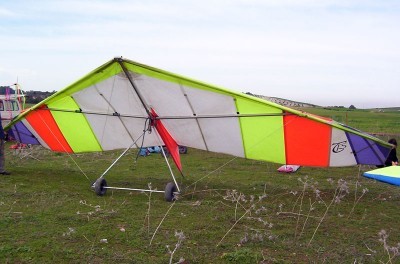
The 1980 Demon was the first double surface wing produced by the Hiway company. Produced in three sizes, 150, 175 and 195 (between 80 and 83) the Demon was regarded as an excellent performer which has mellow handling. A distinguishing feature is the use of a foam insert in the leading edge as opposed to mylar sheet used by competitors.
A 165 which was a 198 prototype Demon had extremely light handling and ‘suspicious’ in pitch but production gliders were fine in this respect. All Demons had foam-backed leading edges as opposed to Mylar. Later models also had blue ‘painted’ rather than anodised tubing.
It was quite heavy at the time.
The Demon (for advanced pilots) was also made under license from Hiway by Flight Designs of Salinas, California. The American version also served as the wing for the “Jetwing” trike also produced by Flight Designs. After Flight Designs was bought out by Pioneer Parachute in 1982, some sails were made by the latter company. These were highly inferior to the original versions, and can be identified by the use of straight-stitch seams rather than zig-zag seams.
1980 Demon medium Leading edge: 19 ft Root chord: 8 ft 5 in Span: 33 ft 6 in Nose angle: 130 deg approx. Weight: 72 lb
1980 Demon large Weight 68 lb
Demon 160 Wing area: 14.8 m² Wing span: 9.73 m Aspect ratio: 6.4 Hang glider weight: 29 kg Minimum pilot weight: 54 kg Maximum pilot weight: 69 kg Minimum speed: 25 km/h Max glide ratio (L/H): 8.6 Max glide ratio speed: 29 km/h Minimum sink rate: 0.9 m/s Packed length: 5.57 m Packed length short: 4.25 m Nose angle: 125°
Demon 175 Wing area: 16.26 m² Wing span: 10 m Aspect ratio: 6.2 Hang glider weight: 33 kg Minimum pilot weight: 63 kg Maximum pilot weight: 91 kg Max glide ratio speed: 30 km/h Packed length: 5.67 m Packed length short: 4.25 m Nose angle: 125°
Demon 195 Wing area: 18.12 m² Wing span: 10.6 m Aspect ratio: 6.3 Hang glider weight: 32 kg Minimum pilot weight: 82 kg Maximum pilot weight: 100 kg Max glide ratio speed: 32 km/h Nose angle: 125°
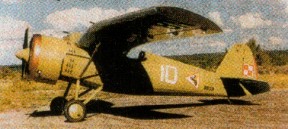
Historical Aircraft Corp offers kits to build a range of 60 percent scale single-seat fighter representations, including P-51D, Corsair, PZL P.11 c and, P-40 Tomahawk, plus an 85 percent scale representation of Ryan STA. First flown in 1990, the kit included engine, prop and instruments, with a 1997 price of US$25,500. Historical Aircraft Corp P.11c
Top speed: 105 mph Cruise: 90 mph Stall: 55 mph Range: 300 sm Rate of climb: 900 fpm Takeoff dist: 900 ft Landing dist: 900 ft Service ceiling: 12,500 ft Engine: 100 hp Fuel capacity: 11 USG Empty weight: 850 lb Gross weight: 1100 lb Height: 7.5 ft Length: 18.3 ft Wing span: 27.8 ft Wing area: 97.3 sq.ft Seats: 1 Landing gear: tailwheel
Historical Aircraft Corp offers kits to build a range of 60 percent scale single-seat fighter representations, including P-51D, Corsair, PZL P.11 c and, P-40 Tomahawk, plus an 85 percent scale representation of Ryan STA.