Pazmany

Ladislao Pazmany in 1941

Ladislao Pazmany is of Hungarian descent. His family moved to Argentina when he was three and he grew up and was educated there. After obtaining a degree in aero engineering, he worked wherever engineering jobs were available in the unstable economy that prevailed in Argentina at the time.

For nearly a decade he designed aircraft, pipelines, high tension power towers, suspenison bridges, chemical and hydroelectric plants, was an instructor at an aeronautics school.

In May of l956 Paz and his family moved to the U.S. and settled in San Diego where he went to work for Convair. The following month he attended his first EAA Chapter 14 meeting and has been involved in EAA activity ever since. At Convair, he worked on F-102, F-106 and other projects, and founded L. Pazmany & Associates at San Diego, California.

Concurrent with his full time employment he designed he PL-1, which flew for the first time on March 23, 1962, made plans available to homebuilders and wrote the book “Light Airplane Design”.

1980-95: Pazmany Aircraft, P.O. Box 80051, San Diego, CA 92138.

Paxman’s Northern Lite Aerocraft Viper

A wood and fabric design, the prototype was completed in 1994. The kit price in 1997 was US$7500, including engine, prop and instruments.

Engine: Subaru EA 81, 100 hp
HP range: 65-115
Height: 6 ft
Length: 20.5 ft
Wing span: 27 ft
Wing area: 102 sq.ft
Empty weight: 650 lb
Gross weight: 1300 lb
Fuel capacity: 17 USG
Top speed: 130 mph
Cruise: 110 mph
Stall: 38 mph
Range: 585 sm
Rate of climb: 1500 fpm
Takeoff dist: 300 ft
Landing dist: 400 ft
Seats: 2
Landing gear: tailwheel

Engine: Suzuki Turbo, 100 hp
HP range: 65-115
Height: 6 ft
Length: 20.5 ft
Wing span: 27 ft
Wing area: 102 sq.ft
Weight empty: 585 lbs
Gross: 1050 lbs
Fuel cap: 17 USG
Speed max: 125 mph
Cruise: 110 mph
Range: 585 sm
Stall: 38 mph
ROC: 1500 fpm
Take-off dist: 300 ft
Landing dist: 400 ft
Seats: 2
Landing gear: tail wheel

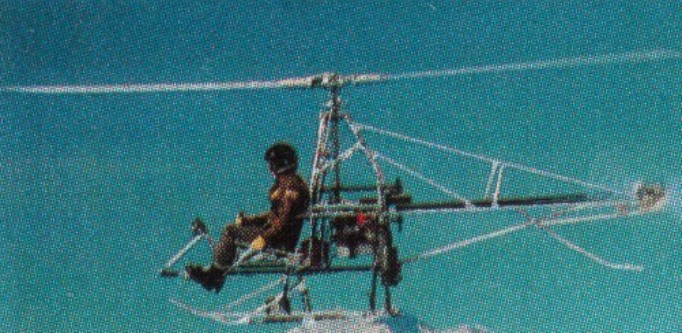
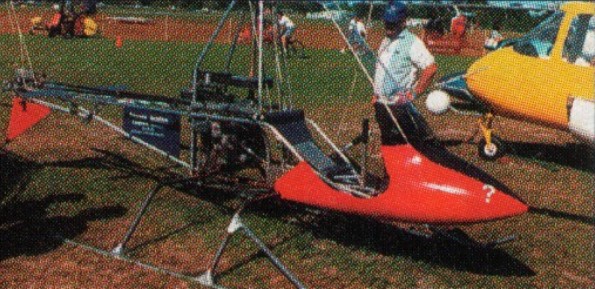
Pawnee Aviation Warrior

A kit helicopter, first flown in 1992, the kits had all major parts assembled, and all blades and parts balanced.
Kit price in 1997 was US$15,500.

Engine: Hirth, 65 hp
hp range: 65-110
Height: 7 ft
Length: 15 ft
Disk span: 21 ft
Empty weight: 435 lb
Gross weight: 825 lb
Fuel capacity: 14 USG
Max speed: 100 mph
Cruise: 80 mph
Range: 175 sm
Rate of climb: 1000 fpm
Service ceiling: 10,000 ft
Seats: 1

Paup P-Craft

Single seat single engined high wing monoplane with two axis control (optional conventional three axis control). Wing has unswept leading edge, swept forward trailing edge and tapering chord; cruciform tail. Pitch control by elevator on tail; yaw control by fin mounted rudder; no separate roll control (optional roll control by ailerons); control inputs through stick for pitch/yaw and (optionally) pedals for roll. Wing braced from below by struts; wing profile; double surface. Undercarriage has three wheels in tail dragger formation; bungee suspension on all wheels. Push right go right tailwheel steering connected to yaw control. No brakes. Aluminium tube/steel tube framework, without pod. Engine mounted below wing driving pusher propeller. Framework in 2024T3 aluminium and 4130 chrome moly steel. Wing covering is Stits Polyfiber, doped.
Shown for the first time to the public at 0shkosh in August 1982, P Craft from D Paup appears to be a minimum aircraft and as such is directly descended from the Kolb Flyer and Ron Wheeler Scout.

This one offers the choice between two axis control, with steering by induced roll, or conventional three axis control when fitted with ailerons (an option on the standard kit). Where the lower longeron and a higher, nearly parallel tube which carries the pilot seat meet at the nose, there is a horizontal transverse tube on which can be hinged the rudder pedals.

Paup aircraft offers the two axis version in kit form, requiring 150 hours for completion, at the price of $3395 in 1983.

Engine: Cuyuna 215D, 20hp at 6000rpm
Propeller diameter and pitch 36 x 12 inch, 0.91 x 0.30 m
No reduction
Power per unit area 0.15hp/sq.ft, 1.6hp/sq.m
Fuel capacity 2.5 US gal, 2.1 Imp gal, 9.5 litre
Wing span 32.5 ft, 9.88 m
Total wing area 132 sq.ft, 12.3 sq.m
Wing aspect ratio 8.0/1
Main wheels diameter overall 20 inch, 51 cm
Empty weight 165 lb, 75kg
Max take off weight 402 lb, 182 kg
Payload 237 lb, 107 kg
Max wing loading 3.05 lb/sq.ft, 14.8 kg/sq.m
Max power loading 20.1 lb/hp, 9.1 kg/hp
Max level speed 60 mph, 97 kph
Never exceed speed 70 mph, 113 kph
Max cruising speed 50 mph, 80 kph
Economic cruising speed 35 mph, 56 kph
Stalling speed 22 mph, 35 kph
Max climb rate at sea level 300ft/min, 1.5m/s
Take off distance 75 ft, 23 m

Patricroft Rogallo

Geoff Ball and Hughie McGovern

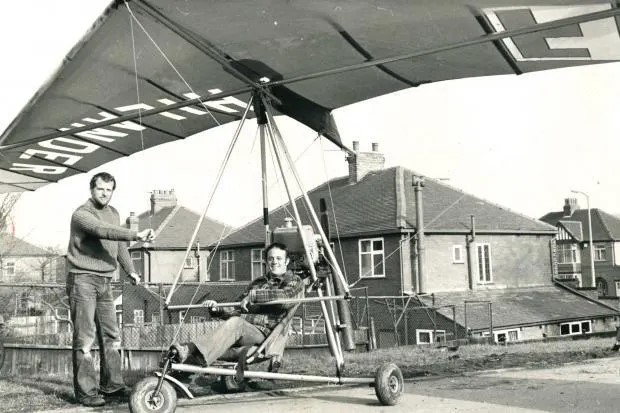
Geoff Ball and Hughie McGovern had a novel way of beating the traffic to work in the morning in 1981 – they flew in by hang-glider.
The engineers worked at Patricroft which made powered hang-gliders and they commuted to the factor from a field near Geoff’s Meadowside Avenue home in Tong Fold.

The journey took them less than 10 minutes and they never had to face any hold-ups

Partenavia Costruzioni Aeronautiche Spa

In the postwar period, Luigi “Gino” Pascale and his brother Giovanni “Nino” Pascale of Naples, Italy, having been enthusiastic flying model aircraft makers, decided to work on full-scale aircraft. The first, built while the brothers were college students, was the “P.48 Astore (Goshawk)” — a two-seat aircraft, with the seats in tandem, featuring a high strut-braced wing, fixed taildragger landing gear, and a Continental O-170 / A65 flat-four air-cooled engine with 48 kW (65 HP).

One Astore was built, performing its initial flight in 1952 — by which time Luigi Pascale had become an instructor in mechanical engineering at Naples University, where he would become a full professor and help establish a department of aeronautical engineering. The Astore was followed by other one-off designs:
P.52 Tigrotto (Tiger Cub)
P.53 Aeroscooter
P.55 Tornado
P.57 Fachiro
The Fachiro I was followed by three “Fachiro II” and then 33 “Fachiro III”.

Partenavia Costruzioni Aeronautiche Spa, a Naples company formed in 1949 to build series of light aircraft. First to enter production was the P-57 Fachiro of 1957, a four-seat high-wing monoplane with Lycoming engine. This was followed by various developments including the P.64 Oscar (first flown April 1965), also produced in South Africa under license as the RSA.200 by AFIC (Pty) Ltd, and the P.66 Charlie. Partenavia’s first twin was the P.68 six-seat light transport, first flown in May 1970. It was subsequently placed into production in several forms, including the Observer 2 for observation and patrol. AP.68 TP-600 Viator 11 seat transport followed in March 1985. New projects in the early 1990s included PD.93 Idea four-seat trainer and utility monoplane, but in March 1998 Partenavia ceased work and its P.68 series was bought via auction by VulcanAir SpA.

After financial difficulties the company reappeared, in 1986, as Costruzioni Aeronautiche Tecnam (see Tecnam).

In 2008, Partenavia, an Aeritalia division, announced a decision to transfer manufacturing of single engined aircraft, including the mosquito, to fellow Aeritalia subsidiary Aviolight, which was floated at the end of February 2008.