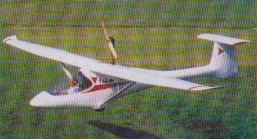
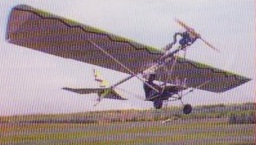
The Tukan features a composite fuselage and fabric covered wood wings. Air brakes are fitted on the upper wing surface. The engine can fold back to inside the fuselage.
Engine: Rotax 447, 40 hp Wing span: 14.7 m Wing area: 14.7 sq.m MAUW: 420 kg Empty weight: 215 kg Fuel capacity: 32 lt Max speed: 125 kph Cruise speed: 85 kph Minimum speed: 60 kph Climb rate: 2 m/s Fuel consumption: 8 lt/hr Seats: 2
Markets plans and kits to build the N-3 Pup single-seat microlight representation of a Piper Cub, the Sport as a lighter version of Pup, the L-4 Super Pup as a more-powerful version of Pup, and the two-seat Ultra Pup, and kits for the Stinger single-seat parasol-wing monoplane (first flown 1995). Also produced the Storch Replica.
1995: 1230 Shepard St, Hendersonville, NC 28792, USA.
The Pratt & Whitney Canada PW300 series is a family of turbofan engines developed by Pratt & Whitney Canada specifically for business jet applications.
The basic configuration of the PW300 is as follows: single stage fan, driven by a three-stage low pressure turbine, supercharging a four-stage axial/single stage centrifugal high pressure compressor, driven by a two stage high pressure turbine. An annular combustor is featured. Some versions have an unmixed exhaust, but the PW306 and PW308 include a forced mixer. A Full Authority Digital Engine Control (FADEC) system is incorporated.
The PW307A is a new centre-line engine developed specifically for a tri-jet application on the Dassault Falcon 7X. The PW307 was certified by Transport Canada in March 2005.
The PW308A has been chosen to power the Scaled Composites White Knight Two, the launch aircraft for Virgin Galactic’s SpaceShipTwo.
Variants: PW305A 20.81kN variant used on the Bombardier Learjet 60
PW305B 23.41kN variant used on the Hawker 1000
PW306A 25.36kN variant used on the IAI Galaxy & Gulfstream G200
PW306BL variant used on the Dornier 328JET
PW306C 25.67kN variant used on the Cessna Citation Sovereign
PW307A 28.49kN variant used on the Dassault Falcon 7X
PW307B variant used on the Bombardier Learjet 85
PW308A 30.69kN (6900 lb) variant used on the Hawker 4000 & Scaled Composites White Knight Two
PW308C 31.14kN variant used on the Dassault Falcon 2000EX/DX/LX
The Pratt & Whitney Canada PW100 aero engine family is a series of 2,000 to 5,000 horsepower (1,500 to 3,700 kW) turboprops manufactured by Pratt and Whitney’s Canadian subsidiary. The engine first entered service in 1984.
Originally called the PT7, the PW100 uses a relatively unusual three-shaft engine configuration. In the PW100, a centrifugal LP impeller (except for the PW150 which uses a 3-stage axial LP compressor), driven by a single stage LP turbine, supercharges a centrifugal HP impeller, driven by a single stage HP turbine. Power is delivered to the offset propeller reduction gearbox via a third shaft, connected to a 2-stage free (power) turbine.
Variants: PW115
PW118 Certified in 1986 with a maximum continuous rating of 1892eshp (1411kW), can be converted to a PW118A.
PW118A Certified in 1987 with a maximum continuous rating of 1893eshp (1412kW), can be converted to a PW118B.
PW118B Certified in 1996 with a maximum continuous rating of 1892eshp (1412kW).
PW119
PW119A Certified in 1992 with a maximum continuous rating of 1948eshp (1453kW), can be converted to a PW119B.
PW119B Certified in 1993 with a maximum continuous rating of 1941eshp (1448kW), can be converted to a PW119C.
PW119C Certified in 1995 with a maximum continuous rating of 1941eshp (1448kW), can be converted to a PW119B.
PW120 Certified in 1983 with a maximum continuous rating of 1787eshp (1333kW), can be converted to a PW121.
PW120A Certified in 1984 with a maximum continuous rating of 1892eshp (1411kW), can be converted to a PW121.
PW121 Certified in 1987 with a maximum continuous rating of 2044eshp (1524kW), can be converted to a PW120.
PW121A Certified in 1995 with a maximum continuous rating of 1992eshp (1465kW).
PW123 Certified in 1987 with a maximum continuous rating of 2261eshp (1687kW), can be converted to a PW123B, C, D or E.
PW123AF Certified in 1989 with a maximum continuous rating of 2261eshp (1686kW), can be converted to PW123.
PW123B Certified in 1991 with a maximum continuous rating of 2262eshp (1687kW), can be converted to a PW123.
PW123C Certified in 1994 with a maximum continuous rating of 2054eshp (1532kW), can be converted to a PW123 or D.
PW123D Certified in 1994 with a maximum continuous rating of 2054eshp (1532kW), can be converted to a PW123 or C.
PW123E Certified in 1995 with a maximum continuous rating of 2261eshp (1687kW), can be converted to a PW123.
PW124
PW124A
PW124B Certified in 1988 with a maximum continuous rating of 2522eshp (1881kW), can be converted to a PW123 or PW127.
PW125
PW125A
PW125B Certified in 1987 with a maximum continuous rating of 2261eshp (1687kW).
PW126 Certified in 1987 with a maximum continuous rating of 2323eshp (1732kW) can be converted to a PW123 or PW126A.
PW126A Certified in 1989 with a maximum continuous rating of 2493eshp (1859kW), can be converted to a PW123 or PW127D.
PW127 Certified in 1992 with a maximum continuous rating of 2619eshp (1953kW), can be converted to a PW127C,E or F.
PW127A Certified in 1992 with a maximum continuous rating of 2620eshp (1954kW), can be converted to a PW127B.
PW127B Certified in 1992 with a maximum continuous rating of 2619eshp (1953kW).
PW127C Certified in 1992 with a maximum continuous rating of 2880eshp (2148kW).
PW127D Certified in 1993 with a maximum continuous rating of 2880eshp (2148kW), can be converted to a PW127B.
PW127E Certified in 1994 with a maximum continuous rating of 2516eshp (1876kW), can be converted to a PW127M.
PW127F Certified in 1996 with a maximum continuous rating of 2619eshp (1953kW), can be converted to a PW127M.
PW127G Certified in 1997 with a maximum continuous rating of 3058eshp (2281kW).
PW127H Certified in 1998 with a maximum continuous rating of 2880eshp (2148kW).
PW127J Certified in 1999 with a maximum continuous rating of 2880eshp (2148kW).
PW127M Certified in 2007 with a maximum continuous rating of 2619eshp (1953kW).
PW150A Certified in 1998-06-24 with a maximum continuous rating of 5071 SHP (3782kW), although capable of up to 7000 SHP. Has a 3 stage axial low pressure compressor instead of the centrifugal NL unit on other variants. Used on the Bombardier Q400.
ST18M marine application for PW100
ST40M marine application for PW150A
Applications ATR 42 (PW120 on -200, PW127E on -500, PW127M on -600) ATR 72 (PW124B on -100 -200, PW127F or M on -500, PW127M on -600) BAe ATP (PW126) Bombardier 415 (PW123AF) Bombardier CL-215T (PW123AF) Bombardier Q100 (PW121) Bombardier Q200/Q300 (PW123) Bombardier Q400 (PW150) Canadair CL-415 (PW123AF) Dornier 328 (PW119) EADS CASA C-295 (PW127G) Embraer EMB 120 Brasilia (PW115, latterly PW118A) Euromil Mi-38 (PW127TS) Fokker 50 (PW125B) Fokker 60 (PW127B) Ilyushin Il-114 (PW127H) Xian MA60 (PW127J)
Specifications: Type: Turboprop Length: Diameter: Dry weight: 929 pounds Weight with accessories and fluid 1064 pounds Compressor: LP and HP independent centrifugal compressors. PW150 LP compressor is three-stage axial. Combustors: Annular reverse flow combustion chamber Turbine: Axial flow: single-stage HP; single-stage LP; the power turbine has two stages on all PW100 variants, and three stages on the PW150. Fuel type: JET A Oil system: Self-contained system Maximum power output: PW120 – takeoff 1800shp – Rto 2000shp PW121 – takeoff 1900shp – Rto 2100shp PW124 – takeoff 2160shp – Rto 2400shp PW127 – takeoff 2475shp – Rto 2750shp Turbine inlet temperature: max ITT for Reserve takeoff power, 816c Start 950c 5 seconds