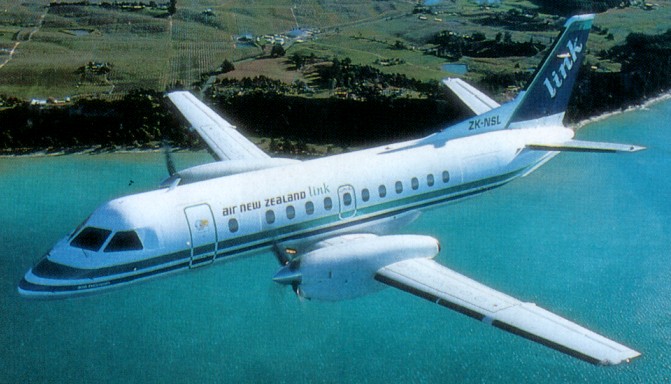
SAAB SF 340

SF340A

For several years, Saab-Scania had been working on a project known as Aircraft 108 (later renamed the Transporter), calculation and design work on the later versions of which (1083 and 1084) had advanced to the stage at which production was feasible. The scope of the project was such that the initial costs and the risks involved were substantial, added to which Saab-Scania had no recent experience in marketing an airliner. As a result SAAB sought a partner in the venture. Negotiations were initiated in 1979 with Fairchild Industries.

SAAB SF 340 Article

This resulted in a 65/35 co-operation agreement being signed on January 25 1980. In this agreement, Fairchild would manufacture the wing and tailplane surfaces and the engine housings at its Republic factory on Long Island, and Saab would manufacture the fuselage and be responsible for final assembly at its new plant in Linkoping, Sweden. SAAB was also responsible for the systems integration, and flight-testing.

Initial project name was ‘3000’ but in July 1980, it was officially named Saab-Fairchild SF-340. In June 1980 General Electric was selected as the engine supplier with its new CT-7 engine derived from the T-700 helicopter unit. Meanwhile Saab had placed a group of engineers with Fairchild to design the aircraft following 15 September 1980. Most of 1980 went to define the aircraft and build a wooden mock-up in Linkoping.

A cantilever low-wing monoplane of basic all-metal structure with the selective use of composite materials, the aircraft is of conventional configuration; it has a fail-safe pressurised fuselage structure, retractable tricycle landing gear with twin wheels on each unit, and is powered by two turboprop engines in wing-mounted nacelles.

The aircraft comprises a round-section fuselage seating up to 35 passengers with a flight attendant and two-person crew. The wing uses NASA-developed low-drag airfoil technology, and two General Electric CT7 turboprops were chosen as powerplants.

Marketing of the aircraft began immediately and early customers were Crossair in Switzerland, Swedair in Sweden and Comair and Air Midwest in USA. In late 1981 production began in the brand new facilities in Linkoping adjacent to the military factory, By early 1982 major sub-assemblies were finished and the first wing was lifted out of the jig in April. The fuselage and wing were mated in August. The rolling out the prototype came on 27 October 1982 in the presence of the Swedish King.

The first Saab-Fairchild 340 prototype (SE-ISF) flew on 25 January 1983, three years to the day after the agreement had been signed with Fairchild. This, plus a second prototype (SE-ISA) and the first production aircraft (SE-ISB flown on 25 August 1983) participated in the certification programme. After a flight test period lasting 16 months involving four aircraft, the SF-340 received its JAR type-certificate on May 30 1984 and FAA approval granted by 29 June 1984. The 340 was the first aircraft to be certified under the new JAR rules in which Belgiurn, Finland, France, Germany, Holland, Norway, Sweden, Switzerland and the UK participated. Australia followed on October 30. The prototype was subsequently mounted on a pole outside Linkoping when the city celebrated its 700 anniversary.

The second prototype has been retained for the subsequent flight-testing including the 340B certification. It was being used in preparation for the Saab 2000 flight test programme.

The third 340, was a pre-production aircraft. It was subsequently modified by Fairchild to incorporate an APU. It was later cut up, and various pieces used for the Saab 2000 programme. The last aircraft was the first production standard, and was later delivered to Comair.

The first production aircraft, s/n 003 SE-ISB, was flown on 25 August 1983.

SAAB SF340A s/n 005 was the first delivered, and it went to Crossair on 6 June 1984. This was placed into service on June 15 flying from Basle to Paris.

Initially two versions were on offer: the basic air transport configuration and an executive version. The first of these ‘biz-props’ was sold to Pittsburgh’s Mellon Bank. The type suffered a setback in 1984 when it was temporarily grounded, after Crossair suffered inflight engine shut downs, but these teething troubles were soon rectified and Saab pressed on with the next stage in the aircraft’s development. In 1985, at the Paris air show, Saab launched a 340 with uprated CT7 engines driving larger Dowty propellers. Maximum take-off weight was increased from the original 11,793kg to 12,872kg. Existing SF-340s were offered the improvement as a modification programme.

Saab attempted to sell the 340 as a corporate aircraft, but only sold four 340As. For this marketing campaign the Saab office in USA actually operated a corporate demonstrator (N340SF) during 1985 and 1986. As the sales-result could not warrant an exclusive demonstrator, it was sold and later converted to airliner standard for Comair.

Fairchild entered economic problems partly due to the increased costs of starting up the 340 programme and partly because of the cancelled T-46 programme. Fairchild withdrew from the aircraft business altogether. Swearingen in Texas was sold and an agreement was reached with Saab to withdraw from the 340 programme. As of 1 November 1985, Saab took over the responsibility for the 340 and renamed it the ‘Saab SF-340’. In 1987 it became simply the ‘Saab 340’ and the factory in Linkoping was expanded to take over the wing- and tail-production, completed in June 1986. SAAB initially retained the SF340 designation but later changed it to 340A.

Next version to be offered was the freighter S340QC which was a quick-change cargo aircraft, the first of which was delivered to Finnaviation in 1987. In that same year, as Saab severed its final links with Fairchild, the family was renamed the S340.

The 100th 340 was delivered in September 1987.

1987 saw the launch of the Saab 340B, first flying on April 21 1989, which features higher power output CT7-9B engines, a larger span tailplane, and a further increased maximum takeoff weight of 12,928kg. Crossair was again the launch customer for this version. From aircraft number 160, all 340s were ‘B’ models. The last SF340A, of 159, was delivered in August 1989. The SF340B has two 1750 shp (1 305 kW) GE CT7-9B turboprops for hot and high use.

Announced improvements to the Saab 340 will enhance the aircraft’s hot-and-high performance and short field capability, through a 0.6m wingtip extension. This increases the Saab 340’s takeoff weight by 544kg, equivalent to six/seven passengers. A third-generation cabin interior, common to the Saab 2000, was also being introduced, along with modifications to the APU and optional low-pressure tyres.

In 1987 and 1988 44 340s were sold each year. In 1989 Saab sold 123 aircraft, the 300 mark was reached in 1990. By mid-1993 Saab 340 orders had exceeded 400, with over 340 delivered, to 28 airlines and four corporate clients.
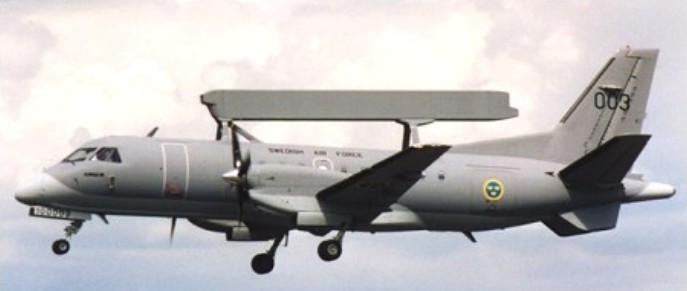
SF340AEW

For the Swedish military the SAAB-340AEW Erieye airborne early warning version was developed, the contract for which was signed by the Swedish air force on 3 February 1993.

This version features an Ericsson phased array surveillance radar above the fuselage, with three operators in the cabin and a mission endurance of up to seven hours. Six aircraft were anticipated lor Swedish service with an initial in-service date of 1995.
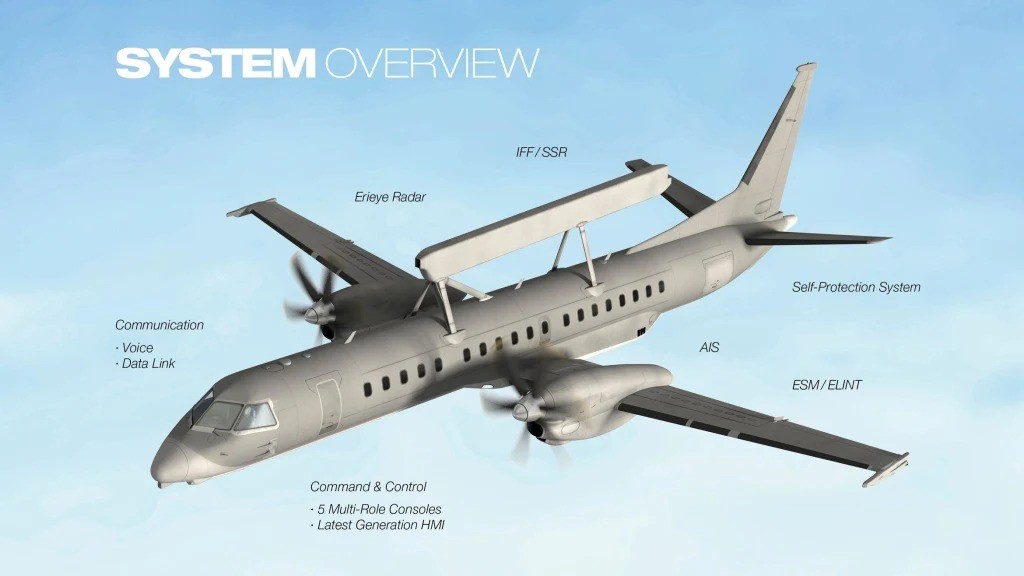
Saab 2000 Erieye AEW&C

The last development of the 340 was the 340B Plus, that introduced changes developed for the larger SAAB 2000. The first 340B Plus was delivered in March 1994. Production of the 340 ended in 1999 with a total of 459 airframes built.

Air Lingus SF340s were disposed of in 1997.

Gallery

340A
Engines: 2 x General Electric CT7-5A2, 1735 hp
Accommodation: 30-37
Wing span: 21,44 m (70 ft 4 in)
Wing area: 41.81 sq.m (450 sq.ft)
Length: 19.72m (64ft 8in)
Height: 6.87 m (22 ft 6 in)
Max. t/o weight: 12400 kg / 27337 lb
Max. land, weight: 27,200 lb
Max. payload: 8,085 lb
OEW: 17,6151b
Typical cruis. speed: 275 kt
Maximum/cruising speed: 507 kph / 315 mph
Landing speed: 154 kph / 96 mph
Range: 805 nm / 1500 km / 930 miles
T/o field length: 3,900 ft
Max, ceiling: 8500 m / 27890 ft
Max, ceiling Exec. version: 25,000ft
Max. SL cabin altitude: 3650 m / 11975 ft

340B
Engines: 2 x General Electric CT7-9B, 1750 shp (1305 kW)
Wing span: 21.44 m (70 ft 4 in)
Wing area: 41.81 sq. m (450 sq. ft)
Length: 19.73 m (64 ft 9 in)
Height: 6.87 m (22 ft 6 in)
Max. t/o weight: 13000 kg / 28660 lb
Max. land. weight: 28, 000 lb
Max. payload: 8,285 lb
OEW: 8035 kg / 17714 lb
Typical cruise speed: 285 kt / 522 km/h / 324 mph
Range (35 pax): 980 nrn / 1807 km / 1123 miles
T/o field length: 4,050ft
Max ceiling: 25,000 ft / 7620 m
Accommodation: 30-37

Saab 340

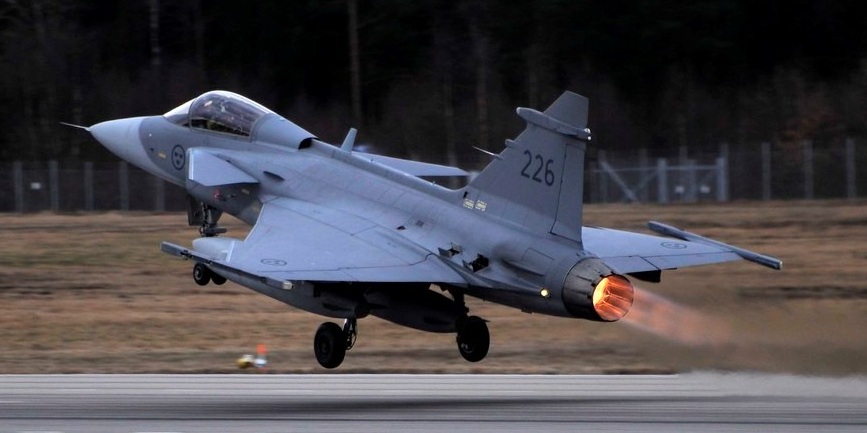
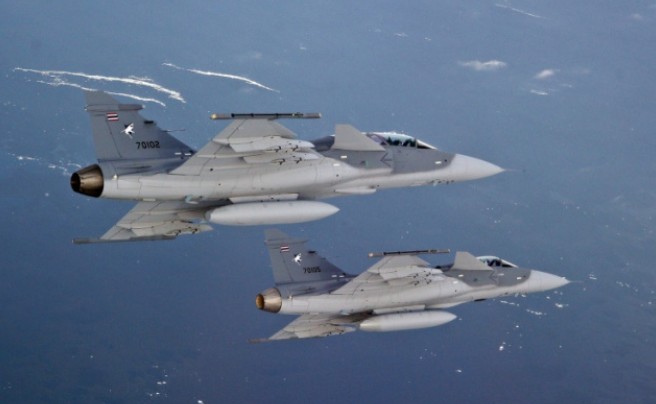
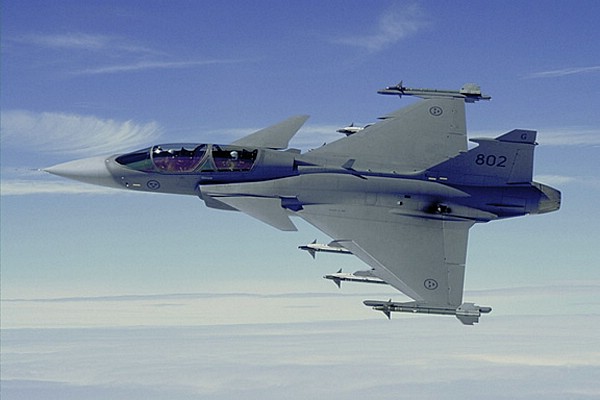
SAAB JAS-39 Gripen

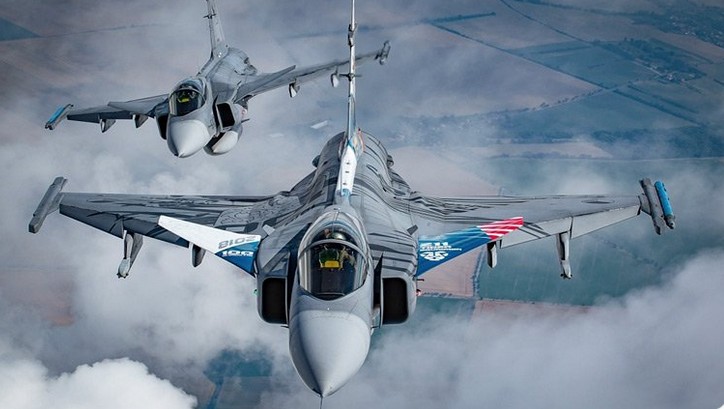
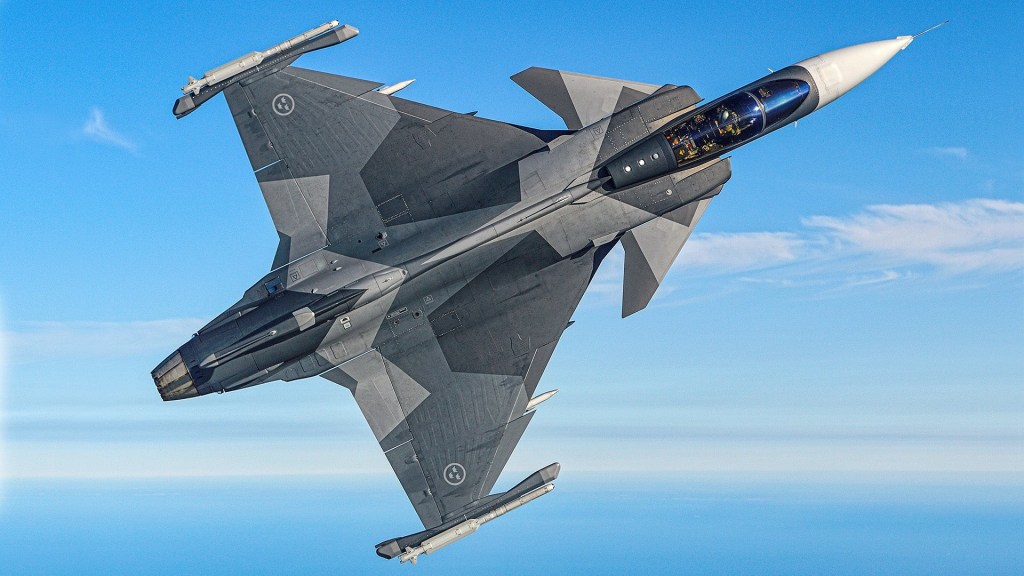
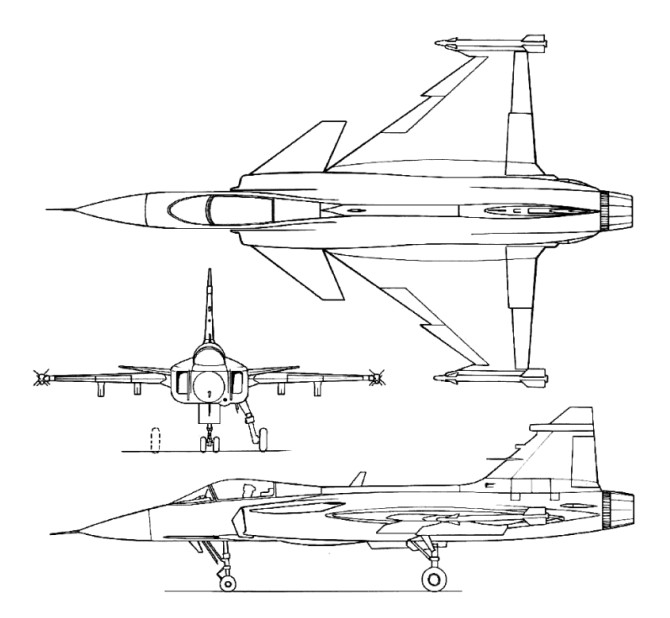
The JAS 39 Gripen is a small, agile and lightweight fighter design for multiple roles in the Royal Swedish Air Force. JAS stands for Jagt-Attack-Spaning which means Fighter-Attack-Reconnaissance. The Gripen (Griffon) design features canards positioned close in front of the delta wing. It is powered by a single 80kN reheated Volvo RM12 licensed built General Electric F404-GE-400 engine.

SAAB JAS-39 Gripen Article

The JAS 39 Gripen is a Swedish fourth-generation multi-role fighter developed by Saab. Its name comes from the mythical griffin, symbolizing divine power.
The design work began in 1979, the first flight took place in 1988, and in 1997 the Gripen entered service with the Swedish Air Force. Costs range from $30 million to $60 million depending on the modification.

The fighter features a canard aerodynamic layout: control surfaces generate lift at any speed, while the delta wing compensates for negative lift at supersonic speeds. This design provides high maneuverability, stability during supersonic flight, and excellent takeoff and landing performance.
To reduce landing distance, the aircraft is equipped with powerful air brakes. Key systems, including the RM12 engine and PS-05/A radar, are modular, simplifying maintenance and upgrades.
A powerful turbofan engine with high bypass allows a top speed of 2,130 km/h and takeoff acceleration in 18 seconds. Initially, the aircraft had a limited weapons set, but it later gained the ability to use most European and American air-launched weapons: bombs, unguided rockets, and precision missiles for ground and naval targets.

It is a canard delta design with a triplex digital fly-by-wire flight control system, a multimode Ericsson PS-05A pulse-Doppler radar, a Honeywell INS, a Hughes wide-angle headup display, an external Flir pod, and an advanced cockpit with three CRT displays. British Aerospace designed and developed the carbonfibre wing, and produced them for the first three prototypes.

It has a modern glass cockpit with three multi function displays and a wide-angle HUD. Its easily programmable software and associated systems make the aircraft suitable to configure it for all kinds of mission profiles.

Armament includes a 27mm Mauser BK27 cannon internally, and six hardpoints.

The first prototype of the JAS 39 was rolled out on April 26, 1987, and first flown in 1988.

Five Gripen prototypes were to be followed by an initial batch of 30 production aircraft. Options were held on another 110, although the total Swedish Air Force requirement exceeded 300 aircraft to replace Drakens and Viggens.

The JAS 39A single-seater and the JAS 39B two-seater were the first production aircraft to enter service in the Swedish Air Force in 1997. The improved JAS 39C and two-seat version JAS 39D were a later production batch. Improvements include air-to-air refuelling capability, NATO weapon pylons, and NATO compatible systems. The export versions are also based on the C/D variants.

After 2004 Swedish A/B variants were to be updated to Batch 3 (C/D) standard.
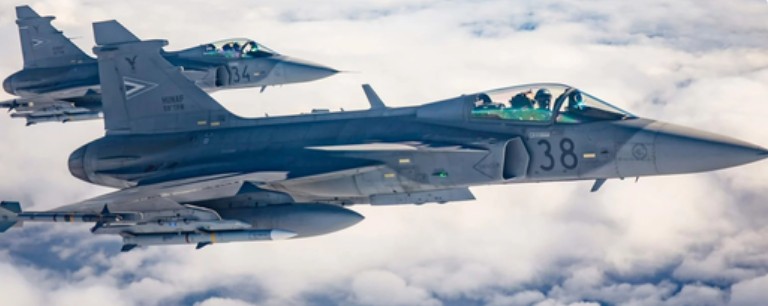
Export customers include South Africa, Czech Republic and Hungary. South Africa was the first foreign customer for the Gripen, ordering 19 single-seat and 9 twin-seat aircraft in 1999. The aircraft were to be delivered between 2007 and 2011 and replace the Cheetah C/D aircraft in service.

In 2003 Hungary signed a lease-and-purchase contract for 12 single-seat and 2 twin-seat aircraft to be delivered in 2006 and 2007. The contract consisted of a 10 year lease after which the aircraft will be property of the Hungarian government. The Gripen will be fully NATO compliant and represent the main fighting force of the Hungarian air force.

In 2004 the Czech Republic signed a lease contract for twelve single-seat and two twin-seat Gripen aircraft for a period of 10 years. The aircraft are diverted from the production line destined for the Swedish Air Force for reduced delivery times. The first Czech Gripen made its first flight in November 2004 and were to be delivered to the Czech Air Force in April 2005, making the Czech Republic the first NATO operator of the type. The last aircraft is to be delivered in August 2005. The JAS 39 C/D is fully NATO compliant and will fill the gap in the Czech air defense left by the MiG-23/29 disposal and MiG-21 retirement.

The Gripen was also offered to Poland to fill its requirement for 48 fourth generation fighter aircraft, but Lockheed Martin’s F-16C/D Block 52 fighter was the winner. Austria preferred the Eurofighter Typhoon over the Gripen. The Saab-BAE SYSTEMS consortium also lost potential export sales to customers the Joint Strike Fighter, such as the Netherlands and Australia.

The Gripen boasts a top speed of Mach 2 and a combat radius of about 500 miles.

Its delta-wing design and fly-by-wire controls make it highly agile, while its PS-05/A pulse-Doppler radar, upgraded in the MS20 configuration, allows it to track multiple targets and deploy a wide array of weapons, from AIM-120 AMRAAM missiles to precision-guided bombs like the GBU-39.

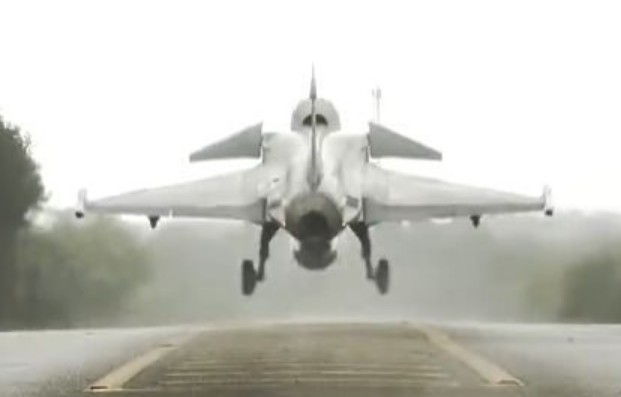
The jet’s versatility shines in its ability to operate from short, unprepared airstrips—a feature rooted in Sweden’s Cold War strategy of dispersed basing—which gives it an edge in flexibility over heavier platforms like the F-35.

At roughly 18,000 pounds empty, it’s a fraction of the F-35’s 29,000-pound weight, and its operating costs, estimated at $4,700 per flight hour, are significantly lower than the F-35’s $44,000, according to a 2021 Pentagon report (2025).

The first prototype Gripen E made its maiden flight from Saab’s Linköping facility on June 15, 2017. The aircraft is slightly larger than the C-model at just under 50 feet and includes a beefed-up fuselage that accommodates approximately 30 percent more fuel. The aircraft also features larger air intakes, the more powerful General Electric F414-GE-39E engine, and a total of 10 hardpoints. A two-seat F-model is now in development for Brazil, which currently has 36 E/F variants on order as the first export customer for the latest versions.

December 2020 saw the first of a planned 60 Gripen Es being handed over to the Swedish Air Force to commence the joint test program for verification and validation between Saab, the Swedish Armed Forces, and FMV, the Swedish procurement agency.

JAS 39 Gripen E

Key specifications of the Gripen E:
Engine
Turbofan engine General Electric F414-GE-39E, providing up to 22,000 pounds of thrust with afterburner. This engine delivers 25% more thrust compared to previous models, enhancing the aircraft’s maneuverability and efficiency.
Radar
Active electronically scanned array (AESA) Raven ES-05, offering high accuracy and long-range target detection.
Weapons systems
The Gripen E has 10 hardpoints, allowing it to carry a wide range of weapons, including Meteor and IRIS-T missiles, as well as various air-to-ground and air-to-air bombs and missiles.
Avionics
Modern flight control and sensor systems provide a high degree of integration and automation. The cockpit features multifunction displays and voice-command control capabilities.
Mobility and support
The Gripen E is designed for efficient combat operations in various climates and can operate from airfields with limited infrastructure, making it highly versatile for diverse operational environments.
The Gripen E is already in service with the Swedish Air Force and is used by other countries, including Brazil and Czechia.

Gallery

JAS 39A
Engine: 1xGeneral Electric/Volvo Flygmotor RM12 (F404-GE-400) afterburning turbofan, 80.5 kN (18,100 lb st)
Length 14.10m (46 ft 3 in)
Height 4.50m (14 ft 9 in)
Wing span 8.40m (27ft 6.25 in)
Wing area: 322.92 sq.ft / 30.0 sq.m
Empty weight: 6622 kg (14,600 lb)
Max Take-Off Weight: 12.500 kg (27,560 lb)
Wing loadimg: 88.77 lb/sq.ft / 433.0 kg/sq.m
Max level speed at 10975m (36,000 ft): Mach 2.0 / 2126 km/h / 1321 mph
Maximum range: 1620 nm / 3000 km
Armament: one Mauser MK27 27mm cannon, up to 6500 kg external
Hardpoints: 6
Crew: 1

SAAB

Svenska Aero
AB Svenska Järnvägsverkstäderna (ASJA)
Svenska Aeroplan Aktiebogalet (SAAB)

Svenska Aero, as a subsidiary of Heinkel, was taken over by AB Svenska Järnvägsverkstäderna (ASJA) in 1932.

The Bofors Company at Trollhattan formed in 1937 Svenska Aeroplan Aktiebogalet (SAAB). Following its merger in 1939 with the AB Svenska Jarnvagsverkstadernas Aeroplanavdelning (AJSA). In 1939 amalgamated with Aircraft Division of Svenska Jarnvagsverkstaderna and moved main establishment to Linkoping. From 1950 acquired other important facilities, including underground factory at Linkoping.

Built 82 Tiger Moth, 43 Hawker Hart, 11 NA-16-4M, FW-44, and Northrop 8A-5 under licence.

In 1945, in the hope of a lasting peace, the Company decided to scale down its production of military aircraft and to develop its civilian operations – a change in policy signified by the ap¬pearance of the Saab 90 Scandia airliner and the Saab 92 car.

Name changed to Saab Aktiebolag May 1965; Malmo Flygindustri became a subsidiary in 1967; in 1968 merged with Scania-Vabis group to became Saab-Scania. Current name Saab Group, comprising five main divisions: Saab AB, Saab Dynamics AB for guided weapons and electronics, Saab Training Systems AB, Saab Aircraft AB for marketing and supporting commercial aircraft, and Saab Combitech AB. Saab AB parent division established January 1997 to combine activities of previous Saab Military Aircraft, Saab Aircraft and Saab Service Partner, and develops and manufactures military and commercial aircraft within business units known as Gripen, General Military Aircraft, Future Products and Technology, Operations Commercial Aircraft, and Collaborative Programs.

First airplanes were license-built Junkers Ju 86K twin-engined bombers, Northrop-Douglas dive-bombers (Douglas 8A-1, similar to the US Army Air Corps’ A-17) and North American NA-16 trainers. First own-design production aircraft was Saab 17 dive-bomber of 1940, used widely and 60 delivered to Ethiopia from 1947. Saab 18 was twin-engined bomber of 1942, some late examples of which had ejection seats. Saab 21A of 1943 was piston-engined single-seat fighter, and 21-R was jet development of the same aircraft. Saab 29 was the so-called “flying barrel” swept-wing jet fighter, in production until 1956, while Saab 32 Lansen of 1952 was swept-wing fighter/attack/reconnaissance two-seater. Saab 35 Draken “double-delta” fighter appeared in 1955, and a squadron remained active as interceptors until 1999. Saab 105 of 1963, a twin-jet light side-by-side two-seater armed multipurpose aircraft, still in use as a trainer in 1999; Swedish Air Force aircraft have just undergone an upgrade with new engines and thus redesignated Sk 60W. Saab 37 Viggen multirole combat aircraft, first flown February 1967, has foreplane and delta wings, and with its STOL capability remains a very potent weapon system. Produced for service between 1971 and 1990, it has been continuously upgraded; redelivered in latest upgraded form 1998 for continued service in JA 37 interceptor and AJS 37 attack/interceptor/maritime-reconnaissance variants. Latest combat aircraft is Saab AB Gripen JAS 39 Gripen, first flown December 1988 and taken into Swedish Air Force service from 1996. Grippen is the world’s first combat aircraft of the new-generation type and the first to combine the roles of interceptor, attack, and reconnaissance in a single aircraft (all as primary roles) by the adoption of push-button control to select the required function in the computer programs of the totally integrated avionics suite.

Civil types have included Saab 90 Scandia twin-engined 32-passenger transport (first flown November 1946); Saab 91 Safir all-metal 3/4-seater (first flown November 1945); two/three-seat high-wing Safari (first flown in July 1969) and its military Supporter development (first flown 1972). In production until 1999 has been the Saab 340 turboprop regional transport (first flown January 1983, and finally produced in 340B and BPIus variants with accommodation for up to 37 passengers) and the Saab 2000 50/58-seat turboprop regional airliner (first flown March 1992). Saab has also developed an airborne early warning and control variant of the 340B airliner as the S100B Argus (first flight of AEW&C prototype with overfuselage radar July 1994), plus a search-and-rescue variant for the Japanese Maritime Safety Agency as the SAR-200 (delivered 1997).

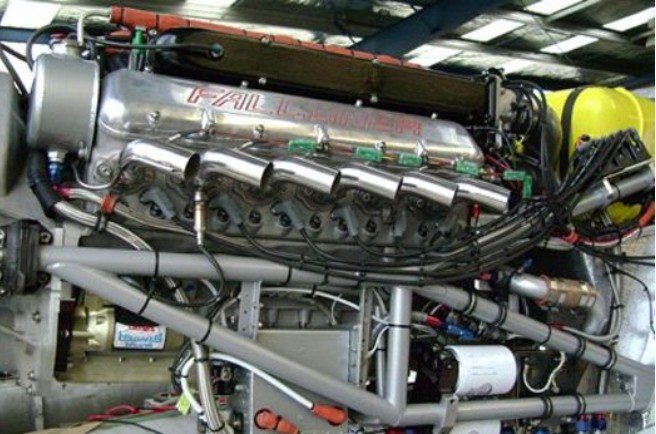
Ryan Falconer V-12

The V-12 engine developed by RFI has been used in racing boats, specialty race and street cars, trucks, airboats and now aircraft. This engine incorporates the latest splayed-valve cylinder head technology and the highest quality internal components developed for acing such as Carrillo rods and JE hypereutectic pistons. The engine was developed by RFI specifically for Papa 51 Ltd. Co. with unique features, including:
Special long-runner electronic sequential tuned-port injection system with end-entry plenums for narrow width
10.9:1 compression ratio
Special grind hydraulic roller cam for low RPM horsepower and torque
Additional bosses on the drive end of the crankcase to provide greater clamp area for the gearbox.

B.J Schramm headed the project to develop the gearbox for Papa 51. Final design and analysis was done by Oswald Webb of England, who worked on the original Merlin engine reduction and was Chief Design Engineer for GKN, the largest gear works in Europe. The unit is designed to endure up to 1500 HP, pulling 13.5 Gs doing 1 second snap rolls for more than 400 hours. The reduction ratio is 2.8:1. It is a straight cut spur gear arrangement with a quill shaft between crankshaft and drive gear.

Ryan Falconer V-12
Type: Aluminum 90 degree V-12
Displacement: 601 cubic inches
Horsepower: 640 HP @ 4500 RPM
Torque: 700+ ft./lb. @ 4000 RPM
Compression Ratio: 10.9:1
Bore: 4.125 in.
Stroke: 3.750 in.
Fuel: 100 LL Avgas.
Heads: Cast aluminum with splayed valve design
Cylinders: Steel sleeveds
Empty Weight: 2200 lbs
Main bearing size: Same as 400 CID Chevrolet “small block”
Rod bearing size: Same as 350 CID Chevrolet “small block”
Cam bearings: Similar to Chevrolet “small block”
Rods: Forged, Carrillo Industriess
Pistons: Forged aluminum
Valve train: Dual spring
Valves: Stainless, 2.190 intake / 1.610 exhaust
Rocker assembly: Investment cast stainless steel, 17-4
Roller tappets: AC Delco
Pushrods: Smith Brothers
Manifold: RFI, with end entry plenums and 70mm butterflies
Ignition: Delco Direct Fire (no distributor) with dual MOTEC computers
Freeze plugs: Threaded with o-rings
Port runners: Pre-machined for better flow
Crankshaft: Bryant
Timing gears: RFI custom
Head gasket: Special, Fel-Pro
Dry oil sump pump: RFI custom
Damper: Fluidampr
Length: 55.5 in.
Width: 24.25 in.
Weight: 980 lb. (firewall forward, includes: accessories, batteries, gear reduction unit, hoses, propeller, etc.)

Ryan 410

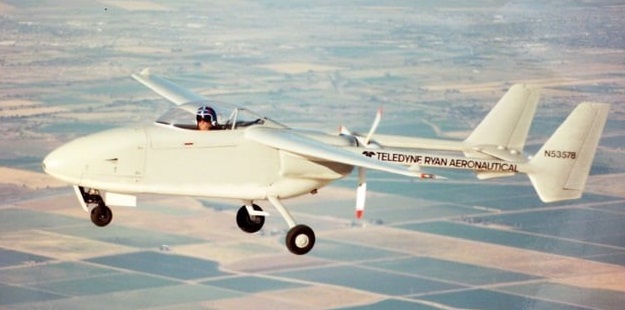
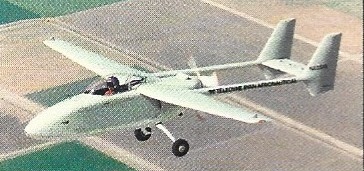
The Teledyne Ryan Model 410 was a surveillance UAV designed in the United States in the late 1980s. In configuration, it was a high-wing cantilever monoplane with twin tails carried on booms and linked by a common horizontal stabilizer. The engine was mounted pusher-fashion at the rear of the fuselage, between the booms. The nosewheel of the tricycle undercarriage was retractable. Construction throughout was of composite materials.

The Model 410 was Ladislao Pazmany’s last design before he quit Ryan. First flying on 27 May 1988, the sole prototype entered its flight test phase at Holtville, Calif, in October 1987. It was converted to manned operation for safety reasons, and completed its manned flight tests early in June 1988. It retained this configuration for the whole of the testing and development phase.

In 1993, the Model 410 was submitted to the UAV Joint Projects Office in response to an RFP for a Tier II system. In January 1994, the contract was awarded to General Atomics for what would eventually become the RQ-1 Predator.

Nothing is known about its fate or current whereabouts of the sole prototype, N53578, but it was deregistered. According to a Northrop Grumman employee, the Model 410 eventually proved overweight.

Powerplant: 1 × Lycoming TIO-320-C1B , 160 hp (120 kW)
Wingspan: 31 ft 0 in (9.45 m)
Empty weight: 1,450 lb (657.7 kg)
Capacity: 300 lb (140 kg) sensor payload carried in internal bay
Range: 1,200 mi (1,931.2 km, 1,000 nmi)
Endurance: 16 hours

Rutan Voyager

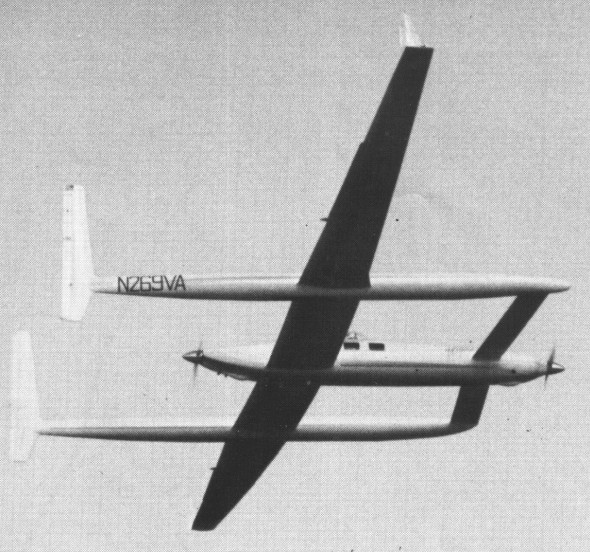
The configuration selected was a twin engine pusher-tractor tandem wing vehicle with twin booms connecting the tip of the forward wing through the center wing terminating at the vertical fin. The cabin was only large enough to accommodate the crew of two and provisions for the estimated 9 day flight.

Structural sample testing was conducted as the first step in the program to determine the lightest materials and fabrication processes available appropriate to the vehicle requirements. It was determined that .010-inch graphite tape skins, with 1/4-inch Nomex honeycomb core would provide adequate structure, and, with suitable application of film adhesive, would also be an adequate fuel barrier. The spars were made from graphite tape and Nomex cores, and were autoclave-cured by an outside vendor.

The result was an airplane with a structural weight/gross weight fraction of only 9%; significantly lower than any existing man-rated airplane. This was key to the Voyager’s success, because the amount of fuel carried, in relation to the vehicle’s takeoff weight, had the strongest influence on range.

Making its first public debut, at the Oshkosh Fly-in on 29 July 1984, was Rutan’s Voyager. The previously-secret aircraft has been under development for more than three years in the Rutan Aircraft Factory in Mojave, California. The Voyager was designed by aeronautical engineer Burt Rutan, 40, for one special mission: very long range flight. “When we started the analysis, the numbers showed that it might be possible to fly completely around the world non-stop. No one has ever tried it before,” Rutan said, “so that became our goal.”

Carbon fibre and Kevlar comprise the major part of Voyager’s struc¬ture, allowing a wing span of 110.8 feet with an aspect ratio of 33.8. The spars are made from solid, oven-cured, carbon graphite, while the skins are thin carbon fibre sheets over a nomex paper honeycomb core, with no metal anywhere in the basic structure other than fasteners.

The engines are mounted in tandem, one on each end of the fuselage. It is now planned that the front engine will be shutdown and its propeller feathered after enough fuel has burned off to allow the rear engine to sustain flight. Mounted between the canard and main wing are three streamlined bodies: the fuselage (33 feet in length) and two outrigger tanks for fuel.

The structural weight of the Voyager is only 938 pounds yet the take-off weight for the global flight will be 11,236 lbs, more than six times its empty weight of 1,858 lbs. Sixteen separate fuel tanks scattered among the wings, canard, booms and fuselage, contain 1,489 United States gallons of fuel weighing 8,934 lbs, leaving just 534 lbs for the crew of two and support equipment. The final landing weight of the aircraft is expected to be only 2,300 pounds. The pilot sits within a bubble canopy above and to the right of the cabin, which contains a stretcher and an area of relative privacy for the off-duty crew member. Comfort is important, as pilots Jeana Yeager and Dick Rutan expect to spend two weeks on their 25,000 mile flight. Their intended flight path will take them across southern United States, in a curve parallel with the northern coast of Brazil, of f the tip of South Africa, across the southern Indian Ocean and north again over Australia and the Pacific and back to California. Keeping to the oceans will eliminate any political problems associated with over flying potentially hostile countries, and Australia can be relied on to be friendly.

The aircraft’s fuel capacity is 1489 gallons, carried in 17 tanks and metered by only one gauge; the crew will use one seat and one bed during the thirteen day flight, flown at between 12 and 15,000 feet on a cruise of around 110 knots; only 3.2 lbs of paint were used on the exterior; there is only one brake, on the nosewheel, and only one rudder, on the left hand fin. July 1984 the Voyager flew 11,593 miles (almost half way around the world) over a closed circuit course along the Californian coast during a test run.

Dick Rutan made history in 1986 when he and copilot Jeana Yeager made the first non-stop, non-refuelled flight around the world. Their aircraft Voyager was designed by Dick’s brother, Burt. Dick and Jeana took off with 1490 gallons of fuel on board and returned home after flying 26,680 miles non-stop with 18 gallons to spare. The flight took 9 days, 3 minutes and 44 seconds.

Rutan Voyager Around the World Article

Rutan Voyager
Length: 32.48 ft / 9.9 m
Height: 10.171 ft / 3.1 m
Wingspan: 110.892 ft / 33.8 m
Wing area: 362.747 sq.ft / 33.7 sq.m
Aspect ratio: 33.8
Max take off weight: 9695.4 lb / 4397.0 kg
Weight empty: 2683.5 lb / 1217.0 kg
Max. weight carried: 7011.9 lb / 3180.0 kg
Max. speed: 130 kts / 240 km/h
Landing speed: 70 kts / 130 km/h
Cruising speed: 86 kts / 160 km/h
Service ceiling: 16404 ft / 5000 m
Wing loading: 26.65 lb/sq.ft / 130.0 kg/sq.m
Range: 23719 nm / 43928 km
Engine: Continental IOL-200, 81 hp
Crew: 2

Rutan Solitare

Rutan’s canard self-launching sailplane attracted much attention when it won the Sailplane Homebuilders Association Design Contest in 1982. The engine, with electric starter for air starting, erects from and retracts into a bay in the forward fuselage by means of electro-hydraulic power. The canard configuration is intended to make the ship virtually stall-proof as the canard stalls before the main wing, causing the ship to pitch nose-down and preventing the main wing from stalling. That, however, does not mean that mishandling cannot cause very high sink rates. The main wing has trailing edge flaps which also operate as spoilers by the leading edge coming above the top surface of the wing when deploying. The effective spoil flap trailing edge surfaces provide good glidepath control.

The Solitaire is a single-place, self-launching canard sailplane developed for recreational soaring, Landing gear is tandem wheels with wingtip rollers. It features a KSM 107-E. 22-hp engine and a retractable propeller. Its structure is all-composite, with prefab molded fuselage shells. Task Research was the manufacturer of the composite moldings kit for the Solitaire.

By 1990 the Rutan design stable of VariEze, LongEze, Defiant and Solitaire were no longer offered for sale.

L/D Max: 32 93 kph / 50 kt / 58 mph
Min Sink: 0.75 m/s / 2.5 fps / 1.48 kt
Wing span: 12.7 m / 41.75 ft
Wing area: 9.52 sq.m / 102.44 sq.ft
Empty Weight: 172 kg / 380 lb
Payload: 109 kg / 240 lb
Gross Weight: 281 kg / 620 lb
Fuel capacity: 5 USG
Wing Load: 39.52 kg/sq.m / 6.05lb/sq.ft
Aspect ratio: 10.78
Airfoil: wing inboard, Roncz 517, outboard 515
Min. flying speed 32 kts
Vmax 115 kts
L/D 32:1 @ 50 kts
Sink rate 150 fpm @ 40 kts
Takeoff run 960 ft
Landing roll 500 ft
Seats: 1

Rutan 40 Defiant / 74 Defiant

Sn 003

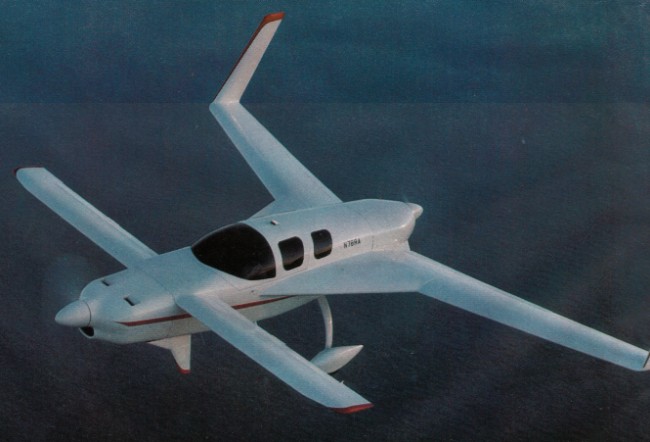
The Model 40 is the first of Rutan’s de-signs intended for the commercial market. It is an overgrown push-pull version of the VariEze, seating four plus baggage (or plus two children), using two Lycoming engines of 160 hp with fixed-pitch propellers. As on the VariEze, the Model 40’s main landing gear is fixed, but the nosewheel retracts. An all-flying rudder protruding from the bot-tom of the nose is connected in a very sim-ple manner to the turn-and-bank gyro and provides wing-levelling.

The prototype of this research aircraft, Rutan Model 40 Defiant s/n 001 N78RA, flew first on 30 June 1978. The Defiant was intended as a proof-of-concept of a very safe light twin design, requiring little trim change and no pilot action in case of engine failure, and with good single engine performance. In 1979, the Rutan Aircraft Factory announced they would proceed with certification of a Model 40 Defiant based light twin. Adequate financing was not secured for this project, and the design was modified for homebuilt construction as the Model 74.

In a significant gesture, Rutan presented his twin to the public not at Oshkosh, where his other designs made their de-buts, but at the National Business Aircraft Association meeting. Rutan has had to insist that the Defiant now flying is a “proof of concept,” composite construction prototype rather than a preproduction prototype. Some features that would be necessary in a marketable airplane, such as doors and entry steps, have been omitted in favor of a structurally simple hinged canopy. This free-blown canopy, furthermore, is semi-circular in section and hat, imposed that shape upon the top half of the fuselage, which in a production airplane would have a more squared-off section for better headroom. The cabin, which in fact is as wide and long as any light twin’s, though shallower, is very hard to get into and out of; and, because of the incorrect roof shape and a not very astute placement of armrests and consoles, it is less than comfortable to sit in. If its present empty weight of about 1,500 pounds rose to 1,700 in a production airplane, the Defiant would continue to perform superbly.

The Defiant has fixed landing gear, fixed- pitch props and no flaps; when an engine fails, the pilot merely goes on flying as before. The whole problem of fast reaction of identifying the bad engine, feathering, retracting gear and flaps and of precisely holding a certain airspeed disappears. The wings are swept in order to move their center of lift aft with respect to the rear engine, and to put the vertical sur-faces as far aft as possible for considerations of general arrangement, in short, not aerodynamic refinement.

To this add cruising speeds of over 170 knots at economy settings, astonishing rates of climb and excellent hands-off stability, as well as a useful load that can handle both full cabin and full fuel, and you have an airplane that promises to do everything well. You also have a potentially powerful competitor in the light-twin market, and one that demonstrates convincingly an alternative to conventional airplane design. The Defiant could por-tend a revolution comparable in importance to the abandonment of the biplane in favor of the monoplane.

What makes the Defiant a performer is its light weight and small size. Its span loading (the quotient of weight and wing-span, and a powerful determinant of climb rate) is about the same as that of the Cougar, Duchess and Seminole; but, with the same engines and a gross weight 1,000 pounds lower, the Defiant climbs better than they do on two engines (it takes it 11 minutes to go from sea level to 12,000 feet at gross weight) and at least as well on one. With centerline thrust, like the Cessna Skymaster’s, the Defiant escapes the asymmetry problems of conventional twins. Its power loading is good even on one engine: at moderate weights, in fact, it is that of a 172. Fixed-pitch props mean that you get the best performance at high altitudes.

The Defiant is economical not only in flight performance, but also in design and construction. The choice of fixed-pitch wooden propellers, fixed gear and extremely simple systems is part of Rutan’s ruling philosophy of design: less is more.

There are two separate electrical systems – two batteries, two alternators and two busses – for true redundancy. The fuel system is simple, and the last 45 minutes of fuel are measured and reported with extra accuracy. The control system is as simple as they come: the actuating rods for the elevators (on the front wing, or canard) and the ailerons (on the main wing) are contained mostly within the fuselage.

Model 74 Defiant

Work began on production Defiant Model 74 in 1982.

Rutan had been saying he would never release the Defiant as a homebuilt but Fred Keller arrived at the 1983 Oshkosh in his homebuilt Defiant.

Plans were offered in mid-1984.

By 1990 the Rutan design stable of VariEze, LongEze, Defiant and Solitaire were no longer offered for sale.

Gallery

Engines: 2 x Lycoming O-320, 160 hp
TBO: 2,000 hr
Props: wood, fixed-pitch, 69-inch diameter
Length: 23 ft
Height: 1.9 ft
Wingspan: 29 ft
Wing area (total lifting surface): 127 sq. ft
Wing loading (total lifting surface): 23 lbs. per sq. ft
Power loading: 9 lbs. per hp
Seats: 4
Empty weight: 1,525 lb
Useful load: 1,375 lb
Payload with full fuel: 835 lb
Gross weight: 2,900 lb
Usable fuel capacity: 90 USG/540 lb
Maximum landing weight: 2,900 lb
Maximum rate of climb: 1,650 fpm
Single-engine rate of climb: 330 fpm
Single-engine climb gradient at 85 knots (Vyse): 233 ft. per nm
Single-engine service ceiling: 7, 100 ft
Maximum speed: 196 kt
Max cruise, 70% power (2,800 rpm) at 9,500 ft: 188 kt
Econ cruise, 55% power at 12,000 ft: 170 kt
Duration at max cruise: 5 hr
Duration at econ cruise: 6.5 hr
Stalling speed, clean: 64 kt

Rutan 61 Long-Ez

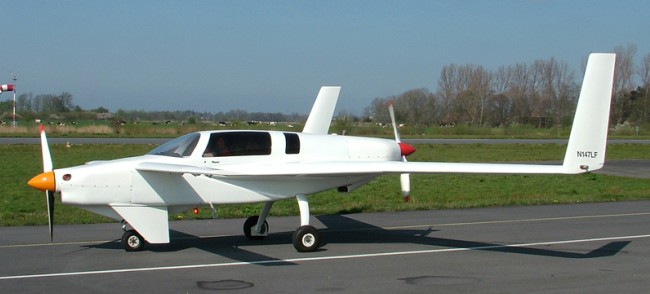
Rutan’s Long-EZ is a larger, heavier version of the VariEze built around the 115-hp Lycoming engine. The airframe will accept 115 to 180 hp. It has over four feet more wingspan and nearly half again the wing area of the VariEze. It takes off in 100 feet less distance and lands in only slightly more than half the distance of the original VariEze. While identical in length — 100 inches — the Long-EZ version is two inches wider.

Final flight-testing of No. 1 Long EZ, N79RA, was done in December 1979.

During one record flight, Dick Rutan logged 52.2 hours on a two-week round trip to Florida from Mojave, averaging a 183 mph airspeed. The Rutan factory estimates that the Long-EZ can be built by relatively competent builders in 800-1000 man-hours or nine months of spare time.

None of the VariEze series has been designed for training purposes. The back seat has a slide control stick, and that was all. There were no rudder pedals or brakes, no throttle, no mixture control, no radio and no intercom in back.

The capabilities of the Long-EZ are indicated by two class records established by Dick Rutan, the designer’s brother: a closed-circuit distance record of 4800.3 miles (7725.3 km) and a straight-line distance record of 4563.7 miles (7344.56 km).

In 1980 cost was US$198,50 at the RAF (Rutan Air Factory) for a set of homebuilder’s plans. In the first five months since long EZ plans have been available, more than 300 sets have been sold.

By 1990 the Rutan design stable of VariEze, LongEze, Defiant and Solitaire were no longer offered for sale.

A rocket powered version of the Long-Ez flew at Mojave in 2002 (see XCOR Aerospace EZ-Rocket).

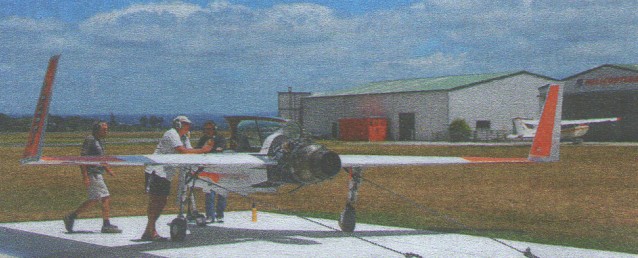
A 2000 lb thrust jet engine Longeze achieves and initial climb rate of 10,000 fpm.

Longeze jet

Variation:
Shaw Twin-Ez
Task Vantage / Sneeky Pete

Rutan Long-EZ
Engine: Lycoming O-235, 108 hp
Fuel type: 80
Propeller makellype: fixed-pitch, wood
Landing gear: fixed main, retractable nose
Gross weight: 1325 lb
Max landing weight: 1300 lb
Empty weight std: 700 lb
Useful load std: 625 lb
Payload full Std. fuel: 313 lb
Fuel capacity std: 52 USG
Wingspan: 26.3 ft
Wing area: 94.8 sq.ft
Wing loading: 14.0 lb/sq.ft
Power loading: 12.3 Ibs/hp
Seating capacity: 2
Cabin doors: Opening conopy
Cabin length: 100 in
Cabin width: 24.2 in
Max level speed: 190 kt / 220 mph
Never exceed: 190 kt / 220 mph
Cruise speed Best Power 75 % power 8500 ft: 161 kt / 185 mph
Cruise speed Best Power 60 % power 12,500 ft: 148 kt /170 mph
Cruise speed Best Power 40 % power 12,500 ft: 127 kt / 146 mph
Max range w/res 75 % power 8500 ft: 1130 nm / 1298 sm
Max range w/res 60 % power 12,500 ft: 1460 nm / 1677 sm
Max range w/res 40 % power 12,500 ft: 1848 nm / 2125 sm
Fuel consumption 75 % power 8500 ft: 6.7 USgph
Fuel consumption 60 % power 12,500 ft: 4.9 USgph
Fuel consumption 40 % power 12,500 ft: 3.4 USgph
Estimated endurance 60 % power: 10:37 hr
Stall speed flops up, gear up: 68 mph
Stall speed flops down, gear down:: 66 mph
Best rate of climb: 1150 fpm
Absolute ceiling: 26,900 ft
Service ceiling: 17,000 ft
Takeoff ground run: 775 ft
Takeoff over 50-ft obstacle: 1600 ft
Landing ground roll: 780 ft
Landing over 50-ft obstacle: 1800 ft