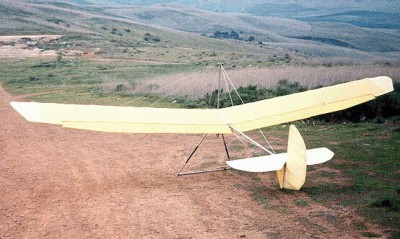
The Sandlin Skypuppy had only about 100 square feet of wing, and rudder steering. It was too fast at Sandlin’s weight for good soaring. Flown around 1986, the big flaps worked well.
The Sandlin Skypuppy had only about 100 square feet of wing, and rudder steering. It was too fast at Sandlin’s weight for good soaring. Flown around 1986, the big flaps worked well.
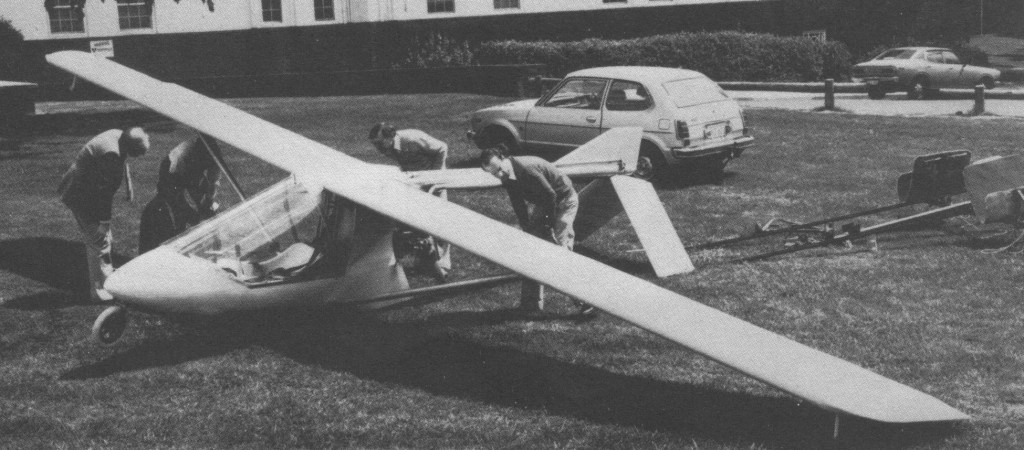
An Australian ultralight circra 1983.
USA
Sabreliner Corporation was founded 1983, following purchase of Rockwell International’s Sabreliner Division by Wolsey & Company, to support Sabreliners in use, upgrade Lockheed T-33 series aircraft, and other work. Won contract in 1989 to undertake life extension program on USAF T-37s.
The Sabreliner Division Type Certificate A2WE was reissued to Saberliner Corp in 1983 to cover active Model 265s. At the end of 1990 the company completed the design of a new version of the Sabreliner designated the Model 85. This has a supercritical wing incorporating winglets, a fuselage stretch of 1.5m, and more powerful TFE731-5 turbofan engines, but further development would require a risk-sharing partner.
A 1989 light-armed, twin-boom surveillance aircraft. A single place enclosed midwing monoplane with retractable undercarriage, one built, first flying on 10/8/89, registered N22AB.
Engine: 300hp Chevrolet V-6 pusher
Wingspan: 22’0″
Length: 15’8″
Useful load: 1300 lb
Max speed: 190 mph
Stall speed: 72 mph
Range: 300 mi
In 1985, Bill Sadler and Bill Gewald began searching for a reliable four-stroke engine for ultralights and homebuilts. Sadler had developed the Sadler Vampire. He went on to design Formula 1 race cars and was an instructor at Massachusetts Institute of Technology.
Sadler teamed with the Gewalds to form the engine development company. Prior to that, the Gewalds operated two oil exploration air charter companies in Southeast Asia-one in North Borneo and the other in Singapore.
Sadler and the Gewalds began a worldwide search for an existing reliable four-stroke engine and found nothing to their liking. So they decided to invent and build one on their own.
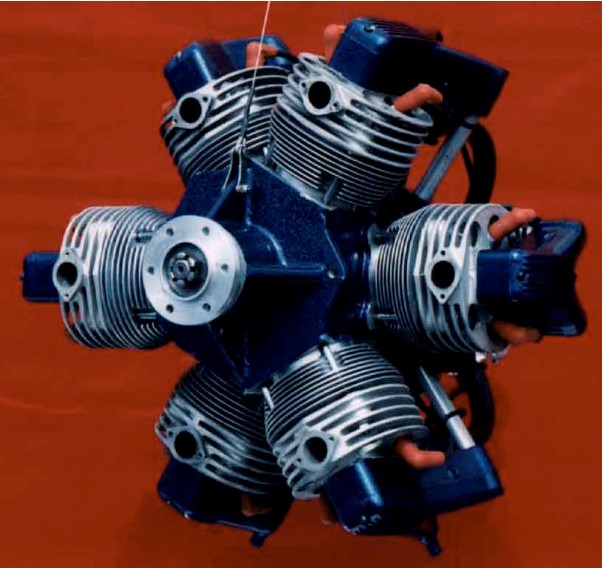
End result was the Sadler 6-cylinder radial engine with a four-cycle, dual electronic ignition with direct drive unit. Made with up-to-date materials and using modern computer numerically designed machinery, the engine has redundancy (12 spark plugs), low rpm, minimum vibration, low fuel consumption and low noise levels.
Patent No. 5,l50,670, was issued in 1992 and a total of 43 proof-of-concept engines were built, but none were offered for sale. According to Betty the company could not support the units with spare parts. However, the engine was installed in an Avid Model C where it produced a cruise speed of 85 mph, a 1,250 fpm rate of climb at gross weight, and a service ceiling above 12,500 feet. The engine, including electric starter and alternator, weighed 121.4 pounds and the all-up weight including engine mount, exhaust manifold and propeller was 162 lbs. There are almost 500 hours of dynamometer testing and the engine has also been successfully test flow on several different aircrafts.
The Sadler Radial Engine is a compact aircraft engine. The 6 cylinder R1765U radial uses two banks of three cylinders with power pulses every 120 degrees of revolution. The design uses VW cylinders and pistons for reliable inexpensive parts. Prototype testing has proven out this radial and casting patterns have been made. The engine is ready for final pre-production development.
Bill Gewald, who developed the engine from Sadler’s design, turned 75 and together with his wife Betty feels it is about time for younger, more energetic people to take charge.
The engine package being offered to investors included drawings, CAD programs, patterns, jigs and fixtures and many parts for the 65-hp R1765U engine. In addition, preliminary engineering and feasibility studies have been completed for 85-hp and 110-hp versions. Mrs. Gewald stated that only crankshafts and cylinder heads are needed to produce completed 65-hp engines. The “R” stands for “radial”, the “17” is “1721cc” displacement, the “65” is horsepower, and “U” means “uncertified”.
“We have never been able to raise enough money to go into full production, but we have all the drawings on autocad. We also have over $17,000 worth of patterns for all the proprietary parts,” she said. “It is a reliable, smooth, compact engine with low RPM (red-line is 3000 rpm) that runs beautifully on automotive fuel and sounds like a radial. They wanted to sell to someone with the financial resources to treat the engine with the TLC it deserves, and would accept the bulk of any payment based on sales royalties and will personally help all we can in production and sales.
The company had one engine running on a stand at the Arlington Airport north of Seattle that was available for demonstration the homebuilders with scaled-down replicas and others originally produced with radial engines.
So, if there is someone or a group out there wanting the challenge of producing a well-researched, out-of-the-ordinary engine design with the time-consuming R&D and basic tooling already complete, contact the Gewalds at Sadler Radial Engines, Inc, 603 NE 9th St., PO Box 953, Coupeville, WA 98239-0953.
This engine is quiet, even without a muffler, which stems not only from the slow-working pistons, but also the noise produced by the engine is at a frequency much lower than the high whine of the two-strokes.
The R1765U has a maximum width of 20.5″, a maximum height of 19.4″, and a length of approximately 17″ depending on starting configuration, carburetion and air cleaner.
There are two rows of three cylinders each, for a total of six cylinders. This arrangement gives a firing impulse every 120º or three power pulses per revolution. Each of the two, three-cylinder rows forms a system whose instantaneous mass-center or centroid, has an approximately circular locus that is exactly balanced by the equal and opposite mass-system of its adjacent cylinder row. In plain language, we can say that one cylinder row balances the other row all of the time.
The slight offset between the cylinder rows results in a dynamic imbalance or a “rocking couple” that is resolved along the aircraft longitudinal axis by the engine mounting system and a counter-weighted crankshaft.
The radial engine has excellent air-cooling characteristics. Each cylinder is individually exposed to its own flow of cooling air without the requirement for extensive baffling and ducting. The second cooling advantage this engine has is its low per-cylinder horsepower output making cooling demands very manageable. The pistons and cylinders are standard Volkswagen, extensively machined.
Individual cylinder heads are cast in 356 aluminum alloy heat-treated to T6. Cast iron valve seat insets are cast integrally with the head. Both inlet and exhaust valves are stainless steel VW racing types for durability and component availability. They ride in bronze valve guides pressed into the cylinder head. Valve springs need only exert a pressure of approximately 26 pounds at mid travel, thereby reducing wear and tear on the valve drive train.
A 5mm deep bathtub combustion chamber is used with a 2 mm quench height area above the piston. This allows for compression a ratio of 9.5 to 1 and the use of unleaded premium auto gasoline. Two spark plugs per cylinder are used to improve reliability as well as combustion efficiency.
The valve train uses only one single small diameter cam for all inlet valves and another identical cam to drive all the exhaust valves. Each tappet housing holds all of the six inlet or exhaust roller tappets. The hardened steel cams run on ball bearing integral shafts to drive the roller tappets. The tappet housings are staggered in the rear case and drive overlapping pushrods to each rocker arm. Because the valves are arranged in line lengthwise along the engine (placing exhaust forward and inlet rearward) and the pushrods all come out of the engine rear case in a single plane, each rocker arm for a given cylinder is displaced laterally to the left or right of the cylinder centerline. This allows the front exhaust rocker arm to miss the inlet valve and spring, as well as allowing the rear rocker arm to be similarly displaced from center, making room for the inlet manifold to pass between the push rods on its way to the cylinder head inlet port.
Valve timing has a minimum of overlap and duration to maximize low-end torque and provide useful horsepower in the 2900 rpm range. Valve cam accelerations have been kept low in the interest of low valve train stress and long life.
Full pressure lubrication is supplied from a rear case mounted oil feed pump running at camshaft speed. Inlet oil to the oil pump comes directly from a remote oil tank. A four-quart oil supply is recommended. Because the cylinder bases protrude into the crankcase cavity, very little back oil finds its way into the lower cylinders.
As originally tested, the engine had two completely independent electronic distributors driven from the rear case. Their shafts are mounted with individual gears that mesh with the main crankshaft time gear. Distributors are battery-coil type. Solid-state breakerless contact points are used to drive the standard coils to achieve optimum reliability and simplicity. An interesting feature of the radial engine is that the firing order proceeds sequentially around the cylinders in a direction opposite to the crankshaft rotation.
The inlet manifold system uses a circular cyclonic plenum chamber at the rear of the engine. Separate manifolds join this chamber to each cylinder’s inlet port. The carburetor is mounted centrally on the plenum box. A heat system can be fabricated using the engine’s exhaust as the heat source.
Configuration: Direct drive, 6 cylinder, four-cycle, internal combustion, gasoline fueled, free air cooled engine, one gravity fed carburetor, and a dry sump lubrication system.
Displacement: 1721cc (105 cu in.)
HP/Torque @ 3000 rpm: 65 hp/113.4
Stroke: 50 mm (1.969 in.)
Bore: 85.5 mm (3.366 in.)
Rotation: clockwise, view from rear
Compression Ratio: 9.5:1
Option: Electric start
Accessories: oil cooler, oil tank (4 quart)
Engine weight with components (dry): 108 lb (Prop. Start)
Engine weight with electric start/alternator systems: 122 lb
Engine diameter: 20.7 in plus oil system components below engine
Performance (With 66″ 2 Blade, Wood Prop.)
Normal rated power, T.O: 62 bhp @ 2,850 rpm
Max. rated power 65 bhp @ 2,975 rpm
Continuous rated power (90%): 58.5 bhp
90% pwr fuel burn: 4.1 USgph / spc=.44 lb./bhp-hr
Typical cruise power (75%): 49.5 bhp
75% pwr fuel burnL 3.4 USgph or spc=.43 lb./bhp-hr
Idle Speed: 800 rpm
American Microlight Inc
Sadler Aircraft Company
Sadler Aircraft Corporation
Sadler Radial Engines P. O. Box 953 Coupeville WA
USA
1982: American Microflight Inc, 8225 East Montehello, Scottsdale, Arizona 85253, USA.
1984: American Microflight Inc, 7654 E.Acoma Dr, Dept G10, Scottsdale, AZ 85260, USA.
Sadler Aircraft Corp was previously known as American Microlight Inc. and Sadler Aircraft Company, developed A-22 Piranha lightly armed surveillance version of its microlight, also being developed by TUSAS in Turkey as Bat.
Sadler Aircraft
1793 NE Rocky Drive
Roseburg OR
97470
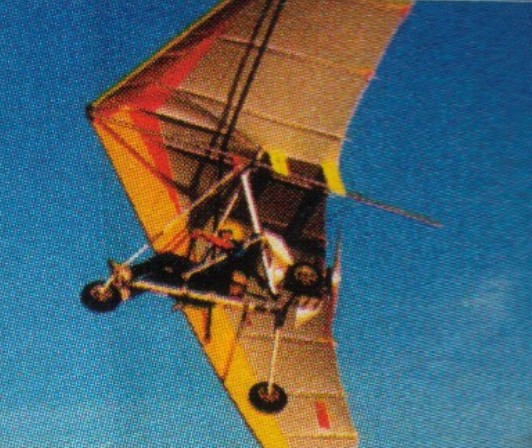
Manufactured in the US, kits included the engine and propeller. Using as standard the Aeros Stranger wing, other options were available.
Engine options were the Rotax 447 (US$7990) of Rotax 503 (US$8795).
Engine: Kawasaki 340cc, 32 hp
HP range: 32-65
Height: 15 ft
Length: 10 ft
Wing span: 34 ft
Wing area: 180 sq.ft
Fuel cap: 5 USG
Weight empty: 205 lb
Gross: 600 lb
Speed max: 50 mph
Cruise: 46 mph
Range: 100 sm
Stall: 19 mph
ROC: 1000 fpm
Take-off dist: 100 ft
Landing dist: 75 ft
Service ceiling: 10,000 ft
Seats: 1-2
Landing gear: nose wheel
1995: 1001 W.Monona Dr, Phoenix, AZ 85027, USA.
Trike builder
Belgium
Formed December 1920, SABCA had a close SABENA association and that airline used SABCA’s only S.2 single-engined monoplane transport. Built Handley Page 3-engined airliners for SABENA Belgian Congo service; also other private-owner prototypes.
At the end of 1920 the Société Anonyme Belge de Constructions Aéronautiques (SABCA) was created to ensure the construction, testing and overhaul of aeronautical equipment for the development of civil aviation and air transport (SABENA will be founded three years later). It will begin with the overhaul and overhaul of Belgian Military Aeronautics aircraft, before starting, in 1922, to build foreign aircraft under license.
The first designs and new realizations will be due to members of the staff of SABCA, encouraged and supported by the company. Among others, the moto-aviette Jullien SJ-1 (in 1923), of Henri JULLIEN, engineer director of the design office of the SABCA, and the “Limousine” Demonty-Poncelet of Mathieu DEMONTY (technical director) and Paul PONCELET (head of the wood section) (in 1924).
On his own, but with the support of SABCA, Paul PONCELET designed and built the “Castar” in 1922-1923, then in 1923 the “Vivette”.
SABCA’s first project was a small aeroplane called the Sabca J1, which was powered by the engine of a FN motorcycle. The company also constructed “Sabca” 1500 with a 200 HP engine and some gliders. It later assembled the Handley-Page, Fokker F VII, and the Savoia-Marchetti used by Sabena. Held Breguet and Avia licences, and from 1927 directed attention to metal construction. Outcome was S-XI 20- passenger monoplane with three 500 hp engines, as well as similar S-XII 4-passenger monoplane with three 120 hp engines. Built under license Renard R.31 reconnaissance monoplane and Savoia-Marchetti S.73 transport.
In October 1937, the Belgian aircraft manufacturer Société Anonyme Belge de Constructions Aéronautiques (SABCA) made a marketing agreement with the Italian company Caproni, with SABCA selling some of Caproni’s military aircraft in certain markets, including the Caproni Ca.135, Ca.310 and the Ca.312, which were to be designated SABCA S.45bis, S.46 and S.48 respectively. As part of this agreement, Caproni were to develop a replacement for the Belgium Air Force’s Fairey Fox biplanes, which were used as two-seat fighters and reconnaissance aircraft, but were obsolete.
Built S.47 2-seat low-wing monoplane fighter of 1937 in collaboration with Caproni. Company revived in 1950s. In 1960s assembled, maintained, and repaired Republic F-84; also collaborated with Avions Fairey on Hawker Hunter and made Vautour components for Sud- Aviation. Much work of various kinds on Lockheed Starfighter, Dassault Mirage, and Breguet Atlantic; also missile and space activities. Dassault Aviation took 53 percent shareholding, while in 1998 Fokker’s shareholding was then reportedly being sold. Recent work has included weapon system integration, development of the cockpit front panel, final assembly, and flight testing of Belgian ArmyA-109 helicopters; update of F-5s; production and upgrading of F-16s; upgrade of Mirage 5s and F1s; production of servo actuators; and construction of subassemblies for Dassault, Boeing, Airbus, and Fokker aircraft.

Saab’s experience with the S340 commuter airliner turned its attention to the future needs of regional and ‘feeder’ carriers. Having forged a market with its smaller aircraft, Saab used the S340 as a baseline from which to develop a new, high-speed turboprop airliner which was to be called the Saab 2000, with a max payload of 5900 kg or up to 2 crew and 58 passengers. The go-ahead came with a launch order from Moritz Suter’s Crossair, already a firm Saab customer, which signed for 25 aircraft with a further 25 on option, on 15 December 1988.
By late 1989 project definition for the Saab 2000 had been completed, with the contracting out of major portions of the aircraft’s construction. CASA of Spain was responsible for the wing design and production, though Saab defined the basic airfoil structure. Valmet of Finland was to build the entire tail unit and elevators, while in England, Westland is responsible for the rear fuselage. For the cockpit, a Collins Proline 4 avionics suite was selected, while a radical reduction in cabin noise levels over existing aircraft was also promised. The concept of ‘hub bypass’ was central to Saab’s sales efforts for the aircraft. To achieve this, Saab planned to build an aircraft capable of 665km/h over a 1850km sector, a speed comparable with the BAe 146 (Avro RJ). A jet-like climb performance was also essential, with figures of 0-6096m in less than 11 minutes assured. The original choice of engine fell between General Electric’s GE38, then under development for the US Navy’s projected LRAACA maritime patrol aircraft, and the Pratt & Whitney PW300 turbofan. In the event, and in conjunction with Crossair, Saab opted for the Allison GMA 2100 turboprop, driving six-bladed, low-noise Dowty propellers. As part of the deal Allison was contracted to build the engine nacelles.
Production of the first prototype began at Linkoping in February 1990. Several European aerospace firms participated in the Saab 2000 manufacturing program including CASA, Westland and Valmet of Finland.
The prototype’s (SE-001) maiden flight occurred on 26 March 1992. A four-aircraft test programme was established with aircraft No. 2 (SE-002) involved in stability and control certification. Much of the high-temperature and adverse weather flying was undertaken by the No. 2 Saab 2000, which completed two visits to Spain. The first full production-standard aircraft was SE-003, with which all the systems certification was achieved, only the autopilot certification being outstanding in mid-1993. Certification in Europe was granted in March 1994 and by the FAA in April 1994. Functional reliability flights were undertaken by aircraft No.4 (SE-004), as part of the ongoing test programme which exceeded 1,200 hours across the fleet.
All Saab’s performance guarantees have been met or exceeded. Take-off and landing distances were bettered by 100-200m. Time from brake release to 6096m is less than eight minutes, and in proving this the Saab 2000 easily broke the existing time-to-climb record for an aircraft in its class (previously held by a Grumman E-2 at 10 minutes). Range and weights have all been better than expected on the production standard aircraft, and the promised cruise speed of 665km/h at 8534m is, on average, 15km/h better. In a dive the Saab 2000 has reached 794km/h with no ill effects. International noise requirements have been bettered by 9.1 decibels.
The fuselage diameter is 91 inches, allowing for a single row of passenger seats on the left side and double row on the right. The gear up limiting speed is 175 kt, with extension being 220 kts and a cruise speed of over 665km/h.
Reducing cabin noise was a cornerstone of the Saab 2000 design philosophy and Saab has developed a so-far unique anti-noise system that has been test flown on a Saab 340, ready for inclusion on its larger sibling. This involves a series of microphones, located around the interior, which monitor cabin noise and then re-broadcast an equal opposite; wave, thus effectively ‘switching off’ background noise and vibration.
August 1994 saw the first delivery to Crossair and September 1994 the first revenue service.
Saab originally foresaw a market for 1,400 new 40- to 50-seat regional airliners by the end of the century, and sales of 400 Saab 2000s were anticipated. While the manufacturer held well over 100 paid options, only 36 firm orders had been received by July 1993. The seventh aircraft and the first for Deutsche BA (formerly Delta Air) flew on 24 June 1993.
Lack of sales and profitability forced Saab to cease the 2000 production with just 63 aircraft built. The last SAAB 2000 was delivered to Crossair in April 1999.
Engines: 2 x Allison AE2100A turboprop, 4152 shp / 3096kW
Props: Dowty 6 blade
Wingspan: 24.76 m / 81 ft 3 in
Length: 27.03 m / 89 ft 8 in
Height: 7.73 m / 25 ft 4 in
Max take-off weight: 22000 kg / 48502 lb
Loaded weight: 13500 kg / 29763 lb
Max. speed: 680 km/h / 423 mph
Cruise: 360 kt
Ceiling: 9450 m / 31000 ft
Range w/max.payload: 2557 km / 1589 miles
Pax cap: 50-58

