UL builder Scherer began copying the Fledge II in 1980.
1982
Scherer Kontakt Oberneuhofstr. 13
CH-6340 Bar
Switzerland.
UL builder Scherer began copying the Fledge II in 1980.
1982
Scherer Kontakt Oberneuhofstr. 13
CH-6340 Bar
Switzerland.
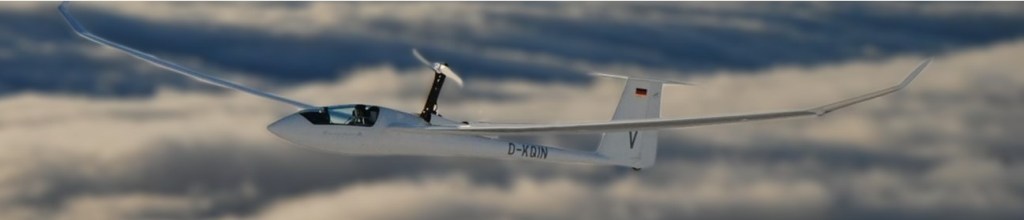
The Open Class Quintur 23 m wingspan is a very thin, high aspect ratio wing, with a maximum of 250 liters of water ballast, allowing for a potential wing loading between 39 and 58 kg/m².
Lange Aviation and Professor Loek Boermans were involved in the conception and design of the wings, with nine exact interacting wing airfoils that provide laminar flow over 95% of the lower and 75% of the upper wing surfaces and are based on a super-elliptical wing geometry. The concept of the outer wing panel with winglets were from Professor Mark Maughmer.
Structural design, ballasting and the patented, extremely light control design were provided by Lange Aviation.
A self-launch optimized fuselage has been designed for the Quintus, providing not only aerodynamic improvements but also details such as bug wiper “garages”. A forward-opening canopy makes getting in and out comfortable. Cockpit blends in either visual carbon or carbon-kevlar hybrid fibre, Alcantara lining, and engraved flap position indicator.
The Quintur M engine start-up is straightforward and automatic. To engage the engine, the pilot only needs to switch on the ignition and press the start button once the engine has been fully extracted. The engine’s start setup is always optimized by a microprocessor to match the current environment.
After switching off the ignition on the Ilec engine control unit, the control unit automatically stops and fixes propeller in the correct upright position and the engine gets retracted.
A rudder-integrated tail wheel supports precise steering for taxiing.
Wing span: 23m / 75.46 ft
Wing area: 14.7 m² / 158.23 ft²
Aspect ratio: 36
Fuselage length: 7.82 m / 25.66 ft
Empty weight: 500 kg / 1102 lb
Max. all-up weight: 850 kg / 1874 lb
Wing loading: 38.8 – 57.8 kg/m² / 7.95 – 11.84 lb/ft²
Max. permitted speed: 270 km/h / 146 kts / 168 mph

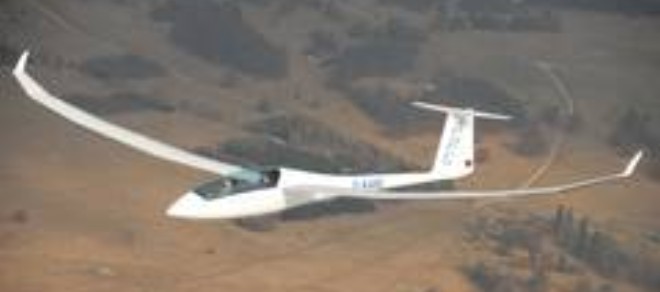
The Arcus was developed using an all-new wing design with full-span flaperons mated to the “L” cockpit design, as used on the Duo Discus XL. Designed by Tilo Holighaus and Christoph Wannenmacher, the Arcus first flew on 7 April 2009 at the Hahnweide airfield.
The Schempp-Hirth Arcus is a flapped two-seat 20m racing class glider of all composite construction, with optional water ballast. This two seater is as agile as a single seater and equipped with flaps.
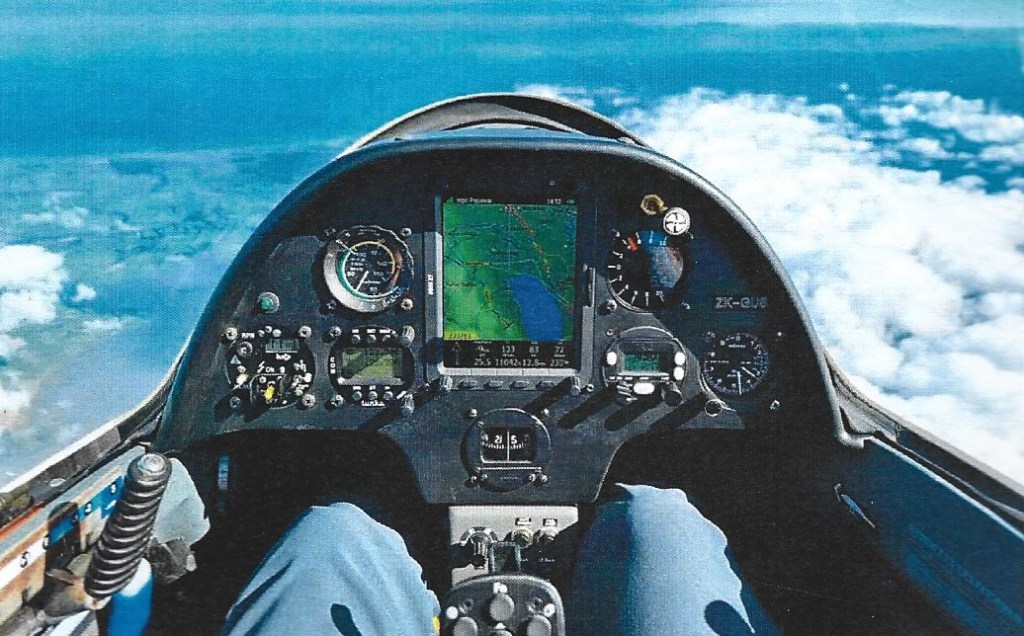
It is available as a pure glider, a sustainer version Arcus T using the retractable Oehler-Turbo (Solo 2350) engine, and as a self-launching glider Arcus M using the Binder (Solo 2625) powerplant system.
Type certificate:
EASA Type Certificate Data Sheet EASA.A.532 Issue 04 dated 08 October 2014
– Arcus T approved 17 May 2011
– Arcus M approved 20 June 2013
– Arcus approved 31 July 2014
Arcus
MCTOW 750 kg [1653 lb.] – with Water Ballast
Max. No. of Seats: 2
Arcus T
Engine: Solo 2350 D
Propeller: OE-FL 5.110/83 av
MCTOW 800 kg [1763 lb.] – with Water Ballast
Max. No. of Seats: 2
Model: Arcus M
Engine: Solo 2625-02 (modified per SB 4600-3)
Propeller: Technoflug KS-1G-160-R-120
MCTOW 800 kg [1763 lb.] – with Water Ballast
Max. No. of Seats: 2
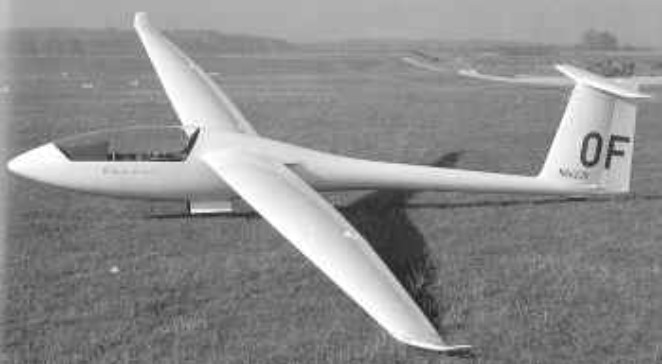
The 15-meter Ventus (Latin for ‘wind’) designed by Holighaus, Schott, Treiber and Schuo, (not to be confused with the later completely redesigned Ventus 2) has all-carbon fiber wings. The Ventus high performance single-seater is the first of a new generation of racing and competition 15m Class sailplanes featuring carbon-fibre in their structures; the mid-set wings are specially designed to take full advantage of this material’s lightness and extra stiffness. The strength of this material permitted use of a very thin and more laminar airfoil developed by F.X. Wortmann, Dieter Althaus and Ventus designer Klaus Holighaus, thinner than previous Wortmann profiles. The stiffness of carbon fiber prevents wing twist at high speeds such as often occurs with fiberglass. A special characteristic of this new section is that at low-drag speeds, stall warning buffeting occurs when the angle of attack must increase over 10° before the stall itself actually occurs, this giving a previously unknown safety margin in narrow thermals, in ridge or mountain flying and in landing. The wing and its skin are made entirely of carbon-fibre, which gives increased torsional stiffness and reduces by over two-thirds the negative tip twist experienced with thin glassfibre wings, and the resulting lift penalties; the wing skin is made of specially developed extrafine-weave carbon cloth, and has high stiffness to maintain the wing profile.
The same new air brake/flap system as on the Nimbus 2C is featured, the air brakes being behind the 70% chord line outside the wing’s laminar flow area, and this system gives an unusually short and slow landing. The two-piece ailerons feature Grob elastic flap-type joints on the lower wing surfaces to make the aileron/wing joint gapless and reduce drag, while enabling the upper surface gap to be kept very small. Tail surfaces are similar to those of the Nimbus, with a fixed incidence tailplane and elevator.
The prototype Ventus first flew on 3 May 1980 and was offered with an A model for shorter pilots, and a slightly wider and longer B model. There are two fuselage sizes, the normal version (the Ventus B) being big enough for pilots from 5ft 9in to 6ft 5in tall, this fuselage being 24.75in wide, 32.75in high and 21ft 4.47in long. The smaller fuselage (the Ventus A) is designed so that pilots up to 5ft 9in tall will not feel ‘lost’ in a cockpit designed to accommodate six-footers, and is 21.25in wide x 29.5 in high x 20ft 9.5 in long; its smaller size results in a slight performance bonus.
In both versions the pilot sits under a one-piece sideways-hinging cockpit canopy which is easily jettisonable; the canopy frame is of carbon-fibre and there is provision for a variety of instrumentation. Both fuselage sizes have a steel mid-fuselage frame on which is mounted the retractable monowheel, the flap and aileron drives and the wing lift-pin sockets; this frame takes the stresses from the landing gear directly through to the wings, and there is also a tail bumper fairing under the fin. The rudder sizes are slightly different for each fuselage size, and there is provision for over 330lb of water ballast in integral fuselage tanks.The Ventus has trailing-edge combination flaps and dive brakes, and aileron control mixers which reduce aileron deflection when extreme positve or negative flap is selected.
The B model had optional 16.6 m. tip extensions, while the C model offered 15 m winglets tip extensions increasing the span to 16.6 or 17.6 m, and a 5 kg /11 lb fin ballast tank. Dick Johnson tested a modified Ventus A with 16.5 m. tip extensions to give a demonstrated best L/D of 50 at 78 kph/ 42 kt/ 48 mph and a minimum sink rate of 0.43 m/s/ 1.42 fps/ 0.84 kt.
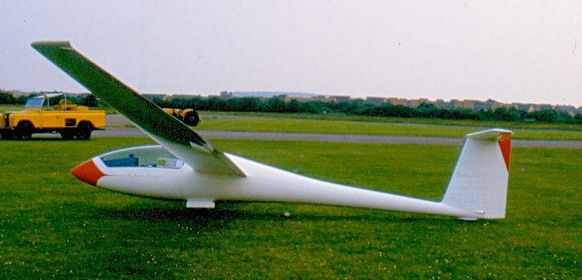
The sustainer Ventus bT had 16.6 m wings and a retractable 15 kW/ 20 bhp Oehler Solo turbo engine.
Constant refinement was also the key for the success of the Racing Class glider Ventus which debuted in spring 1986 as the model Ventus-c (on request with wing tip extensions for 17,6 m wingspan). In 1986 Klaus Holighaus, sole owner and designer of Schempp-Hirth, displayed new 17.6m tips for the Ventus.
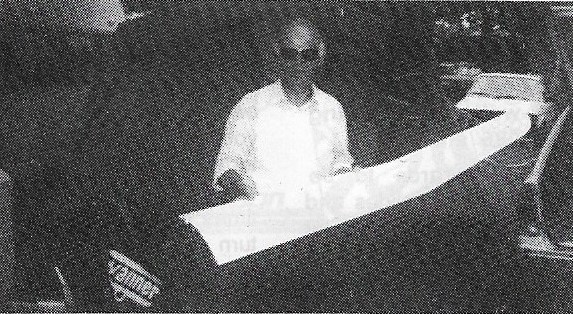
These tips are swept back, with a second stage sweep (backwards and upwards). Holighaus declared that they would add another 2.5 to the L/D taking it to 49:1.
The new improved Ventus had a new aileron control system, “two-story” Schempp-Hirth airbrakes, drag reducing wing-fuselage fairings, and automatic hook-up of all controls.
Production of this model was ceased in 1994 after over 600 examples were produced (including self launchers and turbos).
The cT had 17.6 m wings and a Solo engine uprated to 22 kW/ 30 bhp.
A Ventus won the 15 m class at the 1983 World Championships at Hobbs, NM, and others took 10 of the first 15 places. R.L. Robertson of Great Britain, along with others, won the world triangle distance record of 1,363 km./ 846.9 miles in 1986 in a Ventus A.
The Ventus 2, despite its names, is substantially changed from its similarly named predecessor. It has a complely new Discus planform wing and comes in a number of different configurations.
The unpowered sailplane comes in three different varieties, the short fuselage 15 m Ventus 2a, the larger fuselage 15 m -2b, and the convertible tip 2c (which has the larger -2b fuselage) with a choice of 15 m or 18 m outer wing panels.
On the 31.03.94, the first flight of the “new Ventus generation’ took to the air. A concept still realized by Klaus Holighaus and advanced with energy, but he however could not bring to conclusion as he lost his life in a flight accident on the 09.08.1994.
He had still flown the variants Ventus-2a and Ventus-2b and had also witnessed the double victory of the Ventus-2 at the European Championships in Rieti in 1994 as a testament to his wing shape concepts.
His last design also followed on to win the World Championships in New Zealand as well as in France in 1997.
The 18m version of the Ventus-2 which was designed by Klaus Holighaus was first flown on the 30th March 1995 by his son Tilo for the time. It is produced as the Ventus-2c, as the Ventus-2cT with the “Turbo” and as the self launcher Ventus-2cM.
The sustainer engined 2cT comes with 18 m span, while the self-launching 2cM has the 15 m or 18 m wingtip option with an empty weight of approximately 350 kg / 772 lb. The liquid cooled Solo engine remains in the fuselage when the mast mounted propeller is raised. This has folding blades which reduce the size of the cutout required in the fuselage to accommodate the mast. As a flapped sailplane, the 15 m versions comply with 15 m racing class at the 1995 World Championships at Omarama, New Zealand.
Until spring 1998, 100 examples were delivered. As of the summer of 1998, the self launcher was being produced with an even more powerful SOLO engine.
The World Championships were successful in Mafeking 2001, with a renewed title for the Ventus-2ax in the 15m class, a variant sporting a drag reduced tail section and Maughmer winglets. These modifications (which improved the flight characteristics at lower speeds and higher wing loadings) were carried through to the Ventus2-bx, along with a newly designed outer contour and cockpit area shape.
The Ventus-2cT won the 18m class at the FAI World Air Games in Lillo/Spain. Mid May 2002 saw the delivery of the first ballistic chute “total recovery system“ fitted to a Ventus-2bxR which was designed by the neighbouring company Glasfaser-Flugzeug-Service GmbH in Grabenstetten and tested in a Discus. 2002 saw the delivery of the 1000th Discus (all variants) as well as the completion of the 1000th Ventus (all variants).
In 2003 a fire broke out in one of the buildings delaying production by several months. Affected were the fuselage moulds for the new Ventus-2cxT (a structurally strengthened version with optimised tail unit, improved outer wings and Maughmer winglets for increased roll rate at even higher wing loadings). These changes, including strengthening in the cockpit area, have been incorporated into the Ventus-2cx glider and the motorglider Ventus-2cxM as standard equipment and have the title of “New Ventus Generation“.
The European Gliding Championships in Lithuania 2004 confirmed the performance of the new Schempp-Hirth aircraft, with the the double win of the Ventus-2cx, and in the racing class with the bronze title from Axel Horn in a Ventus-2ax (behind two Ventus-2a).
A one-off sailplane known as the Lentus, which consists of a Ventus A fuselage fitted with Nimbus C wings, was used for performance comparison trials with the Ventus.
Ventus
Wing span: 15m / 49.2ft
Wing area: 9.51sq.m / 102.4sq.ft
Aspect ratio: 23.7
Length: 21.4 ft
Height: 2.7 ft
Empty Weight: 235kg / 518lb
Payload: 190kg / 639lb
Gross Weight: 525kg / 1157lb
Wing Load: 55.2kg/sq.m / 11.31lb/sq.ft
Water Ballast: 150kg / 331lb
Max speed: 135 kt
Stalling speed: 42 kt
L/DMax: 44 at 100 kph / 54 kt / 62 mph
MinSink: 0.58 m/s / 1.90 fps / 1.13 kt / 130 fpm at 58 kt
Airfoil: Wortmann/Holighaus/Althaus
Seats: 1
Ventus a
Span: 49 ft 2.5 in
Length: 20 ft 9.5 in
Wing area: 102.4 sqft
Aspect ratio: 23.7
Empty weight: 474 lb
Max weight: 949 lb
Max speed: 155 mph
Min sinking speed: 2.17 ft/sec at 9.2 lb/sq ft wing loading
Best glide ratio: 44:1 at 74.6 mph
Ventus a
Wing span: 16.6m
Ventus b
Span 15 m / 49 ft 2.5 in
Wing area 9.51 sq.m / 102.4 sqft
Aspect ratio 23,7
Fuselage length 6.58 m / 21 ft 4.75 in
Unloaded weight approx. 225 kg / 486 lb
Gross weight 525 kg / 949 lb
Wing loading 31,5-55,2 kg/sq.m
Water ballast 168 lt
Maximum speed: 250 km/h / 155 mph
Maneuver speed 200 km/h
Min sink: 0.58 m/s / 2.17 ft/sec at 9.2 lb/sq ft wing loading
Best glide ratio: 44:1 at 74.6 mph
Ventus b/16.6
Wing span: 16,5m
Ventus bT
Wingspan: 15/17,6m
Ventus 2A
Wing span: 15m / 49.2ft
Wing area: 9.67sq.m / 104.41sq.ft
Aspect ratio: 23.3
Airfoil: Boermans DU 93-132/15
Empty Weight: 225kg / 496lb
Payload: 300kg / 661lb
Gross Weight: 525kg / 1157lb
Wing Load: 54kg/sq.m / 11.1lb/sq.ft
Water Ballast: 200kg / 441lb
L/DMax: 46 93 kph / 50 kt / 58 mph
MinSink: 0.60 m/s / 1.96 fps / 1.16 kt
Seats: 1
Ventus 2C
Wing span: 18m / 59ft
Wing area: 11sq.m / 118.4sq.ft
Aspect ratio: 29.4
Airfoil: Boermans DU 93-132/15
Empty Weight: 265kg / 562lb
Payload: 270kg / 595lb
Gross Weight: 525kg / 1157lb
Wing Load: 47.73kg/sq.m / 9.77lb/sq.ft
Water Ballast: 200kg / 441lb
L/DMax: 46 93 kph / 50 kt / 58 mph
MinSink: 0.60 m/s / 1.96 fps / 1.16 kt
Seats: 1
Ventus cT
Wing span: 15/17.6m
Ventus cM
Wingspan: 15/17,6m
Sportflugzeugbau Göppingen (Sport Aircraft Göppingen)
Sportflugzeugbau Schempp-Hirth
Schempp-Hirth Flugzeugbau Gmbh
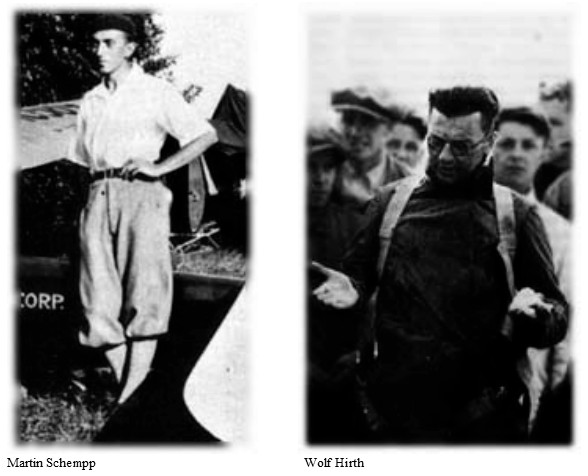
Martin Schempp and Wolf Hirth first met in 1928 and beginning in 1935, the team developed the Minimoa, the first high performance glider to sell more than 100 models. The production of Schempp-Hirth gliders began in the municipal building yard in Göppingen, near Stuttgart, where Martin Schempp founded the Sportflugzeugbau Göppingen (Sport Aircraft Göppingen) company in 1935.
In 1938 the company moved to Kirchheim/Teck and employed more than 300 people during the war time.
The first serial gliders were the aerobatic single seat trainer GÖ-1 ‘Wolf’ from Wolf Hirth and the renown GÖ-3 ‘Minimoa’ as well as the two seat GÖ-4 from Wolfgang Hütter. Occasionally there are single examples which are preserved and maintained as oldtimers which can still be found at airshows.
During the war, the production was forcefully expanded to build parts for, amongst other things, the ME-109, the “Giant” and for the Bachem “Natter”. Alongside the GÖ-4 there were also complete aircraft which were built, like the GÖ-8 and the 13,6m-“Habicht”.
The period after the war till 1955 was bridged with the production of plywood suitcases, leg prosthesis, furniture, weaving looms etc, yet also with fighter jet dummies (F-86) and sound studios for television stations.
The connection to the aviation industry was implemented early on with the production of the Matteson M-1 glider, the production of the powered aircraft GS-6a “Milan” and with works on engine pod and tail section of the “Trumpf” airship D-LEDA.
Licenced production such as “Emeraude” and “Smaragd”, subcontracting for “Kl-107” “, “Do-27”, “Do-28” and subsequently the production of the Standard Austria glider in several versions, ensured the employment of the about 50 employees till 1965.
In 1960s company renamed and built the Milan 656 light tourer, also French Piel Emeraude under licence. During early 1960s production of powered aircraft ceased, licence rights for Emeraude being transferred to Binder Aviatik KG.
Regaining a foothold in the world market was achieved with an own design, the SHK, by Rolf Kunz which was flown into third place in its first attempt at the 1965 World Championships in South Cerny/England.
After that the technology revolution from wood to fiberglass was completed in quick steps – at Schempp-Hirth under the directorship of Klaus Holighaus, who, with the maiden flight of his Cirrus in January 1967, was able to celebrate a successful debut.
Two years later, again in January, he already flew his first “Super Orchid”, the Nimbus-1. With this glider George Moffat won the 1970 World Championships in Marfa/Texas, USA.
With more than 700 produced examples, (of which 200 were produced by Grob), the Standard Cirrus was Schempp-Hirth’s second most successful aircraft in produced units. Further successes followed in 1972 and 1974 when Göran Ax in Yugoslavia and George Moffat in Australia became World Champions in the Open Class flying the Nimbus-2 (the production version of the Nimbus-1).
1974 also marked the maiden flight of the Janus, being the worlds first two seat glider in fiberglass construction. Constantly refined (e.g. 20 m CFK wings) it was only retired from production in 1996 after over 20 years. The last variants were the janus-Ce and janus-CT.
Also in 1974, there was the maiden flight of the single seat motorglider Nimbus-2M. Not only were the first experiences with retractable engines achieved, but also numerous world records were set, from the limited series production.
For the FAI introduced “15 m Racing Class”, Schempp-Hirth delivered the Mini-Nimbus, which came on to the market in many versions and was superseded in 1980 by the Ventus.
A new material had found its way, however, into the Kirchheimer production halls: the carbon fiber. What was included into the Nimbus-2C in a rather inconspicuous manner, proved itself to be the start of, at that time not appreciative of how large, an effective future in the production of high performance gliders. The thin wing profiles of the succeeding developments would not have been possible without the higher strength and stiffness of the carbon fiber.
The lengthening of the lifespan for fiberglass constructed gliders from 3000 to 6000 hours was for example, proven with a Nimbus-2 inner wing.
Serial introduction of carbon fiber was first included on the Nimbus-2C, Mini-Nimbus-C, Janus-C and Janus-CM. the optimal qualities of this new material were only utilized fully later on in the Ventus and Nimbus-3, in the production of the long and thin wings of these models.
Just a few months after its maiden flight, the Nimbus-3 won the 1981 World Championships in Paderborn.
Then the Ventus and Nimbus-3 won the 1983 World Championships in Hobbs/USA and subsequently the Nimbus-3 was also at the front in Rieti in 1985. Together with this, a string of national championships titles for both models and a number of world records for the Nimbus-3 were achieved.
Whilst the production of the single seat Nimbus-3 had to be discontinued after a fire in one of the production halls, this enabled the production of the Racing Class glider Ventus to be increased, allowing the increase in demand for its motorized variant Ventus-bT to be satisfied.
Constant refinement was also the key for the success of the Racing Class glider Ventus which debuted in spring 1986 as the model Ventus-c (on request with wing tip extensions for 17,6 m wingspan). Production of this model was ceased in 1994 after over 600 examples were produced (including self launchers and turbos).
January 1998 saw the delivery of the 4000th built Schempp-Hirth aircraft since the start of the company (including aircraft built under licence).
Today thousands of their gliders are flying around the world. Schempp-Hirth sailplanes include the Ventus A, an advanced 15-meter-class plane with carbon-fiber technology, thin wings, and a low-profile fuselage. The Ventus B is a 15-meter-class craft with a larger cockpit for tall pilots. The Nimbus 2C (open class) has a 20.3- meter wingspan with either carbon or carbon/fiberglass construction. The Janus B has an 18.2-meter wingspan for high-performance tandem two-place flying. The Janus C has a 20-meter span with carbon wings, seating for two, and competition-type performance. The Janus CM, with a 20-meter span, is a two-place motorglider with carbon wings and fully retractable engine. Schempp-Hirth’s newest sailplanes include the Discus, Duo Discus, Ventus and Nimbus, available in a variety of variations, including pure gliders and powered sailplanes.
January 1998 saw the delivery of the 4000th built Schempp-Hirth aircraft since the start of the company (including aircraft built under licence).

2014: Schempp-Hirth Flugzeugbau GmbH
Type Certificate: EASA.A.532
A 1981 single-place cabin mid-wing monoplane powered by a 400hp Avco Lycoming IO-720-B1B. It is unknown if it flew.
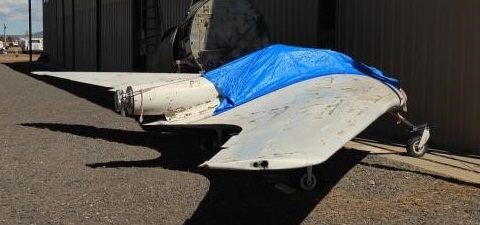
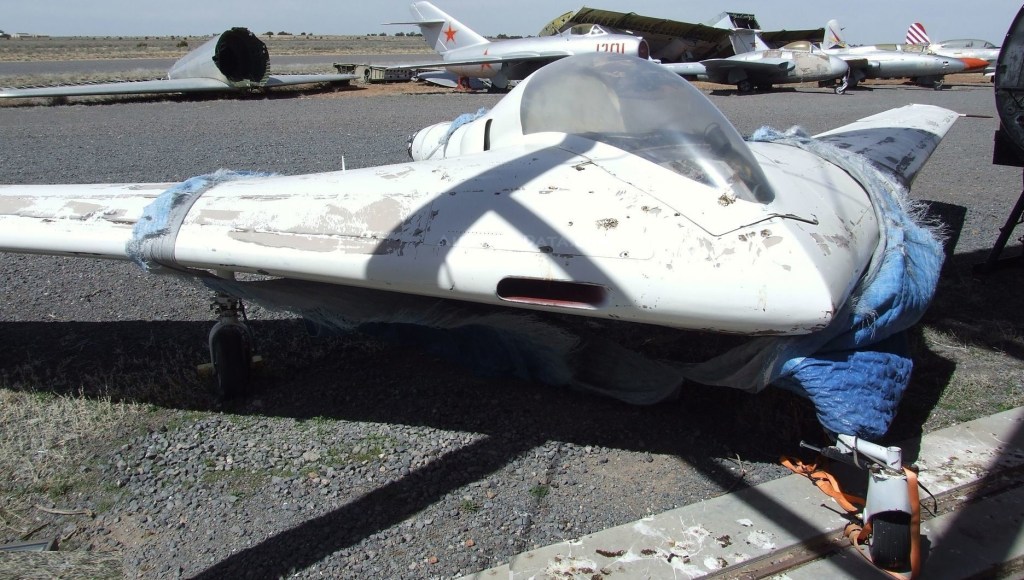
The SA-882 is a flying wing which was designed and built to research the overall aerodynamics, control and flying characteristics of a tailless airplane configuration.
The Schapel Wing is powered by a turbo-charged Mazda, 2 chamber, rotary engine. The 3-bladed propeller is ground adjustable and is driven by a 40-inch long drive shaft. Propeller 2:1 speed reduction is accomplished by a helical gear speed reducer. The engine gave them some problems during the dyno testing phase, but a successful combination was finally developed.
The aircraft was built in female molds using an epoxy system, vaccumed, and cured at 240 degrees F. in an oven. The upper and lower surfaces are a foam sandwich with a three spar system out to the landing gear position and then two spars out to the tip. The wing has five ribs per side and uses a non-laminar flow airfoil of his own design with a very low pitching moment. The wing has a lot of twist between the root and tip, with about 9 degrees negative by the time you reach the tip. This was designed to achieve a zero pitching moment, which has since been confirmed through the flight testing. Max CL came out to about .85, and was driven by all the actuation mechanisms had to be enclosed.
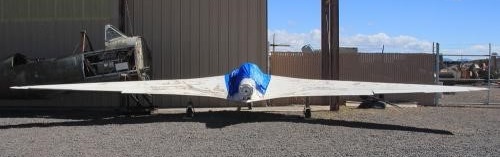
The actual construction involved using unidirectional material, laid up at different angles as required by the results of a computer analysis. They built a male plug, a set of one piece female molds for everything and, then the PVC sandwiched skins constructed. This type of construction gave it about a 1300 lb. empty weight, with a fuel capacity of 57 gallons right at the CG. The spars were made up separately, then added to the laminated lower skins along with the ribs and then bonded all together. The upper skins, in their molds, were then bolted on-top of the low portion so a spar cap could be cast to measure the thickness between the spar and upper skin. Once the skin was constructed, the whole thing was bolted together and put in the oven for curing.
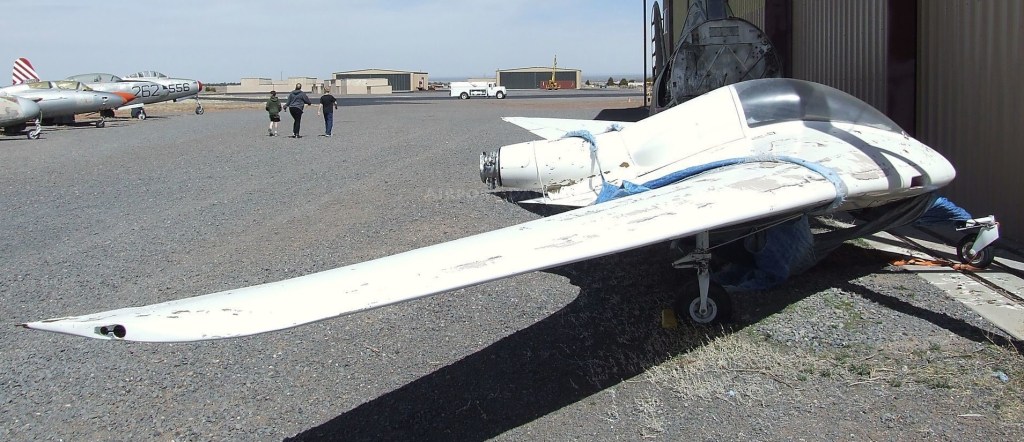
It should have had a steerable nose gear, which it did not. Low speed controllability during the initial phases of takeoff required using a lot of brakes, since the drag rudders were ineffective. This was due to them being at the MAC rather than the wingtips so the pitching moments wouldn’t be changed during flight.
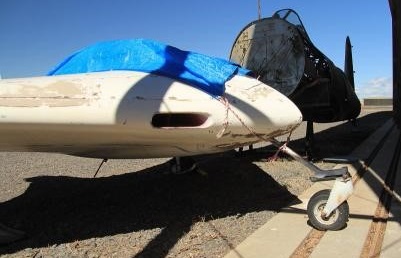
A single-place monoplane, powered by a 180hp turbo Mazda rotary pusher, one was built to full scale circa 1985 and registered N882SA. The SA-882 was flight-tested in 1984 and is now preserved by the Planes of Fame Museum, Chino, Nevada.
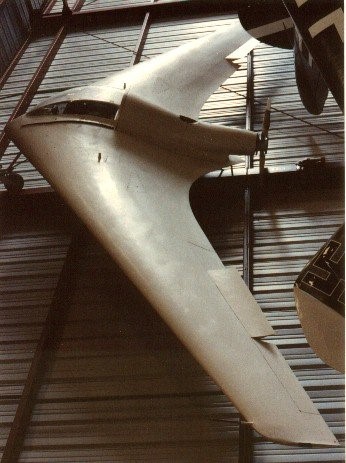
Several things the builder said he would change if he did it again were: put the drag rudders out at the wingtips; instead of having separate elevator and ailerons he would combine the two, and; he felt it would be much simpler to put a jet engine (about 400 lbs thrust) in it versus the rotary.
Engine: Mazda rotary, 180 hp
Wing Span: 34 feet
Wing Area: 160 sq. ft.
Aspect Ratio: 7.23
Gross Weight: 1960 lb
Empty Weight: 1372 lb
Useful Load: 612 lb
Maximum Fuel: 57 USgal
Seats: 1
A 1980 twin-boom, single-place cabin mid-wing agricultural monoplane powered by a 680hp P&W PT6A-15AG pusher. It is unknown if it flew.
1973:
(Rodney E) Schapel Aircraft Co
Reno NV.
USA
Founded 1973. Produced S-525 Super Swat twin-boom and turboprop-powered agricultural aircraft 1980, followed by design of S-325 Mini-Swat conventionally configured agricultural aircraft, SA-882 Flying Wing tailless research aircraft 1985, and design for S-185 as lightweight single-seat attack aircraft.
The (Rodney E) Schapel Aircraft Co had a number of project but it is unknown if any flew.
USA
Scenic Air Lines, in 1977, acquired from American Jet Industries engineering and manufacturing rights for turboprop conversions of Cessna Models 402 and 414, now known as Turbo Star 402 and Turbo Star Pressurized 414. Converted Twin Otters to have low-noise propellers and large windows in 1991.

