A 1983 hang glider.
1980->
Schmidtler Helios
A 1982 hang glider.
Schmidtler
1998:
Wilhelmster, 14
D-80801 München
Germany
Hang glider and trike builder
Schleicher ASW-28
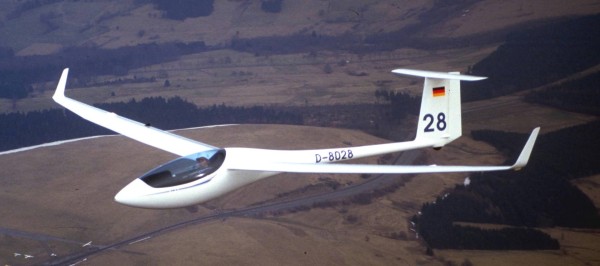
Designed by Gerhard Waibel and built in Poppenhausen, Germany, the Schleicher ASW 28 is a Standard Class glider with a laminar wing profile for “turbulent” conditions. By using carbonfibre and Aramid along with a new Polyethylene fibre, joining a high strength with low weight, Schleicher tries to achieve an empty weight of only 325 kg, and a wing loading of only 30 kg/sq.m. Four integrated tanks for a maximum water ballast of 180 liters keep the spectrum at a 50 kg/sq.m wing loading open.

The ASW 24 derived fuselage is designed to be fitted with a rescue system. The ASW 28 features a new profile from Professor Loek Boermans, which is supposed to give the new glider a top performance and excellent handling characteristics in turbulent air.

L/DMax: 45
MinSink: 0.55 m/s / 1.86 fps / 1.00 kt
Seats: 1
Wing span: 15 m / 49.2 ft
Wing area: 10.5 sq.m / 113 sq.ft
Empty Weight: 235 kg / 510 lb
Gross Weight: 525 kg / 1202 lb
Wing Load: 50 kg/sq.m / 10.24 lb/sq.ft
Aspect ratio: 21.43
Airfoil: Boermans DU 99-146MOD
Schleicher ASW 27
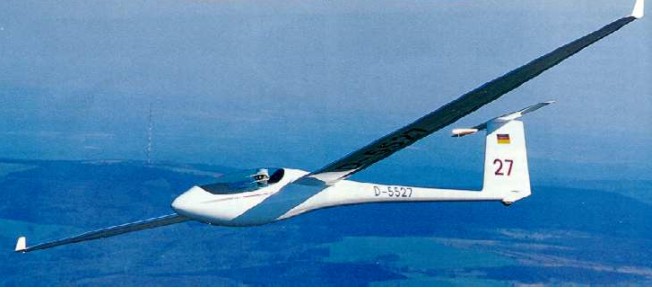
Designed by Gerhard Waibel, the 15 m racing class successor to the ASW-20 has been designed to maximize performance without regard to possible span extension or addition of an engine. Airbrakes are top surface triple element Schempp-Hirth type to compensate for the very thin wing section.
ASW-27
Wing span: 15m / 49.2ft
Wing area: 9sq.m / 96.88sq.ft
Empty Weight: 225kg / 496lb
Payload: 275kg / 606lb
Gross Weight: 500kg / 1102lb
L/DMax: 48 100 kph / 54 kt / 63 mph
MinSink: 0.52 m/s / 1.70 fps / 1.01 kt
Wing Load: 55.55kg/sq.m / 11.37lb/sq.ft
Water Ballast: 180kg / 396lb
Aspect ratio: 25
Airfoil: Boermans DU 89-134/14
Seats: 1
Schleicher ASH-26

Designed by Martin Heide as a dedicated 18 m sailplane rather than an extended-tip 15 m model, flapped self-launching ASH-26E claims better performance from being optimized for this span. The Midwest engine installation is distinctive from most previous mast mounted retractable engines in that the engine remains in the fuselage when the propeller is raised, permitting reduction of the sailplane’s noise footprint.
Engine: 38 kW/ 51 bhp Midwest AE50 AP
Wing span: 18 m / 59 ft
Wing area: 11.7 sq.m / 125.94 sq.ft
Aspect ratio: 27.69
Airfoil: Boermans DU 89-134/14
Empty Weight: 424 kg / 935 lb
Payload: 161 kg / 354 lb
Gross Weight: 585 kg / 1289 lb
Wing Load: 50 kg/sq.m / 10.24 lb/sq.ft
MinSink: 0.52 m/s / 1.70 fps / 1.01 kt
L/DMax: 50 96 kph / 52 kt / 60 mph
Seats: 1
Schleicher ASW-22-2 / ASH 25
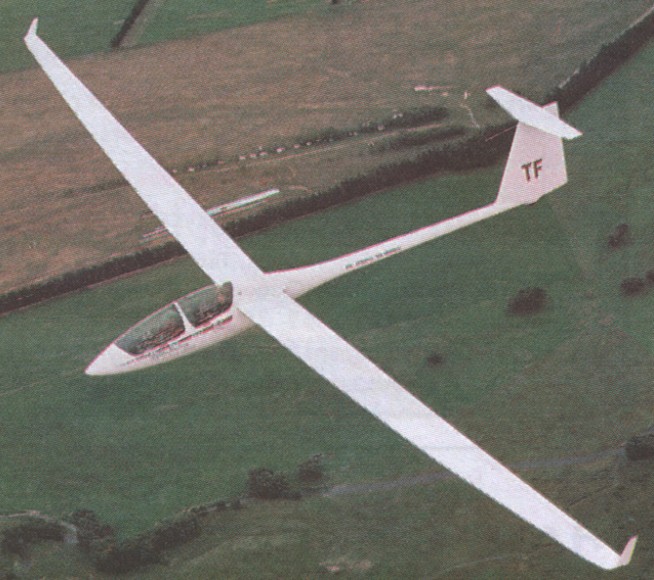
Designed by Martin Heide, the tandem two seat Schleicher ASH25 featured the longest wingspan of any production glider (25 metres). First flown in 1986, the ASH25 first went into production in that year. Construction is all carbon fibre and the sailplane can sustain a glide angle of 1:58. The design was specifically aimed at producing a two seat glider with single seat perform¬ance and utilises the wing of the ASW22B married to a new fuselage of carbon/ aramid fiber reinforced plastic.
Within a couple of years the ASH25 had set five world speed records for triangular courses varying from 330 km / 205.1 miles to 1,380 km / 857.0 miles. Hans Werner Grosse of Germany has set 12 world records in all flying an ASH-25.
The ASH-25 is the production version of the one-off two-place ASW-22-2 using a fuselage adapted from the Akaflieg Stuttgart FS-31.
The ASH-25E is powered by a retractable 19 kW/ 25 bhp Rotax 275 sustainer engine.
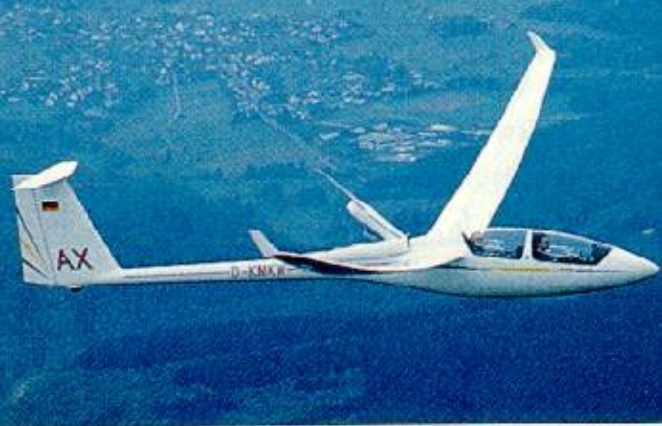
A flight test evaluation by Dick Johnson measured a best L/D of 54.3 : 1 without turbulator tape or special sealing. An ASH-25 flown by G. Herbaud and J-N. Herbaud of France both won the world multiplace straight distance and goal distance records of 1,383 km./ 859.3 miles in the same flight in 1992.
ASH-25E
Engine: 19 kW (25 bhp) Rotax 275
Wing span: 25m / 82ft
Wing area: 16.31sq.m / 175.6sq.ft
Empty Weight: 480kg / 1058lb
Payload: 270kg / 595lb
Gross Weight: 750kg / 1653lb
Wing Load: 45.98kg/sq.m / 9.41lb/sq.ft
L/DMax: 57 108 kph / 58 kt / 67 mph
MinSink: 0.45 m/s / 1.48 fps / 0.88 kt
Water Ballast: 225kg / 496lb
Aspect ratio: 38.3
Airfoil: HQ 17
Seats: 2
Schleicher ASW 24
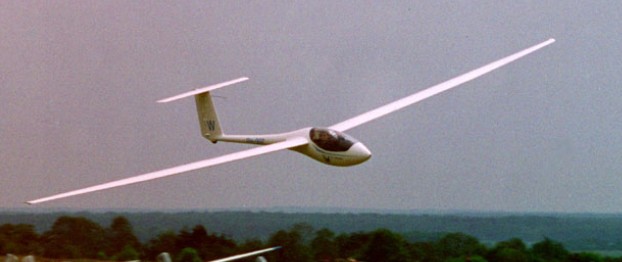
The ASW-24, which first flew in 1987, is the Standard Class successor to the Schleicher ASW-19. Approach control is effected by top surface Schempp-Hirth type airbrakes.
Designer Waibel won the 1992 OSTIV Award for significant contributions to safety for the ASW-24 design.
The ASW-24E is the self-launching version.
ASW-24
Wing span: 15m / 49.2ft
Wing area: 10sq.m / 107.6sq.ft
Empty Weight: 230kg / 507lb
Payload: 270kg / 595lb
Gross Weight: 500kg / 1102lb
L/DMax: 44 105 kph / 57 kt / 65 mph
MinSink: 0.58 m/s / 1.90 fps / 1.13 kt
Wing Load: 50kg/sq.m / 10.24lb/sq.ft
Water Ballast: 170kg / 375lb
Aspect ratio: 22.5
Airfoil: Boermans DU 84-158
Seats: 1
ASW-24E
Engine: 19kW/ 25bhp Rotax 275
Wing span: 15m / 49.2ft
Wing area: 10sq.m / 107.6sq.ft
Empty Weight: 230kg / 507lb
Payload: 270kg / 595lb
Gross Weight: 500kg / 1102lb
L/DMax: 44 105 kph / 57 kt / 65mph
MinSink: 0.58 m/s / 1.90 fps / 1.13kt
Wing Load: 50kg/sq.m / 10.24lb/sq.ft
Water Ballast: 170kg / 375lb
Aspect ratio: 22.5
Airfoil: Boermans DU 84-158
Seats: 1
Schleicher ASW 22
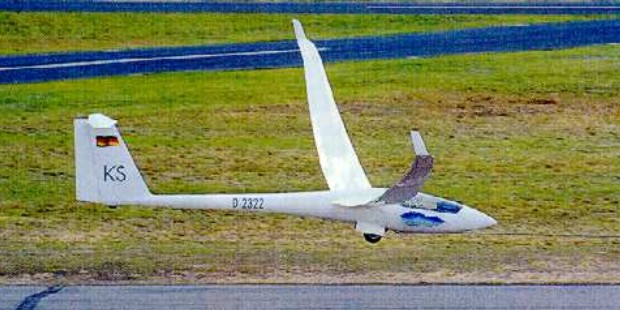
Designed by Gerhard Waibel, the Open Class successor to the Schleicher ASW- 17, the ASW-22 first flew in 1981 with a 22 m wingspan, of which 39 were produced. It was also available with detachable wing tip extensions to give a span of 24m.
Span on the ASW- 22B model was increased to 25 m with a modified inner wing section and flaperons similar to the ASW-20. A 21 m span verison was to be offered with a higher maximum take-off weight for competition or record flights in rough weather.
It uses Horstmann and Quast airfoil technology with underwing pitot tubes to collect high-pressure ram air which then ejected through 860 tiny turbulator holes in the bottom wing skin ahead of the flap and aileron hinge line to delay separation of laminar flow on the lower surface and thereby reduce wing drag. Construction of the four-piece wing is primarily of carbon fiber, while the fuselage and horizontal stabilizer are combinations of fiberglass and Kevlar with some carbon. The wing is made in four sections. Up to 44 Imp gallons of water ballast can be carried.
Approach control is achieved using top surface double segment Schempp-Hirth airbrakes and a tail parachute. The ASW-22 is fitted with a two-mainwheel retractable undercarriage with oleo-pneumatic shock absorption and disc brakes; the tailwheel is retractable. Measured flight testing of the 25 m model by Dick Johnson demonstrated a best L/D of 56:1 at 47 kt.
An ASW- 22 flown by Hans Werner Grosse of Germany gained the world 750 km speed triangle record in 1985 at 158.41 kph/ 85.53 kt/ 98.43 mph. An ASW-22B won 1st and 2nd places in the Open Class at the 1987 World Championships at Benalla, Australa, another came 1st at the 1991 worlds at Uvalde, TX, and at the 1993 Worlds at Borlange Sweden, two came 1st and 2nd.
The ASW-22BE is a self-launching version with a mast mounted engine. Water ballast is reduced to 120 kg./ 264 lb.
The Schleicher ASW-22X experimental operated at 750kg with 24m span, whereas the original C of A allowed this weight only for ASW-22s of 22m span.
Span: 22m / 72 ft 2.25 in
Length: 26 ft 10.75 in
Height: 5 ft 9 in
Wing area: 244.1 sq ft
Aspect ratio: 22m
Empty weight: 882 lb
Max take-off weight: 1,543 lb
Best glide ratio: 55:1 (estimated)
Span: 24m / 78 ft 9 in
Length: 26 ft / 10.75 in
Height: 5 ft 9 in
Wing area: 251.0 sqft
Aspect ratio: 24.7
Max take-off weight: 1,543 lb
Best glide ratio: 55:1 (estimated)
ASW-22
Wing span: 25m / 82ft
Wing area: 16sq.m / 175.6sq.ft
Empty Weight: 450kg / 992lb
Payload: 300kg / 661lb
Gross Weight: 750kg / 1653lb
L/DMax: 60 95 kph / 51 kt / 59 mph
MinSink: 0.41 m/s / 1.35 fps / 0.80 kt at 85 kph / 46 kt / 53 mph
Wing Load: 45.98kg/sq.m / 9.42lb/sq.ft
Water Ballast: 235kg / 518lb
Aspect ratio: 38.3
Airfoil: DLR-HQ 17
Seats: 1
ASW-22BE
Engine: 36 kW/ 48 bhp Rotax 505A
Wing span: 25m / 82ft
Wing area: 16sq.m / 175.6sq.ft
Empty Weight: 450kg / 992lb
Payload: 300kg / 661lb
Gross Weight: 750kg / 1653lb
L/DMax: 60 95 kph / 51 kt / 59 mph
MinSink: 0.44 m/s/ 1.44 fps/ 0.85 kt at 85 kph / 46 kt / 53 mph
Wing Load: 45.98kg/sq.m / 9.42lb/sq.ft
Water Ballast: 235kg / 518lb
Aspect ratio: 38.3
Airfoil: DLR-HQ 17
Seats: 1
Scherer ASW Flash
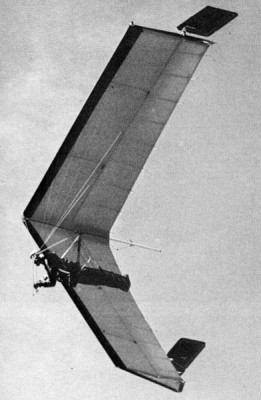
A 1981 hang glider for advanced pilots. The ASW Flash is made by Scherer who began copying the Fledge II in 1980.
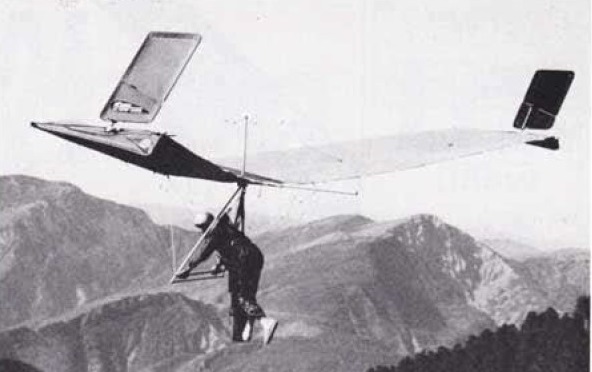
The ASW Flash was sold in Switzerland for £1400 in 1982.
ASW Flash
Wing area: 168 sq.ft
Double surface: 100%
Nose angle: 144°
Weight: 64 lb / 29 kg
Wing area: 15.6 m²
Wing span: 10 m
Aspect ratio: 6.2
Hang glider weight: 29 kg
Nose angle: 127°

