Scheibe Uli II

Tandem two seat single engined high wing mono¬plane with conventional three axis control. Wing has unswept leading and trailing edges and constant chord; conventional tail. Pitch control by fully flying tail; yaw control by fully flying rudder; roll control by half span ailer¬ons; control inputs through stick for pitch/roll and pedals for yaw. Wing braced from above by kingpost and cables; wing profile double surface. Steel tube framework, with optional pod. Engine mounted below wing driving pusher propeller. Wings use two aluminium tubes as spars, with ribs in foam, capped top and bottom with wood; all flying surfaces covered in Ceconite.

This tandem two seater version of the Uli made its first flights in February 1983 and by 1983 two prototypes had been built, which were undergoing certification. The aircraft is fitted with the four cylinder Konig 570cc engine and uses either a two blade or a three blade design of 51 inch (1.30 m) dia¬meter.

Length overall 18.1ft, 5.52m
Wing span 35.4 ft, 10.80 m
Constant chord 4.4 ft, 1.33 m
Sweepback 0 deg
Tailplane span 7.2 ft, 2.20 m
Total wing area 161 sq.ft, 15.0 sq.m
Wing aspect ratio 7.8/1
Wheel track 4.6 ft, 1.40 m
Engine: Konig SD570, 28 hp at 4200 rpm
Propeller diameter 58 inch, 1.47 m. 2-blade
Belt reduction, ratio 1.8/1
Max static thrust 177 lb, 80 kg
Power per unit area 0. 17 hp/sq.ft, 1.9hp/sq.m
Fuel capacity 5.3 US gal, 4.4 Imp gal, 20.0 litre
Empty weight 221 lb, 100kg
Max take off weight 618 lb, 280kg
Payload 397 lb, 180kg
Max wing loading 3.81 lb/sq.ft, 18.7 kg/sq.m
Max power loading 22.1 lb/hp, 10.0kg/hp
Load factors; +6.0, 3.0 ultimate
Economic cruising speed 37 mph, 60 kph
Stalling speed 28 mph, 45 kph
Best glide ratio with power off: 9/1
Take off distance 260 ft, 80 m

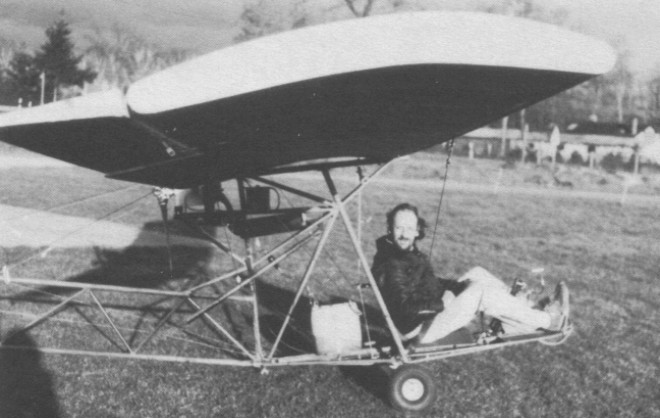
Scheibe Uli I

Single seat single engined high wing mono¬plane with conventional three axis control. Wing has unswept leading and trailing edges and constant chord; conventional tail. Pitch control by fully flying tail; yaw control by fully flying rudder; roll control by half span ailer¬ons; control inputs through stick for pitch/roll and pedals for yaw. Wing braced from above by kingpost and cables; wing profile double surface. Undercarriage has two wheels side by side with tailskid (three wheels in tricycle formation optional); glass fibre tails¬kid and glass fibre suspension on main wheels. No brakes. Steel tube framework, with optional pod. Engine mounted below wing driving pusher propeller. Wings use two aluminium tubes as spars, with ribs in foam, capped top and bottom with wood; all flying surfaces covered in Ceconite.

The prototype of the single seater Uli microlight flew for the first time at the end of 1982 and was shown at Aero 83 Salon at Friedrichshafen. At Aero 83 the Uli I was given a pod, as an option, and a tailwheel had replaced the tailskid. This machine uses welded steel tubes for the framework.

Length overall 18.0ft, 5.50m
Wing span 31.8 ft, 9.70 m
Constant chord 4.4 ft, 1.33 m
Sweepback 0 deg
Tailplane span 7.2 ft, 2.20 m
Total wing area 140 sq.ft, 13.0 sq.m
Wing aspect ratio 7.2/1
Wheel track 4.6 ft, 1.40 m
Engine: Hirth 383cc, 22 hp at 4000 rpm
Propeller diameter 51 inch, 1.30 m
Belt reduction, ratio 1.88/1
Power per unit area 0.16 hp/sq.ft, 1.7 hp/sq.m
Fuel capacity 5.3 US gal, 4.4 Imp gal, 20.0 litre
Empty weight 221 lb, 100kg
Max take off weight 442 lb, 200kg
Payload 221 lb, 100 kg
Max wing loading 3.25 lb/sq.ft, 15.9 kg/sq.m
Max power loading 20.1 lb/hp, 9.1kg/hp
Load factors; +6.0, 3.0 ultimate
Max level speed 50mph, 80kph
Never exceed speed 56mph, 90kph
Max cruising speed 37mph, 70kph
Economic cruising speed 30mph, 48kph
Stalling speed 27 mph, 43 kph
Max climb rate at sea level 400 ft/min, 2.0 m/s
Min sink rate 310 ft/min at 35 mph, 1.6 m/s at 56 kph
Best glide ratio with power off 9/1
Take-off distance 150ft, 45m
Landing dis¬tance 100 ft, 30 m
Range at average cruising speed 112 mile, 180km

Scheibe SF-40

A side by side two seater with a spaceframe fuselage, the wings are constructed in wood.

The SF-40 two-seat lightplane (first flown 1994), the originally offered in A and B versions with tailwheel undercarriages, but the later version was the SF-40-C with a nosewheel undercarriage.

Engine: Sauer, 60 hp
Wing span: 10.8 m
Wing area: 13.4 sq.m
MAUW: 450 kg
Empty weight: 220 kg
Fuel capacity: 40 lt
Max speed: 170 kph
Cruise speed: 150 kph
Minimum speed: 55 kph
Climb rate: 3 m/s
Certification: VZ
Seats: 2
Fuel consumption: 13 lt/hr

Scheibe SF-36

The SF-36 two-seater motor glider was developed from the SF-H34 and uses the letter’s wings and tail unit married to a new fuselage, seating two side by side instead of the SF-H34’s tandem seating. The wings are low-mounted with Schempp-Hirth air brakes, and are detachable for hangarage; folding wings were planned for the SF-36.

Engine is an 80hp Limbach SL2000 driving a fixed-pitch or a three-position variable-pitch airscrew. Construction is of glassfibre-reinforced plastic, and a two mainwheel undercarriage similar to that of the C-Falke ’80 is featured, although a single monowheel with small outrigger wheels under the wings was also offered to customers. The latter was featured on the prototype, which first flew in the summer of 1980, and a retractable single-wheel undercarriage was planned for a later version; in all cases the tailwheel is steerable. The forward-sliding canopy allows entry to be made over the wings.

First SF-36 deliveries were due to start in the spring of 1981. The SF-36 R two-seat motorglider was expected to go into production in France.

Span: 53 ft 6 in
Length: 23 ft 10 in
Wing area: 166 sqft
Aspect ratio: 17.2
Empty weight: 950 lb
Max gross weight: 1,390 lb
Min sinking speed: 3.0 ft/sec at 50 mph

Scheibe

Scheibe-Flugzeugbau GmbH

Egon Scheibe was a young German aircraft engineer, who designed and built some of the most successful gliders before WW2. After the war, he founded Scheibe Flugzeugbau and built a large number of successful gliders, most notably the Bergfalke tandem 2-seater.

Formed at Dachau, near Munich, in 1951 by Egon Scheibe, who at first built gliders designed by Scheibe in Austria. This company had some success with the Mü 13E Bergfalke 1 and then produced a number of conventional gliders. His Sperling two-seat light high-wing monoplane first flew August 1955, and was developed with new wing and tail as SF-23A and built in numbers until 1963. SF-24A Motorspatz built from 1959. SF-25 Motorfalke licencebuilt from 1970 by Slingsby Sailplanes Ltd in UK as Type 61 Falke. SF-28A Tandem-Falke tandem two-seat motorglider no longer offered. Available were the SF-25C Falke 2000 and Rotax-Falke two-seat motorgliders, and the SF-40 two-seat lightplane (first flown 1994), the latter originally offered in A and B versions with tailwheel undercarriages, but the latest version was the SF-40-C with a nosewheel undercarriage. SF-34B Delphin was produced in France as the S.N. Centrair Alliance 34 two-seat glider, while the SF-36 R two-seat motorglider was also expected to go into production in France.

The firm had produced more than 2300 machines by 1983 plus numerous kits for homebuilders.

1983-98: Scheibe Flugzeugbau GmbH, August Pfaltz-Strasse 23, Postfach 1829, D 8060 Dachau bei Mfinchen, West Germany.

Scheibe Flugzeugbau GMBH eventually closed its doors in 2006, partly because of the lack of a successor for Egon Scheibe, but probably also due to the increasingly difficult trading conditions after the boom of Ultralight/Microlight aircraft that have taken over a large portion of the market for fun, relatively cheap, and easy to fly recreational aircraft. The Motorfalke design was subsequently taken over by the newly formed Scheibe Aircraft GMBH based in Heubach (Germany), which has certified the Turbo-Rotax powered version with the glider towing market in mind.

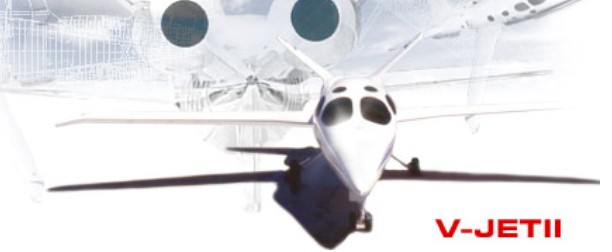
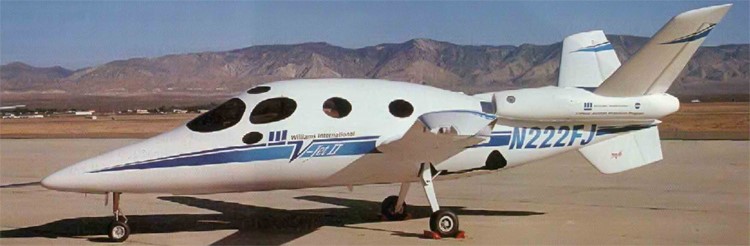
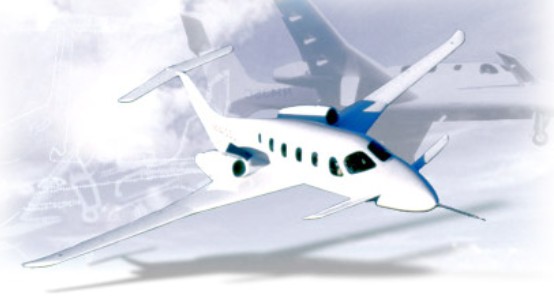
Scaled Composites V-Jet II / Williams International V-Jet II

On June 23, 1997, Williams International announced that its all-composite, turbofan- powered “V-JET II” light aircraft is on schedule for its July 31 fly-in and follow-on demonstration flights and exhibition at the Experimental Aircraft Association (EAA) convention at Oshkosh, July 30 to August 5, 1997. Williams also announced that, although the aircraft is early in its program of gradually expanding its flight envelope, the twin-engine “V-JET II” has already demonstrated docile stall characteristics for beginning pilots, and it has flown at 30,000 feet and at 295 knots true air speed. The Oshkosh show will be the first unveiling of the aircraft to the media and public.

Last fall under a competitive procurement program among jet engine companies, NASA selected Williams International to join NASA in a $100 million cooperative effort to revitalize the once-flourishing light aircraft industry in the United States through small turbofan engine technology. Under the program, Williams and its industry team members, which include Williams suppliers and future aircraft company customers, provide 60 percent of the resources and NASA provides 40 percent for the initial engine demonstration phase.

In 2010, Williams was in the component design phase of the engine technology program, is emphasizing low cost manufacturing processes suitable for high quantity production, and is active with key suppliers to minimize material and purchase parts costs. The new Williams engine has been named the “FJX-2.”

Dr. Sam Williams, Chairman of Williams International, said, “Our objective is to replace aging, piston-powered light aircraft with all new, four-place single and six-place twin, turbofan-powered modern aircraft. This means we must develop a turbofan in the 700 lb thrust category that is very low in cost at a high production rate, is extremely quiet, is light in weight, and is very reliable.”

Not intended for production, the “V-JET II” was designed by Dr. Sam Williams to demonstrate the new Williams FJX-2 high bypass ratio engine characteristics in flight over the anticipated speed and altitude range for the future “turbofan-powered, light aircraft era.”

Several Williams “V-JETs” have been designed in past years by Dr. Williams with three full-scale mockups and at least a dozen small models studied to arrive at the present “V-JET II” configuration. The name, “V-JET”, started with the forward-swept or V-shaped wing that continues from the early Williams designs.

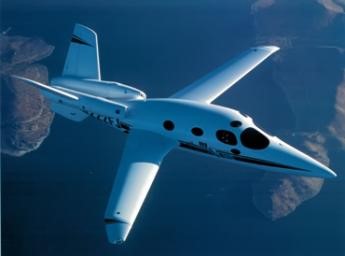
The “V-JET” has the appearance of an advanced fighter with forward-swept wings. The sleek appearance is not only for marketing appeal but is for sound aerodynamic and structural reasons. The Williams design emphasized, and has now achieved for beginning pilots, very docile stall characteristics (because of the forward-swept wing) and minimum pilot action required in the event of a single engine-out condition (because of the close spacing of the engines in the unique Williams V-tail design).

Williams also revealed it contracted with Burt Rutan’s Scaled Composites organization to start with the Williams preliminary design, to conduct the V-JET II” detailed design and analysis, and to manufacture the prototype “V-JET II” (that will fly in to the Oshkosh show). According to Dr. Williams, “Burt Rutan and his team have made major improvements to this design and have introduced into this prototype many new, exciting manufacturing processes.” Flight testing is being done by Scaled Composites’; Doug Shane, acting as Chief Pilot of the program; Matt Gionta, Project Engineer; and Burt Rutan.

The aircraft at Oshkosh this year will be powered by two existing low bypass ratio, 550 lb thrust, FJX-1 turbofan engines developed previously by Williams, These interim engines are being used to check out the aircraft’s performance and systems prior to installation of the new high bypass ratio, FJX-2 engines being developed in cooperation with NASA. The new engines are to be installed during the fourth year of the NASA/Williams program and demonstrated at Oshkosh during the year 2000.

According to Williams, the “V-JET II” will be used primarily to demonstrate the new turbofan engines over a range of flight speeds and altitudes that are expected to be required in future turbofan-powered light aircraft. Installation characteristics, engine performance data, noise levels, exhaust emissions, and flight parameters will be reviewed with the aircraft companies that are participating in the program as members of the NASA/Williams General Aviation Propulsion (GAP) team.

Another purpose of the “V-JET II” flight demonstrations will be to stimulate interest on the part of aircraft companies in designing and developing production aircraft utilizing this new propulsion technology. Williams said, “When the public views the 3800 lb “V-JET II” powered with the existing small turbofan engines, the interest will begin to build. However, later in the program when they view this sleek aircraft powered with extremely quiet, very low cost, light weight, high bypass ration turbofans, the potential for a revival of the light aircraft industry through turbofan power should certainly be underway. I believe every light aircraft pilot dreams of being a jet pilot. This low cost turbofan technology can make this a reality.”

NASA partnered with the general aviation industry in introducing the V-JET II, a turbofan-powered jet. NASA awarded Williams International a 37 million dollar developmental grant to design and build such a small jet engine.

Burt Rutan and his Scaled Composites were contracted to build the V-JET II. While the overall configuration had been created by Sam Williams, it was up to Burt and his staff to do the detail design work and then execute it in the new, composite construction method Scaled Composites had developed.

A the time of its first flight on April 13,1997, as a five seat jet, the VJET II was powered by two Williams International FJX-1 turbofan engines.

Gallery

Engines: two Williams International FJX-1 turbofan
Span: 35.3 ft
Length 31.1 ft
Height: 9.8 ft
Max TO Weight: 3,800 lb
Empty Weight: 2,200 lb
Take off Distance 5000 ft / IS A (25°C): 3,000 ft
Take off Distance SL / std day: 2,300 ft
Climb rate (SL): 3,200 ft/min
Time to climb: 8 min to 18,000 ft
High speed cruise: 370 knts
Range – max fuel: 2600 miles
Range loaded: 1800 miles
Seating: 6
Scaled Composites Triumph

The all-composite Triumph, an 8500-lb, 41,000-ft capable, pressurized 8-seat corporate aircraft, was designed around the then-unflown Williams FJ-44 turbofan engine. In 1988, Scaled performed the first flight of the Triumph, which was also the first flight tests of the FJ-44. The subsequent test program, which consisted of over 100 hours of flight tests, confirmed the performance and operating characteristics of both the engines and the airplane. The Triumph was tested to over 41,000 ft, at speeds up to .69 Mach. Pressurization systems were developed, installed, and tested, basic handling qualities and performance tests were conducted, and a significant body of engine tests were performed.

Scaled Composites 151 Ares

The ARES, Scaled Model 151, was designed initially in response to a U.S. Army request for a Low Cost Battlefield Attack Aircraft. A design study was performed by Rutan Aircraft Factory in 1981 for such an aircraft. The original LCBAA design was for a pusher turboprop aircraft, of generally the same aerodynamic configuration you see here. It also was designed around a 30mm chain gun. Its mission goals were low-altitude, close air support, with long endurance, and with adequate field performance to operate from roads. Its structure and systems were simple enough to be maintained and repaired in the field.

Scaled followed up with the concept, and ultimately decided to build a demonstrator aircraft with internal funds. By the time construction started in 1986, the design had evolved to the current configuration: a single Pratt and Whitney Canada JT15D-5 turbofan engine (same as in the Beechjet / T-1A Jayhawk), and a GAU-12/U 25mm gatling gun.

The ARES first flew on February 19, 1990, with Scaled test pilot Doug Shane at the controls. Since that first flight, the ARES has flown more than 250 hours, and demonstrated all of its design performance and handling qualities goals, including departure-free handling at full aft stick. During November of 1991, under a contract from the U.S. Air Force, initial ground and flight (air-air and air-ground) tests of the GAU-12/U gun system installed in ARES were performed, with outstanding results.

Movie buffs may also remember the ARES villainously portraying the secret ME-263 jet in the screen classic Iron Eagle III.

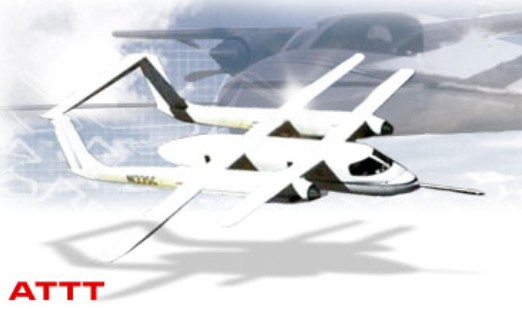
Scaled Composites 133 ATTT

The Model 133-4.62 Advanced Technology Tactical Transport (ATTT) proof-of-concept demonstrator is a 62% scaled version of an airplane designed to challenging STOL and long range requirements. The ATTT was developed and test flown by Scaled Composites, Inc. under contract to DARPA. The initial flight test program consisted of 51 flights with the original cruciform tail configuration, measuring and refining performance, stability and control, and handling qualities. The results of the fabrication and test program were presented in a comprehensive report to DARPA .

In an effort to improve the aft loading capability of the aircraft and to correct aerodynamic deficiencies discovered during the test program, the ATTT aircraft was modified with a twin-boom tail whose general configuration was similar to that of the Rockwell OV-10 Bronco. This modified configuration is shown in the accompanying photograph. Pratt and Whitney of Canada PT6A-135A turboprop engines were attached to the twin booms in a tractor configuration. A simple fully mechanical flight control system was installed, with full control available from both seats. The Scaled-designed landing gear is actuated using electric motors.

The M-133 demonstrator used a unique flap system to enable its STOL performance. The high lift configuration consists of eight Fowler-type flaps, each of 43% chord. The flap system was designed to allow the initial takeoff roll to be performed with the flaps extended, but at low deflections to minimize takeoff drag. As rotation speed was neared, the flaps were quickly rotated to the maximum lift position via a separate pilot action. The ATTT was a key program for Scaled. It demonstrated our ability to perform a challenging aerodynamic and structural design, and to build, test, and deliver what amounted to two different manned research airplanes, including all design and flight test data, to DARPA for less than 3 million dollars, including all recurring and nonrecurring costs.

The Scaled ATTT (also seen as AT3) was flown in two different configurations. First as Model 133-3-62 with a conventional tail section with cruciform tailplanes. First flight 29 December 1987. Later in the test programme small endplates were added to the horizontal tail. During 1989 it few again as Model 133-4-62 with the twin tail booms. Engines were two 850hp P&WC PT6AS-135A end registration was N133SC.

In original form wingspan was 53.208ft, length 44.854ft and height 14.075ft. Internally the project was referred to as SMUT (Special Mission Utility Transport). It was an approx. 62% scale technology demonstrator for a planned ATTT -Advanced Technology Tactical Transport and some money may have come from DARPA – Defence Advanced Research Projects Agency.

The ATTT is in storage at the Air Force Flight Test Center Museum, at Edwards Air Force Base.

Scaled Composites

Scaled Composites was founded in 1982 by Burt Rutan as a research and development company, and located in Mojave, California, offering its services to those requiring specialist help in developing advanced aircraft projects. Undertook work on the NASAAD-1 oblique-wing research aircraft, a subscale demonstrator of the Fairchild NGT trainer (flown September 1981), a subscale demonstrator of the Beech Starship 1 business aircraft (at which time company bought by Beech, 1985, but sold back 1988), plus several other uniquely configured aircraft that included the Rutan 151 ARES agile response effective support combat jet (first flown February 1990). Latest aircraft is Proteus multipurpose, high-altitude and long-duration sensor platform, first flown as a proof-of-concept prototype in July 1998 and featuring rear-mounted main wings, large-span canards, twin tail booms, and a slender fuselage. Initial application is to be for Angel Technologies Corporation, which requires many for communications relay use.

Scaled Composites was acquired by Northrop Grumman in 2007 and is partially engaged in defense research.

2010: Scaled Composites
1624 Flight Line
Mojave, CA 93501
Phone: (661) 824-4541
Fax: (661) 824-4174