Free Flight K1

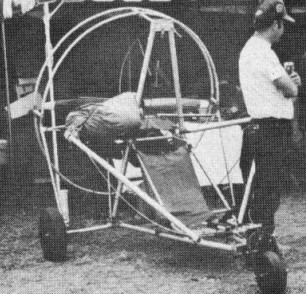
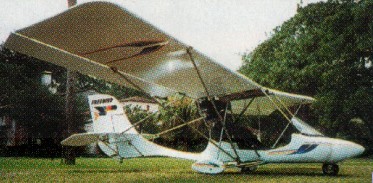
The Free Flight K1 ZK-JFW was originally a “K 1” hang-glider but has been converted to a Trike powered by a Rotax 447 with a Bing carburettor and a three-blade adjustable propeller. It also has a ballistic parachute mounted above the wing for emergency use. Its first flight was at Murawai Beach, New Zealand, by Karl Hoffman.

Engine: Rotax 447.

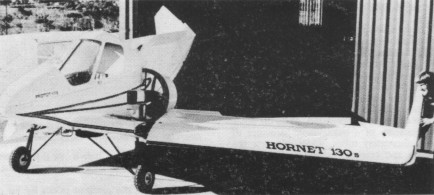
Free Flight Hornet 130S

Single-seat single-engined low-wing monoplane with conventional three-axis control. Wing has swept back leading and trailing edges, and tapering chord; no tail. Pitch/roll control by stabilator; yaw control by tip rudders; control inputs through stick for pitch/roll and pedals for yaw. Cantilever wing; 100% double-surface. Undercarriage has three wheels in tall-dragger formation; rubber suspension on main wheels. Composite construction fuselage, totally enclosed. Engine mounted above wing driving pusher propeller.
The David Betteridge designed Hornet (which should not be confused with the British manufacturer of the same name) is one of the most innovative designs to come from Australia, especially considering that the aircraft was originally conceived in 1977.
At that time Free Flight was a hang-glider producer, and it was David’s involvement which got the Hornet project started. Construction of what was originally intended to be a rigid-wing powered hang-glider began in early 1978 and the first non-flying prototype was exhibited at the Schofields Airshow in Sydney that year, finally taking to the air on 8 March 1979 in the hands of Colin Scott.
From that prototype the Hornet 130S evolved – a tail-less composite-construction machine with a tapered swept-back wing and ailerons which can be used together to act as elevators, in a similar fashion to the stabilators of a Mitchell Wing B10. Like the latter, yaw control is by tip rudders.
As an aid to portability, the wings fold upward and rearward, giving a package for transport which is only 15.1 ft long x 7.5 ft wide (4.6 x 2.3 m). Wing structure consists of a 4.5 inch (114mm) diameter aluminium alloy spar tube reinforced with riveted flanges over the inboard section. Bonded and riveted to this tube are moulded glass-fibre ribs, supporting a C-section alclad rear spar. The leading edge is a U-section glass-fibre moulding with a spruce stiffener. Wing covering is glass-fibre sheet. The fuselage is predominantly glass-fibre too, moulded around paper-honeycomb bulkheads.
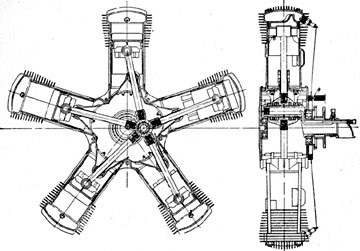
Early versions of the 130S used a Lock Laird 0-500-2 four-stroke opposed twin giving 36 hp, but later the company switched to a fuel-injected version of the Koenig three cylinder radial, coupled to a direct-drive three-blade ducted fan.

Engine: Konig SC430 engine.
Max power 30hp at 4500rpm.
Propeller: three blade.
No reduction.
Power per unit area 0.23hp/sq.ft, 2.5 hp/sq.m.
Empty weight 2291b, 104kg.
Max take-off weight 397 1b, 180kg.
Payload 168 1b, 76 kg.
Max wing loading 3.08 1b/sq.ft, 15.0 kg/sq.m.
Max power loading 13.2 1b/hp, 6.0 kg/hp.
Load factors +6.6, -3.3 design; +8.0, ultimate.
Length overall 9.8ft, 3.0m.
Height overall 5.6ft, 1.70m.
Wing span 25.9ft, 7.90m.
Mean chord 5.0ft, 1.52m.
Dihedral 2 deg.
Sweepback 18 deg.
Total wing area 129 sq.ft, 12.0sq.m.
Wing aspect ratio 5.2/1.
Max level speed 127mph, 204kph.
Cruising speed 98mph, 158 kph.
Stalling speed 35 mph, 56 kph.
Max climb rate at sea level 790 ft/min, 4.0 m/s.
Best glide ratio with power off 16/1.
Take-off distance 200ft, 60m.
Landing distance 350 ft, 105 m.

Freedom Lite Skywatch SS-11

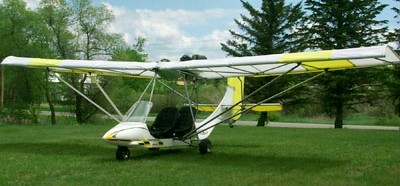
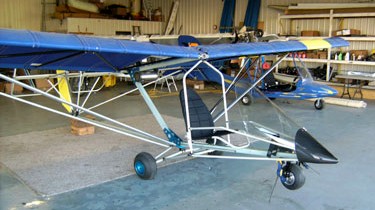
A dual control trainer first flown in 1991. A tandem two seater built with tube and fabric, the wing leading edges form a torsion beam.

Engine: Rotax 582, 64 hp
Wing span: 10 m
Wing area: 14.40 sq.m
MAUW: 430 kg
Empty weight: 190 kg
Fuel capacity: 50 lt
Max speed: 176 kph
Cruise speed: 144 kph
Minimum speed: 48 kph
Climb rate: 5.75 m/s
Fuel consumption: 12 lt/hr
Seats: 2
Price (1998): $30,000
Kit price (1998): $18,000

Top speed: 90 mph
Cruise: 80 mph
Stall: 29 mph
Range: 250 sm
Rate of climb: 780 fpm
Takeoff dist: 200 ft
Landing dist: 250 ft
Service ceiling: 10,000 ft
Engine: Rotax 582, 65 hp
HP range: 50-80
Fuel capacity: 13.5 USG
Empty weight: 420 lb
Gross weight: 950 lb
Height: 7.2 ft
Length: 21.5 ft
Wing span: 33 ft
Wing area: 155 sq.ft
Seats: 2
Landing gear: nose

Freedom Fliers Buckeye

Dual independent hand-controlled steering levers with nose wheel steerable through foot-controlled T-bar.

Engine: Cuyuna ULII-02 (429 cc) 35 hp.
Static thrust: 212 lb
Empty wt: 179 lb
Wing span: 33’6”.
Wing area: 395 sq.ft.
Fuel cap; 2.5 USG.
Construction: Aluminium, Ripstop nylon.
Max wt: 379 lb
Max speed: 26 mph
Vne: 26 mph
Climb rate: 350 fpm
Glide ratio: 2.5-1.
Wing loading: 0.96 lbs/sq.ft.
Power loading: 10.83 lbs/hp.
Engine: Rotax 377 or 477.
Cruise speed: 23 kts.
Stall: 23 kts.

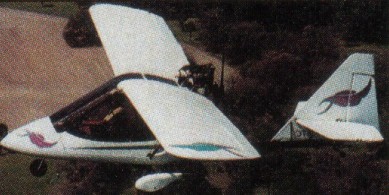
Freebird LiteSport

LiteSport Ultra

The LiteSport Classic is a side by side, Experimental/UltraLight comes standard with the high lift wing. Like all FBI Aircraft, the Classic has detachable wings for simple trailering.
These LSA aircraft come standard with all anodized aluminum, side by side two seater controllable from either seat, with a fiberglass nose cone, hydraulic brakes, and polished aluminum wheels.

LiteSport Classic
Cruise: 75 mph
Stall: 36 mph
Rate of climb: 800 fpm
Takeoff dist: 300 ft
Landing dist: 300 ft
Engine: Rotax 503, 52 hp
HP range: 52-85
Fuel capacity: 10 USG
Empty weight: 440 lb
Gross weight: 870 lb
Length: 16.8 ft
Wing span: 28 ft
Wing area: 142 sq.ft
Seats: 2
Cockpit width: 42 in
Landing gear: nose
LSA: yes

LiteSport Ultra
Cruise: 55 mph
Stall: 22 mph
Range: 90 sm
Rate of climb: 850 fpm
Takeoff dist: 75 ft
Landing dist: 150 ft
Engine: Rotax 447
Fuel capacity: 5 USG
Empty weight: 330 lb
Gross weight: 530 lb
Length: 15.6 ft
Wing span: 26 ft
Wing area: 142 sq.ft
Seats: 1
Cockpit width: 22 in
Landing gear: nose
LSA: yes

LiteSport II
Cruise: 75 mph
Stall: 32 mph
Range: 160 sm
Rate of climb: 800 fpm
Takeoff dist: 250 ft
Landing dist: 150 ft
Engine: Rotax 503, 48 hp
HP range: 48-80
Fuel capacity: 8.5 USG
Empty weight: 375 lb
Gross weight: 900 lb
Length: 15.2 ft
Wing span: 26 ft
Wing area: 142 sq.ft
Cockpit width: 22 in
Seats: 2
Landing gear: nose
LSA: yes

Freebird Sport Aircraft Freebird

Freebird

The FreeBird 103 was computer designed to make a legal 254lb ultralight with 3 axis control, steerable nose wheel, and the Black Max hydraulic brake system. Using the same basic wing design used on the LS-Ultra, the fuselage was totally redesigned to shave weight without compromising integrity.
Designed by Sherman Hawley, the wings fold for storage in a one bay garage, and the craft can be towed by car, and wing unfolded in ten minutes.

Freebird 103

Top speed: 80 mph
Cruise: 75 mph
Stall: 28 mph
Range: 170 sm
Rate of climb: 800 fpm
Takeoff dist: 125 ft
Landing dist: 150 ft
Service ceiling: 12,000 ft
Engine: Rotax 503, 52 hp
Fuel capacity: 10 USG
Empty weight: 385 lb
Gross weight: 970 lb
Height: 4.5 ft
Length: 17 ft
Wing span: 28 ft
Wing area: 132 sq.ft
Seats: 2
Landing gear: nose

Frederick-Ames EOS

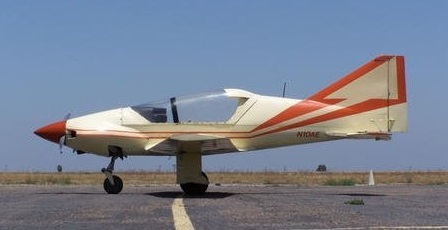
Fred Smith, president of Frederick-Ames Research Corporation at Novi, Michigan, USA, designed a small single-seat sporting aircraft called the EOS (after the Greek goddess of the dawn) N10AE, which first appeared in an incomplete form at the 1973 EAA Fly-in at Oshkosh.

Type: Single-seat light sporting aircraft.
Wings: Cantilever tapered low-wing monoplane. Wing section NACA 651212. Light alloy all-metal structure, except for glass fiber wing fillets, pop riveted and epoxy resin bonded.
Fuselage: Conventional light alloy semi-monocoque structure, pop riveted and epoxy resin bonded. Glass fiber engine cowling and 7 in (178 mm) prop extension shaft with Mooney 201 spinner.
Tail unit: Cantilever light alloy structure, comprising triangular fin, integral with rear fuselage, rudder, and all-moving tail plane with projecting balance arms at roots. Tail plane actuated via servo tabs.
Landing gear: Manually-retractable tricycle type. Main units retract inwards. Fully castoring and steerable nose wheel. Rubber-in-compression shock-absorption. Disc brakes.
Accommodation: Single glass fiber seat under large transparent canopy.
Systems: Electrical system includes 45A alternator and starter.

On its maiden flight on April 25, 1974, the 55 hp Hirth 650 cc engine seized and the aircraft crash landed, causing extensive damage. Despite some restoration work, the aircraft was abandoned through lack of finance.

In early 1978 the project was revived, with a modified Volkswagen motor car engine in place of the original engine. First flight of the reworked aircraft was in mid-1978, piloted by Robert Bishop. By August 1978 the EOS had completed about ten flying hours, and further modifications to the aircraft had been made. Eventually the release of plans and/or kits was never realized, and the prototype remains the only example ever built.

Power plant: Volkswagen 1,834 cc, 70 hp
Propeller: Rand Robinson three-blade ground-adjustable
Propeller diameter: 4 ft 2 in (1.27 m)
Span: 26 ft 0 in (7.92 m)
Wing area: 75 sq.ft (6.97 sq.m)
Wing aspect ratio: 9
Length: 16 ft 7 in (5.05 m)
Height: 6 ft 6 in (1.98 m)
Empty weight: 670 lb (304 kg)
Loaded weight: 975 lb (442 kg)
Fuel capacity 15 gal (56.75 l)
Max speed: 200 mph (322 kmh)
Cruise speed: 175 mph (281 kmh) at 5,000 ft (1,525 m)
Stall speed: 57 mph (92 kmh) at 4,500 ft (1,370 m)
Climb: 1,000 ft (305 m)/min
Take off run: 1,000 ft (305 m)