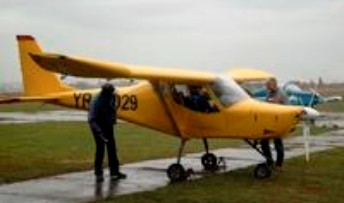
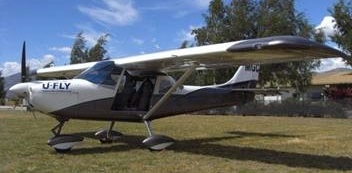
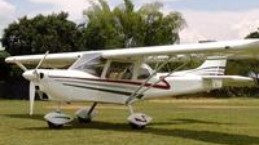
The Rambo is of aluminum construction, steel tube cabin, 118 cm wide. It is fitted with an electric elevator trim, carburator deicing, and cabin vent as standard 2009 Price: 33000 EURO The F99 LSA is a high wing LSA legal craft.
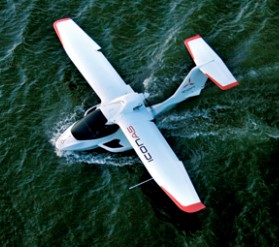
The Icon A5 amphibious LSA was unveiled at a very rock ’n’ roll premiere in Los Angeles in June 2008.
The ICON A5 has two seats and is made mostly of composite materials, with a high wing, T-tail, pusher prop, and tricycle landing gear. It is powered by a Rotax 912 flat-four engine, with hybrid air-water cooling and providing 75 kW (100 HP). All landing gear assemblies have single wheels, the nose gear hinging forward, the main gear retracting into sponsons that also provide flotation stability. Seating is side-by-side, the canopy hinging forward for access. The wings fold back along the rear of the aircraft for ease in handling.
Designed for recreation rather than transport and first flown in July 2008, the A5 is a sport plane available in 2008 for US$139,000.
The A5 received a lot of publicity but no production machine had flown yet.
The long-delayed amphibian could at last be nearing production after wrestling with overweight issues for years. In 2012 the manufacturer awaited FAA’s final decision on whether that agency would allow an additional 250 pounds beyond the LSA amphibious spec of 1,430 pounds or 1,680 pounds MTOW.
Icon’s stated grounds for exception: The extra weight is needed for its spin-resistant wing design. The ruling would only benefit the A5, not any other amphib or float plane.
Engine: Rotax 912, 75 kW Wing span: 10.4m / 34 ft Length: 6.7 m / 22 ft Empty weight: 450 kg / 1,000 lb Max speed: 192 kph Stall: 80 kph
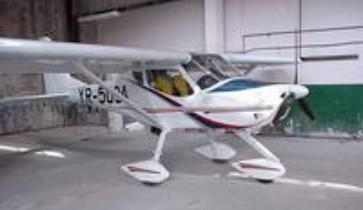
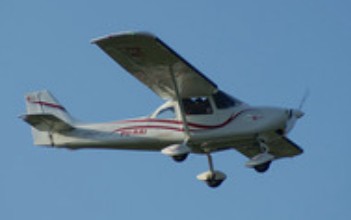
The IBIS GS240 is an all-metal, high-wing aircraft manufactured by the IBIS Aircraft company in Colombia. The GS240 has specifications and performance that are within the limitations of the new Light Sport Aircraft category. The GS240 is available for the U.S. market as a “quick-build kit” that will still meet the requirements of the FAA “51% rule” and allow the GS 240 to be put into the Experimental (Amateur-Built) Category. The GS240 kit is intended to provide as short a building time as reasonably possible for the builder, with all difficult aspects of fabrication and assembly having been done at the factory to minimize complications and delay for the first-time builder. The IBIS GS-240 has specifications and performance that allow it to fit within the new “Light Sport Aircraft” rules. With the GS240 in this category, it can be flown by existing Private and Recreational pilots (without them having to maintain an FAA Medical Certificate), but also by people holding the new “Sport Pilot” license.
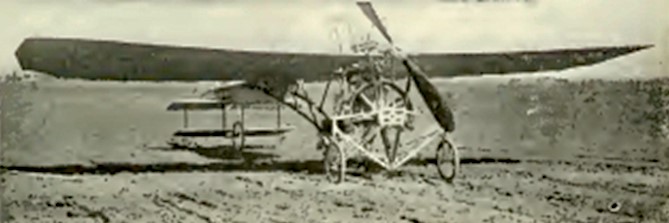
Little is known about this high-wing monoplane, a 1911 design from Woodhaven, New York. It was powered by a 50 hp Gnome, which was mounted low in the fuselage and drove the propeller via a chain. The International Aero Construction company apparently lived from building copies of other well-known designs.
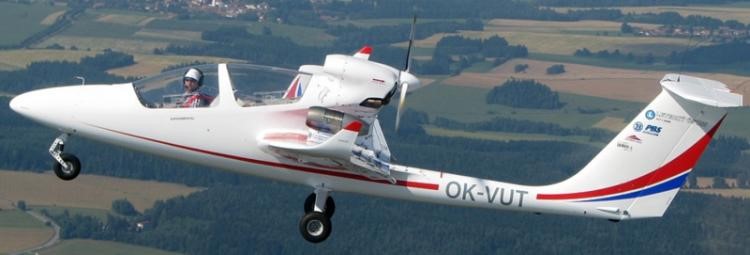
Marabu was completely designed and built by IAE Brno (Czech Republic), under the leadership of Professor Anton Pistek. It is characterized by its Joint Propulsion: Engine 4 cylinder flat Rotax 912 A2 with pusher propeller and turbojet PBS TJ100 M.
It made its first flight on 29 April 2010 at Kunovice (South-East of the Czech Republic) in the hands of test pilot Stanislav Skelnar.
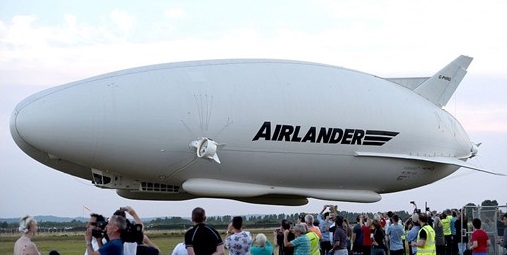
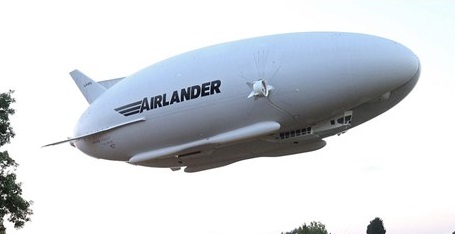
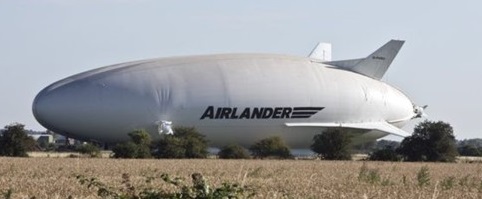
The Hybrid Air Vehicles HAV 304 Airlander 10 is a hybrid airship made by Hybrid Air Vehicles in the UK. It was originally built for the US Army’s Long Endurance Multi-intelligence Vehicle (LEMV) project.
Following the successful demonstration of the HAV-3 small-scale demonstrator, and with Northrop Grumman as the prime bidder, the hybrid airship concept was accepted for the US Long Endurance Multi-intelligence Vehicle (LEMV) project, in preference to the Lockheed Martin P-791 also submitted.
Requirements included the capability to operate at 6 km (20,000 feet) above mean sea level, a 3000 km (2,000 mile) radius of action, and a 21-day on-station availability, provide up to 16 kilowatts of electrical power for payload, be runway independent and carry several different sensors at the same time. According to the U.S. Army, the LEMV was to have been a recoverable and reusable multi-mission platform. It could be forward located to support extended geostationary operations from austere locations and capable of beyond-line-of-sight command and control. Northrop said the LEMV could be used as a cargo aircraft, claiming that it had enough buoyancy to haul seven tons of cargo 2,400 miles at 30 miles per hour.
The HAV 304 was selected by the United States Army for its LEMV programme in which Northrop Grumman was to have been the prime contractor.
The agreement to develop the project was signed on June 14, 2010, between the U.S. Army Space and Missile Defense Command/Army Forces Strategic Command and Northrop Grumman. The agreement also included options for procuring two additional airships.
Northrop Grumman’s subcontractors included: Hybrid Air Vehicles Ltd. in Cranfield, UK (HAV304 platform) Warwick Mills in New Ipswich, USA (fabrics engineering) ILC Dover in Kent County, USA (airship manufacturer and designer) Textron subsidiary AAI Corp. in Hunt Valley, USA (makes the US Army’s OneSystem UAV/surveillance aircraft control & information distribution stations); and SAIC in McLean, USA.
The developmental prototype emerged as the HAV 304, having an internal capacity of 38,000 cubic metres. This compares mid-20th Century airships such as the German Hindenburg-class airships which were 245 m (803 ft 10 in) long.
The airship was a hybrid aircraft and uses aerodynamic lift like a conventional aeroplane to take off before using helium to keep it in the sky once it is airborne. Engines on board are then used to move while it monitors events on the ground. The LEMV’s skin—a blend of Vectran, Kevlar, and Mylar—would have been able to cope with a “reasonable amount of small arms fire.” Northrop estimated that the biggest threat to the craft was weather, where high winds or thunderstorms could buffet the craft.
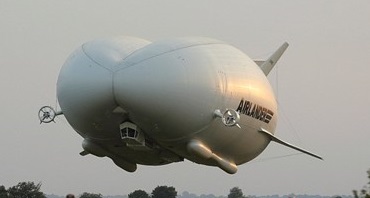
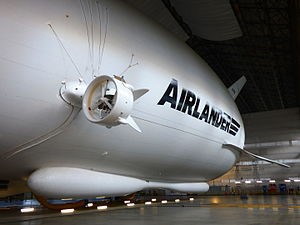
The Airlander, made by British company Hybrid Air Vehicles, has four engines and no internal structure. It maintains its shape thanks to the pressure of the 38,000 cubic meters of helium inside its hull, which is made from ultralight carbon fiber. Together with the aerodynamic shape of its hull, the lighter-than-air helium gas provides most of the lift. The aircraft’s odd shape has led some observers to describe it as a “flying bum.”
The project cost between $154 million and $517 million, dependent on all options. The cost included the design, development, and testing of the airship system within an 18-month time period, followed by transportation to Afghanistan for military assessment.
The timeline for LEMV was an 18-month schedule starting in June 2010 that included vehicle inflation at about month 10. Additional operational characterization would have occurred at Yuma Proving Ground, Arizona, in month 16.
The overall concept struggled with constant time delays and technological challenges. In October 2011 Flight International reported that the LEMV was scheduled to make its first flight in November 2011. According to media reports the LEMV was then set up for its first flight in early June 2012. However, unspecified problems delayed the flight even further. The first flight of the LEMV took place on August 7, 2012 over Joint Base McGuire-Dix-Lakehurst, New Jersey. The flight lasted for 90 minutes and was performed with a crew on board. The first flight primary objective was to perform a safe launch and recovery with a secondary objective to verify the flight control system operation. Additional first flight objectives included airworthiness testing and demonstration, and system level performance verification. All objectives were met during the first flight. That put the combat deployment of the LEMV to Afghanistan in early 2013. However, two months after the test flight, the Army said it had concerns about sending the airship abroad. These included safety, transportation to the theatre of operations, and the timeline of deployment.
The Army was slated to demonstrate the first LEMV in Afghanistan 18 months after June 2010, with proposed plans to build five others following mission completion.
On 7 August 2012 the first test flight of an LEMV was completed at Joint Base McGuire–Dix–Lakehurst, New Jersey. The vehicle tested was one of three planned for the US Army.
The US Army cancelled the LEMV project for cost reasons in February 2013. HAV bought back the airship in September 2013 for $301,000. The cameras, sensors, and communications equipment were removed and the helium was drained before the sale. In 2014—named Airlander—it was reassembled at RAF Cardington in England and re-designated the Airlander 10, to be test-flown in 2016. Hybrid Air Vehicles then managed to raise over 3.4 million pounds ($4.4 million) through two crowd funding campaigns. It also received a grant from the European Union and funding from the U.K. government. The first flight took place on 17 August 2016.
HAV 304 design Length: 91 m (298 ft 7 in) Width: 34 m (111 ft 7 in) Height: 26 m (85 ft 4 in) Envelope: 38,000 cubic metres Engines: four x 350 hp, 4 litre supercharged V8 diesel
Airlander 10 Capacity: 10,000 kg (22,050 lb) Length: 92 m (301 ft 10 in) Wingspan: 43.5 m (142 ft 9 in) Height: 26 m (85 ft 4 in) Volume: 38,000 m3 (1,300,000 cu ft) Gross weight: 20,000 kg (44,092 lb) Powerplant: 4 × 4 litre V8 turbocharged diesel engines, 242 kW (325 hp) each Cruising speed: 148 km/h (92 mph; 80 kn) Endurance: 5 days manned Service ceiling: 6,100 m (20,013 ft) Loiter speed 20 knots (37 km/h)
During 1945 and 1946, Tadeusz Chyliński took part in a competition of the Civil Aviation Department for developing a training motor glider. He won first prize for his project, the HWL Pegaz motor glider. From 1946 to 1947, Tadeusz Chyliński based on an agreement with the Department of Civil Aviation (Departament Lotnictwa Cywilnego) with the help of Bronisław Żurakowski, developed the construction plans for the “Pegaz”. The motor glider was designed to train class “C” glider pilots in stand-alone (without dual-controls) motor piloting, as well as for training and pursuing aeronautic sports in inexpensive aircraft.
The engine for the “Pegaz” was designed by Stefan Gajecki, who was well known for designing skimming boat motors. Construction began on the “Pegaz” at the HWL (Harcerskie Warsztaty Lotnicze – Scouts’ Aircraft Works) in Warsaw.
In 1948, the work was taken over by Warsaw’s Gocław Aircraft Plant 6. The motor glider (one for flying and two unassembled) was finished in spring of 1948. The engineless plane was on display at the Aviation Day in 1948.
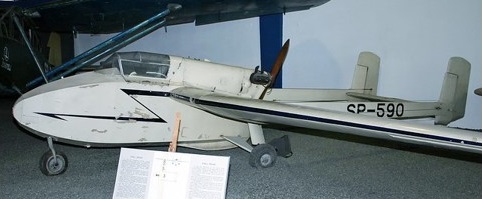
It is a dual-boom monoplane with pusher propeller, three-wheel landing gear with forward steerable wheel, all wood construction. The fuselage is composed of a laminated-wood-sheathed pod containing an enclosed cabin, the engine and two lateral laminated-wood-sheathed boom joining the wing with the directional and diving rudder. The fuselage pod is hexagonal. The instrument panel is fitted with an airspeed indicator, altimeter and vertical speed indicator, a magnetic compass, turn indicator, ignition switch and fuel pump. The cabin also features an air throttle valve and decompressor, a fuel gauge and fuel valve. The motor glider is steered by a stick and rudder bar. The pilot’s seat is made to accommodate a backpack parachute.
The wooden cantilever wing is sheathed in laminated wood and canvas. The wing is a right-angle trapezoid with rounded tips and has three structural sections: a central section and two removable outer sections joined to the central section by three pins. The dual-spar central section is unitized with the fuselage pod and tail booms. The removable monospar outer sections have an oblique auxiliary spar. The canvas-sheathed slotted ailerons are aerodynamically-compensated, differentially displaced 30° upward and 18° downward. The wing has a fixed slot at the edge of attack.
The twin vertical tail is located at the boom tips. The elevator unit is located between them. The monospar fins are sheathed in laminated wood. The control surfaces on the wooden frame are canvas-sheathed.
The three-wheel landing gear has a forward steerable wheel. The main landing gear is tri-strutted with rubber-string shock absorbers. The wheel tires are low-pressured. The aft of the fuselage pod between the wheels is protected against major deflection of the landing gear by an ashwood skin with an inner-tube shock absorber.
The motor glider is powered by an XL-GAD prototype engine. It is a four-cylinder flat two-cycle air-cooled engine. Two cylinders have a decompressor to facilitate startup. The wooden pusher propeller has a fixed pitch and diameter of 1.42 meters. The 30-liter fuel tank is located to the fore of the engine.
The “Pegaz” was painted a cream color. The wing’s edge of attack, registration number and fuselage arrow were painted navy blue.
“Pegaz” was test-flown on July 16, 1949, piloted by Bronisław Żurakowski and Jerzy Szymankiewicz. The factory and certification test were conducted at the National Aviation Institute in Warsaw and completed in May 1950. “Pegaz” was in three air shows on Aviation Day in 1949, 50, 51.
The “Pegaz” proved to be very safe and easy to pilot during testing and operation. It was stable in every axis with the controls released. By stalling and releasing the stick with the engine running, the motor glider was able to make about decreasing changes in velocity, going into a fixed climb rate of 1.5 m/s with a trajectory speed of 90 km/h. Also by stalling and releasing the stick with the engine throttled, the velocity amplitude changed two to three times, after which the aircraft went into a fixed glide at a speed of 110 km/h and a descent rate of 2.0 m/s. When stalled with the rudder released, the motor glider displayed no tendency to spin. It was hard to get the “Pegaz” to go into a tailspin. The speed necessary to go into a tailspin was 55 km/h, with an altitude loss at one spin of 75 meters. Landing speed was 130 km/h. The motor glider performed acrobatic figures with a gravity load range up to 4 g. It could do loops at a speed of 125 km/h without losing altitude and ended loops with the same speed. The “Pegaz” behaved totally normal in dives at 210 km/h.
At first, the plan was to build 80 “Pegaz” planes for various flying clubs. “Pegaz” passed the National Approval Test with a very good rating, however it was never put into production. There was the order from the USSR to stop work on national aviation projects. The “Pegaz” was assigned the registration number SP-590 and was given to the Warsaw Aviation Club to use, piloted by many glider pilots. It has been on display at Polish Aviation Museum in Kraków since August 1964.
HWL Pegaz (SP-590 Engine: 1 × XL-GAD prototype air-cooled 4-cylinder flat engine, 31 hp (23 kW) Wingspan: 11.70 m (38 ft 4⅝ in) Wing area: 14.80 m² (159.25 ft²) Length: 6.85 m (22 ft 5⅝ in) Height: 1.60m (5ft 3 in) Empty weight: 290 kg (639 lb) Loaded weight: 397 kg (893 lb) Maximum speed: 129 km/h (69 kt, 80 mph) Cruise speed: 110 km/h (59 kt, 68mph) Stall speed: 59 km/h (32 kt, 37 mph) Range: 275 km (148 nm, 171 mi) Service ceiling: 3,000 m (9,843 ft) Rate of climb: 2.0 m/s (394 ft/min) Crew: 1, pilot