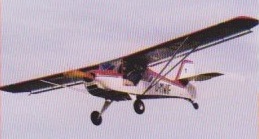
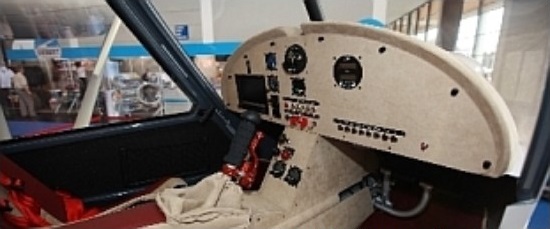
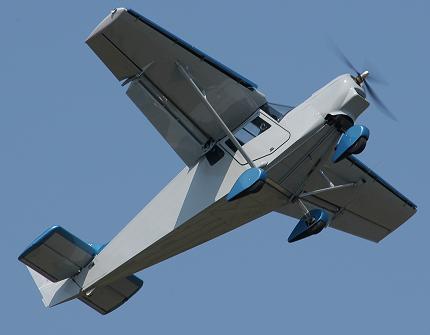
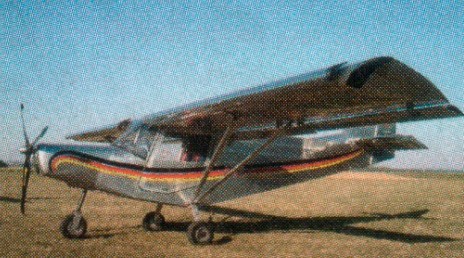
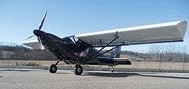
Inspired by the Kitfox and Avid Flyer, the Eurofox also uses a welded steel spaceframe fuselage, tubular spars and plywood ribs, all covered in Dacron.
Engine: Rotax 912, 80 hp Wing span: 9.2 m Wing area: 11.5 sq.m MAUW: 450 kg Empty weight: 250 kg Fuel capacity: 58 lt Max speed: 180 kph Cruise speed: 150 kph Minimum speed: 60 kph Climb rate: 5 m/s Fuel consumption: 10 lt/hr Certification: VZ Seats: 2 Price (1998): 63 240 DM
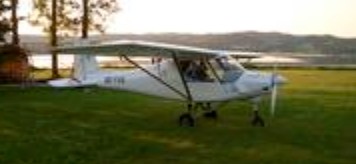
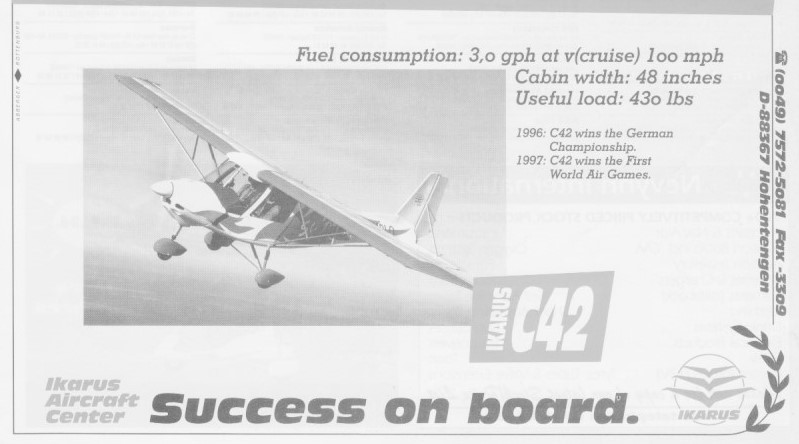
The tube and fabric C42 features an unstressed outer skin. Known as Aerosport Ltd Ikarus C42 in the US, the Ikarus C42 is a popular school plane. More than 650 airplanes have been delivered worldwide.
A newer model is the Ikarus C42B (C-42B). C42B 2009 Price: 40000 EURO
1998
C-42 Engine: Rotax 912, 80 hp Wing span: 9.9 m Wing area: 13.2 sq.m MAUW: 450 kg Empty weight: 230 kg Fuel capacity: 50 lt Max speed: 175 kph Cruise speed: 150 kph Minimum speed: 65 kph Climb rate: 5 m/s Seats: 2 Fuel consumption: 11 lt/hr
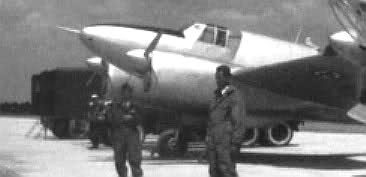
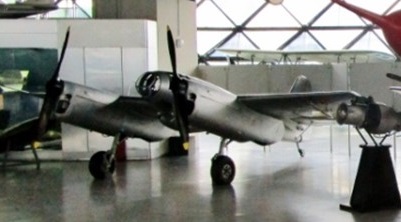
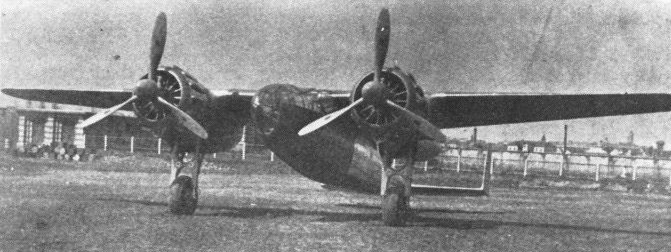
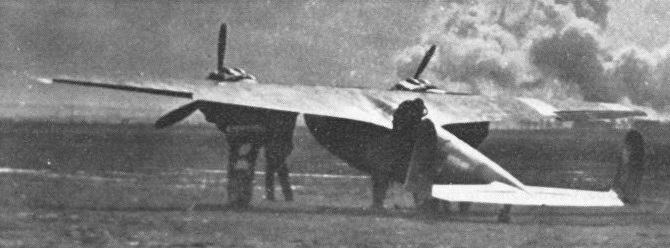
Originally designed before the World War II as a Zmaj R-1 the Ikarus 215 (Икарус 215 in Serbian) twin-engine plane, was a Yugoslav light bomber and a training aircraft. It was designed by Dusan Stankov and built at the Ikarus factory in Zemun-Belgrade.
The aircraft was of mixed construction, twin engine, with a crew of two to four. The main landing gear wheels retracted rearwards into the motor housing.
The prototype first flew in 1949. The 215 did not enter production. The prototype was used for training.
Engines: 2 × Ranger, SGV-770C-1, 387.7 kW (519.9 hp) Propellers: 2-blade Wingspan: 16.14 m (52 ft 11 in) Wing area: 29.80 sq.m (320.8 sq ft) Length: 13.35 m (43 ft 10 in) Height: 4.03 m (13 ft 3 in) Empty weight: 4,297 kg (9,473 lb) Gross weight: 4,685 kg (10,329 lb) Range: 1,120 km (696 mi; 605 nmi) Service ceiling: 8,150 m (26,739 ft) Crew: 2-4
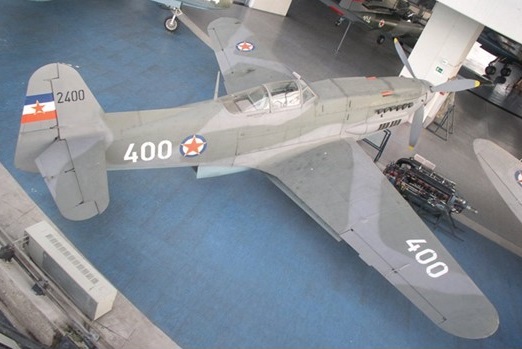
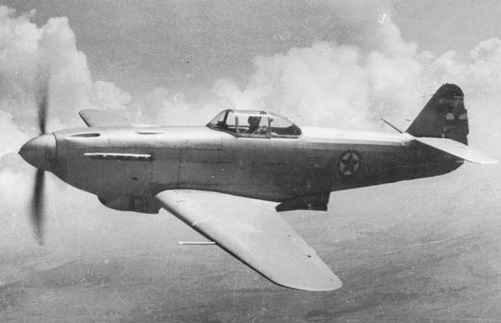
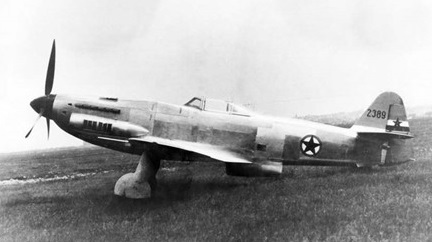
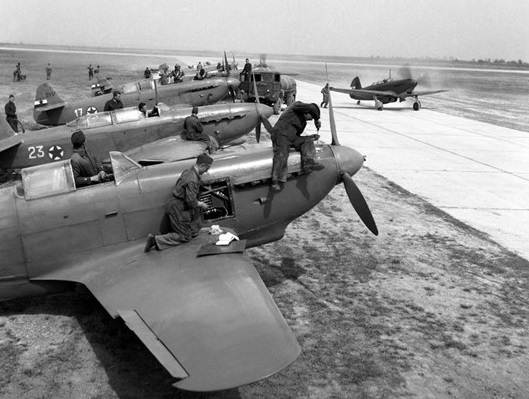
The Ikarus S-49 was a Yugoslav single-seat, single-engine fighter aircraft built for the Yugoslav Air Force (Serbo-Croatian: Ratno vazduhoplovstvo i protivvazdušna obrana – RV i PVO) shortly after World War II. Following the Tito–Stalin Split in 1948, the RV i PVO was left with an aircraft inventory consisting of mostly Soviet aircraft. Unable to acquire new aircraft or spare parts for its existing fleet, the RV i PVO turned to its domestic aviation industry in order to create an indigenous design to fulfill the need for additional aircraft.
The same constructors that built the Rogozarski IK-3 before the war, engineers Kosta Sivcev, Slobodan Zrnic and Svetozar Popovic, used existing technical documentation of the IK-3 to construct a new fighter aircraft, the Ikarus S-49.
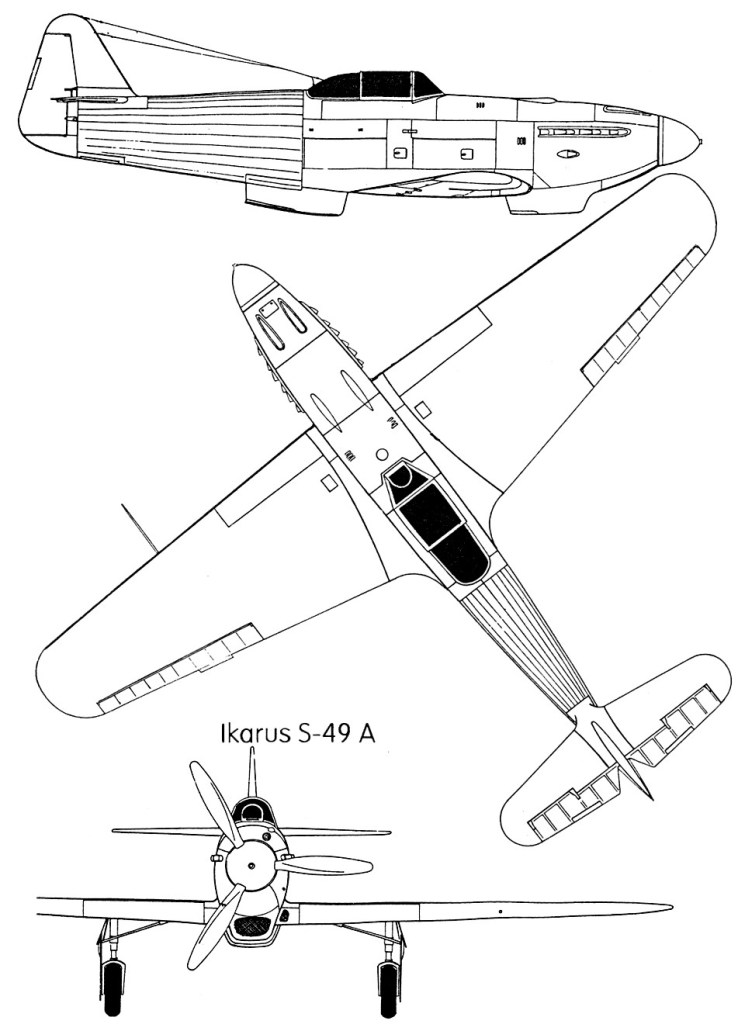
S-49A
The S-49A was of mixed construction, with Soviet built VK-105 engines which were no longer available after 1948. Therefore, it was decided to produce a new version of the aircraft powered by the similar French Hispano-Suiza 12Z-17 engine. Because of the bigger and heavier engine, the new aircraft had to be of all-metal construction with a much longer nose. While the aircraft was mainly built by Ikarus, the wings and tail were built by the SOKO factory in Mostar. The armament consisted of one 20 mm Mauser MG-151/20 autocannon produced by Germany during World War II and two 12.7 mm Colt Browning machine guns. In addition, under wing racks for two 50 kg bombs or four 127 mm HVAR missiles were provided.
The first prototype of the S-49A flew in June 1949. The first operational aircraft were delivered to combat units at the beginning of 1950.
An S-49B Ikarus had been proposed with the German DB-605 engine, but for mass production the Ikarus S-49C was chosen.
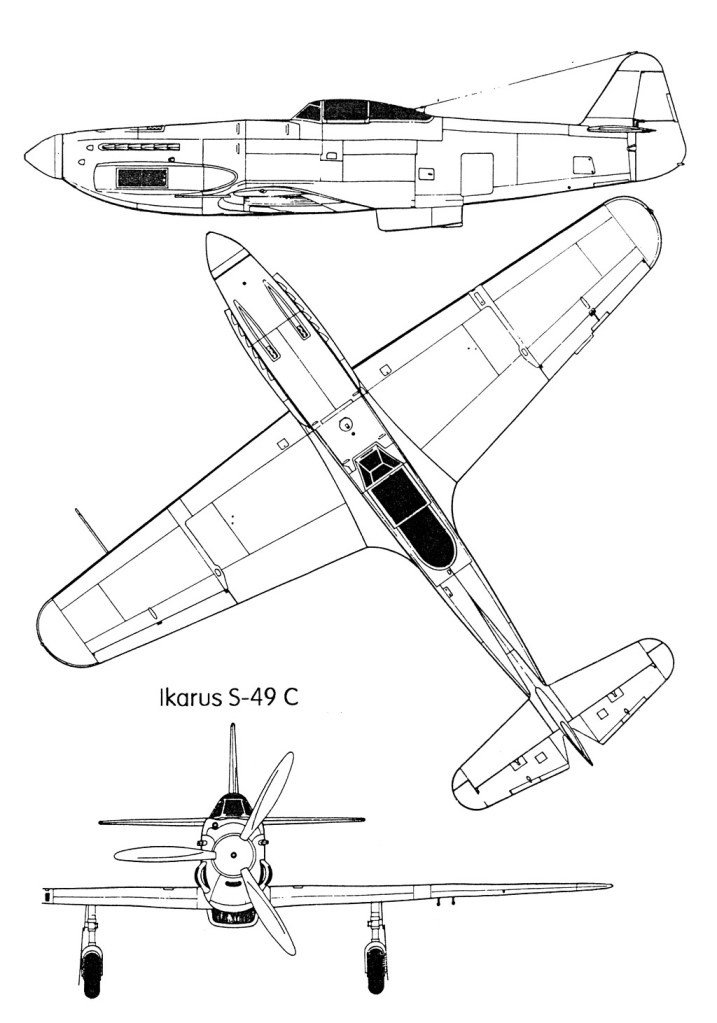
The S-49A was surpassed by the improved S-49C, featuring an all-metal construction and a more powerful engine. At the beginning of 1952, the Ikarus S-49C was introduced into the units of the Yugoslav Air Force.
S-49C
Aircraft Order “Soko” started in 1952 with the assembly of the wing and empennage for the S-49C fighter. An all-metal version of the S-49A powered by a Hispano Suiza HS 12Z-17. Under wing mounts were fitted for rockets, MG-151 or Colt Browning M2 12.7- mm machine guns, or two 50-kg bombs.
A total of 45 S-49A and 113 S-49C were produced by the Ikarus Aircraft Factory in Zemun. The last aircraft were retired from RV i PVO service in 1960/61, having been replaced by more modern jet-powered aircraft.
Variants: S-49A – mixed construction and Klimov M-105 engine (45 built) S-49B – planned version powered by a Daimler-Benz engine; unbuilt. S-49C – all-metal construction and Hispano-Suiza 12Z engine (113 built)
S-49A Engine: Klimov VK-105PF, 1180 hp Wingspan: 10.30 m Length: 8.43 m Height: 3.20 m Wing area: 16.60 sq.m Empty weight: 2320 kg Normal take-off weight: 2950 kg Maximum speed: 554 kph Range: 690 km Rate of climb: 1026 m / min Ceiling: 10,000 m Crew: 1 Armament: 1 x 20-mm motorpushka ShVAK with 120 rounds 2 x 12.7 mm UBS machine gun with 200 rounds
S-49C Engine: 1 × Hispano-Suiza 12Z-17, 1,104 kW (1,500 hp) Length: 9.06 m (29 ft 83in) Wingspan: 10.30 m (33 ft 91 in) Height: 2.90 m (9 ft 6 in) Wing area: 16.65 m2 (179 ft2) Empty weight: 2,818 kg (6,200 lb) Max. takeoff weight: 3,568 kg (7,850 lb) Maximum speed: 628 km/h (339 knots, 390 mph) at 1,525 m (5,000 ft) Range: 690 km (373 nm, 429 mi) Service ceiling: 10,000 m (33,000 ft) Climb to 6,000 m (19,700 ft): 6 min 54 sec Armament 1 × 20 mm MG-151/20 cannon 2 × .50 Colt Browning M2 machine guns with 650 rounds per gun 2 × 50 kg (110 lb) bombs or 4 × 5 in HVAR missiles Crew: one pilot
The 2byFour Cycle: 4 stroke No cylinders: 2 opposed Bore: 101 mm Stroke: 92.7 mm Compression: 8.5 Displacement: 1507 cc Cooling: Air Ignition: Double CDI Dimension: 609 x 558 x 520 mm Weight: 54 kg Max pwr: 48 hp at 3200 rpm Max torque: 120 @ 3200 rpm Price 1998: $5250
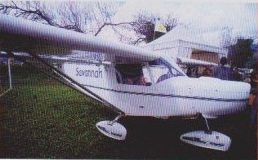
Savannah is a modified copy of the Zenith Zodiac CH-701 STOL aircraft. I.C.P. srl was once a distributor of the Zenith STOL CH-701. I.C.P. was established in 1980 to produce accessories for the automotive sector. At the beginning of the 1990s, I.C.P. began production of UL aircraft, in collaboration with Agrocopteros of Colombia, including models such as the MXP-740, the MXP-740 Savannah, the MXP-640 Amigo and the MXP-650 Amigo. The Savannah has evolved into the Savannah Turbo, Hydro, ADV, VG (Vortex Generator) and the new Savannah XL which features a wider and more comfortable cabin. A light-weight Savannah is the Bingo, offered with different power units. On 12 September 2009, I.C.P. opened its new factory at Castelnuovo Don Bosco (Province of Asti) in Italy.
The Savannah is an evolved version of the Zenith/Zenair STOL CH701 built by the Italian ICP Company (a one time distributor of the CH701). Some differences include a raised cabin the CH701 has the tapered wing roots, the ICP does not and there are also changes to the tailplane. The NZ MCTOW is 544 kg, as against 520 kg in Australia and the US. It is fitted with two 40 litre wing fuel tanks and burns around 15 litres an hour. Power on stall (without flaps) occurs at about 13 kts and the Savannah will cruise at 85 kts. Newer models have progressive modifications including long-¬range tanks and manual slats, additional avionics, electrics and a Rotax 912ULS with a DUC three blade propeller.
The Savannah is an ultralight STOL aircraft (short takeoff and landing) with two side-by-side seats, single high wing, tricycle landing gear and full metal (alluminium) construction. It shares the same structure of the Bingo, differing just in some minor details, the engines mounted and the equipment.
The Savannah ADV tapered wing with reduced surface has a NACA 2315 profile. In substance, a fast wing that seems to clash with the squared and simple fuselage of the Savannah, and its STOL performance. The stall speed at a MTOW of 560 Kg, in clean configuration, is up to 49 kts and has achieved 44 kts during test. In front, the slats run on linear guides and perfectly re-enter in the leading edge profile, keeping it clean. At the trailing edge are two big flaps with high full deflection angle and another slotted winglet extending for the whole leading edge of the flap itself.
Activation of the flap is by a single electrical control, therefore, for every degree of flaps deflection there is a defined extension of the front slats. The pilot has just one switch to operate and the whole mechanism is automatic. This made it possible to establish the optimal settings during the testing phase, thus avoiding potentially dangerous “personal interpretations” by the pilots and making the airplane safe and simple to manage. So, a single switch activates the four moving surfaces and their position is indicated by a pin moving along an arch drawn out at the root of the right wing, where the electric motor and the mechanical activation system is embedded, but still in sight. The regulation is continuous and in case of emergency a little winch is provided to be connected to the electric motor shaft with a cotter pin. The production aircraft were to be fitted with a permanent winch connected to the motor shaft, in order to allow for immediate activation in case of electrical failure.
Savannah Bingo 4S
The Bingo is an ultralight STOL (short take off and landing) aircraft with side-by-side seats, single high wing, tricycle landing gear, metal construction. It has the same structure as the Savannah, differing just in some minor detials, the engine mounts, cowlings, and equipment.
All models are LSA.
Formerly known in the U.S. as the Skykits Savannah line, Italian maker I.C.P. became represented in the US by ICP Aviation in 2012 and included a tail-dragger version (model “T”) of the all-metal Savannah S-LSA. Twenty-nine of the tricycle-gear S model are registered in the U.S. in 2012. The STOL-capable S-LSA has a high-lift airfoil, Junkers-style flaperons, all-window doors and a true STOL stall speed of 26 knots. S model price 2012: $71,950; T model price 2012: $74,950.
Savannah
Variation: Agrocopteros MXP-740
Specifications:
Savannah Stall: 24 kt / 28 mph / 45 kmh Cruise: 76 kt / 87 mph / 140 kmh VNE: 86 kt / 99 mph / 160 kmh Empty Weight: 272 kg / 600 lbs MTOW Weight: 450 kg / 992 lbs Climb Ratio: 1000 ft/min / 5 m/s Glide Ratio: 12:1 Take-off distance (50ft obstacle): 330 ft / 100 m Landing distance (50ft obstacle): 440 ft / 135 m
Savannah (jabiru) Stall: 23 kt / 26 mph / 43 kmh Cruise: 70 kt / 81 mph / 130 kmh VNE: 109 kt / 125 mph / 202 kmh Empty Weight: 278 kg / 613 lbs MTOW Weight: 450 kg / 992 lbs Climb Ratio: 750 ft/min / 4 m/s Take-off distance (50ft obstacle): 260 ft / 80 m Landing distance (50ft obstacle): 260 ft / 80 m 2009 Price: 25000 EURO
Savannah Engine: Rotax 912S, 100 hp HP range: 80-120 Length: 21.3 ft / 6.1 m Height: 2.10 m Wing span: 29.3 ft / 9m Wing area: 142 sq.ft / 12,96 sq.m Wing chord: 144 cm Aspect ratio: 6,3 Empty weight: 635 lb / 272 Kg Gross weight: 1234 lb / 560 Kg Fuel capacity: 21 USG / 80 lt Wing load: 35 kg/sq.m Max. speed: 87 – 95 kt Vne: 108 kt Cruising speed: 78 – 84 kt Stall: 28 mph / 23 kt Approach speed: 31 kt Manoeuvre speed: 74 kt Range: 460 sm / 800 km Rate of climb: 1300 fpm Takeoff dist: 90 ft Landing dist: 160 ft Cockpit width: 41 in Undercarriage: nose wheel Wheels: 4×8″ Loading factor: +6/-4g Fuel consumption 75%: 12 – 14 lt/h Seating: 2, side by side Flaperons 0-20-40°
Savannah ADV Engine: Rotax 912S, 100 hp HP range: 80-120 Length: 21.3 ft Wing span: 26.3 ft / 8 m Wing area: 102 sq.ft / 9.4 sq/m Wing cord at root: 1.5m Wing cord at tip: 0.75m Empty weight: 654 lb Gross weight: 1234 lb Fuel capacity: 21 USG Maximum speed: 112 kts Cruise: 115 mph / 100 kts Stall speed clean: 43 kts Stall speed flaps: 30 kts Range: 510 sm Climb rate: 1200 fpm at 52 kts Takeoff dist: 110 ft / 35 m Landing dist: 160 ft Cockpit width: 41 in Seats: 2 Cockpit width: 41 in Load factor: +6 -3 g
Savannah Bingo 4S Engine: HKS 700E, 60 hp Length: 21.3 ft / 6.1 m Height: 2.45m Wing span: 29.5 ft Wing area: 140 sq.ft Empty weight: 610 lb / 255 kg Gross weight: 1234 lb Fuel capacity: 21 USG Cruise: 75 mph / 65 kt Stall: 28 mph / 25 kt Max speed: 73 kt Range: 460 sm Range with reserve: 880 km Rate of climb: 680 fpm Takeoff dist: 160 ft / 50 m Landing dist: 230 ft / 70 m Cockpit width: 41 in Landing gear: Nose fixed Wheel track: 1.7m Seats: 2 Fuel consumption: 10 lt/hr
Savannah Bingo 4S Engine: Rotax 503 Wing span: 9m Wheel track: 1.7m Empty weight: 245 kg Stall speed: 25 kt Cruise speed: 60 kt Max speed: 70 kt Take off run: 50 m Landing roll: 70 m Climb rate: 480 fpm Fuel consumption: 15 lt/hr Range with res: 520 km MTOW: 450kg Wing span: 9m Wheel track: 1.7m Length: 6.1m Height: 2.45m
Savannah Bingo 4S Engine: Rotax 582 Wing span: 9m Wheel track: 1.7m Empty weight: 250 kg Stall speed: 25 kt Cruise speed: 65 kt Max speed: 73 kt Take off run: 50 m Landing roll: 70 m Climb rate: 840 fpm Fuel consumption: 20 lt/hr Range with res: 410 km MTOW: 450kg Wing span: 9m Wheel track: 1.7m Length: 6.1m Height: 2.45m
Savannah Bingo 4S Engine: Victor 2 Empty weight: 250 kg Stall speed: 25 kt Cruise speed: 70 kt Max speed: 70 kt Take off run: 50 m Landing roll: 70 m Climb rate: 840 fpm Fuel consumption: 18 lt/hr Range with res: 500 km MTOW: 450kg Wing span: 9m Wheel track: 1.7m Length: 6.1m Height: 2.45m
Savannah Bingo 4S Engine: HKS Turbo Wing span: 9m Wheel track: 1.7m Length: 6.1m Height: 2.45m Empty weight: 265 kg Stall speed: 25 kt Cruise speed: 73 kt Max speed: 84 kt Take off run: 35 m Landing roll: 70 m Climb rate: 960 fpm Fuel consumption: 12 lt/hr Range with res: 810 km MTOW: 450kg
Savannah VG Cruise: 100 mph Stall: 30 mph Range: 460 sm Rate of climb: 1300 fpm Takeoff dist: 90 ft Landing dist: 160 ft Engine: Rotax 912S, 100 hp HP range: 80-120 Fuel capacity: 21 USG Empty weight: 645 lb Gross weight: 1234 lb Length: 21.3 ft Wing span: 29.3 ft Wing area: 132 sq.ft Cockpit width: 41 in Landing gear: fixed nose wheel