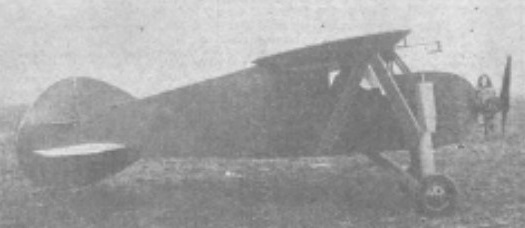
André Jacquemin’s 1934 one-off ‘Ailes Vivantes’ monoplane was tested at Orly around 1935/36. It had a small Poinsard engine.
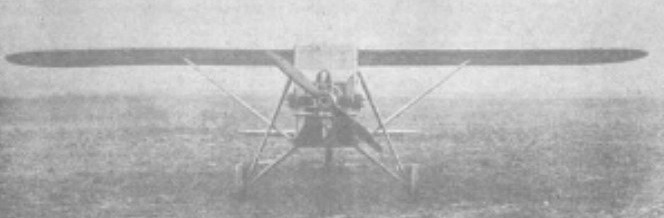
André Jacquemin’s 1934 one-off ‘Ailes Vivantes’ monoplane was tested at Orly around 1935/36. It had a small Poinsard engine.

The 1910 Jacquelin tractor biplane was designed and modified by E.Jacquelin and built by Voisin in France.
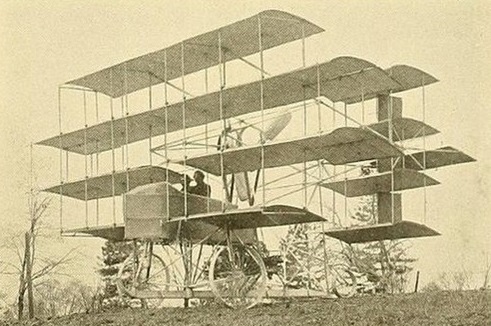
The 1910 Jacobs Multiplane [also identified as the Jacobs-Emerson multiplane] was the creation of Henry William Jacobs of Atchison, Kansas. It had quadruplane wings and tail and two engines, each driving a propeller.
Jacobs used two improved air-cooled 35hp engines he invented, to replace the two original underpowered engines [Emersons?], with which the plane flew in 1910.
It was displayed on the New York Aero Exhibition 1912. Jacobs had formed with others the firm “Multiplane Limited” in Kansas to build the machine and eventually sell it to the market and a brochure of 16 pages was produced.
The 1947 Jacobs O-360 and O-360A were 165hp 360.8ci 6-cyliner, horizontally opposed air-cooled engines.
The 1946 Jacobs O-240 and O-240A were 100hp 240.5ci 4-cyliner, horizontally opposed air-cooled engines.
The 1946 Jacobs O-200 was an 85hp 201.1ci 4-cyliner, horizontally opposed air-cooled engine.
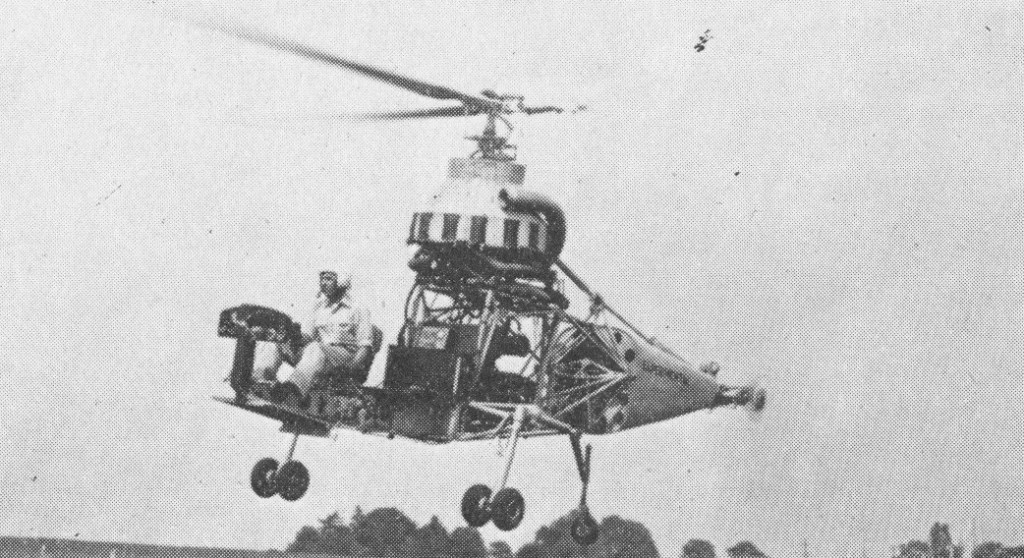
Designed circa 1958 as a high-speed short-haul aircraft, the Jacobs 104 was originally flown as a pure helicopter, as shown in the photograph above. Subsequently, a pusher propeller was fitted at the extreme tail.
It will take off as a helicopter; but in cruising flight it will be possible to transfer power to the pusher propeller, with the rotor auto-rotating and the majority of the lift coming from the fixed wings.
A feature of the Model 104 is the use of a Jacobs-designed engine “package”, consisting of the engine and complete transmission system. It is claimed to be 20 per cent lighter than conventional helicopter power plants, enabling one extra passenger to be carried. Also, by using moulded fibreglass and Plexiglass panels to cover the forward fuselage, high strength is combined with light weight, and the surface requires no painted or doped finish.
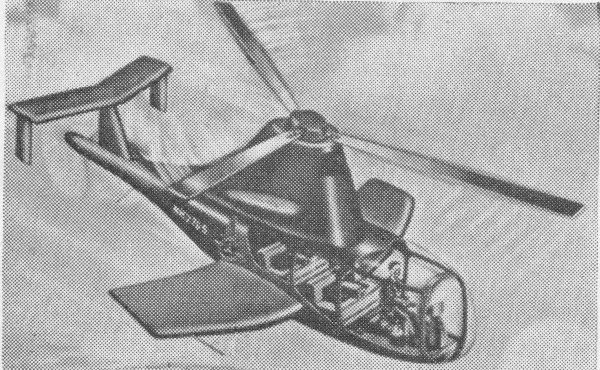
Engine: 350 h.p. Jacobs R-755EH
Rotor diameter: 36 ft.
Rotors: 3-blade main; 3-blade tail; 3-blade propeller.
Overall length: 26 ft. 4 in / 22 ft
Height: 10 ft 10 in
Empty weight: 2360 lb
Loaded weight: 3,475 lb.
Max. speed: 175 m.p.h.
Cruise: 157 mph
ROC: 1400 fpm
Typical range: 300 miles at 157 m.p.h.
Seats: 4-5.
The Jacobs R-915 or L-6 is a seven-cylinder, air-cooled, radial engine for aircraft manufactured in the United States, production started in 1936.
The R-915 was effectively an enlargement of the R-755 with strengthened stressed parts. With a bore and stroke of 5.5 in × 5.5 in (140 mm × 140 mm) the displacement was 914 cu in (15 L), takeoff power was around 330 hp (246 kW). The engine features steel cylinders with aluminum-alloy cylinder heads. The R-915A4 variant features a drive shaft for autogyro use.
Applications:
Avro Anson
Beechcraft Model 18
Beechcraft Staggerwing
Fleet 50
Howard DGA-8
Kellett KD-1
Specifications:
R-915A1
Type: 7-cylinder air-cooled radial piston engine
Bore: 5.5 in (140 mm)
Stroke: 5.5 in (140 mm)
Displacement: 914 cu in (15 L)
Length: 40 in (1,030 mm)
Diameter: 45.5 in (1,160 mm)
Dry weight: 555 lb (252 kg)
Valvetrain: 2 valves per cylinder, pushrod-actuated, Sodium cooled exhaust valves
Fuel system: Single Stromberg NA-R7A carburetor
Fuel type: 73 octane
Oil system: One pressure pump, two scavenge pumps
Cooling system: Air-cooled
Reduction gear: Direct drive, right hand tractor
Power output: 330 hp (246 kW) at 2,200 RPM at sea level
Specific power: 0.36 hp/cu-in (16.4 kW/L)
Compression ratio: 6:1
Power-to-weight ratio: 0.6 hp/lb (1 kW/kg)
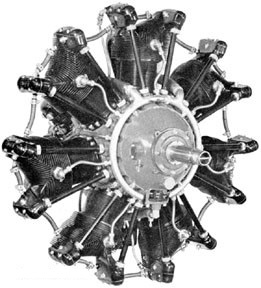
The 1935 L-5 (ATC 156) was a 285hp 7-cylinder, air-cooled radial of 831ci.
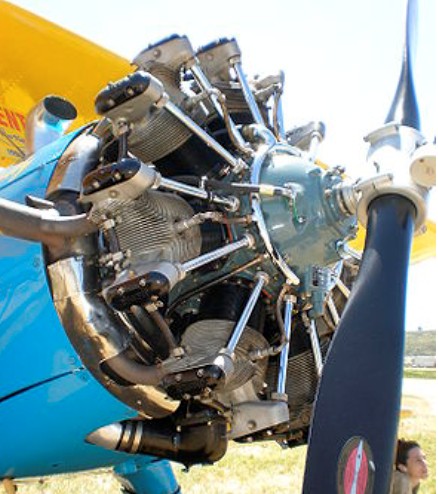
The Jacobs R-755 (company designation L-4) was a seven-cylinder, air-cooled, radial engine for aircraft manufactured in the United States by the Jacobs Aircraft Engine Company.
The R-755 (ATC 237) was first run in 1933 and was still in production in the 1970s. With a bore and stroke of 5.25 in × 5 in (133 mm × 127 mm) the displacement was 757 cu in (12.4 L), power ranged from 200 hp to 350 hp (150 kW – 260 kW). The engine features steel cylinders with aluminum-alloy cylinder heads. An R-755E variant was developed for use in helicopters.
The Jacobs must be primed on every start; two or three strokes on warm days, and five to seven strokes on cold days. Then, with mixture “Full Rich,” carb heat at Cold, and prop set at “Low rpm” (to keep from taking too much oil from the engine), master switch “On,” throttle cracked, and prop clear, turn the ignition key to “Battery Start- and press the starter button. As soon as the engine fires, turn the ignition to “Both Run”. Another shot or two of prime may be needed to keep the engine running at first.
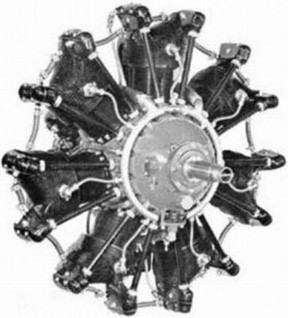
During the take-off run, it needs full right rudder trim to handle the torque, and the 195 will leave the ground in a slightly tail-low attitude at about 60 mph, using about 900 feet of runway. You are allowed full throttle for one minute with this engine; but a good cruise-climb with 2,000 rpm at 23 inches manifold pressure at 115 mph will usually produce around 500-600 fpm.
The S model was produced by Page Industries.
Applications:
Anahuac Tauro
Avro Cadet
Beechcraft Staggerwing
Boeing-Stearman Model 75
Cessna AT-17
Cessna 195
Funk F-23
Grumman Ag Cat
Kellett KD-1
Morane-Saulnier MS-505
Waco CG-15
Waco Custom Cabin series (YKC, YKC-S etc.)
Waco Standard Cabin series (YKS-6 etc.)
Specifications:
R-755-A1
Type: 7-cylinder air-cooled radial piston engine
Bore: 5.25 in (133 mm)
Stroke: 5.0 in (127 mm)
Displacement: 757 cu in (12.4 L)
Length: 27.25 in (692 mm)
Diameter: 44 in (1,188 mm)
Dry weight: 505 lb (229 kg)
Valvetrain: 2 valves per cylinder, pushrod-actuated, Sodium cooled exhaust valves
Fuel system: Single Stromberg NA-R7A carburetor
Fuel type: 73 octane
Oil system: One pressure pump, two scavenge pumps
Cooling system: Air-cooled
Reduction gear: Direct drive, right hand tractor
Power output: 245 hp (183 kW) at 2,200 RPM at sea level
Specific power: 0.32 hp/cu-in (14.8 kW/L)
Power-to-weight ratio: 0.48 hp/lb (0.8 kW/kg)

