The 1930 Jacobs L-3 (ATC 75) was a 55hp air-cooled radial engine of 191ci.
Piston
Jacobs B-1
The circa 1929 Jacobs B-1 was a 2-cylinder, horizontally opposed air-cooled engine of 20hp.
Jacobs Aircraft Engine Co
The Jacobs Aircraft Engine Company was formed in 1929 in Philadelphia. Later the company moved to Pottstown, Pennsylvania after purchasing the machine workshop of the Light Manufacturing and Foundry Company.
An early product was the Jacobs L-3, a small 55 hp 3 cylinder engine of 1929.
The Cessna UC-78 Bobcat used the L-4 engine
By 1933, Jacobs had developed the L-4 seven-cylinder radial air cooled engine with a power rating of 225 horsepower and a displacement of 757 cubic inches (12.4 litres). It was better known as by its military designation, the R-755. At the time it became known as the best producer of engines in the 200-400 horsepower range. Jacobs was the first to start making engines using forged aluminum pistons, sodium-filled exhaust valves and magnesium alloy crankcases.
The L-4 was used mostly on the Cessna UC-78 Bobcat, Cessna 195 and Stearman PT-18 Kaydet.
Due to the tendency of the L-4 engine to vibrate heavily at low rpms it was given the nicknames Shakin’ Jake and Shakey Jake.
Later developments included the 285 hp L-5 or R-830, and 330 hp L-6 or R-915.
Jacobs engines were fitted to many US-built aircraft of the inter-war period, including several Waco models. They were in use in 26 different countries including in Canada, where 330 horsepower L6-MB engines were used to power the Royal Canadian Air Force’s Avro Anson Mk. II aircraft.
In 1941 the American War Department gave the contract to Jacobs to produce Pratt & Whitney R-985 and R-1340 engines until 1945. Jacobs ranked 87th among United States corporations in the value of World War II military production contracts.
After World War II, Jacobs became a division of Republic Industries (not Republic Aircraft).
Products:
Jacobs LA-1
Jacobs LA-2 (R-590)
Jacobs L-3
Jacobs R-755/L-4
Jacobs R-830/L-5
Jacobs R-915/L-6
Jackaroo Aircraft Thruxton Jackaroo
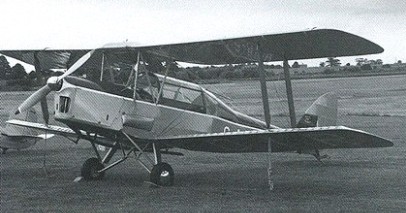
In the early 1950s Sqn Ldr J. E. Doran-Webb, managing director of the Wiltshire School of Flying at Thruxton, considered building a highwing four to five-seat touring aircraft using only Tiger Moth components. Contacts at the Royal Aero Club introduced him to Ronald Prizeman, who schemed a four-seater using the same biplane layout as a Tiger Moth but with a revised fuselage. This was accepted and formed the basis for certification as the D.H.82A (Mod) Jackaroo.
The front side frames of the Tiger Moth fuselage were moved apart by 12.5in within which four seats were installed, with the starboard pair staggered slightly forward. The basic structure and rigging of wings, tail and rear fuselage were not altered but it was necessary to increase the undercarriage track by designing a new W-shaped centre strut.
Two prototypes were built at Thruxton in 1956; G-AOEX was finished as a standard four-seater with cabin and known as a Series 1. It was test flown by Lt-Cdr Pat Shea-Simonds on March 2, 1957. The Series 2, G-AOEY, was conceived as a cargo carrier/cropduster. The cabin could be converted to carry a load of 5501b and a new low-profile superstructure neatly converted the Series 2 into a single-seater with open cockpit.
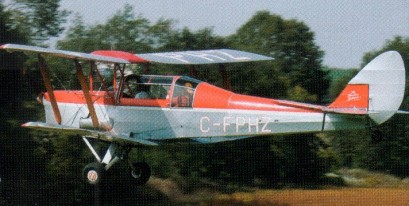
Jackaroo Aircraft Ltd was formed late 1950s at Thruxton, Hampshire, to produce the Thruxton Jackaroo widened-fuselage four-seat version of the de Havilland Tiger Moth. First “production” conversion flew on April 15, 1957, and quite a number of Tiger Moths were converted subsequently to Jackaroos. Company also designed a four-seat low-wing lightplane called the Paragon, being re-formed in early 1960s as Paragon Aircraft Ltd. to produce it under new name of Paladin.
Paragon was formed at Thruxton Aerodrome near Andover, Hampshire, from the earlier Jackaroo Aircraft Ltd., for conversion of standard two-seat Tiger Moth biplanes to four-seat configuration by inserting a new wider center fuselage and extending the top wing centre section. 18 Jackaroo conversions were carried out by the company.
By July 1957 the manufacturer was anticipating that production would reach at least six aircraft per month. An agricultural conversion kit was available at £150. Overseas owners were encouraged to convert their own Tiger Moths by purchasing a packaged kit at £600. Tiger Moths flown into Thruxton could be converted in ten days for £700.
Jackaroo Aircraft Thruxton Memories
Rollason Aircraft at Croydon acquired Jackaroo G-ANZT in 1957, and incorporated a number of improvements. In April 1960 Rollason cornpleted a Jackaroo of its own, G-APOV, in which the rear fuselage faired smoothly from the wide cabin to the tail.
Although never certificated as aerobatic, the aircraft was spun on at least one occasion with all four seats occupied, an experience none of those on board ever wished to repeat.
The big prospective orders never came and import permits for five other Jackaroos already on the line at Thruxton were refused. Each was broken up for spare parts. Designer Ron Prizeman never complained however, despite never receiving his agreed royalty of £2 per aircraft
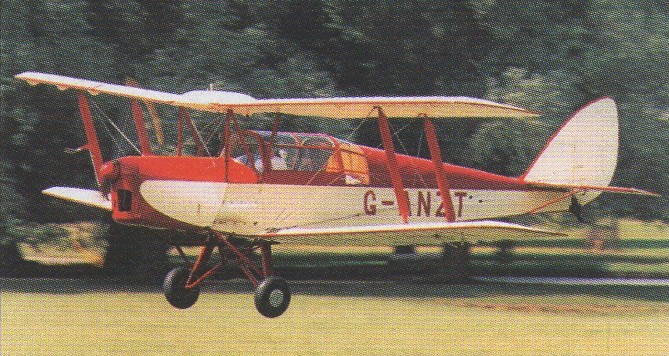
Assets acquired 1964 by Hampshire School of Flying.
Jacchia-Botarini-Wolsit Roma
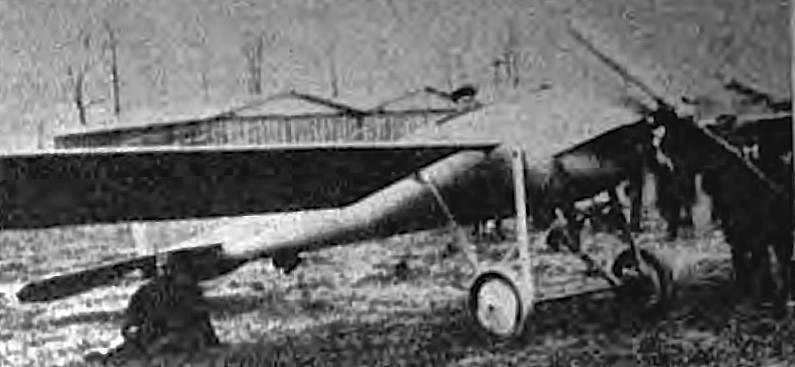
This “aero-torpedo” monoplane was destroyed when pilot Attilio Maffei crashed into some trees during a test flight on April 17th, 1913 in Italy. It was probably the “Jacchia-Wolsitt” floatplane that participated in the 1913 “Circuito delle Laghi”, modified to landplane configuration.
Jabiru 5100
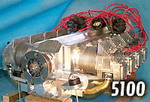
The Jabiru 5100cc Aircraft Engine is a 8-cylinder 4-stroke horizontally opposed air cooled engine. At 257lbs/117kg installed weight the Jabiru 5100 engine is ideal for many of the existing larger homebuilt aircraft such as the RV6/7, Glastar, Lancair & Glasair. The 5100 was in limited production.
Overall dimensions are small. It’s 21.12″/638mm width allows tractor applications with very small frontal areas. The Jabiru engine is designed for either tractor or pusher installation.
Jabiru 3300
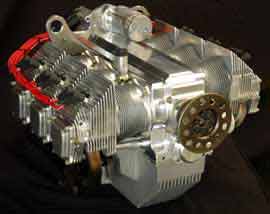
The Jabiru 3300cc Aircraft Engine is a 120hp 6-cylinder 4-stroke horizontally opposed air cooled engine. At 180lbs/81kg installed weight the Jabiru 3300 Aircraft Engine is an ideal replacement for 100-120HP equivalents.
Overall dimensions are small. Its 23.46″/596mm width allows tractor applications with very small frontal areas. The Jabiru engine is designed for either tractor or pusher installation.
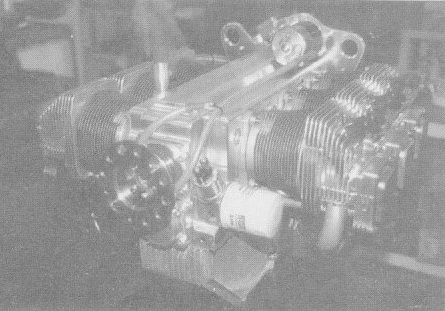
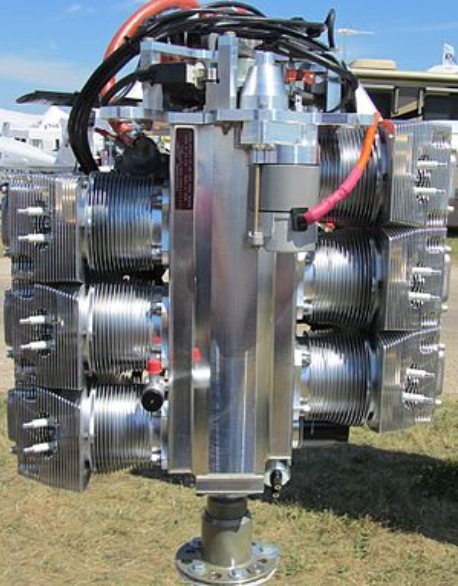
The Jabiru 3300 engine features direct propeller drive, 1 central camshaft, push rods, over head valves (OHV), ram air cooled, wet sump lubrication, dual transistorized magneto ignition, integrated ac generator, electric starter, mechanical fuel pump, naturally aspirated – 1 pressure compensating carburetor, and 6 bearing crankshaft.
2010 Price $17,500
Applications:
Aerocomp VM-1 Esqual
Alpi Pioneer 300
Arion Lightning
Australian Lightwing SP-2000 Speed
BRM Argos
Bushcaddy R-120
Creative Flight Aerocat
CZAW Parrot
Fisher Dakota Hawk
Flaeming Air FA 04 Peregrine
Ion Aircraft Ion
Jabiru J230
Jabiru J430
Just Superstol
MySky MS One
Nexaer LS1
Rand Robinson KR-2S
Sonex Aircraft Sonex
Titan Tornado
ULBI Wild Thing
Type: Flat-6
Displacement: 3300 cc (134cu.in.)
Bore: 97.5 mm (3.838″)
Stroke: 74 mm (2.913″)
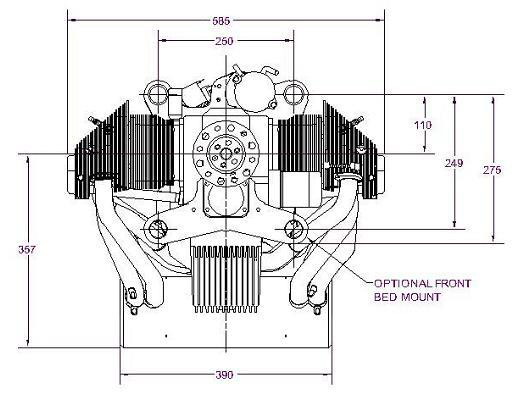
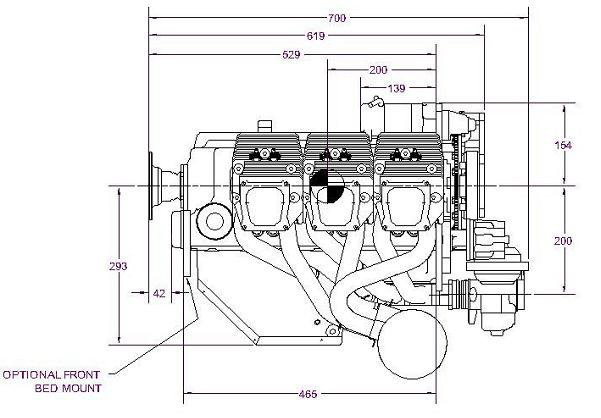
Length: 671 mm (26.42 in)
Width: 582 mm (22.91 in)
Height: 445 mm (17.54 in)
Dry weight: 81 kg (178 lbs) with exhaust, carburetors, starter motor, alternator & ignition system
Compression Ratio: 8:1
Directional Rotation of Prop Shaft: Clockwise – Pilot’s view Tractor applications
Ramp Weight: 178 lbs (81kg) complete including exhaust, carburetor, starter motor, alternator and ignition system
Ignition Timing: 25˚ BTDC fixed timing
Firing order: 1 – 4 – 5 – 2 – 3 – 6
Power Rating: 107 hp @ 2750 rpm continuous, 120 hp @ 3300 rpm intermittent
Fuel system: Mechanical fuel pump
Fuel consumption: 35 litres/h at Takeoff/Max. continuous rating
Fuel Consumption at 75% power: 26 l/hr (6.87 US gal/hr)
Fuel: AVGAS 100/130 or Auto Gas 91 MON (97 RON) Minimum
Oil system: Wet sump
Oil Capacity: 3.5 lt (3.69 quarts)
Oil: Aeroshell W100 or equivalent
Cooling system: Aircooled, Oil Cooling (optional, but usually necessary)
Spark Plugs: NGK D9EA – Automotive
Jabiru 2200
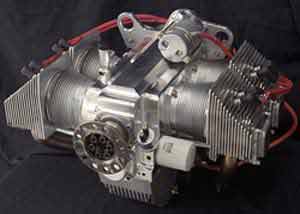
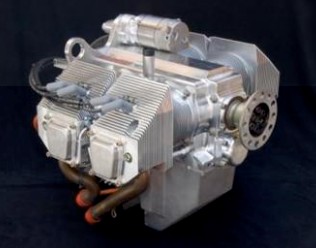
The Jabiru 2200 Aircraft Engine is a 85hp 4-cylinder 4-stroke horizontally opposed air cooled engine. At 132lbs/60kg installed weight it can be installed in an aircraft at the same weight as most popular 2-stroke engines.
Overall dimensions are small. It’s 23.46″/596mm width allows tractor applications with very small frontal areas. The Jabiru engine is designed for either tractor or pusher installation.
It is an ideal replacement for the Rotax 582 2-cylinder 2-stroke; it is the same installed weight as the Rotax 582. It is also a lightweight, smaller-package alternative to all of the VW derivative engines and the Rotax 912.
Jabiru 2200 85 hp engine features 1 central camshaft, push rods, over head valves (OHV), wet sump lubrication, integrated ac generator, electric starter, mechanical fuel pump, dual transistorized magneto ignition, direct propeller drive, and a 6 bearing crankshaft.
2010 Price $13,500
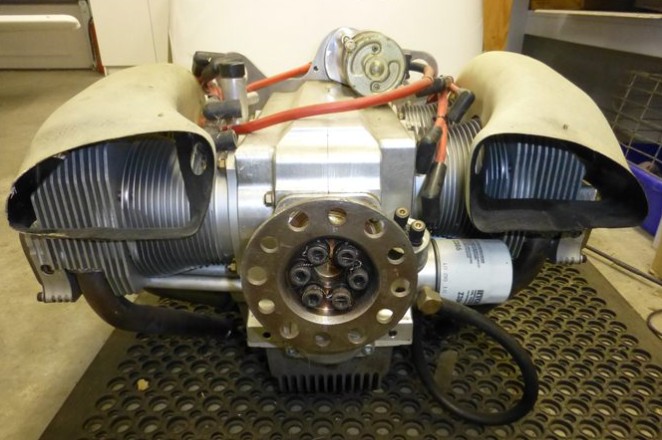
Specifications:
Displacement – 2200cc (134 cu in)
Bore – 97.5mm (3.838″)
Stroke – 74mm (2.913″)
Compression Ratio – 8:1
Prop Rotation – Clockwise from pilot view
Ramp Weight – 62.8kg (133lbs) Including exhaust, carburettor, starter motor, alternator, ignition system, regulator, propeller guides, engine mount rubbers, starter solenoid and muffler springs.
Power Rating – 64kW (85hp) @ 3300 RPM
Fuel – AVGAS 100/130, MOGAS >95
Fuel Consumption at 75% power: 15 l/hr (4 US gal/hr)
Oil Capacity – 2.3 Litres (2.2 Quarts)
Oil: Aeroshell W100 or equivalent
Spark Plugs – NGK D9EA Automotive
Ignition Timing: 25˚ BTDC fixed timing
Firing order: 1 – 3 – 2 – 4
Jabiru 1600
The Jabiru 1600 is a horizontally opposed direct drive four-stroke, air-cooled aircraft piston engine produced by Jabiru Aircraft. Jabiru designed and built the Jabiru 1600 to power the light sport aircraft it produced when it could not obtain supplies of the Italian KFM 112M engine used to power its early production aircraft. The 1600 was approved in Australia in November 1993 and was used on Jabiru production aircraft. Unit cost in 1995 was AUD$10,800.
Type: Flat-4
Bore: 88.0 mm (3.465 in)
Stroke: 66.0 mm (2.598 in)
Displacement: 1606 cm³ (248.9 in³)
Length: 532 mm (20.9 in)
Width: 574 mm (22.6 in)
Height: 472 mm (18.6 in)
Dry weight: 54 kg (119.0 lbs) dry, equipped
Cooling system: Aircooled
Power output: 45 kW (60 hp) at 3,300 RPM
Jabiru UL-D
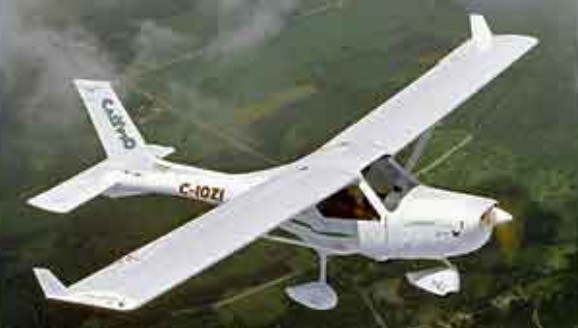
The Jabiru UL-D has been designed to meet the UK Microlight Standard of 268kg max empty weight and 450kg gross weight and the 35 knots (65km/hr) stall speed.
Engine: Jabiru 2200cc
Fuel in wings: 70 ltrs
MTOW: 450 kg
Seats: 2

