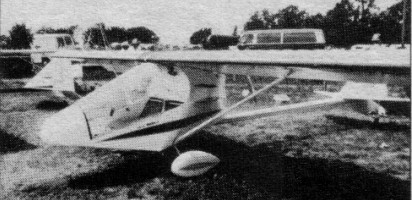
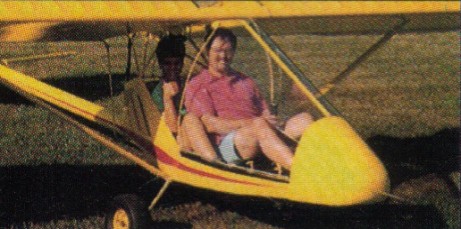
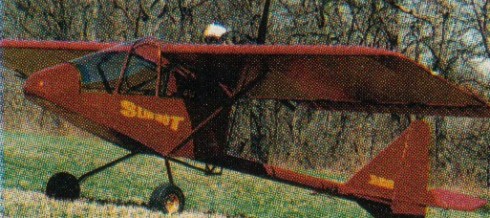
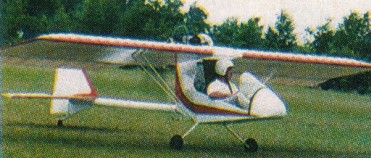
The microlight Kolb Twinstar is a side-by-side two seater built by the Kolb Co., Phoenixville, Pennsylvania. First flown in 1982, it is a high wing conventional design powered by a pusher Rotax engine. Designed by Homer Kolb
Single seat single engined high wing mono¬plane with conventional three axis control. Wing has unswept leading and trailing edges, and constant chord; cruciform tall. Pitch control by elevator on tail; yaw control by fin mounted rudder; roll control by full span ailerons; control inputs through stick for pitch/roll and pedals for yaw. Wing braced from below by struts; wing profile Kolb; double surface. Undercarriage has three wheels in tail dragger formation; suspension on tailwheel and optional spring suspen¬sion on main wheels. Push right go right tailwheel steering connected to yaw control. Brakes on main wheels. Aluminium tube framework, without pod. Engine mounted below wing driving pusher propeller. This Homer Kolb production was shown for the first time in public at the Sun ‘n’ Fun meeting in March 1982, then next at Oshkosh. Kolb Company announced that the Ultrastar would go on sale in October 1982 but initial production was delayed, the first kits not being delivered until December. As with the Flyer, the machine is supplied as a kit requiring the purchaser to do all the fabrication, all the materials and necessary components being included in a price of $3595 in 1982. In March 1983 Kolb Company announced that for $1995 you could have a basic Ultrastar kit of just materials and plans and in addition a covering kit for $345, an accessory kit for $1355 and prefabricated wing ribs for $99.
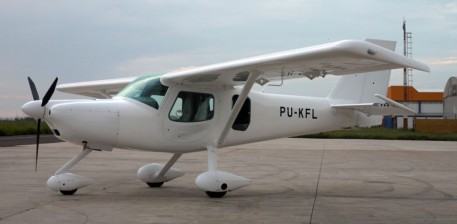
The Flyer SS fuselage is a resin infusion moulded composite structure consisting of a carbon fiber/epoxy resin laminate with rigid PVC, birch plywood and balsa cores. The all-metal wet wing is a single-strut, single spar construction, covered with aluminum skins. The horizontal empennage features a cantilever stabilizer structure covered with aluminum and with fibreglass tips. The vertical tail, ailerons, flaps and elevator are also aluminum covered. Ailerons, elevator are mass balanced. The airplane features dual control sticks, dual rudder pedals and a dual differential braking system. The Frise Ailerons are deflected through a bellcrank / pushrod mechanism mounted on ball bearings. The Fowler flaps are operated by a torque tube connected to an electric motor. Ailerons deflect 30° up and 17° down and flaps 40°. The rudder is cable operated while the elevator is operated via a set of 2 push-pull tubes connected by a central bellcrank. The trim tab is controlled by an electric servo motor.
The main Wittman type landing gear legs are made of heat-treated 6150 HR steel rods, faired with fibreglass. The system consists of a right and a left leg, bolted in two landing gear sockets located at each end on an extruded aluminum carry through square tube laminated in place in the bottom of the fuselage. The nose gear leg is made in the same fashion as the main gear but with a different camber. The wheel is mounted in an aluminum fork and suspension is provided by natural leg bending. The nose wheel is free and can rotate 360°.
Cleveland 5 inch wheels and brakes with 5.00*5 tires are used for all three wheels. Brakes are toe operated and the KOLB FLYER SS offers differential braking from pilot and passenger seats.
The flaps are electrically operated by an electric actuator. The flap control is located in the center console. They offer 5 positions from -4° to 40°. One elevator trim, electrically operated, that combines as an anti-servo tab. Fixed trims are used for the rudder and the ailerons. Two seats, side by side and adjustable, leather seat cushions, dual sticks, dual pedals, center console, top hinged bubble doors, blown acrylic windshield, windows and skylights, baggage compartment accessible via a cargo door on the pilot’s side and over the central bulkhead. Three-point seat belts – shoulder harness for both seats. The two seats are moving forward and aft and are electrically actuated. The control is done via a rocker switch located between the two seats on the center console.
The Rotax 912S develops 100 HP at 5,800 RPM for take-off and 95 HP continuous at 5,500 RPM. Stainless steel exhausts system. 4 cylinder, 4 stroke liquid/air cooled engine with opposed cylinders, dry sump forced lubrication with separate 3l (.8 gal US) oil tank, automatic adjustment by hydraulic valve tappet, 2 CD carburetors, mechanical fuel pump, electronic dual ignition, electric starter, integrated reduction gear 1= 2.43.
Flyer SS Engine: Rotax 912S, 100 hp Wing span: 32Ft / 9.75m Length: 20.6ft6./ 28m Fin height: 8.25ft / 2.5m Airfoil: GA30U-418 Wing area: 117Sq.ft. / 10.8 sq.m Aspect ratio: 8.73 Dihedral: 0.9 deg Incidence: 2.5 deg Aileron Span: 57.6In / 1.46m Aileron Area (each): 3.9Sq.ft / 0.36Sq.m Flap Span: 103.4in Flap Area (each): 6.9Sq.ft / 0.64Sq.m Stabilizer span: 9ft / 2.74m Stabilizer area: 13.9Sq.ft. / 1.29Sq.m Elevator area: 9.7Sq.ft. / 0.9Sq.m Trim tab area: 1Sq.ft. / 0.1Sq.m Horizontal tail Angle of incidence: -1deg Fin area: 4Sq.ft. / 0.37Sq.m Rudder area: 7.1Sq.ft / 0.66Sq.m Landing gear Track: 7.3Ft / 2.23m Wheel base: 68.7In / 1.74m Cabin width: 47 In / 1.2m Cabin Leg room: 46 In / 1.17m Maximum cruising speed: 117 ktas Maximum speed (flaps extended): 74 ktas Cruising speed: 115 ktas Never to exceed speed (VNE): 140 ktas Stall speed (flaps retracted): 45 ktas Stall speed flaps 10°: 38 ktas Stall speed flaps 25°: 32 ktas Stall speed flaps 40°: 30 ktas Climb rate: 1,234 fpm Take-off ground roll: 725 ft. Landing ground roll: 500 ft. Operating ceiling: 12,000 ft. Maximum take-off weight: 1,320 lbs / 600 kg Typical empty weight: 850 lbs / 385 kg Typical useful load: 470 lbs / 213 kg Maximum weight per seat: 240 lbs / 109 kg Maximum baggage weight: 28 lbs / 13 kg Maximum fuel load: 162 lbs / 73 kg Minimum single pilot weight: NO single pilot weight minimum
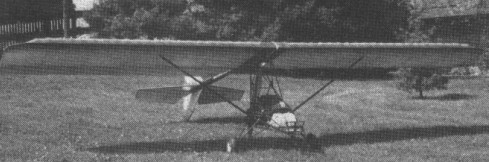
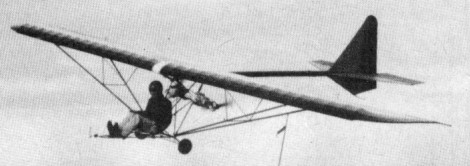
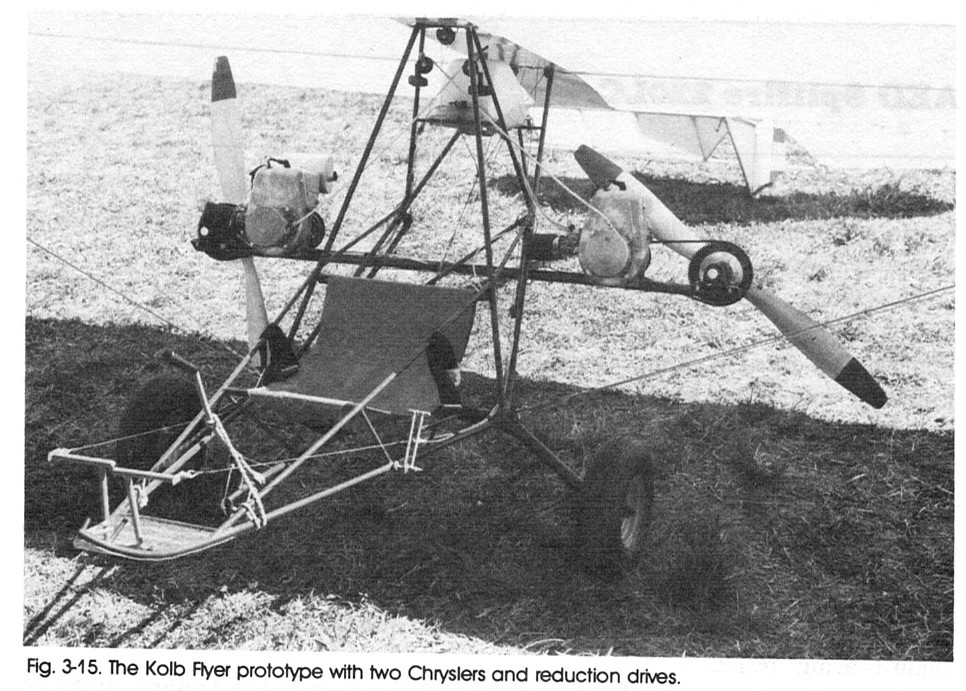
Single seat twin engined high wing mono¬plane with conventional three axis control. Wing has unswept leading and trailing edges, and constant chord; cruciform tail. Pitch control by elevator on tail; yaw control by fin mounted rudder; roll control by one-third span ailerons; control inputs through stick for pitch/roll and pedals for yaw. Wing braced from below by struts; wing profile Kolb; double surface. Undercarriage has two wheels side by side with tailskid; suspension on both wheels. No ground steering. No brakes. Aluminium tube framework, without pod. Engines mounted below wing driving pusher propellers.
The actual Flyer, christened with the same name as the Wright brothers’ aircraft, was built and made its first flight in 1970. Homer Kolb’s prototype weighed 130 lb (59 kg) and flew without problems from its first take off, using two McCulloch Mc101 engines of 12.5 hp each. Refined over the passage of the years but only released to the public since 1980, the Kolb Flyer was only sold as plans in 1982 ($65) or kits at various stages of completion: structural materials $1198, finishing kit $1900 (engines, propellers, wheels, coverings, seat etc) or complete materials kit for $2995.
Engine Two Solo 209, 11.5 hp each at 4500 rpm. Prop¬eller diameter and pitch 36×10 inch, 0.91 x 0.25 m. No reduction. Power per unit area 0.14 hp/sq.ft, 1.5 hp/sq.m. Fuel capacity 1.7 US gal, 1.4 Imp gal, 6.4 litre. Length overall 20.0 ft, 6.09 m. Height overall 4.3ft, 1.29m. Wing span 29.0ft, 8.83m. Constant chord 5.5 ft, 1.65 m. Sweepback 0 degs. Total wing area 160 sq.ft 14.9sq.m. Wing aspect ratio 5.2/1. Main wheels diameter overall 14 inch, 35 cm. Empty weight 185 lb, 84kg. Max take off weight 392 lb, 178kg. Payload 207 lb, 94kg. Max wing loading 2.45 lb/sq.ft, 11.9kg/sq.m. Max power loading 17.0 lb/hp, 7.7kg/hp. Load factors; +4.0, 2.5 ultimate. Max level speed 53 mph, 85 kph. Max cruising speed 40 mph, 64kph. Stalling speed 20mph, 32kph. Max climb rate at sea level 250 ft/min, 1.2 m/s. Best glide ratio with power off 10.8/1 at 27 mph, 43 kph. Take off distance 250 ft, 76 m. Land¬ing distance 75 ft, 23 m. Service ceiling 6850 ft, 2090 m. Range at average cruising speed 35 mile, 56 km.
First produced in 1985. The wings and tail fold for transport. Designed by Homer Kolb The 1997 kit price including a Rotax 447 was $9039.
FireStar II
The FireStar II is a two place version of the Firestar I. The 1997 kit price was US$9264 including the engine. The New Kolb Aircraft LSA Firestar II 2009 Price: 9000 US$
Designed by Homer Kolb, the Firefly was designed to be a legal ultralight with the twin cylinder 40HP Rotax 447 engine installed. This single seat LSA Firefly features 10 minute wing folding and a Quick-build option. The Quick-buid option represents approximately 50% of the building / assembling time of the aircraft.
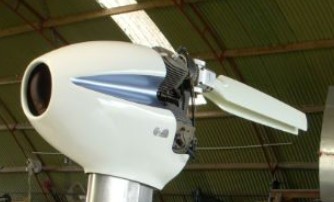
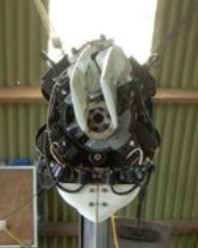
The König SD 570 is a four-cylinder, two-stroke, single ignition radial aircraft engine designed for powered paragliders, powered parachutes and single place ultralight trikes. The SD 570 is an unusual four-cylinder radial engine that is very compact and light weight at only 19 kg (42 lb). The engine features single capacitor discharge ignition, a single Bing 49 diaphragm-type carburetor and rotary valve induction. It was offered without a reduction drive, although when Zanzottera built it an optional 1.75:1 cog belt reduction drive was available. Starting is electric starter only and a recoil starter is not an option.
Earlier versions produced 28 hp (21 kW) at 4200 rpm with a slide-type carburetor and reduction drive. The later version is rated at 24 hp (18 kW) at 4200 rpm. Time between overhaul is rated as 300 hours.
The SD 570 shares the same bore and stroke as the smaller three-cylinder König SC 430 radial engine.
The engine was originally designed and produced by Dieter König of Berlin, Germany. The design was sold to Zanzottera Technologies of Italy and then sold again, along with the rest of Zanzottera’s two-stroke ultralight aircraft engine line to Compact Radial Engines of Surrey, British Columbia, Canada.
Variants:
Zanzottera SD 570 Four-cylinder, two-stroke, single-ignition, radial aircraft engine producing 28 hp (21 kW) at 4200 rpm. Equipped with a slide-type carburetor and an optional reduction drive.
Compact Radial Engines SD 570 Four-cylinder, two-stroke, single-ignition, radial aircraft engine producing 24 hp (18 kW) at 4200 rpm. Equipped with a Bing 49 diaphragm-type carburetor and no reduction drive.
Applications: MFI BA-12 Sländan
Specifications: SD 570 Type: Four-cylinder, radial two-stroke aircraft engine Bore: 66 mm (2.60 in) Stroke: 42 mm (1.65 in) Displacement: 579 cc (35.33 cu in) Dry weight: 19 kg (42 lb) Valvetrain: rotary valve induction Oil system: premixed oil and fuel Cooling system: air-cooled Reduction gear: none Power output: 24 hp (18 kW) at 4200 rpm
The König SC 430 is a three-cylinder, two-stroke, single ignition radial aircraft engine designed for powered paragliders and single place ultralight trikes. The SC 430 is a unique three cylinder radial engine that is very compact and light weight at only 17 kg (37 lb). The engine features single capacitor discharge ignition, a single Bing 49 diaphragm type carburetor and rotary valve induction. It was currently offered without a reduction drive, although when Zanzottera built it a 1.75:1 cog belt reduction drive was available. Starting is electric starter only and a recoil starter is not an option.
Earlier versions produced 24 hp (18 kW) at 4200 rpm with a slide-type carburetor and reduction drive. The later version is rated at 20 hp (15 kW) at 4200 rpm. Time between overhaul is rated as 300 hours.
The SC 430 shares the same bore and stroke as the larger four cylinder König SD 570 radial engine.
The engine was originally designed and produced by Dieter König of Berlin, Germany. The design was sold to Zanzottera Technologies of Italy and then sold again, along with the rest of Zanzottera’s two-stroke ultralight aircraft engine line to Compact Radial Engines of Surrey, British Columbia, Canada.
Unit cost from Compact Radial Engines in 2001 was US$3600
Variants:
Zanzottera SC 430 Three cylinder, two stroke, single ignition, radial aircraft engine producing 24 hp (18 kW) at 4200 rpm. Equipped with a slide-type carburetor and reduction drive.
Compact Radial Engines SC 430 Three cylinder, two stroke, single ignition, radial aircraft engine producing 20 hp (15 kW) at 4200 rpm. Equipped with a Bing 49 diaphragm type carburetor and no reduction drive.
Applications: Air Est Goeland Alpaero Sirius Gardner Scout Stratos 300 UTIAS Ornithopter No.1 Valentin Kiwi 6T Windex 1200
Specifications: CR 430 Type: Three cylinder, radial two-stroke aircraft engine Bore: 66 mm (2.60 in) Stroke: 42 mm (1.65 in) Displacement: 430 cc (20.75 cu in) Dry weight: 17 kg (37 lb) Valvetrain: rotary valve induction Oil system: premixed oil and fuel Cooling system: air cooled Reduction gear: none Power output: 20 hp (15 kW) at 4200 rpm
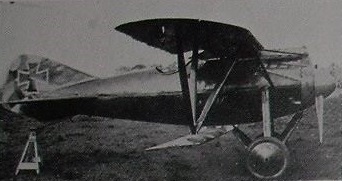
The Kondor Dreidekker, first flown in October 1917, was not a success. Instead, Kondor used the fuselage, empennage and lower wing of the Dreidekker to produce over the winter of 1917-18 a biplane or sesquiplane called the D.7 designed by Walter Rethel.
The common fuselage was a tube steel internal structure with plywood skin, rounded in cross-section. At the front the fuselage reduced smoothly in diameter to a large spinner with a two blade propeller driven by a 160 hp (120 kW) six-cylinder, liquid-cooled upright inline Mercedes D.III engine, though there are hints in the records suggesting an earlier, different engine. The upper part of the engine protruded above the fuselage, enclosed in its own cowling. At the rear the tailplane was mounted at mid-fuselage under a long chord fin with a strongly swept leading edge, carrying a deep rudder. There was a shallow ventral fin. The D.7 had a fixed conventional undercarriage, with each mainwheel’s leg placed vertically and mounted at mid-fuselage, assisted by a forward leaning strut attached under the nose. A long tailskid reached rearwards from the forward edge of the ventral fin.
The wings of the D.7 had constant chord and the upper one was supported just above the fuselage on a cabane. The cockpit was aft of its trailing edge, where there was a central rounded cut-out to assist the pilot’s upward and forward view. The lower wing, narrower in chord, was not directly attached to the fuselage but supported centrally by rear leaning struts from the undercarriage structure. The interplane struts were also unusual; three struts were attached at the same point on the lower wing, spreading out upwards into an inverted tripod or pair of Vs.
The date of the D.7’s first flight is not known though it must have been after October 1917, when the Dreidekker was flying, and before May 1918 when a report from the Idflieg said the D.7 was about to recommence testing with the Mercedes engine. It was not entered into the second D-type (fighter) competition of June 1918, suggesting Kondor were beginning to concentrate on the monoplane designs suggested by the success of the Fokker D.VIII, a process that led to the Kondor E.III.
The D.7 remained a prototype and its development was soon abandoned.
Engine: 1 × Mercedes D.III, 120 kW (160 hp) Propeller: 2-blade Wingspan: 8.50 m (27 ft 11 in) Wing area: 15.70 m2 (169.0 sq ft) Length: 6.20 m (20 ft 4 in) Height: 2.30 m (7 ft 7 in) Empty weight: 590 kg (1,301 lb) Gross weight: 785 kg (1,731 lb) Maximum speed: 180 km/h (112 mph; 97 kn) Endurance: 1.45 hr Crew: One