Kubíček M-2 Skaut

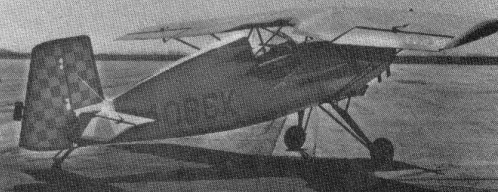
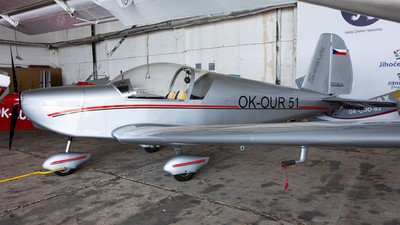
In 2005 Petr Kubiček, encouraged by aerospace engineering students at Brno University, began to design a modernised Mráz M-2 Skaut with the hope of production. The first Kubicek M-2 Scout (the name was Anglicised) of the 21st century appeared, unflown, at Aero ’09 held in Friedrichshafen in the spring of 2009 and flew for the first time on 7 May 2009. The Scout design began with the original plans reassessed with modern methods and using a metal rather than wood structure, supplemented with some composite materials for the engines cowling and flying surface tips.

Externally the old and new aircraft are similar, wings and tail having the same features and the side-by-side seating retained. The aircraft is made from riveted and bonded aluminum sheet and is completely corrosion-treated after assembly. Electrically operated flaps are fitted to the Scout and there is a central trim tab on the elevator. Its fixed tricycle undercarriage is mounted on the fuselage with cantilever composite mainlegs. The mainwheels have brakes operated with a central lever and the nosewheel has helical springing. All wheels are spatted.

The new M-2 was designed to comply with the Fédération Aéronautique Internationale microlight rules and US light-sport aircraft rules.

After its first flight in May 2009, the Scout prototype appeared at several Czech airshows and fly-ins.

Two versions are being developed, one to meet the US Light Sport requirement with a maximum take-off weight (MTOW) of 598 kg (1,320 lb) and a second for the European Ultralight MTOW limit of 450 kg (992 lb). Both these MTOWs are less than that of the original Skaut and empty weight are also less. Certification was proceeding in 2010, with the aim of first deliveries during 2011.

M-2 Scout LSA
US light-sport category
Engine: Rotax 912ULS, 73.5 kW (98.6 hp)
Propeller: 3 blade ground adjustable
Wingspan: 9.6 m (31.5 ft)
Wing area: 12.4 m2 (133 sq ft)
Length: 6.87 m (22 ft 6 in)
Height: 2.35 m (7 ft 9 in)
Empty weight: 320 kg (705 lb)
Gross weight: 600 kg (1,323 lb)
Fuel capacity: 90 L (23.5 US gal; 19.8 Imp gal).
Maximum speed: 220 km/h (140 mph, 120 kn)
Cruise speed: 180 km/h (110 mph, 97 kn)
Stall speed: 72 km/h (45 mph, 39 kn) in the landing configuration
Never exceed speed: 260 km/h (160 mph, 140 kn)
ROC: 6.0 m/s / 1.181 ft/min
Endurance: 6 hours
g limits: +4/-2
Crew: one
Capacity: one passenger
Cockpit width: 120 cm (47 in)

M-2 Scout UL
European ultralight category
Engine: Rotax 912ULS, 73.5 kW (98.6 hp)
Propeller: 3 blade ground adjustable
Wingspan: 9.6 m (31.5 ft)
Wing area: 12.4 m2 (133 sq ft)
Length: 6.87 m (22 ft 6 in)
Height: 2.35 m (7 ft 9 in)
Empty weight: 320 kg (705 lb)
Gross weight: 472.5 kg (1,042 lb)
Fuel capacity: 90 L (23.5 US gal; 19.8 Imp gal).
ROC: 5.0 m/s (984 ft/min)
Cockpit width: 120 cm (47 in)
Crew: one
Capacity: one passenger
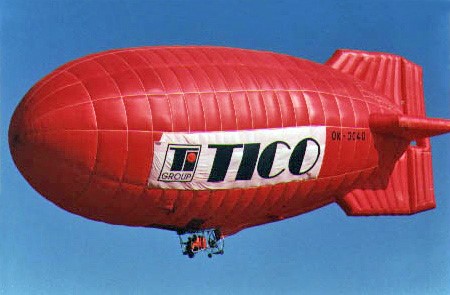
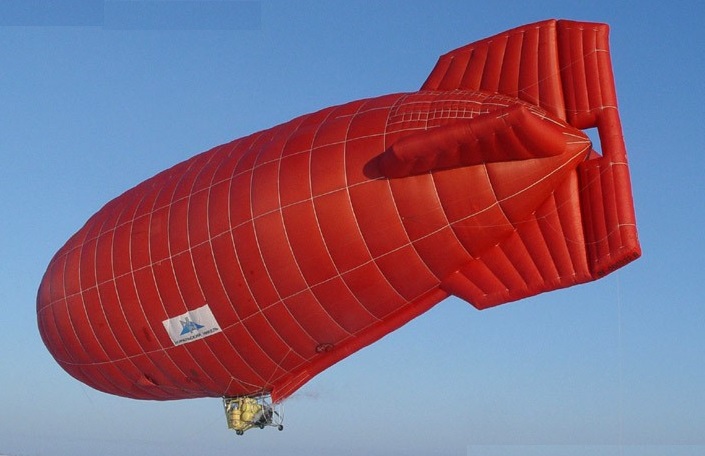
Kubíček AV-1

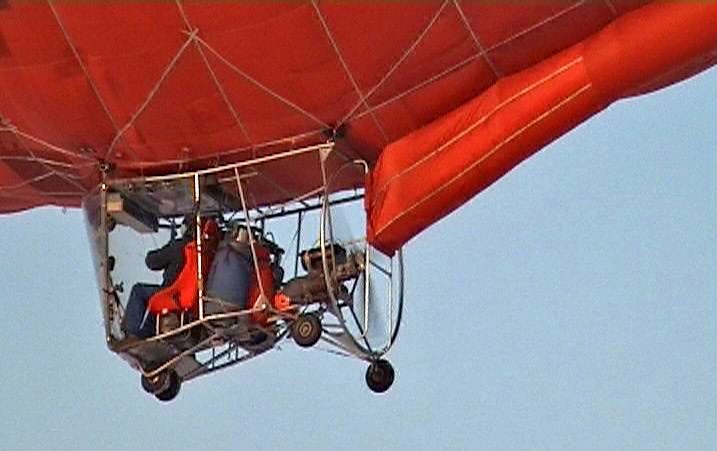
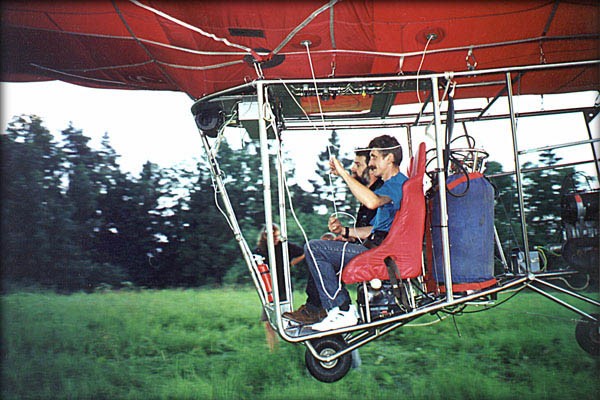
The Kubicek AV-1 is a hot-air airship designed and built in the Czech Republic by Kubicek Limited. The AV-1 was built as an advertising airship for the TICO group of Prague and first flew on the 16 October 1993.

It was later in the colours of Coca-Cola Moscow.

Volume: 2,800 m3 (99,000 cu ft)
Powerplant: 1 × Rotax 503, 37 kW (50 hp)
Propeller: single blade Justas-Stratos 4-blade pusher
Burner: Kubicek H3-double 2 x 2.1 MW
Length: 35.00 m (114 ft 10 in)
Height: 12.00 m (39 ft 4 in) envelope height
Weight: 195 kg
Gondola: Stainless steel, 240 kg
Maximum speed: 25 km/h (16 mph, 13 kn)
Endurance: 1.5
Crew: 1 pilot
Capacity: 1 passenger

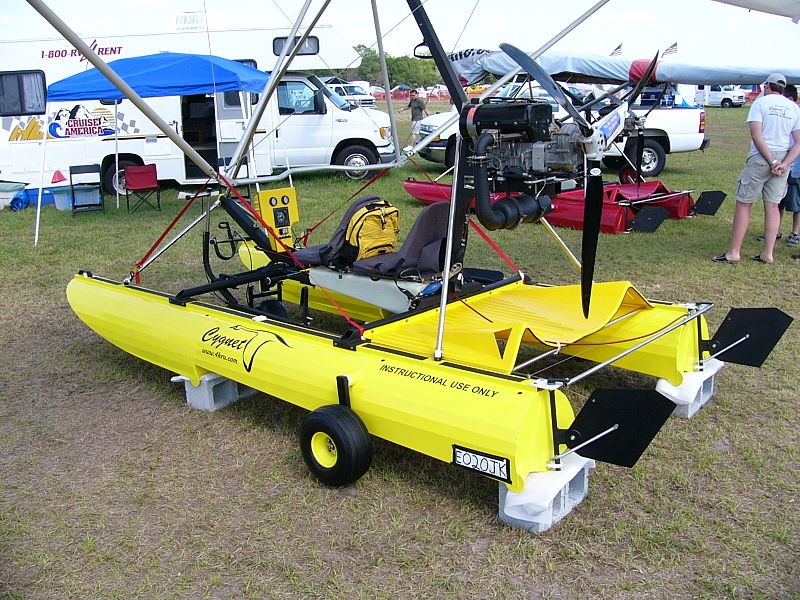
Krucker Cygnet / Sea & Sky Cygnet

Krucker Cygnet at Sun ‘n Fun, 2004

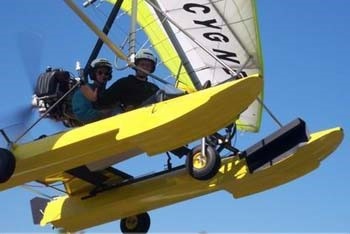
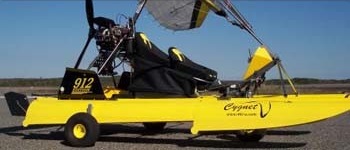
The Krucker Cygnet amphibious ultralight trike was designed by J.P. Krucker and initially produced by his company Krucker Manufacturing in Sudbury, Ontario, Canada. Supplied as a kit for amateur construction or as a complete ready-to-fly-aircraft, the aircraft was designed to comply with the Fédération Aéronautique Internationale microlight category and the US light-sport aircraft rules.

It features a strut-braced hang glider-style high-wing, weight-shift controls, a two-seats-in-tandem open cockpit, retractable wheeled tricycle landing gear and dual floats and a single engine in pusher configuration.

The aircraft is made from bolted-together aluminum tubing, with its single surface wing covered in Dacron sailcloth. Its 10.3 m (33.8 ft) span wing is supported by struts and uses an “A” frame weight-shift control bar. The standard powerplants are the twin cylinder, liquid-cooled, two-stroke, dual-ignition 65 hp (48 kW) Rotax 582 engine, the four cylinder, air and liquid-cooled, four-stroke, dual-ignition 80 hp (60 kW) Rotax 912UL and the 100 hp (75 kW) Rotax 912ULS engines.

A number of different wings can be fitted to the basic carriage, including the North Wings Pulse 17 m2 (180 sq ft) and 19 m2 (200 sq ft) sizes. The LSA-approved wings are the North Wing Mustang 3 in 15 m2 (160 sq ft), 17 m2 (180 sq ft) and 19 m2 (200 sq ft) and the Keitek Hazard.

The Cygnet was awarded Best Trike at Sun ‘n Fun in 2005.

SLSA #99 was the Krucker Cygnet amphib trike. The SLSA completed on 3 July 2009 accoring to U.S. representative, Michael Percy, of XL Kites who imports the Cygnet to the US.

The Cygnet was later manufactured by Sea and Sky of Fort Walton Beach, Florida, United States, selling for US$49,600 (with Rotax 912) in 2011, and still in production in 2013.

Cygnet 2 / North Wings Pulse 17 wing
Engine: 1 × Rotax 582, 64 hp (48 kW)
Propeller: 3-bladed composite
Wingspan: 33 ft 10 in (10.3 m)
Wing area: 189 sq ft (17.6 sq.m)
Empty weight: 529 lb (240 kg)
Gross weight: 992 lb (450 kg)
Fuel capacity: 10 U.S. gallons (38 L; 8.3 imp gal)
Wing loading: 5.2 lb/sq ft (25.6 kg/sq.m)
Maximum speed: 60 mph; 52 kn (96 km/h)
Cruise speed: 37 mph; 32 kn (60 km/h)
Stall speed: 31 mph; 27 kn (50 km/h)
Rate of climb: 490 ft/min (2.5 m/s)
Seats: 2

K & S Jungster II

The Jungster II is a follow-up design that grew out of experience with the Jungster I. The intent was to create a plane with the same open cockpit concept but to increase speed and capacity so that it would be an acceptable cross-country airplane. The Jungster II uses the same design and construction concepts except that it is just a little bit bigger, has left the lower wing, behind in favor of a single extended parasol-type wing, and uses a welded steel-tube center section. Engines rated from 85 to 180 hp are used.

Gross Wt. 1375 lb
Empty Wt. 739 lb
Fuel capacity 16 lb
Wingspan 22’4”
Length 16’11”
Top 170 mph
Cruise 148 mph
Stall 55 mph
Climb rate 3500 fpm
Takeoff run 200 ft
Landing roll 800 ft

K & S Jungster I

The Jungster I was developed as an 8/10 scale version of the famous Bunker Jungsmeister aerobatic airplane. The intention was to capture many of the flying qualities of the Jungmeister in a smaller size. This all-wood, fabric-covered biplane has a swept-back wing design of about 11 degrees to keep the center of lift close to the center of gravi¬ty. It can handle engines rated from 85 to 150 hp and is a frisky single place aerobatic plane.

Gross Wt, 1000 lb
Empty Wt. 605 lb
Fuel capacity 16 USG
Wingspan 16’5”.
Length 16’.
Wing area: 80 sq.ft.
Top 200 mph.
Cruise 150 mph
Stall 52 mph
Climb rate 2500+ fpm
Takeoff run 300 ft
Landing roll 800 ft
Range 300 miles
Seats: 1.