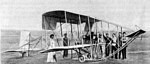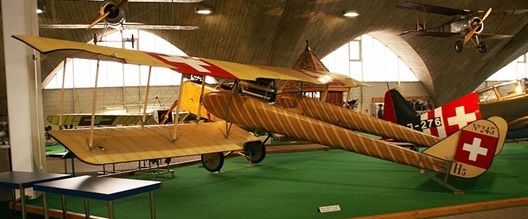
K+W Häfeli DH-1

In 1915 the Federal Construction Works (Eidgenoessische Konstruktionswerkstaette, K+W) set up their aircraft department at Thun, Switzerland and employed August Häfeli as chief engineer. Häfeli had previously designed the AGO C.I and AGO C.II, German reconnaissance biplanes. His first design was the Häfeli DH-1, similar in concept to his designs for AGO Flugzeugwerke.

The DH-1 reconnaissance biplane was a three-bay biplane of wood and fabric construction, it had a fuselage pod with tandem seating for the two-man crew and twin booms mounting the tail. The DH-1 was powered by an Argus As II engine built under licence by Buhler Brothers Limited. Six aircraft were built for the Swiss Air Force.

Six DH-1s were built during 1916 but within a year three had been destroyed in accidents. The survivors were withdrawn from service in 1919 and scrapped.

Engine: 1 × Argus As II, 120 hp (89 kW)
Wingspan: 42 ft 0 in (12.80 m)
Wing area: 409.04 ft² (38 m²)
Length: 28 ft 11¼in (8.82 m)
Height: 9 ft 10 in (3 m)
Empty weight: 1,653 lb (750 kg)
Max. takeoff weight: 2,480 lb (1125 kg)
Maximum speed: 78mph (126 km/h)
Range: 155 miles (250 km)
Service ceiling: 9,840 ft (3000 m)
Crew: two
Armament: one 0.293 in (7.45 mm) machine-gun

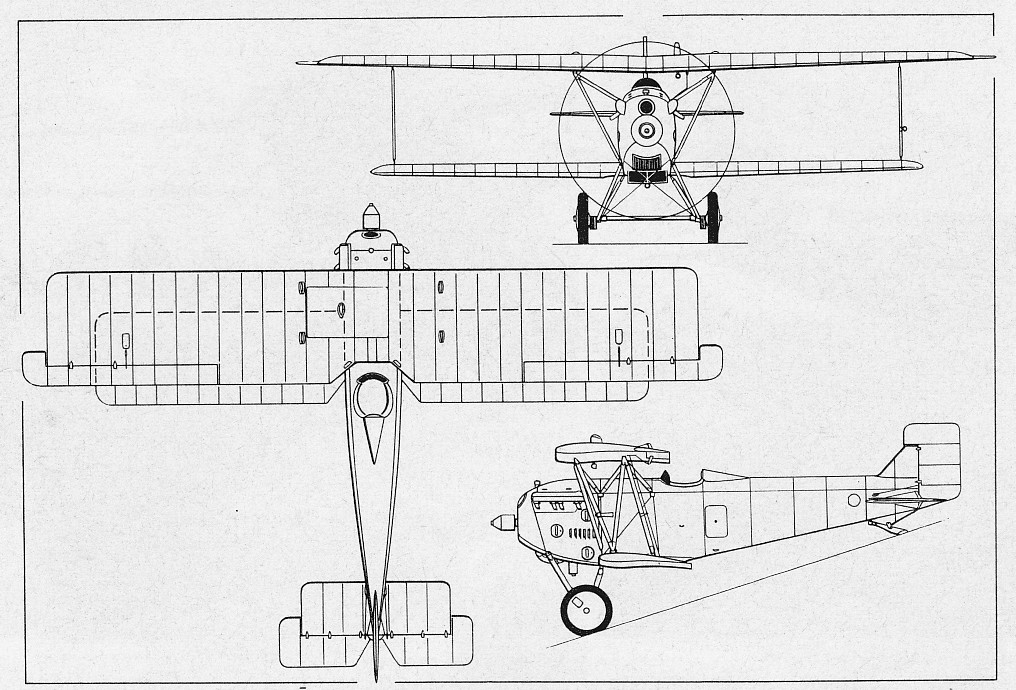
K+W MA-7 Militar-Apparat / Häfeli MA-7

The Militär-Apparat MA-7, also known as the Häfeli MA-7 and K & W MA-7, was a prototype fighter designed by August Häfeli in Switzerland. It flew in two different engine configurations, neither of which were deemed satisfactory and so the type did not enter series production. However, on 23 April 1926, test pilot Max Cartier did achieve a Swiss record for flying at an altitude of 9,800 metres (32,200 feet) above sea level.

Designed by August Häfeli in response to a Swiss Air Force requirement for an indigenous fighter design, the MA-7 was a biplane of fabric-covered wood construction with N-shaped wing struts like its predecessor the Fokker D.VI of 1918. Ailerons were installed only on the upper wing, which also contained an auxiliary gravity fuel tank. Power was provided by a 300 hp (220 kW) Hispano-Suiza 8Fb HS42 V-8 liquid-cooled engine manufactured in Switzerland under license. The aircraft was built by K & W in 1925 and handed over for trials in February 1926.

The prototype was returned to the manufacturer in April 1926 due to unsatisfactory flight characteristics and performance. K & W responded with the installation of an indigenous 400 hp (300 kW) LFW-12 X-1 engine. This, however, proved too large and heavy for the frame and entire MA-7 project was subsequently discontinued. The Swiss Air Force procured the French Dewoitine D.1 as their replacement fighter instead.

Powerplant: 1 × Hispano-Suiza 8Fb HS-42 V8, , 220 kW (300 hp)
Wingspan: 9.91 m (32 ft 6 in)
Wing area: 23.75 m2 (255.6 sq ft)
Length: 6.61 m (21 ft 8 in)
Height: 2.79 m (9 ft 2 in)
Empty weight: 843 kg (1,858 lb)
Gross weight: 1,213 kg (2,674 lb)
Maximum speed: 235 km/h (146 mph, 127 kn)
Cruise speed: 255 km/h (158 mph, 138 kn) (econ cruise)
Range: 300 km (190 mi, 160 nmi)
Service ceiling: 7,600 m (24,900 ft)
Rate of climb: 9.2 m/s (1,810 ft/min)
Crew: One

Kvasz II

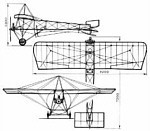
The second monoplane designed and built by Slovakian András (Andrej) Kvasz at a Budapest workshop.

First flown in August 1911 by Kvasz, powered by an Anzani 3W, 25 hp, later Anzani 3Y, 35 hp and Austro Daimler, 40 hp, 4-cyl.

On August 30, 1911, with this monoplane, Kvasz won the Sacellár prize. In November 1911 he organized public flights at Szarvas drawing 40,000 spectators. Kvasz, who worked as an engineer for Aladár Zsélyi in Wiener-Neustadt from 1909 on, started to build his own machines in 1911.

Span: 39’4″
Length: 24’7″
Weight: 750 lb

KAI Strekoza

The Strekoza (Three axis) was a single seat single engined high wing mono¬plane with three axis control circa 1983. Constant chord wing; conventional tail. Pitch control by elevator on tail; yaw control by fin mounted rudder; roll control by full span ailerons. Engine mounted at wing height driving tractor propeller.
The Strekoza is a com¬pletely original design from the students at the polytechnic of Kuibychev and in concept of a mini aeroplane. Using a conventional tail supported by a metal framework, the Strekoza carries slotted ailerons along the entire trailing edge of its constant chord high wing. The engine, an air cooled Wichr 25 developing 25 hp, is placed in a nacelle on the leading edge of the wing, connected to a two blade 43 inch (1.10 m) propeller.

Length overall 19.9 ft, 6.07 m.
Wing span 23.6 ft, 7.20 m.
Constant chord 3.6 ft, 1.10 m.
Total wing area 105 sq.ft, 9.80 sq.m.
Engine: Wichr 25, 25 hp.
Propeller diameter: 43 in, 1.10m.
Power per unit area 0.24hp/ sq.ft, 2.6hp/sq.m
Empty weight 331 lb, 150 kg.
Max take off weight 507 lb, 230kg.
Payload 176 lb, 804.
Max wing loading 4.831b/sq.ft, 23.5kg/sq.m
Max power loading: 20.31b/hp, 9.2kg/hp.
Max level speed: 62mph, 100kph.
Landing speed 28mph, 45 kph.
Stalling speed 31 mph, 50 kph.
Take¬off distance 660 ft, 200 m.
Landing distance 590 ft, 180 m.

Kuhnert Ferryboat

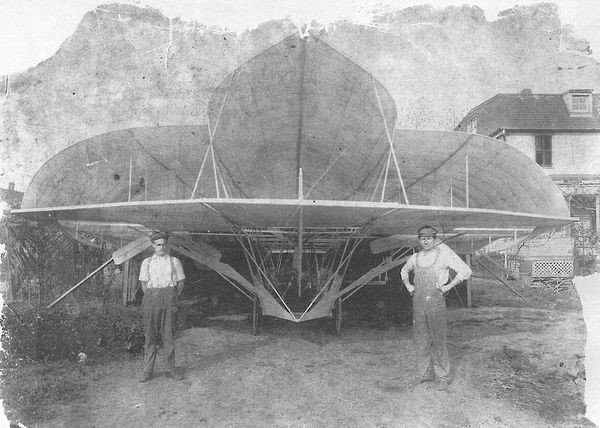
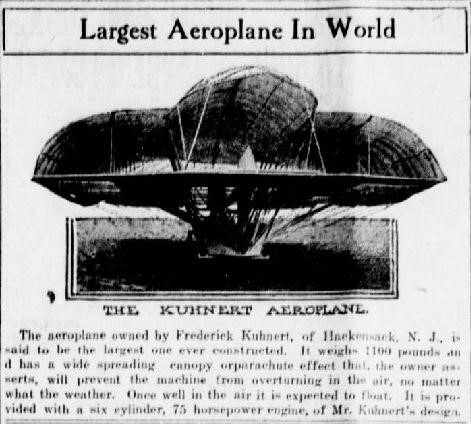
The creation of Frederick Kuhnert of New Jersey, and at the time was said to be to the largest aeroplane in the world, though no doubt it was just one of several claimants to that title. He established the Kuhnert Aerial Construction Company in order to “manufacture flying machines”. In 1910, Kuhnert bought 20 acres of land in the Hackensack Meadowlands to use as an aerodrome where he built a passenger airplane that could hold 14 people. Called Kuhnert’s Ferryboat, it, along with his aerodrome, was destroyed by a tornado in 1912 before it could make its first flight.

Engine: 75 hp

Kuffner WK-1

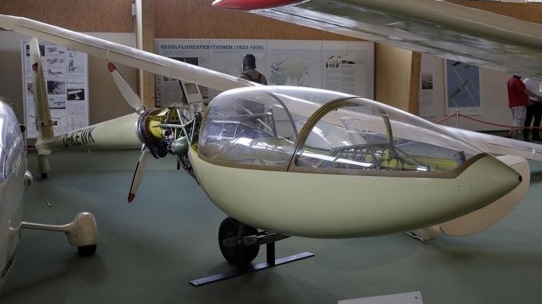
Built by Werner Kuffner (WK) as a one off in 1975, the WK-1 is a two seater motor glider with a BMW R90/S, 600cc 58 HP motor driving a foldable 3 blade prop that spins around the fuselage behind the cabin. The engine runs a toothed belt that spins a metal ring on which folding propeller blades are mounted.

It is in the Glider Museum Wasserkuppe.

Wing span: 18.80m
Empty weight: 430kg
Best glide ratio: 33.2
Seats: 2

Kudashev 1910 Biplane / Кудашев 1

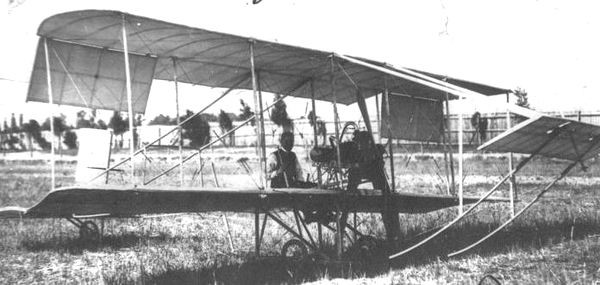
Kudashev’s biplane (Кудашев) Biplane of 1910, sometimes designated Кудашев 1, was, reportedly, the first aeroplane of Russian design flown. On May 23, 1910 it flew about half the length of a football pitch at a height of a couple of feet at Kiev. The flight was not advertised and went unnoticed by the general public. Kudashev was a civil engineer and associate professor at Kiev Polytechnics.

Span: 29’6″
Length: 32’10”
Weight loaded: 926 lb