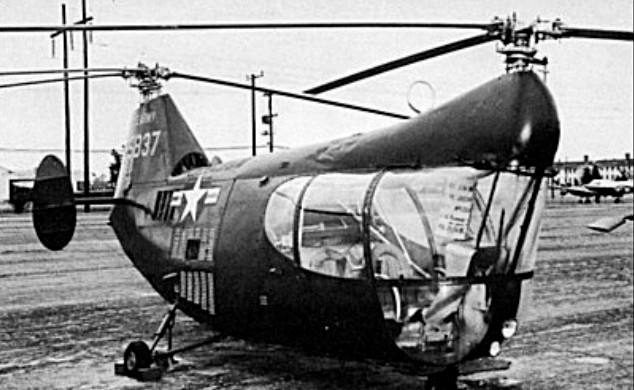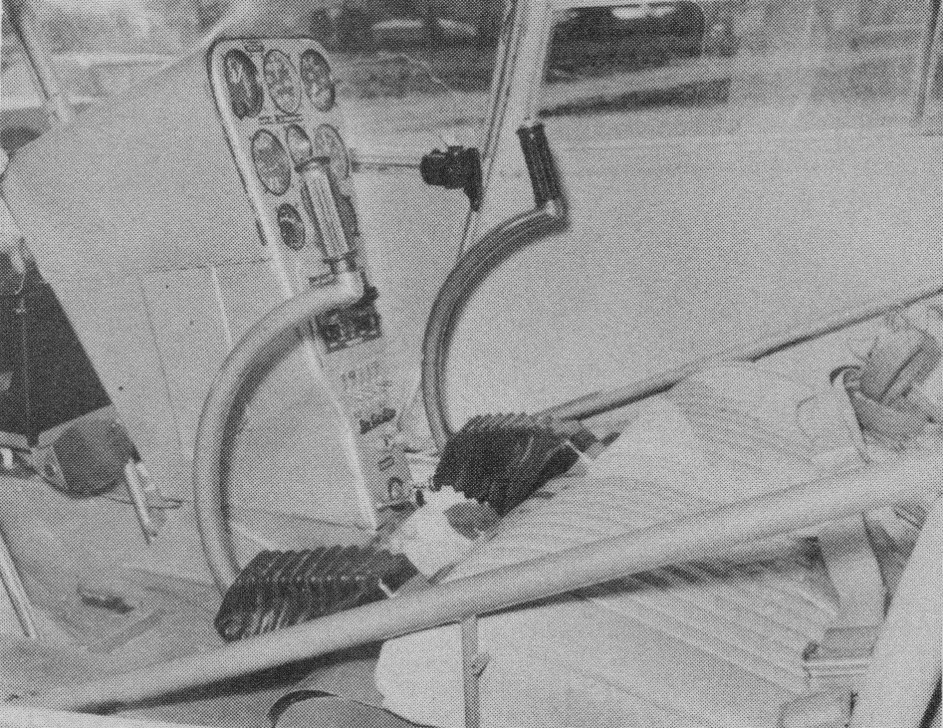
McDonnell XHJD-1 Whirlaway / Platt-LePage Aircraft PL-9

McDonnell Aircraft Co had invested in Platt-LePage Aircraft in mid-1942, in exchange for having McDonnell personnel learn helicopter design. In 1943 McDonnell authorized Constantine M. Zakhartchenko and a small group of engineers to undertake research on design and construction of rotors. He was appraised of Platt-LePage’s preliminary work on a twin-engined, twin-rotor helicopter to meet Army requirements. Although that PL-9 design eventually proved unsuccessful in the Army competition (the AAF selected the Kellet XR-10), it fared better in a different guise as McDonnell, in return for an increase in his investment as finalized in June 1944, obtained Platt-LePage’s agreement allowing the McDonnell Aircraft Corporation to initiate the parallel development of the twin-engined, twin-rotor concept.
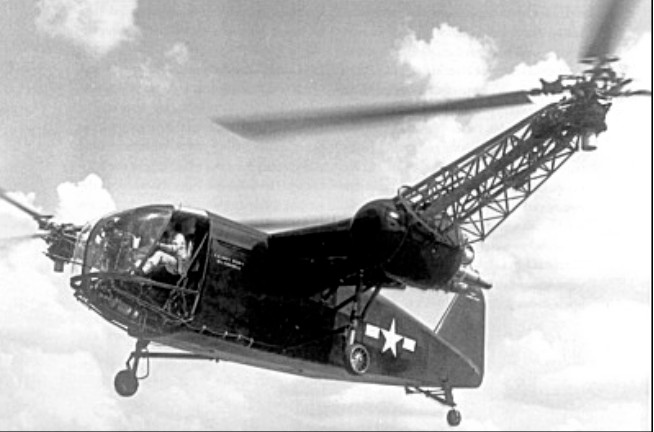
On the strength of both this agreement and the work accomplished by Zakhartchenko’s team, McDonnell proposed a helicopter of this design to the Navy to serve either as a testbed or as an anti-submarine warfare platform. As a testbed, the proposed Model 65 was intended to be used for the study of the effects of rotor diameter, disk loading, variations in rotor blade flap and lag angles, and other variables. In the ASW role, it was to be able to carry an adequate load of detection gear and weapons.

Considering the side-by-side rotor arrangement proposed by McDonnell to be a most suitable configuration for large helicopters capable of operating in the ASW role, the Bureau of Aeronautics issued a Letter of Intent on 15 May, 1944, covering the design, construction, and testing of one XHJD-1. This Letter of Intent was confirmed on 23 March, 1945, when Contract NOa(s)-3703 was awarded.

At the time of contract award, design of the Whirlaway, entrusted to a team led by Constantine Zakhartchenko, was well underway and ground testing was begun early in 1946. Piloted by Charles R. Wood Jr, the XHJD-1 made its first hover flight at Lambert Field, St Louis, on 27 April, 1946.

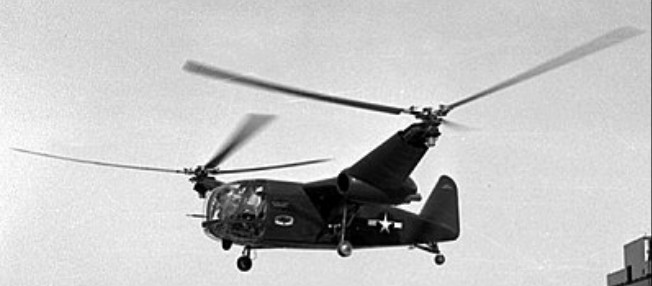
Designed to carry up to ten occupants but normally flown as a two-seater with up to 816kg of test instrumentation, the Whirlaway was fitted with twin side-by-side rotors mounted on pylons extending outboard of the engine nacelles. The nacelles, each housing a 450hp Pratt & Whitney R-985-AN-14B seven-cylinder radial engine, were attached to short wings which supported approximately 10 per cent of the gross weight during cruise and as much as 30 per cent of the weight in power-off autorotation, with consequent substantial improvement in overall performance efficiency. This feature, combined with the ability to transmit power from either engine to both rotors by transmissions and gear boxes, enabled the XHJH-1 to maintain level flight at full gross weight on the power of only one engine.

From April 1946 until June 1951, the XHJD-1 was used for numerous flying research tests including the evaluation of performance, stability balance and vibration characteristics peculiar to its twin-rotor configuration. In the process, the Whirlaway had its original 15.24-m diameter rotors replaced by rotors of varying diameters and had a braced tailplane with externally balanced control surfaces added before translation flights began. Once vibration and resonance problems with its unsynchromzed three-blade rotors were alleviated through the use of shock-absorbing rotor mounts, the XHJD-1 was considered to handle well and was flown some 250 hours without serious mishap. It was flown not only by McDonnell and Navy pilots but after being fitted with a rescue winch, was also evaluated in November 1949 by USAF pilots from the Arctic Rescue Helicopter Board.

As helicopter technology had made significant progress since development of the Whirlaway had been initiated, neither the XHJD-1 nor its proposed Model 65C development was put into production. Upon completion of its trials programme, the XHJD-1 – the first helicopter to bear the McDonnell name and the world’s first successful twin-engined, twin-rotor helicopter was donated to the National Air and Space Museum.

XHJD-1
Engine: 2 x Pratt & Whitney R-985-AN-14B Wasp Junior, 336kW / 450 hp
Rotor diameter: 14.02-15.24m depending on configuration
Overall span: 26.52m
Fuselage length: 9.8m
Height: 3.73m
Empty weight: 3629kg
Loaded weight: 4990kg
Rotor loading: 13.7-16.2kg/sq.m
Power loading: 5.5kg/hp
Maximum speed at 1525m: 193 kph
Cruising speed: 145km/h
Rate of climb: 6.6m/s
Absolute ceiling: 3930m
Range: 485km

McDonnell XP-67 Bat

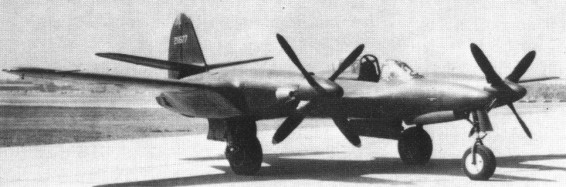
On 29 July 1941 the McDonnell Aircraft Corporation received a contract for two prototype of a long-range single-seat fighter designated XP-67. The design embodied several innovatory features, not least was an attempt to maintain true aerofoil sections throughout the entire fighter, the centre fuselage and thc rear portions of the engine nacelles merging to give the aircraft a unique appearance. The two 1,350 hp Continental XI-1430 12-cylinder inverted-vee engines were fitted with General Electric D-23 turbo-superchargers and featured exhaust thrust augmentation. The cabin was pressurised and proposed armament comprised six 37-mm M-4 cannon. The first XP-67 was flown on 6 January 1944, and flight trials continued until 6 September 1944, when the prototype suffered irreparable fire damage. This accident and the unsatisfactory nature of certain aspects of the fighter’s performance led to the decision to abandon the second prototype and terminate the development contract.

McDonnell XP-67 Bat Article

Engines: 2 x Continental XI-1430 12-cylinder inverted-vee engines with General Electric D-23 turbo-superchargers and exhaust thrust augmenta¬tion, 1,350 hp.
Max speed, 405 mph (652 km/h) at 25,000 ft (7 620 m)
Max climb, 2,600 ft/min (13,20 m/sec)
Max range, 2,385 sm (3 838 km)
Service ceiling: 11400 m / 37400 ft
Empty weight. 17,745 lb (8 049 kg)
Normal loaded weight, 22,11l4 lb (10 031 kg)
Span, 55 ft 0in (16,76m)
Length, 44 ft 9.25 in (13,65)
Height, 15 ft 9 in (4,80 m)
Wing area, 414 sq ft (38,46 sq.m)

McDonnell XP-67

McCulloch MC101 / MAC-101

The McCulloch MAC-101, also called the MC-101 and MC101, is a two-stroke, single cylinder engine that was designed and produced by McCulloch Motors Corporation for kart racing use, being introduced in 1967. It was also used in the late 1970s and early 1980s as an ultralight aircraft engine.

McCulloch MC101 / MAC-101 Article

All models in the MC-101 series have a bore of 2.280 in (5.791 cm), a stroke of 1.835 in (4.661 cm) and a displacement of 7.5 cu in (122.90 cc).

Variants:
MC-101
Introduced in 1967

MC-101A
Introduced in 1969

MC-101AA
Introduced in 1971

MC-101B
Introduced in 1974

MC-101C
Introduced in 1969

MC-101D
Introduced in 1971

MC-101M/C
Introduced in 1973

Applications:
AmEagle American Eaglet
Aviastroitel AC-4 Russia
Birdman TL-1
Eipper Quicksilver
Farner HF Colibri 1 SL
Hovey Whing Ding II
Skyhigh Skybaby
UFM Easy Riser

Specifications:

MC-101B
Type: single cylinder, two-stroke engine
Bore: 2.280 in (5.791 cm)
Stroke: 1.835 in (4.661 cm)
Displacement: 7.5 cu in (122.90 cc)
Fuel system: carburetor
Oil system: pre-mixed
Cooling system: air-cooled
Power output: 12.5 hp (9 kW) at 9000 rpm

McCulloch J-2

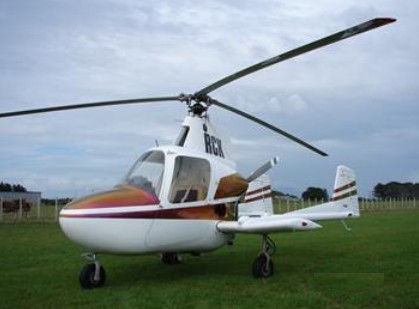
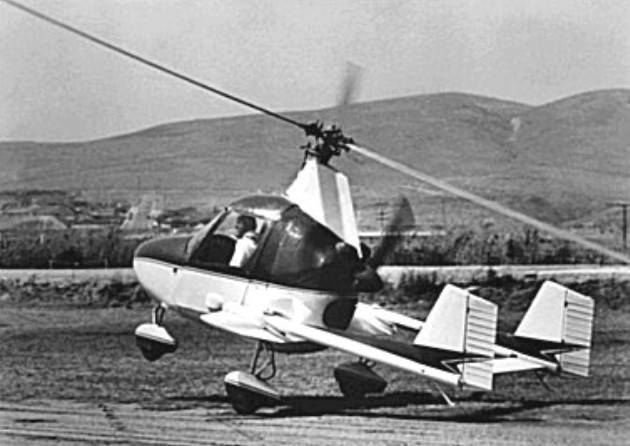
A two-seat light autogyro, the actual prototype J-2, designed by D.K.Jovanovich, first flew in June 1962. Deliveries of production aircraft began in 1970 and by early 1972 a total of 83 had been built. Power was provided by a 180hp Lycoming O-360-A2D engine.

In 1974 Aero Resources took over production of the J-2 two-seat light autogyro from McCulloch Aircraft Corporation. A version known as the Super J-2 was developed from the J-2, powered by a 180hp Lycoming O-360-A2D flat-four engine.

The J-2 has a Hughes 300 three-blade rotor system (wind-driven and inverted) and is powered by a 180 hp Lycoming pusher engine. This gyro is capable of a “jump” lift-off with the aid of its powerful pre-rotator.

Aero Resources Inc assumed responsibility in 1974 for continued production of the J-2 gyroplane, designed by D. K. Jovanovich, and manufactured previously by McCulloch Aircraft Corporation. It also developed an improved version, with 200 hp engine, designated Aero Resources Super J-2.

The J-2 is now classified as a Class 2 Microlight (it was a full C of A Aircraft) so can be flown on Microlight Gyroplane Licence.

Gallery

McCulloch J-2 Gyroplane
Engine: Lycoming 0-360 A2D 180 hp
Propeller: Hartzell 3 Blade Constant Speed
Rotor blades: 3
Seats: 2

Patrick Lewis
I am an ex US Army pilot and after a voluntary RIF in 1970 at the end of my second Vietnam tour emigrated to Australia. I worked for several helicopter companies there and was offered a position with Hawker de Havilland based at their Bankstown GA airport during the mid 1970s. HdH Had purchcased 8 J-2s and needed an experienced rotory wing instructor pilot for sales demonstrations and flight training. My first job was to draft a flight manual sylabus that satisfide The senior examiner. The first J-2 arrived with an instructor pilot who checked out HdHs test pilot who in turned checked me out. I then checked out the local rotory examinar who then signed me off as a qualified instructor. HdH mechanics outfitted a J2 with an extra fuel tank and I made sales demonstration trips from Melbourne in the south to the sheep stations in the Darwin area and on to the North west cattle stations.

Jeff Jacobs
In 1971 I was a young fixed-wing CFI working for Bel-Air Aviation at Long Beach CA, the first dealer and school for the J-2. I had no prior rotor experience but was being trained to fly and instruct in the J-2.
I had soloed the J-2 a few weeks earlier, and on 5/5/71 my boss and instructor Ken McGuire and I flew N4303G from Long Beach to Compton for more practice. We touched down in a light crosswind, and despite the slow speed I lost directional control and the aircraft rolled over on the runway. It was the third J-2 landing rollover accident in three months, which as I recall was almost half the fleet built to that time.
FAA ordered modification to the J-2’s nosegear, and that summer the company flew me out to the factory at Lake Havasu where I flew with Bill Evans in a modified J-2.

Bill Evans
I went to work for McCulloch Aircraft in 1969 and at the time the company was located in El Segundo,CA. At that time the J-2 was just undergoing it’s final FAA certification and later on the entire operation was moved to Lake Havasu City, AZ. I was there for two years until they moved back to Gardena,CA and it then became Aero Resources. During my time in LHC I was doing the Flight Training and later became an FAA designated pilot examiner for Gyroplanes. I also was doing Production Flight Test and Experimental flight test for the company. I stayed on with the company until 1974 when they finally closed their doors. This was at the Van Nuy, CA airport.
I think my total time in the J-2 was around 2200 hours. I flew the J-2 at the Paris Air Show and all over France. Also crossed the English Channel and did some flying in England as well. All and all it was a really fun aircraft to fly but had so many limitations when it came to performace. One of the biggest problems was the noise it produced. This really plagued the engineering department and nothing seemed to help. We had to wear special David Clark headsets and still the noise level in the cockpit was deafening. We did experiment with a 200 HP Lycoming engine and also a 3 bladed constant speed Hartzell prop. These improvement helped a little but in the end, it still did not have the desired performance. It had a very limited range with a lot of unuseable fuel left. The required distance for takeoffs was far more than acceptable. We were able to land in off airport locations but with the wood props it was usually an invitation to some major damage. The landing gear struts would some times remain extended or be uneven and this will make landing sometimes very exciting if you didn’t expect it.
We did develop several techniques that would enhance both the take and landing performance but was never able to get them certified.

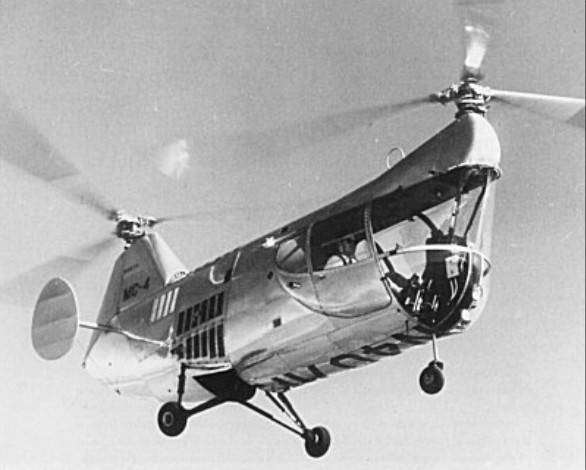
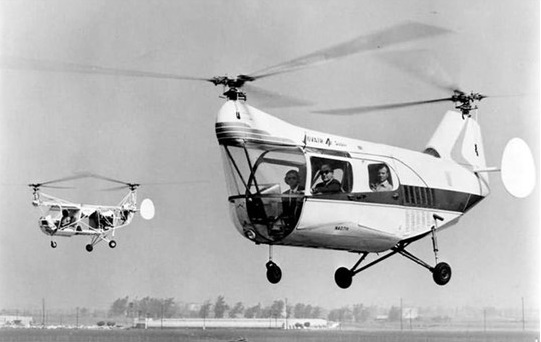
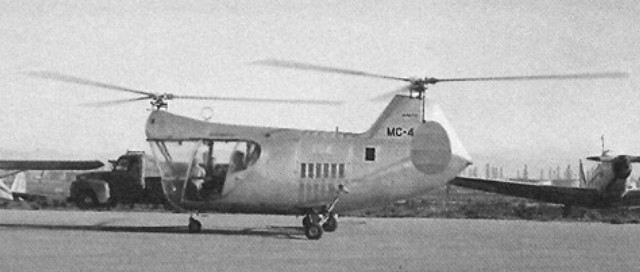
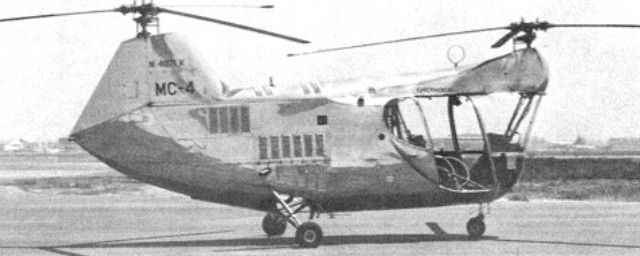
McCulloch MC-4 / YH-30 / HUM-1 / Jovair Sedan 4A / Sedan 4E

MC-4

In 1949 Helicopter Division of McCulloch Motors Corporation appointed as chief designer D. K. Jovanovich, formerly of Helicopter Engineering and Research Corporation, who developed his JOV-3 as McCulloch MC-4 tandem rotor two-seat helicopter, first flown Los Angeles March 20, 1951.

This was the first tandem-rotor helicopter to be certificated by the U.S. Civil Aeronautics Administration for commercial use, and is also one of the smallest helicopters to be built with a tandem layout. Its development began in 1946 with the Helicopter Engineering and Research Corporation headed by D.K. Jovanovich and F. Kozloski, where a small 2-seat prototype (N9000H) was built with the designation JOV-3. This aircraft, powered by a 125hp Lycoming O-290, was flown successfully in 1948.

Jovanovich and Kozloski transferred in 1949 to the newly-formed helicopter division of the McCulloch Motors Corporation, where an enlarged development of the JOV-3 was built as the MC-4 with 6.71m rotors and a 165hp Franklin 6V4-165-832 engine. The main drive shaft is driven through a 12-unit vee-belt system. This prototype (N4070K) flew for the first time on March 20, 1951 at Los Angeles, and soon afterwards McCulloch began the construction of a prototype MC-4C (N4071K) and three generally similar YH-30’s (52-5837 to ’39) for evaluation by the U.S. Army. These were slightly larger than the MC-4, having 200hp Franklins and egg-shaped tail fins mounted on outriggers below the rear rotor head. The YH-30’s trials programme yielded no military orders, and no civilian customers were immediately forthcoming for the MC-4C, which was certificated by the CAA on 17 February 1953.

Jovanovich and Kozloski left McCulloch when the Airplane Division was closed, and formed Jovair Corp in 1957 to continue their work on helicopters. They resumed the design rights and purchased one of the MC-4A’s (N4071K) which had been produced for evaluation by the USN (as the HUM-1).

Four-seat 4E Sedan with the 1962-built Jovair 4A, a stripped-down two-seat agricultural and training aircraft

Jovair modified the MC-4C as a prototype for a four-seat private helicopter designated the Sedan 4E. The Sedan 4E was powered by 210 hp Franklin 6A-335 engine and received certification in March 1963. A version with a turbocharged engine was designed as the Sedan 4ES and a more basic Sedan 4A for agricultural use. By 1965 a small number of Sedan helicopters were built. In 1969 McCulloch regained the rights to the helicopter designs who continued development of the Jovair 4E Sedan as the McCulloch MC-4E.

The design was offered to the U.S. Army as the XH-30 (MC-4C, serials 52-5837 through -5839) and to the Navy as the XHUM-1 (MC-4A) by McCulloch Motors Corporation. Three were built for the Army and two for the Navy in 1953. Neither service had a use for them and they were returned to McCulloch.

The YH-30 was a craft of relatively simple construction, consisting of a steel tube framework to which was attached a light metal skin. The helicopter’s single 200hp Franklin engine was mounted horizontally amidships and drove the two inter-meshing tandem rotors through a single horizontal drive shaft and two right-angled reduction units. Two small endplate rudders were fixed to the rear fuselage to provide additional lateral stability, and the aircraft was equipped with wheeled tricycle landing gear. The craft’s two crew members enjoyed better than average visibility to the front and sides, though the view upward was blocked by the overhanging front rotor housing.

The Army’s evaluation of the YH-30 showed the helicopter to be somewhat underpowered and its drive system to be overly complex. The type was therefore not procured in quantity, and the three evaluation machines were declared surplus in mid-1953 and disposed of.

McCulloch MC-4

An MC-4C was used in the 1954 science fiction production Gog.

The civil version, the slightly larger MC-4, was unable to generate any sales and McCulloch lost interest in the project and turned it back over to the original designer D. K. Jovanovich.

Jovair Corporation produced N4071K in developed form as the prototype for a new 4-seat private or executive helicopter known as the Sedan 4E. The Franklin 6A-335 of 210hp was now installed and the fuselage offered comfortable accommodation and easy 4-door access to 3 passengers in addition to the pilot. A supercharged version, the Sedan 4ES, was offered with a 225hp Franklin 6AS-335. The Sedan 4E received type approval from the FAA in March 1963, and some two years later small-scale production of this version was begun; a version, with a 235hp 6A-350 engine, is slightly heavier. In mid-1963 Jovair offered the stripped-fuselage Sedan 4A as an agricultural, training or utility cargo version, with provision for some 450kg of cargo or crop spraying equipment in place of the rear passenger compartment.

Jovair Sedan
Jovair 4E

The Jovair E4 features independently removable components for ease of maintenance, including heavy-duty vibrationless control system, interchangeable rotor balades and ground resonanceless design. Landing gear is fixed type tri-gear. The Jovair Sedan has skinned, steel tube fuselage structure. Rotor blades are all metal using bonded, wrap-around skin construction, factory balanced. A hinged type rotor system is utilised. Vibrationless flexible Vee-belt drive transmits power to the shafts and gears (2 sets of bevel gears used) and one-size flex-spline type coupling replaces universal joints.

In 2008 two MC-4Cs were still registered in the United States. The Pima Air and Space Museum has a HUM-1, registration N4072K (Serial Number: 133817). The Yanks American Air Museum at Chino are restoring a MC-4C to flying condition although they have no plans to fly it. It may be N4071K or N4091K. One of the three YH-30 miitary prototypes is preserved by the US Army Aviation Museum at Fort Rucker, Alabama. It is c/n 001 and has the military serial 52-5837. As of April 2013 it remains in a storage building and is not on public display.

Variants:
McCulloch MC-4
Prototype with a 165 hp Franklin engine, two built, one for evaluation by the United States Navy.

McCulloch MC-4A
Variant for evaluation by the United States Navy as the XHUM-1, two built.

McCulloch MC-4C
Prototype with a 200 hp Franklin engine, one built and an additional three for United States Army evaluation as the YH-30.

Jovair Sedan 4E
Production civil four-seat version powered by a 210 hp Franklin 6A-335 engine.

Jovair Sedan 4ES
Sedan with a turbocharged 225 hp Franklin engine.

Jovair Sedan 4A
Simplified agricultural version.

YH-30
Military version of the MC-4C, three built.

XHUM-1
Two MC-4As for evaluation by the United States Navy, later redesignated HUM-1.

Jim Trego 02.09.2011
I was one of the engineers on the project. There were only 23 people on the project including engineers, welders, mechanics and a test pilot. A real fun project that didn’t go anywhere because the Korean war ended and so did the market for helicopters.

Gallery

MC-4
Engine: 1 x Franklin 6A4-200-C6, 149kW / 200 hp
Rotors: 2 x 3-blade tandem inter-meshing
Rotor diameter: 7.01m / 23 ft
Fuselage length: 9.88m
Height: 2.77m
Max take-off weight: 1043kg / 2,300 lb
Empty weight: 726kg
Max speed: 169km/h / 120 mph
Cruising speed: 137km/h
Ceiling: 3048m / 10,000 ft
Range: 322km / 200 miles at 85 mph with full load
Crew: 2

HUM-1
Engines: 1 Franklin 6A4-200-C6 200 hp
Rotor diameter: 23 ft
Length: 32 ft 5 in
Height: 9 ft 3 in
Weight: 2,300 lbs
Max. Speed: 105 mph
Service Ceiling: 8,000 ft
Range: 200 miles
Crew: 2

YH-30
Powerplant: 1 × Franklin O-335-6 (6A4-200-C6), 200 hp (147.1 kW)
Crew: two
Length: 32 ft 0 in
Main rotor diameter: 2× 22 ft 0 in
Height: 9 ft 2 in
Empty weight: 1200 lb (544 kg)
Gross weight: 2000 lb (907 kg)
Maximum speed: 105 mph (168.98 km/h)
Range: 200 miles (321.86 km)

Jovair 4E
Rotor blade diameter: 23 ft
Rotor blades chord: 6.76in
Overall width: 18 ft
Height: 9 ft
Overall length: 33 ft 2 in
Fuselage length: 18 ft
Empty weight: 1463 lb
Useful load: 837 lb
Gross weight: 2300 lb
Cruise speed: 90+ mph
Endurance: 2 hr
Service ceiling: 12,500 ft
Hover ceiling IGE: 6000 ft
Hover ceiling OGE: 3000 ft
Undercarriage tread: 6 ft 6.75 in
Undercarriage track: 7 ft
Basic price: $48,500

McCormick – Romme Umbrella Plane

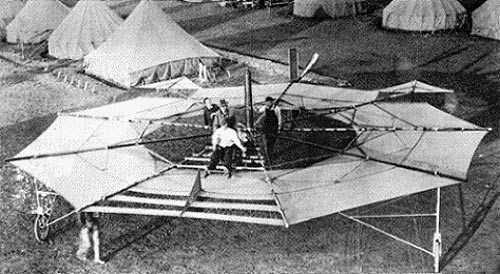
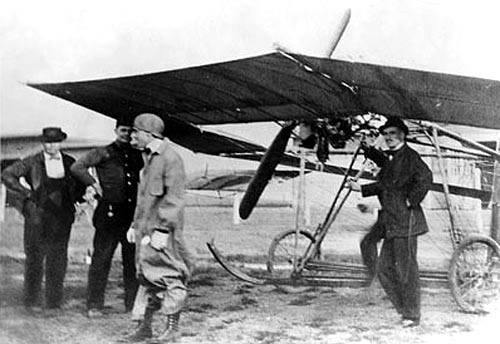
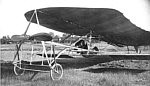
Harold F. McCormick, of the harvesting machine manufacturing business, and millionaire, John D. Rockfeller, Jr. decided, about September 1910, to support the aircraft design ideas of, a New York inventor, William S. Romme. In 1910 Romme had won a design contests first prize, for length of flight, stability and originality, with an unusual circular-shaped model monoplane. It was this model that Romme hoped to develop into a full-scale airplane and override the Wright patents on the airplane. McCormick and Rockfeller formed a corporation to exploit the Romme designs.

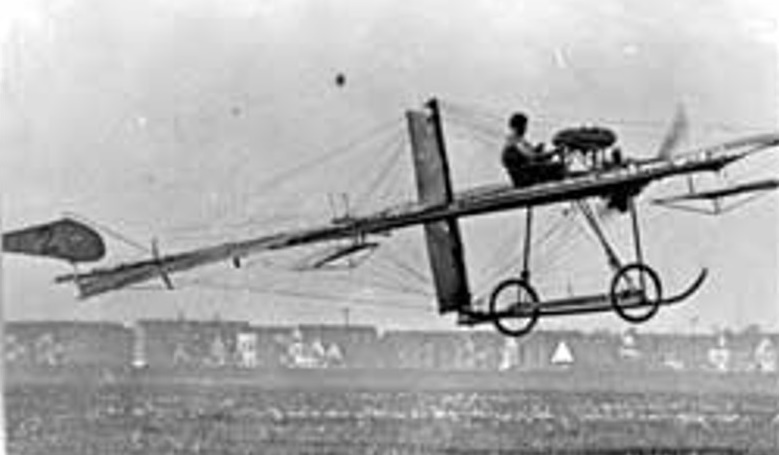
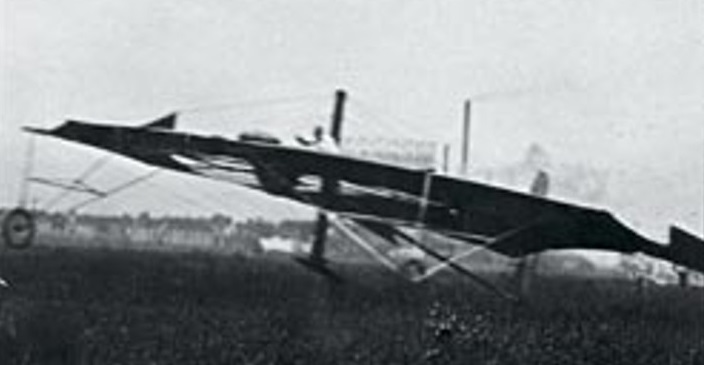
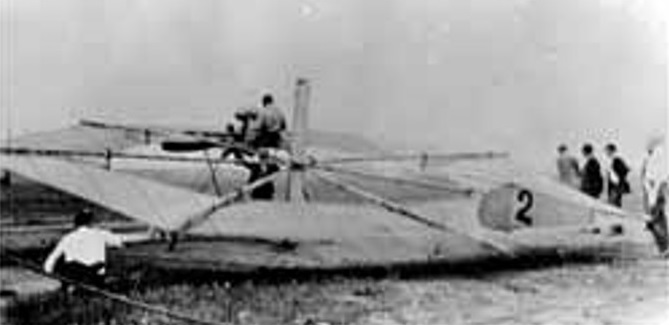
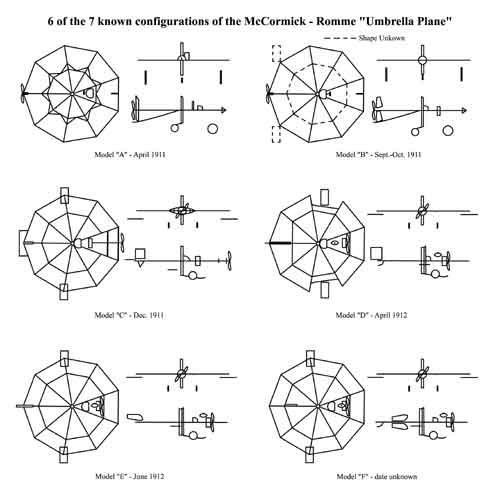
Because of shortcomings of the Wright machine, and the patents controlled by the Wright Brothers forced other designers to use radically different designs. One of these pioneer machines was the McCormick – Romme Cycloplane of 1911 with its spoked-wheel platform, stalky undercarriage, unprotected pilot at the center, and the propeller driven by long shaft from the centrally mounted engine. Like most early airplanes of these times, constant changes were made to correct problems. At least seven different configurations of the Cycloplane are known.

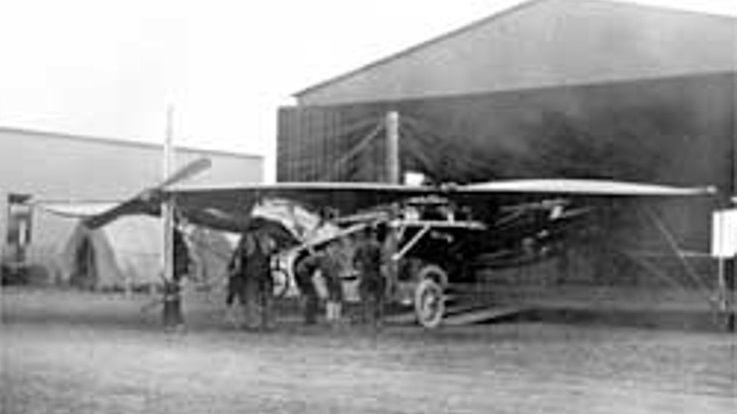
With McCormick’s financial backing work continued at Mineola, Long Island. The first monoplane was wrecked by wind in November 1910. Plans were immediately made to rebuild the plane in the south. In April 1911 a monoplane built in Belmont, New York and given some preliminary testing was now in San Antonio, Texas. While running the plane over the ground, it struck a rut, was turned over by the wind and badly damaged. Romme escaped without injury. Besides the McCormick – Romme contingent other civilians using the San Antonio flying area near Fort Sam Houston were the Max Lillie flying school from Chicago. Lillie’s mechanic and the McCormick – Romme group with the help of some soldiers, set the plane on a two-wheeled cart and returned it to its hangar. After this fiasco, little further progress seems to have been made, probably because of the wait for the Gnome engine. Meanwhile the Aero Club of Illinois completed a new 180-acre flying field at Cicero, just west of Chicago. The completion of this field and its facilities were all that was necessary for McCormick to move his experimental work to Chicago. It was here that the McCormick – Romme machine was referred to as the “Umbrella Airplane” in the Aero Magazine. While the monoplane had been reported as McCormick’s design, he recognized the need for skilled engineers and mechanics to convert his and Romme’s ideas into a practical airplane. He hired a young graduate of the Armour Institute, Sidney V. James. While he participated to some degree in all of the McCormick projects, he concentrated on the Mustard Plaster airplane concept, and specialized in propeller design and wrote extensively on the subject.

At the same time McCormick hired another engineer, fresh from the University of Pennsylvania, Chance Milton Vought. He guided the development of the Umbrella Plane through most of its entire career.

When the Cicero Flying field was officially opened on July 4, 1911, besides the McCormick monoplane (The Mustard Plaster) and the McCormick – Romme Umbrella Plane, eleven other airplanes were located here. By July 15, 1911, the two McCormick airplanes had their 50H.P. Gnome engines installed. On August 23,1911, Romme made the first successful flight in the Umbrella Plane, reaching a height of 15 feet. Between the Texas accident and the July flight the Umbrella Plane was rebuilt. While the appearance was not significantly changed the modifications were very important, control wise. Movable control surfaces were installed on each side at the rear of the circular wing, rudders with greater cord replaced the two tall narrow rudders, and the triangular center projections on the wing were removed. The pilot now sat with his back against the center post and his feet straddling the cylindrical cowling surrounding the Gnome engine.

Experimentation continued until the fall of 1911, sometimes successfully. Problems continued with the Umbrella Plane. Exactly what Chance Vought’s contribution was, is hard to define but he was the principal engineering talent behind the work, with help from several skilled mechanics in McCormick’s organization.
In early 1912, the propeller was attached directly to the Gnome engine eliminating the long drive shaft, ribs were installed in some of the wing surfaces,ailerons were moved forward, the rudder was moved further aft, and the separate elevator was eliminated and replaced by warping the wing trailing edge. In April 1912, Andre Ruez, McCormick’s test pilot allowed the Gnome engine to reach full power and as the speed increased, lifted the plane off the ground in a short hop strait ahead. During the next few days Ruel climbed higher and made longer flights until he reached a height of 30 feet after scores of flights. Several minor changes were made and flights continued in 1912. The last change moved the rudder forward to a position behind the center post with an inverted duplicate on the same shaft below the plane. In March 1913, Max Lillie made several circuits of the Cicero field, in the Umbrella Plane, which attracted an immense interest of the spectators.

What eventually happened to the plane is unknown, but it was discarded in 1913. Vought, in an early 1913-newspaper interview, stated the umbrella plane was a “freak”, left the McCormick company and joined the Lillie organization.

McLeod Terrafly

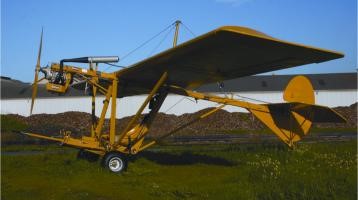
Designed to capture the spirit of the Santos Dumont Demoiselle, in developing this aircraft over 19 years, designer Kevin McLeod set out to produce a simple, rugged ‘back to basics’ machine that he hoped would be fun to fly.

The Terrafly is an original design ultralight aircraft built under the provisions of Australian ANO 95-10. Work started on the project in 1984.

The Terrafly is a single engine, high-wing, tail-dragging monoplane with conventional three axis controls. As with the Demoiselle, the pilot sits under the wing with the propeller wash in his face. The open cockpit has an airspeed indicator, altimeter, a dual CHT/EGT gauge, compass, clock, a G-meter, a Hobbs Hour Meter and fuel sight gauge.

The only example of the Terrafly built, registered 10-0571, was not test-flown and so information on its performance has never been established. The aircraft was donated to the South Australia Aviation Museum in October 2006 by the owner/designer.

Engine: Rotax 377 35 hp
Cruising Speed: 55 kt (100 kph) estimated
Maximum take-off weight: 225 kg
Length: 5.54 m
Wingspan: 7.62 m
Height: 2.6 m
Capacity: 1 pilot