
McCarter Meadowlark
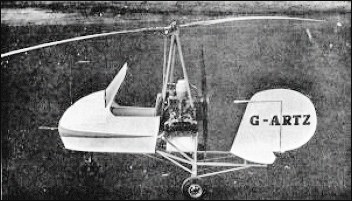
The McCandless M4 was a British single-seater ultra-light autogyro first flown in 1961. The original McCandless M4, developed by Rex and Cromie McCandless, was powered by a Triumph motor-cycle engine, this was later briefly replaced by a Norton motor-cycle engine which was abandoned in favour of a Volkswagen flat-four four-cylinder horizontally-opposed air-cooled engine which could be connected to the propeller without gears.
W. H. Ekin (Engineering) Company Ltd was formed at Crumlin, Co. Antrim, Northern Ireland, March 1969 to undertake production of six McCandless gyroplanes. The first one flew in February 1972. Extensive redesign was then undertaken and new prototype flew February 1973. Modified type called WHE Airbuggy.
There were two prototypes, one M1 and one M4 at the Ulster Folk and Transport Museum.
One flying VW engine-driven M4 type had the registration EI-ASR.
In total there were 8 built.
Cruising speed: 130km/h.
A single-seat gyroplane built in 1962.
There were two prototypes, one M1 and one M4 at the Ulster Folk and Transport Museum
The Mazoyer 1909 monoplane was designed and built by Marius Mazoyer in France.
Wing area: 28 sq.yd
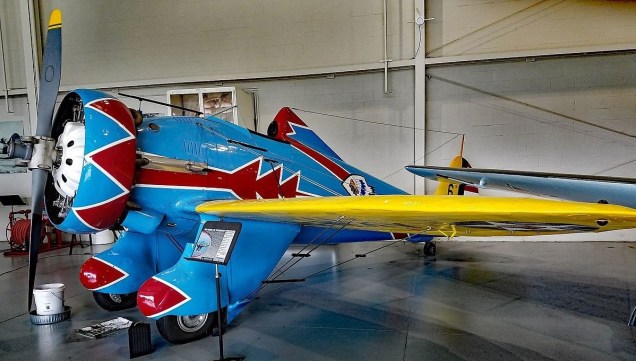
Mayocraft Inc completed construction and flight-testing of its P-26D, a near-100 percent scale tribute to the Boeing P-26 aircraft. Although not an exact replica, the aircraft is generally patterned after the famed Boeing P-26 “Peashooter”.
Mayocraft tried to be faithful not only to the overall appearance of the P-26, but also to most of the fabrication methods at the time of its manufacture. The aircraft’s all-metal skin has been hand formed and shaped in many complex compound curves by Mayo in his shop, which is in essence a small aircraft factory with tools, technology and expertise straight out of the mid-1930’s. The craft has over 29,000 3 AD rivets, inserted, driven and made flush with the skin. The craft has other parts, most of which had to be machined and fabricated from raw metal or cleverly adapted from existing aircraft parts.
Nathan Mayo devised fabrication methods like pressing into hard rubber and pull-forming sheet metal, whose results mimic those from the much larger production machines that would have been found in a 1930s-era aircraft factory.
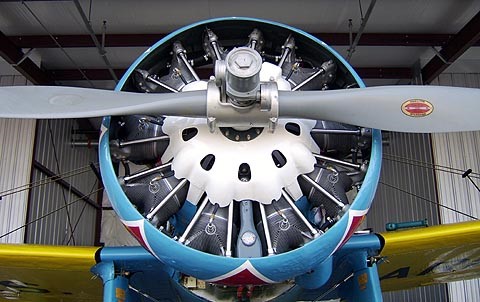
For safety and performance’s sake selected improvements were made. Alclad 2024-T3 aluminum was used throughout instead of the Dural of the 1930’s because the modern alloy is 20 percent stronger. The main landing gear wheels and brakes are adapted from a Cessna T-50. The engine exhaust is made from a stainless steel alloy specially formulated for aerospace applications. For a few non-structural elements, in place of metal they formed fiberglass. The engine and propeller are the same as employed in the T-6.
Mayo adapted a different airfoil shape to the wing that should make the bird a little easier to fly and land than the original. Mayo calculated that, because of these improvements and the fact that the Peashooter does not have the armament that was originally needed in the combat airplane, “it has a performance about 10 percent better than the original.”
The shock struts are Bendix from a Cessna UC-78 and brakes are Cleveland, 4 disk, hydraulic with an AT-6 master cylinder.
The main tires are 7.50 x 10, tail tire – 12.5 – P51 channel tread, and the tail wheel has detent & positive lock.
The paint scheme design was from the 1st. Pursuit Group, 94th. Squadron, Selfried Field, Michigan, circa 1935-1936, done with DuPont Imron paint.
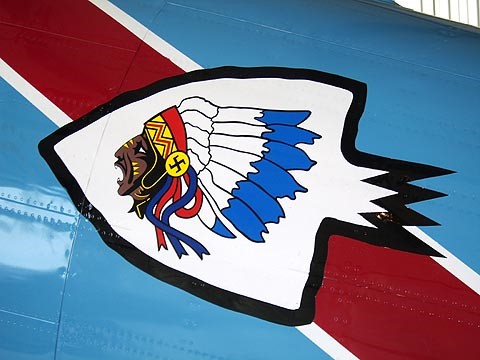
Registered NX26PX, taxi testing commenced in September, 2006. Flight testing was completed in 2009.
The Mayocraft P-26D is now on display at the Military Aviation Museum in Virginia Beach, Virginia.
Mayocraft P26D Peashooter
Scale: Near 100 percent
Engine: Pratt & Whitney R-1340-AN1
Prop: Hamilton Standard 12D-40 with 6101-12 Blades
Airfoil: E-193 (UIUB)
Fuel capacities:
Main fuselage tank: 57 gal.
Each wing tank: 23 gal.
Oil capacity: 9 gal.
Anticipated Performance
Cruise speed: greater than 210 MPH
Max. initial rate of climb: more than 2500 fpm.
Max. speed (VNE): 315 MPH
Landing speed: 73 MPH with flaps
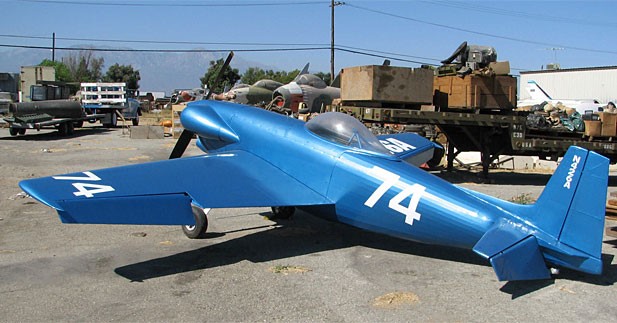
The Mr. D Midget Racer designed and built by Robert Mayer of Michigan, race number 74 was raced by pilot Hank Orlowski in 1951 at the Detroit Air Races. It qualified at a speed of 160 mph.
The aircraft was later raced at Wallingford, Ct., and took 4th place in the Formula One race. Following this, the airplane was retired.
Mr D’s short racing career spanned the years 1951- 1953.
This original Midget Racer was donated to the Planes of Fame Air Museum and was restored by Museum volunteers in 2004- 2005.
Engine: Continental C-85, 85 hp
Span: 19 ft. 0 in
Length: 14 ft. 9 in
Crew: 1
The Maybach Mb.IV, originally designated Maybach HS, (only related to the Mb IVa by layout and size), was a six cylinder in-line, water cooled, piston engine, originally developed for use in airships, it was also used for large aircraft such as the Dornier Rs.I giant seaplane. Variants of the original HS engine included the Maybach HS D and Maybach HS Lu
MbIVa’s featured six over-sized cylinders, a compression ratio of 6.7/1 and a dry weight of about 860lb. (in the 1918 version with aluminum pistons.) There was a floatless carburetor at each end of the engine (working with a ball-and-sump setup) and the engine was hand-cranked, with compression reliefs on the cylinders magneto starting and hand-powered suction primer. Designed for high-altitude flying, they could not be run a full throttle below 6000 feet. Rugged, reliable power plants, they could run out about 2000 hours between overhaul.
Variants:
Maybach HS
Company designation
Maybach HS D
A variant of the HS
Maybach HS Lu
A high compression high altitude rated variant.
Power: 240-hp
Mb.IV
The Idflieg designation for production HS engines.
Applications:
Dornier Rs.I
LVG G.III
Siemens-Schuckert L.I

In 1908 the then 20 year old Max Schüler built a biplane (‘Drachenflieger’) in Chemnitz – Germany. The machine was a big pusher biplane having characteristics of both the Voisin and Wright machines. According to Lange it was destroyed when trying to take off during its first flight.

Max Schüler had built a monoplane in Chemnitz, Germany, and designed a motor. He began the construction of a double-decker here but failed. Max Schüler came to Johannisthal in 1909, set up an aircraft construction workshop.
After this failure, he wanted to try again with a monoplane, but had no more money. He sought support and found it with Wolfgang Harlan. This funded with a repayment date and agreed to surrender the aircraft in the event of non-regular repayment instead of money. Whatever happened Schiller’s workshop was the first in Johannisthal which had to give up because of lack of money.
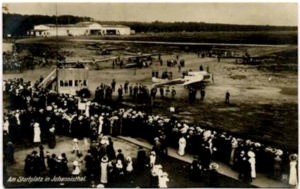
In 1910 the ‘Aeroplan’ monoplane was built by chemist Max Schuler.

