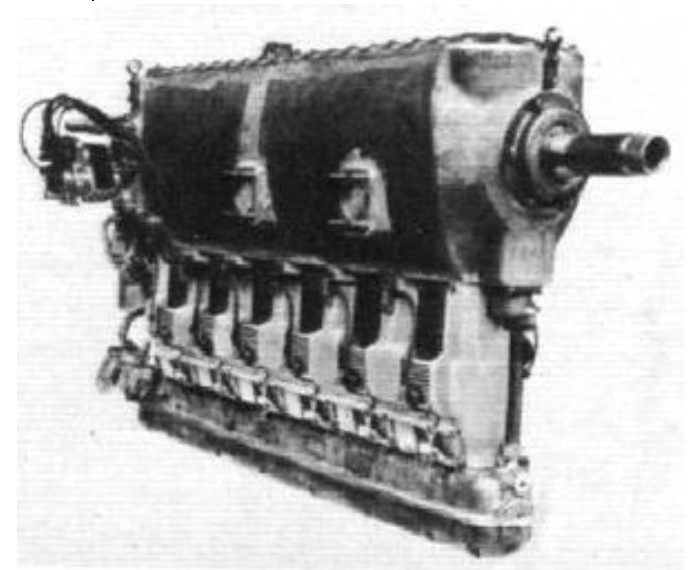
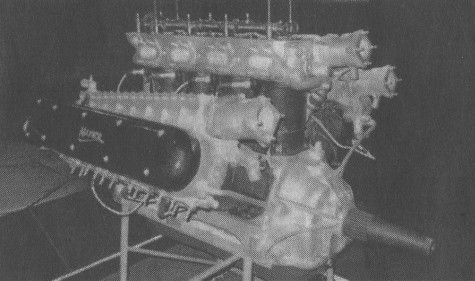
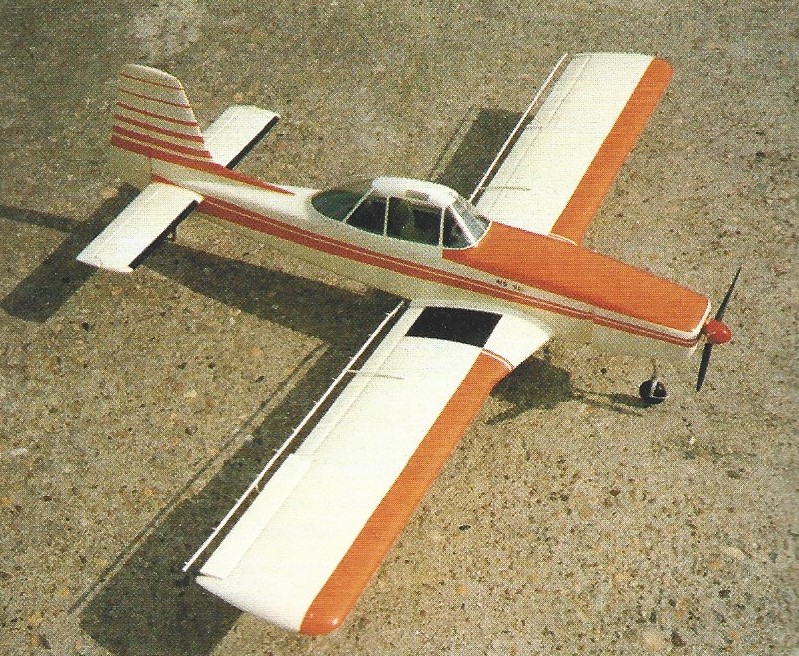
The Napier Javelin was a British six-cylinder air-cooled aero engine designed by Frank Halford and built by Napier & Son. The six cylinders were arranged inverted and inline. Unlike the similar, the poppet valves operated by a single gear driven overhead camshaft.
First run in 1932 and flown in March 1934 in the prototype of the Percival Mew Gull racing aircraft, the engine was also used in the Spartan Arrow biplane and the Percival Gull.
Variants: Javelin I Initial version producing 150 hp.
Javelin III A longer stroke and increased capacity version of 160 hp.
Javelin IIIA A Mark III with a starter motor, generator and other improvements for the Martin Baker MB.1.
Specifications: Javelin I Type: 6-cylinder inverted inline air-cooled engine. Bore: 4.5 in (114.3 mm) Stroke: 5.25 in (133.35 mm) Displacement: 501 cu in (8.21 lt) Length: 58.5 in (1486 mm) Width: 26 in (660.4 mm) Height: 31.5 in (800 mm) Dry weight: 410 lb (186 kg) Valvetrain: Overhead cam poppet-valves Fuel system: Twin updraught carburettors Fuel type: Petrol Cooling system: Air-cooled Reduction gear: Direct drive, left hand tractor Power output: 150 hp (112 kW) at 2,000 rpm Compression ratio: 5.3:1
The Junkers Jumo Fo3 and 204 were licensed to Napier & Son, who built a small number as the Napier Culverin just prior to the war. Late in the war, they mounted three Culverins in a triangle layout to produce the Napier Deltic, which was for some time one of the most powerful and compact diesel engines in the world.
In the early years of jet development, during WWII, it became clear that the jet’s fuel efficiency was well below that of the reciprocating engine. The low continuous temperature tolerated by the combustion chambers, under 1200°K, was to blame. Piston engines tolerate a peak combustion temperature of some 4800°K, because this high temperature is sustained only for one or two milliseconds. The thermodynamic efficiency of an ideal engine is given simply by 100(1-Te/Tp) in percent, where Te is the exhaust temperature in Kelvin, and Tp is the peak combustion temperature. Thus, a jet could easily triple its fuel efficiency by using a diesel engine to inject the kerosene fuel and combust the fuel/air mixture. The best gasoline fuel (130 avgas) at the time was unsuitable as it tolerated a maximum compression ratio of about 10:1, whereas ordinary diesel engines could attain 18:1, and 22:1 with Ricardo indirect combustion chambers.
In 1945 the Air Ministry asked for proposals for a new 6,000 horsepower (4,500 kW) class engine with good fuel economy. Curtiss-Wright was designing an engine of this sort of power known as the turbo-compound engine, but Sir Harry Ricardo, one of Britain’s great engine designers, suggested that the most economical combination would be a similar design using a diesel two-stroke in place of the Curtiss’s petrol engine.
Before World War II Napier had licensed the Junkers Jumo 204 diesel design to set up production in the UK as the Napier Culverin, but the onset of the war made the Sabre all-important and work on the Culverin was stopped. In response to the Air Ministry’s 1945 requirements Napier dusted off this work, combining two enlarged Culverins into an H-block similar to the Sabre, resulting in a 75 litre design. Markets for an engine of this size seemed limited, however, so instead they reverted to the original Sabre-like horizontally opposed 12 cylinder design, and the result was the Nomad.
The objective of the design was to produce a civilian power plant with far superior fuel efficiency to the emerging jet engine. Thermal efficiency is given by 1-(Tx/Tp), where Tx is the exhaust temperature (any absolute scale) and Tp is the peak combustion temperature. Jet engines have relatively low-temperature combustion systems which produce a Tp of no more than about 1000 kelvin, much less than the typical 5000 kelvin of a reciprocating engine, and so jets have very poor thermal efficiency. The Nomad design focused on replacing the low temperature combustion chambers of the jet engine with highly efficient Diesel combustion chambers. In practice, it was much too difficult to couple the Diesel power output back into the turbine cycle. The maximum practical power of the Nomad was 4,000 horsepower (3,000 kW), and it was much heavier than a pure jet of the same power.
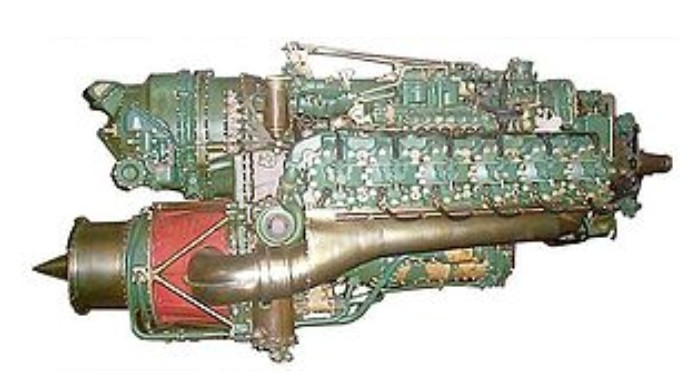
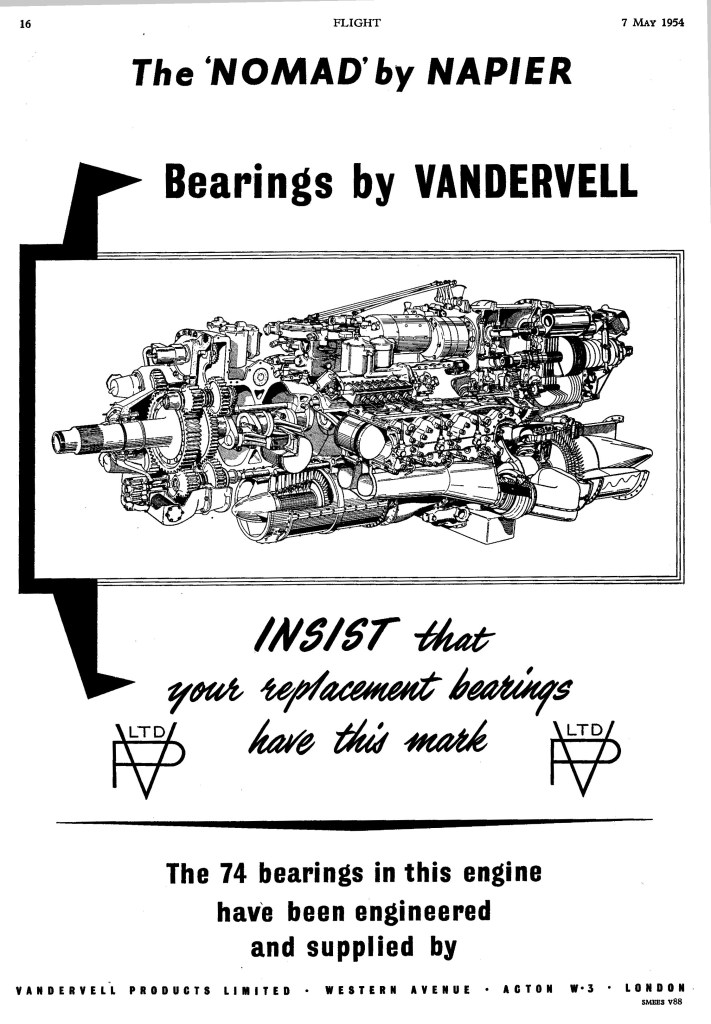
The Napier Nomad was a British diesel aircraft engine designed and built by Napier & Son in 1949. They combined a piston engine with a turbine to recover energy from the exhaust and thereby improve fuel economy. Two versions were tested, the complex Nomad I which used two propellers, each driven by the mechanically independent stages, and the Nomad II, using the turbo-compound principle, coupled the two parts to drive a single propeller. The Nomad II had the lowest specific fuel consumption figures seen up to that time.
The initial Nomad design (E.125) or Nomad 3 was almost two engines in one. One was a turbo-supercharged two-stroke diesel, having some resemblance to half of a Napier Sabre. Mounted below this were the rotating parts of a turboprop engine, based on the Naiad design, the output of which drove the front propeller of a contra-rotating pair. To achieve higher boost, the crankshaft drove a centrifugal supercharger, which also provided the scavenging needed for starting the engine from rest. During take-off additional fuel was injected into the rear turbine stage for more power, and turned off once the aircraft was cruising.
The compressor and turbine assemblies of the Nomad were tested during 1948, and the complete unit was run in October 1949. The prototype was installed in the nose of an Avro Lincoln heavy bomber for testing: it first flew in 1950 and appeared at the Farnborough Air Display on 10 September 1951. In total the Nomad I ran for just over 1,000 hours, and proved to be rather temperamental, but when running properly it could produce 3,000 horsepower (2,200 kW) and 320 lbf (1.4 kN) thrust. It had a specific fuel consumption (sfc) of 0.36 lb/(hp·h) (0.22 kg/(kW·h)). In contrast, a very efficient Pratt & Whitney R-1830 petrol radial engine consumes 0.49 lb/hp.h at cruise settings. However, in practice the jet engine is still preferable since it is much smaller and lighter, and operates at much higher altitudes and speeds. The jet thus consumes about the same amount of fuel for a given trip distance, due to its much shorter transit time at higher altitudes.
The prototype Nomad I is on display at the National Museum of Flight at East Fortune Airfield in Scotland.
Even before the Nomad I was running, its successor, the Nomad II (E.145) Nomad 6, had already been designed. In this version an extra stage was added to the axial compressor/supercharger, eliminating the separate centrifugal part and the intercooler. The turbine (which also received an additional stage) was now only used to drive the compressor, and feed back any excess power to the main shaft using a hydraulic clutch; the separate propeller from the turbine was deleted, just as the whole of the “afterburner” system with its valves etc. So the system was now like a combination of a mechanical supercharger, and a turbocharger without any need for bypass. The result was smaller and considerably simpler: a single engine driving a single propeller. Overall about 1,000 lb (450 kg) was taken off the weight. The wet liners of the cylinders of the Nomad I were changed for dry liners. While the Nomad II was undergoing testing, a prototype Avro Shackleton was lent to Napier as a testbed. The engine proved bulky, like the Nomad I before it, and in the meantime several dummy engines were used on the Shackleton for various tests.
A further development, the Nomad Nm.7, of 3,500 shp (2,600 kW) was announced in 1953.
By 1954 interest in the Nomad was waning, and after the only project, the Avro Type 719 Shackleton IV, based on it was cancelled, work on the engine was ended in April 1955, after an expenditure of £5.1 million. By this time civilian jets such as the Boeing 707 were nearing completion, and the Nomad was never seriously considered by any aircraft manufacturer.
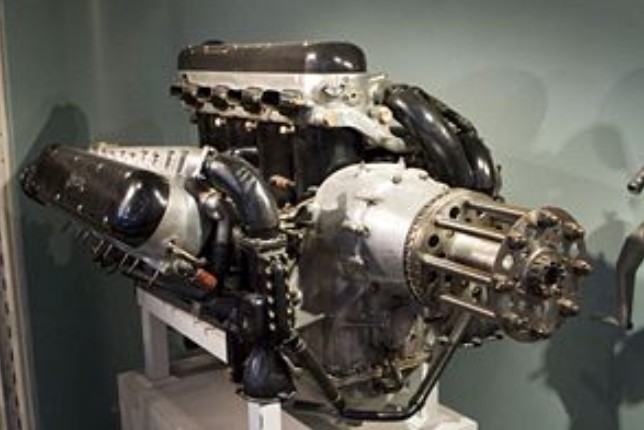
A Nomad II is on display at the Steven F. Udvar-Hazy Center in Virginia.
Specifications: Nomad II Type: Twelve-cylinder, two-stroke valveless diesel engine compounded with three-stage turbine driving both crankshaft and axial compressor. Bore: 6.00 inches (152 mm) Stroke: 7.375 inches (187.3 mm) Displacement: 2,502 cu.in (41.1 lt) Length: 119 inches (3,000 mm) Width: 56.25 inches (1,429 mm) Height: 40 inches (1,000 mm) Dry weight: 3,580 pounds (1,620 kg) Valvetrain: Piston ported two-stroke Supercharger: Napier Naiad turboshaft and gas generator, maximum boost pressure 89 psi Turbocharger: Engine exhaust gases ducted in to Naiad turbine section Fuel type: Diesel oil or kerosene or wide-cut petrol or “other fuels” Cooling system: Liquid-cooled Power output: 3,150 ehp (2,344 kW) max take-off at 89 psi (610 kPa)(208″Hg)(6.9Atm) boost including 320 lbf residual thrust from the turbine at 2,050 rpm (crankshaft) and 18,200 rpm (turbine) Specific power: 1.25 ehp/cu.in (57.0 kW/lt) Compression ratio: 8.1 (cylinder ratio), 31.5:1 (combined pressure ratio) Specific fuel consumption: 0.345 lb/(ehp·h) (0.210 kg/(kW·h))(combined unit) at 11,000 ft and 300 knots Power-to-weight ratio: 0.88 ehp/lb (1.44 kW/kg)
Turbine section Type: Gas generator based on Napier Naiad Compressor: 12-stage axial flow compressor Turbine: 3-stage axial flow Maximum thrust: 320 lbf residual at 18,200 rpm Overall pressure ratio: 8.25:1
Early in the First World War Napier were contracted to build aero engines to designs from other companies: initially a Royal Aircraft Factory model and then Sunbeams. Both proved to be rather unreliable, and in 1916 Napier decided to design their own instead. Reasoning that the key design criteria were high power, light weight, and low frontal area, the engine was laid out with its 12 cylinders in what they called a “broad arrow”—three banks of four cylinders sharing a common crankcase. This suggested the design’s first name, the Triple-Four. These designs are sometimes referred to as a W-block, although that designation applies more correctly to an engine in which a common crankcase is shared by not merely three but in fact four rows of cylinders (since a “W” is made of four lines or bars). The engine was also advanced in form, the heads using four valves per cylinder with twin overhead camshafts on each bank of cylinders and a single block being milled from aluminium instead of the more common separate-cylinder steel construction used on almost all other designs.
Under A. J. Rowledge, the design of the newly renamed Lion was completed in 1917, and the first hand-built prototypes ran later that year. It was fitted to a de Havilland built DH.9 in early 1918, proving to have many cooling problems. In addition the milled block turned out to be difficult to build with any accuracy and they reverted to separate cylinders, although they remained aluminium. Both of these problems were worked out by the middle of the year and the engine entered production in June 1918. The first Lion I versions delivered 450 hp (335 kW) from their 24 litres. As the most powerful engine available (particularly after a turbocharger became an option in 1922), the Lion went on to be a huge commercial success. Through the years between the wars Napier manufactured little else. Between the wars it powered over 160 different types of aircraft.
In highly-tuned racing versions the engine could reach 1,300 hp (970 kW), and it was used to break many world records: height, air speed, and distance in aircraft, boats, delivering 1,375 hp (1,025 kW) in a highly tuned Lion for a water speed record of 100 mph (160 km/h) in 1933. In land speed records, Lion engines powered many of Sir Malcolm Campbell’s record breakers including a record of over 250 mph (400 km/h) in 1932 and John Cobb’s 394 mph (634 km/h) Railton Mobil Special in 1947 – a record that came well after the Lion had passed its prime and stood until the 1960s. The record had been held by British drivers for 32 years. Lions powered successful entrants in air racing, the Schneider Cup, in 1922 and 1927, but were then dropped by Supermarine in favour of a new engine from Rolls-Royce, the Rolls-Royce R which had been especially designed for racing. It was a Lion that powered the Supermarine S5 that won the 1927 Schneider Trophy for seaplane speed racing.
It was still being fitted to planes in 1929 and it was still being put into boats in 1933.
During the 1930s a new generation of much larger and more powerful engines started to appear, and the Lion was clearly past its prime. Gradually, they fell further and further behind. By the time the Bristol Hercules and the Rolls-Royce Merlin arrived in the late 1930s, the Lion was too small and old-fashioned.
A marine version of the Lion, unsurprisingly called the Sea Lion, was used to power high speed air-sea rescue launches operated by the RAF.
Another adaptation for the Lion aero engine was propeller-driven motor sleighs, which were used for high-speed transport and SAR duties on sea ice by the Finnish Air Force and Navy.
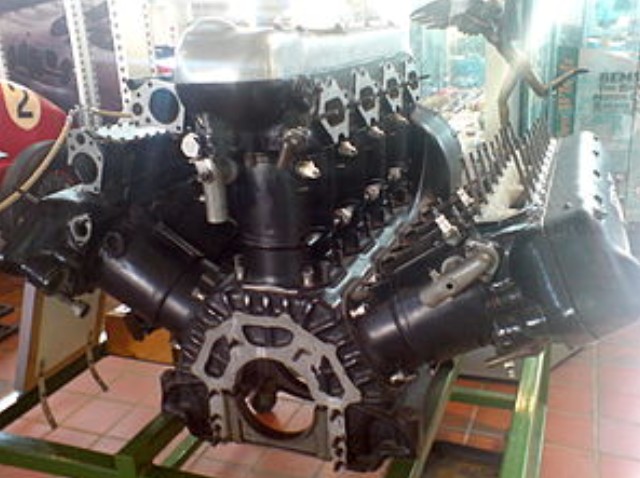
Napier Lion W12
Lion models:
Lion I 1918 450 bhp (340 kW) at 1,950 rpm geared, also related IA and 1AY
Lion II 1919 Works No: E64 450 bhp (340 kW) at 2,000 rpm
Lion IIII experimental geared Gloster Gorcock
Lion V 470 bhp (350 kW) at 2,000 rpm 500 bhp (370 kW) at 2,250 rpm VA had increased CR to 5.8 Mainstay engine of the RAF in the late 1920s, replaced by Lion XI
Lion VS Works No: E79 Turbocharged, intercooled
Lion VIS 1927 Turbocharged Application: Gloster Guan
Lion VII 1925 700 bhp (520 kW) (racing) Application: Gloster III (Schneider Trophy entrant) Supermarine S.4
Lion VIIA 1927 Works No: E86 900 bhp (670 kW) (racing) Application: Golden Arrow Blue Bird (1927) Miss England I Supermarine S.5 Gloster IV
Lion VIIB 1927 875 bhp (652 kW) (racing) geared Application: Supermarine S.5 Gloster IV
Lion VIID 1929 Works No: E91 1,350 bhp (1,010 kW) at 3,600 rpm (racing) Supercharged, about 6-8 built Application: Blue Bird (1931) Fred H Stewarts Enterprise Betty Carstairss Estelle V powerboat Miss Britain III Gloster VI (Schneider Trophy entrant) Railton Special (John Cobb’s land speed record car)
Lion VIII 1927 direct drive Gloster Gorcock
Lion XIA 1928 580 bhp (430 kW) at 2,585 rpm, 6:1 CR RAF production model Application: Napier-Railton
Lioness Works No: E71 Inverted layout, for better visibility. At least some were built turbocharged, for racing.
Sea Lion 1933 500 and 600 bhp (370 and 450 kW) Marine version of Lion XI British Power Boat Company Type Two 63 ft HSL
Applications: Aircraft Alliance P.2 Seabird Avro Bison Blackburn Blackburn Blackburn Dart Blackburn Pellet Blackburn Ripon Blackburn Velos Boulton Paul Atlantic Boulton Paul Bodmin Boulton Paul Bolton English Electric Kingston flying boat (prototype) Fairey III Fairey Fawn Fokker C.IV-W Fokker C.V Fokker D.C.I Fokker D.XIII Gloster Gorcock Gloster Guan Handley Page H.P.31 Harrow Handley Page Hyderabad Mitsubishi B1M Parnall Pike Parnall Possum Parnall Puffin Supermarine S.4 Supermarine S.5 Supermarine Seagull Supermarine Southampton Tarrant Tabor Vickers Vernon Vickers Valparaiso Vickers Victoria Vickers Virginia Vickers Vixen Westland Walrus
Other applications British Power Boat Company Type Two 63 ft HSL British Power Boat Company 60 ft 4 in
Specifications: Lion II Type: 12-cylinder water-cooled W-block (3 banks of 4 cylinders) aircraft piston engine Bore: 5.5 in (139.7 mm) Stroke: 5.125 in (130.17 mm) Displacement: 1,461.6 cu.in (23.9 L) Length: 57.5 in (1460 mm) Width: 42.0 in (1067 mm) Height: 43.5 in (1105 mm) Dry weight: 960 lb (435 kg) Valvetrain: Two intake and two exhaust valves per cylinder actuated via double overhead camshafts per cylinder block. Cooling system: Water-cooled Power output: 480 hp (358 kW) at 2,200 rpm at 5,000 ft Specific power: 0.32 hp/cu.in (15.0 kW/L) Compression ratio: 5.8:1 Power-to-weight ratio: 0.5 hp/lb (0.82 kW/kg)
Around 1915, the Nanyuan Gun Bus No. 1 appeared, perhaps an indigenous design, perhaps based on imported aircraft. The Gun Bus was a single-engine pusher aircraft with a crew of two, a pilot and a gunner. It might have found service in China’s civil unrest at the time.
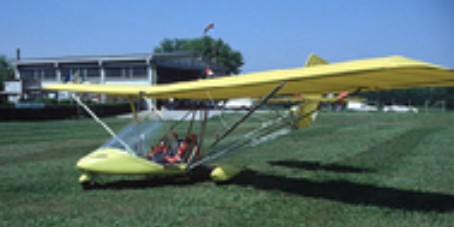
Now considered a classic of Italian ultra-lights, the Groppino is the basic for excellence, for the school and who that want an economic ultralight aircraft, simple and fun. The aircraft is equipped with dual controls and nose wheel steering.
The cockpit offers great visibility and the aircraft is constructed entirely of metal. The aircraft engine is a very sturdy and reliable Rotax 912 ULS so you can travel at a cruising speed of 125 mph (201 km / h) with a fuel consumption of around 17 liters / h. Price 2009: 61900 EURO
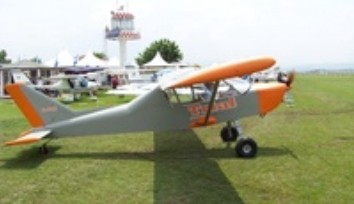
Foldable wings, all metal frame construction with central chrome molybdenum. Large door on right side that allows easy access to front and rear seat. Tundra wheels equipped to operate on rough terrain. The Jabiru engine ensures efficient and low noise while maintaining excellent performance.
Stall: 32 kt / 37 mph / 60 kmh Cruise: 86 kt / 99 mph / 160 kmh VNE: 119 kt / 137 mph / 220 kmh Empty Weight: 285 kg / 628 lbs MTOW Weight: 450 kg / 992 lbs Take-off distance (50ft obstacle): 390 ft / 120 m Landing distance (50ft obstacle): 330 ft / 100 m
Engine: Rotax 503, 52 hp Wing span: 9.9 m Wing area: 16.7 sq.m MAUW: 450 kg Empty weight: 180 kg Fuel capacity: 30 lt Max speed: 120 kph Cruise speed: 80 kph Minimum speed: 45 kph Climb rate: 4 m/s Seats: 2 Fuel consumption: 15 lt/hr
In 1988 Textron was contracted to supply three 400hp IO-720-D1B engines for the N-5. The contract provided for three specially equipped engines to be supplied for the N-5 prototypes, with an option on production engines from late-1990.
Nanchang developed the N-5A agricultural aircraft, first flown on 26 December 1989. The N5A received its CAAC production certificate in the 1990s. By 1995, eight had been built.