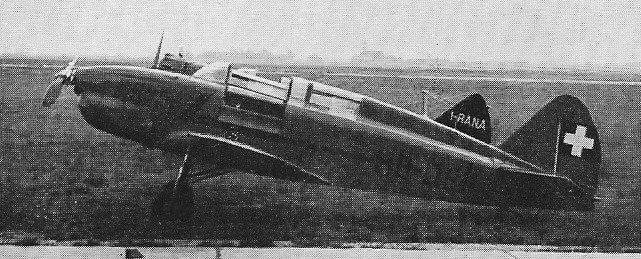
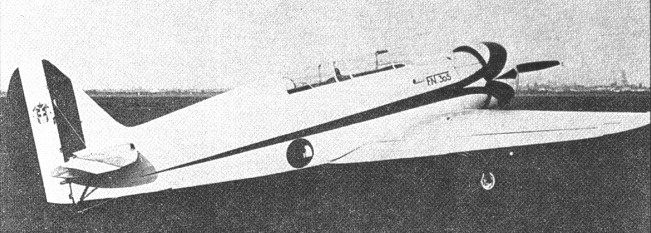
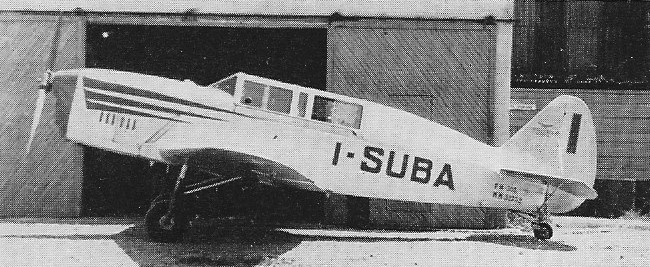
As a 1938 development of the FN305, there were also 25 F.N.315 intermediate trainers with the 172-kW (230-hp) Hirth HM 508D inline, a revised canopy, a new tail unit, flaps and increased dihedral on the outer wing panels.
The F.N.315 was also produced with the Alfa Romeo 115-1 of 185 hp.
The F.N.315 was exported to six countries, and a light-attack version was flown experimentally.
Engine: Hirth HM 508, 172 kW (230 hp). Wingspan: 27 ft 9 in Wing area: 129.12 sq.ft Length: 22 ft 11 in Height: 6 ft 10.5 in Empty weight: 1562 lb Loaded weight: 2255 lb Max speed: 239 mph at 8200 ft Cruise: 220 mph at 11,480 ft Time to 13,120ft: 6 min 40 sec Cruise range: 590 mi
First flown in January 1935, the F.N.305 training, touring and sporting aeroplane had single or tandem seating under a large glasshouse canopy and, with a 149-kW (200-hp) Fiat A.70S radial, attained a fair level of performance thanks to its retractable landing gear. Several one-off variants were produced before Piaggio started building the F.N.305A two-seat version with the Alfa-Romeo 115 inline. The type was used by the Italian air force as a tighter trainer and liaison aeroplane. Between 1937 and 1943 production totalled 258 including small numbers of the F.N.305B and F.N.305C single-seaters with open and enclosed cockpits respectively.
An experimental version, the F.N.305-D, established s long-distance record by flying from Rome to Addis Ababa.
F.N.305 Wingspan: 27 ft 9 in Wing area: 129.12 sq.ft Length: 22 ft 11 in Height: 6 ft 10.5 in Empty weight: 1320 lb Loaded weight: 1980 lb Max speed: 211 mph Cruise: 189 mph Service ceiling: 22,950 ft Range: 435 mi
F.N.305A Powerplant: l x Alfa-Romeo 115-1, 142kW (190 hp) Span: 8.47m (27ft 9.5in) Length: 7m (22 ft 11.5 in) Armament: 1 or 2 x 7.7-mm (0.303-in) mg Max T/O weight: 900kg (1,9841b) Max speed: 193 mph Operational range: 311 miles.
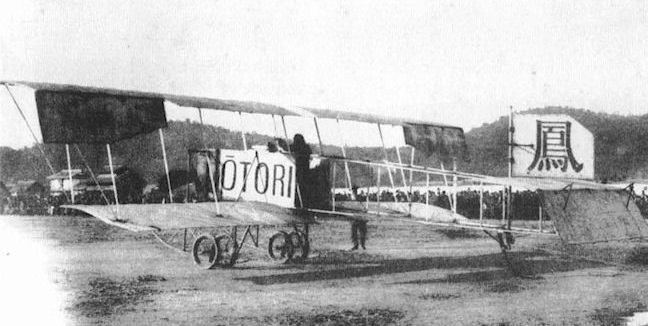
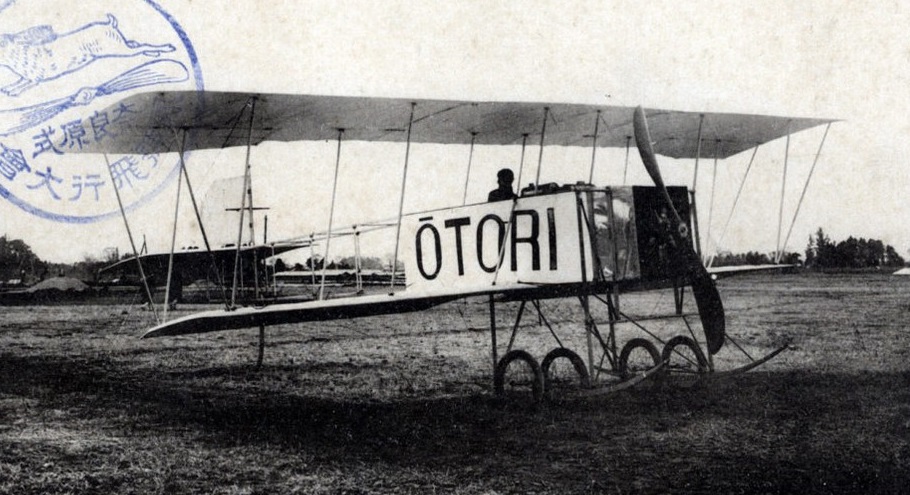
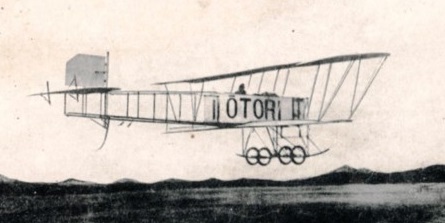
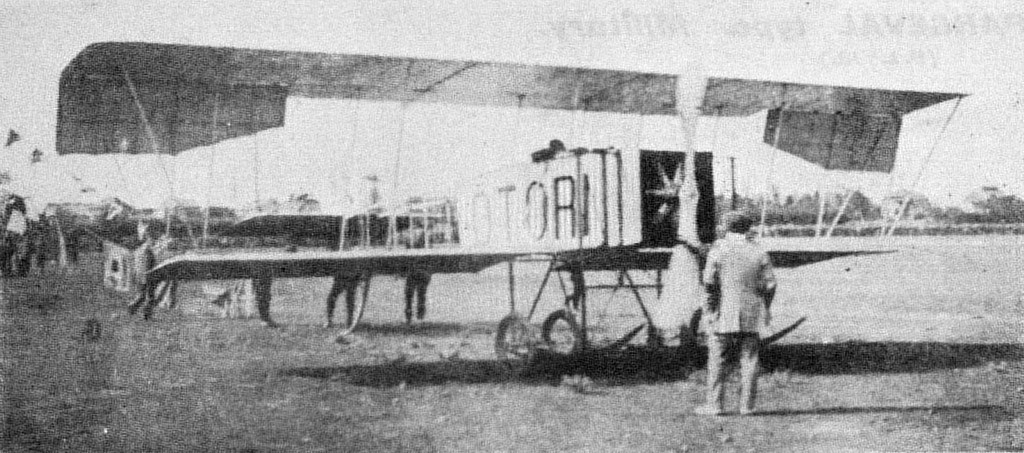
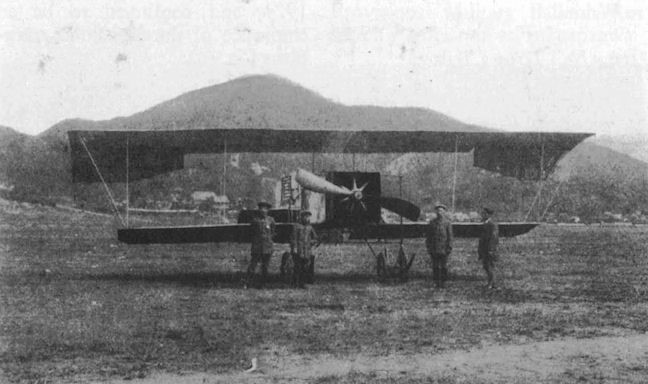
While the Narahara No.4 Ohtori-go was touring Japan with demonstration flights by Shimo, the Narahara No.5 Ohtori Nisei-go (meaning Ohtori the 2nd) was built. It was almost identical to the No.4 but was powered by a 70hp Gnome rotary engine and had a strengthened undercarriage. This aeroplane was completed in June 1913 and made exhibition flights at Ibaragi, Toyama, Ishikawa and Niigata from June to September that year.
Sanji Narahara eventually retired completely from aviation at his family’s insistence. His aviation activities were first taken over by Einosuke Shirato who then began manufacturing aeroplanes under his own name and provided flying training at Inage beach. In addition to Shirato’s activities, Otojiro Itoh also became known for his aviation endeavours, and between the two, a new era of civil aviation began in 1913 stemming from Narahara’s works and now centred at the Shirato/ltoh Airfields.
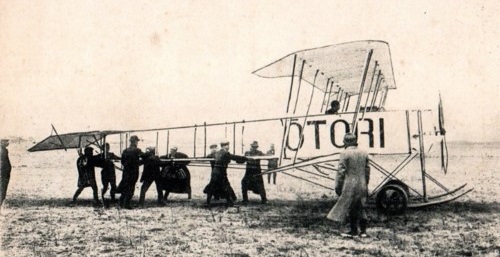
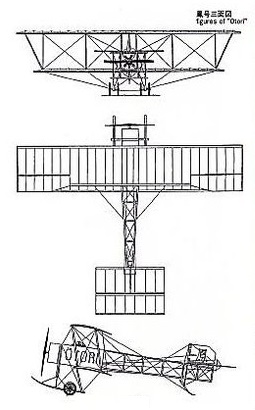
In the autumn of 1911, Narahara’s group was joined by Shuhei Iwamoto, later a professor of Tokyo University, and Kiyoshi Shiga, BSc. By March 1912 they had created the Narahara No.4 Aeroplane with the help of Saken Kawabe, Otojiro Itoh and Ginjiro Goto, themselves to become notable in aviation. The aeroplane was built at the Orient Aeroplane Company (Toyo Hikoki Shokai), having its office in Kyobashi, Tokyo. The factory was then located at Fukagawa (near or at Susaki Airfield) and final assembly was made at Tokorozawa where it was to be flown. It received the name of Ohtori-go, after a champion sumo-wrestler, Ohtori, at the request of the sponsor who supported the project.
A single-engine tractor training biplane with wooden structure with fabric covering. The pupil and instructor were in an open cockpit.
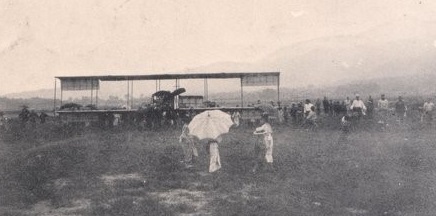
The aeroplane performed well and was taken on exhibition tours, with flights at major cities throughout Japan to demonstrate what was referred to as their ‘Japanese-made civil aeroplane’. Since there were no airfields in Japan at this time, flights were made from race tracks or military parade grounds of such relatively small size that landings and take offs were very near the spectators. During the first of these exhibition flights on 13 April, 1912, at Kawasaki Race Track, Kanagawa Prefecture, a failing engine caused the aeroplane to land short, allowing a wingtip to strike a school boy, breaking his arm.
The aeroplane was again demonstrated on 11 and 12 May for His Highness the Crown Prince (later Emperor Taisho) and his three sons (one to later become Emperor Showa [Hirohito]) along with Field Marshal Aritomo Yamagata and many other high-ranking officers at the Aoyama Military Parade Grounds. These demonstrations brought Narahara an award by the Imperial House, the first distinction given to someone involved in Japanese civil aviation.
The last exhibition flight by the Ohtori No.4 was in Seoul, Korea, on 3 and 4 April, 1913.
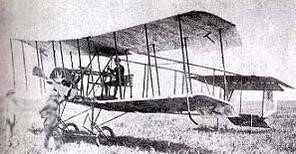
Around 1910, retired Japanese Navy engineer Sanji Narahara, who had studied munitions at the Imperial University, built an airframe for himself and on May 5, 1911, made a successful flight with a French-made engine installed.
Second biplane designed and built by Sanji Narahara, dating from early 1911. Of twin-boom, open construction and powered by a 50 hp Gnôme rotary, this Japanese machine actually flew as there is at least one photograph showing it in-flight.
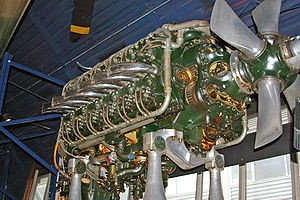
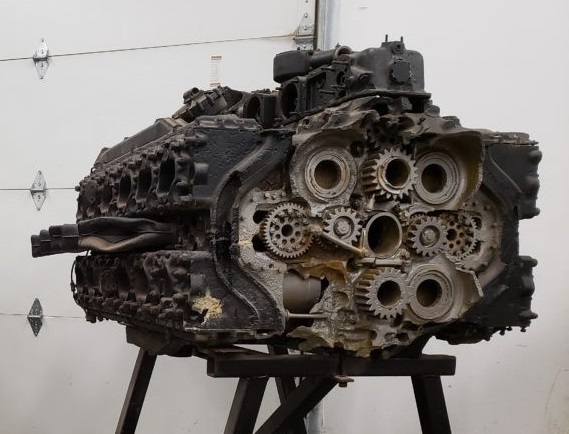
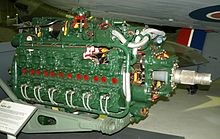
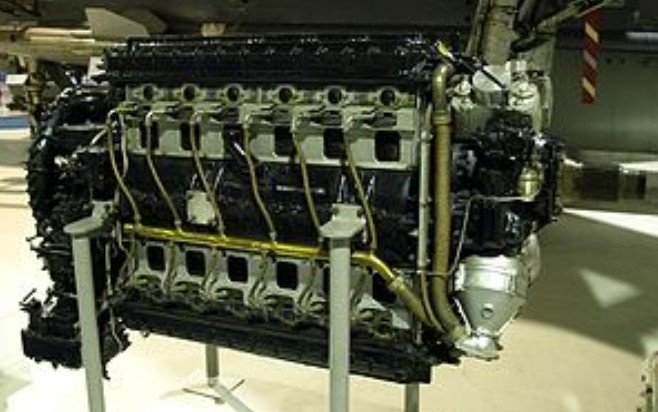
The Napier Sabre was a British H-24-cylinder, liquid-cooled, sleeve valve, piston aero engine, designed by Major Frank Halford and built by D. Napier & Son during World War II. The engine evolved to develop from 2,200 hp (1,600 kW) in its earlier versions to 3,500 hp (2,600 kW) in late-model prototypes.
Prior to the Sabre, Napier had been working on large aero engines for some time. Their Lion, had been a very successful engine between the World Wars and in modified form had powered several of the Supermarine Schneider Trophy competitors in 1923 and 1927, as well as several land speed record cars. By the late 1920s, the Lion was no longer competitive and work started on replacements.
Napier followed the Lion with two new H-block designs: the H-16 (Rapier) and the H-24 (Dagger). The H-block has a compact layout, consisting of two horizontally opposed engines, lying one atop or beside another. Since the cylinders are opposed, the motion in one is balanced by the motion on the opposing side, leading to no first order vibration or second order vibration. In these new designs, Napier chose air cooling but in service, the rear cylinders proved to be impossible to cool properly, which made the engines unreliable.
In 1927, Harry Ricardo published a study on the concept of the sleeve valve engine. In it, he wrote that traditional poppet valve engines would be unlikely to produce much more than 1,500 hp (1,100 kW), a figure that many companies were eyeing for next generation engines. To pass this limit, the sleeve valve would have to be used, to increase volumetric efficiency, as well as to decrease the engine’s sensitivity to detonation, which was prevalent with the poor quality fuels in use at the time. Halford had worked for Ricardo 1919-1922 at their London office and Halford’s 1923 office was in Ladbroke Grove, North Kensington, only a few miles from Ricardo, while Halford’s 1929 office was even closer (700 yards), and while in 1927 Ricardo started work with Bristol Engines on a line of sleeve-valve designs, Halford started work with Napier, using the Dagger as the basis. The layout of the H-block, with its inherent balance and the Sabre’s relatively short stroke, allowed it to run at a higher rate of rotation, to deliver more power from a smaller displacement, provided that good volumetric efficiency could be maintained (with better breathing), which sleeve valves could do.
The Napier company decided first to develop a large 24 cylinder liquid–cooled engine, capable of producing at least 2,000 hp (1,491 kW) in late 1935. Although the company continued with the opposed H layout of the Dagger, this new design positioned the cylinder blocks horizontally and it was to use sleeve valves. All of the accessories were grouped conveniently above and below the cylinder blocks, rather than being at the front and rear of the engine, as in most contemporary designs.
Napier Sabre
The Air Ministry supported the Sabre programme with a development order in 1937 for two reasons: to provide an alternative engine if the Rolls-Royce Vulture and the Bristol Centaurus failed as the next generation of high power engines and to keep Napier in the aero-engine industry. The first Sabre engines were ready for testing in January 1938, although they were limited to 1,350 hp (1,000 kW). By March, they were passing tests at 2,050 hp (1,500 kW) and by June 1940, when the Sabre passed the Air Ministry’s 100-hour test, the first production versions were delivering 2,200 hp (1,640 kW) from their 2,238 cubic inch (37 litre) displacements. By the end of the year, they were producing 2,400 hp (1,800 kW). The contemporary 1940 Rolls-Royce Merlin II was generating just over 1,000 hp (750 kW) from a 1,647 cubic inch (27 litre) displacement.
Problems arose as soon as mass production began. Prototype engines had been hand-assembled by Napier craftsmen and it proved to be difficult to adapt it to assembly-line production techniques. The sleeves often failed due to the way they were manufactured from chrome-molybdenum steel, leading to seized cylinders, which caused the loss of the sole prototype Martin-Baker MB 3. The Ministry of Aircraft Production was responsible for the development of the engine and arranged for sleeves to be machined by the Bristol Aeroplane Company from their Taurus engine forgings. These nitrided austenitic steel sleeves were the result of many years of intensive sleeve development, experience that Napier did not have. Air filters had to be fitted when a new sleeve problem appeared in 1944 when aircraft were operating from Normandy soil with its abrasive, gritty dust.
Quality control proved to be inadequate, engines were often delivered with improperly cleaned castings, broken piston rings and machine cuttings left inside the engine. Mechanics were overworked trying to keep the Sabres running and during cold weather they had to run them every two hours during the night so that the engine oil would not congeal and prevent the engine from starting the next day. These problems took too long to remedy and the engine gained a bad reputation. To make matters worse, mechanics and pilots unfamiliar with the different nature of the engine, tended to blame the Sabre for problems that were caused by not following correct procedures. This was exacerbated by the representatives of the competing Rolls-Royce company, which had its own agenda. In 1944, Rolls-Royce produced a similar design prototype called the Eagle.
Napier seemed complacent and tinkered with the design for better performance. In 1942, it started a series of projects to improve its high-altitude performance, with the addition of a three-speed, two-stage supercharger, when the basic engine was still not running reliably. In December 1942, the company was purchased by the English Electric Company, which ended the supercharger project immediately and devoted the whole company to solving the production problems, which was achieved quickly.
By 1944, the Sabre V was delivering 2,400 horsepower (1,800 kW) consistently and the reputation of the engine started to improve. This was the last version to enter service, being used in the Hawker Typhoon and its derivative, the Hawker Tempest. Without the advanced supercharger, the engine’s performance over 20,000 ft (6,100 m) fell off rapidly and pilots flying Sabre-powered aircraft, were generally instructed to enter combat only below this altitude. At low altitude, both planes were formidable. As air superiority over Continental Europe was slowly gained, Typhoons were increasingly used as fighter-bombers, notably by the RAF Second Tactical Air Force. The Tempest became the principal destroyer of the V-1 flying bomb (Fieseler Fi 103), since it was the fastest of all the Allied fighters at low levels. Later, the Tempest destroyed about 20 Messerschmitt Me 262 jet aircraft.
Development continued and the later Sabre VII delivered 3,500 hp (2,600 kW) with a new supercharger. The final test engines delivered 5,500 hp (4,100 kW) at 45 lb/in2 boost. By the end of World War II, there were several engines in the same power class. The Pratt & Whitney R-4360 Wasp Major four-row, 28-cylinder radial produced 3,000 hp (2,280 kW) at first and later types produced 3,800 hp (2,834 kW), but these required almost twice the displacement in order to do so, 4,360 cubic inches (71 litres).
Napier Sabre III
The first operational aircraft to be powered by the Sabre were the Hawker Typhoon and Hawker Tempest; the first aircraft powered by the Sabre was the Napier-Heston Racer, which was designed to capture the world speed record. Other aircraft using the Sabre were early prototype and production variants of the Blackburn Firebrand (in 21 early production aircraft), the Martin-Baker MB 3 prototype and a Hawker Fury prototype (2 built (LA610, VP207), 485 mph). The Napier also flew in Fairey Battle testbed, Folland Fo.108 testbed and Vickers Warwick prototype. The rapid introduction of jet engines after the war led to the quick demise of the Sabre, as there was less need for high power military piston aero engines and because Napier turned its attention to developing turboprop engines.
Variants:
Sabre I (E.107) (1939) 2,000 horsepower (1,490 kW).
Sabre IIB 2,400 horsepower (1,790 kW). Four choke S.U. carburettor: Mainly used in Hawker Tempest V.
Sabre IIC 2,065 horsepower (1,540 kW). Similar to Mk VII.
Sabre III 2,250 horsepower (1,680 kW). Similar to Mk IIA, tailored for the Blackburn Firebrand: 25 manufactured and installed.
Sabre IV 2,240 horsepower (1,670 kW). As Mk VA with Hobson fuel injection: preliminary flight development engine for Sabre V series. Used in Hawker Tempest I.
Sabre V 2,600 horsepower (1,940 kW). Developed MK II, redesigned supercharger with increased boost, redesigned induction system.
Sabre VA 2,600 horsepower (1,940 kW). Mk V with Hobson-R.A.E fuel injection, single-lever throttle and propeller control: used in Hawker Tempest VI.
Sabre VI 2,310 horsepower (1,720 kW). Mk VA with Rotol cooling fan: used in 2 Hawker Tempest Vs modified to use Napier designed annular radiators; also in experimental Vickers Warwick V.
Sabre VII 3,055 horsepower (2,278 kW). Mk VA strengthened to withstand high powers produced using Water/Methanol injection. Larger supercharger impeller.
Sabre VIII 3,000 horsepower (2,240 kW). Intended for Hawker Fury; tested in the Folland Fo.108.
Sabre E.118 (1941) Three-speed, two-stage supercharger, contra-rotating propeller; test flown in Fo.108.
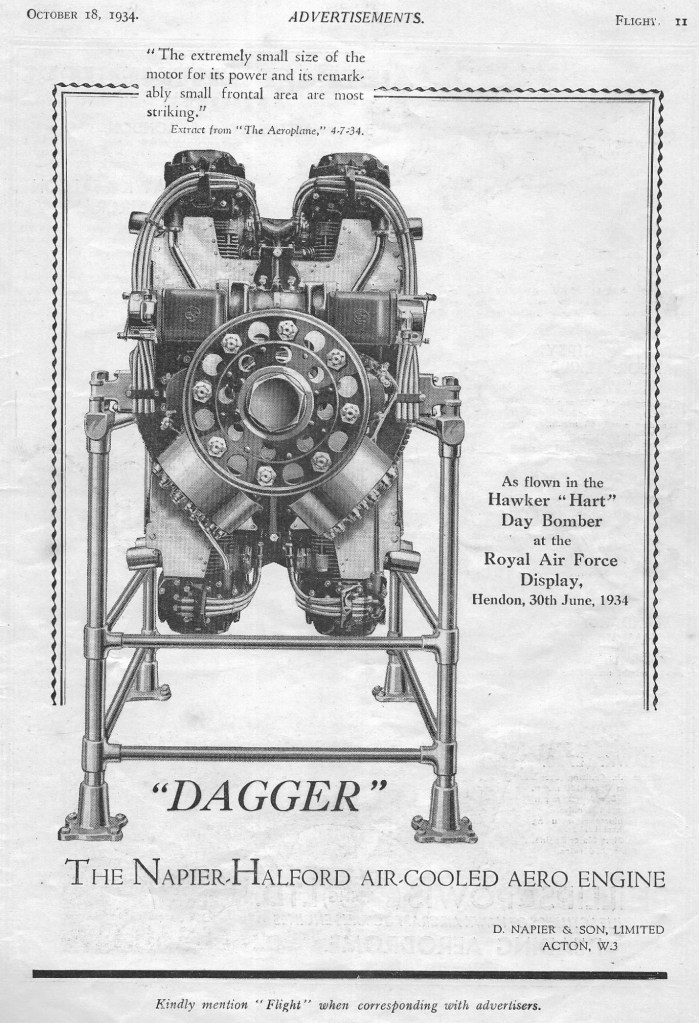
A development of the earlier Napier Rapier, the Napier Dagger was a 24-cylinder H-pattern (or H-Block) air-cooled engine designed by Frank Halford and built by Napier and first run in 1934.
The H-Block has a compact layout, as it essentially consists of two vertically opposed inline engines lying side-by-side and driving side-by-side crankshafts. Since the cylinders are opposed, the motion in one is balanced by the opposite motion in the one on the opposite side, leading to very smooth running.
The Dagger had fast rotation, running at up to 4,000 rpm, but it had conventional poppet valves.
There were problems with cooling, maintenance, manufacturing, and weight, which were not solved during the Dagger’s lifetime and went unresolved well into its successors lifetime, (Napier Sabre). The Dagger powered the Hawker Hector army co-operation aircraft and the Handley Page Hereford (a variant of the Hampden) bomber. The operational usefulness of the Hector was restricted by engine cooling problems, which made it unsuitable for operations in the tropics, and the Hereford was found to be unsuitable for combat because its Dagger VIII engines were noisy and unreliable. The Dagger also found an application in the experimental Martin-Baker MB 2 fighter.
Variants: Napier-Halford Dagger I 1934 – 650 hp.
Dagger II 1938 – 755 hp
Dagger IIIM 1938 – 725 hp
Dagger VIII 1938 – 955 hp, intermediate altitude supercharger, initially known as E.108
Specifications: Napier Dagger III MS Type: Twenty-four-cylinder supercharged air-cooled H engine Bore: 3.813 in (96.8 mm) Stroke: 3.75 in (95.25 mm) Displacement: 1,027 cu.in (16.8 lt) Length: 80 in (2,032 mm) Width: 22.5 in (584 mm) Height: 45.125 in (1,146 mm) Dry weight: 1,358 lb (616 kg) Valvetrain: One inlet and one exhaust valve per cylinder Supercharger: Single-speed centrifugal type supercharger, 5.04:1 reduction Fuel system: Napier-Claudel-Hobson carburettor Fuel type: 87 Octane petrol Cooling system: Air-cooled Reduction gear: Spur, 2.69:1 Power output: 725 hp (541 kW) at 3,500 rpm for takeoff 794 hp (592 kW) at 4,000 rpm at 5,000 ft (1,520 m) Specific power: 0.77 hp/in³ (35.13 kW/l) Compression ratio: 7.75:1 Specific fuel consumption: 0.43 lb/(hp•h) (261 g/(kW•h)) Oil consumption: 0.18-0.35 oz/(hp•h) (7-13 g/(kW•h)) Power-to-weight ratio: 0.62 hp/lb (1.02 kW/kg)
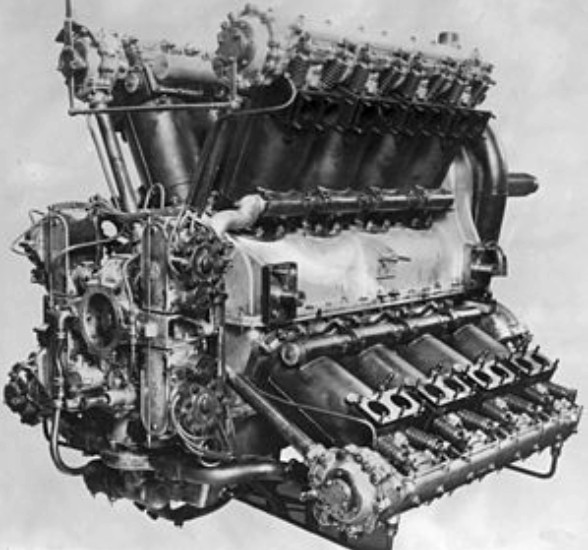
The Napier Cub was a large experimental 1,000 horsepower (750 kW) 16-cylinder ‘X’ pattern liquid-cooled aero engine built by the British engine company Napier & Son. The Cub was the only Napier ‘X’ engine design.
The four banks of four cylinders were arranged in a flattened ‘X’ when viewed from the front. The angle between the upper cylinders was 52.5 degrees, the lower cylinders 127.5 degrees which gave an angle of 90 degrees between the outer cylinder banks. The cylinders consisted of separate individual steel forgings with welded steel water cooling jackets. The carburettor was situated below the propeller reduction gear at the front of the engine and fed the inlet valves through four inlet manifolds. The valve drive gear, magnetos and pumps were fitted to the rear of the crankcase.
First run in 1919 and first flown on 15 December 1922 in an Avro Aldershot biplane bomber aircraft, the only other application was in the Blackburn Cubaroo. Only six engines of this type were ordered and produced.
Specifications: Type: 16-cylinder liquid-cooled X engine Bore: 6.25 in (158.75 mm) Stroke: 7.5 in (190.5 mm) Displacement: 3,681 cu in (60.32 L) Dry weight: 2,450 lb (1,111 kg) Valvetrain: Single overhead camshaft with four poppet valves per cylinder Fuel system: Updraught carburettor Fuel type: Petrol Cooling system: Liquid cooled Reduction gear: Spur geared, reduction ratio 0.489:1, left hand tractor Power output: 1,000 hp at 1,800 rpm Compression ratio: 5.3:1 Power-to-weight ratio: 0.4 hp/lb