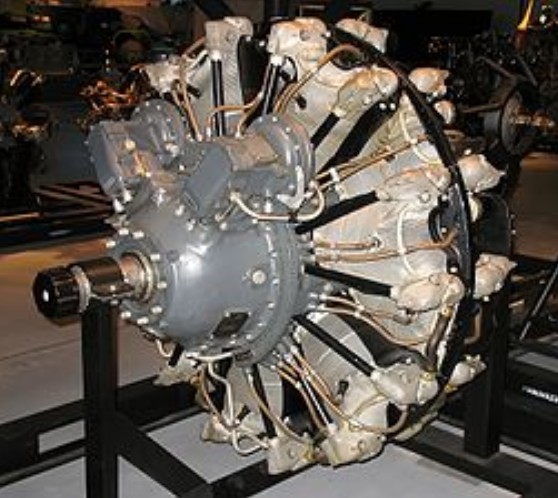
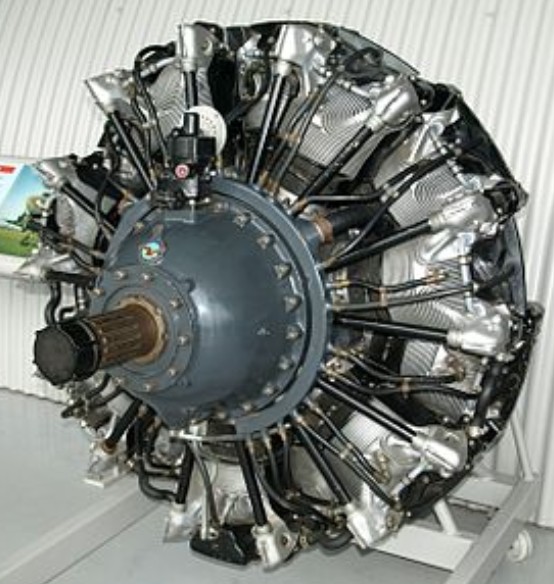
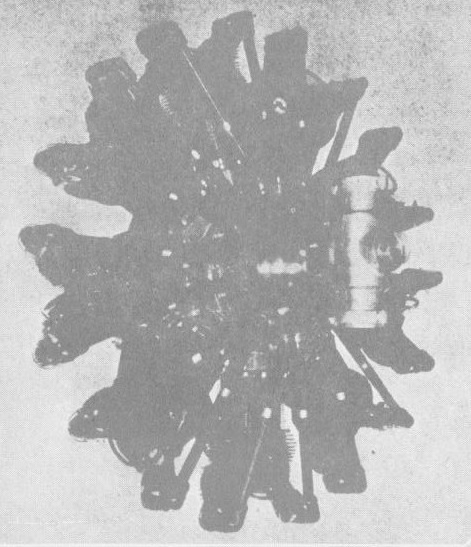
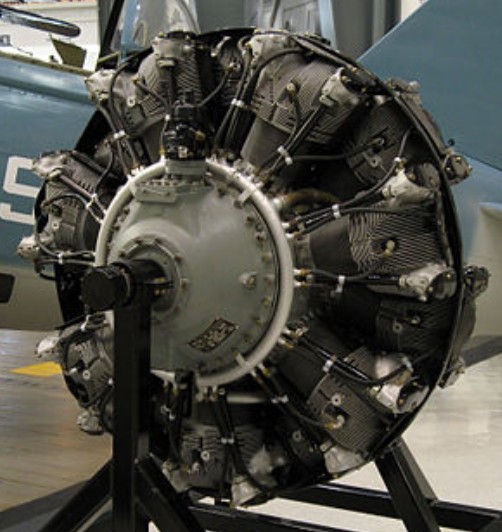
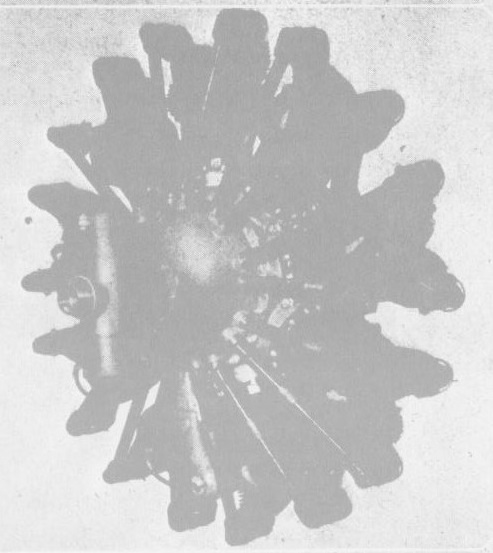
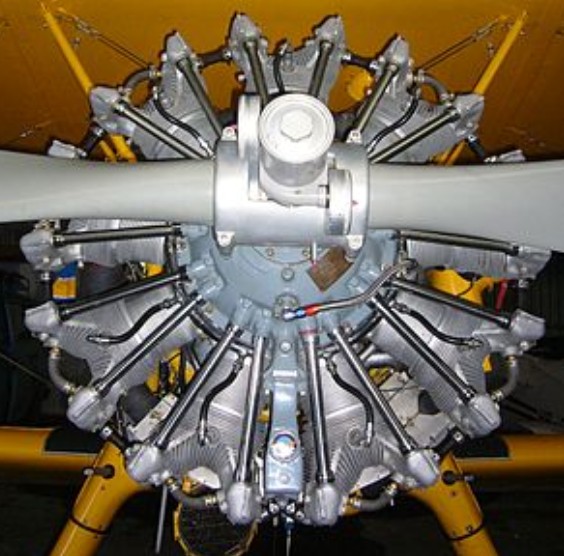
Pratt & Whitney R-2180 was the designations for two closely related radial engines developed in the United States by Pratt & Whitney. They had two rows of seven cylinders each.
Pratt & Whitney R-2180-A Twin Hornet – first run in 1936 Pratt & Whitney R-2180-E Twin Wasp E – first run in 1945
The Pratt & Whitney R-2060 Yellow Jacket was a liquid-cooled aircraft engine project developed for the United States Army in the early 1930s. First run in 1932, the engine had five banks of four in-line cylinders, and displaced 2,060 cubic inches. Designed to produce 1,000 hp, the engine produced 1,116 hp on its final run after 35 hours of testing. The engine was cancelled in favor of continuing development of Pratt & Whitney’s air-cooled R-1830 Twin Wasp radial engine.
The R-2000 was an enlarged version of the radial Pratt & Whitney R-1830 Twin Wasp developed in 1942, with focus on reducing the manufacturing costs and fuel requirements. The bore was increased to 5.75 inch, while it still retained the 5.5 inch stroke. This brought displacement up to 2,000 cu.in. There were a number of detail changes from the R-1830, such as front-mounted instead of rear-mounted magnetos, plain bearings for the crankshaft rather than roller bearings, and 87 octane fuel (specified because there were fears wartime supplies of 100 octane might fall short, but those fears were groundless). The R-2000 produced 1,300 hp @ 2,700 rpm with 87 octane, 1,350 hp with 100 octane and 1,450 hp @ 2,800 rpm with 100/130-grade fuel.
Applications: Douglas C-54 Skymaster Douglas DC-4 Douglas Super DC-3 de Havilland Canada DHC-4 Caribou Vought XF5U
Specifications:
R-2000-3 Type: Twin-row radial engine, 14 cylinder Bore: 5.75 in (146 mm) Stroke: 5.5 in (139.7 mm) Displacement: 2,004 cu in (32.8 lt) Length: 61.02 in (1550 mm) Diameter: 49.49 in (1257 mm) Dry weight: 1570 lb (714 kg) Fuel system: Stromberg carburetor Fuel type: 100/130 grade gasoline Cooling system: Air-cooled Reduction gear: 2:1 Power output: 1,350 hp at 2,700 rpm (sea level) Compression ratio: 6.5:1
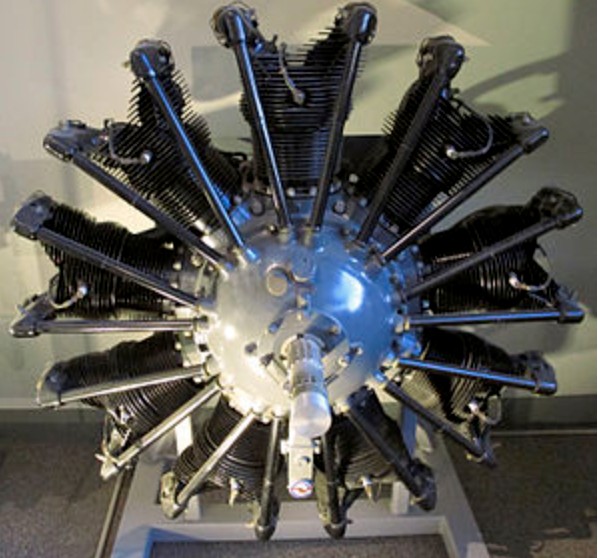
The Pratt & Whitney R-1860 Hornet B was a relatively uncommon aircraft engine, first run in 1929. It was a development of Pratt & Whitney’s earlier R-1690 Hornet and was basically similar, but enlarged in capacity from 1,690 to 1,860 cubic inches (30.5 L). Bore was increased by 1/8″ and the stroke by 3/8″. Both engines were air-cooled radial engines, with a single row of nine cylinders.
The master connecting rod has a solid instead of detachable cap big end for higher crank speeds. The single throw two-pice crahkshaft is divided into a forward and rear section. The crankpin is integral with the forward section which transmits power to the propeller hub carried by it. The rear section telescopes into the crankpin and is carried completely through it. The two sections are united by a through bolt and kept in the proper angular relation by splines.
The main crankcase of forged aluminium is divided into two similar sections in the plane of the cylinder and united by nine through bolts between the cylinders as well as by the cylinder flanges.
The cylinder and valve design was with two large valves driven by pushrods. All valve operating parts are enclosed. The rocker arms are supported by ball bearings and are mounted in the rocker housings which are part of the cylinder head. The push rods are enclosed by telescopic covers held in place by springs.
Every Pratt & Whitney engine is provided with a General Electric rotary induction fan used to provide proper mixture distribution. With suitable gear ratio it is possible for certain specialised purposes to provide a reasonable amount of supercharging without additional weight or complication.
All the accessories are grouped at the rear of the engine protected by the cowling.
On geared engines a 3:1 propeller speed reduction is provided by a geared unit of patented Pratt & whiney design, weighing 885 lb.
The enlarged engine was designed by George Willgoos and was first available in 1929.
The fourteen-cylinder Twin Wasp was more complex and costly than the nine-cylinder, single-row Hornet B. The Twin Wasp was by far the more powerful engine though, even in its early versions it produced 800 hp to the Hornet B’s 575 bhp. A further advantage was the reduced diameter of the Wasp: 48 inches compared to 57. This reduced drag, and the very large diameter of the Hornet would also have been a serious drawback for visibility if used in a small single-engined aircraft.
Although a technically competent design, the enlarged Hornet B engine was not a commercial success. Customers preferred to buy the R-1830 Twin Wasp instead, which in time became the most numerous aircraft engine ever produced.
Applications: Bellanca C-27 Airbus Boeing Monomail Boeing YB-9 Consolidated Commodore Consolidated Fleetster Fokker F-32 Keystone B-4A Keystone LB-8 (prototype only) Keystone XLB-12 (engine evaluation testbed only) Martin XT6M (prototype only) Sikorsky S-40 Sikorsky S-41
Specifications: Type: Nine-cylinder single-row supercharged air-cooled radial engine Rating – direct: 575 hp / 429 kW at 1950 rpm Rating – geared: 550 hp at 1950 rpm Displacement: 1860 cu.in (30.54 L) Compression ratio: 5-1 Bore: 6.25 in (158.8 mm) Stroke: 6.75 in (171.4 mm) Length: 44 9/16 in / 113.7 cm Diameter: 56 3/4 in / 144.6 cm Weight: 810 lb Dry weight: 376.4 kg (830 lb) Fuel consumption: not more than .55 lb/hp/hr Oil consumption: not more than .035 lb/hp/hr Lubrication: Pressue (gear pump) 75-100 lb Ignition: Scintilla dual Carburation: Stromberg, 2 bbls Supercharger: Single-speed centrifugal type supercharger Valvetrain: Pushrod-actuated, two valves per cylinder Starter: Eclipse Spark plugs: B.G. Price Series B: $8500 Price Series B G: $9500
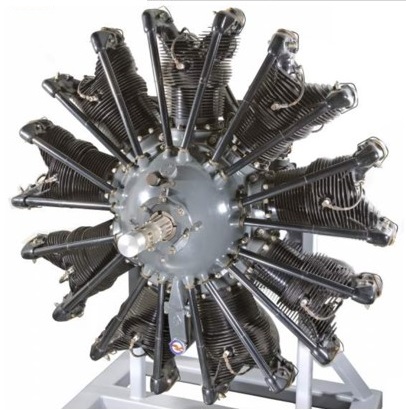
First run in 1932, the Pratt & Whitney R-1830 Twin Wasp was an American aircraft engine widely used in the 1930s and 1940s. Produced by Pratt & Whitney, it was a two-row, 14-cylinder, air-cooled radial design. It displaced 1,830 cu in (30.0 L) and its bore and stroke were both 5.5 in (140 mm). A total of 173,618 R-1830 engines was built, and from their use in two of the most-produced aircraft ever built, the B-24 bomber and DC-3 transport, more Twin Wasps may have been built than any other aviation piston engine in history. An enlarged version with a slightly higher power rating was produced as the R-2000.
Variants: R-1830-1: 800 hp (597 kW) R-1830-9: 850 hp (634 kW), 950 hp (708 kW) R-1830-11: 800 hp (597 kW) R-1830-13: 600 hp (447 kW), 900 hp (671 kW), 950 hp (708 kW), 1,050 hp (783 kW) R-1830-17: 1,200 hp (895 kW) R-1830-21: 1,200 hp (895 kW) R-1830-25: 1,100 hp (820 kW) R-1830-33: 1,200 hp (895 kW) R-1830-35: 1,200 hp (895 kW) Fitted with GE B-2 turbosupercharger R-1830-41: 1,200 hp (895 kW) Fitted with GE B-2 turbosupercharger R-1830-43: 1,200 hp (895 kW) R-1830-45: 1,050 hp (783 kW) R-1830-49: 1,200 hp (895 kW) R-1830-64: 850 hp (634 kW), 900 hp (671 kW) R-1830-65: 1,200 hp (895 kW) R-1830-66: 1,000 hp (746 kW), 1,050 hp (783 kW), 1,200 hp (895 kW) R-1830-72: 1,050 hp (783 kW) R-1830-76: 1,200 hp (895 kW) R-1830-82: 1,200 hp (895 kW) R-1830-86: 1,200 hp (895 kW) R-1830-88: 1,200 hp (895 kW) R-1830-90: 1,200 hp (895 kW) R-1830-90-B: 1,200 hp (895 kW) R-1830-92: 1,200 hp (895 kW) R-1830-94: 1,350 hp (1,007 kW) R-1830-S1C3-G: 1,050 hp (783 kW), 1,200 hp (895 kW) R-1830-S3C4: 1,200 hp (895 kW) R-1830-S3C4-G: 1,200 hp (895 kW) R-1830-S6C3-G: 1,100 hp (820 kW) R-1830-SC-G: 900 hp (671 kW) R-1830-SC2-G: 900 hp (671 kW), 1,050 hp (783 kW) R-1830-SC3-G: 1,065 hp (749 kW) Swedish unit built under license by SFA company for Finnish VL Myrsky II
Applications: Bristol Beaufort (Australian-built production) Bloch MB.176 Burnelli CBY-3 CAC Boomerang CAC Woomera Consolidated B-24 Liberator Consolidated PBY Catalina Consolidated PB2Y Coronado Consolidated PB4Y Privateer Curtiss P-36 Hawk Douglas C-47 Skytrain Douglas DC-3 Douglas DB-7 (early variants only) Douglas TBD Devastator FFVS J 22 Fokker D.XXI-4 Grumman F4F Wildcat Lioré et Olivier LeO 453 Lisunov Li-3 – A Yugoslav version of the Soviet Lisunov Li-2 Martin Maryland Republic P-43 Lancer Saab 17 Saab 18 Short Sunderland V Seversky P-35 Vickers Wellington IV VL Myrsky Vultee P-66 Vanguard
Specifications: Type: Fourteen-cylinder two-row supercharged air-cooled radial engine Bore: 5.5 in (139.7 mm) Stroke: 5.5 in (139.7 mm) Displacement: 1,829.4 in³ (30 l) Length: 59.06 in (1,500 mm) Diameter: 48.03 in (1,220 mm) Dry weight: 1,250 lb (567 kg) Valvetrain: Two overhead valves per cylinder Supercharger: Single-speed General Electric centrifugal type supercharger, 1:7.15 speed increase Fuel system: Two-barrel Stromberg carburetor Fuel type: 95-100 octane rating gasoline Cooling system: Air-cooled Reduction gear: Epicyclic gearing, 2:3 Power output: 1,200 hp (895 kW) at 2,700 rpm for takeoff 700 hp (522 kW) at 2,325 rpm cruise power at 13,120 ft (4,000 m) Specific power: 0.66 hp/in³ (29.83 kW/l) Compression ratio: 6.7:1 Specific fuel consumption: 0.49 lb/(hp•h) (295 g/(kW•h)) Power-to-weight ratio: 0.96 hp/lb (1.58 kW/kg)
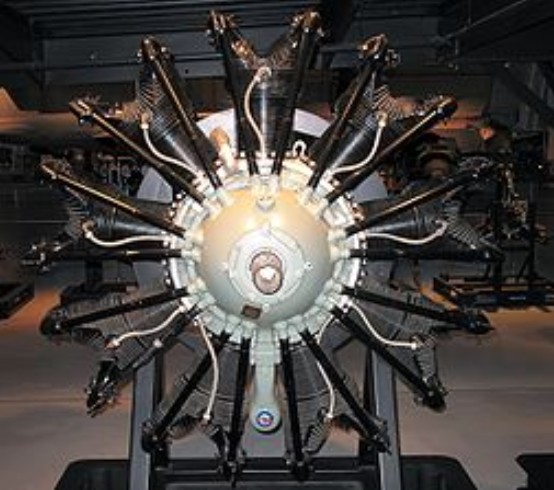
First run in June 1926, the Pratt & Whitney R-1690 Hornet was a widely used aircraft engine. It was a single-row, 9-cylinder air-cooled radial design. Displacement was 1,690 cubic inches (27.7 L).
The master connecting rod has a solid instead of detachable cap big end for higher crank speeds. The single throw two-pice crahkshaft is divided into a forward and rear section. The crankpin is integral with the forward section which transmits power to the propeller hub carried by it. The rear section telescopes into the crankpin and is carried completely through it. The two sections are united by a through bolt and kept in the proper angular relation by splines.
The main crankcase of forged aluminium is divided into two similar sections in the plane of the cylinder and united by nine through bolts between the cylinders as well as by the cylinder flanges.
All valve operating parts are enclosed. The rocker arms are supported by ball bearings and are mounted in the rocker housings which are part of the cylinder head. The push rods are enclosed by telescopic covers held in place by springs.
Every Pratt & Whitney engine is provided with a General Electric rotary induction fan used to provide proper mixture distribution. With suitable gear ratio it is possible for certain specialised purposes to provide a reasonable amount of supercharging without additional weight or complication.
All the accessories are grouped at the rear of the engine protected by the cowling.
On geared engines a 2:1 propeller speed reduction is provided by a geared unit of patented Pratt & Whitney design, weighing 840 lb.
It first flew in 1927. Developed by Pratt & Whitney, 2,944 were produced from 1926 through 1942.
It was built under licence in Italy as the Fiat A.59. In Germany, the BMW 132 was a developed version of this engine.
The R-1860 Hornet B was an enlarged version produced from 1929.
Variants: R-1690-3 525 hp (392 kW), 625 hp (466 kW)
R-1690-5 525 hp (392 kW)
R-1690-B 575 hp (429 kW)
R-1690-11 600 hp (450 kW), 775 hp (578 kW)
R-1690-S5D1G 700 hp (522 kW)
R-1690-52 750 hp (559 kW)
R-1690-SDG
R-1690-S1EG 750 hp (559 kW)
R-1690-S2EG
R-1690-25 850 hp (634 kW)
R-1690-S1C3G 1,050 hp (780 kW)
Fiat A.59 R. Licence built in Italy with reduction gearing.
Fiat A.59 R.C. Licence built in Italy with reduction gearing and supercharger.
BMW Hornet Licence production of the Hornet in Germany, independently developed as the BMW 132.
Applications: Bach Air Yacht Bellanca 31-40 Boeing 80 Boeing Model 95 Boeing 221 Boeing Model 299 Burnelli UB-14 Douglas O-38 Fokker F.32 Junkers Ju-52 Junkers Ju 86 Junkers W 34 Keystone B-3 Lockheed Model 14 Super Electra (L-14H) Lockheed Lodestar (C-56A, C-56B, C-56C, C-56D, C-56E, C-59/Mk 1a) Martin XB-14 Vought O2U Corsair Sikorsky S-42 Sikorsky S-43 Wedell-Williams Model 44
Specifications:
Hornet A-1 Type: 9 cylinder fixed radial, air cooled Military Rating: 525 hp at 1900 rpm Commercial Rating direct: 525 hp at 1900 rpm Commercial Rating geared: 500 hp at 1900 rpm Displacement: 1690 cu.in Compression ratio: 5-1 Bore: 6.125 in Stroke: 6.375 in Length: 44 7/8 in Diameter: 55 7/16 in Weight: 775 lb Fuel consumption: not more than .55 lb/hp/hr Oil consumption: not more than .035 lb/hp/hr Lubrication: Pressure (gear pump) 75-100 lb Ignition: Scintilla, dual Carburation: Stromberg, 2 bbls. Starter: Eclipse Spark plugs: Eclipse Price Series A: $8500 Price Series A.G: $9500
R-1690 SIE-G Type: Nine-cylinder single-row supercharged air-cooled radial engine Bore: 6 1⁄8 in (155.6 mm) Stroke: 6 3⁄8 in (161.9 mm) Displacement: 1,690.5 in³ (27.7 l) Length: 50.98 in (1,295 mm) Diameter: 54.41 in (1,382 mm) Dry weight: 1,014 lb (460 kg) Valvetrain: Pushrod-actuated Supercharger: Single-speed centrifugal type supercharger, 12.0:1 gear ratio Fuel system: Two-barrel Stromberg carburetor Fuel type: 87 octane rating gasoline Cooling system: Air-cooled Reduction gear: Epicyclic gearing, 2:3 Power output: 789 hp (589 kW) at 2,300 rpm for takeoff 740 hp (552 kW) at 2,250 rpm at 7,000 ft (2,135 m) Specific power: 0.47 hp/in³ (21.26 kW/l) Compression ratio: 6.0:1 Specific fuel consumption: 0.6 lb/(hp•h) (362 g/(kW/h)) Oil consumption: 0.42 oz/(hp•h) (16 g/(kW/h)) Power-to-weight ratio: 0.78 hp/lb (1.28 kW/kg)
The Pratt & Whitney R-1535 Twin Wasp Junior was an engine used in American aircraft in the 1930s. The engine was first introduced in 1932 as a 14 cylinder version of the 9-cylinder R-985. It was a two-row, air-cooled radial design. Displacement was 1,535 in³ (25.2 lt); bore and stroke were both 5-3/16 in (131.8 mm).
Variants: R-1535-11 – 750 hp (559 kW) R-1535-13 – 750 hp (559 kW), 825 hp (615 kW) R-1535-44 – 625 hp (466 kW) R-1535-72 – 650 hp (485 kW) R-1535-94 – 825 hp (615 kW) R-1535-96 – 825 hp (615 kW) R-1535-98 – 700 hp (521 kW) R-1535-SB4-G – 825 hp (615 kW)
Applications: Bellanca 28-70 Breguet 695 Curtiss SBC-3 Helldiver Douglas O-46 Fokker D.XXI (Finnish licence-built series 4 and 5) Grumman F2F Hughes H-1 Racer Miles Master Northrop A-17 Northrop BT Vought SBU Corsair Vought SB2U Vindicator
Specifications: R-1535-SB4-G Type: Fourteen-cylinder two-row supercharged air-cooled radial engine Bore: 5 3⁄16 in (131.8 mm) Stroke: 5 3⁄16 in (131.8 mm) Displacement: 1,534.9 in³ (25.153 l) Length: 53.27 in (1,353 mm) Diameter: 44.13 in (1,121 mm) Dry weight: 1,087 lb (493 kg) Valvetrain: Two overhead valves per cylinder Supercharger: Single-speed centrifugal type supercharger, 11:1 reduction Fuel system: Two-barrel Stromberg carburetor Fuel type: 87 octane rating gasoline Cooling system: Air-cooled Reduction gear: Epicyclic gearing, 0.75:1 Power output: 825 hp (615 kW) at 2,625 rpm for takeoff Specific power: 0.54 hp/in³ (24.45 kW/l) Compression ratio: 6.75:1 Specific fuel consumption: 0.49 lb/(hp•h) (295 g/(kW•h)) Oil consumption: 0.39 oz/(hp•h) (15 g/(kW•h)) Power-to-weight ratio: 0.76 hp/lb (1.25 kW/kg)
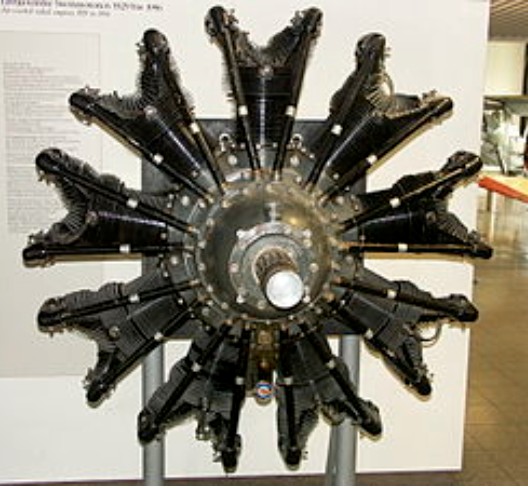
The Pratt & Whitney R-1340 Wasp was a radial aircraft engine that was widely used in American aircraft from the 1920s onward. It was the Pratt & Whitney aircraft companys first engine, and the first of the famed Wasp series. It was a single-row, nine-cylinder, air-cooled, radial design, and displaced 1,344 cubic inches (22 L); bore and stroke were both 5.75 in (146 mm).
The first Wasp was finished on 17 December 1929. Rear-mounted accessories included Scintilla magnetos, Stromberg carburettor, fuel and oil pumps. A started and generator were optional. The prototype never flew and is preserved in the Smithsonian collection. The cost to the Navy was $15,385.92.
Flight tests were conducted in several Navy types, one being Boeing’s Model 69, designated F2B-1.
Within sixty days, fifteen engines a month were being delivered to the Navy’s initial order for 200 engines, at $7,730.00 each.
The Wasp C featured a solid master connecting rod and two piece crankshaft. The master connecting rod has a solid instead of detachable cap big end allowing higher crank speeds. The single throw two-pice crankshaft is divided into a forward and rear section. The crankpin is integral with the forward section which transmits power to the propeller hub carried by it. The rear section telescopes into the crankpin and is carried completely through it. The two sections are united by a through bolt and kept in the proper angular relation by splines.
The main crankcase of forged aluminium is divided into two similar sections in the plane of the cylinder and united by nine through bolts between the cylinders as well as by the cylinder flanges.
All valve operating parts are enclosed. The rocker arms are supported by ball bearings and are mounted in the rocker housings which are part of the cylinder head. The push rods are enclosed by telescopic covers held in place by springs.
Pratt & Whitney Wasp A Serial Number 1, (R-1340), Radial 9 Engine at the National Air and Space Museum.
After taking delivery of the prototype Wright XF3W-1, the Navy installed the Pratt & Whitney Wasp number two. The Wright XF3W-1 was the first airplane to fly with a Pratt & Whitney Wasp engine.
Every Pratt & Whitney engine is provided with a General Electric rotary induction fan used to provide proper mixture distribution. With suitable gear ratio it is possible for certain specialised purposes to provide a reasonable amount of supercharging without additional weight or complication.
All the accessories are grouped at the rear of the engine protected by the cowling.
On geared engines a 2:1 propeller speed reduction is provided by a geared unit of patented Pratt & whiney design, weighing 775 lb.
First run on 29 December 1925, a total of 34,966 engines were produced.
Variants: R-1340-7: 450 hp (336 kW), 600 hp (447 kW) R-1340-8: 425 hp (317 kW) R-1340-9: 450 hp (336 kW), 525 hp (391 kW) R-1340-16: 550 hp (410 kW) R-1340-17: 525 hp (391 kW) R-1340-19: 600 hp (447 kW) R-1340-19F: 600 hp (447 kW) R-1340-21G: 550 hp (410 kW) R-1340-22: 550 hp (410 kW) R-1340-23: 575 hp (429 kW) R-1340-30: 550 hp (410 kW) R-1340-31: 550 hp (410 kW) R-1340-33: 600 hp (447 kW) R-1340-48: 600 hp (447 kW) R-1340-49: 600 hp (447 kW) R-1340-AN1: 550 hp (410 kW), 600 hp (447 kW) R-1340-AN2: 550 hp (410 kW), 3:2 geared prop shaft R-1340-B: 450 hp (336 kW) R-1340-D: 500 hp (373 kW) R-1340-S1H1-G: 550 hp (410 kW), 600 (447 kW) R-1340-S3H1: 600 hp (447 kW)
Applications: Agusta-Bell AB.102 Air Tractor AT-301 Air Tractor AT-401 Ayres Thrush Bach Air Yacht Boeing Model 40A Boeing 247 Boeing F3B Boeing F4B Boeing P-12 Boeing P-26 Peashooter Boeing P-29 CAC Ceres CAC Wirraway Curtiss Falcon Curtiss F7C Seahawk Curtiss O-52 Curtiss P-6S Hawk Curtiss SOC Seagull de Havilland Canada DHC-3 Otter Douglas Dolphin Fairchild FB-3 Fokker F.10 Fokker F.32 Ford Trimotor Gee Bee R-1 Gee Bee R-2 Super Sportster Gee Bee R 1/2 Super Sportster Gee Bee Z Gee Bee QED Grumman Mallard Grumman Ag Cat Howard DGA-6 Junkers W 34 Junkers Ju 52 Knoll Aircraft Company KN-3 Kaman HH-43 Huskie Lockheed Vega Lockheed Model 8 Sirius Lockheed Model 9 Orion Lockheed Model 10-C & 10-E Electra Lockheed XC-35 Loening OL-8 Noorduyn Norseman North American BC-1 North American T-6/SNJ Texan/Harvard Northrop Alpha Northrop C-19 Alpha Scottish Aviation Twin Pioneer Sikorsky H-19 Sikorsky S-38 Thomas-Morse XP-13A Viper Vought O2U Corsair Wedell-Williams Model 45 Westland Whirlwind (helicopter)
Specifications:
Original Wasp Bore: 5.75 in Stroke: 5.75 in Displacement: 1300 cu.in Compression: 5.25-1 Power: 400 hp at 1900 rpm Dry weight: 650 lb
Wasp A Nine-cylinder radial direct-drive Supercharged Air-cooled Displacement: 1,343.8-cubic-inch / 22.021 lt Compression ratio: 5.25:1 Power rating: 410 hp at 1,900 rpm at SL Fuel: 58 octane gasoline Length: 3 ft 6.63 in / 1.083 m Diameter: 4 ft 3.44 in / 1.307 m Weight: 745 lb / 338 kg
Wasp C Type: 9 cylinder fixed radial, air cooled Military Rating: 450 hp at 2100 rpm Commercial Rating Direct: 420 hp at 2000 rpm Commercial Rating Geared: 420 hp at 2100 rpm Displacement: 1344 cu.in Compression ratio: 5.24-1 Bore: 5 3/4 in Stroke: 5 3/4 in Length: 42 9/16 in Diameter: 51 1/2 in Weight: 695 lb Fuel consumption: not more than .55 lb/hp/hr Oil consumption: not more than .035 lb/hp/hr Lubrication: Pressure (gear pump) 75-100 lb Ignition: Scintilla, dual Carburation: Stromberg, 2 bbls Starter: Eclipse Spark plugs: B.G. Price Series C: $7200 Price Series C.G: $8200
R-1340-S1H1-G Type: Nine-cylinder single-row supercharged air-cooled radial engine Bore: 5.75 in (146 mm) Stroke: 5.75 in (146 mm) Displacement: 1,344 in3 (22 L) Diameter: 51.75 in (1.314 m) Dry weight: 930 lb (422 kg) Valvetrain: Two overhead valves per cylinder Supercharger: Single-speed centrifugal type supercharger, 1:10 step-up Fuel system: Two-barrel Stromberg carburetor Fuel type: 91 octane rating gasoline Cooling system: Air-cooled Reduction gear: 3:2 Power output: 600 hp (447 kW) at 2,250 rpm at 6,200 ft (1,890 m) Specific power: 0.45 hp/in³ (20.3 kW/L) Compression ratio: 6:1 Power-to-weight ratio: 0.65 hp/lb (1.05 kW/kg)
Pratt & Whitney developed the R-985 Wasp Junior as a smaller version of the R-1340 Wasp to compete in the market for medium-sized aircraft engines. Like its larger brother, the Wasp Junior was an air-cooled nine-cylinder radial, with its power boosted by a gear-driven single-speed centrifugal supercharger. Its cylinders were smaller, however, with a bore and stroke of 5 3⁄16 in (132 mm), giving a 27% lesser total displacement. The Wasp Junior used many parts from the Wasp and even had the same mounting dimensions, allowing an aircraft to easily use either the smaller or the larger engine. The first run of the Wasp Junior was in 1929, and sales began in 1930. The initial version, the Wasp Junior A, produced 300 hp (224 kW).
The U.S. military designated the Wasp Junior as the R-985, with various suffixes denoting different military engine models. However, Pratt & Whitney never adopted the R-985 designation scheme for its civil Wasp Juniors, identifying them simply by name and model (e.g. “Wasp Junior A”).
Pratt & Whitney followed the Wasp Junior A with more powerful models in the “A series”. These had higher compression ratios, greater RPM limits, and more effective supercharging, and they led to the “B series”. The first B series model was the Wasp Junior TB, which could maintain 420 hp (313 kW) at sea level and could reach 440 hp (328 kW) for takeoff. The TB was tuned for best performance at sea level; it was soon joined by the Wasp Junior SB, which was tuned for best performance at altitude and could sustain 400 hp (298 kW) at altitudes up to 5,000 ft (1,500 m), with 450 hp (336 kW) available for takeoff. A still later model, the Wasp Junior T1B2, had improved performance at low level, being able to sustain 450 hp (336 kW) up to 1,500 ft (460 m) while still matching the SB’s power at high altitudes. The SB and T1B2, and later versions of these with similar performance, were the most popular Wasp Junior models. One later development of the T1B2, the Wasp Junior B4, was especially designed for vertical mounting in helicopters.
During the mid-1930s, Pratt & Whitney developed a still greater improvement of the Wasp Junior, the “C series”, with an even higher compression ratio and RPM limit. The only type produced in this series, the Wasp Junior SC-G, could sustain 525 hp (391 kW) at an altitude of 9,500 ft (2,900 m) and could produce 600 hp (447 kW) for takeoff. It also included reduction gearing to allow the high-revving engine to drive a propeller at suitable speeds, hence the “-G” suffix. Aviator Jacqueline Cochran flew a special Model D-17W Beechcraft Staggerwing with this engine in 1937, setting a speed and altitude record and placing third in the Bendix transcontinental race. However, the SC-G never got past the experimental stage.
Early versions of the Wasp Junior were used in various small civil and military utility aircraft, but only in limited numbers. The type became more popular later in the 1930s. It was selected for the Lockheed Model 10A Electra twin-engined airliner, as well as for other small twin-engined civil transports like the Lockheed Model 12A Electra Junior, the Beechcraft Model 18, and the Grumman Goose amphibian. It was also used in single-engined civil utility aircraft like the Beechcraft Staggerwing, the Howard DGA-15, and the Spartan Executive.
As World War II arrived, the U.S. military chose the Wasp Junior for the Vultee BT-13 Valiant and North American BT-14 basic training aircraft and for the Vought OS2U Kingfisher observation floatplane. Military versions of existing Wasp-Junior-powered civil aircraft were also produced, such as the military derivatives of the Beech 18, Beech Staggerwing, Grumman Goose, and Howard DGA-15. The Wasp Junior also powered some versions of the British Avro Anson and Airspeed Oxford twin-engine trainers. The demands of World War II led to the production of many thousands of Wasp Juniors.
Up until the end of the war, the Wasp Junior’s closest competitor was Wright Aeronautical’s R-975 Whirlwind. However, during the war, the Wasp Junior was far more widely used in aircraft than the R-975, and Wright ceased production of the R-975 in 1945.
After World War II, many military-surplus aircraft with Wasp Junior engines entered the civil market. Production of the Beech 18 with the Wasp Junior engine continued until 1970. New designs based on the Wasp Junior were also introduced, such as the Sikorsky H-5 helicopter, the de Havilland Beaver and Max Holste Broussard bush airplanes, and agricultural aircraft like the Snow S-2B and S-2C, Grumman Ag Cat, and Weatherley 201.
Pratt & Whitney ceased production of the Wasp Junior in 1953, having built 39,037 engines.
Pratt & Whitney 450 hp DHC-2 Beaver Starting one entails pulling the prop through nine blades to make sure no engine oil had seeped past the rings of the lower cylinders: if you didn’t take this precaution, a hydraulic effect in the cylinders could result, bending the conrods. You then primed the engine with a few pumps on a pump just inside the cockpit door. Then you pumped the engine ‘wobbly pump’ to get the fuel up to the carburettor, flicked on the master switch, adjusted the mixture lever to full rich, pumped the throttle two or three times and adjust it to a point just above the stop, flicked another switch to crank the engine over (which produces a loud whine), and after five blade rotations, switched on both magnetos. The engine would then commence backfiring loudly. By then, you were watching to ensure the oil pressure was coming up. With luck, pressure was in the green zone on the gauges by the time the detonations from the engine had smoothed. The oil was to warm up to atleast 40 degreess C.
Applications: Air Tractor AT-300 Avro Anson (Mk V) Barkley-Grow T8P-1 Beechcraft Model 18 and military derivatives Beechcraft Staggerwing D17S, D17W, G17S Bell XV-3 Bellanca 300-W Berliner-Joyce OJ Boeing-Stearman Model 75 (in aftermarket conversions) Bratukhin G-3 CAC Winjeel de Havilland Canada DHC-2 Beaver and L-20/U-6 military versions Douglas C-26 Dolphin Fleetwings BT-12 Grumman G-164 Ag Cat (some models) Grumman G-21 Goose Howard DGA-11 Howard DGA-15P Koolhoven F.K.51 (some models) Lockheed Model 10-A Electra Lockheed Model 12-A Electra Junior Max Holste MH.1521 Broussard McDonnell XHJH Whirlaway North American BT-14 PWS-24bis Seversky BT-8 Sikorsky H-5 helicopter (and S-51 civil version) Sikorsky S-39 amphibian Snow S-2B and S-2C Spartan Executive 7W Stinson Reliant SR-9F and SR-10F Vought OS2U Kingfisher Vultee BT-13 Valiant Waco S3HD Waco SRE Aristocrat Weatherly 201 series Weatherly 620
Specifications:
Wasp Jr. A R-985-1 U.S. military version First production version. Power, continuous: 300 hp (224 kW) at 2,000 RPM sea level Power, takeoff: 300 hp (224 kW) at 2,000 RPM Compression ratio: 5.0:1 Supercharger gear ratio: 7:1 Octane rating: 68 Dry weight: 565 lb (256 kg)
Wasp Jr. TB, TB2 R-985-9, -11, -11A, -21, -46 U.S. military versions Early B-series versions rated for sea-level performance. Power, continuous: 420 hp (313 kW) at 2,200 RPM sea level Power, takeoff: 440 hp (328 kW) at 2,300 RPM Compression ratio: 6.0:1 Supercharger gear ratio: 8:1 Octane rating: 80 Dry weight: 640 lb (290 kg)
Wasp Jr. SB, SB2, SB3 R-985-13, -17, -23, -33, -48, -50; R-985-AN-2, -4, -6, -6B, -8, -10, -12, -12B, -14B U.S. military versions Common B-series versions rated for performance at altitude. Type: 9-cylinder supercharged air-cooled radial piston engine Power, continuous: 400 hp (298 kW) at 2,200 RPM 5,000 ft (1,500 m) Power, takeoff: 450 hp (336 kW) at 2,300 RPM Bore: 5 3⁄16 in (132 mm) Stroke: 5 3⁄16 in (132 mm) Displacement: 985 cu in (16.14 L) Length: 41.59 in (1,056 mm) Diameter: 45.75 in (1,162 mm) Compression ratio: 6.0:1 Supercharger: Single-speed gear-driven General Electric centrifugal supercharger, with impeller driven at 10 times crankshaft speed Octane rating: 80/87 aviation gasoline Dry weight: 640 lb (290 kg) ComponentsValvetrain: Two overhead valves per cylinder, pushrod-actuated Reduction gear: Direct drive Specific power: 0.406 hp/cu.in (18.5 kW/lt) Power-to-weight ratio: 0.625 hp/lb (1.03 kW/kg)
Wasp Jr. T1B2, T1B3 R-985-25, -27, -39, -39A; R-985-AN-1, -1A, -3, -3A U.S. military versions Common B-series versions with improved sea-level performance. Power, continuous: 450 hp (336 kW) at 2,300 RPM 1,500 ft (460 m) Power, takeoff: 450 hp (336 kW) at 2,300 RPM Compression ratio: 6.0:1 Supercharger gear ratio: 10:1 Octane rating: 80/87 Dry weight: 653 lb (296 kg)
Wasp Jr. B4 R-985-AN-5, -7 U.S. military versions Vertically mounted development of T1B3, for helicopters. Power, continuous: 450 hp (336 kW) at 2,300 RPM 2,300 ft (700 m) Power, takeoff: 450 hp (336 kW) at 2,300 RPM Compression ratio: 6.0:1 Supercharger gear ratio: 10:1 Octane rating: 80/87 Dry weight: 684 lb (310 kg)
Wasp Jr. SC-G Experimental high-powered version with propeller reduction gearing. Power, continuous: 525 hp (391 kW) at 2,700 RPM 9,500 ft (2,900 m) Power, takeoff: 600 hp (447 kW) at 2,850 RPM Compression ratio: 6.7:1 Supercharger gear ratio: 10:1 Octane rating: 100 Dry weight: 864 lb (392 kg)
The six-cylinder, horizontally opposed, piston, 235-h .p. M-208-C was also known as the Praga Doris C. The Doris C is a development of the 220-h.p. (3,000 r.p.m .) Doris B flat-six .