In 1950, Paul Price built a single place, open cockpit high-wing monoplane, the Price Special, registered N?767?.
Engine: 40hp Aeronca E113C
Wing span: 12’6″
Length: 5’5″
Cuise: 70 mph
Stall: 30 mph
Gross weight: 325
Seats: 1
In 1950, Paul Price built a single place, open cockpit high-wing monoplane, the Price Special, registered N?767?.
Engine: 40hp Aeronca E113C
Wing span: 12’6″
Length: 5’5″
Cuise: 70 mph
Stall: 30 mph
Gross weight: 325
Seats: 1
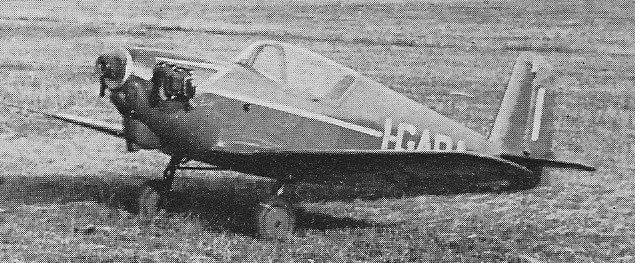
The PM-280 artuca (Tortoise) was produced in 1949 by the Instituto di Aeronautica of the Politecnico di Milano in Italy to the designs of Ermenegildo Preti.
A single-seat low-wing monoplane of all-wood construction, the Tartuca is fitted with flaps and a retractable undercarriage. Power is from a 60 hp C.N.A. D4 engine.
From the time that the design was started to the test flight was only ten weeks.
Engine: 60 hp C.N.A. D4
Wingspan: 16 ft 5 in
Wing area: 53.8 sq.ft
Length: 16 ft 6 in
Empty weight: 550 lb
Loaded weight: 770 lb
Max speed: 161 mph
Time to 3280 ft: 5 min 50 sec
Range: 342 mi
Ceiling: 10,827 ft

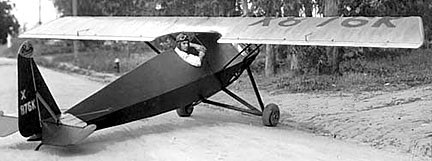
The Prest Baby Pursuit of 1929 was a single-place monoplane with a diamond-shaped fuselage cross-section, designed by Clarence Prest. Priced at $2,100, optional engines were the 40hp Szekely SR-3 and 60hp Lawrance.
Seven were built including prototype NX876K, NX955Y, NX2304, NX13741, and NX17308/17309.
One set a world’s lightplane speed record of 101mph on 28 May 1930, using a 40hp Szekely, piloted by Prest.
Engine: 45hp Anzani
Wingspan: 24’0″
Length: 17’11”
Useful load: 225 lb
Max speed: 100 mph
Cruise: 80 mph
Stall: 40 mph
Range: 250 mi
Predappio sa, a division of the Caproni Group, produced two trainers in the late 1930s, the Ca.602 two-seat biplane and a single-seat aerobatic version, the Ca.603, both powered by Alfa-Romeo in-line engines.
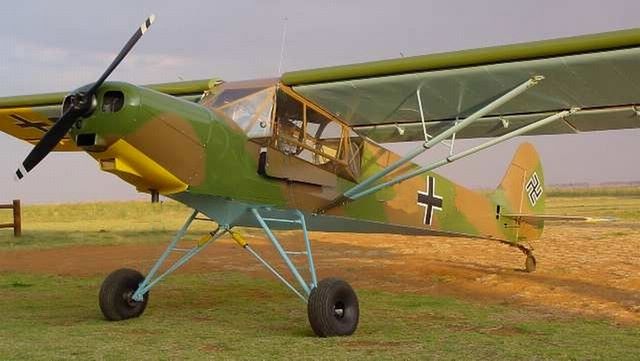
The LSA STOL King is of conventional tube and fabric design, approximately the size of a Cub, with a full glass enclosure and a tall stance for very rough field operation. Slow flights of 16 mph can be achieved and stall speeds of 15 mph let you land in some of the most remote areas of the world.
The construction material are 4130 steel tube & fabric and wing sub-kits come with ailerons, flaps, all hardware, brackets, fittings, fuel tanks, ribs, skins, spars and lift struts. No fabric.
Fuselage sub-kits come with stabilizers, elevators, rudder, landing gear, seat cusions, control systems, all glass, blank instrument panel, wheels and brakes, tailwheel, stringer formers, shock struts, brackets, fittings, firewall and all hardware and necessary accessories. No fabric or instruments.
Firewall forward package comes with engine, exhaust stacks, intake manifolds, carb heat, engine mount, prop, carburetor and hardware Engine prices will vary depending on model, horsepower and electrical option.
In 2009 the complete kit cost US$25,000 less engine, instruments, fabric, prop.
Engine: 75 hp
Horsepower: 75 – 150 hp
Propeller: 72 x 43
Overall length: 23 ft – 8 in
Height: 7 ft – 3 in
Wingspan: 31 ft – 6 in
Wing area: 158 square feet
Wing loading: 7.6 lb/sq.ft
Empty weight: 600 lbs
Gross weight: 1200 lbs
Useful weight: 600 lbs
Fuel capacity: 20 + US gallons
Cabin width: 32.50 inches
Ultimate “g” loading: +6.0 – 3.0
Best speed: 100 mph
Cruise speed: 90 mph
Stall Speed @ Gross w/Full Flaps: 15 mph
Service ceiling: 12,000
Takeoff distance: 50 ft
Landing distance: 50 ft
Rate of Climb (gross): 1200 fpm
Maximun range: up to 700 miles
Landing gear: FG (Tailwheel)
Seats: 2
Engine: 120 hp
Horsepower: 75 – 150 hp
Propeller: 72 x 43
Overall length: 23 ft – 8 in
Height: 7 ft – 3 in
Wingspan: 31 ft – 6 in
Wing area: 158 square feet
Wing loading: 7.6 lb/sq.ft
Empty weight: 600 lbs
Gross weight: 1200 lbs
Useful weight: 600 lbs
Fuel capacity: 20 + US gallons
Cabin width: 32.50 inches
Ultimate “g” loading: +6.0 – 3.0
Best speed: 130 mph
Cruise speed: 100 mph
Stall Speed @ Gross w/Full Flaps: 15 mph
Service ceiling: 12,000
Takeoff distance: 50 ft
Landing distance: 50 ft
Rate of Climb (gross): 1200 fpm
Maximun range: up to 700 miles
Landing gear: FG (Tailwheel)
Seats: 2
Engine: VW 50 hp
HP range: 75-130
Length: 24 ft
Wing span: 31.5 ft
Wing area: 158 sq.ft
Empty weight: 600 lb
Gross weight: 1200 lb
Fuel capacity: 20USG
Cruise: 100 mph
Stall: 15 mph
Range: 520 sm
Rate of climb: 1200 fpm
Takeoff dist: 50 ft
Landing dist: 50 ft
Cockpit width: 33 in
Seats: 2 tandem
Landing gear: tailwheel
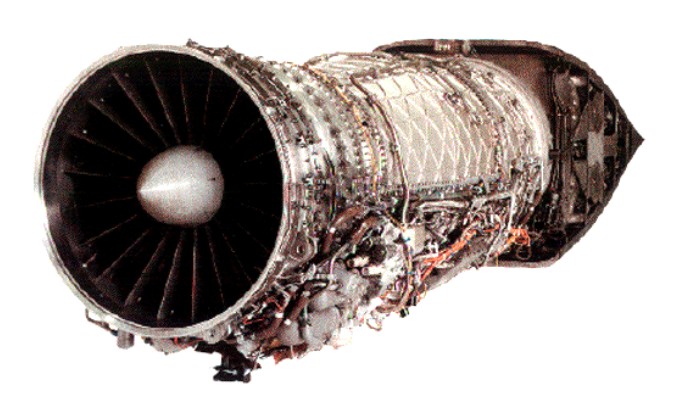
The Pratt & Whitney F119 (company designation PW5000) is an afterburning turbofan engine developed by Pratt & Whitney for the Lockheed Martin F-22 Raptor advanced tactical fighter.
The engine delivers thrust in the 35,000 lbf (160 kN) class, and is designed for supersonic flight without the use of afterburner (supercruise). Delivering almost 22% more thrust with 40% fewer parts than conventional, fourth-generation military aircraft engine models, the F119 allows sustained supercruise speeds of up to Mach 1.72. The F119’s nozzles incorporate thrust vectoring technology. These nozzles direct the engine thrust ±20° in the pitch axis to give the F-22 enhanced maneuverability.
The F119 derivative, the F135, produces 40,000 lbf (180 kN) of thrust for the F-35 Lightning II.

In 2013 Pratt assisted the F119 Heavy Maintenance Center (HMC) at Tinker Air Force Base, Oklahoma in the first depot overhaul of a F119 engine.
Applications:
Lockheed Martin F-22 Raptor
Lockheed YF-22
Northrop YF-23
Specifications:
F119
Type: twin-spool, augmented turbofan
Length: 16 ft 11 in (5.16 m)
Diameter: ~46 in (1.168 m)
Dry weight: 3,900 lb (1770 kg)
Compressor: Twin Spool/Counter Rotating/Axial Flow/Low Aspect Ratio 3 stage low-pressure, 6 stage high-pressure compressor
Combustors: Annular Combustor
Turbine: Axial Flow/Counter-Rotating 2 single-stage turbines
Nozzle: Two Dimensional Vectoring Convergent/Divergent
Maximum thrust: >35,000 lbf (156 kN) (with afterburner)
Thrust-to-weight ratio: 7.95
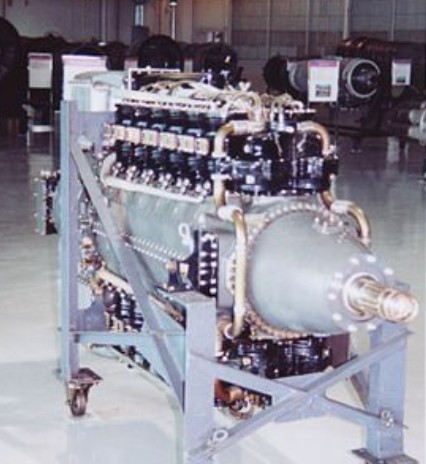
The Pratt & Whitney X-1800 (later enlarged as the XH-2600) was an H-block aircraft engine project developed between 1938 and 1940, which was cancelled with only one example being built.
The X-1800 was a watercooled 24-cylinder H-block of 2,240 cu.in displacement; this was later expanded to 2,600 cu.in displacement. It was intended to be used in the Vultee XP-54, Curtiss-Wright XP-55 Ascender, Northrop XP-56, and Lockheed XP-49. Projected performance was to be 1,800 to 2,200 hp (1350-1640 kW), with a turbocharger to secure high-altitude performance. The designation came from the intended power rating rather than the more usual cubic inch engine displacement figure.
The target date for series production was 1942. In 1940, however, performance on the test bench did not continue to improve, demonstrating a need for considerable additional development effort. Pratt & Whitney subsequently ended development of the X-1800 in October 1940, with only one built, to concentrate on radial engines.
Specifications:
X-1800
Type: 24 cylinder H-engine
Bore: 5.25in (133.35mm)
Stroke: 5.00in (127mm)
Displacement: 2,597.7 cu in (42.57L)
Length: 107in (2.71m)
Dry weight: 2,400lb (1,089kg)
Valvetrain: Sleeve valves
Power output: 1,800 – 2,000 hp
The Pratt & Whitney XH-3130 (sometimes called the XL-3130) was an H-block aircraft engine project developed for the United States Navy in the late 1930s. The design was later enlarged as the XH-3730), but the project was canceled in 1940 in favor of Pratt & Whitney developing the R-4360 Wasp Major air-cooled radial engine.
Type: 24 cylinder H-engine
Bore: 6.00in (152.4mm)
Stroke: 5.50in (139.7mm)
Displacement: 3,732.2 cu in (61.16L)
Valvetrain: Sleeve valves
Power output: 2,900 hp
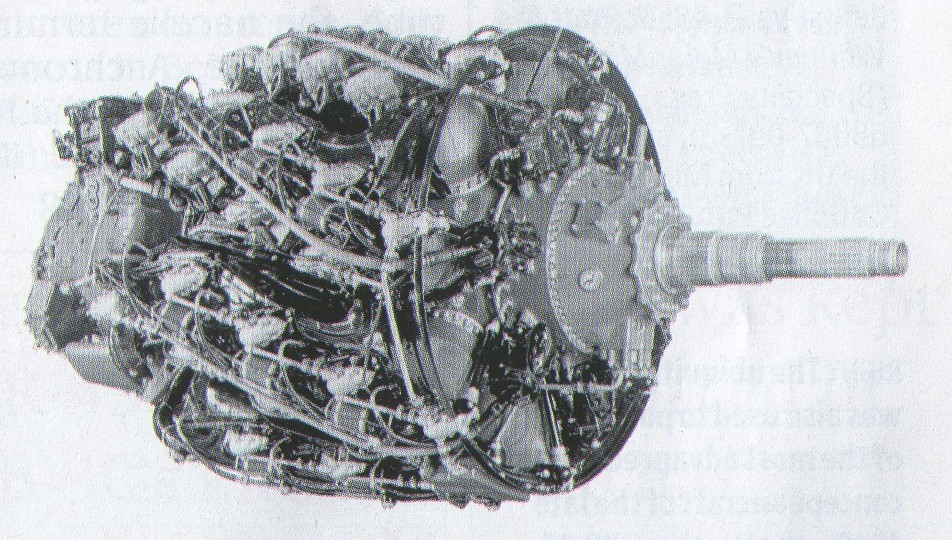
Starting in 1940, and production begining in 1945, just too late for the Second World War, the engineers at P&W were tasked with developing a 3,000 h.p.-plus engine. At the beginning of the R-4360’s development, state-of-the-art engines were struggling to achieve 2,000 h.p. P&W decided on air cooling and, after a number of variations and permutations of cylinder arrangement had been investigated, the final concept, which went into production, was four rows of seven cylinders, giving a total of 28.
Cooling high-performance air-cooled engines was always a challenge, for the R-4360. Each row of pistons was slightly offset from the previous, forming a semi-helical arrangement to facilitate efficient airflow cooling of the successive rows of cylinders, with the spiraled cylinder setup inspiring the engine’s “corncob” nickname. Seven plenums, one between each cylinder bank, created the necessary cooling air path. A complex tight baffling system ensured that cooling air was forced through the cylinders in a quasi-cross-flow pattern. To ensure an unobstructed path, intake manifolds were routed over the top of the cylinders, terminating in a downdraught flow into the hemispherical combustion chamber.
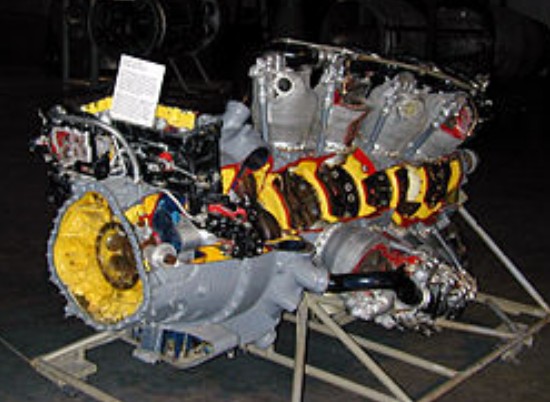
A mechanical supercharger geared at 6.374:1 ratio to engine speed provided forced induction, while the propeller was geared at 0.375:1 so that the tips did not reach inefficient supersonic speeds. General Electric (GE) had designed most previous P&W superchargers, but this time P&W decided to do it in-house. According to former R-4360 engineers, P&W’s supercharger was more efficient than GE’s. Most superchargers were single-stage, with variable speed or single speed. Additionally, most R-4360 applications were augmented by GE turbosuperchargers with intercooling, A two-stage gear-driven supercharger was also developed.
Inevitable teething problems arose when the R-4360 entered service, such as frying the ignition system, intake manifold problems and, perhaps most seriously, poor oil scavenging owing to aeration of the oil. The disarmingly simple solution for the last of these problems was to incorporate perforated sheet-metal plates in the rear housing, which took out much of the entrapped air.
Although reliable in flight, the Wasp Major was maintenance-intensive. Improper starting technique could foul all 56 spark plugs, which would require hours to clean or replace. As with most piston aircraft engines of the era, the time between overhauls of the Wasp Major was about 600 hours when used in commercial service.
Engine displacement was 4,362.50 cu.in (71.5 lt), hence the model designation. Initial models developed 3,000 hp (2,240 kW), and later models 3,500 hp, but one model delivered 4,300 hp (3200 kW) using two large turbochargers in addition to the supercharger. Engines weighed 3,482 to 3,870 lb (1,579 to 1,755 kg), giving a power-to-weight ratio of 1.11 hp/lb (1.83 kW/kg), which was matched or exceeded by very few contemporary engines.
Designed for military use, the R-4360 also saw commercial use as the “Wasp Major”. The R-4360 was used for a number of applications, including commercial aviation, military aircraft and air racing. The R-4360-8 powered the Douglas XTB2D-1 Skypirate, the contra-rotating propeller shafts each drove a Hamilton Standard four-bladed propeller. The Skypirate was cancelled after one prototype.
Wasp Majors were produced between 1944 and 1955; 18,697 were built.
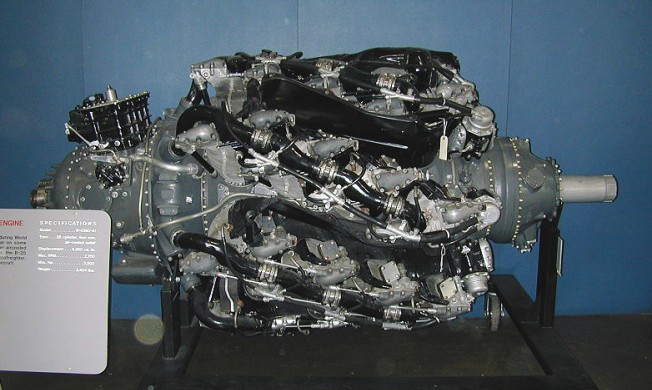
A derivative engine, the Pratt & Whitney R-2180-E Twin Wasp E, was essentially the R-4360 “cut in half”. It had two rows of seven cylinders each, and was used on the postwar Saab 90 Scandia airliner.
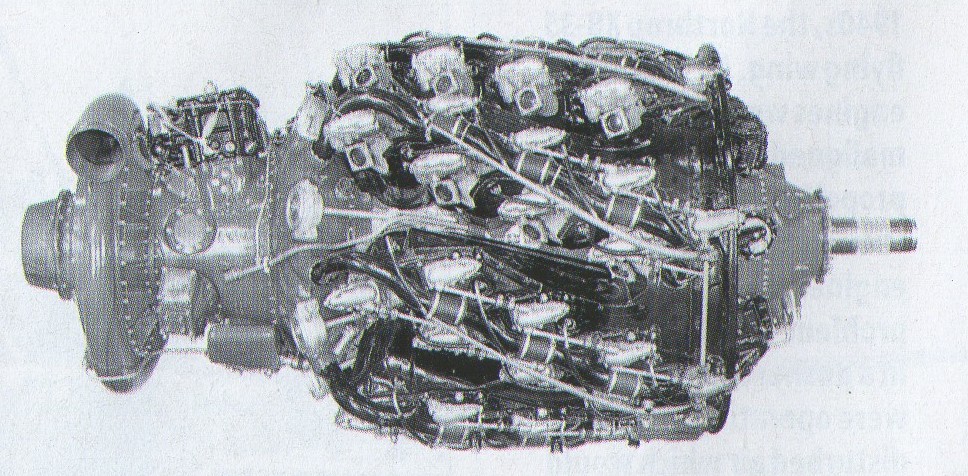
The R-4360-33 powered the Boeing XB-44, essentially a B-29 converted to carry R-4360s. Note auxiliary gear driven supercharger on the rear of the engine. Some R-4360s utilised both contra-props and two-stage supercharging.
Applications:
Aero Spacelines Mini Guppy
Aero Spacelines Pregnant Guppy
Boeing 377 Stratocruiser
Boeing B-50 Superfortress
Boeing C-97 Stratofreighter
Boeing KC-97 Stratotanker
Boeing XF8B
Boeing XB-44 Superfortress
Convair B-36
Convair XC-99
Curtiss XBTC
Douglas C-74 Globemaster
Douglas C-124 Globemaster II
Douglas TB2D Skypirate
Fairchild C-119 Flying Boxcar
Fairchild C-120 Packplane
Goodyear F2G Corsair
Hughes H-4 Hercules (“Spruce Goose”)
Hughes XF-11
Lockheed R6V Constitution
Martin AM Mauler
Martin JRM Mars
Martin P4M Mercator
Northrop B-35
Republic XP-72
Republic XF-12 Rainbow
SNCASE SE-2010 Armagnac
Vultee A-41
Variants:
R-4360-4 – 2,650 hp (1,976 kW)
R-4360-20 – 3,500 hp (2,610 kW)
R-4360-25 – 3,000 hp (2,237 kW)
R-4360-41 – 3,500 hp (2,610 kW)
R-4360-51 VDT – “Variable Discharge Turbine” 4,300 hp (3,210 kW). Intended for B-36C. Used on Boeing YB-50C Superfortress. Turbo-supercharger exhaust used to augment thrust.
R-4360-53 – 3,800 hp (2,834 kW)
R-4360-B3 – 3,500 hp (2,610 kW)
R-4360-B6 – 3,500 hp (2,610 kW)
Specifications:
R-4360-51VDT
Type: 28-cylinder supercharged air-cooled four-row radial engine
Bore: 5.75 inches (146 mm).
Stroke: 6.00 inches (152 mm).
Displacement: 4,362.5 cubic inches (71.489 lt).
Length: 96.5 inches (2,450 mm).
Diameter: 55 inches (1,400 mm).
Dry weight: 3,870 pounds (1,760 kg).
Valvetrain: Poppet, two valves per cylinder
Supercharger: Gear-driven single stage variable speed centrifugal type supercharger
Turbocharger: General Electric CHM-2
Fuel system: Bendix-Stromberg PR-100E2 pressure carburetor
Fuel type: 115/145 Aviation gasoline
Cooling system: Air-cooled
Power output: 4,300 hp (3.2 MW)
Specific power: 0.99 hp/cu.in (44.9 kW/lt)
Compression ratio: 6.7 : 1
Power-to-weight ratio: 1.11 hp/lb (1.83 kW/kg)
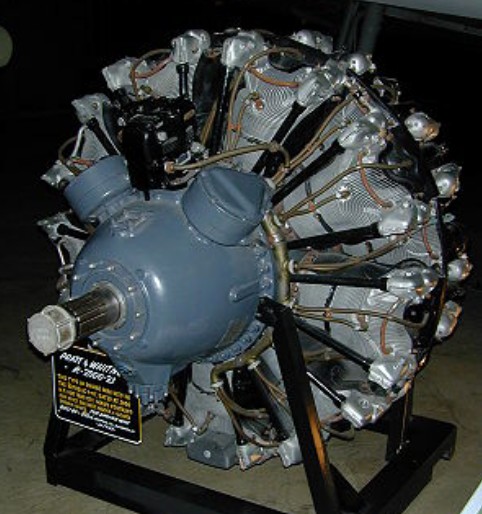
First run in 1937, the R-2800 was America’s first 18-cylinder radial engine design. The Double Wasp was more powerful than the world’s only other modern eighteen, the Gnome-Rhône 18L; which itself was even larger than the contemporary American Wright Duplex-Cyclone radial of 3,347 cu.in (54.86 lt) then under development, but the Double Wasp was much smaller in displacement than either of the other 18-cylinder designs, and heat dissipation was a greater problem. To enable more efficient cooling, the usual practice of casting or forging the cylinder head cooling fins that had been effective enough for other engine designs was discarded, and instead, much thinner and closer-pitched cooling fins were machined from the solid metal of the head forging. The fins were all cut at the same time by a gang of milling saws, automatically guided as it fed across the head in such a way that the bottom of the grooves rose and fell to make the roots of the fins follow the contour of the head, with the elaborate process substantially increasing the surface area of the fins. Cylinder cooling was effected by aluminum cooling muffs that were shrunk onto the steel alloy forged barrels. In addition to requiring a new cylinder head design, the Double Wasp was probably the most difficult to effectively direct a flow of cooling air around.
Pratt & Whitney R-2800 Double Wasp Article
The twin ignition magnetos on the Double Wasp were prominently mounted on the upper surface of the forward gear reduction housing and almost always prominently visible within a cowling, with the driveshafts for the magnetos emerging from the gear reduction case either directly forward or directly behind the magneto’s cases, or on the later C-series R-2800s with the two-piece gear reduction housings, on the “outboard” sides of the magneto casings.
When the R-2800 was introduced in 1939 it was capable of producing 2,000 hp (1,500 kW), for a specific power value of 0.71 hp/cu.in (32.6 kW/L). In 1941 the power output of production models increased to 2,100 hp (1,600 kW), and to 2,400 hp (1,800 kW) late in the war. However, even more was coaxed from experimental models, with fan-cooled subtypes producing 2,800 hp (2,100 kW), but in general the R-2800 was a rather highly developed powerplant right from the beginning.
The R-2800 was used to power several types of fighters and medium bombers during the war, notably the US Navy’s Vought F4U Corsair, with the XF4U-1 first prototype Corsair becoming the first-ever airframe to fly with the Double Wasp on May 29, 1940, and the first single-engine US fighter plane to exceed 400 mph (640 km/h) in level flight during October 1940. The R-2800 also powered the Corsair’s naval rival, the Grumman F6F Hellcat, the US Army Air Forces’ Republic P-47 Thunderbolt, the twin-engined Martin B-26 Marauder and Douglas A-26 Invader, as well as the first purpose-built twin-engined radar-equipped night fighter, the Northrop P-61 Black Widow.
When the US entered the war in December 1941, some major changes in American military aviation engine design and manufacturing philosophy rapidly emerged, with such long-established engines as the Wright Cyclone and Double Wasp being re-rated on fuel of much higher octane rating (anti-knock value) to give considerably more power. By 1944, versions of the R-2800 powering late-model P-47s (and other aircraft) had a rating (experimental) of 2,800 hp on 115-grade fuel with water injection.
After World War II, the engine was used in the Korean War, and surplus World War II aircraft powered by the Double Wasp served with other countries well past the Korean War, some being retired as late as the latter part of the 1960s when the aircraft were replaced.
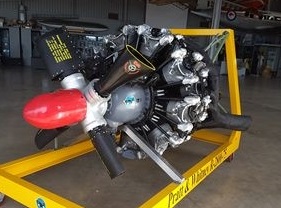
A major war demands the utmost performance from engines fitted to aircraft whose life in front-line service was unlikely to exceed 50 hours’ flying, over a period of only a month or two. In peacetime however, the call was for reliability over a period of perhaps a dozen years, and the R-2800’s reliability commended its use for long-range patrol aircraft and for the Douglas DC-6, Martin 4-0-4, and Convair transports. This last application is noteworthy, since these were twin-engined aircraft of size, passenger capacity, and high wing loading comparable with the DC-4 and the first Constellations.
A total of 125,334 R-2800 engines were produced between 1939 and 1960.
Variants:
Power ratings quoted are usually maximum “military” power that the engine could generate on takeoff and at altitude: 100 Octane fuel was used, unless otherwise noted.
The R-2800 was developed and modified into a basic sequence of subtypes, “A” through “E” series, each of which indicated major internal and external modifications and improvements, such that the “E” series engines had very few parts in common with the “A”.
Note: Suffixes such as -S14A-G denote engines developed for export to other countries.
The dash number for each military type (e.g.: -21) was allocated to identify the complete engine model in accordance with the specification under which the engine was manufactured, thus it did not necessarily indicate the sequence in which the engines were manufactured; for example: the -18W was a “C” series engine, built from 1945, whereas the -21 was a “B” series engine, built from 1943.
Until 1940 the armed forces adhered strictly to the convention that engines built for the Army Air Force used odd dash numbers (e.g.: -5), while those built for the US Navy used even (e.g.: -8). After 1940, however, in the interests of standardization, engines were sometimes built to a joint Army-Navy contract, in which case the engines used a common dash number (e.g.: the -10 was used by both Army and Naval aircraft.)
The suffix W e.g.: -10W denotes a sub-series modified to use A.D.I Anti-Detonant Injection or water injection equipment, using various mixes of water and methyl alcohol (CH3OH) injected into the carburetor to increase power for short periods: several models of R-2800s were fitted as standard with A.D.I and did not use the W suffix. Few commercial aircraft used water injection.
“A” Series:
R-2800-1
1,500 hp (1,118 kW) at 2,400 rpm at 7,500 ft (2,286 m). Production prototype of “A” series engines with the first flight test July 29, 1939. Single-speed two-stage supercharger. Production = 2 (P&W). Tested in Vultee YA-19B.
R-2800-5
1,850 hp (1,379 kW) at 2,600 rpm at 2,700 ft (823 m). Main production “A” series engine used in Douglas B-23 Dragon, Martin B-26A, early B series and XB-26D and Curtiss C-55/XC-46. Production = 1,429 (P&W 475, Ford 954.)
“B” Series:
The A and B series can be most readily identified by their smooth, single piece nose casings.
R-2800-8
2,000 hp (1,491 kW) at 2,700 rpm at 1,000 ft (305 m); 1,800 (1,342 kW) at 2,700 rpm at 15,500 ft (4,724 m). First series production “B” Series engine using a two-stage, two-speed supercharger and with internal engineering changes resulting in increased power and reliability. Updraft Bendix-Stromberg PT-13D-4 pressure carburetor. First production engines delivered to U.S.N November 11, 1941. Used in Brewster F3A-1, Goodyear FG-1, Vought F4U-1 and F4U-2. Production = 3,903 (P&W 2,194; Nash 1,709.)
R-2800-8W
2,250 hp (1,677 kW) WEP with water injection. First production engine using ADI equipment, major production version of -8 and used in same versions of F4U Corsair. Production = 8,668 (P&W 5,574; Nash 3,094.)
R-2800-10 and R-2800-10W
2,000 hp (1,491 kW) at 2,700 rpm at 1,000 ft (305 m); 1,800 (1,342 kW) at 2,700 rpm at 15,500 ft (4,724 m); up to 2,250 hp (1,677 kW) WEP with water injection. Similar to -8 series apart from downdraft PT-13G2-10 and PT-13G6-10 (-10W) carburetor. Used in Curtiss XP-60E, Grumman F6F-3 (-10; late production -10W) and F6F-5 (-10W) series and Northrop XP-61, YP-61, and P-61A-1. Production = 4,621 -10 (P&W 2,931; Nash 1,690) and 12,940 -10W (P&W 3,040; Nash 9,900); Total = 17,561.
R-2800-21
2,000 hp (1,491 kW) at 2,700 rpm at 2,500 ft (762 m); 2,000 hp (1,491 kW) at 2,700 rpm at 25,000 ft (7,620 m). First production variant fed by a General Electric C-1 turbosupercharger. Designed for use in the Republic P-47B, C, D, G and XP-47F and K. Production = 5,720 (P&W 1,049; Ford 4,671.)
R-2800-59
2,000 hp (1,491 kW) at 2,700 rpm at 2,500 ft (762 m); 2,000 hp (1,491 kW) at 2,500 rpm at 25,000 ft (7,620 m); 2,300 hp (1,700 kW) WEP with water injection. Main production variant used in P-47 series, fed by an improved C-23 turbosupercharger. Differed from -21 in being fitted with A.D.I and a General Electric ignition system with a simplified, tubular ignition harness developed by the Scinitilla company in partnership with Bendix. Used in P-47C and D, XP-47L. Production = 11,391 (P&W 592; Ford 10,799).
“C” Series
R-2800-18W
2,100 hp (1,566 kW) at 2,800 rpm at 1,000 ft (305 m); 1,800 hp (1,342 kW) at 2,800 rpm at 25,500 ft (7,772 m). First series production variant of the “C” Series, which was a complete redesign of the R-2800. Some of the main changes were forged, rather than cast cylinders, allowing an increased compression ratio (from 6.65:1 to 6.75:1), a redesigned crankshaft, a single piece, rather than split crankcase center section, and a two section nose casing, incorporating hydraulically operated torque-monitoring equipment and an automatic, vacuum operated spark-advance unit. The supercharger used fluid coupling for the second stage. Updraft Bendix-Stromberg PT-13G2-10 carburetor. Used in Vought F4U-4 and -4 variants. Production = 3,257 (P&W).
R-2800-22W – 2,400 hp (1,789 kW)
R-2800-27 – 2,000 hp (1,491 kW)
R-2800-30W – 2,250 hp (1,677 kW)
R-2800-31 – 2,000 hp (1,491 kW)
R-2800-32(E) – 2,450 hp (1,827 kW), 2,850 hp (2,125 kW) with water-methanol injection
R-2800-34 – 2,100 hp (1,567 kW)
R-2800-34W – 2,400 hp (1,789 kW)
R-2800-39 – 2,000 hp (1,491 kW)
R-2800-41 – 2,000 hp (1,491 kW)
R-2800-43 – 2,000 hp (1,491 kW)
R-2800-44 – 2,300 hp (1,700 kW)
R-2800-44W – 2,400 hp (1,789 kW)
R-2800-48 – 2,500 hp (1,890 kW)
R-2800-48W – 2,400 hp (1,789 kW)
R-2800-51 – 2,000 hp (1,491 kW)
R-2800-54 – 2,100 hp (1,567 kW)
R-2800-57 – 2,800 hp (2,090 kW)
R-2800-57C – 2,800 hp (2,090 kW)
R-2800-59W – 2,500 hp (1,890 kW)
R-2800-65 – 2,000 hp (1,491 kW)
R-2800-65W – 2,250 hp (1,677 kW)
R-2800-71 – 2,000 hp (1,491 kW)
R-2800-73 – 2,800 hp (2,090 kW)
R-2800-75 – 2,200 hp (1,640 kW)
R-2800-77 – 2,800 hp (2,090 kW)
R-2800-79 – 2,000 hp (,1491 kW)
R-2800-83 – 2,100 hp (1,567 kW)
R-2800-83AM – 2,100 hp (1,567 kW)
R-2800-99W – 2,300 hp (1,700 kW)
R-2800-103W – 2,500 hp (1,890 kW)
R-2800-2SB-G – 1,850 hp (1,379 kW)
R-2800-CB16 – 2,400 hp (1,789 kW), 2,500 hp (1,890 kW)
R-2800-CB17 – 2,500 hp (1,890 kW)
R-2800-S1A4-G – 1,850 hp (1,379 kW)
R-2800-S1C3-G – 2,100 hp (1,567 kW)
Applications:
Brewster XA-32
Breguet Deux-Ponts
Canadair CL-215
Canadair C-5 North Star
Consolidated TBY Sea Wolf
Convair 240, 340, and 440
Curtiss P-60
Curtiss XF15C
Curtiss C-46 Commando
Douglas A-26 Invader
Douglas DC-6
Fairchild C-82 Packet
Fairchild C-123 Provider
Grumman AF Guardian
Grumman F6F Hellcat
Grumman F7F Tigercat
Grumman F8F Bearcat
Howard 500
Lockheed Ventura/B-34 Lexington/PV-1 Ventura/PV-2 Harpoon
Lockheed XC-69E Constellation
Martin B-26 Marauder
Martin 2-0-2
Martin 4-0-4
North American AJ Savage
North American XB-28
Northrop XP-56 Black Bullet
Northrop P-61 Black Widow
Northrop F-15 Reporter
Republic P-47 Thunderbolt
Sikorsky CH-37 Mojave
Sikorsky S-60
Vickers Warwick
Vought F4U Corsair
Vultee YA-19B
Specifications:
R-2800-54
Type: 18-cylinder air-cooled twin-row radial engine with water injection
Bore: 5.75 in (146.05 mm)
Stroke: 6 in (152.4 mm)
Displacement: 2,804.5 cu.in (45.96 L)
Diameter: 52.8 in (1,342 mm)
Dry weight: 2,360 lb (1,073 kg)
Valvetrain: Poppet, two valves per cylinder
Supercharger: Variable-speed (in F8F-2, unified with throttle via AEC automatic engine control), single-stage single-speed centrifugal type supercharger
Fuel system: One Stromberg injection carburetor
Fuel type: 100/130 octane gasoline
Cooling system: Air-cooled
Power output: 2,100 hp (1,567 kW) @ 2,700 rpm
Specific power: 0.75 hp/cu.in (34.1 kW/L)
Power-to-weight ratio: 0.89 hp/lb (1.46 kW/kg)

