Proctor Kittiwake I / Mitchell-Proctor Kittiwake I

G-ATXN Mitchell-Procter Kittiwake

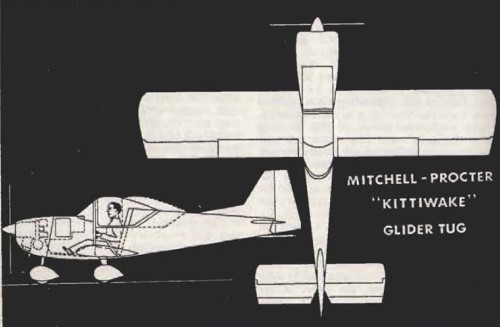
Originally designed in 1964-65 by R. G. Proctor and C. G. B. Mitchell as a dedicated single-seat glider tug aircraft. Mitchell-Procter Aircraft was set up to produce the Kittwake prototype. It was a development of the Mitchell-Prizeman Scamp design study of 1964. ‘Kit’ Mitchell was the Kittiwake’s designer, with Roy Procter in charge of building it. It had excellent visibility, sturdy landing gear.

The Kittiwake was of all-metal stressed skin construction with tricycle landing gear. The nose-wheel was steerable for taxiing and the aircraft was fitted with hydraulic brakes.
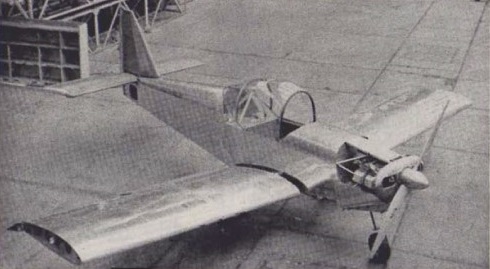
Mitchell-Proctor Kittiwake Under Construction 1 Jan 1967

The aircraft would be capable of aerobatics with a rate of Roll 200 degrees at 103 mph (90 kn; 166 km/h). The Kittiwake had a rate of climb of 700 feet (213 metres) per minute with a 1,000 lb (454 kg) glider in tow.

The single-seat Kittiwake I is an all-metal aircraft, with low cantilever wings of parallel chord built around a single spar carrying 5° of dihedral. NACA single slotted flaps occupy the whole of the trailing edge inboard of the ailerons. The wings attach to a centre section which is integral with the fuselage, a feature intended to help construction in a small space like a garage. The straight tapered fin carries a horn balanced rudder and the constant chord tailplane has a starboard side trim tab.
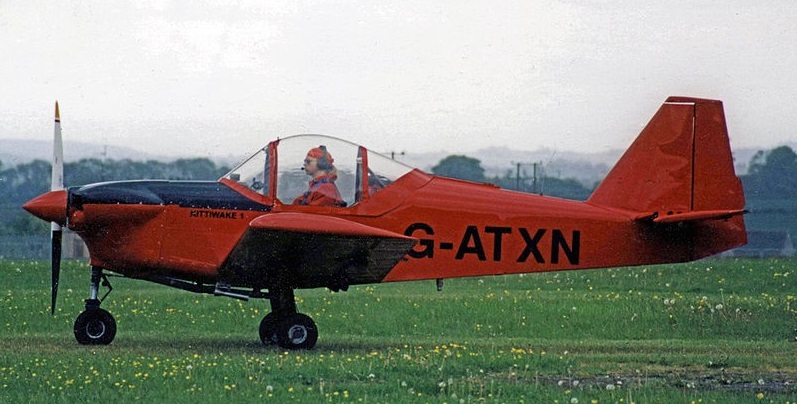
The Kittiwake’s fuselage is built around four longerons, with flat sides and bottom and single curvature decking. Its overwing cockpit has a rearward sliding canopy and its fixed tricycle undercarriage has cantilever angled steel spring main legs attached to the lower longerons, giving a track of 5 ft 9 in (1.75 m). The Kittiwake I was powered by a 100 hp (75 kW) Continental O-200 engine.

The wing had generous flaps with high operating speeds which allowed for a fast descent. It had a self-starter system, provision for a radio. The Kittiwake also had a mechanism for retracting the tow rope during the descent. This design was fully aerobatic and additional fuel tanks could be fitted to extend the range.

Mitchell-Proctor Kittiwake Under Construction 1966

By the middle of 1965 production tooling were being made for the wing ribs as well as spars machined.

The Kittiwake single-seat, low-wing monoplane was designed to make full use of all-metal materials and modern construction while retaining a simplicity of design that lends itself to homebuilding.
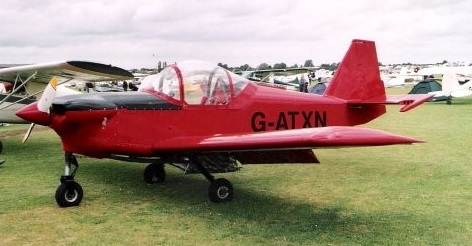
Mitchell-Proctor Kittiwake I G-ATXN Cranfield 22 Jun 2002

The prototype was started at Camberley but completed by BEA Engineering in 1966-7, powered by a Continental O-200-A. First flown at Lasham on 23 May 1967, it was registered G-ATXN PFA.1306. It was re-engined with a fan-cooled Lycoming O-290 at Lasham in 1972. The prototype was later known as the Mitchell-Procter Kittiwake I. Around a year and a half later the partnership was dissolved and plans for home builders were produced by Procter Aircraft Associates.

A second was built at RNAS Lee-on-Solent as an apprentice project under Lieutenant Commander Cudmore, started in 1969. First flying on 21 October 1971 sn serial XW784, at Lee-on-Solent, powered by a Rolls-Royce/Continental O-200-A.
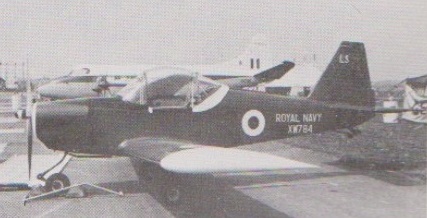
It was subsequently registered G-BBRN. Built, one by Royal Navy apprentices in 1971 for glider towing, a larger diameter (6 ft 4 in, 1.93 m) propeller is fitted, increasing the rate of climb by 24%. A tow release hook is fitted under the tail. Only one Kittiwake II, the prototype, was built.

In later years the prototype was re-engined with a Lycoming O-290-D2 engine.

Mitchell continued development and produced the Mitchell Kittiwake II two-seater. Plans were available for both single-seat and two-seat versions, but only four were constructed. Examples built of the Kittiwake I: G-AXTN, G-BBRN (marked as XW784).
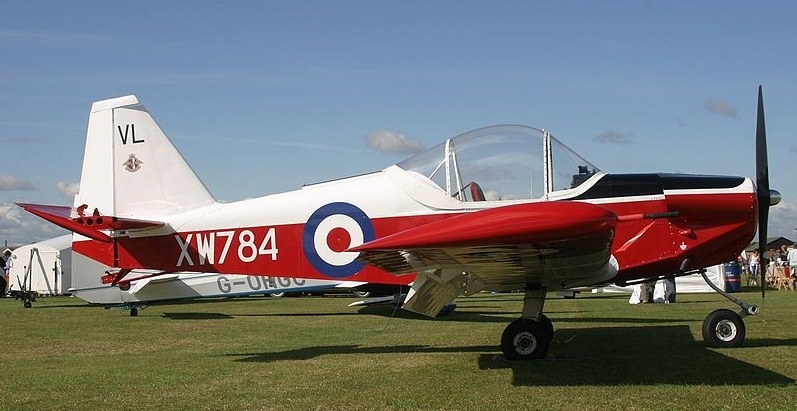
One Kittiwake was active until at least at 2005 and the other is still active. They remain on the UK Civil Register. These are the prototype, G-ATXN and the ex-Naval G-BBRN. The latter is painted, as in its Naval days, as XW784.

Gallery

Kittiwake I
Engine: 1 × Rolls Royce-Continental O-200-A, 100 hp (75 kW)
Propeller: 2-bladed McCauley 69CM52, 5 ft 9 in (1.75 m) diameter metal, fixed pitch
Wing span: 24 ft 0 in (7.32 m)
Wing area: 105 sq ft (9.8 m2)
Length: 19 ft 7 in (5.97 m)
Height: 7 ft 6 in (2.29 m)
Empty weight: 910 lb (413 kg)
Gross weight: 1,250 lb (567 kg) for aerobatic flight
Maximum take-off weight: 1,350 lb (612 kg)
Fuel capacity 26 USG
Maximum speed: 131 mph (211 km/h; 114 kn)
Cruise speed: 122 mph (106 kn; 196 km/h) at 75% power
Stall 48 mph
Range: 540 miles (469 nmi; 869 km) at 92 mph (148 km/h)
Ferry Range with additional tanks: 600 miles (521 nm; 966 km)
Rate of climb: 850 ft/min (4.3 m/s)
Crew: 1
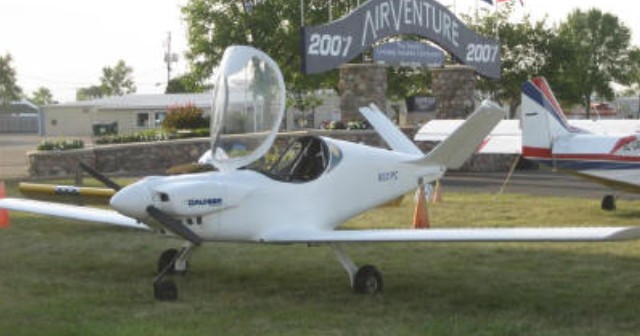
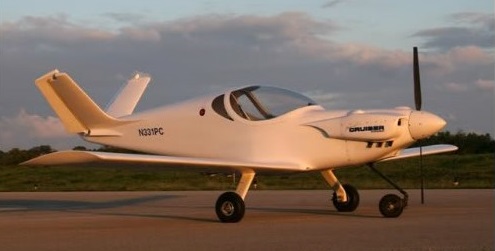
Pro-Composites Personal Cruiser

The Personal Cruiser currently uses a Corvair automotive engine converted for aircraft use, and is designed for an installed engine weight of up to 250lbs and from 65-115 hp. The Personal Cruise has a 29″ wide cabin.

The 2009 airframe kit price was $9,710. In the air complete from $18k to $25k.

Engine: Corvair 2700cc, 100 hp
Hp range: 60-120
Wing area: 76.5 sqft
Span: 25.5 ft
M.A.C: 36 in
Airfoil: Eppler
Aspect Ratio: 8
Dihedral: 6 degrees
Length: 17’ 4”
Empty Weight: 650 – 750 lbs
Useful Load: 500 lbs
Gross Weight: 1250 lbs
Fuel Load: 12-18 US Gallons
Vne: 212 mph
Va: 147 mph
Econ. Cruise power: 116 mph @ 2.5 gph
High Cruise: 150 mph @ 4.8 gph
Rate of Climb: 700-1800 feet/min
Stall: 58 mph (Clean)
Load factor: +4.5g/-3.0 at 1250lbs
Take-off / Landing: 400 ft/ 350ft
Cockpit Width: 29” interior dimension
V-tail Area: 16 sqft
V-tail Span: 6.125 ft
V-tail Airfoil: Eppler
Landing Gear: Fixed Tri-gear w/castering nose wheel

Pröckl & Hasselböck Motorschwingenflieger / Flügelschlagflieger

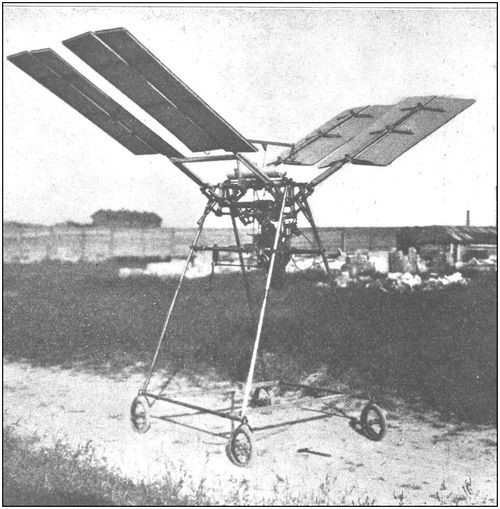
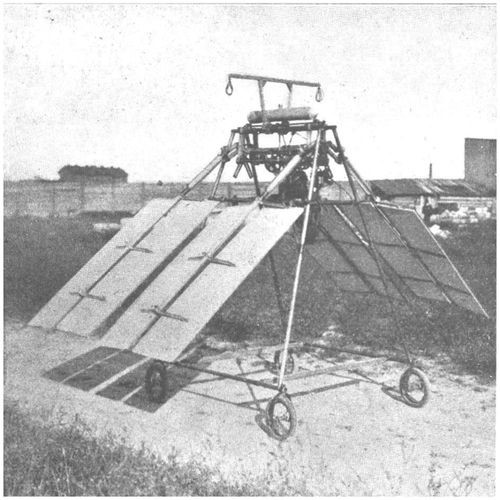
The Motorschwingenflieger / Flügelschlagflieger designed by Moritz Hasselböck and Wilhelm Pröckl, and apparently worked on for five years in Vienna, was completed about 1908. The construction of the machine reveals that the flapping wings were not only just flapping in a vertical plane. Pröckl & Hasselböck had realized that in this way the ornithopter would only ascend and descend vertically. To achieve forward motion they devised a method to rotate the wings to another angle with the objective to achieve forward motion or in the event of landing, a braking of the speed of descent.

The machine was built to specification by “Automobilfirma Wyner, Huber und Reich” of Vienna. Photos taken on the property of the firm date from July 1908.

Pritchard Rocket Air Ship

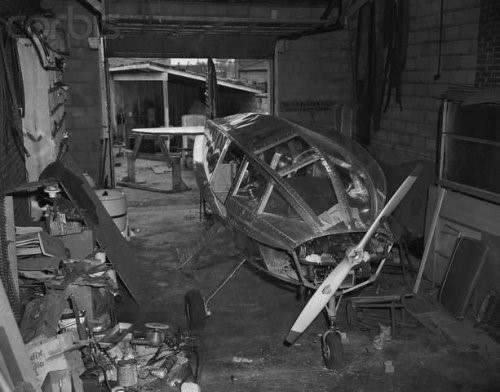
Charles Pritchard of Emporia, Virginia, was a railroader by profession, set out to build an all-aluminium wingless combined aircraft/car which had been ten years in the making.

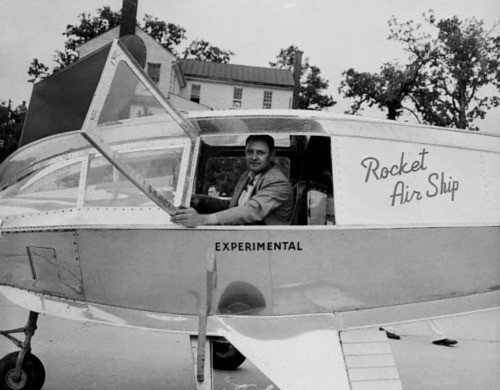
The Rocket Air Ship plane has short baffles or fins in place of wings, a 90 hp engine, a conventional propeller and tail assembly and a tricycle landing gear. It was 21 feet long, 98 inches wide and weighed 800 lbs.

The body of the plane is made entirely of aluminium. Each side has baffles (or fins) of varying length. The fins “hold air in the proper channel over the hull of the ship to give the hull its lift”.

Ailerons for changing direction in flight are on the sides of the plane. Conventional equipment on the wingless craft includes a tricycle landing gear, metal propeller, 90 hp engine and flight instruments.

Built for less than $1500, Pritchard was helped in the construction by Billy Davis of Emporia.

“Charles Pritchard, designer builder and pilot, makes first test of his wingless Rocket Air Ship on mile lone runway at Emporia, Virginia, airport.

Plane has short baffles or fins in place of wings, 90 hp engine, conventional propeller and tail assembly, tricycle landing gear, is 21 feet long 98 inches wide weighs 800 lbs. Pritchard made eight runs along runway, but didn’t; get off the ground. Says he’ll make modifications and try again.” (circa 1955)

Primac Tukan

The Tukan features a composite fuselage and fabric covered wood wings. Air brakes are fitted on the upper wing surface. The engine can fold back to inside the fuselage.

Engine: Rotax 447, 40 hp
Wing span: 14.7 m
Wing area: 14.7 sq.m
MAUW: 420 kg
Empty weight: 215 kg
Fuel capacity: 32 lt
Max speed: 125 kph
Cruise speed: 85 kph
Minimum speed: 60 kph
Climb rate: 2 m/s
Fuel consumption: 8 lt/hr
Seats: 2

Primac Moskitto M-10

First flown in December 1996, options include a closed cockpit, and floats. The wings fold in 8 minutes. The aircraft is stressed to +6 and –3 G.

Engine: Rotax 447, 40 hp
HP range: 27-50
Wing span: 26.3 ft / 8.02 m
Wing area: 117.1 sq.ft / 10.99 sq.m
Length: 15.2 ft
Height: 5.6 ft
MAUW: 497 lb / 240 kg
Empty weight: 219 lb / 98 kg
Fuel capacity: 7.5 USG / 30 lt
Max speed: 73 mph / 110 kph
Cruise speed: 61 mph / 88 kph
Stall: 30 mph / 40 kph
Rate of climb: 1450 fpm / 6.8 m/s
Service ceiling: 10,000 ft
Range: 165 sm
Takeoff dist: 90 ft
Landing dist: 120 ft
Seats: 1
Landing gear: tailwheel
Fuel consumption: 7.2 lt/hr
Price (1998): US$12,250
Kit price (1998): US$6400

Price PL-2-DM

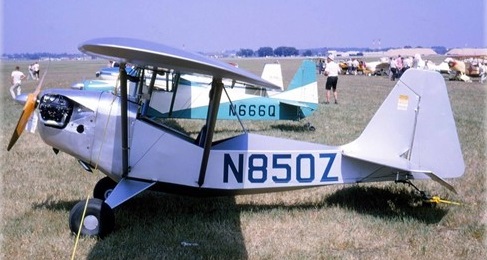
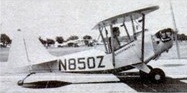
In 1962 Paul Price built the Price PL-2-DM, registered N850Z c/n 2,, which appears to be a much larger version of his Price Special. The PL-2-DM is also a single place, open cockpit high-wing monoplane.

PL-2-DM
Engine: 65hp Lycoming O-145 or Continental C-65
Wingspan: 24’0″
Length: 15’6″
Useful load: 225 lb
Max speed: 85 mph
Cruise: 60 mph
Stall: 40 mph
Range: 90 mi
Seats: 1