Built by Sexton of Cicero IL., USA, in 1911. It was a single-place open cockpit, parasol monoplane. The aircraft featured a cantilever wing with underslung ailerons and open-frame fuselage.
Apparently, it flew only once but with dog as passenger.
Built by Sexton of Cicero IL., USA, in 1911. It was a single-place open cockpit, parasol monoplane. The aircraft featured a cantilever wing with underslung ailerons and open-frame fuselage.
Apparently, it flew only once but with dog as passenger.
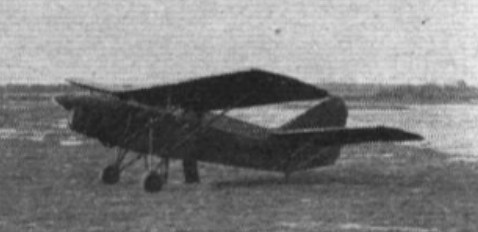
Societe Francaise De Constructions Aeronautiques / SFCA had license for Peyret “tandem monoplane” renamed and developed as Taupin.
The 1930 Taupin was essentially an enlarged, powered derivative of the Alérion glider. 2-seat tandem-wing.
The wing span was recorded as 7.2m but Sailplane & Glider 31 Mar 1933 says 8.4m main and 6.5m rear wing spans.
Engine: 1 x 50hp Beaussier
Also flown with 30 hp ABC Scorpion horiz-opposed 2-cylinder
The SFCA-Peyret Taupin, aka “Le Taupin” (flown 1937) was an amateur-construction Peyret VI with 1 x 30 hp flat-2 cylinder Mengin 2 A1.
A two-seat version appeared in 1937as the “Cinq-demi Taupin”, known as the Lignel 44.
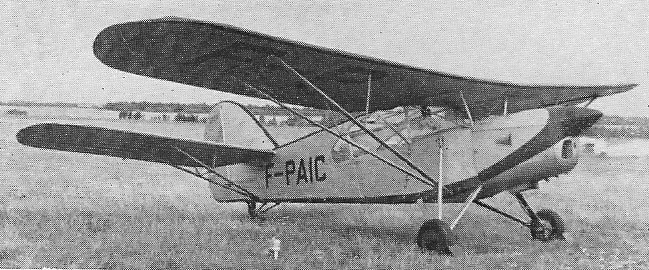
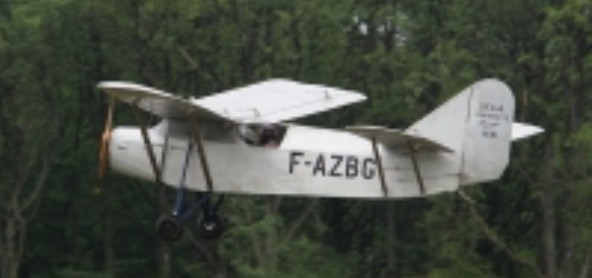
Lignel 44
Engine: Regnier 4-J0, 65 hp
Wing span: 28 ft 7 in
Forward wing area: 140 sq.ft
Rear wing area: 75.3 sq.ft
Length: 19 ft 10 in
Height: 8 ft 11 in
Empty weight: 543 lb
Loaded weight: 1276 lb
Max speed: 84 mph
Cruise: 74.5 mph
Service ceiling: 13,776 ft
Range: 310 mi
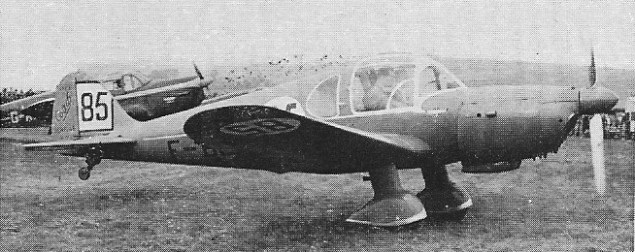
The Lignel 46 Coach, produced by the Societe Francaise de Constructions Aeronautiques, is a four-seat cabin monoplane powered by a 180 hp Mathis 8G-20 engine. Built only in prototype form, the Coach has taken first place in a number of European rallies. It employs a composite bonded material known as Brodeau-Lignel in its construction, and dual controls are provided.
The sides of the canopy hinge forward for access and can be jettisoned in an emergency.
Engine: 180 hp Mathis 8G-20
Span: 34 ft 5 in
Wing area: 161.459 sq.ft
Length: 26 ft 2.75 in
Height: 8 ft 6.25 in
Empty weight: 1852 lb
Loaded weight: 2943 lb
Max speed: 168 mph
Cruise: 152 mph
Range: 620 mi

The Schneider Henri-Paul four-seater night bomber was built at Schneider’s Harfleur plant in France. A four-engine biplane with sails supported on steel spars and a grid of aluminum alloy ribs. Equal span, the wings had a central rectangular section and external panels in an arrow. The fuselage was formed by a beam of dural tubes 55 mm in diameter assembled by riveted steel fittings. The front part of the fuselage received a metallic coating, the rear part being simply covered, supporting a fabric empennage. The engines were mounted in pairs on each side of the fuselage, installed in tandem in interplanetary pods, driving four blade propellers of 3.60 m in diameter.
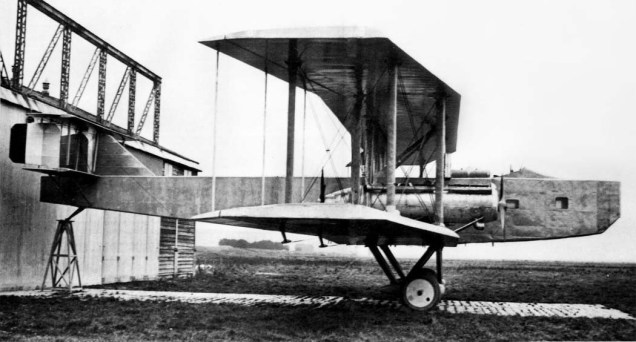
This aircraft made its first flight in September 1922 on the Le Havre-Bléville1 site. It was exhibited at the Grand Palais at the 8th Aviation Show in December 1922, but the program for which it was built had been abandoned.
Engines: 4 x Lorraine-Dietrich 12Da, 370 hp
Wingspan: 30,0 m
Length: 19.89 m
Height: 6.10 m
Wing area: 220.0 sq.m
Empty weight: 6500 kg
Maximum weight: 10,020 kg
Maximum speed: 160 kph
Ceiling: 5,000 m
Range: 750 km
Armament: 2 machine guns
Bombload: 120 kg
Crew: 5
Number built: 1
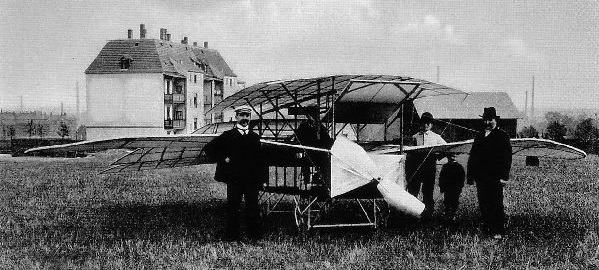
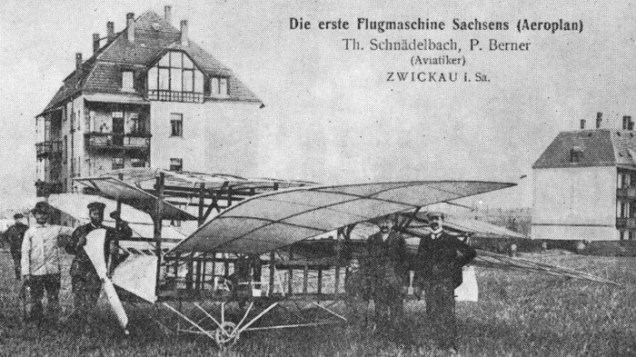
The first Flugmaschine in Sachsen, Germany, in 1909. It was a mixed version of a Schwingenflieger and a Gleitflieger, as the wings could flap but there were also two (tandem) wings fitted above the open fuselage. The elevator in the front was an ‘all-flying’ construction and the rudder is at the back. Total wing area is 40,10 square meter. The engine of 10 hp (due to be upgraded to 25 hp) drove the propeller at the front of the fuselage. Total weight (empty) of the machine is 335 kg, span is 9 meter and length 7 meter. Height is 2,20 meter.
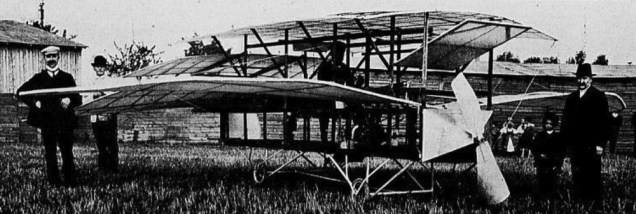
There are contradictory accounts as to its flying success.
The 1930 West Coast Co WCK-2 Sportster was a two-place cabin, parasol wing monoplane powered by a 100hp Kinner K-5 engine.
The one built was registered NX10526 c/n 2 and crashed while being flown by aspiring test pilot Tony LeVier.

The Schmuck Bros Aircraft Co S-3 Sport two-place monoplane was powered by a 90hp Curtiss OX-5, and later with a 100hp Kinner.
Built circa 1928 at Monarch Aero Corp field, it was registered N510 c/n 2.
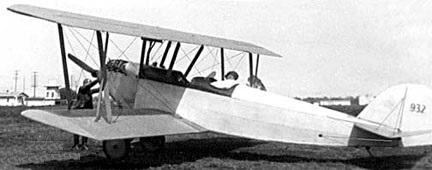
The 1927 Schmuck Bros Aircraft Co S-1 Commercial Sport, or Monarch, with its elephant-ear ailerons, was the only one built. Registered N932 c/n 1, it was first flown on 8 September 1927, it was dismantled in February 1930.
Engine: 90hp Curtiss OX-5
Wingspan: 32’0″
Length: 24’0″
Max speed: 100 mph
Stall: 35 mph
Seats: 3
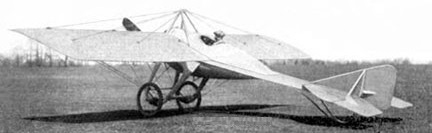
Designed by Etienne Dormoy and brought from France to the USA by Maximilian Schmid, this fully monocoque fuselage design was first of its kind in USA. Built for competitions, it won the $1,000 NY Times Race on 4 July 1914 at Governor’s Island NY (piloted by Harold Kantner), as well as several more subsequent races.
It was then converted into a biplane with a 100hp LeRhône for military trials at North Island, San Diego. It and three other entrants were rejected for not meeting certain requirements specified by the Army.
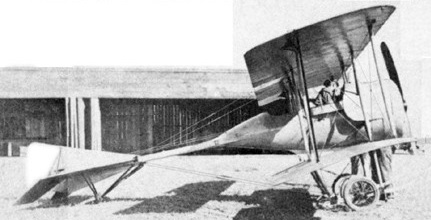
Monoplane
Engine: 50hp LeRhône
Speed: 70 mph
Seats: 1
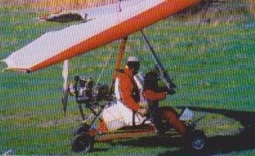
In 1998 Schmidtler was concentrating on trike production over hang gliders. The Enduro was flown mainly Air Creation wings.
The Enduro XC is a faired-in version for cross country flying.
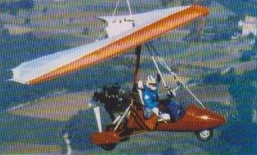
Enduro
Empty weight: 155 kg
Wing span: 10 m
Wing area: 14 sq.m
Fuel capacity: 64 lt
Certification: Vz
Engine: Rotax 582, 65 hp
MAUW: 400 kg
Seats: 2
Max speed: 100 kph
Cruise speed: 65-95 kph
Minimum speed: 55 kph
Climb rate: 5 m/s
Fuel consumption: 10 lt/hr
Price (1998):
Enduro XC
Empty weight: 165 kg
Wing span: 10 m
Wing area: 14 sq.m
Fuel capacity: 64 lt
Certification: Vz
Engine: Rotax 582, 65 hp
MAUW: 400 kg
Seats: 2
Max speed: 100 kph
Cruise speed: 65-95 kph
Minimum speed: 55 kph
Climb rate: 5 m/s
Fuel consumption: 10 lt/hr

