Schmidt / U S Aerial Navigation Co 1911 Biplane

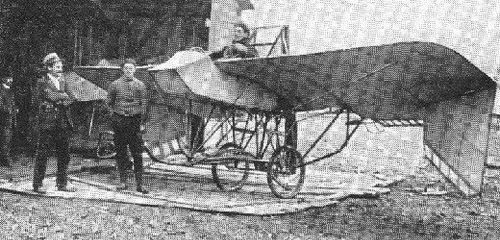
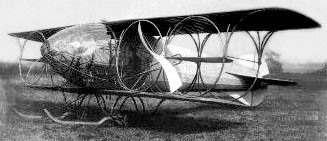
A large, rounded, startlingly modern fuselage for its day, using what appears to be almost geodesic construction, with chain-driven twin tractor propellers.

During 1910 and 1911 this aircraft was built in a shop adjacent to Mineola Field NJ. The design was basically sound and the plane performed well beyond expectations. In Jan 1912, US Patent #596448 was granted to the aeroplane per notification from Munn & Co, Patent Attorneys, NYC.

Schmelzenbach und Hollmann Halbdoppeldecker

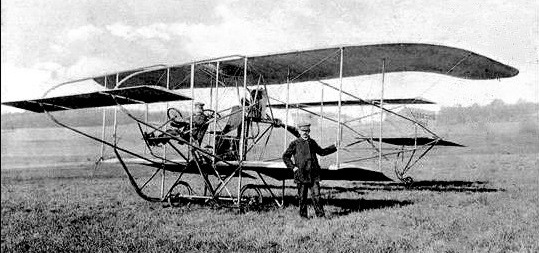
This machine was tested in spring or summer 1911 at the flying ground Plauen-Reisig in Sachsen, Germany. It had a Taube-like top wing, a forward elevator, a chain driven pusher propeller and a small stabilizing plane on top the original tail-boom construction. According to Lange it was powered by a 65hp Hilz inline-4. There are thoughts that Schmelzenbach and Hollmann wanted to open a flying school and this plane was intended as a trainer, therefore being equipped with dual controls.

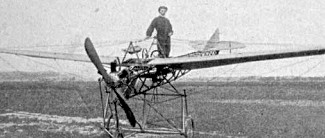
Schmaltz Eindecker

Ernst Schmalz, born 1879 in Nidau, Switzerland, in 1908 built with the help of Failloubaz, a pusher monoplane, powered by a 12 hp Anzani motor, with large ailerons he himself named “Stabiloklappen”. In flight tests at Thun he made jumps of up to a height of 6 meters. In 1909, Schmalz retired from flying. He sold his apparatus to a chauffeur, who collided with a tree top in flight tests on the Beundenfeld in Bern. Although the pilot remained intact, the aeroplane itself was a total loss.

Schleicher ASW-22-2 / ASH 25

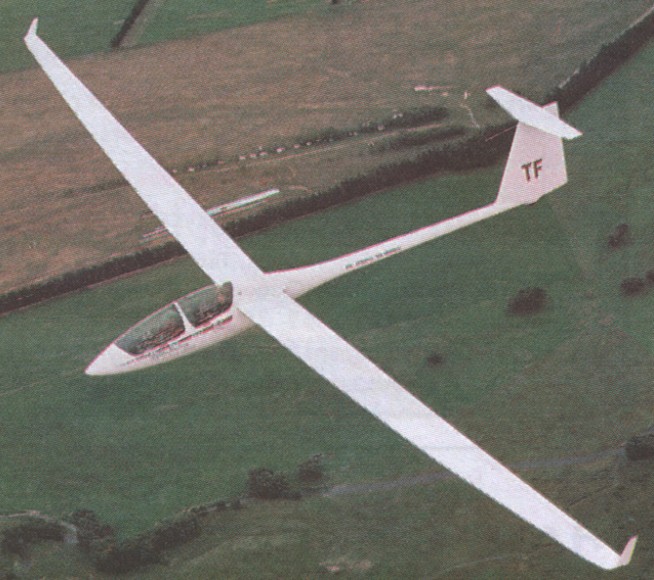
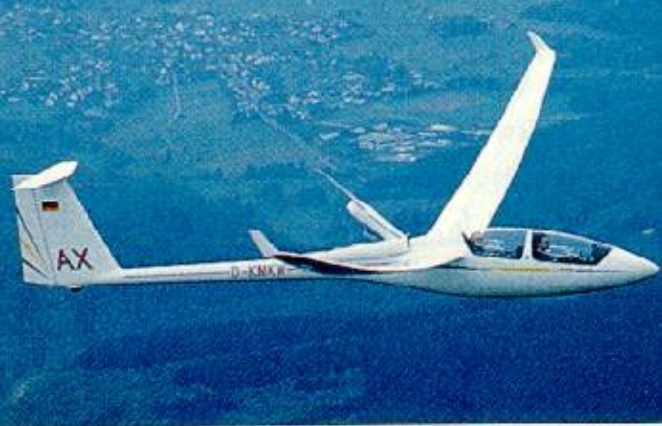
Designed by Martin Heide, the tandem two seat Schleicher ASH25 featured the longest wingspan of any production glider (25 metres). First flown in 1986, the ASH25 first went into production in that year. Construction is all carbon fibre and the sailplane can sustain a glide angle of 1:58. The design was specifically aimed at producing a two seat glider with single seat perform¬ance and utilises the wing of the ASW22B married to a new fuselage of carbon/ aramid fiber reinforced plastic.

Within a couple of years the ASH25 had set five world speed records for triangular courses varying from 330 km / 205.1 miles to 1,380 km / 857.0 miles. Hans Werner Grosse of Germany has set 12 world records in all flying an ASH-25.

The ASH-25 is the production version of the one-off two-place ASW-22-2 using a fuselage adapted from the Akaflieg Stuttgart FS-31.

The ASH-25E is powered by a retractable 19 kW/ 25 bhp Rotax 275 sustainer engine.

ASH-25E

A flight test evaluation by Dick Johnson measured a best L/D of 54.3 : 1 without turbulator tape or special sealing. An ASH-25 flown by G. Herbaud and J-N. Herbaud of France both won the world multiplace straight distance and goal distance records of 1,383 km./ 859.3 miles in the same flight in 1992.

ASH-25E
Engine: 19 kW (25 bhp) Rotax 275
Wing span: 25m / 82ft
Wing area: 16.31sq.m / 175.6sq.ft
Empty Weight: 480kg / 1058lb
Payload: 270kg / 595lb
Gross Weight: 750kg / 1653lb
Wing Load: 45.98kg/sq.m / 9.41lb/sq.ft
L/DMax: 57 108 kph / 58 kt / 67 mph
MinSink: 0.45 m/s / 1.48 fps / 0.88 kt
Water Ballast: 225kg / 496lb
Aspect ratio: 38.3
Airfoil: HQ 17
Seats: 2

Schleicher AS-K 16

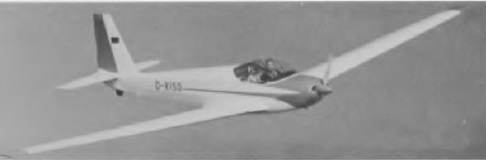
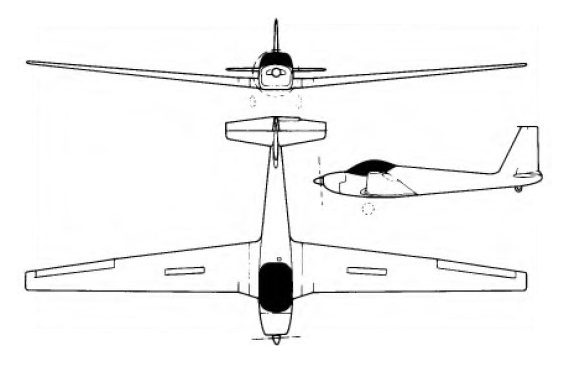
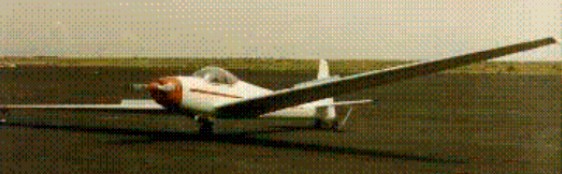
The AS-K 16 is a side-by-side two-seater motor glider, with dual controls. The type is of mixed construction with a welded steel tube fuselage covered in fabric, plywood and glassfibre. The cantilever single-spar low-set wooden wings are fabric-covered with glassfibre tips and spoilers in the upper surfaces. The tail unit is of wooden construction with fabric covering, with combined trim and anti-balance tabs in the port elevator. The AS-K 16 has main wheels retracting inwards into the bottom of the fuselage, and a fixed tailwheel; the main wheels have rubber shock absorbers and Tost drum brakes. The pilots sit under a one-piece blown canopy that hinges sideways to open. Powerplant is a 72hp Limbach SL 1700EB1 modified Volkswagen ‘flat four’ engine driving a Hoffman HO-V 62 two blade variable-pitch propeller.

It first flew in prototype form on 2 February 1971 and first appeared in public at the second German Motor Glider Competition at Burg Feuerstein in June that year, but it did not compete.

An AS-K 16 flown by Hans Werner Grosse and Ing R. Kaiser took third place in the First International Motor Glider Competition in 1974.

By January 1976 38 AS-K 16s had been built, but it is now out of production.

Engine: VW Limbach, 75 hp
Wingspan 49 ft 2 in
Length 21 ft 10 in
Gross 1,540 lb
Empty 1,010 lb
Useful 530 lb
Fuel 60 lb
Wing loading 7.1 lbs/sq ft
Wing aspect ratio 17.1
Max airspeed 110 kt
Rough air speed 110 kt
Stall 40 kt
Lift to drag 25 at 50 kt
Sink 3 fps at 45 kt
Wingspan 53 ft
Length 24 ft
Seats 2

Engine: Limbach SL 1700 EB1, 53.7 kW (72 hp)
Span: 52 ft 6 in / 16.0 m
Length: 24 ft 0.25 in / 7.32 m
Height: 6 ft 10.75 in / 2.10 m
Wing area: 204.5 sq ft / 19.0 sq.m
Aspect ratio: 13.5
Wing section: NACA 63618/Joukowsky 12%
Empty weight: 1,036 lb / 470 kg
Max weight: 1,543 lb / 700 kg
Water ballast: None
Max wing loading: 37.0 kg/sq.m / 7.57 lb/sq ft)
Max speed: 124 mph / 108 kt / 200 km/h
Stalling speed: 37 kt / 69 km/h
Min sinking speed: 3.28 ft/sec / 1.0 m/sec at 46 mph / 40 kt / 74 km/h
Best glide ratio: 25:1 at 58.5 mph / 51 kt / 94 km/h
Take-off run: 755 ft / 230 m
Rate of climb at S/L: 150 m/min / 492 ft/min
Range: 310 miles / 500 km / 270 nm
Schleicher ASK-14 / KA 12

This single-seater motor glider was originally known as the Ka 12 and was designed by Ing Rudolf Kaiser but, to avoid confusion with the AS-W 12 high performance sailplane which was also built by Schleicher, it was redesignated AS-K 14.

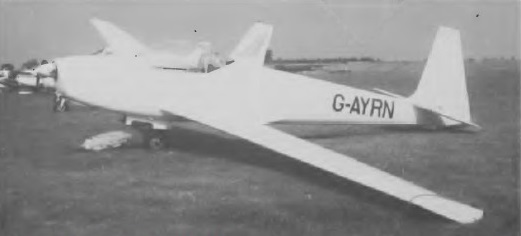
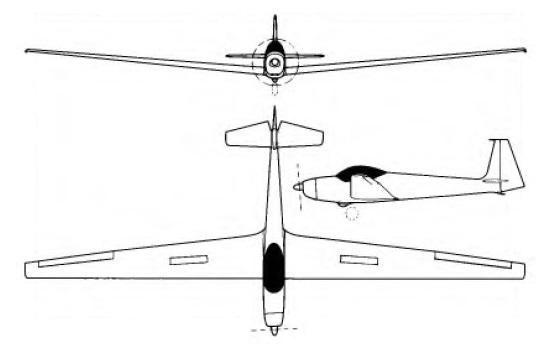
Of conventional wooden construction, it has what is basically a Ka 6E’s semimonocoque fuselage with plywood covering married to low-set cantilever wood and fabric wings with 5° dihedral, similar to the Ka 6E’s and with the same aerofoil section; the single-spar wings have spoilers in the upper surfaces and plywood-covered ailerons. The pilot sits under a large one-piece blown Plexiglas canopy that hinges sideways to starboard, and the landing gear consists of a manually retracted monowheel on a leg tall enough to give adequate ground clearance for the propeller, plus a tailskid. Powerplant is a 26hp Hirth F10 K19 ‘flat four’ two-stroke engine in a conventional tractor installation driving a two-blade Hoffman feathering propeller; starting is manually. The tail unit is of wood/plywood/fabric construction, with a low-set all-moving tailplane.

The prototype made its first flight on 25 April 1967, and the type took second, third and fourth palces in the first at Burg Feuerstein in the German Motor Glider Competition, which was held in 1970; in the sixth of these competitions, in 1976, the AS-K 14 was still good enough to take second and third places.

Gallery

Engine: 19 kW/ 26 bhp Hirth F10 K19
Wing span: 14.3 m / 46 ft 11 in
Wing area: 12.68 sq.m / 136.5 sq.ft
Aspect ratio: 16.8
Airfoil: NACA 63-618/ 615
Length: 6.6 m / 21 ft 8 in
Height: 1.6 m / 5 ft 3 in
Empty Weight: 245 kg / 540 lb
Payload: 115 kg / 254 lb
Gross Weight: 360 kg / 794 lb
Water ballast: None
Wing Load: 28.6 kg/sq.m / 5.82 lb/sq.ft
Max speed: 124 mph / 108 kt / 200 km/h (in smooth air)
Stalling speed: 33.5 kt / 62 km/h
MinSink: 0.75 m/s / 2.46 fps / 1.46 kt at 45 mph / 39 kt / 72 km/h
L/DMax: 28 at 81 kph / 44 kt / 51 mph
Take-off run: 120 m / 393 ft
Rate of climb: 150 m/min / 492 ft/min
Seats: 1
No. Built: 66

Schlageter 1910 Eindecker

Robert Schlageter of Luzer, Switzerland, was born in 1887. He quit his technical studies in Burgdorf to devote himself to aviation. After first tests with gliders, he began to build, with the help of two friends, his first monoplane, with a triangular-section fuselage and an Anzani engine, in 1909. Then he built in four months, for a company in Mainz, another monoplane of the same type. His planes flew only in good wind conditions, but he won a prize at a fair in Chemnitz in 1911. He had to quit aviation for economic reasons, was forced to sell his planes and spare parts.

Schiefer & Sons Aeroplane Co RS

In 1917 Schiefer & Sons Aeroplane Co built the RS, designed by N B Robbins. A Pursuit trainer based somewhat on French V-strutted Nieuport design, it first flew on 9 December 1917.

The sole example was bought for a reported $11,000 and tested by the Army, but rejected as not being as good as Orenco or Thomas-Morse.

Engine: US-built Gnöne 9, 100hp
Wingspan: 26’6″
Length: 20’0″
Seats: 1

Scheutzow Flexhub

The 1963 Scheutzow Helicopter Flexhub was described “test-bed” version of Model B N564A, the blades were set on rubber bushings instead of conventional ball- and roller-bearings..

Engine: Continental C-85, 85hp
Rotor diameter: 22’9″
Length; 18’6″
Useful load: 470 lb
Max speed: 85 mph
Cruise speed: 75 mph
Range: 170
Seats: 2

Scheutzow Bee / Model B

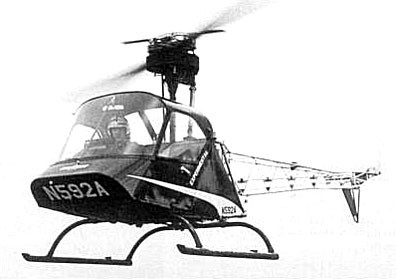
Scheutzow Bee N592A

Webb Scheutzow formed Scheutzow Helicopter Corp in the early 1960s by to build a light helicopter with special rotorhead (blades carried on rubber bushings). The Bee side-by-side two-seater flew 1968 and three prototypes were built.

Ceased development 1977.

Engine: Lycoming IVO-360-A1A, 180hp derated to 165hp
Rotor diameter: 27’0″
Length: 24’1″
Useflu load: 590 lb
Max speed: 93 mph
Cruise speed: 80 mph
Range: 175-200 mi
Ceiling (hover): 10,800′
Seats: 2