In 1938 built a three-engined high-wing six-seat aircraft.
Piston
Air Tractor AT-300 / AT-301 / AT-302

Leland Snow moved to Wichita Falls, Texas, and started design work on a new cropduster, derived from the S2B he had designed and built in the fifties. In 1972 he obtained a small business loan, rented a building back in Olney and started to build jigs and tooling for what was to become the Air Tractor AT-300 – a conventional layout crop-duster powered by a Pratt and Whitney R-985-AN1 of 450hp. A 320 US gallon hopper was installed in a fuselage made of tube construction and included a sealed enclosed cockpit. The aircraft had a conventional tail but with fabric covered control surfaces. The vertical portion incorporated a dorsal fin giving the tail a round shape, unlike later aircraft. The cantilever 45 foot span wing is of all metal construction and incorporates large Fowler type trailing edge flaps. The prototype took seven months to build and Snow first flew the aircraft, N44200, in Septertiber 1973. FAA Certification took fifty-nine days and the first production Air Tractor was sold in March 1974. Seven more were delivered that year including the first Air Tractor AT-301, N4327S, the same aircraft but fitted with a P&W R-1340-AN1 of 600 hp and with an operating weight of 7300 lbs. Twenty aircraft were built during 1975 and, at the end of the year, a new hangar was erected to house the expanding company.
In June 1977, N44415, a turbine version of the AT-301, was flown. Known as the AT-302, it was powered by the then new Avco Lycoming LTP101-A1A of 600 hp. Fourteen were built, followed by the AT-302A in 1980 which had a 400 gallon hopper installed. With an operating weight of 7700 lbs, the aircraft had a wider hopper box and was designed for dry fertilisers.
By the end of 1979, some 229 AT-301 had been built. In 1986 the AT-301 design was improved, including redesigning the wing. Before being superseded by the 401 in 1988, 863 AT-301s were built.
AT-300
Engine: Pratt and Whitney R-985-AN1, 450 hp
Wing span: 45 ft
MAUW: 7300 lb
Hopper cap: 300 USG
AT-301
Engine: Pratt & Whitney R-1340, 600 hp
AT-302
Engine: LTP-101-A1A, 600 hp
Hopper cap: 320 USG
AT-302A
Engine: LTP-101-A1A, 600 hp
Hopper cap: 400 USG
Air Tractor AT-250
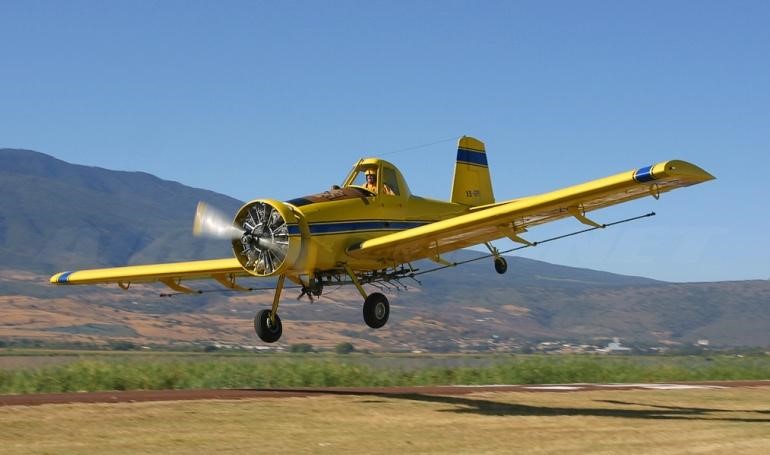
In July 1982, a smaller aircraft was flown, N3163L, the AT-250 with a 260 gallon hopper. The wingspan had been reduced to 41 ft 6 in and it was powered by the P&W R-985, the 450 hp radial used on the AT-300. Only one was built and it was sold to a US operator in March 1992.
Engine: P&W R-985, 450 hp
Wingspan: 41 ft 6 in / 12.5 m
Length: 8.2 m
Height: 2.6 m
MTOW: 4000 kg
Fuel Capacity: 817 lt
Hopper cap: 260 USG
Max Speed: 135 kt
Optimum Speed: 124 kt
Max Climb Rate: 1100 ft/min
Max Range: 550 Nm
Absolute Ceiling: 15000 ft
Optimum Ceiling: 12000 ft
Take Off Distance: 400 m
Seats: 1
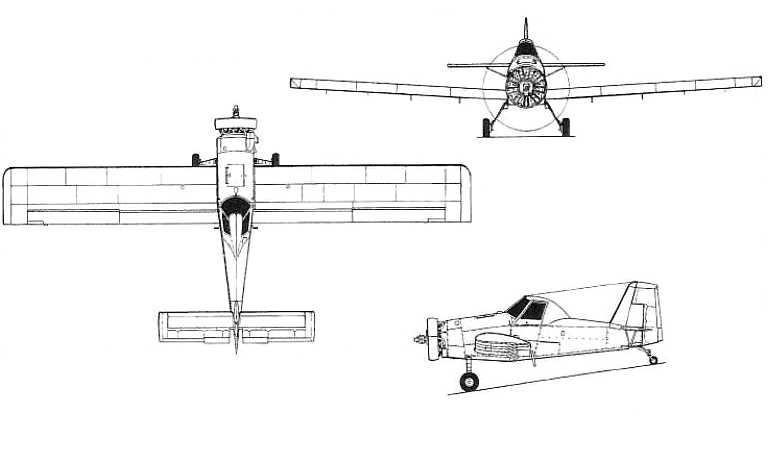
Airtime Explorer

Explorer motorised hang glider harness, by Airtime.
Radne Raket 120cc 2 stroke motor factory modified for FLPHG, 15Hp. Pull start, manual decompression.
Suits pilot 5 ft 8 in to 6 ft 2 in
Airtechs Industria Aeronautica Guara G300

The aircraft G300 was being developed as an agricultural spraying aircraft. A single engine, low wing monoplane, the G300 has a 600 kg capacity spraying tank.
Seats: 1
Engine: SMA SR305, 230 hp
Fuel: JET A1
Spray capacity: 600 Kg.
Airtechs Industria Aeronautica Guara G200 / GP-A135-A

The aircraft is a single engine low wing monoplane, with tandem two seats, and fixed tricycle landing gear. Metallic construction semi monocoque fuselage.
Engine: Lycoming AEIO 360 A1B6, 300 hp or SMA SR305 – 230 hp, fuel JET A1
Number of seats: 02 (tandem)
Air-Tech Skylark
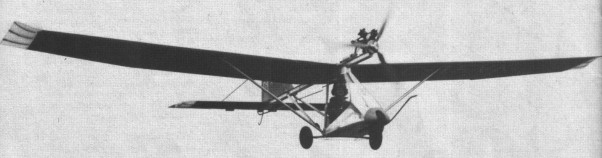
The Skylark is high-wing with a forward engine mounted on a cantilever beam fuselage. The forward-swept wing is rectangular with a tapered trapezoidal tip, and is supported by a single strut. Tail surfaces are classic, and tricycle landing gear is used. The engine and propeller are well forward of the cockpit. The forward-swept wing and under-wing cockpit location produce good visibility; pilot weight has minimal effect on the aircraft’s center of gravity; and the ideal spanwise lift distribution inhibits stalling of the wingtips, ensures against spinning and signals approaching stall by buffeting of the tail surfaces. Two people can easily disassemble the Skylark. By removing three bolts, the horizontal tail surfaces can be folded up against the fin. Each wing can be detached by removing only four bolts. The Skylark wing profile was designed by NASA using technology specially for use in slow-flying aircraft. Features in¬clude low drag in the range of useful air¬speeds, low stall speed, and mild stall characteristics (which are fully exploited by the forward-swept wing to produce a “spinproof” design). Aluminium sheet, extruded tubes and angles, all of general-aviation proven 2024 alloy are used throughout. Airtech uses modern adhesive bonding technology, along with blind and solid rivets. High-strength PVC foam, stamped aluminum ribs, silky-smooth Teflon bellcrank bearings, aluminum pushrods with spherical couplings, “Ceconite 7600 Process” aircraft fabric, precision molded fiberglass fairings, molded plexiglas windscreen all combine to satisfy the most demanding aviators. The standard airspeed indicator, altimeter, tachometer and toe-operated disk brakes are as comforting to the pilot as the contoured seat designed for those up to 6 feet, 6 inches, with “stick-and-rudder” controls. The Skylark uses the Konig SD-570 four-cylinder radial. Using a 2.8:1 reduction drive, the Skylark’s engine turns its 72-inch propeller at only 1500 rpm during takeoff; the result is exceptional static thrust and the virtual elimination of propeller noise.
Engine: Koenig SD-570 4-cyl radial two-stroke
Reduction: 2.8:1
Prop: 72 in
Air-Tech SS/Z
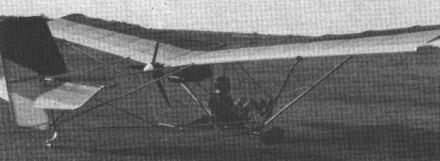
Engine: Rotax 377
Wing span: 30 ft
Fuel cap: 4.5 USG
Airsport s.r.o Song LW / E-Song / Electric Aircraft Corporation ElectraFlyer-ULS
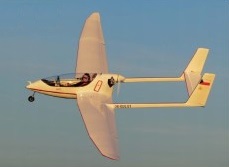
The Airsport Song is a Czech ultralight aircraft, designed by Marek Ivanov to comply with the LTF-L 120 kg, US FAR 103 Ultralight Vehicles and English SSDR categories. It features a cantilever low-wing, twin-booms, a single seat enclosed cockpit, fixed tricycle landing gear and a single engine in pusher configuration. The Song has been produced in both a twin–tail and inverted V-tail layout. In most configurations, the Song includes a Galaxy GRS 3/270 ballistic parachute rescue system.
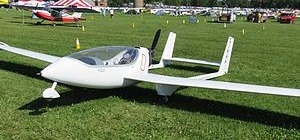
The Song is made from composites. Its polyhedral wing comes in two optional spans: 7.5 m (24.6 ft) (with flaperons) and 11.2 m (36.7 ft) (with ailerons and either spoilers or flaps). Standard engines available are the 20.5 hp (15 kW) Bailey V5 four-stroke and the 35 hp (26 kW) Verner JCV 360 four-stroke powerplant.
Randall Fishman of Electric Aircraft Corporation produces an electric-powered version of the Song, the Electric Aircraft Corporation ElectraFlyer-ULS.
Song SW-V
Engine: 1 × Bailey V5 Single Cylinder, 15.3 kW (20.5 hp)
Wingspan: 11.2 m (36 ft 9 in)
Wing area: 10.5 m2 (113 sq ft)
Length: 5.9 m (19 ft 4 in)
Empty weight: 110 kg (243 lb)
Gross weight: 220 kg (485 lb)
Fuel capacity: 25 litres (5.5 imp gal; 6.6 US gal)
Maximum speed: 201 km/h (125 mph, 109 kn)
Cruise speed: 80 km/h (50 mph, 43 kn)
Stall speed: 50 km/h (31 mph, 27 kn)
Never exceed speed: 140 km/h (87 mph, 76 kn)
Rate of climb: 1.5 m/s (300 ft/min) with Bailey V5, (5 m/s with Verner JCV 360)
Crew: one
Airsport s.r.o AIRector
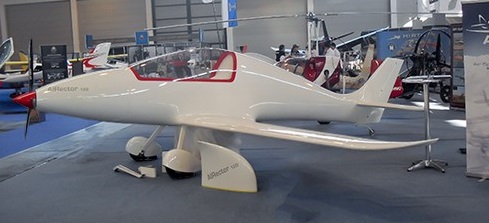
The Air Sports AIRector 120 is a German ultralight aircraft, designed and produced by Air Sports Aircraft of Dassel. It was introduced at the Aero show held in Friedrichshafen in 2010.

