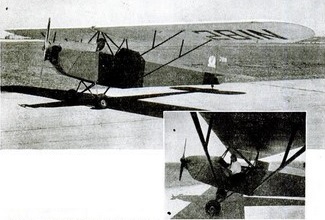
In 1930 American tested the American Eaglet at Kansas City. A home builders lightweight aircraft, it is a parasol type capable of carrying one person with a Cleone engine, or two with a Szekeley three cylinder 35 hp engine.
The conventional wings are built up in spruve and plywood. A feature of the fuselage is the way the lower longerons are brought together mid-way between the nose and tsil group as a single member. The fuselage is 23 inches wide and constructed of steel tubing as is the tail group.
Cables are used for control throughout. These run over pulleys and the aileron cables come down over two auxilliary pulleys at either side of the forward section of the cockpit. An aluminium seat is fitted with an instantaneous action safety belt.
The landing gear is a rigid inverted Vee type. It is equipped with 7×16 inch air wheels on four inch hubs. The landing gear is diagonally braced. A shoe tail skid is fitted, tied into the stern post and a rubber shock chord is used.
Wing tip ailerons are fitted. The horizontal stabiliser is ground adjustable and the fin is rigid. An unbalanced rudder is used.
Ordinary motor car gasoline and lubrication oil are mixed at 8:1 and carried in a single tank built into the cowling directly ahead of the pilot.
The gap where the wings are fasteed to the cabane section is covered with celluloid.
The Eaglet was sold for $995 with the Cleone engine and $1395 with the Szekeley in 1930.
Engine: Cleone Wingspan: 34 ft 4 in Length: 21 ft 6 in Height: 78 in Wing area: 164.4 sq. ft Max weight: 580 lb Engine weight: 46 lb Prop weight: 4 lb Battery weight: 15 lb Fuel capacity: 36 lb Speed: 60 mph Landing speed: 15 mph ROC: 350 fpm Glide ratio: 12-1 TO MAUW: 13 sec Fuel burn: less than 2 USG/hr
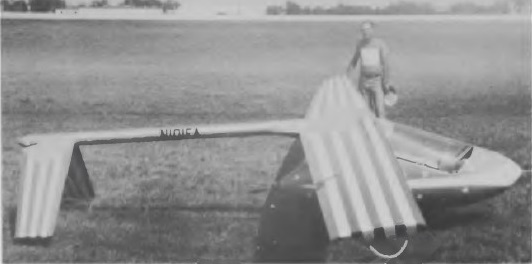
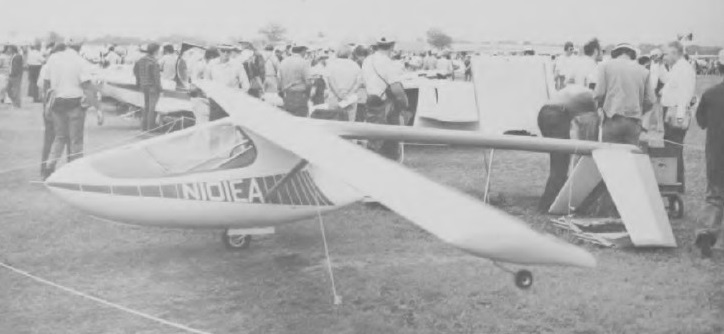
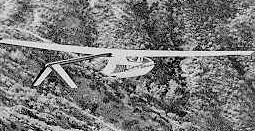
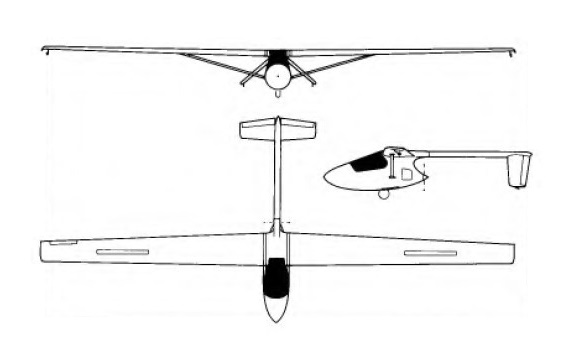
Designed by Larry Haig of Muskegon, Michigan, beginning in September 1974, the American Eaglet is a self-launching sailplane. The type is a high wing monoplane with a pod-and-boom type fuselage with the 12 hp(8.95kW) McCulloch 101B engine mounted aft of the cockpit and driving a 2 ft (60.96 cm)-diameter pusher propeller. The nylon propeller blades fold aft automatically when the engine stops. The cantilever inverted-Vee tailplane and elevators are carried on a tail boom that is a thin-walled 5 in (12.7 cm)-diameter aluminium tube with a moulded glassfibre tailcone. The compact cockpit includes a side-mounted control stick and aft-hinged, single-curved canopy. Construction is largely of glassfibre and urethane foam cores, with some components of aluminium.
The wings are stressed skin structures with spruce load-bearing spars and a single aluminium tube bracing strut on each side; the spars are surrounded by a urethane foam core, the leading edges and wing tips being of moulded glassfibre, and the urethane core portions are covered with epoxy-bonded precure glassfibre skin. There are no ailerons or flaps, but the functions of these two (ie roll and glide path control) are combined in two spoiler-like surfaces called ‘spoilerons’ at 30% chord on each upper surface towards the wing tip. The forward portion of the fuselage consists of two pre-formed glassfibre half shells pop-riveted to tubular aluminium longerons, the main load-bearing member in the fuselage being the bulkhead which carries the pilot’s seat on one side and the engine mounting on the other. This also carries the tail boom at the top rear, the monowheel at the bottom and the wing spar carry-through at the top, and this bulkhead is an aluminium-skinned urethane foam composite structure. There is a combined pitot tube/lifting handle in the fuselage nose. The inverted-Vee tailplane is very similar to the wings structurally, with an epoxy/glassfibre skin over urethane foam cores, and this V-tail greatly improves control in pitch and yaw, as the prop wash ‘blows’ directly over the tail surfaces; the V-tail also makes spins impossible. The manually-retractable monowheel has an external friction-pad brake, and is supplemented by a tailwheel under the tip of each tailplane.
The American Eaglet can be completed and flown as a pure sailplane, without the engine; the powerplant fitted is a McCulloch 101B single cylinder two-stroke engine developing 12.2hp at 8,000rpm, and drives a two-blade fixed-pitch pusher propeller with nylon plastic blades that fold backwards through 90° when the engine is stopped. The engine is intended only for take-off and self recovery, and is not designed for continuous cross country operation; it can be restarted in flight. A fuel tank of 2 litres (0.5 US gallons) capacity is provided. Fuel tank capacity is generally sufficient for one takeoff and climb to 2,000 feet AGL and three airborne restarts and climbs from 500 feet back up to 2,000 feet. The McCulloch 101B engine was available in only limited quantities, and the West Bend 820 engine will be fitted when availability of the 101B becomes a problem.
The Eaglet was designed for kit building and Larry Haig formed the AmEAGLE Corporation to market it.
Construction of the prototype, registered N101EA, started in June 1975 and this made its first flight on 19 November that year; a second prototype was later flown. A total of 400 kits had been ordered by early 1980, of which 20 had been completed.
Engine: McCulloch 10IB, 8.95 kW / 12 hp Wing span: 36 ft 0 in /10.97 m Length: 16 ft 0 in / 4.88 m Height: 0.91 m / 3 ft 0 in Wing area: 72 sq.ft / 6.69 sq.m Empty Weight: 160 lb / 72.5 kg Payload: 200 lb / 90.5 kg Gross Weight: 360 lb /163 kg Water ballast: None Fuel capacity 2 lt / 0.5 US gal Wing Load: 5 lb/sq.ft / 41.04 kg/sq.m Max speed: 115 mph / 100 kt / 185 km/h (in smooth air, power off) Aspect ratio: 18 Airfoil: Wortmann FX-61-184 Stall speed: 33 kt / 61 km/h MinSink: 0.76 m/s / 2.50 fps / 1.48 kt at 40 mph / 35 kt / 65 km/h L/DMax: 27 @ 84 kph/ 45 kt /52 mph Max rate of climb at sea level: 400 ft/min / 122 m/min Take-off run: 1,000 ft No. of Seats: 1
The Canguru was designed in 1939 by the Gliding Institute Polytechnic of Milan (Centro Volo a Vela del Politecnico Di Milano) under the direction of the Engineer Ermenegildo Preti.
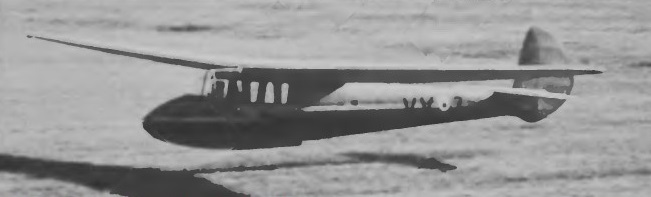
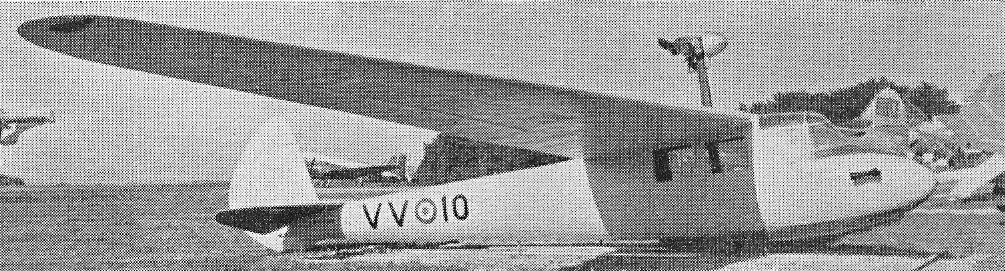
The Canguru two-seater is of conventional all-wood and fabric construction, with a high cantilever wing which has a single main spar with a torsionally stiff D-type leading edge; the wing is in two halves and can easily be detached for transport. CVV-type air brakes limit the maximum diving speed to 137mph. The oval-section fuselage is a monocoque structure and the two pilots are seated in tandem, an unusual feature being the location of the second pilot actually beneath the wing rather than ahead of it or in line with the leading edge. The cantilever tail unit has a low-set tailplane.
The CVV 6 Canguru two-seater was developed by the CVV (Centre Volo a Vela del Politecnico di Milano) and built in small numbers by Ambrosini – or Societa Aeronautica Italiana, Ing A. Ambrosini & C. It was also built under licence by Meteor SpA, Costruzioni Aeronautiche.
In addition to the prototype, the Italian air force has ordered 32 copies. The first flew in 1940, only two copies were built during the duration of the war. Others were produced between 1953 and 1955.
A powered prototype Ambrosini CVV6 Canguro, with Italian military number MM100028, was built with a 20 hp flat-twin engine.
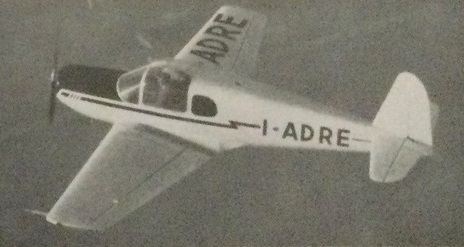
Designed by Stelio Frati, the Rondone was produced in two versions; the two-seat F.4 Rondone I and three-seat F.7 Rondone II (originally known as the Airone).
A batch of ten Rondone I two-seaters were built by S.A.I. Ambrosini, and additional aircraft were built by Legnami Pasotti & Co.
Rondone I
Both versions are generally similar externally.
The F 7 Rondone II with the 90 hp engine sold for 4.5 Mill.Lire.
Raab Flugzeugbau also acquired rights to license-produce the Ambrosini Rondone four-seat monoplane.
F.4 Rondone I Engine: Walter Mikron II, 65 hp Seats: 2 Empty weight: 749 lb Loaded weight: 1212 lb Max speed: 143 mph Cruise: 124 mph Range: 466 mi Wingspan: 28 ft 2.25 in Length: 20 ft 2 in Wing area: 114.097 sq.ft
F.7 Rondone II Engine: Continental C90, 90 hp Seats: 3 Empty weight: 1124 lb Loaded weight: 1742 lb Max speed: 149 mph Cruise: 130 mph Range: 385 mi Wingspan: 30 ft 6 in Length: 22 ft 3.5 in Wing area: 142.083 sq.ft
Derived from the S.A.I.2S, the S.1001 was produced in two versions; A four-seat tourer powered by a 130 hp Alfa 110, and A two-seat military trainer powered by a 145 hp DH Gipsy Major 10.
In 1948 the S1001 Grifo broke more records.
S.1001
The two seat S.1002 Trasimenus is essentially a variant of the S.1001 Grifo with a modified wing featuring increased span to 35 ft 9 in and area, and markedly increased dihedral. The fuselage of the Trasimenus is identical to that of the Grifo, and a 130 hp Alfa 110ter engine.
S.1001 Tourer Engine: 130 hp Alfa 110 Wingspan: 32 ft 5.5 in Length: 25 ft 7 in Empty weight: 1543 lb Loaded weight: 2340 lb Max speed: 149 mph Cruise: 130.5 mph Seats: 4
S.1001 Military Engine: 145 hp DH Gipsy Major 10 Seats: 2
S.1002 Trasimenus Engine: 130 hp Alfa 110ter Wingspan: 35 ft 9 in Seats: 2
When SAI Ambrosini embarked on the creation of a light jet with supersonic capabilities, it was decided to proceed step by step, with experimentation.
A standard Ambrosini S.7, named Freccia, was equipped with a 45° swept wing.
First flown on 18 July 1952 on the military base at Aviano, the pilot was Ireneo Di Crescenzo. Test were flown until 1 August 1952. After tests with the sweptback wing, designer Sergio Stefanutti designed the Sagittario (Archer) powered by a 400kg thrust Turbomeca Marbore turbojet.
The S.7 was produced in single- and two seat versions for the Italian Air Force. The two-seater being S.7B.
S.7
A further development of the basic design is the Super S.7, or Supersette, which is slightly larger than the S.7 and powered by a 340 hp de Havilland Gipsy Queen 70-3 engine.
S.7 Engine: 225 hp Alfa 115ter Wingspan: 28 ft 10 in Wing area: 137.8 sq.ft Length: 26 ft 10 in Empty weight: 2365 lb Loaded weight: 3030 lb Max speed: 224 mph ROC: 1103 fpm
Super S.7 / Supersette Engine: 340 hp de Havilland Gipsy Queen 70-3 Wingspan: 30 ft 6 in Wing area: 148,5 sq.ft Empty weight: 3030 lb Loaded weight: 4300 lb Max speed: 267 mph ROC: 985 fpm
Supersette Engine: Alfa Romeo 121 C, 395 hp Wingspan: 30.512 ft / 9.3 m Length: 26.804 ft / 8.17 m Max take off weight: 4304.2 lb / 1952.0 kg Max. speed: 227 kt / 420 km/h Service ceiling: 24606 ft / 7500 m Range: 594 nm / 1100 km Crew: 2
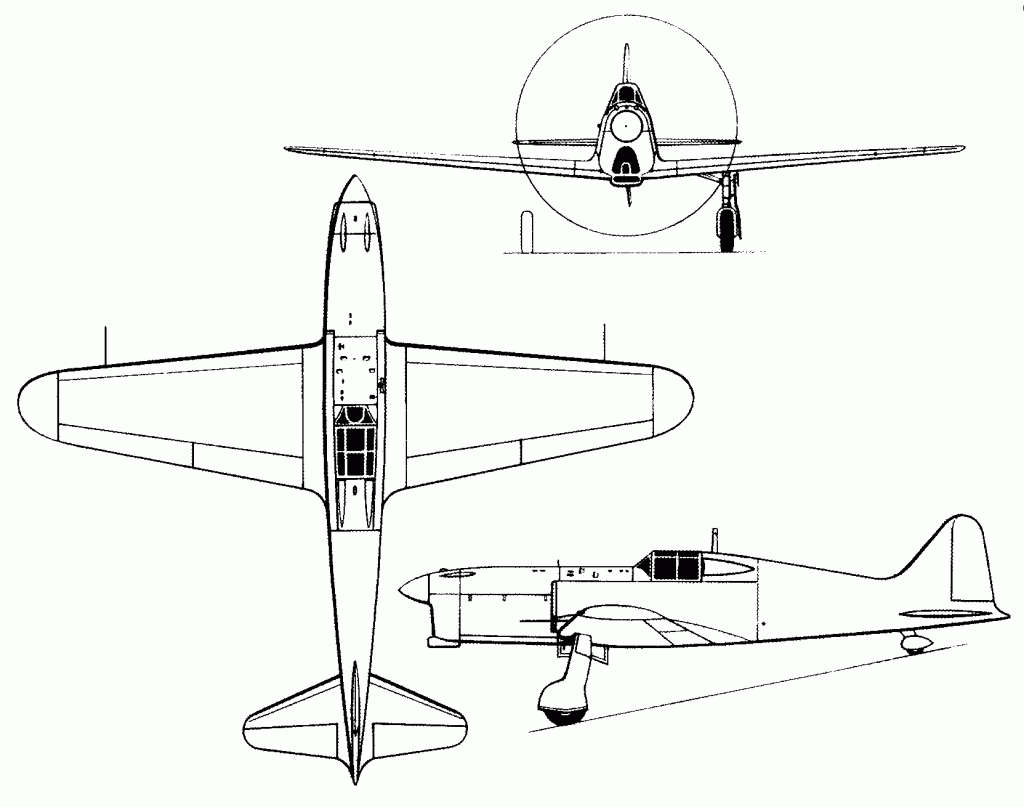
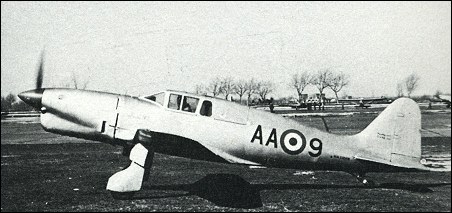
A lightweight single seat fighter by Societa Aeronautica Italiana (Ambrosini), the Type 403 Dardo (Arrow) appeared in late 1942, developed from the S.A.I.207. The 403 differed by having a later series of 750 hp Isotta Fraschini Delta inverted V 12 aircooled engine, and constant speed Piaggio propeller. The airframe was of similar all-¬wood form but had a new wing profile, greater area, redesigned tail surfaces – the incidence of the tailplane being variable in flight – a redesigned rear fuselage, a fully-retractable tailwheel, provision for wing guns and a more robust structure.
The Stefanutti-designed S.403 flew for the first time in January 1943, powered by an Isotta-Fraschini R.C.21/60 engine of 750hp which provided a maximum speed of 403 m.p.h. In the final two years of the programme all that happened was the first few items of production tooling, but no Dardos.
The armament was two 20 mm (0.79 in) Mauser MG 151 cannon in the wings and two 12.7 mm (0.5in) Breda SAFAT heavy machine guns above the engine. The Dardo¬-C was to be a long range version with increased internal fuel and two drop tanks. An order for 3000 was placed with S.A.I. (800), Savoia Marchetti (1,200) and Caproni (1,000), but only the prototype flew as the Armistice ended all further work.
S.A.I.403 Engine: Isotta-Fraschini Delta HG 21/60, 559-kW (750-hp). Take-off weight: 2640 kg / 5820 lb Empty weight: 1983 kg / 4372 lb Wingspan: 9.80 m / 32 ft 2 in Length: 8.20 m / 26 ft 11 in Height: 2.90 m / 9 ft 6 in Wing area: 14.46 sq.m / 155.65 sq ft Max. speed: 648 km/h / 403 mph Range: 937 km / 582 miles Ceiling: 10000 m Crew: 1 Armament: two 20 mm (0.79 in) Mauser MG 151 cannon and two 12.7 mm (0.5in) Breda SAFAT machine guns
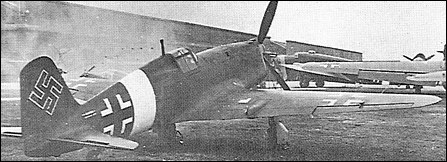
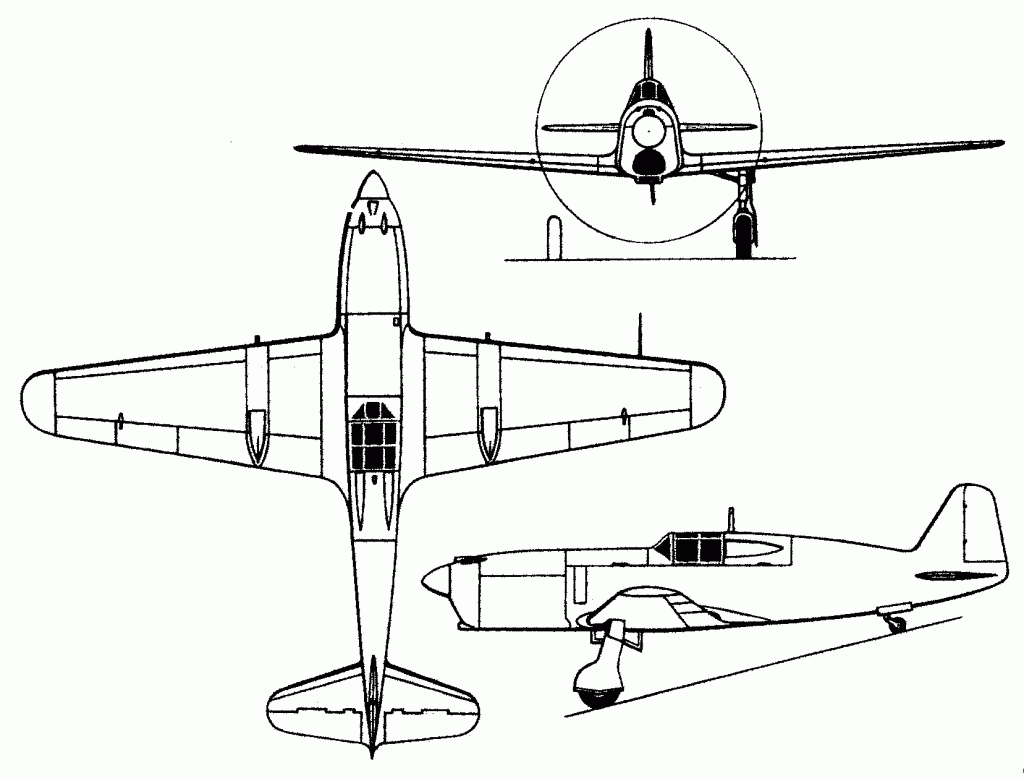
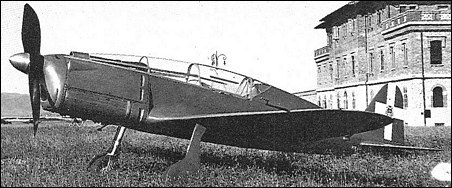
Developed from the S.107 lightweight single-seat fighter and featuring a similar wooden structure with monocoque fuselage, the S.207 was essentially a more powerful, productionised version of the basic design. The first of two prototypes of the S.207 was flown in 1940, and was powered by an Isotta-Fraschini Delta R.C.35 12-cylinder inverted-Vee air-cooled engine rated at 705hp.
The second prototype was powered by the R.C.40 version of the engine rated at 750hp at 4000m. In dives the S.A.I.207 attained an indicated air speed of 466 m.p.h. at 10,000 ft. (representing a true air speed of 596 m.p.h., or Mach 0.86), and maximum level speed was 357 m.p.h., with the 750 h.p.
Armament was two synchronised 12.7mm machine guns, and a pre-series of 12 S.207s was built during March-July 1943, several of these being assigned to the 83a Squadriglia (18° Gruppo, 3° Stormo) for evaluation, and six being assigned in August 1943 to the 162a and 163a squadriglie (161° Gruppo). The Ministero dell’Aeronautica placed orders for 2,000 of the S.A.I.207 production version, but only 13 pre-production aircraft were completed, the order then being switched to the improved S.A.I.403 Dardo (Dart).
One pre-series S.207 was fitted with an armament of two 20mm cannon.
S.A.I.207 Engine: 1 x Isotta-Fraschini Delta HG 40, 559kW (750 hp). Wingspan: 9m (29 ft 6.3 in) Length: 8.02 m / 26 ft 4 in Height: .40 m / 7 ft 10 in Wing area: 13.90 sq.m / 149.62 sq ft Empty weight: 1750 kg / 3858 lb Max T/O weight: 2415 kg (5,324 lb). Max speed: 398 mph at 14,765 ft Operational range: 590 miles Ceiling: 12000 m Climb to 6000 m: 7 min 34 sec Armament: 2 12,7 mm machine-guns Max Dive speed: 960 km/h Armament: 2 x 12.7-mm (0.5-in) mg.
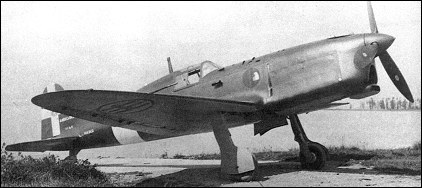
Despite highly enthusiastic flight test reports, the need for increased production of combat aircraft necessitated the shelving of the S.A.I.7 trainer, but the aerodynamic qualities of the basic design were such that Stefanutti contemplated its adaptation as a lightweight interceptor fighter. The initial single-seat model, the S.A.I.I07, was built for research purposes and, powered by a 540-h.p. Isotta-Fraschini Gamma, was flown early in 1942
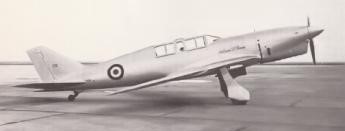
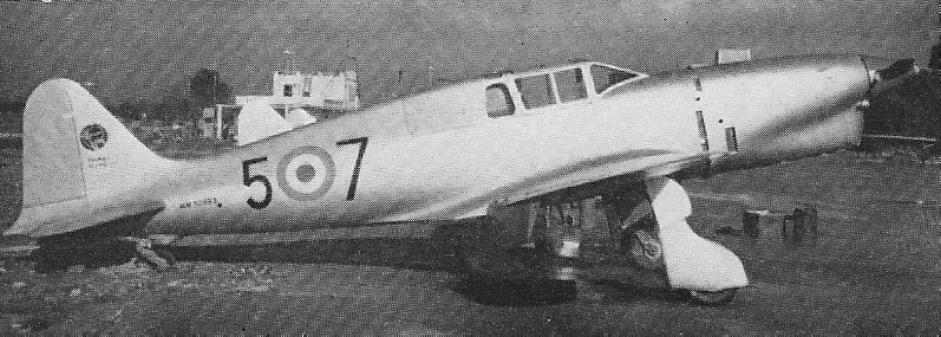
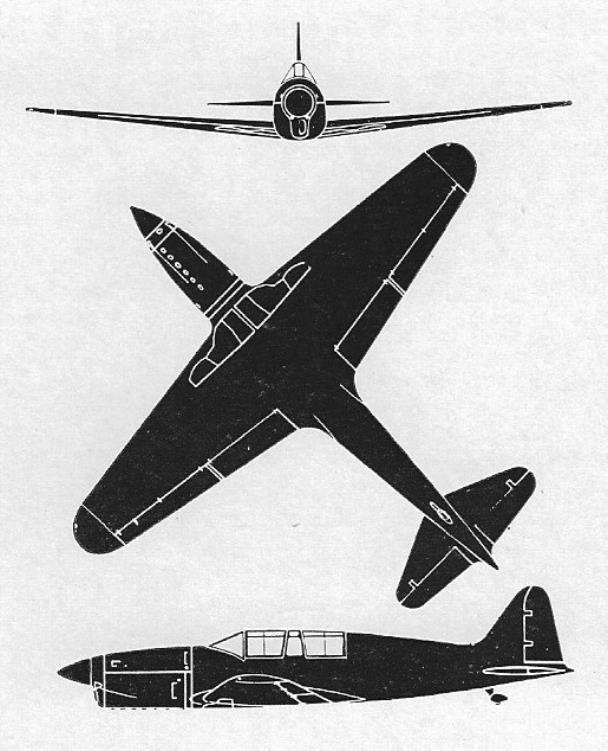
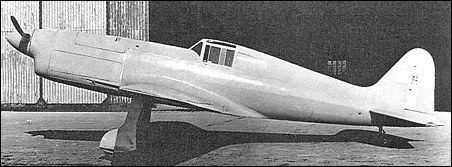
Working at the Societa Aeronautica Italiana of Ing Angelo Ambrosini, Sergio Stefanutti developed the S.107 lightweight fighter from the S.7 tandem two-seat aerobatic trainer and competition aircraft. Flown for the first time early in 1940, the S.107 was powered by a 515hp Isotta-Fraschini Gamma R.C.35-I 12-cylinder inverted-Vee air-cooled engine and armament was one 7.7mm machine gun. As initially flown, the S.107 was fitted with a long, faired windscreen extending over the engine in an attempt to reduce aerodynamic drag. This was found to impair vision from the cockpit, and it was replaced by a stepped windscreen. Performance was demonstrated at Guidonia, and progressive development of the basic design led to the S.207, the sole example of the S.107 being lost in an accident on 18 July 1941.
Engine: Isotta-Fraschini Gamma RC.35-I, 515 hp Take-off weight: 1600 kg / 3527 lb Empty weight: 1280 kg / 2822 lb Wingspan: 9.00 m / 29 ft 6 in Length: 8.00 m / 26 ft 3 in Height: 2.40 m / 7 ft 10 in Wing area: 13.10 sq.m / 141.01 sq ft Max. speed: 500 km/h / 311 mph Range: 800 km / 497 miles
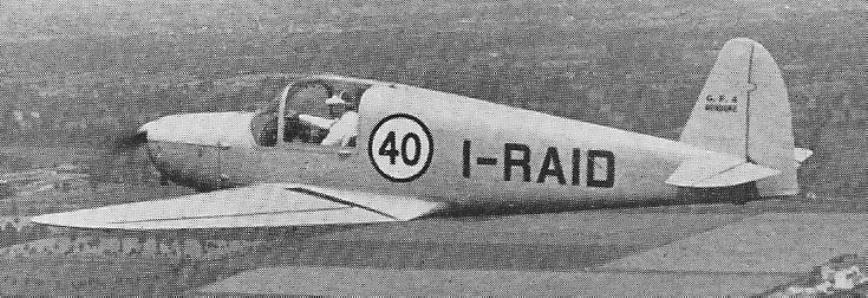
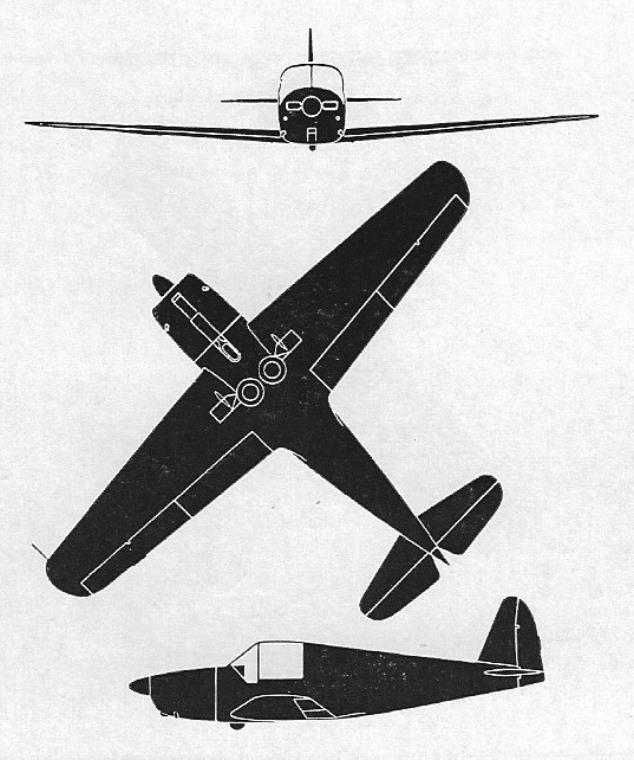
Designed between October 1938 and April 1939 by Sergio Stefanutti as a two-seat high-speed tourer monoplane, the Ambrosini S.A.I.7 was a low-wing cantilever monoplane of wooden construction with fully retractable landing gear. The first two aircraft were specifically intended to take part in the IV Avio Raduno del Littorio contest for touring aircraft, and they flew within days of each other, only shortly before the competition opened at Rimini aerodrome on 15 July 1939. Both aircraft had an additional streamlined glazed section added between the nose and the normal cabin enclosure for the contest. The S.A.I.7s did not win the contest, but one machine captured an international speed record over the 100km closed circuit on 27 August 1939. The F.A.I. Category I aircraft with a speed of 244 m.p.h Ten of the S.A.I.7 militarised two-seat fighter trainer version appeared during 1943, and the experimental S.A.I.107, S.A.I.207 and S.A.I.403 light fighters were developed from it. In 1949 S.A.I. Ambrosini placed the S.A.I.7 in full-scale production. The post-war version replaced the 209kW Hirth HM.508D engine of the record-breakers and the 209kW Isotta-Fraschini Beta RC.10 of the wartime version with an Alfa Romeo engine, but apart from improved constructional detail there were few major changes. Most of the 145 post-war Ambrosini S.7s, some of them completed in single-seat configuration, formed the equipment of various flight training centres attached to the Aeronautica Militare zone headquarters. The military service was terminated in 1956 The S.7 participated in numerous competitions and Leonardo Bonzi established international records over the 100km and 1000km distances on 21 December 1951, with average speeds of 367.36km/h and 358.63km/h respectively.
Engine: 1 x Alfa Romeo 115ter, 168kW Take-off weight: 1317 kg / 2904 lb Empty weight: 1105 kg / 2436 lb Wingspan: 8.79 m / 28 ft 10 in Length: 8.17 m / 26 ft 10 in Height: 2.8 m / 9 ft 2 in Wing area: 12.8 sq.m / 137.78 sq ft Max. speed: 358 km/h / 222 mph Cruise speed: 264 km/h / 164 mph Ceiling: 5250 m / 17200 ft Range: 1000 km / 621 miles