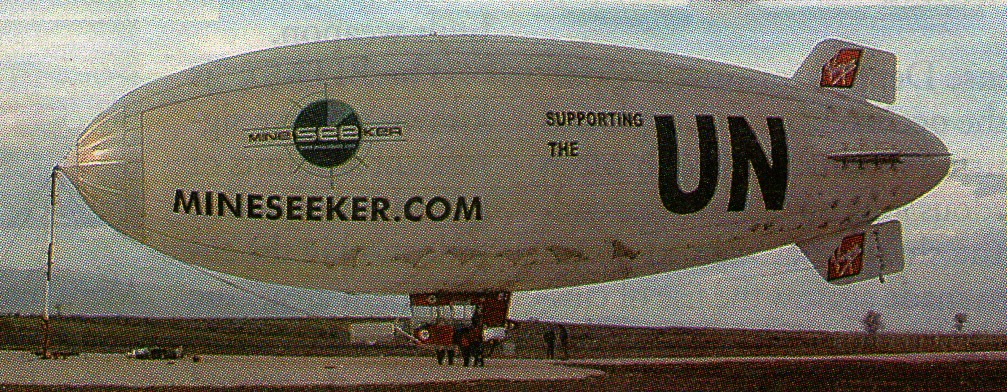
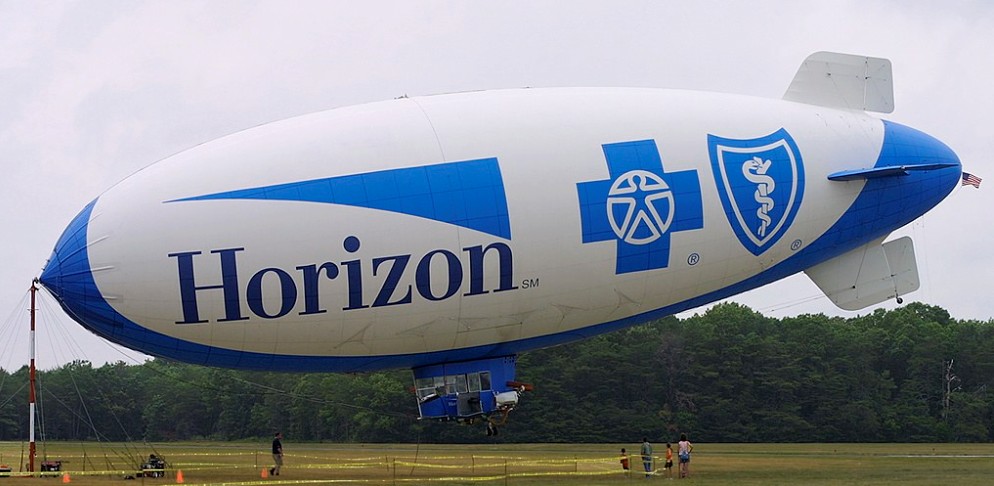
The U.K.’s Defense Evaluation and Research Agency (DERA) cornpleted field trials in Kosovo of a prototype of an ultrawideband synthetic aperture radar being developed to detect mines and unexploded ordnance. The project was run by Mineseeker, a joint venture between DERA and The Lightship Group, a company owned by Virgin Atlantic chief Richard Branson. Mineseeker aims to employ airships as mobile sensor platforms to detect and delineate mined areas and unexploded cluster bombs and other ordnance. In addition to serving as a realistic test bed for DERNs ultrawideband radar, the airship was also fitted with electro-optic sensors. The Kosovo deployment provided valuable imagery and data for the U.N.’s Mine Action Coordination Center (MACC) which is conducting mine clearance operations in the country. Feasibility flight trials of the radar mounted on a helium-filled, nonrigid airship were conducted by DERA in January in the U.K. The same 40-meter-long A60+ airship, built by the American Blimp Corp., was used in Kosovo. Data generated from the ultrawideband radar deployment in Kosovo is being studied by DERA officials in the U.K. The sensor is intended to locate and differentiate metal and plastic mines. The deployment began with the manned airship starting operations four days later, operating from bases in Kosovo and Italy. Over a period of six weeks, the Mineseeker team surveyed 30 sites in Kosovo, locating, identifying and mapping recorded minefields, as well as searching for unexploded ordnance from cluster bomb strikes.
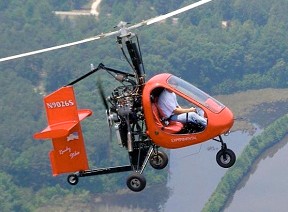
The American Autogyro Inc, formed in December 2002, as a division of Groen Brothers Aviation, with the objective to develop stability augmentation and other safety features for existing autogyros. Following incremental development on several testbeds, American Autogyro launched at AirVenture, Oshkosh, July 2003, the Sparrowhawk two-seat autogyro/kitbuilt when proof-of-concept vehicle N974J (flown February 2003) was displayed. Kit deliveries then scheduled to begin in late 2003, although stability augmentation kits for gyrocopters already flying were available from April 2003. A development aircraft was based on an RAF 2000 pod, but modified with a large all-moving rudder and fixed cruciform horizontal stabiliser with endplates. Rudder/stabiliser intersection is in line with propeller boss for optimum dynamic stability, assisted by rudder self-centring springs. Dual control sticks operate roll and cyclic rotor control; rudder pedals also used for ground steering, in conjunction with differential braking. The structure is aluminium frame with glass fibre pod and honeycomb composites empennage; aluminium keel and mast; tubular steel landing gear; bonded metal rotor blades. The fixed landing gear is tricycle type with a safety tailwheel, and cable-operated brakes on the mainwheels (15 x 6.00). The single 110kW Subaru EJ22 flat-four drives a two-blade, fixed-pitch, carbon fibrepusher propeller and rotor prerotate drive. Fuel capacity 95 litres of which 87 litres are usable. Factory-complete aircraft were available, and a law enforcement/aerial patrol version (EJ22 engine) first flew in the third quarter of 2003. A total of 28 had been sold by August 2003. In 2003 the prices were: Experimental category kit US$27,390; Light Sport Aircraft quick-assembly kit US$40,700 or US$46.200 flyaway; law enforcement version US$62,384, assembled and equipped. The Sparrowhawk has an aluminum frame and moulded fiberglass cabin, and the Quick Build Kit price: in 2009 was $45,500. The SparrowHawk III quick build kit significantly reduces the time and effort involved. Estimated build time for the SparrowHawk III is approximately 300 hours. The SparrowHawk III is a 2 seat, aluminum frame, centerline thrust gyroplane with a 44 inch wide moulded fiberglass cabin. The SparrowHawk provides comfortable seating for individuals with up to 6’ 6” in height and 240 lbs in weight. The kit comes with everything you need to fly, daytime VFR, except for fuel, including dual controls.
Sparrowhawk Rotor diameter: 9.14m Fuselage length: 4.14m Height overall: 2.97m Max. take-off weight: 612kg Empty weight: 386kg Never-exceed speed: 185km/h Max cruising speed: 130km/h Max rate of climb at sea level: 152m/min Service ceiling: 3,050m Take-off run: 92-153m Take-off to 15m: 305m Landing from 15m: 92m Range at 75% power: 453km
Sparrowhawk III Engine: Subaru EJ25, 165 hp Propeller: Warp Drive Rotor Blades: Sportcopter 2 blade Length: 12 ft 3 in Width: 6 ft 1 in Height: 10 ft Dry Weight: 900 Ibs Useful Load: 600 Ibs Gross Weight: 1,500 Ibs Fuel Capacity: 23 USgal Fuel Consumption: 6.5 gph at cruise Rotor Diameter: 30 ft Minimum Take-off Ground Roll: 100 ft Normal Take-off Ground Roll: 300-500 ft Landing Roll: 0-30 ft Rate of Climb: 650 ft./min Speed – Maximum (Vne): 100 mph Speed – Cruise: 75 mph Service Ceiling: 10,000 ft Endurance (with 1/2 hour reserve) at cruise: 3 hours Seats: 2
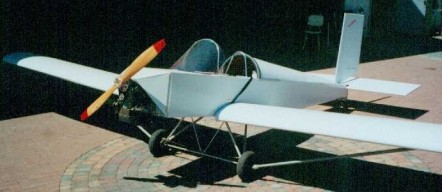
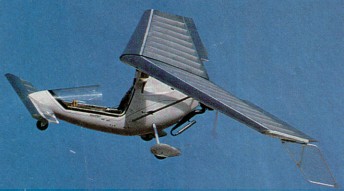
Of pre-manufactured sub-assemblies, with wings, tail empennage and fuselage all pre-built, ready for bolt-on, the kit arrives pre-fabricated and pre-painted white. The wings are built around a single deep spar. There are 26 foam ribs in each 12 foot long wing. When this assembly has been built, it is covered in full-span panels of pre-painted (white) aluminum skins, durable and UV-resistant. The resultant wing weighs less than 35 pounds. It is attached to the fuselage with just a few bolts, and in about 5 minutes. This airplane can be easily assembled in the field, and allows for trailer transport. The purchaser assembles pre-built components with the supplied aircraft-grade bolts and nuts. This means that wrenches are the only tools required to assemble this aircraft kit. It was designed to fly with a Hirth F-33 25hp engine, with electric start, or alternately, the Zenoah GB25 22hp engine with pull start can be used. Higher horsepower engines are not recommended. First flown in August 1997, by July 2003 the Eureka had been withdrawn from the market due to lack of resources.
Engine: Hirth F33, 25hp HP Range: 22-26 Wing Span: 26 ft Wing Area: 104 sq.ft. Height: 5.0 ft Length: 14.5 ft Empty Weight: 230 lb Gross Weight: 460 lb Fuel Capacity: 5 USG Top Speed: 63 mph Cruise: 55 mph Endurance: 1.5 hours Stall: 27 mph Rate of Climb: 500 fpm Takeoff Distance: 300 ft Landing Distance: 250 ft Service Ceiling: 10,000 ft Seats: 1 Landing Gear: Tailwheel Bldg. Materials: Aluminum, Foam Airframe Cost: $5000 (2009)
Engine: Zenoah G25B, 22hp HP Range: 22-26 Wing Span: 26 ft Wing Area: 104 sq.ft. Height: 5.0 ft Length: 14.5 ft Empty Weight: 238 lb Gross Weight: 460 lb Fuel Capacity: 5 USG Top Speed: 63 mph Cruise: 55 mph Endurance: 1.6 hours Stall: 27 mph Rate of Climb: 450 fpm Takeoff Distance: 350 ft Landing Distance: 250 ft Service Ceiling: 10,000 ft Seats: 1 Landing Gear: Tailwheel Bldg. Materials: Aluminum, Foam Airframe Cost: $5000 (2009)
Engine: Cuyuna, 22 hp HP range: 22-25 Wing span: 26 ft Wing area: 104 sq.ft Length: 14.5 ft Height: 5 ft MTOW: 460 lb Empty wt: 250 lb Fuel cap: 5 USG Top speed: 63 mph Cruise: 60 mph Stall: 27 mph Range: 150 sm ROC: 350 fpm TO dist: 400 ft Ldg dist: 250 ft Service ceiling: 7000 ft Seats: 1 Undercarriage: tailwheel Take-off distance (50ft obstacle): 300 ft / 91 m Landing distance (50ft obstacle): 250 ft / 76 m
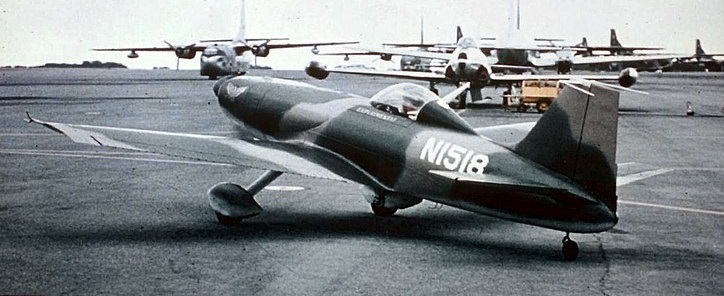
The American Electric Piranha (also named Blair-American USA or American USA was a prototype American counter-insurgency aircraft. Designed by Milt Blair and Dick Ennis in the early 1960s, developed from the LeVier Cosmic Wind, it was built by the American Electric Corporation.
Developed for use by the United States Air Force under Project Little Brother, initial flight testing of the Piranha took place at Mojave Airport in California; following delivery for evaluation, it was tested at Eglin Air Force Base in Florida. The design armament of the Piranha was two pods each carrying four Zuni unguided rockets, mounted on the aircraft’s wingtips, and a single 500-pound (230 kg) bomb on a belly hardpoint.
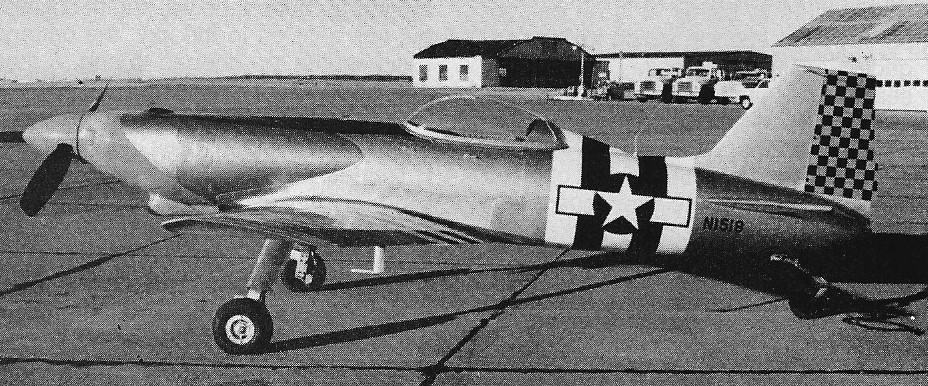
Evaluation of the Piranha ceased following the death of Milt Blair in an unrelated aircraft accident. The prototype, N1518, is flown by a private owner in Kansas. Possibly, seven examples were built and tested.
Bud Pinkston’s Piranha is thought to be the only one still flying, and by virtue of its serial number (USA-1) could be the original prototype. Bud even has an old company sales film touting the Piranha’s virtues to the military. In 1985, American Electric project engineer and Piranha designer Dick Ennis met Bud at an air show in Kansas. Dick was surprised to see the prototype No. 1 still flying and filled Bud in on the history of the Piranha.
When Bud finally got his hands on the Piranha, it already had 200 hours in the logbook, mostly military test time. The Piranha is all-aluminum construction and uses thick .050-inch skins throughout.
Bud believes the wing design was based on the aluminum Cosmic Wind Racer that Lockheed test pilots Herman Salmon and Tony LeVeir built and raced. The very beefy wing uses a built-up I-beam spar that angles forward from the root to the tip. The wing also uses solid ribs. Since the wet-wing tanks extend from the root rib to the tip rib, the ribs have flapper doors that act as one-way check valves to control fuel migration. Each wing holds 20 gallons of fuel, with a header tank making up another 20 gallons, for a total fuel capacity of 60 gallons (58 usable). Bud switches from left to right tank every 15 minutes to maintain roll trim.
The tapered wing starts with a symmetrical root rib, and there is considerable downward twist as the wing concludes at the tip. The wings have no flaps but do have 84-inch-long ailerons that span the full length of the wings. Only 8.75 square feet of aileron area is greatly responsible for the Piranha’s roll rate of 720 degrees per second. The first time Bud slapped the stick over, the roll was so abrupt that he slammed his head against the canopy and required four stitches in his right ear.
The fuselage is unique in that American Electric Corporation chose to hydro-form it from the cockpit aft. It was formed on the same plug they used to make napalm bomb casings. Notice the rear end cap under the rudder.
The cockpit is a model of simplicity and effectiveness. The canopy hinges on the right side and latches on the left. Two Piper-style latches are used to clamp the cockpit down and are accessible from inside or out. Once inside, the Piranha is placarded with a VSO of 80 kts (92 mph), and a VNE of 340 kts (391 mph). The VNE of 340 kts was the limit of the factory flutter testing.
Electrical switches are mounted on the lower left of the instrument panel. On the left side, the ammeter, tachometer, and airspeed indicator start to wrap around the panel. At the one o’clock position, the altimeter is mounted. Farther down the panel you will find the g meter, and below it the combination manifold pressure/fuel flow gauge. The oil pressure gauge is to the right.
A military-style throttle/prop quadrant is mounted on the left side of the cockpit. Centered behind the control stick are a transponder and Terra NAV/COMM King KLN-88 Loran. Bud uses a Garmin 295 handheld GPS for all the primary navigation duties. A full safety harness is bolted to the structure behind the seat.
Bud made several modifications during his tenure as owner. In an effort to eke out some more top speed, Bud clipped the wing tips. The original wingspan was 19.5 feet, but Bud clipped the tip rib off each side, reducing the wingspan to 18.5 feet. It did not help the top speed one iota, but did increase the roll rate.
He replaced the original nose bowl and spinner with LoPresti units to clean up the nose. This mod did not add any speed but really helped the engine cooling. Bud had to add a cowl flap to keep from overcooling the engine and oil. The oil temperatures rarely topped 130˚F before, but now with the cowl flap installed he sees 190˚F.
Bud also ditched the original sharp-nosed wheelpants in favor of the Vans RV-style pressure recovery main wheelpants. Using the same Vans geometry, he scaled down and fabricated his own matching tail wheelpant. The new wheelpants added 8 mph to the top speed. The tail wheel is steerable and is mounted on the rudder spar. It has a built-in shock absorber that consists of a damped spring and has 2 inches of total travel.
The Piranha sports a very tightly cowled Lycoming parallel valve IO-360. With 10 to 1 compression and Bendix magnetos, it produces 210 hp and redlines at 2700 rpm. The mechanical fuel injection system uses a mechanical fuel pump augmented by an electric boost pump. It has proven to be an easy starter. Along with the nose bowl modification, Bud also switched to a K&N air filter. The combination resulted in a half-inch increase in manifold pressure.
The Lycoming swings a two-blade Hartzell constant-speed prop that was taken from a Piper Twin Comanche. The propeller blades were cut down and re-pitched. The prop diameter is now 67 inches and the blades have a 6.375-inch maximum chord. It is full feathering.
The Piranha weighs in at 900 pounds empty. Adding 60 gallons of fuel, 30 pounds of baggage, and finally Bud at 150 pounds, the Piranha’s takeoff weight tips the scales at 1,440 pounds. With 67.7 square feet of wing area, the wing loading comes in at 21.3 pounds per square foot. Power loading is 6.8 pounds/hp.
The Piranha accelerates briskly on takeoff —the tail is up within 4 to 5 seconds. Bud’s ground run averages 1,100 feet, he rotates at 110 mph and climbs out at 1,500 feet per minute on a standard atmosphere day. In order to maintain visibility over the nose, he accelerates the Piranha to 185-190 mph during the climb until he levels off at his cruising altitude. Average time to climb to 10,000 feet from his home field in Kansas is six minutes.
The Lycoming consumes 8 gph in cruise. To get that number, Bud likes to fly high, around 10,000-12,000 feet, where he sets the prop and throttle to achieve 2500 rpm at 19 inches of manifold pressure. At this setting, he cruises at 230 mph. At wide-open throttle, he indicates 260 mph and fuel consumption jumps to 10 gph. Bud has been to 18,000 feet and considers that to be the Piranha’s ceiling, although he is sure it could go a bit higher.
The stick forces are the lightest that Bud has ever experienced on a high-performance airplane. The most he needs to move the stick in any direction is 2 inches. However, stop-to-stop the stick has a 12-inch-by-12-inch deflection box. The airframe is stressed for 16 g’s both ways.
Bud describes the Piranha as having neutral stability. For example, if while flying straight and level, he pulls back on the stick and then lets go, the nose rises and the Piranha tends to stay at this new angle of attack. There is no moment that increases the AOA, nor is there any moment to restore it to the original straight and level attitude. This behavior makes it a busy airplane —not to mention the lack of any ability to damp out pitch oscillations.
Stalls are very benign. At gross weight, the wing sends a strong signal to the pilot that it is ready to quit lifting around 130 mph. Empty, the stall occurs at 105 mph with an obvious shudder. The Piranha flies straight and is very controllable during the stall recovery, a trait Bud attributes to the considerable downward wing twist built into the wings’ leading edge. What about the 80 kt (92 mph) VSO, in a quest for speed he clipped a foot off the wingspan.
By 1987 the Piranha had logged 550 hrs and was finished in a military paint scheme.
1987
Piranha USA-1 Engine: Lycoming IO-360: 210 hp@ 2700 rpm Prop: Hartzell C/S 2-Blade 74” Diameter Wing Span: 18.5 ft. Wing area: 70 sq ft (6.5 m2) Overall Length: 18 ft. 4 in. Empty Weight: 900 lbs Gross Weight: 1440 lbs Baggage Capacity: 30 lbs Power Loading: 6.8 lbs/hp Wing Loading: 21.3 lbs/sq. ft. E. Flat Plate Area: 1.85 sq. ft. Cabin Width Inside: 28 in. Load Factor (g’s): +16, -16 Vne: 391 mph Cruise Speed @ 2500 rpm/19 in./10,000 ft. 230 mph Top Speed: 260 mph Stall Speed Range (No Flaps Available): 130/105 mph Rate of Climb @ Gross Wt. Sea Level: 1500 ft./min. Economy Cruise Range (60 gal): 1700 approx. Crew: one Hardpoints: 1 with a capacity of 500 pounds (230 kg) Rockets: 2 4-round 5.0-inch (127 mm) Zuni rocket pods
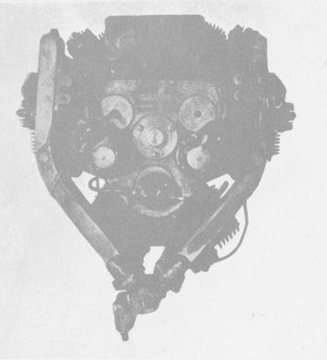
All moving parts of the Hudson-Hawk are under force feed lubrication and fully enclosed.
The Hudson-Hawk featured small diameter L-heads, solid (no cap) connecting rods, and a built up crankshaft. A self-starter and supercharger were available at extra cost.
Type: 6 cylinder, 4 stroke, air cooled, fixed radial Rating: 100 hp at 1800 rpm Displacement: 372 cu.in Compression ratio: 5.4-1 Bore: 3.875 in Stroke: 5.250 in Diameter: 33 in Length: 28 in Weight: 326 lb Fuel consumption: not more than .50 lb/hp/hr Oil consumption: not more than .035 lb/hp/hr Lubrication: Force feed, pressure and scavenging pumps Ignition: 2 Scintilla Carburation: McCadden Spark plugs: 2 per cylinder
Agricultural aircraft, a development of Stearman Model 75 (Boeing Kaydet). Alternatively offered new high-lift wings and special modification kits. In eight years more than 200 Stearmans were fitted with new wings, permitting loads of over 2,000 Ib (907 kg).
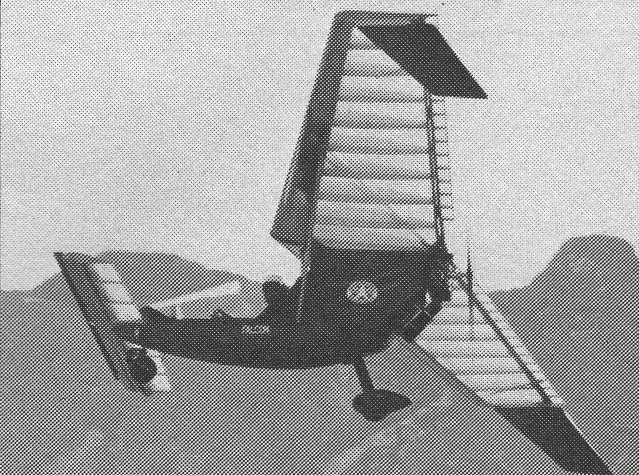
In March 1981 Romuald Drlik began the design work for a new lightweight canard-type aircraft, tentativly named Falcon and in May 1981 Romuald and helpers began construction on the first Falcon prototype (model “A”). After first trying a single-wheel gear and side-stick (neither successful) the #1 Falcon flies in late July 1981 using tricycle gear, a double-surface variable camber Dacron wing, centre hinged-stick, and a Robin 240 cc single-cylinder engine.
The Falcon’s fuselage is moulded Kevlar and graphite. The wings and canard, though constructed by standard techniques with aluminium and foam, are covered with “Tedlar”, a durable and resilient alloy of Teflon and mylar.
Falcon performance figures reach the established limits for an ultralight, with cruise speed at 60, stall at 26 and maximum at 63. Powered by a small single-cylinder, 26-hp Rotax engine, the Falcon’s highly efficient configuration affords the highest allowable performance, while the incidence angle of the canard limits excessive speed. Controls are standard three-axis, with full-span ailerons.
The Falcon was to be available as a complete, ready to fly craft, not a kit. The finished Falcon featured in-flight restarting, cockpit choke system, five-function AeroGage panel, nosewheel steering and brake, shoulder harness/seat belt, padded seat, ¾ canopy, cabin heat and choice of several fuselage colours. Projected price was $7500 (in August 1983).
In August 1981 the #2 Falcon prototype was displayed (static only) at Oshkosh and during the winter of 1981-82, the development continued on prototypes #2 and #3, altering forward wing position wing incidence, engine (changed to Cuyuna 215), wing camber, gear geometry, and rudder shape. In Jan 1982 the #3 Falcon prototype was flown in an Arizona race but DNF’s due to a reduction system failure. The empty weight of this (registered) aircraft was 215 lbs. Testing in Feb 1982 showed static loads tests on the #3 prototype go beyond 7 g’s positive and three negative before yield. In March 1982 Prototype #4 (Model 1B) was flown at the Sun N’ Fun Fly-in, using a Cuyuna 430 engine. Testing continued with Prototype #5 first flying in April 1982. Prototype #6 began flight tests July 1982, having a shorter span (31.5 feet) and a totally different wing design using a single strut, D-tube spar, and doped Ceconite wings. November 1982 brought the first flights of prototype #7 (model “C1′), using fiberglass D-tubes for wing structure, 36 ft. span, and lighter Rotax 277 engine. This craft was made in response to the release of FAR Part 103 in October of 1982, to meet the requirements of the new ultralight air vehicle category. In January 1983, prototype #7 won first-in-class at the Arizona Air Race. This same month, #7 makes flights to 13,000 feet, is flown in snowstorms and rainstorms, and flown in 25-30 mph winds. March 1983 brought first flights of prototype #8, N 918 M, incorporating 36-ft aluminum D-tube wings, all-fiberglass fuselage structure (eliminating tube-style engine and wing mount), and Tedlar wing covering. Prototype #8 won Grand Champion and Outstanding Craftmanship awards at Sun &’ Fun March 1983. During 1983, N 918 M was exhibited at many airshows, with continued flight testing in Albuquerque as well. In August 1983 three pre-production ultralight-legal Falcons were flown at Oshkosh, utilizing Kevlar-and-graphite fuselages and numerous refinements. Two of the planes were delivered to Falcon dealers. One craft won Reserve Grand Champion, then was flown home in one afternoon to Minneapolis (over 260 miles), averaging 57 mph ground speed. In August 1983, load tests to destruction were performed on the other Oshkosh plane (prototype #9, which was weighed by the EAA at 240 lbs), documenting a load-carrying strength of 7 g’s positive, three negative for the main wing and over 10 g positive 5 negative for the forward wing. January 1984 – Deliveries of production Falcons begin.
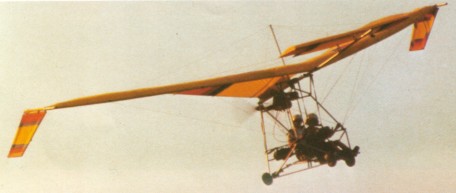
Wing has swept back leading and trailing edges, and tapering chord; no tail, canard wing. Pitch control by elevator on canard; yaw control by tip rudders, roll control by fullspan ailerons; control inputs through stick for pitch/roll and pedals for yaw. Wing braced from below by struts; wing profile; double surface. Undercarriage has three wheels in tricycle formation; steel spring suspension on nosewheel and axle flex suspension on main wheels. Push right go right nosewheel steering connected to yaw control. Brake on nosewheel. Glass fibre fuselage, partially enclosed. Engine mounted below wing driving pusher propeller. The Falcon XP two seat tandem version became available in early 1984.
Falcon Engine: Rotax 277, 28hp at 6200rpm Power per unit area 0.15 hp/sq.ft, 16.3 hp/sq.m Fuel capacity 5.0 US gal, 4.2 Imp gal, 18.9 litre Length overall 10.6 ft, 3.20 m Height overall 5.0ft, 1.52m Wing span 36.0ft, 10.97m Mean chord 4.5ft, 1.34m Canard span 10.3 ft, 3.12 m Canard chord 1.9 ft, 0.53 m Total wing area 185 sq.ft, 17.2sq.m Main wing area 165 sq.ft, 15.3sq.m Canard area 20 sq.ft, 1.9sq.m Main wing aspect ratio 7.9/1 Wheel track 5.2ft, 1.57m Wheelbase 5.5 ft, 1.65 m Nosewheel diameter overall 11 inch, 28 cm Main wheels diameter overall 11 inch, 28 cm Empty weight 2501b, 113kg Max take off weight 4931b, 223kg Payload 2431b, 100kg Max wing loading 2.66 lb/sq.ft, 13.0kg/sq.m Max power loading 17.6 lb/hp, 8.0kg/hp Max level speed 100 mph, 161 kph Max cruising speed 63 mph, 101 kph Stalling speed 26 mph, 42 kph Max climb rate at sea level 500 ft/min, 2.5m/s Min sink rate 250ft/min at 40mph, 1.2 m/s at 64 kph Best glide ratio with power off 16/1 Service ceiling 15,000 ft, 4570 m Range at average cruising speed 300 mile, 483 km
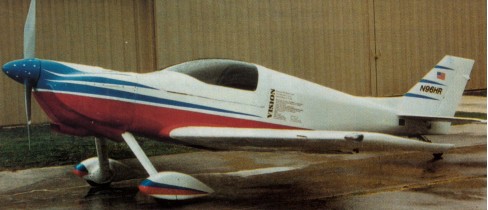
The American Affordable Aircraft Vision is an economical, 2 seat, all composite aircraft that is built from construction manuals. Designed by Steven Rahm for first time builders, each of the sub-assemblies cost less than $500.00 on the prototype. This plane was constructed by first time builders to test the construction manuals and no construction manuals were sold until testing of the prototype. The plane is all composite with no wood under-structure and uses no foams. There is a full sandwich skin on both sides. This is a plans built plane with supplemental parts. It can be built from manuals and raw materials or pre formed parts. The aim is to keep the wet-layup moldless airframe as low a cost as possible. Required power is 85-115 hp giving a cruise of over 150 mph. Engines up to 300 lb and 160 hp are acceptable. The prototype was first flown in 1996. Landing over 50 ft requires 1200 feet and takeoffs require 1500. Stall with flaps is 54 mph but touchdown can be slightly slower with ground effect. Climb rate solo with full fuel is 1400 fpm at sea level on 85 degree day with this prop and the economical Subaru engine. Two models are available – The sportier SP model and the extended wing EX version which is more suitable for high altitude flying, heavier loads, and lower experience pilots. Both versions are supplied with the plans. Construct entirely from the manuals using raw materials or from pre-formed parts. Most of the Visions are built with 44″ to 46″ wide cockpits. Even pilots as tall as 6’5″ can be accommodated. Weight should be at 850 lb empty, the prototype is close to 900. Intitally the gross weight has been set at 1350 lb. pending further testing and the aerobatic weight is at 1250 lb. (With SP wing, engines over 115 hp raise gross to 1450. With “EX” wing and engines to 120 hp gross is 1500 and for engines over 120 hp gross is 1600. +6/-4 g rating is always at 1250 lb.) When the Vision was designed in 1994 there was no thought of LSA. However, since each builder is the manufacturer of their own aircraft they also determine and set the gross weight. Setting the gross weight within LSA limits is simple enough as the Vision is well under any structural or performance concerns for an EX version. In order to fit the stall requirement with flaps up a full time leading edge slot would need to be installed; this is a simple matter once you understand just how easy it is to work with and modify composite structures. In the interest of having the most useful load it is critical that the empty weight is a low as possible since the gross weight can not be higher than 1320 lbs. The use of the carbon pre-built spar and Fold-a-Plane panels provided by Pro-Composites will greatly reduce the weight of the Vision – beyond what can be obtained through building according to the plans. Also important is using a light power plant such as the 120 hp Jabiru. Using these recommended changes a Vision should be in the 700’s empty weight. Keeping the top speed down is simply a prop choice so the whole equation of meeting LSA requirement is no major undertaking.
Staff at Electra Flyer (an Albuquerque-based hang glider company) sensed the presence of a growing demand for a powered, portable, super lightweight aircraft.
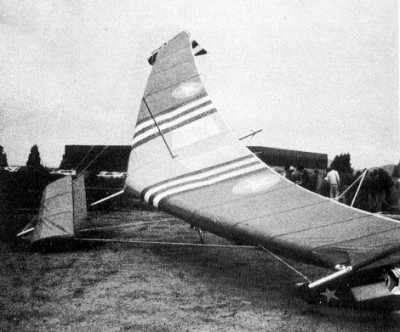
Subsequent development was intermittent encountering several obstacles. Although it flew well, it was not unlike other conventional powered hang gliders. Being heavier than desired, it failed to offer the portability necessary for convenience. While its performance fell within normal parameters, it lacked certain handling characteristics required for acceptance by the general flying community. It would be one thing to sell it to an experienced pilot, but another to sell it to a person with little or no flying background. They also wanted to produce a craft completely built and test-flown by the factory. Early in 1979, Romauld Drlik called to say that his research efforts had produced a craft so unique that Electra should halt their own ultralight development until hearing further from him. Romauld’s design was built around a power system, (as opposed to most ultralights which are hang gliders with engines added) and employed a canard wing. Conceived to be extremely portable, it could be carried on one’s shoulder, transported without special car racks and stored inside an apartment. And it could be built from available hang glider components. When the craft it had logged over 100 hours and undergone numerous changes, an agreement to manufacture the ship was made. Back in Albuquerque, the prototype was refined, employing a semidouble-surfaced airfoil and a flexible airframe which could be assembled/ disassembled in only 25 minutes.The result was EAGLE. In EAGLE, as the pilot’s body moves aft, the elevator automatically deploys in the “down” position, causing the nose to climb. Since the canard’s angle of incidence is higher than that of the main wing, it stalls first. Yet when this happens, it is in a relatively unloaded state. The resultant force is a slight oscillation or porpoising of the nose. Turning is accompanied by a steering wheel which controls drag rudders at the tips. The drag of the tip rudder causes the craft to turn, producing a coordinated roll. Pitch is controlled by fore and aft pilot movement which activites the elevator attached to the canard. While on the ground, the, foot controlled nosewheel is used for steering. At higher speeds, prior to takeoff and just after landing, the tip rudders can be used to steer. EAGLE folds up into a hang glider like package which can be carried on one’s shoulder (with the landing gear and engine over the other) and transported via car top. And the frame can be further disassembled to 12-foot lengths for airline transportation. Performance is a realistic 200-250 fpm climb at sea level (using the standard Chrysler engine), and over 400 fpm with the optional Chrysler Twin-pak engines.
The Eagle was never really a hang glider, being intended for motorized flight. It was foot-launched only once, as part of an early FAA requirement for ultralights, by one of the factory pilots.
Cruise speed is about 35 mph with the standard unit. Glide ratio is 10:1. Takeoff and landing speeds are 16-17 mph, and top speed is close to 50 mph. Mush speed is approximately 16 mph.
Canard ultralight Controlled by tip rudder for roll; elevator plus variable cg for pitch; twist grip throttle for climb and descent; steerable nose wheel. The 215B is a canard design with tip rudders, built and test flown before delivery. Elevator on canard responds to weight shift for pitch control. Steering handlebar moves tip rudders for roll con¬trol. Aluminum tubing, Dacron covering. POWERPLANT: Cuyuna two-cycle engine with in-flight restarter. LANDING GEAR: Trike, steerable nosewheel. Price 1982: $4,395 (with engine). Units delivered to June 1981: 1,016. The Eagle SL is a canard ultralight Controlled by tip rudder for roll; elevator plus variable canard for pitch; twist grip throttle for climb and descent; steerable nose wheel. Seat fixed. First year built: 1981. Price 1982: $4,695 (with engine). The prototype of the Eagle XL used a double skinned wing and retained the tiller of the previous models, but on the production models a side stick was substituted, controll¬ing the spoilers and the elevator hinged from the trailing edge of the canard. What was new also was the canard was fitted with fixed slats on the leading edge. The pushrod controlling the elevator has been replaced by a flexible control, similar to those fitted to outboard motors. The rudder bar works the tip rudders which were initially triangular as on the Eagle of 1981, but were redesigned in a trapezoidal shape and enlarged. The nosewheel steering is connected to the rudder bar. Appearing also in 1982 under the confusing title of Double Eagle, this single seat machine was renamed the Eagle 430B at the Sun’n’Fun fly in in March 1983 at Lakeland, Florida. It is designed for heavier pilots and has a pilot weight range of 200 300 lb (91 136 kg). It has been equipped from the start with the twin cylinder Cuyuna 430RR 35 hp engine, which makes it stand out from the ordinary Eagle, which has the 215RR 20hp engine. However, it retains the hybrid control of the latter: in pitch, the elevator responds to the pilot’s body movements, while the tip rudders respond to the tiller to control yaw. The frame of the Eagle 430B has been enlarged com¬pared with the basic model and the structure reinforced as a result. The Eagle 2 Place was a side by side two seat single engined high¬wing monoplane with conventional three axis control. Wing has swept back leading and trailing edges, and tapering chord; no tail, canard wing. Pitch control by elevator on canard; yaw control by tip rudders; roll control by one third span spoilers; control inputs through stick for pitch/roll and pedals for yaw. Wing braced from above by kingpost and cables, from below by cables; wing profile; double surface. Undercarriage has three wheels in tricycle formation; no suspension on nosewheel and suspension on main wheels. Nosewheel steering by lever between seats. Brake on nosewheel. Aluminium tube framework, without pod. Engine mounted below wing driving pusher propeller. The prototype two seat Eagle appeared in 1982, fitted with controls operating on all three axes, adopting spoilers as on the XL model but retaining the swing seat as used in the hybrid model 215B. It was originally equipped with the Cuyuna 430RR 35 hp, but this was dropped for the production machines in favour of the 50hp twin cylinder in line Rotax 503. This announcement was made in March 1983 in the course of the Sun’n’Fun Fly in at Lakeland, Florida where American Aerolights revealed full information on the Eagle 2 Place, which was classed as an experimental aircraft in the US. The aircraft was provided as a complete kit requiring 100hr for completion. The kit includes as standard the fairings for all three wheels, which are an option on the other Eagles, and also a nosewheel brake.
Double Eagle / Eagle 430B Engine: Cuyuna 430RR, 35 hp at 6000 rpm. Prop diameter x pitch: 54 x 36 inch, 1.37 x 0.91 m. Toothed belt reduction, ratio: 2.2/1. Max static thrust: 240 lb, 109kg. Power per unit area: 0.19hp/sq.ft,2.1 hp/sq.m. Fuel capacity: 5.0 US gal, 4.2 Imp gal, 18.9 litre. Length overall: 15.0 ft, 4.57 m. Height overall: 10.0ft, 3.04m. Wing span: 35ft, 10.67m. Mean chord: 4.3ft, 1.31m. Canard span: 7.8ft, 2.38m. Canard chord: 3.7 ft, 1.13 m. Total wing area: 180 sq.ft, 16.7sq.m. Main wing area: 151 sq.ft, 14.0sq.m. Canard area: 29 sq.ft, 2.7sq.m . Main wing aspect ratio: 8.1/1. Nosewheel diameter overall: 16 inch, 41 cm. Empty weight: 210 lb, 95kg. Main wheels diameter overall: 16 inch, 41 cm. Max take off weight: 520 lb, 236kg. Max wing loading: 2.88 lb/sq.ft, 14.1 kg/sq.m. Payload: 310 lb, 141kg. Max power loading: 14.9 lb/hp, 6.7kg/hp. Load factors: +8.0, 3.0 ultimate. Max level speed: 55 mph, 88 kph. Economic cruise: 37 mph, 60 kph. Stalling speed: 25 mph, 40 kph. Max ROC sea level: 750 ft/min, 3.8 m/s. Min sink rate: 400 ft/min, 2.0 m/s. Best glide ratio pwr off: 8/1. Take off distance: 100 ft, 30 m. Landing distance: 50 ft, 15 m. Service ceiling: 17,500 ft, 5340 m. Range ave cruise: 50 mile, 80 km. Pilot weight: 180-300 lbs.
Eagle SL Gross wt: 405 lbs. Empty wt: 180 lbs. Max pilot wt: 225 lbs. First year built; 1981.
Eagle XL Engine: Cuyuna 430RR, 35 hp at 6000 rpm. Prop diameter x pitch: 54 x 36 inch, 1.37 x 0.91 m. Toothed belt reduction, ratio: 2.2/1. Max static thrust: 240 lb, 109 kg. Power per unit area: 0.20hp/sq.ft, 2.13 hp/sq.m. Fuel capacity: 4.0 US gal, 3.3 Imp gal, 15.1 litre. Length overall: 15.0 ft, 4.57 m. Height overall: 9.0ft, 2.74m. Wing span: 35.0ft, 10.67m. Mean chord: 4.4ft, 1.35m. Canard span: 10.0 ft, 3.04 m. Canard chord: 2.2 ft, 0.67 m. Total wing area: 177 sq.ft, 16.5sq.m. Main wing area: 154 sq.ft, 14.4sq.m. Canard area: 22sq.ft, 2.0sq.m. Main wing aspect ratio: 8.0/1. Wheel track: 5.4ft, 1.62m. Wheelbase: 5.6 ft, 1.67m. Nosewheel diameter overall: 11 inch, 28 cm. Empty weight: 225 lb, 102kg. Main wheels diameter overall: 11 inch, 28 cm. Max take off weight: 464 lb, 211 kg. Max wing loading: 2.62 lb/sq.ft, 12.8 kg/sq.m. Payload: 239 lb, 109 kg. Max power loading: 13.2 lb/hp, 6.0kg/hp. Load factors: +8, 2.5 ultimate. Max level speed: 50 mph, 80 kph. Vne: 55 mph, 88kph. Economic cruising speed: 35 mph, 56 kph. Stalling speed: 26 mph, 41 kph. Max climb rate at sea level: 850 ft/min, 4.3 m/s. Min sink rate: 300 ft/min, 1.5m/s. Best glide ratio with power off: 7/1. Take off distance: 125ft, 40m. Landing dis¬tance: 125ft, 40m. Service ceiling: 17,500ft, 5340m. Range at average cruise: 50 mile, 80 km. Pilot weight range: 120-240 lbs.
Eagle 2 Place Engine: Rotax 503, 50 p at 6000 rpm. Propeller diameter and pitch: 58 x 27 inch, 1.47 x 0.69 m. Max static thrust: 285 lb, 129 kg. Power per unit area: 0.28hp/sq.ft, 3.0hp/sq.m. Length overall: 15.0 ft, 4.57 m. Height overall: 10.0ft, 3.05m. Wing span: 35.0ft, 10.67m. Mean chord: 5.0ft, 1.52m. Canard span: 10.0 ft, 3.05 m. Canard chord: 3.1 ft, 0.94 m. Total wing area: 177 sq.ft, 16.5sq.m. Main wing area: 146 sq.ft, 13.6sq.m. Canard area: 31 sq.ft, 2.9sq.m . Main wing aspect ratio: 8.4/1. Wheel track: 6.4ft, 1.93m. Wheelbase: 6.6 ft, 1.98 m. Nosewheel dia. Overall: 16 inch, 41 cm. Main wheels diameter overall: 16 inch, 41 cm. Empty weight: 310 lb, 141 kg. Max take off weight: 660 lb, 299 kg. Payload: 350 lb, 159 kg. Max wing loading: 3.72 lb/sq.ft, 18.2 kg/sq.m. Max level speed: 45 mph, 72 kph. Max power loading: 13.2 lb/hp, 5.9 kg/hp. Cruising speed: 42mph, 67kph. Stalling speed: 30mph, 48 kph. Max ROC sea level: 400 ft/min, 2.0 m/s. Min sink rate: 500 ft/min, 2.5 m/s. Best glide ratio pwr off: 4/1. Take off distance: 250 ft, 75 m. Landing distance: 250 ft, 75 m. Service ceiling: 8000 ft, 2440 m.