Ambrosini SS 4

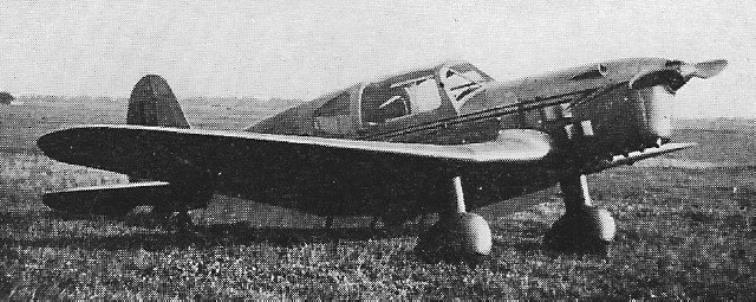
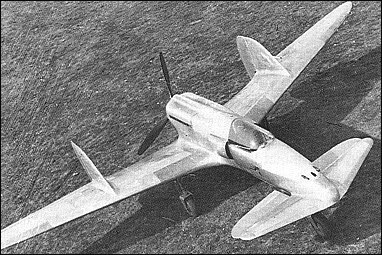
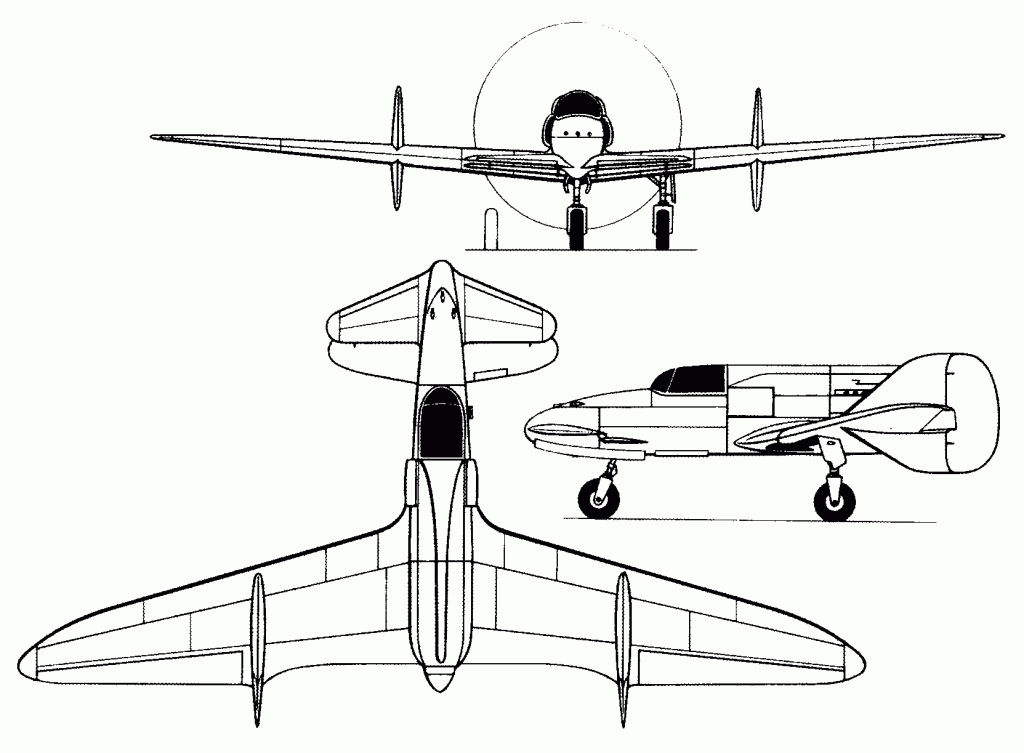
The single-seat S.S.4 monoplane fighter designed by Ing Sergio Stefanutti was tail-first configuration with a retractable nosewheel undercarriage. Built by the Societa Aeronautica Italiana Ing A Ambrosini it was of all-metal construction and powered by a 960hp liquid-cooled 12-cylinder Isotta-Fraschini Asso XI R.C.40 engine driving a three-bladed variable-pitch pusher propeller.

With a 960 hp Isotta Fraschini Asso XI 12 cylinder liquid-cooled engine, the S.S.4 was capable of a maximum speed of 540 kph (335 mph) at 5000 m (16,400 ft) and was to have been armed with two 20 mm and one 30 mm cannon.
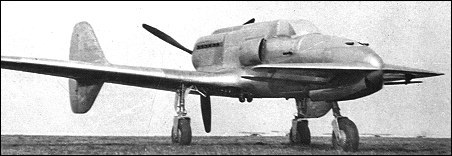
The sole prototype was first flown on 7 March 1939, but was destroyed during its second flight on the following day when the starboard aileron separated, the wing developed a high amplitude oscillation and the aircraft entered a dive and crashed at Guidonia.

Although. the Italian Air Ministry ordered another prototype, pres¬sure of other projects caused the fighter to be abandoned. No further development was undertaken.

Manufacturer’s estimates:

Engine: Isotta-Fraschini Asso XI R.C.40, 960hp
Take-off weight: 2446 kg / 5393 lb
Empty weight: 1800 kg / 3968 lb
Wingspan: 12.32 m / 40 ft 5 in
Length: 6.74 m / 22 ft 1 in
Height: 2.48 m / 8 ft 2 in
Wing area: 17.50 sq.m / 188.37 sq ft
Max. speed: 540 km/h / 336 mph
Ambrosini S.A.I.3

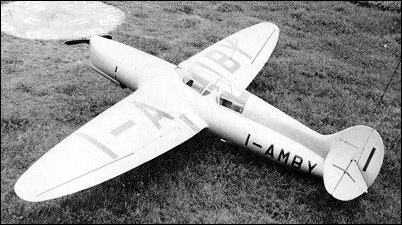
Designed as a two-seat light training and touring monoplane, the Ambrosini S.A.I.3 had long-span elliptical wings, a deep rear fuselage and a fixed tailwheel type landing gear. The chosen powerplant was either a 63kW Fiat A.50 radial or 97kW Alfa Romeo A.110 inverted inline piston engine, the latter enclosed within a close cowling. Small batches of the S.A.I.3 were built, some of them with an enclosed cabin in place of the more common tandem open cockpits. The more powerful Alfa Romeo-engined model had superior performance, despite a maximum take-off weight increase by 40kg to 830kg; maximum speed rose to 230km/h, service ceiling to 5200m and range to 680km.

S.A.I.3
Engine: 1 x Fiat A.50 piston engine, 63kW
Take-off weight: 790 kg / 1742 lb
Empty weight: 550 kg / 1213 lb
Wingspan: 10.45 m / 34 ft 3 in
Length: 7.05 m / 23 ft 2 in
Height: 2.8 m / 9 ft 2 in
Wing area: 14 sq.m / 150.69 sq ft
Max. speed: 200 km/h / 124 mph
Cruise speed: 170 km/h / 106 mph
Ceiling: 4000 m / 13100 ft
Range: 620 km / 385 miles

Ambrosini S.A.I. 2

S.A.I. 2S

Ambrosini took over the Passignano factory of the Societa Aeronautica Italiana in 1934 and in 1935 produced the S.A.I. 2 five seat cabin monoplane for the Littorio Rally and Air Race,

The S.A.I. 2S four-seater cabin monoplane was developed from the S.A.I. 2, and the post-war Grifo and Girfalco were developed directly from this aircraft.

Engine: Alfa 115, 185 hp
Wingspan: 34 ft 11 in
Length: 25 ft 6 in
Height: 9 ft 2 in
Empty weight: 158 lb
Loaded weight: 3124 lb
Max speed: 161 mph
Cruise: 137 mph
Range: 702 mi

Amax Eagle

Eagle LT

A single seat open frame autogyro. Frame is 2.5 x 2 bolted aluminium tube. Shock absorbing gear, 12 USG seat tank, instrument panel. Options include electric start, hydraulic brakes, prerotator, pod etc. Engine: 85 or 100 hp Amax/Subaru 1800 cc. Prop: 68” 11o Warp Drive 3 blade, carbon fibre ground adjustable. Rotor blades: Aerodyne aluminium 26’ x 7 5/8”.

Eagle LT
Engine: 85 hp
HP range: 85-115
Speed max: 100 mph
Cruise: 75 mph
Range: 200 sm
ROC: 1100 fpm
Take-off dist: 50 ft
Service ceiling: 10,000 ft
Fuel cap: 12 USG
Weight empty: 410 lb
Gross: 720 lb
Height: 8.33 ft
Length: 10 ft
Disk span: 26 ft
Seats: 1
Landing gear: nose wheel

Eagle TT
Speed max: 100 mph
Cruise: 70 mph
Range: 200 sm
ROC: 1100 fpm
Take-off dist: 50 ft
Service ceiling: 10,000 ft
Engine: 85 hp
HP range: 85-115
Fuel cap: 12 USG
Weight empty: 410 lb
Gross: 720 lb
Height: 8.33 ft
Disk span: 26 ft
Seats: 1
Landing gear: nose wheel

Amax Double Eagle

Double Eagle TT

A two seat tandem, open frame autogyro, the frame is 2.5 x 2 bolted aluminium tube. Shock absorbing gear, tall tail, 12 USG seat tank, instrument panel. Options include electric start, hydraulic brakes, prerotator, pod etc. Engine: 110-150 hp Amax/Subaru (EA82, EJ20, EJ22) 1800-2200cc. Prop: 7’7” 12o Warp Drive carbon fibre ground adjustable. Rotor blades: Aerodyne aluminium 28’ x 8.5”.

Engine: 105 hp
HP range: 105-140
Speed max: 100 mph
Cruise: 70 mph
Range: 200 sm
ROC: 1100 fpm
Take-off dist: 100 ft
Service ceiling: 10,000 ft
Fuel cap: 12 USG
Weight empty: 575 lb
Gross: 1150 lb
Height: 8.33 ft
Length: 13.75 ft
Disk span: 30 ft
Seats: 2
Landing gear: nose wheel

Alvis Leonides Major

In 1951 Alvis started development of a 14 cylinder, two row radial of 1,118 cu in (18.3 L) displacement, based on the Leonides. Certification covered the Mk. 702/1 for aeroplanes at 875 hp and the 751/1 for helicopters at 850 hp. The only numerous model of the Major was the Mk. 755/1, a medium supercharged, de-rated, obliquely mounted direct-drive and fan cooled engine fitted to the Westland Whirlwind Mks. 5, 6, 7 and 8.

Applications:
Bristol Type 173 Mk1,2 & Mk3 – 2x 755/1 Mk 155, 780hp, 755/2 Mk 160, 780hp or 2x 850 hp
Handley Page Herald – four 870 hp
Handley Page H.P.R.1 Marathon – two
Westland Whirlwind 1 x 755/1 Mk 155, 780hp

Specifications:
Leonides Major, geared, fixed wing version
Type: 14-cylinder, twin-row air-cooled radial piston engine, geared down and supercharged
Bore: 4.80in (122 mm)
Stroke: 4.41 in (112 mm)
Displacement: 1,117 cu in (18.34 L)
Length: 70.9 in (1.80 m)
Diameter: 38.9 in
Width: 988 mm
Dry weight: (dry) 1,200 lb (545 kg)
Valvetrain: 2 sodium cooled valves per cylinder, driven by 2 cam disks
Supercharger: Single speed, single stage diven at 6.5:1
Fuel system: Fuel injection, low pressure via Hobson or SU pump. 2 plugs per cylinder, twin BTH C.14.C/1 magnetos
Fuel type: 100/130 grade
Oil system: Dry sump, pressure and scavenge pumps
Cooling system: Air-cooled
Reduction gear: Farman type epicyclic, ratio 0.533:1
Power output: (international rating) 860 hp (642 kW) at 1,500 ft (457 m)
Compression ratio: 6.8:1
Fuel consumption: (at maximum continuous power) 60 Imp. gal/h (273 L/h)
Oil consumption: 6-12 pint/h (3.4-6.8 L/h)

Alvis Leonides

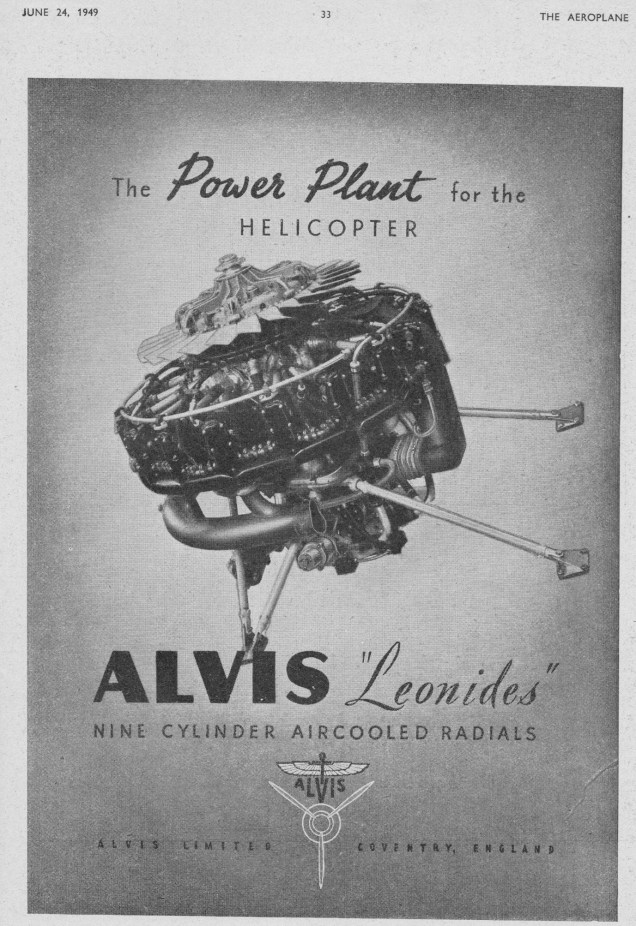
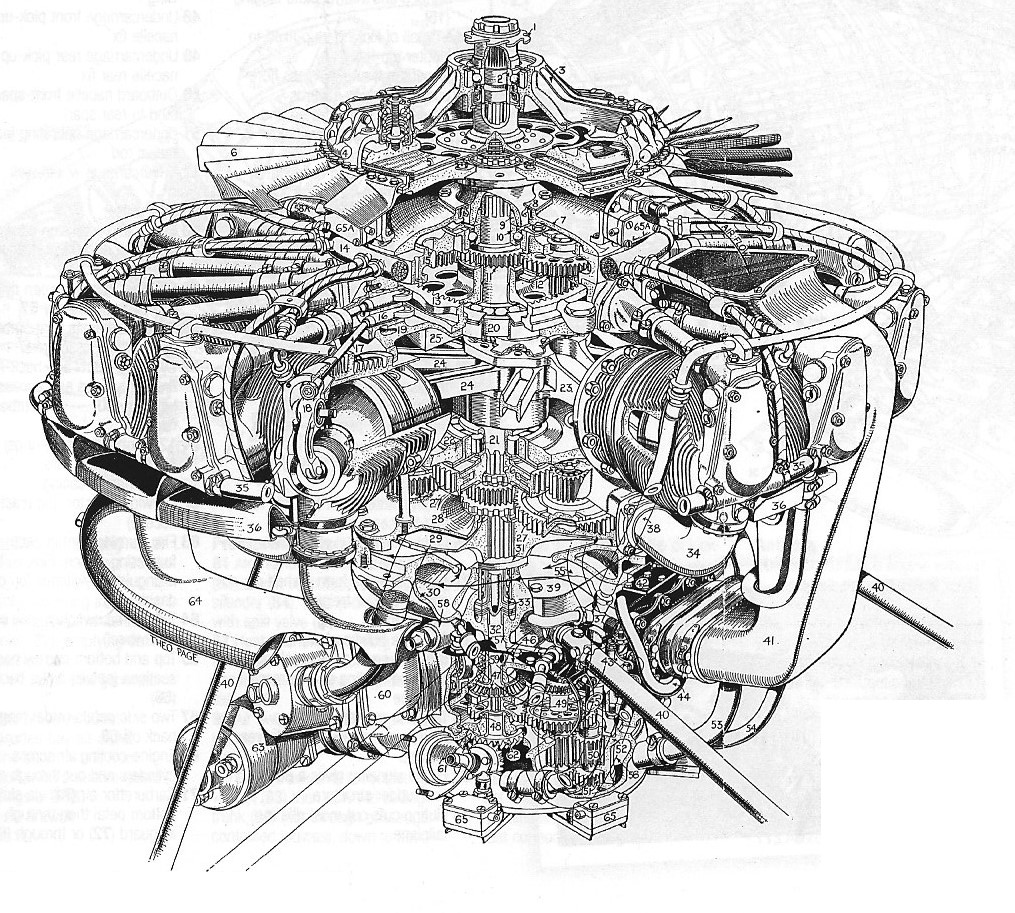
The Alvis Leonides was a British air-cooled nine-cylinder radial aero engines first developed by Alvis in 1936. Development of the nine-cylinder engine was led by Capt. George Thomas Smith-Clarke. The prototype engine, called 9ARS and which weighed 693 lb and developed 450 hp, was run in December 1936.

In 1938 Airspeed (1934) Ltd lent their test pilot, George Errington, and their much rebuilt Bristol Bulldog (K3183), to carry out test flights. Development was continued at a reduced pace during the Second World War and following testing in an Airspeed Oxford and an Airspeed Consul (VX587) Alvis was ready to market the engine in 1947 as the Series 500 (502, 503 and sub-types) for aeroplanes and Series 520 for helicopters. (Most helicopter engines were direct drive – no reduction gearbox – with a centrifugal clutch and fan cooling).

The first production use was the Percival Prince which flew in July 1948 and the Westland Sikorsky S-51 and Westland Dragonfly helicopters.

From 1959 the stroke was increased to 4.8 inch for the Series 530 (mainly the Mk. 531 for Twin Pioneers) rated at 640 hp. It was Britain’s last high-power production piston aero-engine when manufacture ceased in 1966.

Gallery

Applications:

  • Production –
    Bristol Sycamore – 1x Mk. 173, 550 hp (410 kW)
    Percival P.66 President/Prince – 2 x 503/7A, Mk 128 01/2, 540/560 hp (RAF: Pembroke, RN; Sea Prince)
    Percival Provost – 1x 126, 550-hp (410 kW)
    Scottish Aviation Pioneer – 1 x 503/7A, Mk 128 01/2, 540/560 hp
    Scottish Aviation Twin PioneerCC1 – 2 x 514/8, 550 hp
    Scottish Aviation Twin PioneerCC2 – 2 x 531/8,Mk138, 640 hp
    Westland Dragonfly – 1x 521/1, 520shp (388 kW)
    Westland Widgeon – 1x 521/1, 520shp (388 kW)
  • Conversions
    Harker Leo-cat – 1x 560 hp (418 kW)
    Server-Aero Leo-cat – 1x 560 hp (418 kW)
  • Prototypes
    Agusta AZ8-L 4x 503/2
    de Havilland Canada DHC-2 Beaver Mk.2 – 1x 502/4, 520 hp
    Fairey Gyrodyne – one 525 hp to drive rotor and propeller
    Fairey Jet Gyrodyne – one 525 hp to drive air compressor and propellers
    Handley Page H.P.R.2 (WE505 only) – 1 x 502/4 550 hp
    SR-N1 Hovercraft – the first hovercraft

Specifications
Type: 9-cylinder supercharged air-cooled radial piston engine.
Bore: 4.8 inch (122 mm)
Stroke: 4.41 inch (112 mm)
Displacement: 718.6 in3 (11.8 L)
Diameter: 41 inch (1.04 m)
Dry weight: 815 lb (370 kg)
Valvetrain: Two pushrod-actuated poppet valves per cylinder with sodium-cooled exhaust valve.
Supercharger: Single speed, single stage, boost pressure automatically linked to the throttle.
Fuel system: Hobson single-point fuel injection unit.
Fuel type: Petrol, 115 Octane
Oil system: Dry sump
Cooling system: Air-cooled.
Power output: 550 hp (410 kW)

Alvis Leonides 23 HM

Alvis Pelides

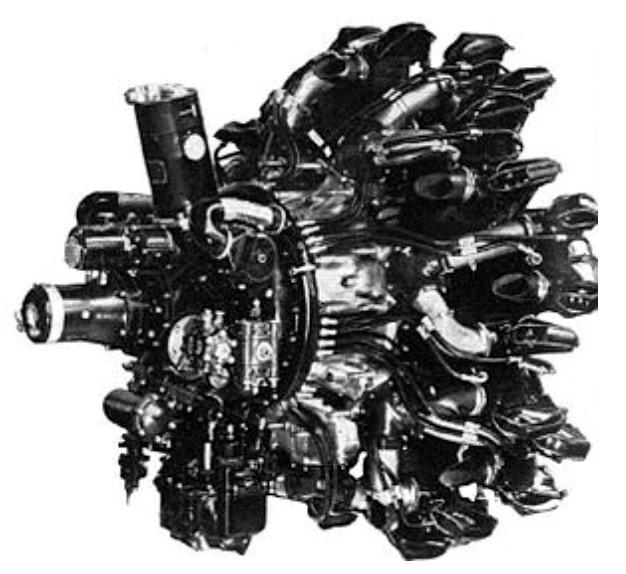
The Alvis Pelides was an unflown British air-cooled radial aero engine first developed in 1936. The Pelides Major was a projected but unbuilt development as were the Alcides, Alcides Major and the Maeonides Major, the Alvis aircraft engine range taking their names from Greek mythology.

The Pelides was the first aero engine of Alvis design, the company had previously built the French Gnome-Rhône Mistral Major under license. With the two companies working closely together the 14 cylinder radial layout of this engine retained metric dimensions but substituted metric screw threads with British fasteners such as BSF and Whitworth. Material specifications were different as were the detail design of internal parts such as the crankpin. The Pelides passed a 50 hour Air Ministry type test in 1937 where it produced 1,065 hp (794 kW) but no aircraft application was found and only 15 engines were built. The onset of the Second World War caused the abandonment of any further development of the Pelides and its related designs.

Variants (projected):
Pelides Major
The Pelides Major was a projected but unbuilt version retaining the same dimensions as the Pelides but with improvements to the supercharger.

Alcides and Alcides Major
The Alcides of 1937 was another projected medium supercharged two row radial engine but was planned to have 18 cylinders with a displacement of 3,314 cu in (54.24 L) and a power output of 1,300 hp (969 kW). Again the Alcides Major was an improved fully supercharged version.

Maeonides Major
Also designed in 1937 was the unbuilt supercharged Maeonides Major, effectively a smaller version of the Pelides with a displacement of 1,158 cu in (19 L) and a power output of 650 hp (485 kW).

Specifications:

Pelides
Type: 14-cylinder, 2 row, supercharged air-cooled radial piston engine.
Bore: 5.75 inch (146 mm)
Stroke: 6.5 inch (165 mm)
Displacement: 2,359.8 cu in (38.7 L)
Diameter: 52 in (1321 mm)
Dry weight: 1,190 lb (540 kg)
Valvetrain: Two pushrod-actuated poppet valves per cylinder with sodium-cooled exhaust valve.
Supercharger: Single speed, single stage.
Fuel system: Heated Zenith carburettor
Fuel type: Petrol, 87 Octane
Oil system: Dry sump
Cooling system: Air-cooled.
Power output: 1,000 hp (746 kW) at 2,400 rpm (rated power)
Compression ratio: 5.5:1
Power-to-weight ratio: 0.84 hp/lb (1.4 kW/kg)

Alvarez 1904 Monoplane

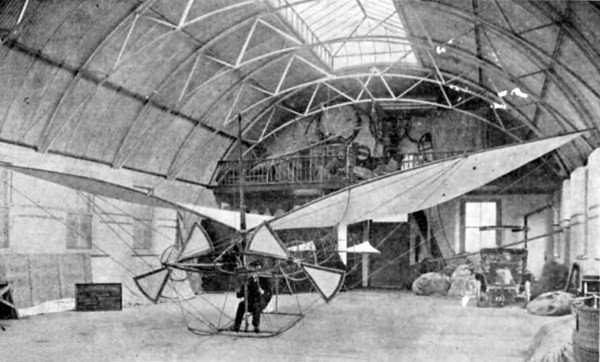
Designed by a Mr. Alvarez of Brazil, built by the firm of C. G. Spencer and Sons of Highbury and tested at Hendon with ballast instead of a pilot. It was taken to altitude of 3,000 feet by a balloon and dropped with the engine running, descending steadily to a soft landing. It had a 2 hp motor, a span of 40 ft, a wing area of 400 sq.ft and weighed 150 lbs. A larger model was planned, but nothing is known of it.

Altitude Formula GT

The Formula GT prototype aircraft, designed by Jeff Ackland, was completed and first flown in April, 2001.
The GT shares its wing and horizontal tail planform/design with the Radial Rocket and P85.

Although the prototype Formula GT was powered by a 260 HP Lycoming engine, the GT was actually designed from the outset to utilize a liquid cooled LS V8 engine. The GT offers a side by side seating, and tricycle gear.