Denver CO and Long Beach CA.
Aero engine builders circa 1911.
Denver CO and Long Beach CA.
Aero engine builders circa 1911.
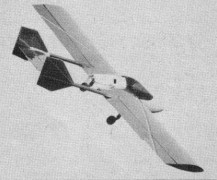
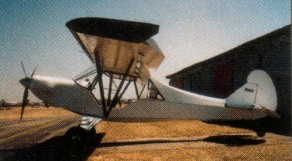
Single seat single engined mid wing mono¬plane with conventional three axis. Wing has unswept leading and trailing edges, and constant chord; two fin tail. Pitch control by elevator on tail; yaw control by fin mounted rudders; roll control by full span spoilers; control inputs through stick for pitch/roll, pedals for yaw. Cantilever wing; wing profile NACA 633 218A; double surface. Undercarriage has three wheels in tricycle formation; with tailskid; no suspension on any wheels. Push right go right nosewheel steering connected to yaw control. Brakes on main wheels. Aluminium steel tube framework, partially enclosed. Engine mounted at wing height driving pusher propeller. 6061 T6 aluminium tubes, 2024 alclad skin and glass flibre pod.
The prototype of the Sadler Vampire was unveiled at Oshkosh in August 1982, where it was announced as likely to be on sale during 1983.
The price with a 20 hp engine was $7950 in 1983.
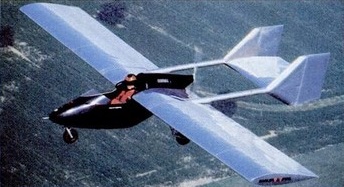
The quiet operation of the prototype was mainly due to the use of a reconnaissance and target drone engine of Israeli manufacture. The aircraft’s use of an aluminium riveted skin for the tail surfaces and the wing with ribs of pressed aluminium may not be unusual in general aviation but is very rare in the ultralight world. The profile of the wing is NACA 633 218A and is laminar. Beneath the spoilers, running the full span of the wings at the trailing edge, are four position hinged flaps.
American Microflight intend only to sell their Sadler Vampire ready to fly.
Option of KFM 107 engine.
In 1983 Ultra Light Aircraft Corporation (ULAC) was setting up a production facility for the American Microf¬light Sadler Vampire, for which ULAC has acquired the Europe/Africa licence.
Bill Sadler had his Sadler Vampire at the 2008 U.S. Sport Aviation Exposition. Sadler announced the introduction of the plane into the lightsport aircraft category at Airventure 2007, at that time it was planned that the craft would be powered by the 100 HP Rotax 912 S.
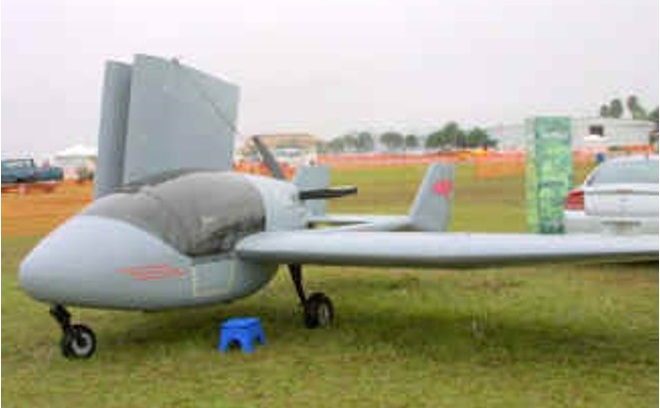
Sadler Aircraft Corp, previously known as American Microlight Inc, developed A-22 Piranha lightly armed surveillance version of its microlight, also being developed by TUSAS. Tusas Aerospace Industries Inc in Turkey developed the TG-X1 Bat very light single-seat attack / surveillance aircraft (first flown February 1997, based on U.S. Sadler A-22 Piranha).
The Vampire was available and fully built at Wedgetail Aircraft factory at Camden in NSW, Australia, circa 2019.
Engine: NGL WAE 34, 26 hp
Poly V belt reduction, ratio 2.0/1
Power per unit area 0.20 hp/sq.ft, 2.35 hp/sq.m
Fuel capac¬ity 5.0 US gal, 4.2 Imp gal, 18.9 litre in main tank
Length overall 18.1 ft, 5.51 m
Height overall 4.8ft, 1.42m
Wing span 30.1 ft, 9.40m
Constant chord 5.0ft, 1.52m
Sweepback 0 degs
Total wing area 128sq.ft, 11.9sq.m
Wing aspect ratio 7.4/1
Nosewheel diameter overall 10 inch, 256mm
Main wheels diameter overall 10 inch, 250mm
Empty weight 220 lb, 100kg
Max take off weight 450 lb, 204kg
Payload 230 lb, 104kg
Max wing loading 3.5 lb/sq.ft, 17.1 kg/sq.m
Max power loading 17.3 lb/hp, 7.8 kg/hp
Max level speed 85mph, 137kph
Max cruising speed 55 mph, 88 kph
Stalling speed 25 mph, 40kph
Take off distance 300 ft, 91 m
Landing distance 200 ft, 61 m
Engine: Solo 210 (210 cc) 20 hp
Static thrust: 130 lb
Empty wt: 250 lb
Wing span: 30 ft
Wing area: 125 sq.ft
Height: 4 ft 8 in
Length: 17 ft 6 in
Fuel cap; 4.5 USG
Construction: Aluminium, Fibreglass
Max wt: 500 lb
Stall: 25 mph
Max speed: 63 mph
Vne: 85 mph
Climb rate: 350 fpm @ 45 mph
Design limit: +6, -6g
Glide ratio: 12-1
Wing loading: 4 lbs/sq.ft
Power loading: 25 lbs/hp

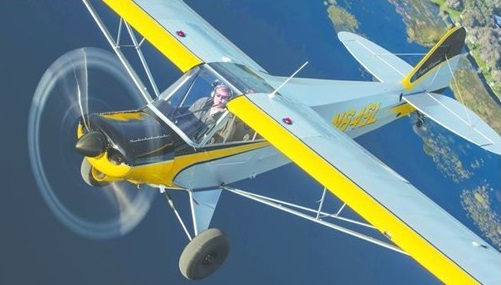
American Legend had 11 new registrations in the US during 2012. The Super Legend and new Legend Smart Cub (with a Garmin G3X system) were the most popular. Texas Star kit versions were also offered.

The Super Legend sports flaps, many carbon-fiber components and a 115 hp Lycoming IO-233-LSA multi-fuel engine. Continental O-200 (100 hp) and Jabiru 3300A (120 hp) versions were also offered. Price 2012: US$124,900 (open-cowl Legend Cub); US$128,900 (closed-cowl Cub); US$146,900 (Super Legend).
Versions:
AL3C-100
Super Legend
Legend Smart Cub
Texas Star
Specifications:
Legend Cub AL3C-100
Piper J-3 replica
Engine: Continental O-200-D, 100 hp
Wingspan: 35’6″
Length: 22’5″
Empty Weight: 386 kg / 850 lbs
MTOW Weight: 600 kg / 1323 lbs
Stall: 30 kt / 34 mph / 55 kmh
Cruise: 83 kt / 95 mph / 153 kmh
VNE: 96 kt / 110 mph / 177 kmh
ROC: 500 ft/min / 3 m/s
Range: 315 mi
Ceiling: 15,000′
Take-off distance (50ft obstacle): 350 ft / 107 m
Landing distance (50ft obstacle): 350 ft / 107 m
Base price 2016: $136,900
Legend Cub AL3C
Piper J-3 replica
Engine: Jibaru 120hp
AL11C-100
2004 Piper PA-11 replica
Engine: 100hp Continental O-200
AL11J-120
2004 Piper PA-11 replica
Engine: 120hp Jabiru 3300A
A STOL utility aircraft (LSA) with interchangeable flaps and ailerons, as well as elevators and rudder, and an 18 cu.ft cargo area. First fown in 1994.
The man who designed this airplane was named Steve Nussbaum, he flew out of the airport I worked at, Galt airport 10C. I remember on a good day he could get one of these off the ground in 88 ft. He also designed the ribs to be replaceable in the field if they ever broke during a forced landing.
Ted Domski
Engine: Continental IO-240, 125 hp
Wing span: 30.6 ft
Wing area: 130.6 sq.ft
Fuel capacity: 26 USG
Empty weight: 850 lb
Gross weight: 1400 lb
Height: 6.5 ft
Length: 20.8 ft
Top speed: 140 mph
Cruise: 117 mph
Stall: 30 mph
Range: 500 sm
Takeoff dist: 100 ft
Landing dist: 125 ft
Service ceiling: 12,500 ft
Seats: 2 tandem
Landing gear: tailwheel
Cruise: 100 mph
Stall: 30 mph
Range: 490 sm
Rate of climb: 1000 fpm
Takeoff dist: 120 ft
Landing dist: 120 ft
Engine: Continental O-200, 100 hp
HP range: 100-125
Fuel capacity: 26 USG
Empty weight: 771 lb
Gross weight: 1320 lb
Length: 21.9 ft
Wing span: 30.6 ft
Wing area: 130.5 sq.ft
Seats: 2 tandem
Cockpit width: 28 in
Landing gear: tailwheel
A biplane trainer
A light parasol monoplane, first two-seat light airplane to be granted Approval Type Certificate by US Department of Commerce. Several hundred Eaglets built before company suspended operations in 1930 Depression.
Victor H. Roos Aircraft Co. succeeded American Eagle-Lincoln Aircraft Corporation in mid-1930s, and continued to produce American Eaglet light monoplane with 45hp Szekely engine.
In 1942 American Eaglecraft Co revived the American Eaglet light monoplane by building a new prototype. Tests postponed until after war. By end of February 1960 had built one Eaglet and was supplying plans for amateur builders. Company later sold to John Spach.
based on former Bellanca/Champion Scout.
based on former Bellanca/Champion Super Decathlon
based on former Bellanca/Champion Citabria
Engine: Superior Vantage O-360-A3A2, 180hp
TBO: 2000 hrs
Propeller: Sensenich FP
Prop diameter: 76 in
Landing Gear type: Fixed/Conv.
Max ramp weight: 1800 lb
Max gross weight: 1800lb
Landing weight: 1800lb
Empty weight, std: 1250lb
Useful load, std: 550lb
Useable fuel, std: 35 USG
Payload, full std. fuel: 290 lb
Wingspan: 34.5 ft
Overall length: 22.1 ft
Height: 7.7 ft
Wing area:171.9 sq.ft
Wing loading: 10.5 lbs./sq. ft
Power loading: 10.0 lbs./hp
Wheel size: 8.00 x 6 in
Seating capacity: 2
Cabin doors: 1
Cabin width: 30 in
Cabin height: 47 in
Cruise speed, 80% power: 117 kt
Fuel burn , 80% power: 11 USgph
Best rate of climb, SL: 1350 fpm
Service ceiling: 17,000 ft
Vso: 46 kt
Takeoff ground roll: 370 ft
Takeoff over 50 ft. obstacle: 695 ft
Landing ground roll: 360 ft
Landing over 50 ft. obstacle: 740 ft

