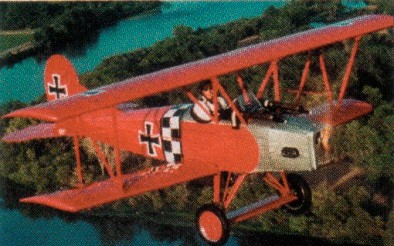
Designed by Emmett M. Tally III, the Birdman TL-1 is an ultralight craft emphasiing ease of construction and light weight. The fuselage is a standard plywood monocoque, and the tail section is a V-type, and synthetic skin, Monokote heat shrink film, is used to cover the wood and foam-reinforced wings. It features sequential spoilers for lateral control. While the main gears are at¬tached under the wing, the pilot’s legs and feet take the place of a nosegear. The pilot is seated at the CG, enabling him to rotate into a standing position as an aid to ground handling. The standing pilot actually becomes the nosewheel. The TL 1A was powered by a 15 hp McCulloch single cylinder air cooled engine. Two gallons of fuel give it a range of 320 km (200 miles) at 54 kg (120 lb), and marketed in 1980 by a Dayton Beach accountant who sells complete kits for less than $2000.
TL-1 Gross Wt. 350 lbs Empty Wt. 100 lb Fuel capacity: 4 USG Wingspan: 34 ft Length: 20 ft Engine: 15-hp Tally Aircraft MC101 DT Top speed: 60mph Cruise speed: 54mph Stall speed: 19mph Climb rate: 350 fpm Ceiling: 12,500 ft Takeoff run: 75 ft Landing roll: 25 ft Range: 200 sm
TL-1A Cruise 38 mph Top speed: 44 mph ROC: 300 fpm Stall: 14 mph Wing span: 34 ft
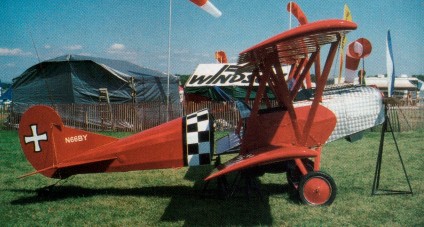
In 1989, Cory Bird was a shop fabricator at Scaled Composites, aviation designer Burt Rutan’s company, when he decided to use his knowledge of composite construction to build aeronautical art. Built by Patti and Cory Bird, after 14 years of on again, off again construction, Symmetry first flew in April 2003. The aircraft took the Grand Champion award at Oshkosh 2004.
In 1989, Cory Bird was a shop fabricator at Scaled Composites, aviation designer Burt Rutan’s company, when he decided to use his knowledge of composite construction to build the Bird Symmetry.
The 53-year-old Bird, a project manager at Scaled, was hard at work on another design for a plane that will carry two and land on shorter airstrips than Symmetry.
During the late 1960s Forrest Bird designed, and his Bird Corporation developed a conversion for the PBY Catalina to improve performance.
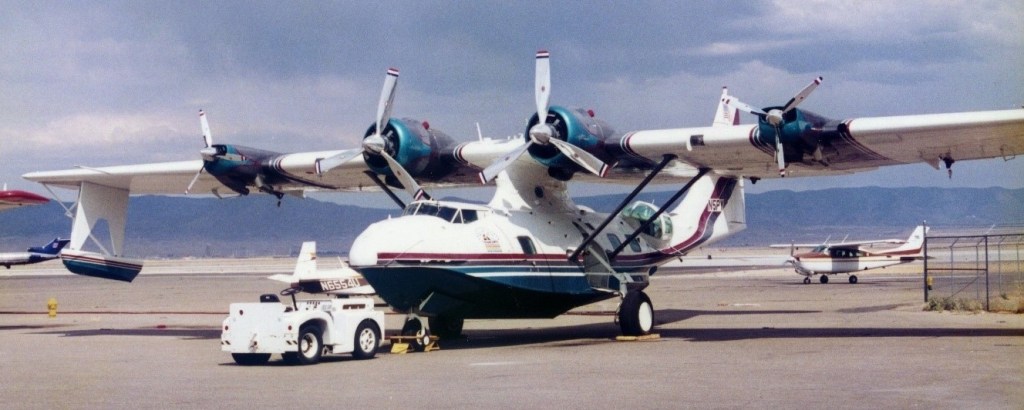
The Catalina was modified by adding two 340 hp (254 kW) Lycoming GSO-480-B2D6 engines positioned outboard of the original Pratt & Whitney radials to increase range and performance. (These engines and cowlings had originally been installed on the McKinnon four engine Grumman Goose. When they were removed by McKinnon to convert the Goose to twin turboprop power, they were purchased by Bird for his PBY Innovator conversion. Engineering for the Innovator conversion was performed by Spectro engineering of Los Angeles).
The wing attach fittings were strengthened and fuel capacity increased by adding fuel bladders to the outer wing panels. The engineer’s controls were previously moved to the cockpit by Southern California Air Service during their “Landseaair” conversion to allow operation without a Flight Engineer. Propeller control for the two Lycomings was electrical. The Lycoming’s propellers were fully reversible, distinctly improving the handling dexterity on the water. The main engine propellers were controlled by the standard mechanical linkage. The larger “Super Cat” rudder and increased power main engines (1830–94) had been installed at an earlier time. The angle of incidence of the wing and horizontal surfaces were not modified during the conversion.
First flying in 1967, the effect of the extra engines exceeded expectations, such that it was capable of a cruising speed of 152 mph (244 km/h) on four engines, and of maintaining 124 mph with one of the main engines feathered. The original PBY cruised at about 125 mph. The downside of the Innovator conversion was the gross weight of the aircraft increased to over 29,000 lbs. This exceeded the 27,000 lbs maximum that the US Military considered safe for water operations.
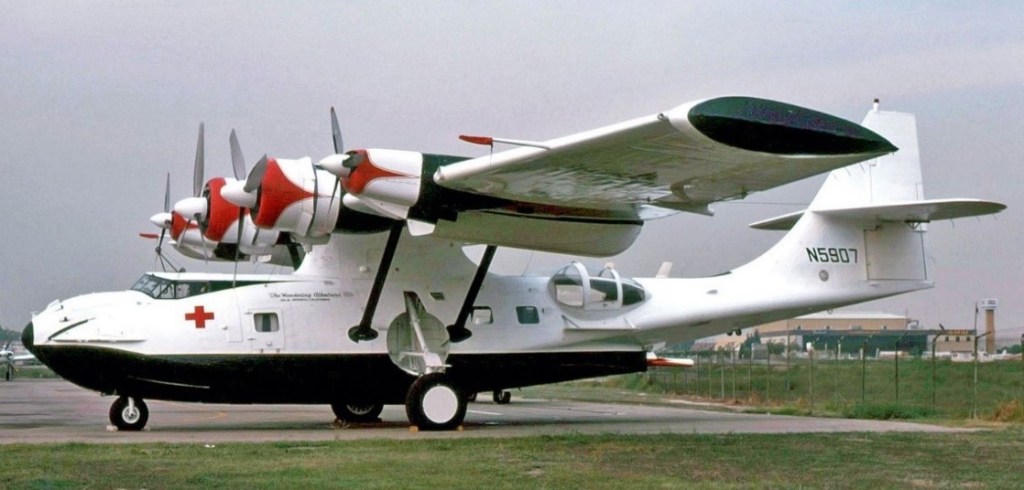
Only one Innovator was converted, a 28-5AMC Canso A (This was a Consolidated built aircraft. Built in November 1941 (under a contract for Canada), registration N5907, formerly RCAF serial number 9746, which was already used by Dr. Bird as a flying classroom/salesroom for medical equipment. Bird Corporation registered it as N81RD, and sold it in 1976, when its registration reverted to N5907. In the late 1970s, Pyramid Corporation purchased the Innovator and converted it to a camera platform to count whales along the west coast of the Americas. A plastic bubble with camera was installed in the nose and cameras were installed in the right blister and air stair door.
The Innovator was stored in Titusville, Florida at the end of this contract. While in storage a local law enforcement official decided that, since it was a large seaplane, it must have been used for illegal purposes and the aircraft was confiscated. Many years of lawsuits later, the Innovator was exonerated but time and the Florida sun had taken its toll. In the early 1990s, a New Mexico aircraft salesmen bought the Innovator, registered it as N5PY and spent the better part of a year restoring the aircraft to flying status. In 1997, during inspection, the new owners found an improper repair to the main keel truss from an earlier gear-up landing in the 1960s.
The extent of the damage, the previous attempt at repair and corrosion issues showed the need for a major IRAN (Inspect and repair as necessary) of the aircraft. At this time it was decided that, due to the extreme weight gain and aging complexity of the Innovator conversion, returning the aircraft to its original twin engine “Landseaire” condition was the safest and best option for the future preservation of the aircraft. As of 2013, restoration continues with the bow, pylon, and tail sections completely restored and a complete new keel truss, keelson, stringers, and bottom skins currently being installed; currently registered as N5PY.
Innovator Engines: 2 × Pratt & Whitney R-1830-94 Twin Wasp, 1,350 hp (1,010 kW) with 3-bladed Hamilton Standard constant-speed propellers & 2 × Lycoming GSO-480-B2D6, 340 hp (250 kW) with 3-bladed Hartzell 83XF-3A fully-feathering reversible-pitch propellers Wingspan: 104 ft 0 in (31.7 m) Wing area: 1,400 sq ft (130 m2) Aspect ratio: 7.73 Length: 63 ft 10 in (19.46 m) Height: 20 ft 2 in (6.15 m) Gross weight: 29,000 lb (13,154 kg) + Fuel capacity: 1,750 US gal (1,457 imp gal; 6,624 l) main tank + 375 US gal (312 imp gal; 1,420 l) in 3x additional bladder wing tanks Cruise speed: 174 kn (200 mph, 322 km/h) maximum 137 kn (158 mph; 254 km/h) at 34,000 lb (15,422 kg) gross weight and 5,000 ft (1,524 m) 132 kn (152 mph; 244 km/h) at 64% power and 11,000 ft (3,353 m) 125 kn (144 mph; 232 km/h) starboard auxiliary engine feathered 124 kn (143 mph; 230 km/h) port auxiliary engine feathered 112 kn (129 mph; 207 km/h) both auxiliary engines feathered 110 kn (127 mph; 204 km/h) starboard main engine feathered 108 kn (124 mph; 200 km/h) port main engine feathered Service ceiling: 15,000 ft (4,600 m) one main engine inoperative Service ceiling: 10,000 ft (3,048 m) with both port engines inoperative Rate of climb: 750 ft/min (3.8 m/s) at 75% power at sea level Take-off run: 1,000 ft (305 m) at 34,000 lb (15,422 kg) Take-off at 85% power: < 2,000 ft (610 m) at 34,000 lb (15,422 kg) Crew: 2
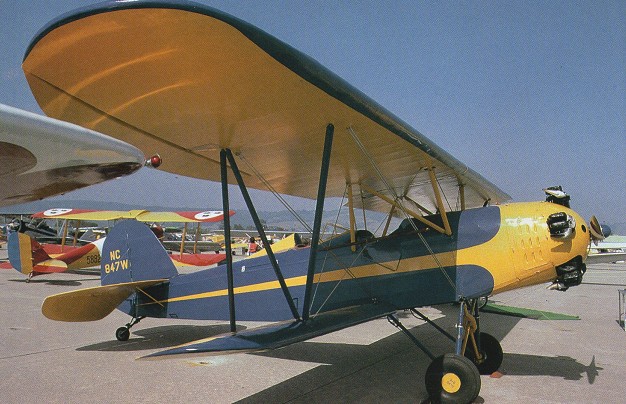
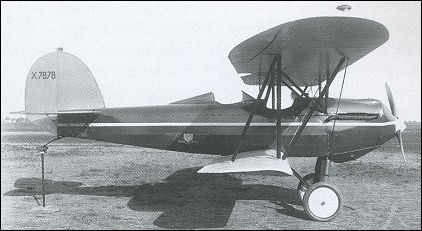
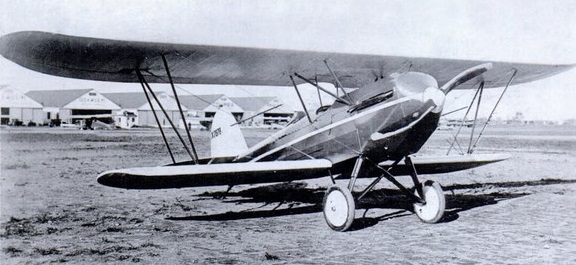
In 1928 the Brunner-Winkle Aircraft Corporation was founded to manufacture a three-seat open cockpit commercial biplane known as the Bird biplane. In March 1929 the Bird Aircraft Corporation was incorporated, with William E. Winkle as vice-president, to continue production of the Bird biplane with a variety of engines ranging from 100- 165 hp. It was made available subsequently in four- and five-seat forms.
Bird A
Final assembly and flight-testing of the Bird was done at Roosevelt Field in Garden City. Originally powered by a 90 hp Curtiss OX-5, the Bird was able to carry three people in its two open cockpits.
Brunner Winkle Aircraft Corp Model A Bird, Roosevelt Field, 1929
There were approximately 225 Birds built from 1929 thru 1931. The “A” model was powered by the OX-5 engine, the “BK” model used the 100HP Kinner engine and the “CK” used the larger 125 HP Kinner engine. In addition, they also had several individual models. One had the Packard diesel engine and another the Jacobs radial engine.
The BK was a three-seater.
Bird BK N789Y
McCrum revised the plans for the Bird Wing again in the 1950s to install a 450 hp 336 kW Pratt & Whitney R-985 Wasp Junior radial engine and a 3 inch fuselage widening to convert the design into an agricultural aircraft which never went into production.
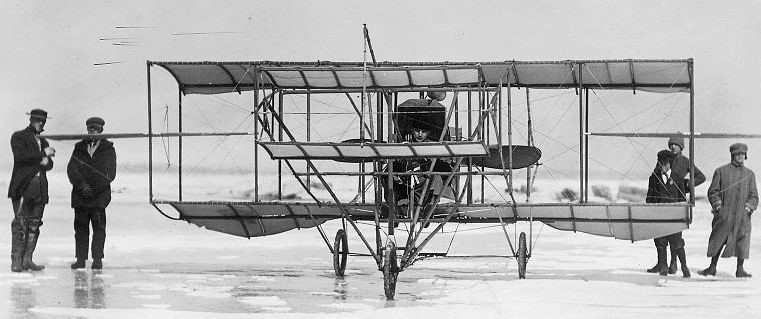
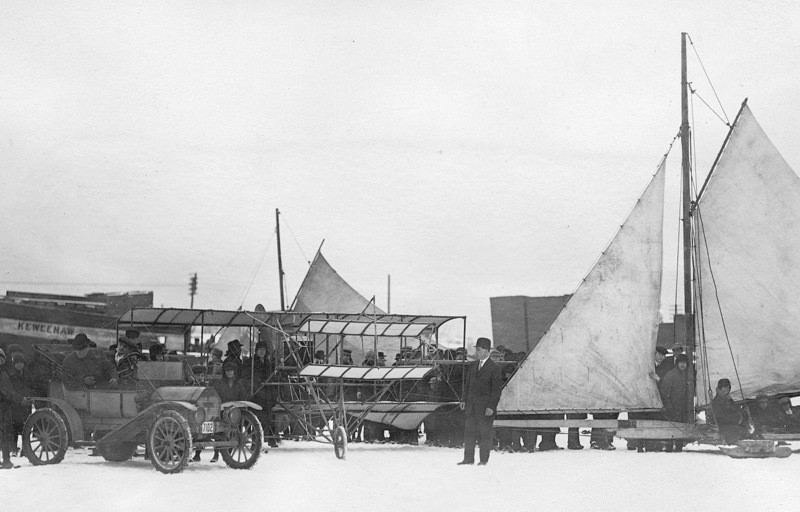
George J. Bing was one of Sandusky, Ohio’s prominent businessmen. He operated a carriage, bicycle, and automobile repair shop at West Adams and Tiffin Avenue and held the distinction of being the first to build an airplane in the city of Sandusky. In 1911, he constructed this biplane, modelling it after the Hudson flier flown from Euclid Beach to Cedar Point by Glenn Curtiss in 1910. It was tested on the ice of Lake Erie, but apparently never flew.