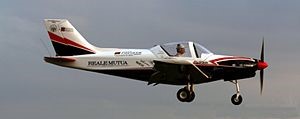
This aircraft was designed and built by the Italian astronaut Maurizio Keli (Italian: Maurizio Cheli), with the assistance of the Turin Polytechnic Institute, DigiSky and several other companies (Sparco, Sicme Motori). As a prototype, an Alpi Pioneer 300 aircraft was used. June 10, 2009 made the first flight. The main design feature is electric traction. A battery pack weighing more than 70 kg is installed on the machine. The power of this electric motor is 75 kW.
SkySpark June 12, 2009 set a world speed record for this type – 250 kilometers per hour.
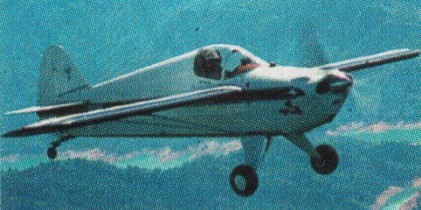
Engine: Continental C-85-12, 85 hp HP range: 75-200 Wingspan 23 ft Length 17 ft Height: 5.8 ft Wing area; 81 sq.ft Gross Wt. 805 lb Empty Wt. 665 lb Fuel capaci¬ty 14 USG Top 130 mph. Cruise 120 mph Range 275 miles Stall 57 mph Climb rate 1000 fpm Takeoff run 600 ft Landing roll 700 ft Seats 1
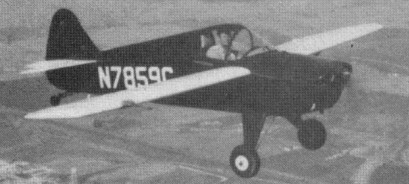
The Lark is an enclosed cabin cockpit midwing monoplane. This single-seat taildragger is relatively unusual with its strut-braced mid-wing configuration. The fuselage is of steel-tube construction, and the wing uses wood spars and ribs. The whole aircraft is fabric covered. Engines vary from 65 to 100 hp.
Gross Wt. 855 lb Empty Wt. 555 lb Fuel capacity 12 USG Wingspan 23 ft Length 17 ft Top 135 mph. Cruise 122 mph Stall 55 mph Climb rate 1000 fpm Takeoff run 550 ft Landing roll 700 ft Range 300 miles
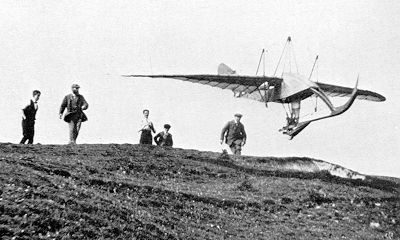
A human-powered flying-wing ornithopter – the aviette was a joint 1912 venture of the British based artist José Weiss and Scottish veterinarian Alexander Keith.
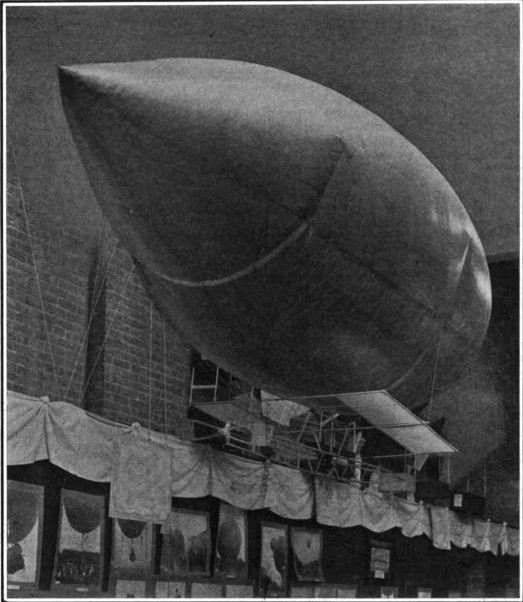
An electrically-propelled dirigible balloon combined with lifting aeroplanes. Its envelope constructed by Carl E. Myers at his balloon farm at Frankfort, N.Y. for Mr. W. M. Keil of Tuxedo Park, N.Y., this Keil-Myers HTA/LTA airship was presented the week of January 13, 1906 at the 69th Regiment Armoury Auto Show in Manhattan, of which the aviation exhibition element was put on by the Aero Club of America. Nothing is known of its existence afterwards.
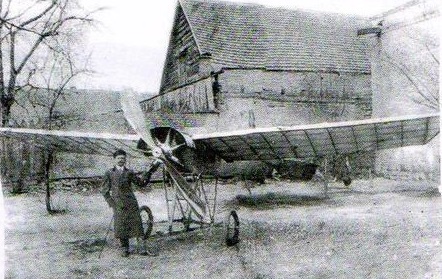
The second monoplane design of Kébouroff and Vasiliev, built in 1912 in Georgia (part of Russia). In 1910 Vissarion Kébouroff took flying lessons from Blériot at his flying school in Pau, France where he obtained a brevet from the Aero Club de France. On his return to Russia he brought back two Blériot monoplanes which he flew there frequently. As these machines were rapidly worn out and in need of repair, Kébouroff worked together with Alexander Vasiliev to design and built a new monoplane to replace the aging Blériots. Kébouroff and Vasiliev actually built a pair, where the second (1912) is given as the same construction as the first but fitted with a 50 hp Gnôme rotary engine. Later a third monoplane was built by the two which was designed somewhat along the lines of the Nieuport IV monoplane.
Designed by Horace Keane, the HKL-27 was a short-lived redesign of the Aeromarine Klemm AKL-26. A two place, open cockpit, low wing monoplane, the wood frame work was fabric covered.
Five were produced at $1800 around 1929.
Engine: Ford V-8, 82hp Wing span: 36’8″ Length: 23’4″ Useful load: 650 lb Max speed: 112 ph Cruise: 94 mph Stall: 47 mph Range: 450 mi Ceiling: 12,000′
Horace Keane was born July 29, 1885 and was raised in the town of St. Joseph, Michigan. His family was well known in theatrical circles. Horace had a genius for things mechanical, and received an engineering education at Armour Institution of Technology.
After graduation, he assisted Augustus Herring in building gliders. At the age of 17, he made his first solo in a glider from the top of a sand dune along the shore of Lake Michigan. In 1903 he toured Europe with Octave Chanute, building and flying planes of his own design. Upon his return to Amereica, he went to work for the Chicago Milwaukee Electric Railroad helping to design interurban cars.
His main interest was aviation and he was soon busy building and flying planes of his own design. Later, after World War I, he bought up a number of war surplus planes and went into barnstorming. None of his promotions proved to be financially successful.
1920: (Horace) Keane Aeroplanes, North Beach, Long Island NY.
c.1921: Acquired inventory and manufacturing rights to ACE (Aircraft Engr Co, NY). Photos of the ACE K-1 appeared in some Keane ads.
c.1925: Keane Aircraft Corp, Keyport NJ.
The Klemm design was briefly revived by Keane Aircraft Co, Keyport, in 1937.
In 1940 he organized the Zodiac Aircraft Company to produce training planes. Contracts for the planes were obtained but Keane soon found himself edged out of the picture.
After World War II, he served as a consulting engineer to a number of aircraft firms. Upon retirement, he went to live in Topanga, California. At the time of his death May 7, 1974, he was visiting his daughter in England.