One patriot who felt he could fill this gap and strike a blow at the Kaiser was a Surrey building contractor, W. G. Tarrant, whose company had been involved in wartime contract work manufacturing wooden aircraft components. Tarrant hired Walter Henry Barling to design the aircraft, which was to be a ‘bloody paralyzer’ of a triplane made entirely of home-grown timber and constructed using a largely female work force, according to the terms of the contract issued by the Ministry of Munitions. The massive Tabor triplane was the first and last aeroplane built by W. G. Tarrant Ltd of Byfleet, Surrey. Designed in an attempt to enable Berlin to be bombed from bases in England, and assembled at RAE Farnborough, the aircraft was not completed until 1919.
When it appeared, too late for its intended purpose, it spanned 40m (131 ft 3 in) from tip to tip of its middle wing, and had a 22.25m (131 ft 3 in) fuselage of monocoque construction formed from ply skinning over Warren-girder type circular formers. Serialled F1765, the one and only completed Tabor was powered by a total of six 450 h.p. Napier Lion engines: two pairs in push-pull tandem between lower and middle wings, and another two tractor engines between middle and top planes. The fuselage was of finely streamlined monocoque construction, while the tail consisted of a biplane unit with twin fins and rudders.
The Tabor stood as high as a four-storey house, and its height, and particularly the location of its upper engines, brought about its speedy demise. On 26 May 1919 the giant Tabor was winched out of the balloon shed at the Royal Aircraft Establishment at Farnborough along a specially built railway track. Some 508 kg (1120 lb) of lead was loaded into the nose at the last moment when some final calculations showed that the aircraft might be tail heavy, and the long, wearisome process of hand-starting the six Napier Lions began. With all engines running the pilot, Captain F. G. Dunn, and his co-pilot, Captain P. T. Rawlings, began taxi trials. Also aboard were a technical observer from Tarrant’s, a fitter, an engineer officer, and two foremen from the RAE. When Dunn opened up the top engines, which had previously been throttled back, and the sudden extra thrust so far above the aircraft’s centreline caused it to nose-over and bury its forward fuselage in the earth just as it was about to leave the ground. The two pilots died shortly afterwards of their injuries and Tarrant, perhaps fortunately for other aviators, never again dabbled with aviation.
Construction of a second Tabor was abandoned.
Engines: 6 x Napier Lion, 450 hp Wingspan: 40m (131 ft 3 in) Fuselage length: 22.25m (131 ft 3 in) Weight: 45,000 lb
UK Building contractor of Byfleet, near Brooklands, Surrey, which undertook aircraft component manufacture during First World War. Only aircraft produced was Tabor long range bomber, designed with collaboration from Royal Aircraft Establishment; this six-engined triplane nosed-over and was wrecked in its first attempt to take off in May 1919.
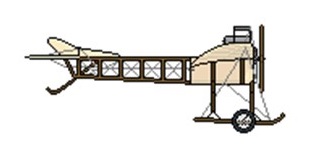
This peculiar monoplane, also known as the “Monoplan de course Paul de Lesseps”, was designed and built in 1910 by Taris, a Polytechnique graduate that taught aerodynamics at the Ligue Nationale Aérienne. A characteristic feature was its intricate triangular fuselage, uncovered and the front and covered at the rear and with a triangular cockpit floor breaking the lines. It was powered by a 50 hp Gnôme driving a ground-adjustable four-bladed propeller. It crashed in 1911.
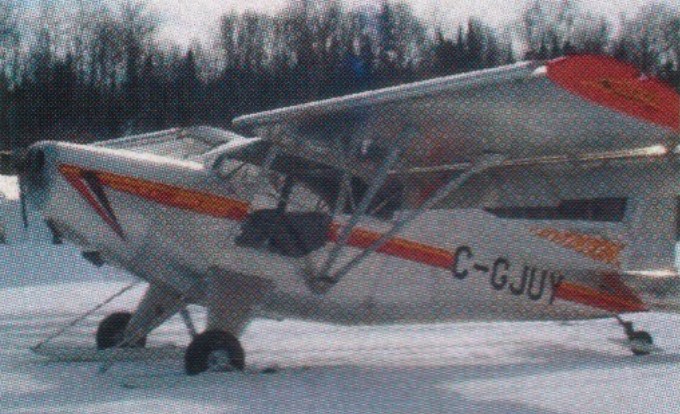
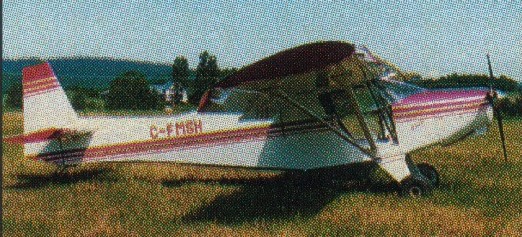
The Tapanee Levitation 4 is a Canadian four-seat STOL aircraft designed to be homebuilt by Michel Lequin for Tapenee Aviation of Quebec. A larger version of the companies earlier Pegazair bushplane, the Levitation is a high-wing monoplane with V-strut bracing, first flown in 2002. Powered by a 180 hp (134 kW) Lycoming O-360 flat-six piston engine with a two-blade propeller. The Leviation has a fixed conventional landing gear with a tailwheel and a cabin holding a pilot and three passengers in two rows of side-by-side seating. By December 2004 five kits had been sold.
Variants: Levitation 2 Levitation 4
Specifications:
Levitation Engine: Lycoming O-360, 180 hp / 134 kW Propeller: Hartzell 80 in Length: 7.47 m (24 ft 6 in) Overall Height: 2.44 m (8 ft 0 in) Wingspan: 10.21 m (33 ft 6 in) Wing area: 180 sq.ft / 16.72sq.m Wing Loading: 13.9 lb/sq.ft Gross weight: 2500 lbs / 1133 kg Empty Weight: 621 kg (1368 lb) Usefull load: 1138 lbs Stall Speed: 38 Mph / 62 km/h Cruise speed: 115-120 Mph VNE: 159 Mph / 255 km/h Range at cruise: 575 sm / 925 km Gross wgt takeoff dist: 400 ft Landing Distance: 300 ft Climb rate at Gross: 700 fpm / 3.6 m/s Power Loading: 13.9 lb/hp Cabin Length: 109 in Cabin width at elbow: 48 in Usable fuel: 55 US Gallons Fuel Optional, Wings: 36 USG Baggage Area: 25 cu.ft Seats: 4
In 1909 Czesław Tański started design works on an aircraft with longitudinal axis steering done by change of the angle-of-attack of the whole wing. Construction lasted until 1911 and in autumn of that year, the airplane, named Łątka (Dragonfly) underwent trials at Warsaw’s Mokotów airfield. Unfortunately, Tański, witnessing numerous undercarriage failures on other aircraft, designed very heavy one for his aircraft, which resulted in aircraft – powered by relatively weak Anzani engine – never managed to take off the ground.
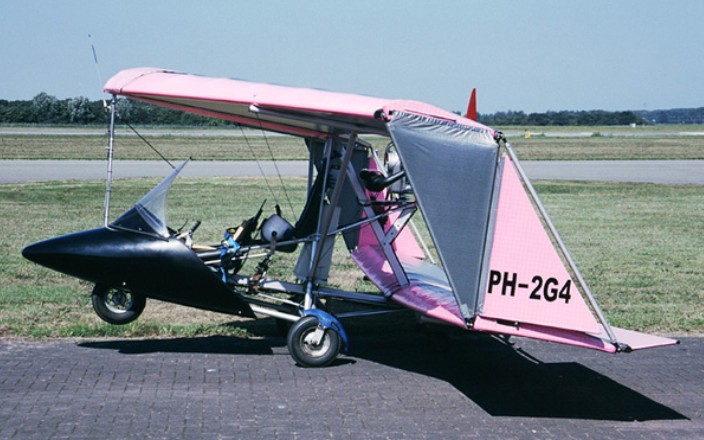
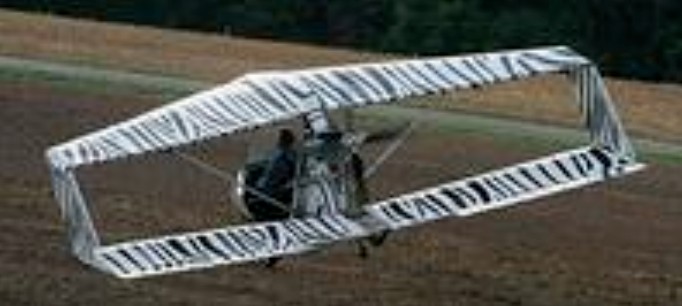
The Sunny is a tube and fabric design ultralight aircraft that was designed by Dieter Schulz. The aircraft complies with the Fédération Aéronautique Internationale microlight category rules. It features an unusual diamond-shaped biplane, strut-braced closed wing layout, a two-seats-in-tandem enclosed or open cockpit, fixed tricycle landing gear and a single engine in pusher configuration. The upper wing is swept back, while the lower wing is straight, but mounted further aft. The two wings are joined by swept tip rudders. The elevons are mounted to the lower wing only.
The aircraft is made from bolted-together aluminum tubing, with its flying surfaces covered in Dacron sailcloth. Standard engines available include many models of Hirth, Rotax, BMW and Verner 133M powerplants, ranging from 65 to 80 hp (48 to 60 kW).
A side by side trainer, production of the Sunny Sport UL-biplane was started by Dieter Schulzs company, Tandem Aircraft KG of Saulgau, Germany, in 1989. In the first year 25 Sunnies were sold, however the sale figures of the Sunny went down over the years. About 150 examples between 1989 and 1999. Finally in 1999 Tandem Aircraft KG became bankrupt.
Alexander Dewald bought the rights in 1999 and it was then produced by Dewald Leichtflugzeugbau Gmbh of Bad Schönborn, Germany and more recently by Airkraft Gmbh Leichtflugzeugbau of Beringen, Switzerland, who seem to have gone out of business in about 2011 and production ended after 250 were built.
Originally supplied ready-to-fly, later the aircraft was supplied as a kit for amateur construction or as a complete ready-to-fly-aircraft. Both the tandem-seat Sunny Sport and the side-by-side versions were produced by Dewald. Both versions feature a number of small, but significant, design changes.
The price in 2009 was €13499, and €21,000 (assembled, 2011).
Variants:
Sunny Light Version with open cockpit Engine: 1 × Rotax 582, 48 kW (64 hp) Wingspan: 7 m (23 ft 0 in) Wing area: 17 sq.m (180 sq ft) Empty weight: 220 kg (485 lb) Gross weight: 450 kg (992 lb) Fuel capacity: 44 litres (9.7 imp gal; 12 US gal) Optional fuel capacity: 80 litres (18 imp gal; 21 US gal) Maximum speed: 145 km/h (90 mph; 78 kn) Cruise speed: 100 km/h (62 mph; 54 kn) Stall speed: 55 km/h (34 mph; 30 kn) Rate of climb: 4 m/s (790 ft/min) Seats: 2
Sunny Sport Two seat tandem version with enclosed or semi-enclosed cockpit
Sunny Side-By-Side Version with side-by-side configuration seats
Sunny Targa Fully enclosed version.
Sunny Amphibian Version with amphibious floats
Engine: Rotax 582, 65 hp HP range: 50-90 Height: 6.42 ft Length: 12 ft Wing span: 23 ft Wing area: 184 sq.ft Fuel cap: 14 USG Weight empty: 396 lbs Gross: 816 lbs VNE: 76 kt / 87 mph / 140 kmh Speed max: 80 mph Cruise: 62 mph Range: 220 sm Stall: 31 mph ROC: 1180 fpm Take-off dist: 130 ft Seats: 2 Landing gear: nose wheel
Engine: Hirth 2706, 65 hp Wing span: 7 m Wing area: 17 sq.m MAUW: 450 kg Empty weight: 170 kg Fuel capacity: 50 lt Max speed: 150 kph Cruise speed: 120 kph Minimum speed: 65 kph Climb rate: 5 m/s Certification: VZ Seats: 2 Fuel consumption: 12 lt/hr Price (1998): 37,000 DM
Tampier developed also for the French Army a two-seat reconnaissance aircraft designated T.4, which also featured a two-cylinder auxiliary engine. This was not only intended for main engine starting, but was also used to power a generator in flight to provide essential electrical services, and in particular to make possible the use of early air-to-ground communication equipment.
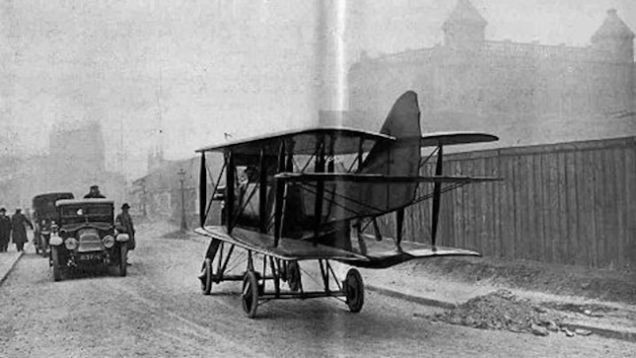
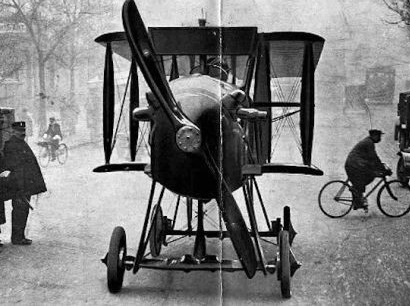
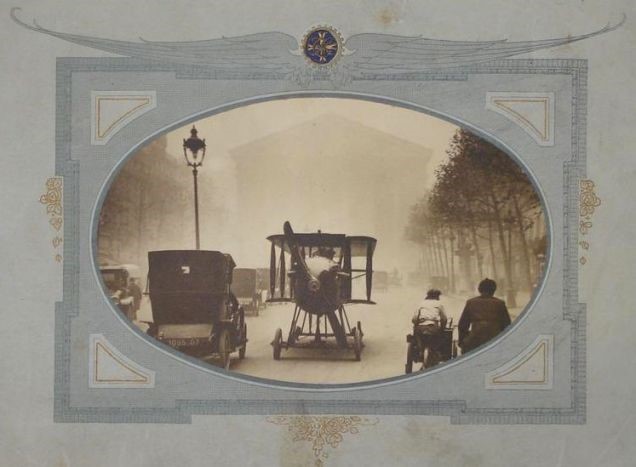
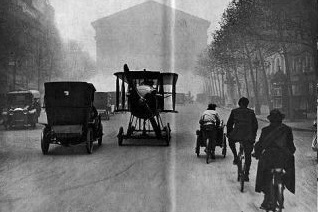
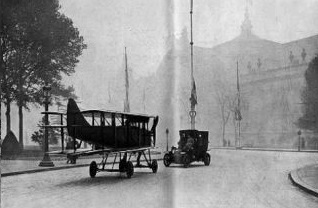
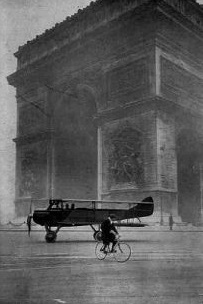
Frenchman Rene Tampier started up again after World War I and successfully built a four-wheeled bi-plane with foldable wings. Tampier first drove his Avion-Automobile in October 1921 and exhibited it at the 1921 Paris Salon, after a two-hour drive in the city. It flew two weeks later.
Tampier opted for two separate powerplants: a small four cylinder motor driving the vehicle’s rear axle, and a 300 hp Hispano Suiza V 12 aero engine to get it airborne. The biplane wings folded back alongside the fuselage for motoring. The pilot sat facing the tail when driving.
Between 1922 and 1925 Tampier built several different versions of the Avion Automobile, all of which he drove and flew, but as a vehicle it was cumbersome and awkward and the idea was never adopted commercially.