In 1976 Donald E Taylor built the ‘Tinker Toy’, two place cockpit, highwing monoplane, registered N5DT. Firs flown on 6/16/74, power was a 102hp Chevy Corvair Monza pusher.
A two-seat cabin monoplane of all-metal construction with a high lattice girder with diagonal surface bracing.
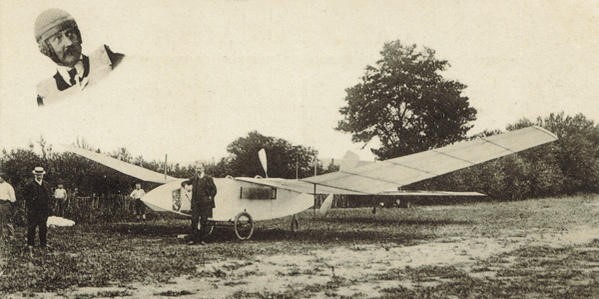
Built at Hamsey Green, UK, by designer R.Taylor in 1936. Only one was built of three planned. The designer died in the crash of the prototype in 7 January 1937 on its first flight.
c/n TE.2 G-AEPX prototype built with Cirrus Minor I engine. c/n TE.3 G-AEPY single seat, not built c/n TE.4 G-AEPZ two-seater, not built c/n G-AERA not built
The “Letatlin” during a gliding parade in Moscow in 1933
The ornithopter designed by Vladimir Tatlin from 1929 to 1932 and Tatlin built three versions of his machine. The word Letatlin is formed from the verb letat (fly), associated with the name of its creator, Tatlin. In the Stalin years, Tatlin, one of the major artists of the constructivist movement of the Soviet revolutionary years, designed his ornithopter inspired from birds.
Tatlin had carried out a trial flight that hadn’t worked out.
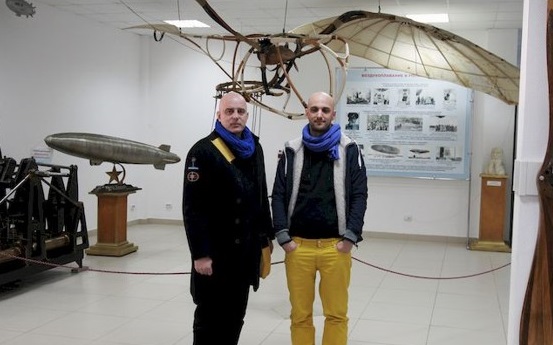
The ornithopter designed by Tatlin from 1929 to 1932 had disappeared. It had been more or less abandoned for twenty years in a warehouse belonging to the Molino Russian Federation Central Air force museum, next to Star City, the Youri-Gagarin cosmonaut training center fifty kilometers away from Moscow. It was the KSEVT, team, the space culture center in Slovenia, that by chance came across the machine in a precarious state during a protocol visit to the Monino museum in 2014. In February 2014, they were taken to the historical part of the Monino museum where one can see pioneers’ flying machines, since the Russians went into aeronautics very early. Miha Turšič, director of KSEVT until 2016, member of the collective Postgravityart, spotted the Letatlin in the corridors of the Monino museum in April 2014.
While the group was in discussion, Miha Turšič went ahead, getting a bit lost in the aisles of the museum, and suddenly I found myself face to face with a machine that looked like a plane but wasn’t one. He knew of the Letatlin and there it was right in front of him. We immediately asked if they knew what they had there, one of the most iconic works of 20th century art. They told us: “Yes, it’s an old Russian artist who built sort of flying machines rather like Leonardo de Vinci.” They had no idea of the importance of the piece. They considered it as best as an experimental flying machine that had never flown. Tatlin was mentioned, but with no context.
It was Letatlin n°3 that was found. It would have reached Monino in 1996 after being damaged on the way back from a presentation in an exhibition in Athens and was left there, abandoned in the context of complicated years following the collapse of the USSR.
Restoration of the “Letatlin”
The Molino Air force museum had just retrieved it a year earlier from the museum storeroom where it lay in bits in a corner, deteriorated, really damaged, and they had reassembled it to hang it in their museum.
The “Letatlin” restored in the Tretiakov gallery in Moscow
It was obvious that a renovation was necessary for the Letatlin. The Monino museum and the Tretiakov gallery finally found an agreement for its renovation. Turšič went to Moscow at the end of December 2017 to meet the curator of the museum and saw it displayed in the 20th century art collection.
Dragan Živadinov and Miha Turšič in front of the “Letatlin” at the Monino museum on April 11, 2014.
The Letatlin finally found the perfect place for its presentation to the public.
Tatarinov started building his “Aeromobile” at Petrograd in 1909 with a grant provided by the Russian Ministry of War. The project was never completed, since Sukhomlinov, Russian Minister of War at the time, thought the work was progressing too slowly and consequently, the continuation of funding was denied. In despair, Tatarinov set fire to his rotorcraft and the hangar which housed it. The “Aeromobile” had four rotors, each turning at the end of an X-form of beams. Beneath it the chassis contained an EDTT 25 hp water-cooled engine which was to drive the rotors as well as a five-bladed “centrifugal propeller”. The pilot’s seat and controls were placed behind the engine. The total weight of the machine was 1300 kg.
This single pilot manned test-bed was built by Jim Kern’s TASK Research Inc. of Santa Paula, California in 1982, which supplied many composite structures/components for the Rutan designed Long-EZ, Defiant, and Voyager aircraft during the early to mid-1980’s under contract to Northrop’s Electric Mechanical Division in the late 1980s to test early avionics/electronic equipment for remotely piloted vehicles.
The Vantage was a single-seat pusher canard which resembled a Rutan Long-EZ, but was slightly larger with more rounded fuselage sides, a large bulbous two piece canopy. The craft also incorporated an extra long pitot tube in the front. Power was supplied by a single Lycoming O-360 (180 HP) engine turning a variable pitch wood or composite propeller. The aircraft incorporated a retractable nose gear which was powered by an electric motor. The wing root to fuselage joint was blended/contoured and flowed seamlessly into the cockpit. Nicknamed “Sneeky Pete” by its pilots, the undesignated aircraft was outfitted with various special avionics depending on the specific mission requirement. The exterior was painted white, with the name “Sneeky Pete” written along the side of the fuselage, though this is not apparent in the one picture that was released.
Although the maiden flight of “Sneeky Pete” took place at Mojave Airport on July 18th, 1982 with Dick Rutan at the controls (Mike Melvill, along with many others served as test pilots for this aircraft), Rutan Aircraft Factory or Scaled Composites apparently were not involved in the elaboration and building process of the aircraft. It is believed that the flight test program for “Sneeky Pete” first took place at the remote Groom Lake test site in Nevada widely known as “Area 51” (AFFTC DET. 3) in late 1982. The aircraft was periodically tested over the years with various equipment, put into seclusion at various times, but has never been officially retired. During its “down time”, “Sneeky Pete” was most likely stored in a top-secret facility known as “Dyson’s Dock” at Groom Lake which was also the location of the Northrop “Tacit Blue” technology demonstrator after it was retired in 1985.
In 1993, “Sneeky Pete” was acquired and rebuilt by Scaled Composites and experimentally fitted with a Williams FJ107 jet engine, a small turbofan engine designed to power cruise missiles and developed by the Williams International company from their WR19.The FJ107 was notably the powerplant for the AGM-86 ALCM, BGM-109 Tomahawk, and AGM-129 ACM, as well as the experimental Williams X-Jet flying platform. In its jet-powered form, the aircraft was first tested in August 1993 and was known at Scaled Composites as the Jet LEZ Vantage or Model 61-B. A striking feature of the revised aircraft was a square, flat section, as seen from below, added at the back of the aircraft. The section wasn’t as wide as the strakes at the front wing roots but was longer along the fuselage, in comparison.
Jet LEZ Vantage
Only one airframe was ever constructed. The data gathered throughout the “Sneeky Pete” program contributed to today’s advanced UAVs such as the Northrop/Grumman Global Hawk, General Atomics Predator, Boeing X-45, Northrop/Grumman X-47 Pegasus. The aircraft was returned to a more conventional configuration and still appears on the civil register as being owned by Scaled Composites, but its current whereabouts are unknown, and, like many experimental variants of the Long-EZ, it is not properly documented, due to its classified use by the military.
N3142B c/n 1 Powerplant:1 x Lycoming O-360 (180 hp) / 1 x Williams FJ107 / 1 x Lycoming IO-320 (150 hp) Wingspan: 28 ft. Overall length: 17ft. (approximate) Weight: up to 12,499 lb. (with Lycoming engine) Crew/passengers: 2