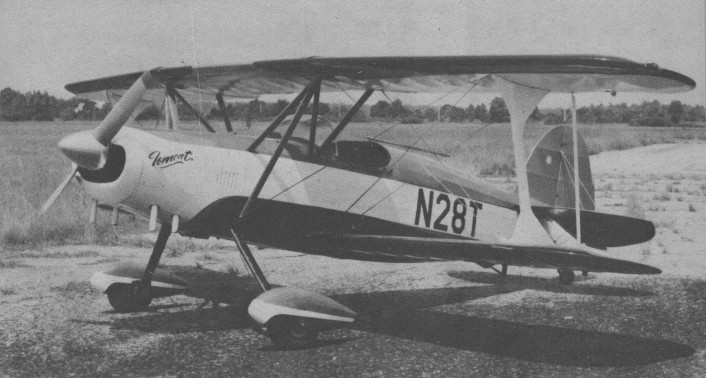
Pete Tomalesky in early 1970 began the project to design and build a two-place, side-by-side biplane he called the Tomcat. He later removed the tubular spring gear and fitted a one-piece flat aluminum gear in its place. First flying in November 1973, he flew the Tomcat N28T in several I.A.C. amateur acrobatic contests.
“The Tomcat was intended to be an aerobatic/sport plane, and it uses a fuel-injected 160-hp Lycoming. The airframe will accept an engine with as much as 300 hp, and with a sliding canopy fitted, the Tomcat would be a highly competitive acrobatic machine
Mike Tomalesky describes the Tomcat’s construction as being of typical steel and wood, with a wingspan of 24 feet (top wing) and 181/2-foot length. All airfoils are fully symmetrical, and four interconnected ailerons are featured.
“I’ve dive-tested the Tomcat to 200 mph,” says Mike, and with the 160-hp engine it cruises at 110 mph and climbs at 1200 fpm. I’ve tried some 70 different aerobatic maneuvers and variations, including outside loops, point rolls and several inverted flat spins,”
The Tomcat was sold to the Suncoast Pilot’s Club at Clearwater Airport, and numerous pilots have since checked out in-it. Mike says he’s joining the club so he can put more time in on the Tomcat, which he hasn’t flown for some time. He describes the craft as highly responsive in pitch and roll, and says, “it does not get heavy prior to the stall, which is only brought on by a lot of work on the pilot’s part. Rudder control is excellent.
In aerobatic flying, entry speed of 140 mph IAS is used for loops, hammerhead turns, taiislides, point rolls and slow rolls. A 30-second slow roll has been recorded, with a minimum loss of altitude. “Four-and eight-point rolls are crisp, and 16-point rolls, at which 1 was very good, are possible,” mike enthuses. Square loops are entered at 160 mph, usually out of a hammerhead turn. Most rolls are done at cruise power, and Mike reports that snaps are fantastic. He says, “A real, fast snap can be done at 85 mph with ailerons and power added. Snaps out of knife edge are entered at from 110 to 120 mph.
Mike enters spins in the Tomcat at the usual stall speed, with no aileron required for a fast, tight spin, and recovery is virtually instantaneous, using conventional opposite rudder and forward stick. Spins do tighten up after six to eight turns, he says. Inverted spins are entered at stall speed and are simple to perform.
Outside loops from top around are entered at 80 mph, with speed at the bottom from 160 to 180 mph, depending on how many negative C’s are pushed. “At no time in the 100 hours of constant, rugged aerobatic flying I did,” says Mike, “was any part of the Tomcat damaged or deformed, and no abnormal flight characteristics were noted in any configuration.
Mike’s dad Pete began building the Tomcat in 1971 when he was operating a company called Tru-Flight near Clearwater Executive Airport, which was involved in building complete and partial aircraft. Construction time on the Tomcat ran to 14 months, or some 2000 hours, with the first flight taking place at Clearwater Airport in early September 1972. Virtually no modifications or adjustments were required, except to tighten the flying and landing wires and repair a cracked cowling.
TomcaCs fuselage is built up from 4130 steel tubing, gas welded, with spruce stringers attached to birch formers. The firewall is stainless steel; the nose bowl and wheel pants are f iberglass landing gear was an original steel rod design, later modified to one piece flat stock aluminum, with Cleveland brakes and 600 x 6 wheels and tires. A 36-USgallon aluminum fuel tank is mounted forward of the cockpit. The entire fuselage is fabric covered and doped.
Wing ribs are routed from five-ply birch plywood, and the spars are spruce, with laminated spruce wingtip, bows, leading and trailing edges are of aluminum, and the four identical ailerons are interconneded, actuated by push-puli tubes in the bottom wings.
The tail surfaces are outlined with 4130 steel tubing, ribs are bent sheet steel, the entire structure gas welded. An aluminum trim tab is on the left elevator only, operated, by a vernier control at the pilot’s left. Two sets of streamlined flying wires form the leading and trailing edges ‘of the stabilizer, with the entire structure fabric covered. The elevator is push pull tube operated, the rudder actuated by braided stainless steel cables.
Inside the cockpit, the pilot is provided, with a central control stick, interconnected with a shorter, removable stick for the passenger. Toe brakes are on the pilot’s side, with smaller, brakeless pedals on the passenger’s side.
The throttle and mixture control, originally at center, have been moved to the pilot’s left side, but a central throttle can be connected for student/passenger use. A radio navcom is located between and forward of the pilot’s legs in the center console, which also has a map storage area below the radio.
On the panel in front of the passenger’s seat are switches and circuit breakers, including master switch, turn and bank, electric fuel pump, nav lights and radio switch. Tomalesky placed the pilot seat six inches forward of the passenger’s seat to facilitate elbow clearance. Both seats are of fiberglass, bucket-type, with aerobatic seat belts and shoulder harnesses.
The baggage compartment is placed immediately behind the seats at shoulder height, with entry through a full-width aluminum door with a key lock. Baggage capacity is 50 pounds.
The 36-gallon fuel tank includes a 21 gallon header tank located at lower right ahead of the passenger’s rudder pedals, designed to house the flop-tube fuel pickup; it serves as the inverted fuel system. The fuel tank is double vented, on the bottom of the fuselage and on the top wing. Fueling is accomplished through a centrally located cap forward of the windshield.
A full oil inverted system with check valves and collecter tank are mounted on the firewall, and provisions have been made for mountings for tracks on the fuselge sides and atop the forward turtle deck to accommodate a full sliding canopy.
One of the few modifications made was a change from the original exhaust system, routed out through the bottom center or the engine cowl to four straight stacks protruding from the lower cowl. This change was made after one of the longer stacks fatigued and was lost in flight.
So far, says Mike Tomalesky, some 500 hours have been logged by a number of pilots flying the Tomcat, many carrying passengers in aerobatic demos.
Engine: Lycoming IO-320-B1A, 160 hp
Propeller: Fixed pitch
Wingspan Top: 24 ft 0 in
Wingspan Bottom: 22 ft0 in
Airfoil section Top: 63015
Airfoil section Bottom: 2300 Series-symmetrical
Length: 18 ft 6 in
Height: 7 ft 0 in
Wing area: 133 sq.ft
Gross weight: 1725 lb
Empty weight: 1154
Useful load: 571 lb
Baggage capacity: 50 (max)
Fuel capacity: 36 USgal
Seats: 2 side by side
Top speed normal: 160 mph
Cruise speed: 110 mph
Stall speed: 55 mph
Rate of climb: 1100 fpm