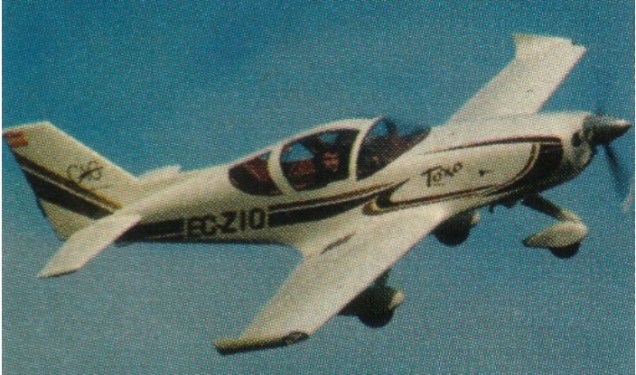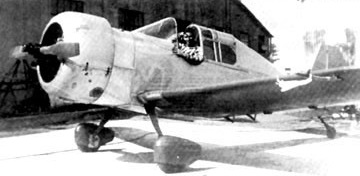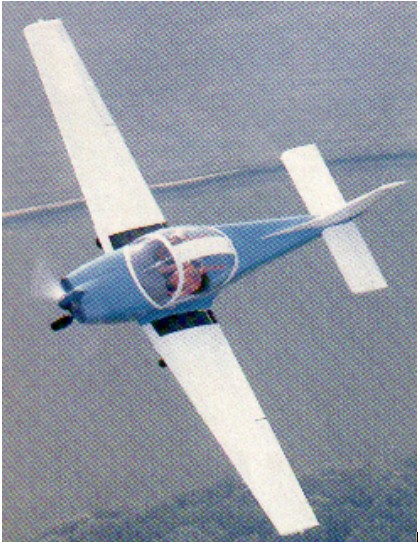
Trago Mills SAH.1 Sprint / Orca Aircraft Ltd SAH-1 / Lovaux / FLS Aerospace Sprint

Trago’s boss, supermarket entrepreneur Mike Roberts, claimed to have already spent £1•25 million since he brought in chief designer Sydney Holloway in 1977 to build a trainer aimed at reversing the fortunes of British light aviation.
Holloway started work on the SAH.1 in 1977, build¬ing the aircraft in the living room of his home next to Bodmin airfield. Holloway’s wife Sheina did the drawings and put up with the mess. Holloway’s task was eased by the spon¬taneous help given by several skilled experts including Frank Robertson (no relation to Mike Robertson), who took over responsibility for the aerodynamic and stress calculations.

Holloway went for a strong but simple metal airframe, with the emphasis on minimum maintenance and easy repair. Unproven materials have been avoided, and PVC foam has been used for skin stabilisation to prevent “oil-canning”. The ailerons are of the slot¬ted Frise type, with differential action and external mass-balances. The slotted flaps, operated by means of a lever between the seats, incorporate built-in steps for easy entry.

With a 47 in cockpit, and a 14 cu.ft baggage bay behind the two folding and adjustable seats which can carry l00lb of baggage.

The SAH.1 can carry two l80 lb people and and two 12.5 Imp gal integral wing tanks full. It is cleared for aerobatics and spinning, and is stressed to +6g/-3g.

Orca Aircraft Ltd purchased the SAH-1 trainer from Trago Mills but went into administration in 1989. The SAH-1 became Sprint when purchased by Lovaux / FLS Aerospace. Lovaux Ltd was a subsidiary of FLS Aerospace for aircraft maintenance.

Powerplant: One 118 b.h.p. Avco Lycoming O-235-L2A
Prop: McCauley fixed-pitch, 5ft 6in diameter
Wing span: 30ft 8.4in
Length overall: 2lft 10.25in
Height: 7ft 7.5in
Cockpit length: 5ft
Cockpit width: 3ft 11.5in
Baggage volume: 14 cu.ft
Empty, equipped: 1,l00lb
Max take-off: 1,750lb
Max fuel load 25 Imp gal: 188 lb
Max wing loading: 14.581b/sq.ft
Never exceed: 164kt
Max level speed/sea level: 122kt
Cruise at 75% power/sea level: 110 kt
Service ceiling: 16,400ft
Take-off to 50ft (15 deg flap): 1,285ft
Range with 45mm reserve: 620 n.m.
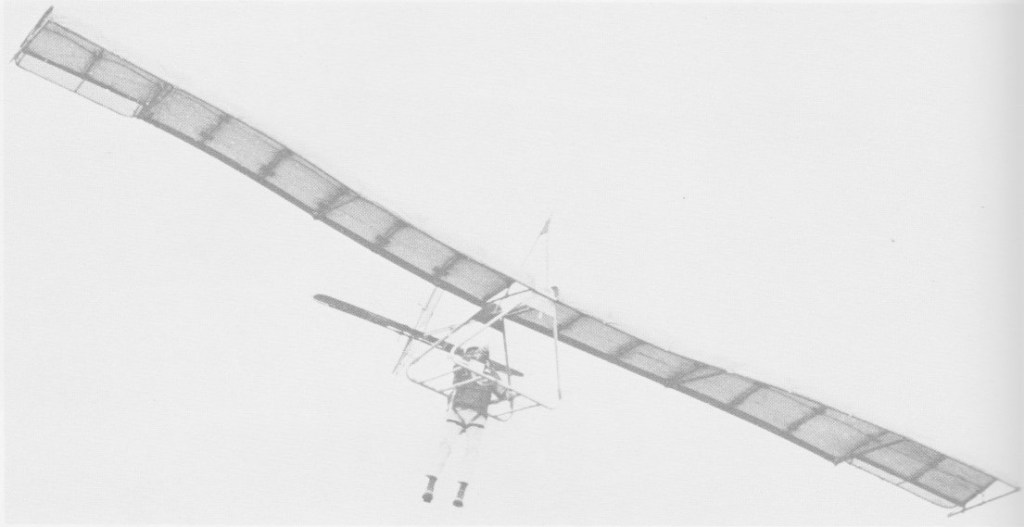
Tradewinds Gliders TW-21

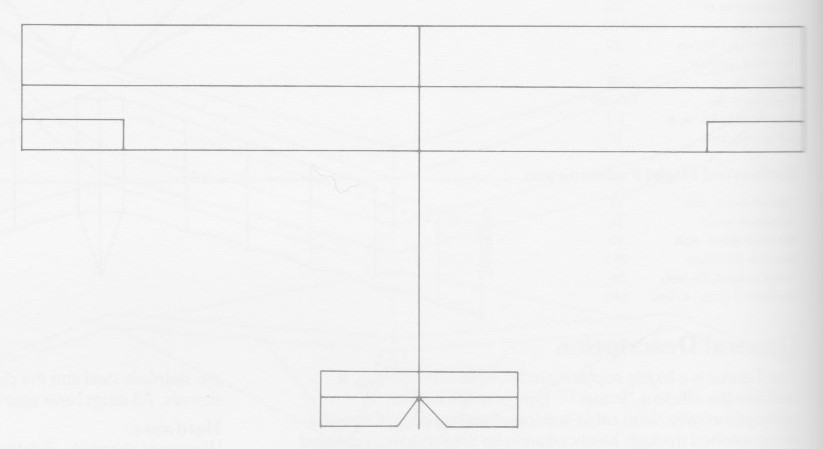
Circa 1972, the TW-21 is a fixed wing that has full three axis control, ailerons, rudder and elevators.

Stressed for 4.5G, all tubing is 6061-T6 seamless aircraft aluminium. Sizes from 5/8in to 1 5/8 in is used. Rigging cable is 3/32in 7×7 and 1 5/8 x .049 is used. All fittings and joints are heli-arc welded.

All bolts, nuts, turnbuckles, pulleys and brackets are aircraft quality. The sail options were 3.0 or 5.8 oz dacron, with a choice of 10 colours. All seams and stress areas are double zig-zag stitched and reinforced.

The TW-21 has fully adjustable seat harness and ground support straps, and an optional prone harness was available.

The control system and control stick are machined steel and welded.
Chord length: 4 ft 9 in
Wing span: 32 ft
Aspect ratio: 6.85
Nose angle: 0˚
Wing area: 153 sq,ft
Weight: 55 lb
Pilot weight: 110-220 lb
Takeoff speed: 12 mph
Stall speed: 14 mph
Max speed: 45 mph
Best glide ratio (L/D): 12:1
Best L/D speed: 26 mph
Min sink: 185 fpm

Chord length: 4 ft 9 in
Wing span: 34 ft
Wing area: 154.5 sq,ft
Aspect ratio: 7.55
Nose angle: 0˚
Weight: 71 lb
Pilot weight: 110-250 lb
Takeoff speed: 12 mph
Stall speed: 14 mph
Max speed: 45 mph
Best glide ratio (L/D): 12:1
Best L/D speed: 26 mph
Min sink: 185 fpm

Toyo Aircraft T-T.10

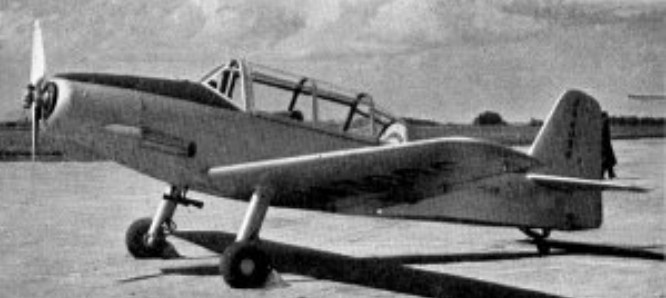
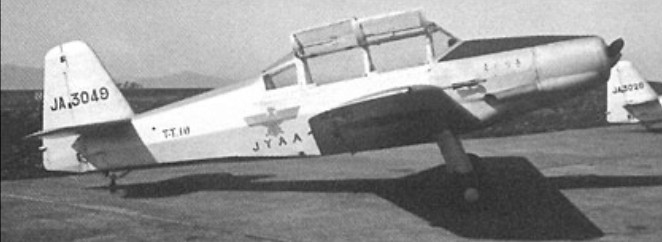
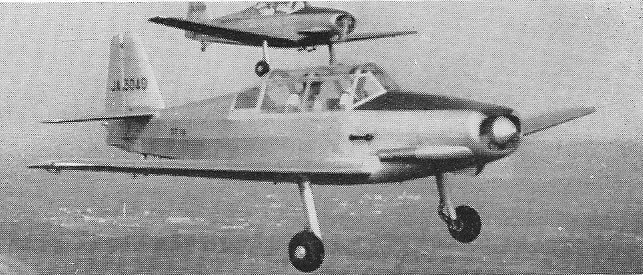
Toyo Aircraft was established in June 1952 and their first aircraft, the T-T.10 designed by Yoshio Hashiguchi, was completed by the end of the year. It is of mixed construction; the wing is built entirely from wood and fabric around two spars, with a plywood skin enclosed within fabric. The flaps and ailerons are wood framed and fabric covered. In planform the wings are straight tapered with rounded tips; most of the taper is on the trailing edge. There is 6 degrees of dihedral. The T-T.10’s tail surfaces are also straight tapered with rounded tips, generally wood framed with fabric covering. Its horizontal tail is mounted at the top of the fuselage. The elevators have a cut-out to allow rudder movement, as the latter extends down to the keel. There is a trim tab on the port elevator.

The fuselage of the T-T.10 is fabric covered over a welded chrome-molybdenum steel frame. The engine is a 140 hp (104 kW) Lycoming O-290-D2 flat four, driving a two bladed propeller. Student and instructor sit in tandem with dual controls under a multi-framed, continuous, two part sliding canopy. The rear fuselage line is raised compared with the forward section, but not to the full canopy height. The T-T.10 has conventional landing gear, with narrowly faired cantilever, coil spring damped mainlegs and a tailwheel.

The first T-T.10, registration JA3026, flew for the first time on 30 December 1952; the first production model (JA3049) followed soon after, on 11 February 1953. Production numbers are not known exactly; one report speaks of a “small batch” but only the first two T-T.10s appear in the single engine serial range JA3001 – JA3100, which covers the period August 1952 to September 1955, so they may constitute the whole batch.

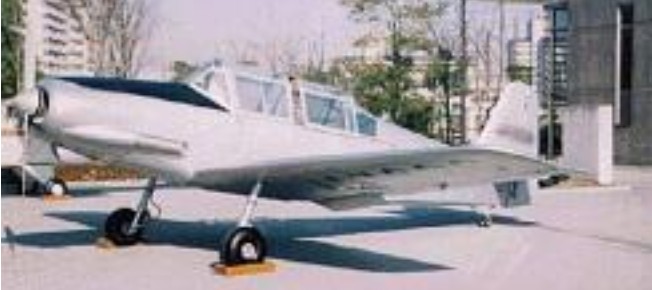
One aircraft is on display at the Tokyo Metropolitan College F.A.M.E. Gallery: T-T.10 JA3026.

Engine: Lycoming O-290-D2, 100 kW (140 hp)
Propeller: 2-bladed Sensenich CSM3FM4/C374 fixed pitch
Wingspan: 8.60 m (28 ft 3 in)
Length: 7.15 m (23 ft 5 in)
Height: 2.10 m (6 ft 11 in) tail down
Wing area: 12.0 sq.m (129 sq ft)
Aspect ratio: 6.0
Airfoil: NACA 1415 at root, 2410 (modified) tip
Empty weight: 568 kg (1,252 lb)
Gross weight: 800 kg (1,764 lb)
Fuel capacity: 90 L (19.8 Imp gal; 23.8 US gal)
Maximum speed: 235 km/h (146 mph; 127 kn) at sea level
Cruising speed: 190 km/h (118 mph; 103 kn)
Stall speed: 80 km/h (50 mph; 43 kn) with 30° flaps
Service ceiling: 4,300 m (14,108 ft) service
Rate of climb: 3.8 m/s (750 ft/min) initial
Wing loading: 67 kg/sq.m (14 lb/sq ft)
Power/mass: 8.0 kg/kW (13.1 lb/hp)
Take-off distance to clear 15.25 m (50 ft): 290 m (950 ft)
Landing distance from 15.25 m (50 ft): 300 m (985 ft)
Crew: 2

Townsend Thunderbird

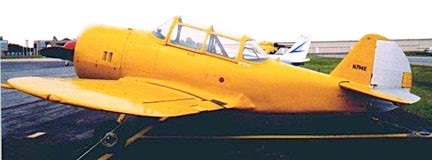
Townsend Thunderbird N749T

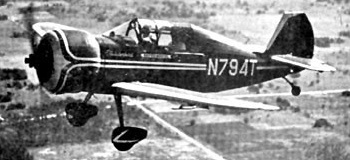
The Townsend Thunderbird was assembled in 1955 from parts of at least four different planes. The fuselage structure (20′ in length) appears to be a cut-down Fairchild PT-26 with its canopy. The cowling is from a Stearman, the landing gear from a Cessna 190 or 195. Its wings, vertical and horizontal stabs are from a Vultee BT-13 or -15. The wings are just the outer panels (wing span is 25′) and the stabs have been cut down in size. Engine is a Wright R-975, which suggests BT-15.

Registered N749T, the aircraft started out fabric covered, but was later metalized.

Townsend Thunderbird N749T

In September 2002 Tony Pileggi purchased the home-built Thunderbird. With quite a history and, while it’s a shame to change all that, it was not safe to fly. Actually, it was really great in the air. Take-off and landing were scary. It was too short-coupled and over-powered, and it had an aft c/g or not enough horizontal stabiliser. The tail would not come off the runway until about 65 mph with full forward stick.

During flight-testing, the clean power-off stall speed was about 80 mph. At the first flap setting, the power-off stall speed was between 85 and 90, with a very abrupt snap into a spin. Attempting to recover from the spin under 100 mph resulted in a secondary stall, again with a tight spin. This was attributed to the very small flap size as they ran from the fuselage outboard only 16″. The size of the flaps created a thicker wing section at the root, and so caused the tips to stall long before the roots.

Tony Pileggi decided to disassemble the ship after the landing gear collapsed and made for a very exciting landing. When he removed the forward fuselage aluminium, he found some old cracks and some scary welding on the frame. A first impulse was to scrap the entire aircraft, but he then began thinking about redesigning it and building a replica of a WWII-era fixed-gear fighter. After extensive research, he found a plane that the Thunderbird most closely resembled, the Nakajima Ki-27.

Thunderbird
Engine: Jacobs R-755-9, 245hp
Wingspan: 27’5″
Length: 21’3″
Empty wt: 1800 lb
Max speed: 220 mph
Cruise speed: 152 mph
Stall: 75 mph
Range: 200 mi
Seats: 1

Towle TA-2

Towle TA-2 was built as a successor to the WC model. In 1930 one was built, NX491H, powered by two 240hp Wright Whirlwind J-6 on a faired housing and wing struts were omitted. Only the one was built.

Engines: 2 x Wright Whirlwind J-6, 240hp
Wingspan: 56’0″
Length: 42’0″
Useful load: 2257 lb
Max speed: 120 mph
Cruise speed: 100 mph
Stall: 55 mph
Range: 500 mi