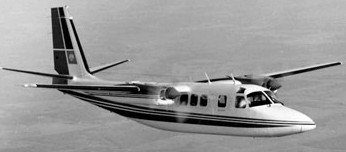
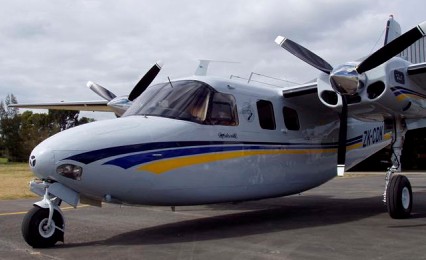
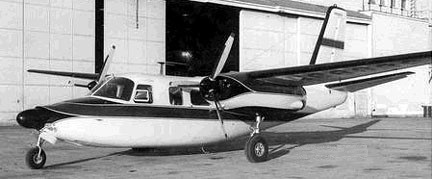
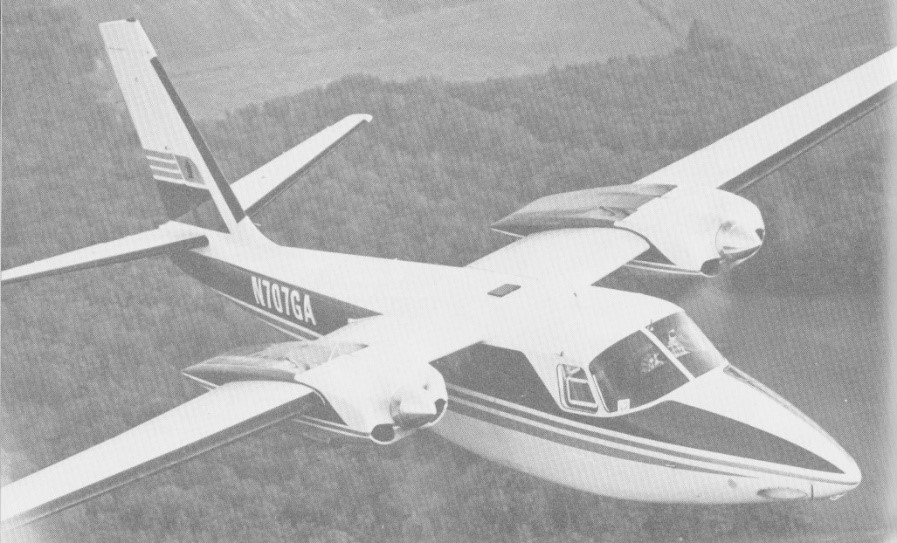
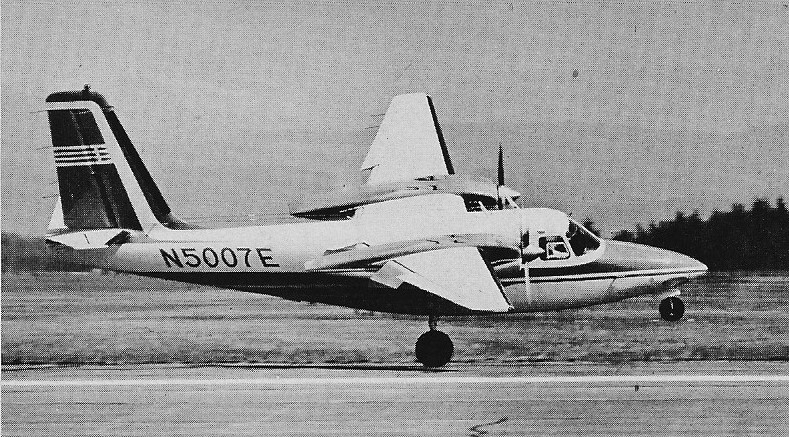
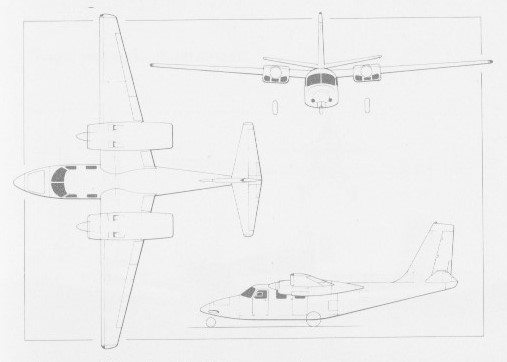
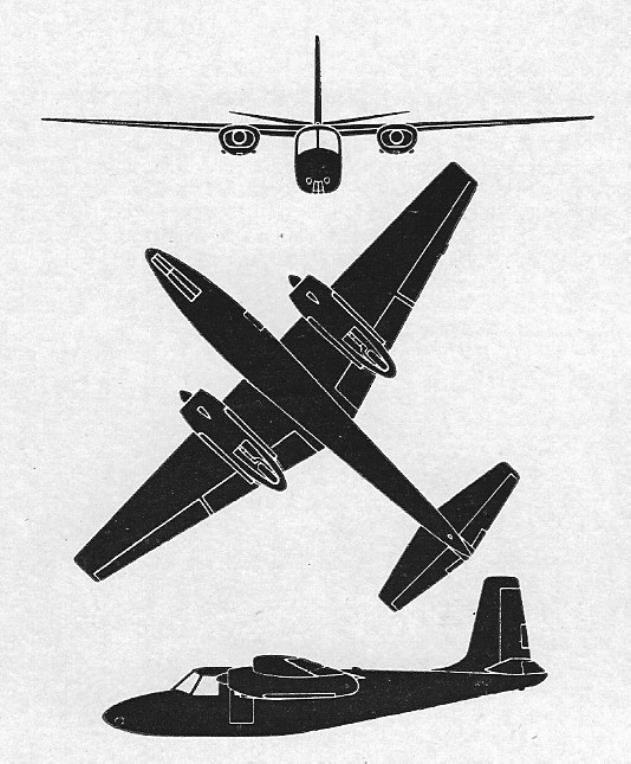
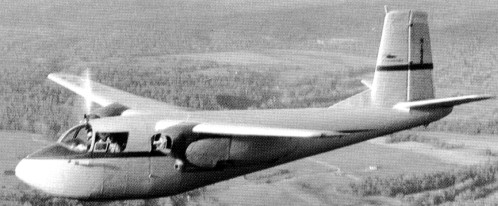
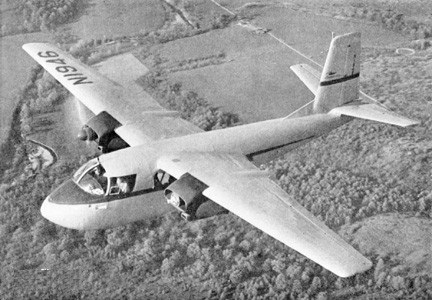
The Rockwell Commander 685 was a turbocharged high-performance piston-powered airplane designed to meet the business requirements of room and speed normally found in propjet aircraft. The seven to nine place 685 is powered by twin turbocharged 435-hp Continental engines with Hartzell constant-speed full feathering three-blade props. It can cruise at speeds of 255 mph at 24,000 feet. Its cabin can be arranged in no less than 12 different ways and can maintain sea level cabin pressure at altitudes up to 9,000 feet (4.2 psi differential). The Commander’s high wing, sturdy landing gear, and 75 knot stall speed allow it to operate from short unimproved strips. With 322 gallons of fuel, the 685 has a range of 1,731 miles with a 45-minute reserve. Its simple fuel system requires no crossfeeding. All fuel feeds into a central fuselage tank.
The 685 / 680FL, Courser Commander (ATC 2A4) first flew on 29 December 1962. It sold only in small numbers and was cancelled in late 1969.
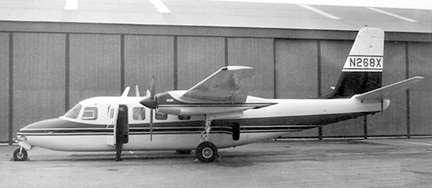
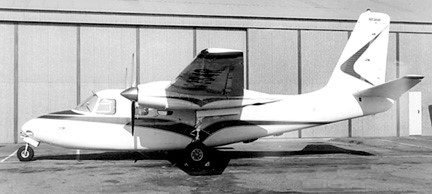
Aero Commander 680FL N68X
685 Engines: 2 x Continental GTSIO-¬520-K, 435hp MAUW: 9000 lbs. Gross weight: 9,000 lb Empty weight: 6,021 lb Fuel capacity: 250-322 USG Seats: 9 Top speed: 279 mph. Cruise speed: 256 mph Stall speed: 86 mph Initial climb rate: 1,490 fpm Range: 976-1,284 sm Ceiling: 27,500 ft Takeoff dist (50ft): 1,943 ft Landing distance (50ft): 2,312 ft
Appearing circa 1970, the Aero Commander was under ATC 2A7 and A3SW.
Aero Commander 680
Two civil 680 went to the USAF as U-4B, 55-4647 and 55-4648, and four to Army, 56-4023 to 56-4026, later becoming U-9C.
The US Army tested electronics systems with the one NL-26D, 57-6531, and tested side-looking radar (SLAR) with RL-26D 57-6183 and 57-6184, plus three modified from L-26C. They later became NL-9D and RU-9D. Two more were built, but destroyed in pre-delivery accidents.
Aero Commander 680 Super in production in late 1955.
The Aero Commander 680-E (ATC 2A4) appeared in 1958.
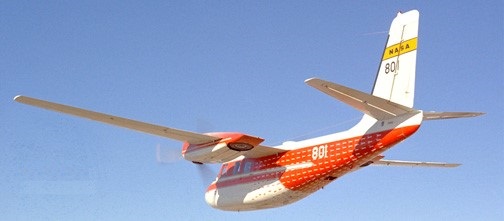
Aero Commander 680F NASA801
The 680F first appeared in 1964.
First flown on 31 December 1964, the first turbo-prop Commander, the 680T, appeared in 1966. The 680T was to all intents and purposes, a turbine-engined edition of the pressurised Grand Commander, the nine seat 680FLP.
The 1967 680V featured picture windows and clamshell gear doors.
The 680W appeared in 1968.
The 1969 680T Turbo II, Hawk Commander ATC (2A4) was priced at $369,500.
The first of the Commander twins was the 1958 model 500 with 230hp Lycoming O-540 engines. In 1960 the model 500A with Continental IO-470-M engines, redesigned nacelles, structural mods, new landing gear, and higher gross weight, was introduced. Both operated under 6A1.
The 500 was developed into the six seat Aero Commander 520 (the 520 indicating the total horsepower), certificated January 30,1952 and selling forty-three in that same year of production. From 1956 USAF and Army version of 520, 560, and 680 were designated L-26. All redesignated U-9 in 1962.
Approximately 150 model 520 were built. The 520 sold for $45,000, $66,000 in 1954. An upgrading of the powerplants followed in 1954, from the 260 hp Lycoming GO-435 engines of the Commander 520 to the 295 hp Lycoming GO-480 engines of the 560 in 1954. Gross weight lifted by 500 lbs to the 6,000 of the Commander 560 vertical tail surfaces were slightly swept. Approximately 150 model 560A were built with swept vertical tail, increased gross weight, and structural mods.
Three civil 520 went to the US Army, 52-6217 to 52-6219, as YL-26, later becoming U-9B.
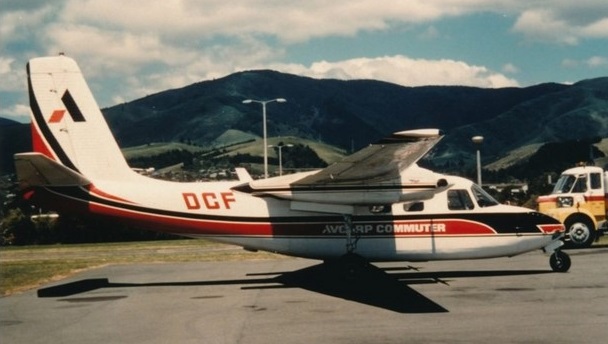
Aero Commander 500A ZK-DCF
The 1960 model 500B, also under 6A1 featured Lycoming IO-540-B1A5 engines and a gross weight of 6750 lb.
Aero Commander 500B N9384R
President Eisenhower took office and refused to use the “Independence”, Harry Truman’s airplane, as his Air Force One. Instead, he ordered a Lockheed Constellation as his primary aircraft. But for short trips into and out of his farm grass strip near Gettysburg, PA, the President needed something to operate from the short and unimproved landing area. Helicopters were not yet reliable enough. Driving took too long and snarled traffic. He told his chief pilot, Col. William Draper, to conduct an evaluation. His mission was to find a plane to go back and forth to the farm, and to make other short trips. The Colonel chose one of the most popular executive transports of the day, the Aero Commander 560A, and the Air Force ordered several for the President’s use. The Air Force designated the planes the L-26. Himself a pilot, Ike often took the controls of the Aero Commander, enjoying the opportunity to fly.
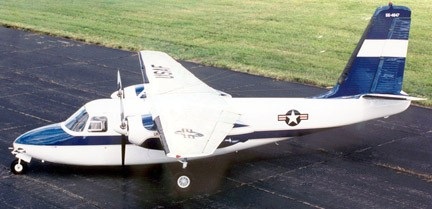
The fourteen U-4B (redesignated from L-26B) plus two L-26C (55-4647 and 55-4648) were the first lightplanes to earn the designation “Air Force One” and painted in the now standard blue-and-white color scheme.
Aero Commander U-4B 55-4647
A fleet of six Commander L-26’s were assigned to the White House and used exclusively by President Eisenhower, Vice President Nixon, Cabinet and government officials, Secret Service, family and White House staff. This aircraft, 55-4638, was one of those original six. Two more were added a year later with turbocharged engines and assigned exclusively for Presidential use. This plane was used daily in the famous Gettysburg Airlift in 1955 and 1956, as well as the Greenbriar Airlift that hauled Ike along with the President of Mexico to North Carolina. Another seven L-26 aircraft were based in the Washington DC area and assigned to military units.
The sole USAF YL-26A 55-3815 of 1955 was a civil 560, later becoming U-4A.
A total of 34 L-26B were produced from 1952. Fourteen went to USAF; 55-4634 to 55-4646, and 57-1791, later becoming U-4B.
Approximately 70 model 560E were built with wingtip extensions and gross weight increase.
95 of the Aero Commander 500 were built.
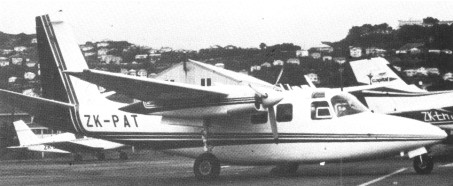
The Aero Commander 500A and 500B later known as 500U, then Shrike Commander.
Shrike Commander
The 560F was a 1960 model.
The 1968 500S (6A1) incorporated more powerful engines, a redesigned pointed nose, some structural strengthening, pilot’s door and other equipment changes. Engines can be run at full throttle without restriction. All fuel tanks are interconnected, so no tank selection or cross-feeding is required. One-engine flight is managed without any particular fuss.
The 1964 500-U / Shrike Commander / Shrike Esquire (6A1) was the only twin in its class approved for limited aerobatics, as demonstrated by Bob Hoover in tours. Base price was $103,950.
Shrike Commander Pilot Bob Hoover
One distinguishing feature of the Rockwell Shrike is its eyebrow windows for improved cockpit visibility. The Shrike was certified in the utility category partly because the landing gear was designed for use on aircraft nearly twice the Shrike’s gross weight making landings on unimproved airstrips easy. The Shrike Commander 500S production was terminated 1980.
Shrike Commander Engines: 2 x Lycoming IO-540-E1B5, 290-hp Wing span: 49 ft 0.5 in / 14.95 m Length: 36 ft 9.75 in / 11.22 m Gross wt: 6,750 lb / 3062 kg Empty wt: 4,608 lb / 2090 kg Top speed: 215 mph Cruise speed 75% 9000ft/2745m: 203 mph / 176 kt / 326 kph Stall speed: 68 mph Initial climb rate: 1,340 fpm / 409 m/min Range at 178 kt / 205 mph / 330 km, 45min res: 798 miles / 698 nm / 1525 km Service ceiling: 19,400 ft / 5913 m TO dist (50ft): 1,915 ft Landing distance (50ft): 2,235 ft Fuel capacity: 156 USG Seats: 4-7 Cabin length: 10 ft 7.5 in / 3.24 m Cabin width: 4 ft 4 in / 1.32 m Cabin height: 4 ft 5 in / 1.35 m Cabin capacity: 177 cu.ft / 5.01 cu.m / 500 lb / 227 kg
500U Engines: 2 x Lycoming O-540-A1A6, later GO-480-C1B6, 290-hp Wingspan: 49’1″ Length: 36’7″ Gross wt: 6,750 lb Empty wt: 4,635 lb Fuel capacity: 156 USG Top speed: 230 mph Cruise speed: 215 mph Stall speed: 68 mph Ceiling: 19,400 ft Initial climb rate: 1,340 ft Range: 1,230 sm Takeoff distance (50ft): 1,375 ft Landing distance (50ft): 1,235 ft Seats: 4-7
520 Engines: 2 x Lycoming GO-435-A, 260 hp Wingspan: 43’10” Length: 32’0″ Useful load: 1318 lb Max speed: 181 mph Cruise: 165 mph Stall: 56 mph Range: 700 mi Seats: 8
560 Engines: 2 x Lycoming GO-480, 295 hp Span: 44 ft Wing area: 242 sq.ft Length: 34 ft 2.5 in Height: 14 ft 9 in MAUW: 6000 lb
560A Engine: 270 hp Lycoming GO-480-B Span: 44 ft Wing area: 242 sq.ft Length: 34 ft 2.5 in Height: 14 ft 9 in Empty weight: 3970 lb Loaded weight: 6000 lb Max speed: 209 mph at SL Cruise: 200 mph at 10,000 ft ROC: 1400 fpm Range: 1048 mi Seats: 5-7
Ted Smith and a team of fellow engineers at Douglas de-riveted and stripped down an A-20 airframe. Ted scaled down the plans and they started the rebuilding his business aircraft. This prototype flew from Santa Monica airport in 1947 and by 1948 was rolling off the production line in Bethany, Oklahoma.
The first Aero Commander had two 190 hp Lycoming O 435s driving wooden blade Aeromatics. This was the airplane that made headlines when it took off at gross from Bethany, Oklahoma in 1951 and flew non-stop to Washington, D.C. with the left prop in the baggage compartment.
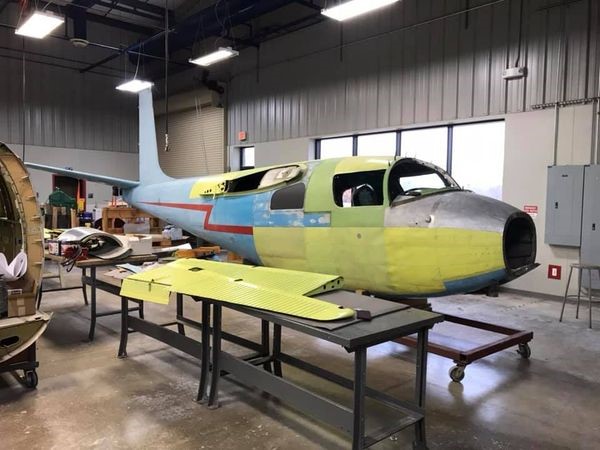
From 1974 to 2006 the airframe sat on a pole at the state fairgrounds. It subsequently went to a technical school, where Tom Ray and Kenny Payton, engineers who worked at the Rockwell/Gulfstream factory, knew the history of the airplane and used their sheet metal classes to help restore it.
Between those efforts, and now with the support of Dave Amis and others, the Blue Goose has a strong future. Amis worked with the city of Bethany, which owned the airplane, to transfer the historic artifact to the Oklahoma History Center. He has gathered local businesses and Twin Commander supporters, and is soon planning to mate the wings, weld the landing gear, paint it, and eventually have it installed on a pedestal in a park immediately south of the Wiley Post airport in Oklahoma City.
The DG-1 held the distinction of being the first custom-built Unlimited Class racer to be built in the United States since the 1930s. It was intended for competition in that category as recognized by the United States Air Racing Association of the National Aeronautic Association. The prototype N10E flew on 25 July 1977, and in addition to racing, the design is adaptable for follow-on production of two-place, tandem seating models. The wings are the cantilevered midwing type with a fiberglass-reinforced plastic spar and foam-filled internally. The fuselage is a steel-tube frame covered by plywood and fiberglass reinforced. Power is supplied by fore and aft Mazda auto engines modified to produce in excess of 330 hp each. Both are fuel injected and turbocharged by custom AiResearch units and turn 68-inch three-blade propellers.
Engines: 2 x 330-hp Mazda RX-3 auto. Wing span: 19ft 7 in Length: 20ft 4in Gross weight: 2300 lb Empty weight: 1700 lb Fuel capacity: 55-90 USG. Top speed: 400 mph Cruise: 345 mph Stall: 98 mph Range: 460 mi
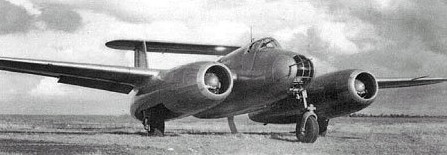
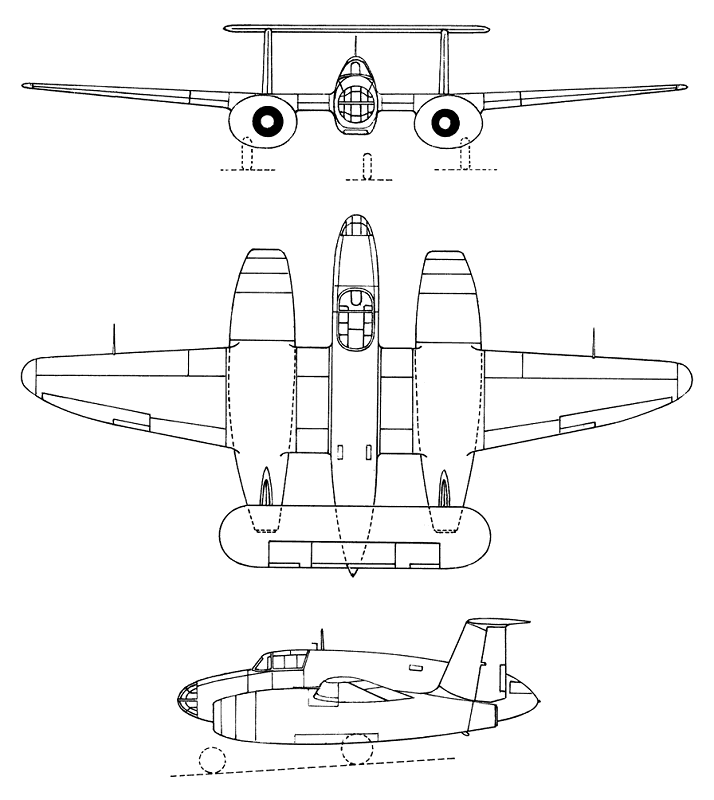
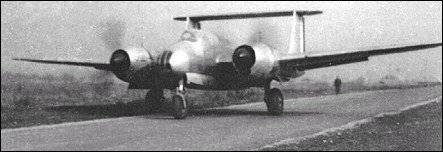
A turbojet-powered derivative of the NC.1070, the NC.1071 had underwing engine nacelles, which also carried the tailfins, connected by a tailplane on top. The first prototype flew on 12 October 1948 but the second prototype was abandoned after suffering structural damage in a flight to Mach 0.7. Aerocentre went into liquidation during 1949 and the project was cancelled in 1951.
Engine: 2 x 2350kg Hispano-Suiza (Rolls Royce) Nene 101 Take-off weight: 13750 kg / 30314 lb Empty weight: 7980 kg / 17593 lb Wingspan: 20.0 m / 66 ft 7 in Length: 10.75 m / 35 ft 3 in Height: 4.6 m / 15 ft 1 in Wing area: 50.0 sq.m / 538.20 sq ft Max. Speed: 800 km/h / 497 mph Cruise speed: 724 km/h / 450 mph Ceiling: 13000 m / 42650 ft Range: 1000 km / 621 miles Armament: 2 x 20mm cannon, 800kg of weapons
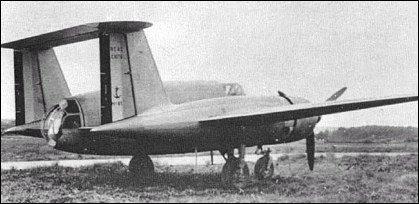
The only prototype of the NC.1070 naval bomber flew for the first time on 23 April 1947. With development of the turbojet-powered NC.1071, the NC.1070 was cancelled.
Engine: 2 x 1600hp Gnome Rhone 14R-24/25 piston engines Take-off weight: 10844 kg / 23907 lb Empty weight: 7850 kg / 17306 lb Wingspan: 20.0 m / 66 ft 7 in Length: 10.21 m / 34 ft 6 in Height: 4.15 m / 14 ft 7 in Wing area: 50.0 sq.m / 538.2 sq.ft Max. Speed: 578 km/h / 359 mph Cruise speed: 526 km/h / 327 mph Ceiling: 9950 m / 32650 ft Range: 3400 km / 2113 miles Crew: 3 Armament: 4 x 20mm cannon, 800kg of bombs
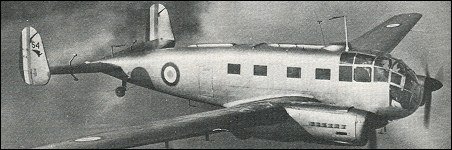
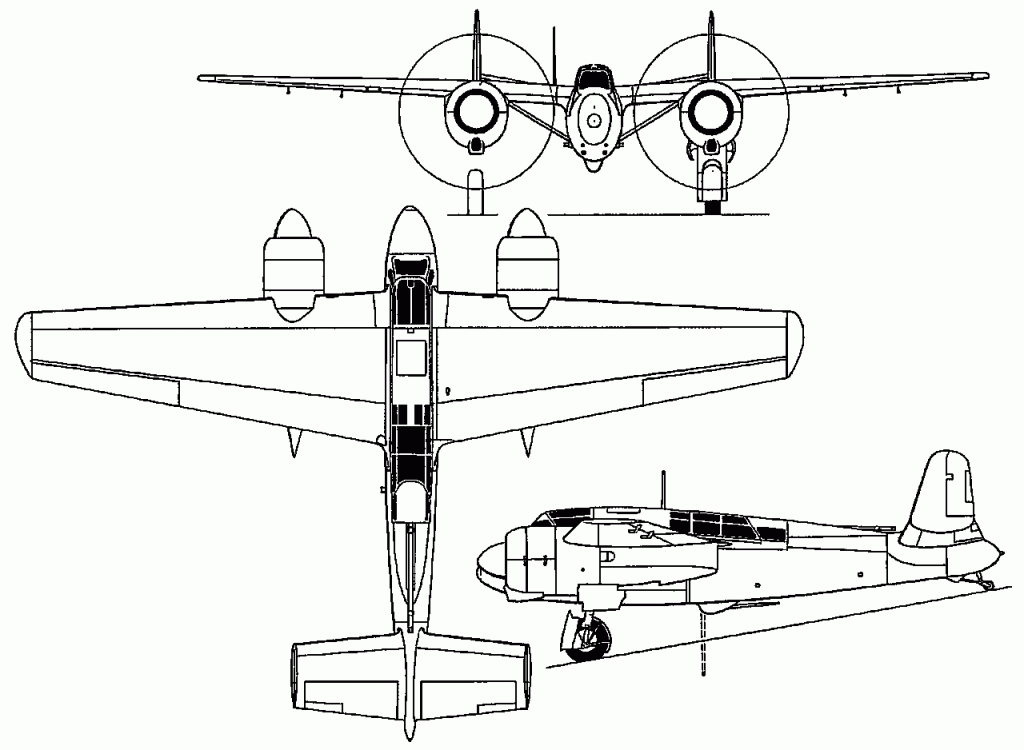
Production of the twin-engined eight-passenger Siebel Si.204A transport aircraft and Siebel Si.204D military instrument trainer for French and Luftwaffe service began at the SNCAC factory at Bourges in 1942. Post-war SNCAC put the aircraft back into production as the NC.701 (Si.204D) and NC.702 (Si.204A) powered by Renault 12S engines (440kW SNECMA S-12-SO2-3Hs, French-built Argus As.411s). Approximately 300 were built. The NC.702 version accommodated a crew of two and eight passengers (four on each side of a central aisle), with a toilet and luggage compartment aft. As a freighter, the interior equipment was removed and the cabin divided into four compartments. Among the many operators of the Martinet were Air France and CSA of Czechoslovakia.
NC.702 / Si.204A Engines: 2 x Renault 12S, 440kW Take-off weight: 5600 kg / 12346 lb Wingspan: 21.83 m / 72 ft 7 in Length: 12.81 m / 42 ft 0 in Cruise speed: 325 km/h / 202 mph Range: 810-1400 km / 503 – 870 miles Range max.fuel: 2000 km / 1243 miles
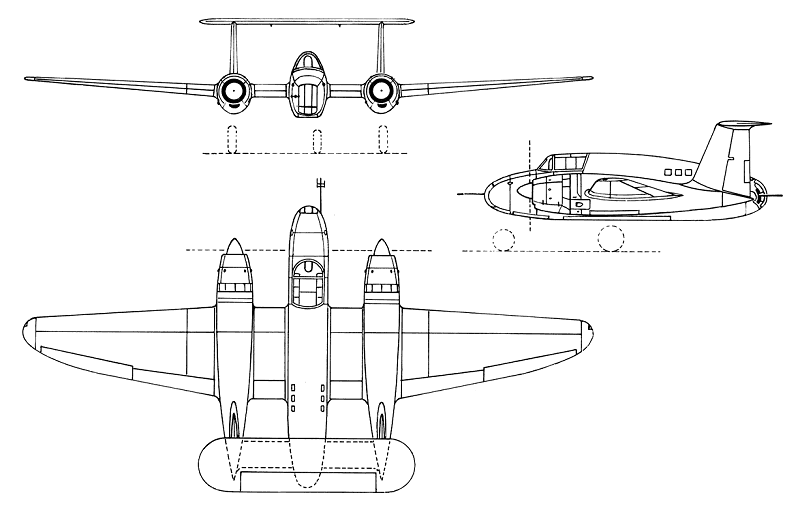
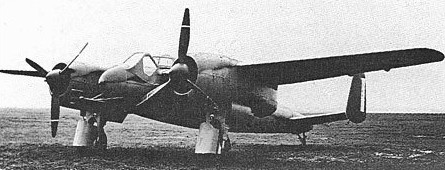
Derived from the Hanriot H.220, and after a major redesign as the H.220-2, was displayed statically as the NC 600 in July 1939 at the Salon de l’Aeronautique held in Brussels. The genuine NC 600 differed from the H.220-2 in having, a number of changes, including a revised wing. The wing of the NC 600 had three degrees of leading edge taper and perpendicular spars (span and area remaining unchanged). Although the H.220-2 had not overcome the airflow turbulence generated by the wing centre section bracing struts which produced serious tail buffet under certain conditions, the SNCA du Centre retained this feature for the NC 600, which flew for the first time on 15 May 1940. This aircraft, which introduced raised aft fuselage decking, redesigned endplate fins and rudders, and a raised tail assembly, was powered by two Gnome-Rhone 14M0/01 Mars radials each rated at 710hp for take-off. Armament was two 20-mm HS 404 cannon plus two 7.5mm MAC 1934 machine guns firing forward and a 20mm weapon on a flexible mounting firing aft, this partially retracting into a slot in the fuselage decking. The NC 600 was proposed as a two-seat fighter, and six were under construction when Germany occupied Bourges. Further development was then abandoned when the SNCAC former Hanriot factory at Bourges was chosen to build Breguet 696.
Engines: 2 x Gnome-Rhone 14M0/01 Mars radial, 710hp Take-off weight: 4000 kg / 8819 lb Empty weight: 2948 kg / 6499 lb Wingspan: 12.8 m / 42 ft 0 in Length: 8.80 m / 29 ft 10 in Height: 3.40 m / 11 ft 2 in Wing area: 21.16 sq.m / 227.76 sq.ft Max. speed: 542 km/h / 337 mph Range: 860 km / 534 miles