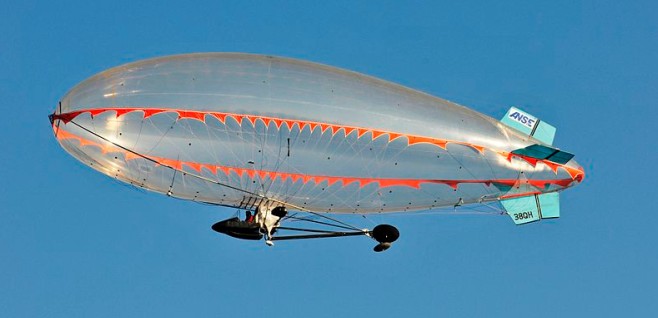
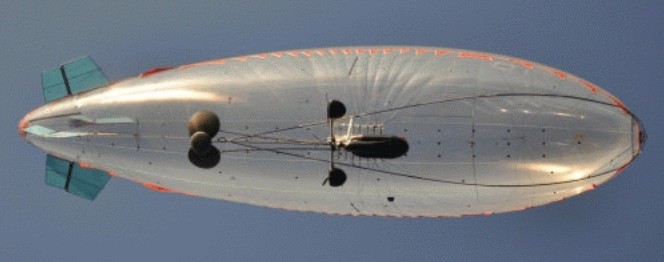
The French company Aero-Nautic Services & Engineering (A-NSE) tested in 2013 a demonstrator of an airship designed for marine surveillance missions. During the campaign carried out in Hyères, the data gathered by the airship was live-transmitted to the ground via a data link provided by Thales Communications Security.
The aircraft is raised by helium, the engine only being used to propel it, which makes it much more economical and gives it greater endurance than an aeroplane. Airships are very stable and manoeuvrable, and can hover if required. In technical terms airships have evolved considerably, with the use of new materials and the emergence of new technology making them cost-efficient and effective for civilian and military applications,” explains Baptiste Regas, Managing Director of A-NSE.
According to the young French company based in Montrouge near Paris, whose Angoulême site has produced the AN 400, the airship can complement the airborne resources currently in service. “Airships are much more economical and can be used as guards, thereby saving the potential of aeroplanes on certain missions. So, they could carry out marine surveillance up to one hundred nautical miles from the coast, extending the detection range of the network of signal stations on the coastline. In such cases, aeroplanes could be reserved for remote missions or operations requiring great speed, such as marine search and rescue. The idea is not to replace the aeroplane – it is a truly complementary resource to current capacities.”
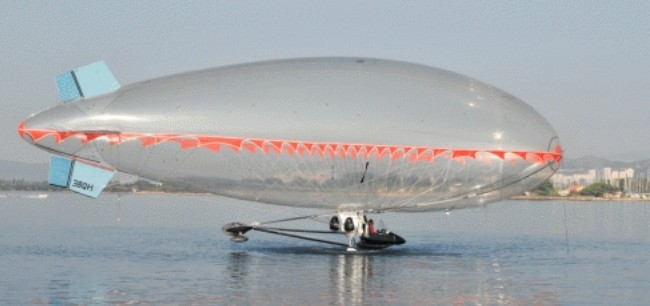
Although certain countries, such as the United States and Germany, are showing a renewed interest in airships for the purposes of marine surveillance, the models currently being used are based on a traditional implementation design. As in the good old days, aircraft are launched from land and brought back to earth by means of ropes with 15 people involved in the landing procedure. This manual technique is potentially dangerous, but also costly in terms of personnel. Which is why A-NSE has developed and patented a new design, by means of which its airship can land on the sea. During the approach over the sea or a lake, a system of ballast located at the rear is deployed on each side of the aircraft and draws in water to add weight to and stabilise the airship. Then, once the machine is on the surface, it anchors to a mooring buoy. “This tested technique substantially reduces operating costs by eliminating the need for ground personnel.”
Engine: 2 x 18 hp Envelope volume: 400 cu.m Max. diameter: 5,5 m Length: 25 m Max. weight at take-off: 400 kg Empty weight: 240 kg Payload: 160 kg Min. speed: 0 km/h Cruise speed: 65 km/h Max. speed: 85 km/h Climb rate: 5 m/s Endurance at 0 km/h : 10 h Endurance at max. speed : 6 h Action range: 390 km Max. wind at take-off: 45 km/h Altitude: 100 to 3000 ft AIS A & B (range): 210 km Radar (range): 100 km EO/IR (range): 30 km Communication system: 50 km
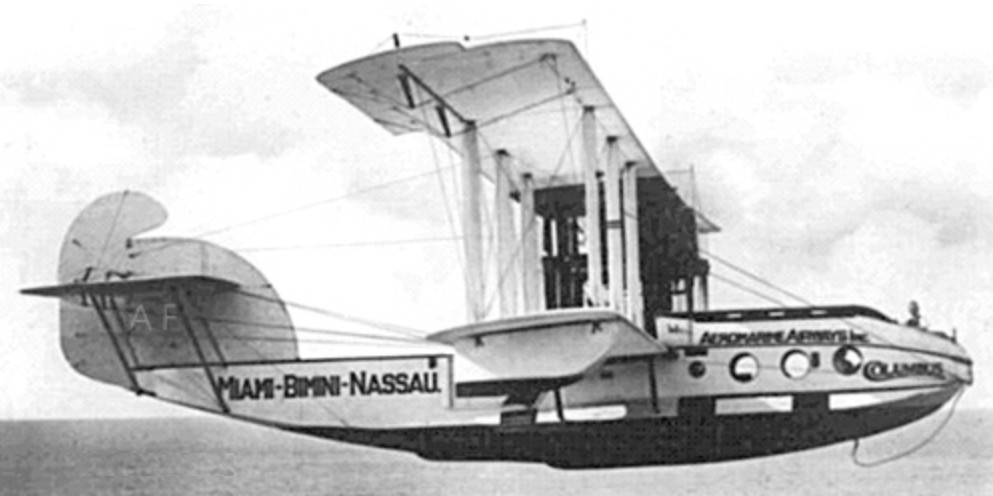
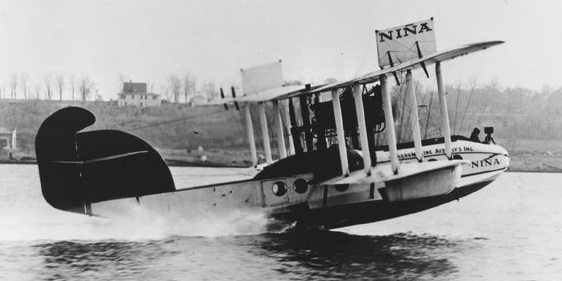
The Aeromarine 75s of 1920 were conversions of surplus USN Curtiss F-5Ls (actually ex-RAF Felixstowe F.5Ls). The conversion involved moving the two-place cockpit back to the trailing edge of the wings and installing passenger accommodations with side windows in the forward half of the hull.
Aeromarine 75 “Nina”
Completed in late 1920, the first two model 75s began operating in 1921 with Aeromarine’s subsidiary, Aeromarine East India Airways, where they commenced scheduled operations between New York City and Havana, Cuba, via Atlantic City, Beaufort, South Carolina, Miami, and Key West, carrying 12 passengers. The two-day air journey took only half the time required by train and boat. In 1922, as more model 75s came into service, the carrier opened a new route across Lake Erie between Detroit and Cleveland and extended southern services to include Nassau and Bimini islands.
In late 1923, after three year of regular flights, Aeromarine ceased operations due to financial difficulties.
Between 1920 and 1921 Aeromarine Plane and Motor Company modified for the needs for its subsidiary company Aeromarine Airways 8 F.5L coming from the surpluses of the US Navy. Arranged for the transport of 10 passengers, these sometimes baptized apparatuses Navy Cruiser they were used as of November 1920 between Key West, Florida, and Havana, Cuba. One of these seaplanes carried out as of the 1 {{er}} November 1920 the first international air postal connection on behalf of the US Post Office). Aeromarine Airways also exploited the seasonal connections Miami – Bimini – Nassau, New York City – Atlantic City, and the line Cleveland – Detroit starting from July 14th, 1922. These apparatuses were baptized Santa Maria / Wolverine, Pinta , Niña , Colombus , Balboa , Ponce of Leon , Buckeye and Mendoza. This last is famous to have flown over New York with 27 people on board in May 1922. The Polar Bear is a Aeromarine 75 especially arranged for a polar forwarding of hunting organized in spring 1923 by Inglis Moore Uppercu, sole distributer of the cars Cadillac with New York and managing director of Aeromarine.
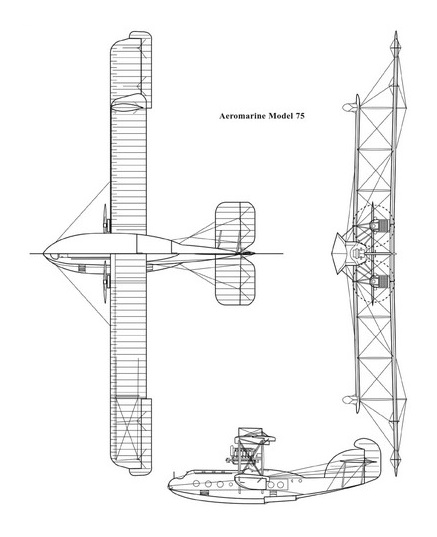
Aeromarine 75
Seven HS-2L were also converted.
Two F-5Ls (Aeromarine Model 75) with accommodation for 12 passengers used on Key West-Havana run until 1923, when air mail subsidies withdrawn.
Engines: 2 x Liberty 12A, 420 hp Props: 2 blade wooden fixed pitch Wing span – upper: 103 ft 9 in Wing area: 1397 sq.ft Length: 49 ft 4 in Empty weight: 9000 lb est Loaded weight: 13,600 lb Max speed: 82 mph Cruise: 75 mph Ceiling: 5000 ft Range: 830 mi Passengers: 12-14 civil Estimated 4-5 completed
The Limousine Flying Boat twin-engine biplane flying-boat was a five seat passenger aircraft of 1922/3. Two designs; one unbuilt and one possibly built, but not flown. Found as the Model 60-U-8-D of 1922 and 60-S-2.
Engine: 2 x Hisso or Aeromarine U-8D, 180hp Wing span: 55 ft 6 in-55 ft 9in Length: 31 ft 9 in
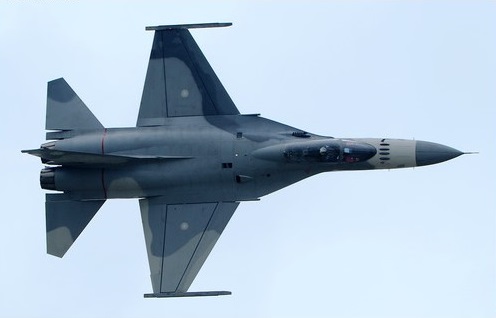
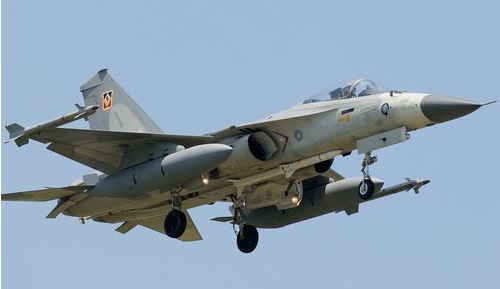
In the 1980s the United States of America tried to improve its relations with China, and part of this policy prevented the US government from delivering of the Northrop F-20 Tigershark or General Dynamics F-16 Falcon to Taiwan in 1982. Taiwan decided to develop a fighter itself to supplement and replace its fleet of F-5E Tiger IIs and F-104s and develop a BVR capability.
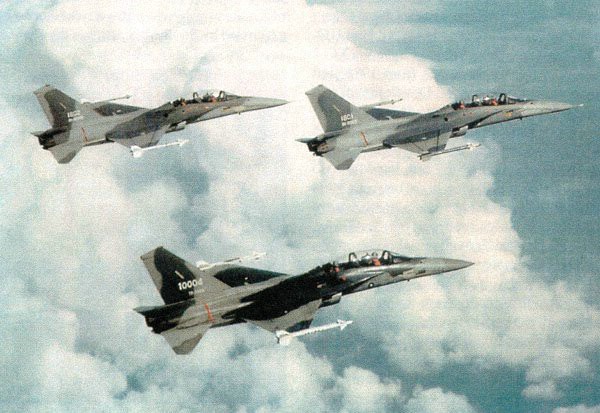
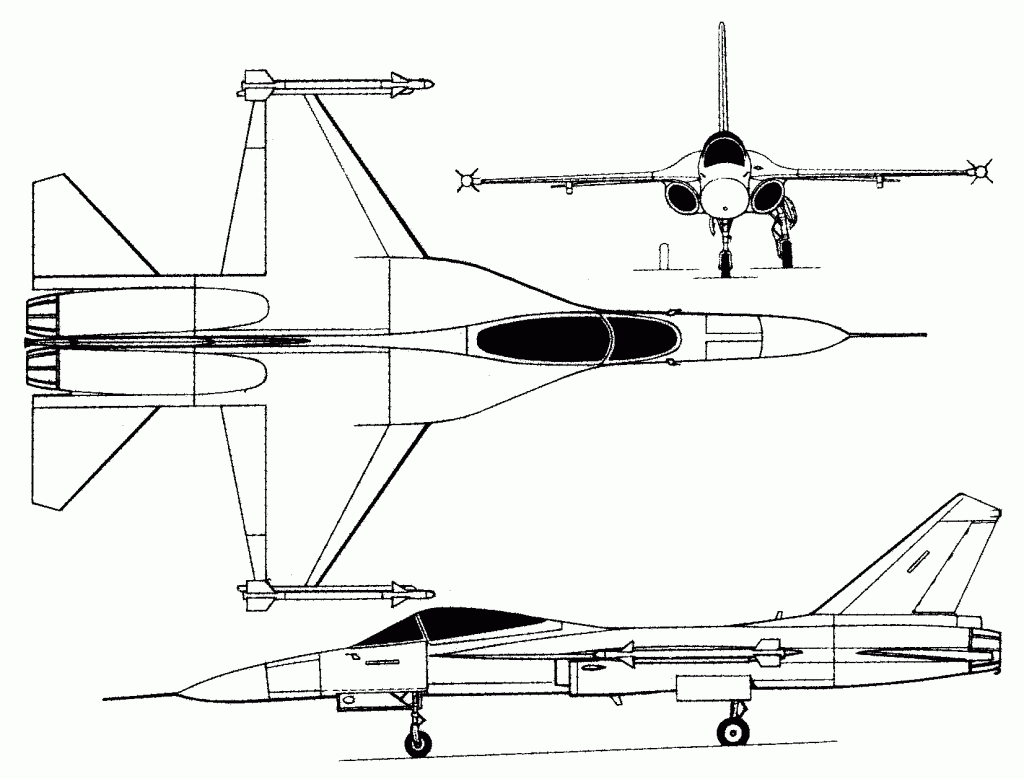
The program, Indigenous Defensive Fighter (IDF), was based on extensive cooperation between the Taiwanese aerospace industry and several US companies, including General Dynamics, Westinghouse, Honeywell and Lear. The Taiching based Aerospace Industrial Development Corporation (AIDC) was the main contractor. Formed for the development of the engine was the International Turbine Engine Corporation (ITEC), a joint venture between AIDC and Allied Signal. Commencing development in 1982 at the Aero Industry Development Center (AIDC) at Taichung, the Chiang Ching-Kuo indigenous air defence fighter was named F-CK-1 “Ching-Kuo” after a former president of Taiwan. The aircraft’s primary mission is that of air defense carrying the indigenous Tien Chien (Sky Sword) I Sidewinder-equivalent and the Beyond Visual Range (BVR) Tien Chien II. The multi-role aircraft can also be used in the ground attack role or the martitime attack role using its multi-mode Golden Dragon GD-53 radar, which is a license built version of the Westinghouse AN/APG-67(V). For the martime attack role the aircraft can be equipped with up to three indigenous Hsing Feng II AShM. Internally the Ching-Kuo carries the M61A1 Vulcan 20mm cannon.
Three single-seat F-CK-1A and one two-seat F-CK-1B prototypes were ordered and on 10 December 1988 the first IDF prototype was rolled out. On 28 May 1989 the first, a single-seater, made its first flight. In total four prototypes were built, three single-seat and one two-seat variant. The first (A-1) incurring damage on a very public landing attempt. The second A-2 prototype was lost altogether in a Mach 1 speed trials test. After having completed another 10 pre-production aircraft, full production began and deliveries started early 1994. In December 1994 the first squadron of IDF or Ching-Kuo fighters was formed, achieving initial operational capability in 1995. The Ching-Kuo fighter was powered by two Garrett TFE 1042-70 turbofans, produced in Taiwan by the International Turbo Engine Company and developed in afterburning form under the Yun Han (Cloud Man) programme, each providing 3783kg with maximum afterburning. The airframe was developed in collaboration with General Dynamics under the Ying Yang (Soaring Eagle) programme; the avionics were acquired and integrated under the leadership of Lear Siegler under the Tien Lei (Sky Thunder) programme, and the primary missile armament was evolved under the Tien Chien (Sky Sword) programme. The cockpit is equipped with a wide angle HUD, two MFD, a side stick, HOTAS and has a 30 degree declined Martin Baker Mk.12 ejection seat. Armament consisted of one 20mm M61A Vulcan rotary cannon and, for the intercept role, four Sky Sword I short-range and two Sky Sword II medium-range AAMs, the maximum external stores load being 4082kg. The first of 10 pre-production Ching-Kuos (a two-seater) flew in 1992, when production of up to a further 130 was being planned.
In 1998, in service F-CK-1s were rotated to AIDC for a limited post-production upgrade, including GEC-Marconi Combined Interrogator/Transponder (CIT), Litton Improved Radar Warning Receivers (IRWRs), and Rockwell Collins Instrument Landing System (ILS).
Production ended late 1999 at 130. Reportedly 102 single-seaters and 28 two-seaters had been produced. Taiwan had decided to purchase the F-16 when the Bush administration authorized the sale of more military technology to Taiwan. Having already acquired Mirage 2000 fighter from French to fill the gap, no more IDF aircraft were needed. Subsequently plans for more powerful engines were scrapped. The 130th aircraft was delivered on 14 January 2000 and entered service in July. Taiwan operated two wings of Ching-Kuo fighters based at Ching Chuan Kang AB (Taicheng) and Tainan AB. In 2001, AIDC started development of the upgraded F-CK-1C/D. On October 9, 2006, flight testing of the upgraded F-CK-1 IDF began when first single-seat F-CK-1C prototype (10005/958136) undertook its maiden flight from AIDC’s facility at Taichung. On March 27, 2007, the first two-seat F-CK-1D prototype (10006/96-8137) was also unveilled at a ceremony, attended by president Chen Shui-bian, who formally named the new variant Hsung Ying (Goshawk), instead of the earlier announced name of Shiang-Seng. The F-CK-1C/D upgrade features a new BAE 32-bit flight control computer, improved mission computer and head-up display, advanced fire control radar system and improved weapons capability. Structural enhancements enable it to carry four instead of two Tianchien II (Skysword II) medium-range air-to-air missiles and strengthen the undercarriage. The upgrade also includes two additional fuel tanks in the form of conformal tanks mounted dorsally on the fuselage, first seen on the F-CK-1D prototype.
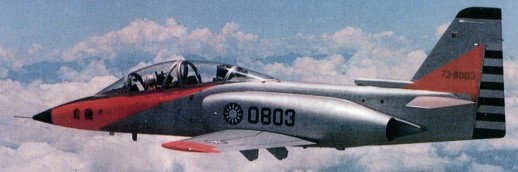
With development and design by AIDC begun in 1975, with assistance from Northrop, the first XAT-3 prototype flew on September 16, 1980. The aircraft is a twin-turbofan tandem-seat trainer with an unswept wing of supercritical section. Power is from two Garrett TFE731 engines, each giving 15.57kN thrust. For weapons training and light attack duties a semi-recessed gun pack with twin 0.5in machine-guns can be installed in a weapons bay beneath the rear cockpit, and external stores can be carried on four under-wing and one under fuselage hardpoints. Wingtip launch rails for AIM-9J Sidewinders are provided. Total external weapons avaiable load is 2,720kg (6,000lb). An A/A37U-15TTS aerial target system can be carried on the centreline pylon.
Deliveries of the AT-TC-3 to the Republic of China Air Force began in March 1984, and more than 50 were on order for use as basic and advanced trainers, replacing the Lockheed T-33 trainers. Production aircraft totaling 60 were delivered from 1984 through 1990.
AIDC AT-3A Tzu-Chiang Engine: 2 x Garrett (Honeywell) TFE731-1-2L turbofan, 3,500lbs Length: 42.32ft (12.9m) Wingspan: 34.32ft (10.46m) Height: 14.30ft (4.36m) Wing area: 235.732 sq.ft / 21.9 sq.m Empty Weight: 17,505lbs (7,940kg) Maximum Speed: 562mph (904kmh; 488kts) Cruising speed: 476 kt / 882 km/h Landing speed: 90 kt / 167 km/h Maximum Range: 1,417miles (2,280km) Rate-of-Climb: 10,100ft/min (3,078m/min) Service Ceiling: 48,064ft (14,650m) Armament: 2 x 12.7mm semi-recessed gun packs in internal weapons bay (optional), 1900kg ext Hardpoints: 6 Accommodation: 2
AT¬-TC-3 Engine: 2 x Garrett TFE731 Installed thrust: 31.1 kN Span: 10.5 m Length: 12.5 m Wing area: 21.9 sq.m Empty wt: 3855 kg MTOW: 7485 kg Warload: 2270 kg Max speed: 900 kph Initial ROC: 2440 m/min. Ceiling: 14,600 m T/O run: 458 m Ldg run: 671 m Fuel internal: 1630 lt Range: 2297 km Endurance: 3.2 hr Hardpoints: 5+2 wingtip Armament: 1 x .5 in, 2 x AAM.
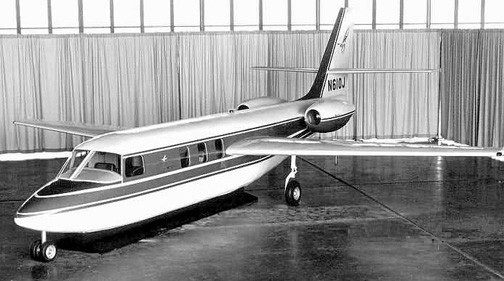
In 1960 the first production Jet Commander flew (GE CJ610 engines) and was sold to the Japanese newspaper chain Ashai. When North American and Rockwell merged in 1967, the Justice Department insisted that the new firm divest itself of Rockwell’s rights to the Jet Commander. The Government felt that common ownership of two bizjet designs the Commander and North American’s existing Sabreliner – would give North American Rockwell a dominance on the market. For a variety of reasons (the Sabreliner’s origin as a military project was mentioned most frequently), the Government decreed that the Commander must go. The entire project, including tooling, was bought by Israeli Aircraft Industries. The Aero Commander introduced Model 1121, was modified to become the Israel Aircraft Industries 1123 and in 1976 was offered by IAI with Garrett turbofan engines as the 1124 Westwind and its successor, the Westwind 1.
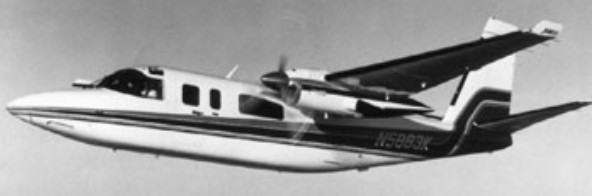
In 1980, an increase in turboprop sales led by the Jetprop 980 and Jetprop 840. The former carries up to eight persons and is powered by Garrett TPE-3331-10-501K turboprops. It is characterized by a 309 knot cruise, a 3,176-pound useful load, 5.2 psi pressurization, and enough fuel for a mission-efficient range of 2,040 run with reserves. The 840, powered by twin Garrett TPE-331-5-254K turboprops, boasts speeds up to 290 knots and a maximum range of 1,780 nm with reserves. Rockwell-developed high-technology sound control permits an easy conversation level in the cabins of both aircraft. Standard and custom cabin appointments permit the owner to outfit the interiors with hideaway tables, beverage servers, reclining chairs, telephones, and stereo systems. The numerical designations of the 840/980 denote maximum potential horsepower per side before derating to a common 700 shaft horsepower each. Both airplanes have Garrett TPE 331s: 10 on the 980 and 5 on the 840. The 980’s greater potential power translates into better climb above 10,000 feet, extra speed and a superior single engine ceiling. Fuel on the 690B was housed in 22 bladders holding 380 gallons, but the 840/980’s Garretts are fed by a more uniform system. Capacity has gone up to 420 USG, and the wings are wet outboard of the nacelles. Bladders (10 of them) remain in the inboard sections. The new layout cuts refuelling time by two thirds, but at the cost of numerous inspection panels for access to the wet bays. The void left by removal of the fuselage tank on the 840/980 has allowed the baggage volume to be almost doubled to 75 cubic feet. Absolute ceiling of the 980 is 39,900. The Commander 840 cruises at 267 knots at 31,000 ft. Maximum takeoff weight for the 290B, 840 and 980 is 10,325 pounds, but empty equipped weights for the new ones are down, by 295 pounds on the 840 (6,545 lb) and 255 on the 980 (6,585 lb). Rate of climb has changed little. On both engines, both new airplanes produce 2,840 fpm at sea level; with one dead at 5,000 feet, 900 fpm. Single engine ceiling, however, has risen on the 980 to 26,000 feet compared with 19,600 for the 690B and 20,400 for the 840.
AE-840 Engines: 2 x Garrett TPE-331-5-524K, 718 shp Props: Dowty Rotol 3-blade, 106-in Seats: 7/9 Length: 43 ft Height: 15 ft Wingspan: 52.1 ft Wing area: 279 sq.ft Wing aspect ratio: 9.8 Maximum ramp weight: 10,375 lbs Maximum takeoff weight: 10,375 lbs Standard empty weight: 6635 lbs Maximum useful load: 3740 lbs Zero-fuel weight: 8463 lbs Maximum landing weight: 9675 lbs Wing loading: 37 lbs/sq.ft Power loading: 7.2 lbs/hp Maximum usable fuel: 2848 lbs / 420 USG Rate of climb sea level: 2,840 fpm Certificated ceiling: 31,000 ft Max pressurisation differential: 5.2 psi 8000 ft cabin alt @: 23,900 ft Maximum single-engine rate of climb: 1003 fpm @ 115 kts SE ROC 5,000 ft: 900 fpm Single-engine climb gradient: 523 ft/nm Single-engine ceiling: 21,050 ft Maximum speed: 290 kts Normal cruise @ 31,000ft: 269 kts Fuel flow @ normal cruise: 378 pph Endurance at normal cruise: 7 hrs Max range with res: 1,780 nm Stalling speed clean: 77 kts Stalling speed gear/flaps down: 75 kts Turbulent-air penetration speed: 180 kts Baggage volume: 75 cubic feet Takeoff distance (50ft): 1,830 ft Landing distance (50ft): 2,050ft
AE-980 Engines: 2 x Garrett TPE-331-10-501K, 733 shp Props: Dowty Rotol 3-blade, 106-in Seats: 7/9 Length: 43 ft Height: 15 ft Wingspan: 52.1 ft Wing area: 279 sq.ft Wing aspect ratio: 9.8 Maximum ramp weight: 10,375 lbs Maximum takeoff weight: 10,325 lbs Standard empty weight: 6733 lbs Maximum useful load: 3642 lbs Zero-fuel weight: 8463 lbs Maximum landing weight: 9675 lbs Wing loading: 37 lbs/sq.ft Power loading: 7 lbs/hp Maximum usable fuel: 3176 lbs / 420 USG Best rate of climb: 2777fpm Certificated ceiling: 31,000 ft Absolute ceiling: 39,900 ft Max pressurisation differential: 5.2 psi 8000 ft cabin alt @: 23,900 ft Maximum single-engine rate of climb: 982 fpm @ 115 kts Single-engine climb gradient: 512 ft/nm Single-engine ceiling: 24,850 ft Maximum speed: 309 kts Normal cruise @ 31,000ft: 295 kts Fuel flow @ normal cruise: 444 pph Endurance at normal cruise: 6.6 hrs Stalling speed clean: 77 kts Stalling speed gear/flaps down: 75 kts Turbulent-air penetration speed: 180 kts Takeoff distance (50ft): 1,830 ft Landing distance (50ft): 2,150 ft Baggage volume: 75 cu.ft
Commander 980 Engines: 2 x Garrett TPE 331 10, 980 shp Props: Dowty Rotol 3 blade, 106 in. dia TBO: 3, 000 hrs Length: 43 ft Height: 15 ft Wingspan: 52 ft Wing area: 280 sq. ft Max ramp wt: 10,375 lbs Max takeoff wt: 10,325 lb Std empty wt: 6,298 lb Max useful load: 4,027 lb Max landing wt: 9,675 lb Wing loading: 36.96 lb/sq.ft Power loading: 7.22 lb/hp Max usable fuel: 420 USG/2,814 lb Max rate of climb, sea level: 2,840 fpm Max rate of climb, 8,000 ft: 2,710 fpm Max operating altitude: 31,000 ft Single engine rate of climb, sea level: 1,010 fpm Single engine climb gradient, sea level: 578 ft/nm Single engine service ceiling: 26,000 ft Max speed: 315 kts Cruise, max cruise power at 31,000 ft: 300 kts Fuel flow at max cruise power: 492 pph Endurance at max cruise power, no res: 5.7 hrs Stalling speed, clean: 77 kts Stalling speed, flaps down: 75 kts Turbulent air penetration speed: 184 kt
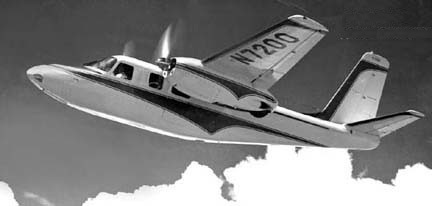
In 1958 the first pressurised Aero Commander was produced as the 720 Alti-Cruiser. An improved 680-E as the world’s first certificated, pressurized, non-airline business plane.
With extended wing, refrigerated air conditioning, Lear autopilot, they sold for $183,750.
With a pressurisation differential of only 2.3 psi and a loss of 300 lbs of payload compared to the non-pressurised version, the 680E, the 720 model was a flop in the marketplace with only thirteen sold. Production of the 720 ceased in 1960.
Design changes within the 1000 enabled greater interior space without changing the exterior fuselage dimensions. Cabin length was increased 2.9 feet and the cabin floor lowered nearly four inches to give a cabin height of 4.8 feet. A heavier structure was required all round to take the higher differential and the bottom exterior fuselage skins, replacing the floor of the former pressure vessel, were strengthened. Two aspects highlighted by the changes are the requirement to keep the rails extending the passenger steps clean and the now curved rear pressure bulkhead. The cleanliness of the rails prevents any damage to the seals and resultant loss of cabin pressure. In the 1000 the rear pressure bulkhead is curved, with the rearmost point being almost 3 feet further aft; the additional area accommodating the flushing toilet, small (100 lb maximum) baggage area and refreshment centre.
695A / 1000 Engines: 2 x AiResearch TPE 331-10-501K, 820 SHP. MTOW: 11,200 lb Press diff: 6.7 psi. Max SL alt: 15,900 ft
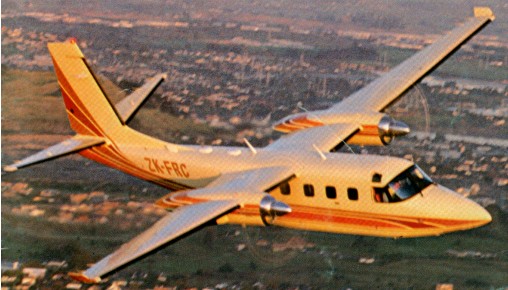
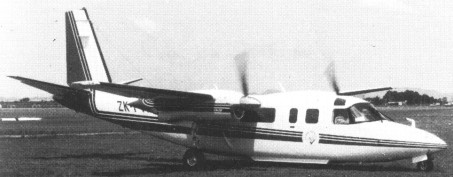
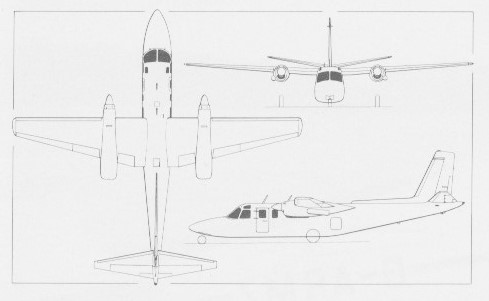
The Turbo Commander first appeared in 1965 as a pressurized version of the Grand Commander. Power was supplied by twin 605-shp AiResearch turboprop engines, each driving a three-blade constant-speed reversible-pitch propeller. This model became known as the Turbo Hawk and was built until 1971 when it was replaced by the Turbo Commander 681B, another pressurized version similar to the Shrike Commander, with 717-shp powerplants. The 690 Turbo Commander first flew on 3 March 1969. The North American Rock¬well Turbo Commander 690 was certificated at a gross weight of 10,250lb/4,650kg, in 1972, a payload improvement of 340lb, 155kg. Announcing the increase, the manufacturer stated that the 690, fully equipped, can carry seven people and full fuel tanks giving a range of 1,790 statute miles.
Turbo Commander 681B
In 1964 Aero Commander offered to fit oversize panoramic cabin windows to their Grand Commander at an extra cost of $6000.
The Turbo Commander cabin can be pressurized to 5.2 psi and the operational ceiling is 31,000 feet. Interior temperature is controlled by a high-volume climate system, and heated windshields provide maximum visibility in all weather conditions. The Turbo Commander is also certified for flight into known-icing conditions, and all deicing equipment is standard. While the 690A is just minutes slower that most business jets on a 900- to 1,000-mile business trip, fuel consumption is about 50% less.
The combination of reversible props, tough landing gear, high-wing, and 14-inch prop clearance are custom-tailored for short, rough landing strips. Engines that are flat-rated from 840 shp, to a nominal 700 shp help the 690A climb directly to the best cruise altitude without lengthy step climbing.
Aero Commander 681B N9004N
The 690B was offered in the Executive I and Executive II models. Many features that are usually considered optional are standard equipment in the Executive I, including avionics and cabin accommodations. The Executive II was for owners who wanted to select their own avionics and interior appointments.
After hit¬ting a high of 50 airplanes in 1974, produc¬tion waned, and production was reduced by 1978. Rockwell offered the Shrike in an Esquire version. It was a deluxe model that fea¬tured opulent interiors. The only options in an Esquire II are Rajay turbocharging and air conditioning. Complete deicing, a super plush interior, prop synchro¬nizer, everything from the radar in the nose to the DeVore Tel Tail lighting of the vertical fin is standard equipment. Price, 1978: $329,500.
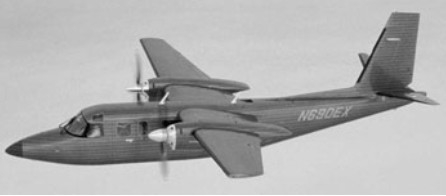
690EX
Turbo Hawk Engine: 2 x AiResearch turboprop 605-shp Gross weight: 9,400 lb Prop: 3-blade constant-speed reversible-pitch Empty weight: 5,783 lb Fuel capacity: 286-337 USG Top speed: 290 mph Cruise speed: 280 mph Stall speed: 94 mph Initial climb rate: 2,025 fpm Ceiling: 25,000 ft Range: 1,094 sm Takeoff dist (50ft): 1,975 ft Landing dist (50ft): 1,200 ft Seats: 8-10
681B Engines: 2 x AiResearch TPE 331-43BL 605-shp Wingspan: 44 ft 0.75 in / 13.43 m Length: 42 ft 11.74 in / 13.10 m Empty weight: 5,647 lb / 2561 kg MTOW: 9,400 lb / 4265 kg Fuel capacity: 286-337USG Top speed: 290 mph Max cruise speed: 278 mph / 241 kt / 447 kph Stall speed: 94 mph Initial climb rate: 2,007 fpm / 612 m/min Service ceiling: 25,600 ft 7800 m Range std fuel 21,000ft/6400m 221kt/254mph/409kph: 1,062 sm / 922 nm / 1709 km Range max fuel 21,000ft/6400m 221kt/254mph/409kph: 1,315 sm / 1141 nm / 2116 km Takeoff dist (50′): 2,016 ft Landing distance (50′): 1,200 ft Seats: 8-9 Baggage capacity: 500 lb / 227 kg
690A Engines: 2 x Garrett, 700shp TBO: 3000hr Max cruise: 285mph Econ cruise: 250mph Stall: 77mph Fuel cap: 2573lb Service ceiling: 33,000ft SE service ceiling: 19,700ft ROC: 2849fpm SE ROC: 893fpm Min field length: 1666ft Payload with full fuel: 1252lb Max range: 1767sm Pressurisation diff: 5.2psi High speed range: 1234sm Max payload: 1573lb Range max payload: 748sm Seats: 9. Gross wt: 10,300lb Equipped empty wt: 6475lb Useful load: 3285lb
690B Engines: 2 x Garrett/AiResearch TPE 331 5 251K, 700 shp. TBO: 3,000 hrs Props: constant speed, three blade, reversible. Length: 44 ft. 4 in Height: 14 ft 11 in Wingspan: 46 ft 8 in Wing area: 266 sq ft Wing loading: 38.82 lb/sq.ft Power loading: 7.37 lb/shp Empty wt: 6,840 lb Max TO weight: 10,250 lb Useful load: 3,535 lb Payload with full fuel: 962 lb Max ramp wt: 10,375 lb Usable fuel cap: 384 USG/2,573 lb Max landing wt: 9,675 lb Max rate of climb: 2,821 fpm. SE ROC: 878 fpm. Operational ceiling: 31,000 ft SE service ceiling: 19,600 ft Stalling speed, clean: 82 kts SE climb gradient 115 kts (Vy): 460 fpm Max cruise at 18,000 ft: 286 kts Duration at max cruise: 4.37 hrs Stalling speed, full flaps: 77 kt Long range cruise 31,000 ft: 250 kts. Top speed: 30 mph Duration at long range cruise: 6.55 hrs. Pressurization differential: 5.2 psi 10,000 ft. cabin at: 27,000 ft Seats: 7-10 Takeoff distance (50ft): 1,666 ft Landing distance (50ft): 2,084 ft
Shrike Engine: 2 x Lycoming IO-540-E1B5, 290 hp. Seats: 7 Wing loading: 26.47 lb/sq.ft Pwr loading: 11.63 lb/hp Gross wt: 6750 lb Empty wt: 6735 lb Equipped useful load: 1769 lb Payload max fuel: 854 lb Range max fuel/cruise: 671nm/3.8hr Ceiling: 19,400 ft Range max fuel /range: 813nm/5.1hr 55% cruise: 161 kt Vmc: 65 kt Stall: 59-68 kt 1.3 Vso: 77 kt ROC: 1340 fpm SE ROC: 266 fpm @ 94 kt SE ceiling: 6,500 ft Min field length: 1915 ft Fuel cap: 915 lb
Esquire II Engines: 2 x Lycoming IO 540 E1B5, 290 hp Propeller: three blade, constant speed, 80 in. dia. TBO: 1,400 hrs Length: 36 ft. 10 in Height: 14 ft. 6 in Wingspan: 49 ft. 6 in Wing area: 255 sq.ft Wing loading: 26.47 lb/sq.ft Power loading: 11.63 lb/hp Seats: 6 Empty weight: 5,136 lb Useful load: 1,614 lb Payload with full fuel: 628 lb Gross weight: 6,750 lb Usable fuel capacity: 156 USG/936 lb Maximum speed: 187 kts Service ceiling: 19,400 ft Maximum rate of climb: 1,340 fpm Single engine ROC: 266 fpm SE service ceiling: 6,500 ft Duration at max cruise: 4.8 hrs Stalling speed, clean: 68 kt Stalling speed, full flaps: 59 kt SE climb gradient at 93 knots (Vy): 171 ft/nm. Max cruise, 75% power at 9,000 ft: 176 kts
690 Turbo Commander Engines: 2 x 700hp TPE-331-5-251K