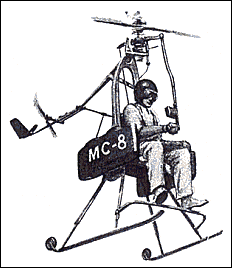
Aerospace General Corp announced their Mini Copter with an optional landing skid. Two small rocket motors powered the Mini Copter, converting hydrogen peroxide fuel into superheated steam which was released through rotor tip nozzles, providing equivalent to a 90 hp engine. Fuel was carried in two tanks each side of the pilot. The entire machine fitted into a cylindrical container no larger than a jet fighter’s droptank. The Mini-Copter was first flown in 1973.
The Mini-Copter was intended originally for air-dropping to a pilot who had been forced down behind enemy lines or in terrain unsuited to conventional rescue. It was evaluated by the US Army in an Individual Tactical Air Vehicle (ITAV) role in three configurations:
1: is the basic version with no landing gear and the fuel tanks and control/rotor unit strapped to the pilot;
2: consists of a welded steel tube structure carrying the control/ rotor unit and fuel tanks, and providing a seat for the pilot;
3: is generally similar to version 2 but has the addition of a 67kW McCulloch flat-four engine. This model takes off as a helicopter using its two 19kg Aerospace General rocket motors (one on the tip of each main rotor blade) but at 48kph forward speed the tip units are turned off and the aircraft flies as an autogyro using the McCulloch engine.
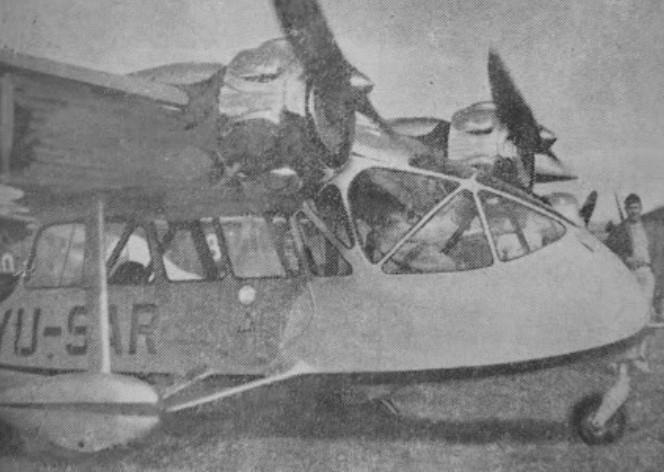
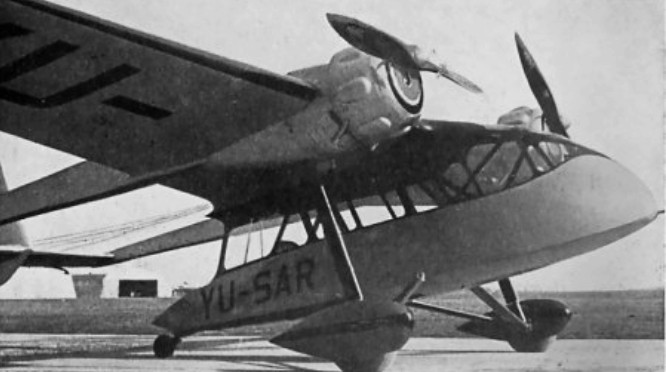
Work on the design of aircraft Aeroput MMS-3 (Serbian Cyrillic: Аеропут ММС-3) was conducted in 1934, the sole designer was aeronautical engineer Milenko Mitrović – Spirta, whose initials are on the plane as the MMS label. The number on the label represents a 3-seater passenger plane. Mr Milenko Mitrović – Spirta was then technical director of Aeroput and suggested that the Board of Directors on the basis of his project, which was in March 1934 tested in the Eiffel wind tunnel in Paris, made for Aeroput in his workshop for repairing aircraft an airplane which would be used as aviotaxi, for whom he felt a great need. The constructor then tried several configurations, including inline and stellar engines, without guards and shields, placed at different distances from the gondola hull. Finally, selected system characterized by aerodynamic perfection of Class 12, in those years achieved only by a very good gliders.
The MMS-3 was a twin-engine high wing monoplane of wooden construction with the fuselage covered with plywood, and the wings with fabric, intended primarily for avio taxiing. It was powered by two 88 hp (66 kW; 90 PS) Pobjoy Niagara III the 7-cylinder piston radial engines. These engines were characterized by low fuel consumption and very quiet operation allowing greater passenger comfort. The aircraft flew with two bifurcated wooden propeller with fixed steps. The wooden wing consisted of a double box-shaped wing-spar with a leading edge covered with birch wood. Rest of the wing was covered with plywood covered with doped fabric. The fuselage section including the pilot /passenger cabin had a rounded well streamlined nose and ended at the rear with a small conical tail section. The fuselage had inside three seats placed on a row with two doors on each side that could be opened upwards. The elevator at the tail was fitted with small so-called ‘Flettner’-flaps. The single vertical tail was centrally placed on the horizontal tail section. For that time the plane had unusual concept, instead of conventional fuselage, in the extension of the engine carrier had two tail fins (bi-fuselage). Fuel tanks were located in the wing between the two engines with fuel capacity of 265 l (70 US gal). The cabins for pilots and passengers was one unit, which like gondola is located below the airplane wings. The cabin had a large window area that provided excellent visibility to the pilot and passengers. This made him an extraordinary airplane for panorama flights. It had a fixed landing gear of a conventional type, tail wheel was located at the rear of the gondola fuselage and the main gondola wheels were mounted on one side of the gondola fuselage and on the other side to engine mount. The main wheels have aerodynamic fairings. In 1940 the MMS-3 was used to test the tricycle undercarriage with the front wheel and served as a test basis for a hypothetical bomber version called NEMI, but the project never materialized.
During 1935 the prototype was built, and flew the first time in January 1936. The first flight and test of aircraft conducted by pilot Vladimir Striževski – Striž head of Aeroput transport pilots. The plane showed good performance.
The appearance of the MMS-3, because of its outstanding aerodynamic characteristics, caused interest in France, United Kingdom, Germany and Czechoslovakia. Negotiations for the sale of the license were started, but were not concluded, and production did not take place.
In the summer of 1936 the MMS-3 received a certificate and was registered as YU-SAR. It was used on passenger routes from Belgrade to Sarajevo, Podgorica and Skoplje, also carrying mail and newspapers. During the flight Belgrade – Podujevo – Skoplje on 15 September 1936 it made a forced landing due to an engine failure and was damaged slightly. The damage was quickly repaired so that by the end of 1937 the aircraft had 65 hours of flight time, 1938 – 79 hours, 1939– 102 hours. In addition, it was used for Aeroput’s pilots training. It was also used for publicity purposes, taking the visitors of aero-meetings at the minimum prices which contributed to the popularization of aviation and air transport in Yugoslavia. The passenger seats could be easily remove and the plane turned into the cargo airplane (the first Yugoslav cargo plane).
Just before the April War in 1941 the aircraft was used by the 603rd training squadron of the Royal Yugoslav Air Force (JKRV) which was located at Grab Airport near Trebinje and it was destroyed during withdrawal from the airport. According to other sources, in March 1941, ahead of the tense of international situation around Yugoslavia, the MMS-3 was taken over by the Royal Yugoslav Air Force (JKRV) and placed him in the 603rd Auxiliary Squadron, where it was to be used as a liaison aircraft, deployment and courier needs. According to eyewitness reports, after the German invasion of Yugoslavia in April 1941, the aircraft was destroyed by the crew at the airport near the village of Divci in Valjevo region so that it would not fall into enemy hands. The constructor Milenko Mitrović – Spirta (15 Febtuary 1905 Novi Sad, Serbia – 23 August 1986 Peterborough, NH, USA) in April 1941 photographed the plane before it was destroyed.
Engines: 2 × Pobjoy Niagara III, 88 hp (66 kW; 90 PS) each Wingspan: 11.56 m (37 ft 11.1 in) Length: 7.42 m (24 ft 4.1 in) Wing area: 16 sq.m (172 sq.ft) Height: 2.25 m (7 ft 4.6 in) Empty weight: 630 kg (1,389 lb) Loaded weight: 1,030 kg (2,271 lb) Wing loading: 64.38 kg/sq.m (13.04 lb/sq.ft) Power/mass: 128 W/kg (0.078 hp/lb) Maximum speed: 235 km/h, 127 kn (146 mph) Cruise speed: 215 km/h (134 mph) Landing speed: 75 km/h Range: 600 km (373 mi) Endurance 3 pob: 3 hr Endurance 2 pob: 5 hr Service ceiling: 6,000 m (19,685 ft) SE service ceiling: 1800 m Rate of climb: 6.5 m/s (1,278 ft/min) Climb to 5000 m: 22 min Crew: 1 Capacity: 3 passengers
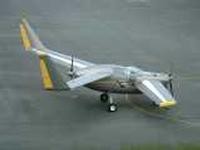
A twin-engined light aircraft with twin tail booms and an upward-lifting rear cabin door for cargo carrying. Aeroprogress in the USA offers the T-420 Strizh.
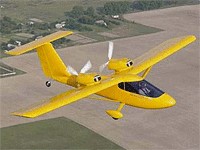
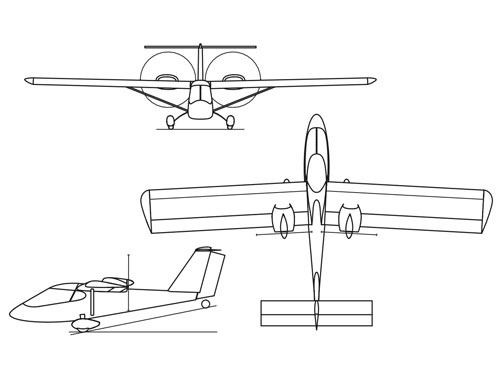
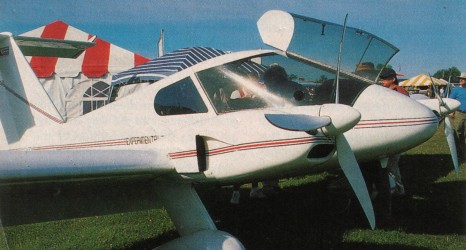
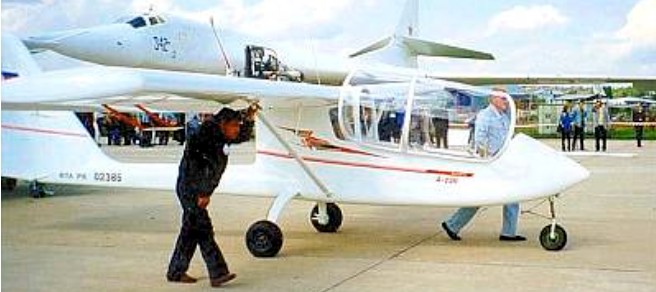
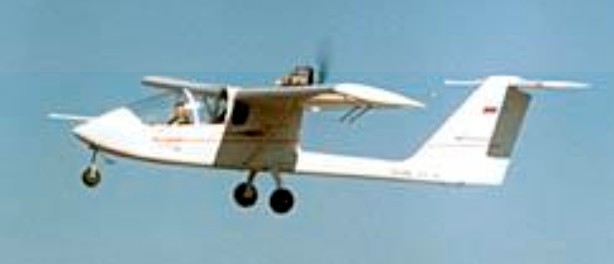
The A-36 is a light twin-engine two-seat airplane, designed to fly over hard-to-reach areas.
Equipped with two four-stroke Rotax-912S engines, the airplane has an all-metal wing, tail unit, rear fuselage, and fiberglass forward fuselage, main landing gear spring, engine cowlings and various fairings. A-36 has all-flying horizontal tail (stabilator), electrically driven trim tabs on horizontal tail and rudder, flight control system with side sticks in the cockpit. A-36 is capable of taking-off and continuing the flight using only one engine.
The airplane has side sticks, elbow rests, seats adjustable in flight, ventilation and an optional autopilot system. The A-36 has a luggage compartment designed for 100 kg (220 lb) of useful load.
The A-36 was produced on request.
Engines: 2 x Rotax-912S, 100 hp / 74 kW Wing span: 11 m / 36.1 ft Length: 7,1 m / 23.3 ft Height: 2,3 m / 7.6 ft Wing area: 15,4 sq.m / 166 sq. ft Empty weight: 450 kg / 991 lb Take-off weight: 750 kg / 1652 lb Fuel capacity: 140 lt / 38 US gal Stalling speed: 67 km/h / 42 mph Landing speed: 70 km/h / 44 mph Cruise speed: 220 km/h / 138 mph Top level speed: 260 km/h / 163 mph Rate of climb: 11 m/s / 2164 fpm Rate of climb SE: 4 m/s / 787 fpm Take-off run: 120 m / 393 ft Landing run: 150 m / 492 ft Practical ceiling: 8500 m / 27 869 ft Practical ceiling SE: 4500 m / 14 754 ft Maximum range (30 min res): 950 km / 513 nm Maximum endurance: 6 hr
The Coach / Baby Dragon is a light light multi-purpose aircraft. It can be flown from land (wheels), snow (skis) or water (floats). The prototype A-23 first flew in 1992 with two RMZ-640 engines (replaced later by single 64hp Rotax-582) had a narrow angular fuselage. It served for four years in the pilot’s club.
For series production, a more powerful Rotax-912 engine was chosen (while the original engine was still available in the economy package). Cockpit width was increased to 760mm providing sufficient comfort for pilot. Both composite fuselage and wing are now made in matrixes. The slab-type fiberglass tailplane unit was revised – raised to the top of the tailfin.
A-23M wings carry single “flaperon” each – there is no separation between aileron and landing flap.
The first flight of the A-23M took place on August 5, 1999. The A-23M prototype flew approximately 120 hours during Fall 1999. The only problem was insufficient compensation of the large flaperons.
The A-23M may be built (converted?) as a crop duster. Wheels, skis and floats are included in standard package.
Production was launched in the winter of 2000. First batch – 3 machines with different engines. Available as a kit.
On June 24, 2000 director of Aeroprakt-Samara I.A.Vakhrushev and co-pilot were killed in crash of the series A-23M. This happened on landing approach at Smyshliaevka airfield near Samara. Probable cause – tailplane flatter.
A-23 Engines: 2 x RMZ-640 Bouran Crew: 1+1
A-23 Coach Year: 1992 Engines: 2 x Rotax 582, 64hp Maximum range: 620 km Fuel capacity: 75 lt Crew: 1+1 Price 2010: 25,000US$ Unassembled kit 2010: 12,700US$
A-23M Baby Dragon Year: 1999 Crew: 1+1 Engines: 2 x Rotax 952, 100hp Length: 7.5m Height: 2.4m Wingspan: 9.8m Empty weight: 300kg Maximum Takeoff weight: 600kg Power load: 6 kg/hp Maximum sustained speed: 180km/h Cruise: 130 to 150km/h Range Maximum range: 1000 km Fuel capacity: 120 lt Payload Total: 250kg Price 2010: 35,000US$ Unassembled kit 2010: 12,700US$
A three-axis ULM, two-seater with side by side seating. With a mid-wing, twin-engine push-pull, canard formula, tricycle landing gear, and composites construction.