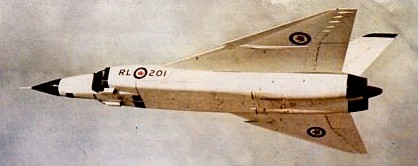
The first stages of development of a new two-seat all-weather long-range interceptor for the RCAF began in early 1953, at the time when the RCAF was busy forming its first CF-100 squadron. By April 1954 Avro’s design team was involved in the manufacture of the first five Arrow 1 prototypes.
The CF-105 featured a true delta-wing design fitted with twin turbojet engines. The aircraft would be piloted by a crew of two, made up of a pilot and his radar operator. Avro made the decision to design the CF-105 as a pure delta wing platform. The aircraft’s single-minded interceptor purpose was to travel in straight lines, finding the fastest way to get to its target in the shortest amount of time. The increase in drag was offset by the added fuel that could be stored in the wings as the CF-105 system would be expected to feed two thirsty turbojet engines, each with afterburner capability. The Orenda Iroquois – a highly advanced engine for its time – was selected as the powerplant that would propel the CF-105 Arrow for decades to come. This had a needle-nose, widening just aft of the cockpit, where intakes on each side of the fuselage fed air to two turbojet engines mounted side by side within the fuselage. The Arrow 1s were powered by two Pratt & Whitney J75s, but it was intended that the following Arrow 2s would have engines of indigenous design and manufacture, in the form of PS-13 Iroquois turbojets, developed by Avro’s Orenda engine division, each of which promised a thrust of 12700kg with maximum reheat.
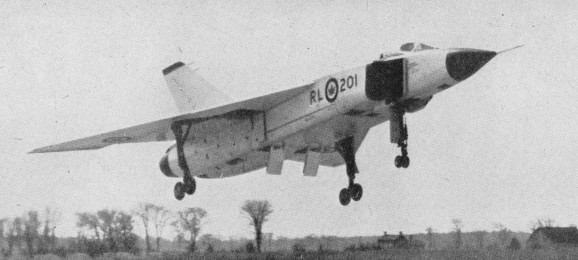
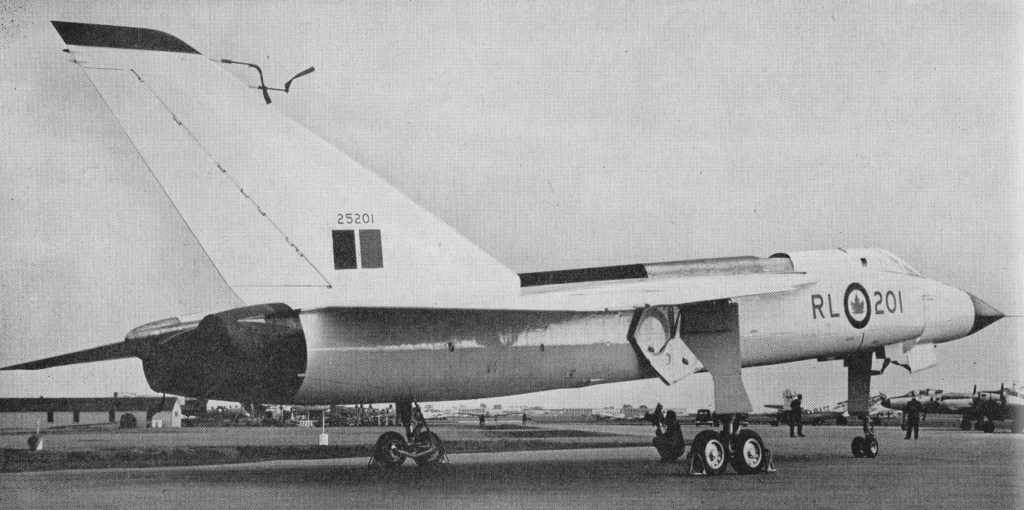
The two-man cockpit was held well-forward in the design, protruding between the two rectangular intakes to either side. The intakes ran the length of the fuselage and the delta wings extended from the installations as high shoulder-mounted assemblies. The aircraft’s layout ended with the twin engine outtakes at rear capped by a single vertical tail fin set between the two engine compartments. The main landing gear extended from the wings (another benefit of the delta wing concept) as opposed to the fuselage body with two wheels to a gear (in single file arrangement). The nose landing gear leg retracted into the fuselage just behind and below the cockpit.
The Arrow appeared in its first form as the Mark 1 with production approved by 1955. The first Arrow completed October 1957, became model RL-201 and this aircraft was fitted with lower-powered Pratt & Whitney J75 series engines while the Orenda brand series were completing development. The unveiling was intended to be a huge affair but the successful launch of the Soviet satellite Sputnik destroyed any hope of that and in many ways forecasted the future of the CF-105 program itself. Several other delays of the internal systems added to the already bumpy curtain-raising event.
The Royal Canadian Mounted Police were monitoring an illegal agent working for the Russians on the Avro Arrow project.
The first was first flown by Jan Zurakowski on 25 March 1958, this Mach 2 all weather fighter had a continental radius of action and could operate up to 70,000ft. It achieved 1,000 mph on its seventh flight. The two underfuselage speed brakes could be held open during Mach 1 flights. Four more Mark 1 soon followed. Over the months of testing, a major issue arose with the complex main landing gear arrangement. The design relied upon the two main single-file landing gear wheels to fit into the wing. This necessitated that the gear rotate before settling fully into the thin delta wing design. After addressing several of these key issues, the five CF-105’s were moved out of the A.V. Roe internal company test program and forwarded to official military trials beginning 1959.
By this time, the future of the CF-105 was already highly in doubt. 1957 saw a political turn in Canada which the new conservative-leaning party began targeting the spending projects of the former liberal party. The CF-105 was not immune to the discourse and when the Americans came calling with their NORAD (NORth American Air Defense) initiative and its thousands of available aircraft for use across Canadian air defense. It was seen fit to cancel the CF-105 Arrow project altogether on 20 February 1959 by John Diefenbaker, a Prime Minister of Canada, after expenditure of about $400 million. It is estimated that an astounding 50,000 jobs were lost with the cancellation of the program – or about 80% of Avro Canada altogether – permanently damaging the Canadian aerospace industry.
The prototype and six more airframes were sliced up, crushed and burned. Three years later Canada had to buy McDonnell F-101 Voodoo fighters from the USA.
Engines: 2 x Pratt & Whitney J75-P-3, 47,000lbs thrust. Wingspan: 15.24 m / 50 ft 0 in Length: 23.72 m / 78 ft 10 in Height: 6.48 m / 21 ft 3 in Wing area: 113.8 sq.m / 1224.93 sq ft Empty Weight: 49,042lbs (22,245kg) Maximum Take-Off Weight: 68,608lbs (31,120kg) Maximum Speed: 1,307mph (2,104kmh; 1,136kts; M 2.3) Maximum Range: 410miles (660km) Service Ceiling: 58,563ft (17,850m) Crew: 2 Armament: 1 internal weapons bay Hardpoints: 8
The Royal Canadian Air Force, needed an all weather fighter to defend the vast dominion and after talking with the American and British air staffs decided to write its own specification, issued in October 1946. It called for a fighter having a crew of two, advanced radar, all weather and night equipment, heavy gun armament, the ability, to operate from advanced air¬bases with austere ground equipment and runways only 4,000ft long. Plus a combination of speed, rate of climb and range never before attained in any combat aircraft.
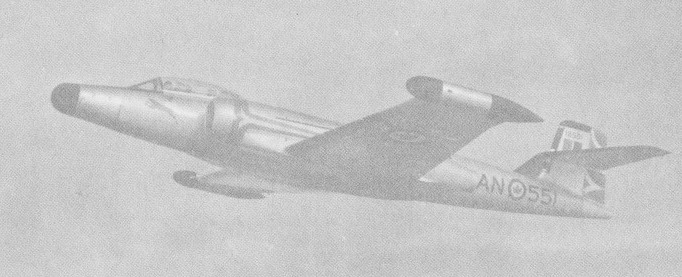
Design of the two-seat all-weather long-range fighter was initiated in October 1946, the Avro Canada team under E. H. Atkin, chief engineer, settled for a long slim fuselage, low unswept wing of quite high aspect ratio, and twin engines on the sides of the fuselage above the wing. The Avro scheme made the engines higher off the ground, but still easy to service and not difficult to change. The steerable nose gear and main legs all had twin wheels. The first of two prototype CF-100 Mk Is (No 18101, FB-D) was flown on 19 January 1950, both of these aircraft being powered by Rolls-Royce Avon RA 3 turbojets, each of 2948kg thrust. Although not designed for speeds over Mach 0.85, it was taken supersonic during a dive by test pilot Janus Żurakowski in December 1952.
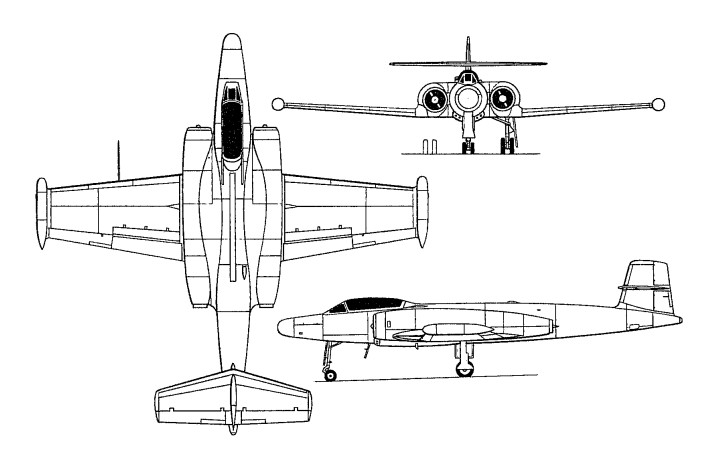
It was a low-wing cantilever monoplane of all metal construction, the tail unit incorporating a tailplane and elevators mounted mid-way up the fin. The retractable tricycle landing gear had twin wheels on each unit, and accommodation for two, in tandem, was in a pressurised cockpit. All control surfaces were fully powered. Large airbrakes were fitted above and below the wing ahead of the flaps. Pilot and navigator sat in tandem Martin Baker seats.
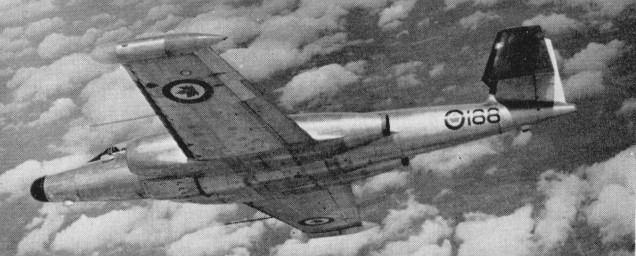
CF-100 Mk.1
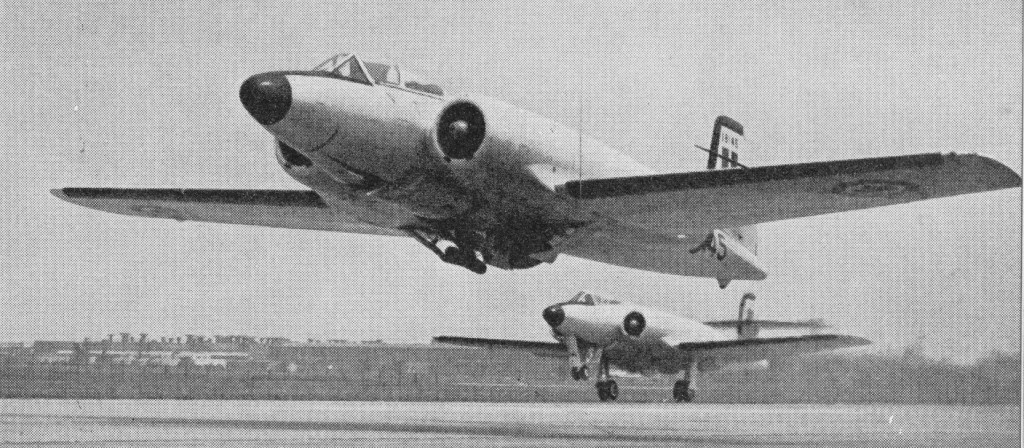
Successful testing of the prototypes led to an order for 10 unarmed pre-production CF-100 Mk 2s, these being the first examples to be powered by 2722kg / 6,000 lb thrust Orenda 2 turbojets, built by the engine division of Avro Canada. When the first of these CF-100 Mk 2s made its maiden flight, on 20 June 1951, it was the first aircraft that had been completely designed and built in Canada. One of this pre-production batch was equipped as a dual-control trainer, becoming designated CF-100 Mk 2T, and another example from this batch was the first to enter service with the RCAF, on 17 October 1951.
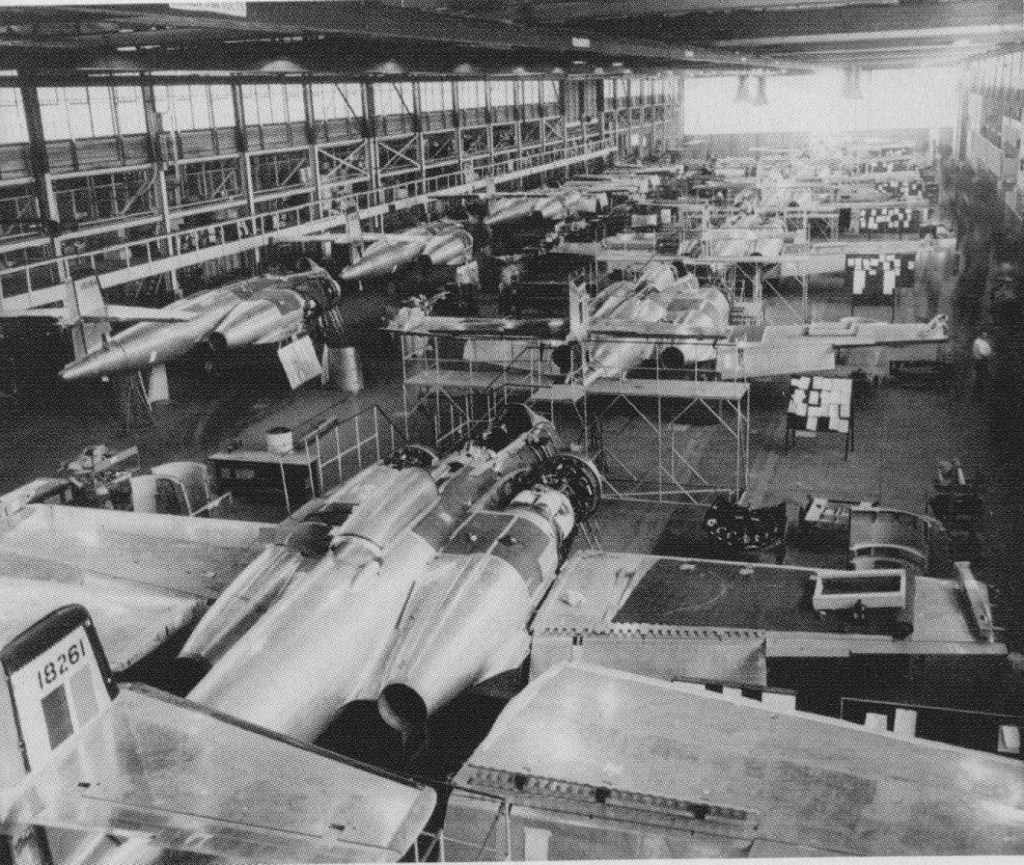
Orders followed for 124 production aircraft designated CF-100 Mk 3 in September 1950, named Canuck by the RCAF, and the first of these entered service soon after a first flight in early September 1952. They differed by having Orenda 8 turbojets of 6,000 lb thrust (of similar output to the Orenda 2s), carried eight 12.7mm Colt-Browning machine-guns in a ventral pack, which could be winched in or out of the fighter as a unit, and were equipped with nose-mounted AN/APC -33 radar. The Mk 3 entered service with No 445 Squadron at North Bay, Ontario, in 1953. A total of 70 of this version was built before production switched to the definitive CF-100 Mk 4, and once the Mk 4 became available in 1954, most of the remaining Mk 3’s were either used at the Operational Training Units or converted to dual control trainers. 50 were converted to CF-100 Mks 3CT and 3DT trainers.
CF-100 Mk.3A
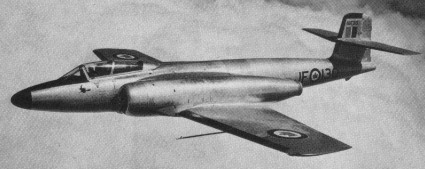
In 1951, in partnership with Hughes Aircraft, Avro Canada completely replanned the CF 100 with the new armament. The tenth CF 100 Mk 2 was chosen as the aircraft to develop the new system, making its maiden flight as the prototype Mk 4 on October 11, 1952, the same day as the first production Mk 3. The nose was longer and fatter, and instead of the APG 33 gunsight radar of the Mk 3 there was a radome for the MG 2 (E4) fire-control radar. The standard Mk 4 retained the gun pack but added wing tip pods each housing either 29 or 30 Mighty Mouse rockets, the same FFAR (folding fin aircraft rocket) of 2.75in calibre as standard on the, USAF interceptors. The Mk 4 had collision course fire control, the new interception method in which the radar and autopilot interlinked to steer the aircraft automatically to launch the rockets in a salvo to pass through a “box” of sky at the same time as the hostile aircraft. It freed interceptors from the need to attack from behind, and in a side on interception gave a much better reflective target for the radar.
The last 54 aircraft were cut from the Mk 3 order, holding production of this model to 70, while orders for the Mk 4 were repeated until they reached the total of 510. It was the RCAFs standard all weather fighter in 1953 59 and continued to serve, into the 1960s after modification to Mk 5 standard. Early Mk 4s were styled Mk.4A and fitted with the Orenda 9 rated at 6,500 lb, and visually distinguished by the free spinning two-blade windmill on the inlet bullet from which alcohol anti icing fluid could be sprayed. The Mk 4B was fitted with the Orenda II of 7,275 lb thrust, and most 4Bs were also fitted with all-rocket armament, the gunpack being replaced by a retractable box containing a further 48 FFARs launched in salvo by hydraulically extending the box briefly into the airstream. A further modification in most 4As and all 4Bs was that the large canopy was blown from a single sheet of Plexiglas.
CF-100 Mk.4B No.445 Sqn RCAF, Marville, France 1957
The first production Mk 4 flew on October 24, 1953. The Mk.4 version was redesignated CF-100 Mk 4A after the introduction of a generally similar CF-100 Mk 4B that differed primarily by having more powerful Orenda 11 turbojets, each of 3300kg thrust.
Unofficially known as the Canuck, the CF-100 Mk 4A was the first CF-l00 to be fitted with AN/APC-40 radar and was powered by the 2948-kg (6,500-lb) thrust Orenda 9 turbojet engine, which was replaced by the slightly more powerful Orenda 11 on the CF-100 Mk 4B model. Armament in both cases took the form of eight 12.7-mm (0.5-in) machine-guns backed-up by 104 70-mm (2.75-in) rockets carried in the distinctive wing-tip pods. Production of CF-100 Mks 4A and 4B totalled 134 and 144 respectively, being followed by the CF-100 Mk 5 production version.
The CF-100 Mk 5, which featured an extended wing span and updated equipment, was lighter for it lack-ed the machine-guns of earlier variants, relying solely on rockets for interception. Aimed entirely at increasing high altitude manoeuvrability, the Mk 5, the first of which flew on October 12, 1955, had just over 3.5ft added on the end of each wing, the new sections having constant chord. Tailplane area was also slightly increased, and among less basic changes was the introduction of a larger wingtip pod housing 52 FFARs, making (with the centreline pack) a maximum of 152. No Mk 5s were built new, the 100 aircraft for inventory being converted while the final 4Bs were still on the assembly line, 53 of which were supplied to Belgium, based at Beauvechain, these being the only CF-100s to be exported.
The first production example flew on 12 October 1955.
CF-100 Mk.5
In addition, a substantial number of CF-100 Mk 4s were up-dated to the later configuration for service with squadrons of the then Royal Canadian Air Force in both Canada and Europe. The CF-100’s operational career as an interceptor came to an end in the early 1960s, but a few aircraft were further modified to act as electronic aggressors in evaluating the performance of Canada’s defences. Known as CF-100 Mk 5C and CF-100 Mk 5D aircraft, these were finally retired by No. 414 Squadron in late 1981.
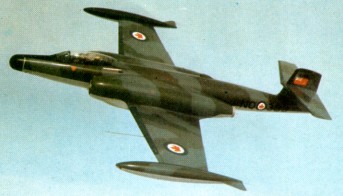
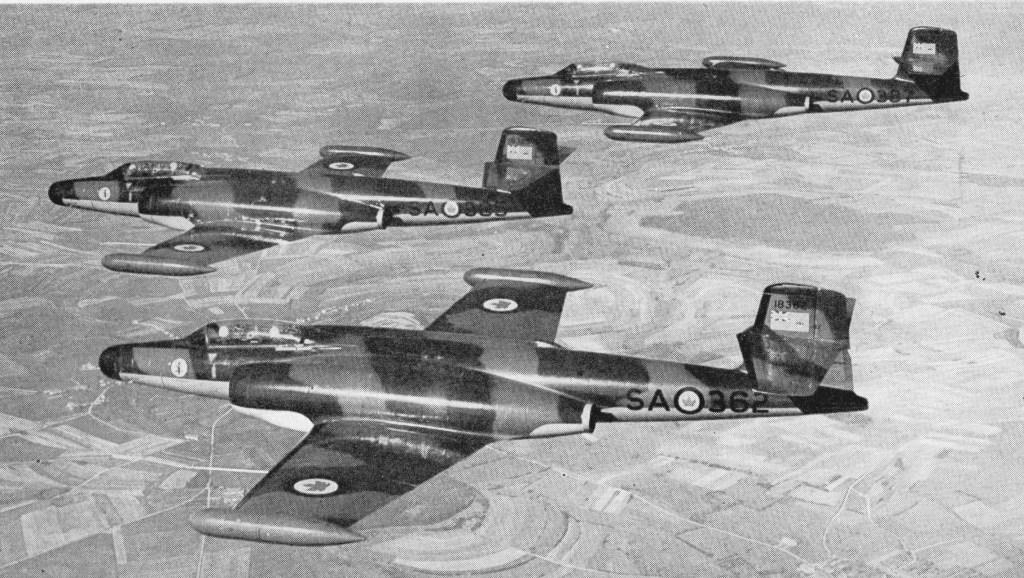
On November 4, 1956, No 445 Squadron brought its Mk 4Bs to Europe to add all¬-weather defence to AAME (Allied Air Forces Central Europe), and until 1962 four RCAF squadrons of 4Bs and 5s operated from the Gros Tenquin/ Marville, / Zweibrücken / Baden Söllin¬gen complex as the all weather com¬ponent of the 1st Air Division. So reliable were the Canadian fighters¬ ¬that the Belgian Air Force purchased 53 ex RCAF Mk 5s and took delivery from December 1957. By this time all CF 100s in front line service had green/grey camouflage, the Belgians merely changing the national markings. Though the added wing sections caused structural problems at high indicated airspeeds the Mk 5 remained an adequate all weather platform well into the 1960s.
The Avro CF-100 “Canuck” was the RCAF’s second operational jet fighter replacing the de Havilland Vampire. They patrolled the skies over North America and Western Europe from 1953-1981. The aircraft last served with No. 414 “Black Knight” squadron (electronic warfare unit) at North Bay, as a Mark 5D ECM (electronic counter measures aircraft).
A total of 692 aircraft were produced in the different variants, and the CF-100 was world’s first straight-wing combat aircraft to exceed Mach 1 (in a dive, 18 December 1952). Many innovations in radar and quick-change weapons were developed on the CF-100, and some of its design features were incorporated in the Avro Arrow.
A. V. Roe Canada CF-100 Mk.1 All-weather fighter Engines: 2 x 6,500 lb. thrust Avro Orenda 9 turbojets. Wingspan: 58 ft 5 in Length: 54 ft. 4 in Loaded weight: 34,000 lb. Max. speed: over 650 m.p.h. Max. range: 2,000 miles. Armament: 132x.2.75 in. rockets. In retractable pack under fuselage and wing-tip containers. Crew: 2
CF-100 Mk 3D dual trainer Engines: Two Orenda 8, 6000 lb thrust axial flow gas turbine Maximum speed: Mach .85 Empty weight: 23,000 lb (10 432 kg) Maximum weight: 34,000 lb (15,436 kg) Span: 57 ft 6 in (17.5 m) over tip tanks Length: 52 ft 3 in (15.9 m) Height: 14 ft 6 in (4.4 m)
CF-100 Mk 4 Engines: 2 x 2948kg thrust Orenda 9
CF-100 Mk 5 Engines: 2 x turbo-jet Orenda 11 or 14, 32.3kN, 3300-kg (7, 275-lb) Max take-off weight: 16330 kg (36,000 lb) Empty weight: 10478 kg / 23100 lb Wingspan: 18.54 m (60 ft 10 in) Length: 16.48 m / 54 ft 1 in Height: 4.74 m / 16 ft 7 in Wing area: 54.9 sq.m / 590.94 sq ft Wheel track: 10 ft 2 in Wheelbase: 18 ft 1 in Maximum speed 1046 km/h (650 mph) at 3050 m (10,000 ft) Initial climb rate 2591 m (8,500 ft) per minute Service ceiling: 16460 m / 54000 ft Range w/max.fuel: 3220 km / 2001 miles Range w/max.payload: 2072 km / 1288 miles Combat radius 1046 km (650 miles) Armament: 29 x 70mm missiles in each of wing containers Crew: 2
Beginning as an A. V. Roe project in 1958, the original Type 748 was planned as a 20-seat short/medium-range feeder airliner. When no interest was shown in the design, it was scaled up in size and the Hawker Siddeley Group, of which Avro was a component company, decided to put the aircraft into production.
The first flight of the prototype took place at Woodford on 24 June 1960. The first production aircraft, capable of seating a maximum of 48 passengers, was designated Avro 748 Series 1. It first flew on 31 August 1961, powered by two 1298kW Rolls-Royce Dart 514 turboprops.
This aircraft has a takeoff run of only 2,750 feet, for STOL performance it has a long-span wing, mounted low, with Fowler flaps driven by an electric actuator. The Rolls-Royce Dart turboprops, mounted with their jet pipes above the wings, are rated at about 2,280 hp, though some military versions have 3,200-hp Darts. Most civil versions of the HS 748 seat 40 to 58 passengers and some are equipped for freight or passenger/freight operations.
Redesignated HS.748 in 1963, later versions included the Series 2 and Series 2A (1967) civil transports; Andover CC.Mk 1 and CC.Mk 2 for the RAF, the CC.Mk 2 being two specially equipped examples for The Queen’s Flight; the Coastguarder variant was also developed, optimised for maritime patrol, flying in 1977.
Six Andovers were delivered to the RAF, two for Queen’s Flight, and four for special passenger service. Prince Phillip Duke of Edinburgh, after completing transition training, used Queen’s Andover CC Mk.2 during his tour of Mexico and Caribbean in October and November 1964.
Hawker Siddeley Andover C.1
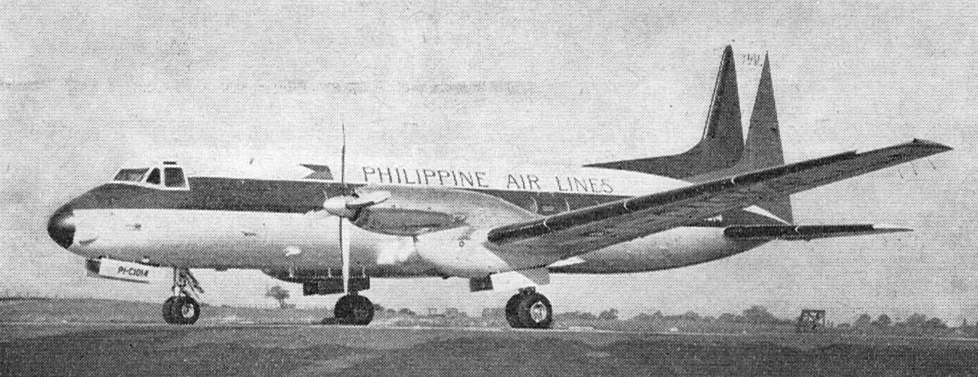
1st of six HS.748 for Philippine Air Lines, handed over at Woodford, 29 September 1967
The 748-2B incorporated a 2000 lb increase in payload, increased span, more powerful engines, and a number of cockpit refinements, flew in June 1979. A production version of the twin-turboprop transport is the Super 748. In its Military Transport form the 748 has a large rear freight door, strengthened floor, and optional military overload take-off and landing weights giving improved payload/range capabilities.
Andover NZ7626
Outwardly, the 748 is similar to the 780 Andover aircraft which differ mainly in having more powerful engines (and reverse pitch propellors), a rear loading ramp, and a kneeling undercarriage. Only 31 Andovers were built, along with six of the Andover CC.2 version of the civil 748. Although developed from the basic Hawker Siddeley 748 and retaining it’s exterior looks, with the exception of the revised tail and straight-in loading ramp, the Andover does have only 20 per cent commonality with the 748. The Andover’s “kneeling” undercarriage allows the aircraft’s fuselage to be lowered to allow easier loading and unloading. The STOL performance for a 42,000 lbs take off, the Andover requires 1,300 ft (to 50 ft), while 1,340 ft is needed for a short field landing (from 50 ft) at 40,000 lbs auw. Reverse-thrust propellors assists the short field performance. Production of all versions, including 79 assembled in India by Hindustan Aircraft from parts manufactured in both countries, totaled 380 aircraft.
HS748-2A Engines: 2 x Rolls-Royce Dart, 2280 shp. Wing span: 98 ft 6 in (15.24 m). Length: 67 ft 0 in (20.42 m). Height: 24 ft 10 in (3.51 m). Max TO wt: 44,495 lb (20182 kg). Max level speed: 278 mph (448 kph).
BAE 748-2B Engines: 2 x Rolls-Royce Dart 7 Mk.535-2, 1,835 shp. Props: Dowty-Rotol 4-blade, 144-in. Seats: 48/50. Length: 67 ft. Height: 24.8 ft. Wingspan: 102.5 ft. Wing area: 829 sq.ft. Wing aspect ratio: 12.7. Maximum ramp weight: 46,700 lbs. Maximum takeoff weight: 46,500 lbs. Standard empty weight: 26,650 lbs. Maximum useful load: 20,050 lbs. Maximum landing weight: 43,000 lbs. Wing loading: 56.1 lbs/sq.ft. Power loading: 12.7 lbs/hp. Maximum usable fuel: 11,200 lbs. Best rate of climb: 1470 fpm. Service ceiling: 25,000 ft. Max pressurisation differential: 5.5 psi. 8000 ft cabin alt @: 25,000 ft. Maximum single-engine rate of climb: 359 fpm. Single-engine ceiling: 10,700 ft. Maximum speed: 250 kts. Normal cruise @ 25,000ft: 230 kts. Fuel flow @ normal cruise: 1257 pph. Endurance at normal cruise: 8.4 hrs: Stalling speed clean: 95 kts. Stalling speed gear/flaps down: 71 kts. Turbulent-air penetration speed: 155 kts.
HS 748 series 2B Engines: 2 x Rolls-Royce Dart Mk 555, 1700kW Take-off weight: 23133 kg / 51000 lb Empty weight: 11644 kg / 25671 lb Wingspan: 31.23 m / 102 ft 6 in Length: 20.42 m / 66 ft 12 in Height: 7.57 m / 24 ft 10 in Wing area: 77.0 sq.m / 828.82 sq ft Cruise speed: 452 km/h / 281 mph Ceiling: 7620 m / 25000 ft Range w/max.payload: 1307 km / 812 miles Crew: 2-3 Passengers: 52
748 Military Engine: 2 x R-R Dart turboprop, 3400 kW. Span: 31.2 m. Length: 20.4 m. Wing area: 77 sq.m. Empty wt: 11,700 kg. MTOW: 23,100 kg. Payload: 5800 kg. Cruise speed: 455 kph. Initial ROC: 430 m / min. Ceiling: 7600 m. T/O run: 1082 m. Ldg run: 387 m. Fuel internal: 6550 lt. Range/payload: 1865 km with 5800 kg. Capacity: 60 pax.
748MF Andover C.1 Engines: 2 x RR Dart 12 Mk 201C, 3,000 shp. MTOW: 50,000 lbs. Fuel cap: 1,440 Imp gallons, + 860 gallons in an integral centre-wing tank. Range: 1,020 nm (1,800 nm with 860 Imp aux). Pax cap: 57 passengers (at 30” pitch). Cruise alt: 20,000 ft. Max speed: 302 mph @ 15,000 ft. Service ceiling: 23,800 ft. Maximum payload: 14,750 lbs. Take off distance mauw: 3810 ft. Landing ground roll max ldg wt (47,600 lbs): 2490 ft.
HS.780 C.1 Engines: 2 x Rolls-Royce Dart 12 Mk.201, 3425 shp. Max payload: 6270 kg.
Hawker Siddeley Andover C Mk 1 Engine: 2 x Rolls Royce Dart R.Da 12 Mk. 210 C, 2929 shp Length: 77.92 ft / 23.75 m Height: 30.085 ft / 9.17 m Wingspan: 98.261 ft / 29.95 m Max. speed: 262 kts / 485 km/h Service ceiling: 24016 ft / 7320 m Range: 1031 nm / 1909 km Crew: 3+44
748-2A Andover CC2 Engines: 2 x RR RDa7 Dart 152, 2280 shp. TBO: 1600 hr. Max cruise: 245 mph. Econ cruise: 243 mph. Stall: 82 mph. Fuel cap: 11628 lb. Fuel flow max cruise: 1850 pph. Fuel flow econ cruise: 1400 pph. Service ceiling: 23,000 ft. SE service ceiling: 13,000 ft. ROC: 1300 fpm. SE ROC: 750 fpm. Min balanced field length: 4050 ft. Payload with full fuel: 8790 lb. Max range: 1828 mile. High speed range: 1068 mile. Max payload: 16,773 lb. Range with max payload: 761 mile. Pressurisation differential: 5.5 lb. Seats: 47. Gross wt: 46,500 lb. Empty wt: 29,727 lb. Useful load: 16,773 lb.
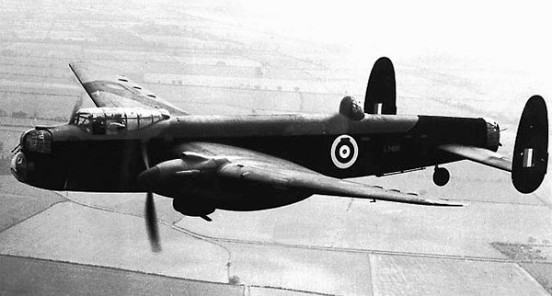
The Avro Manchester was to fulfill Air Ministry Specification P.13/36. The specification called for a twin engine heavy bomber that could sport a multi-purpose payload of bombs or torpedoes.
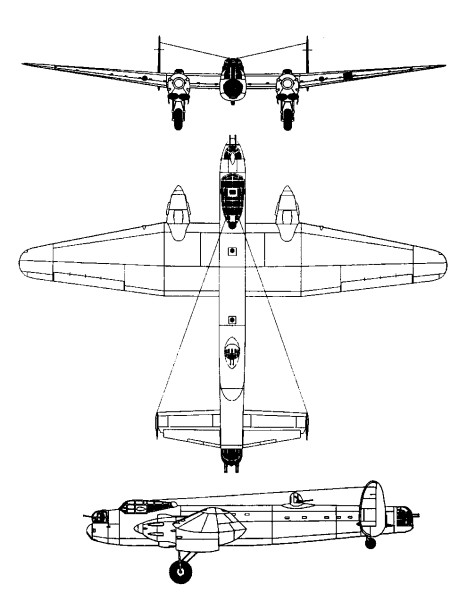
The Manchester twin engines were underslung on mid-mounted monoplane wings with dihedral outboard of the engines and main wheel undercarriage. The fuselage was of a mostly straight design from nose to tail. The flight deck maintained a good all-around vantage point and featured extensive framing. The empennage was dominated by the identifiable twin vertical fin arrangement common to other Avro designs. The initial production Manchester, however, sported a third vertical tail fin running between the base two and along the rear portion of the upper fuselage. The rear fuselage extended out beyond this assembly, which held the rear gunner’s position.
Crew accommodations amounted to seven personnel. The aircraft was defended by 8 x 7.7mm (.303 caliber) Browning machine guns in various strategic emplacements. Two were fitted to the nose turret while the tail turret mounted no fewer than four of these weapons. The remaining two were positioned in a dorsal turret mounted to the rearward portion of the fuselage. From an offensive standpoint, the Manchester could field up to 10,350lbs of internally-held bombs or torpedoes (2).
Production model specs were quite pedestrian with a top reported speed of 250 miles per hour, a range of 1,200 miles and a service ceiling of just 19,500 feet.
Power for the Manchester was derived from the twin Rolls-Royce Vulture I 24-cylicnder X-type engines of 1,500 horsepower each (initially rated as high as 1,760 horsepower each). This selection of powerplant would eventually become the Manchesters undoing as the engines proved to have a nasty tendency to catch fire when in-flight. Though the same issue greeted the Handley Page Halifax design, forcing the Halifax to become a four-engine bomber utilizing the Rolls-Royce Merlin X series of engines, Avro continued the Manchester design with the Vulture series. By the series operation run, no fewer than 30 Manchesters were lost to engine failures effectively forcing the bomber out of service.
The first Manchester prototype, model L7246, took to the skies for the first time on July 25th, 1939. This aircraft was followed by a second prototype going airborne on May 26th, 1940. The Manchester entered production in this form as the Manchester Mk I model series but was delivered in only 20 such examples. Mk I aircraft joined No. 207 Squadron in November of 1940. Its first mission came about on February 24th, 1941. Manchester Mk IA’s soon followed and were delivered in 200 total examples. These particular Manchesters differed in that they had their central tail fins removed in favor of enlarging the remaining two tail fins. In this form, the Manchester would be most oft-remembered.
At the height of its operational use, the Manchester formed at least eight bomber squadrons and was utilized by RAF Coastal Command as well. The last Manchester mission was recorded on June 25th, 1942. Production ended almost as soon as it had begun, wrapping up in November of 1941.
The Manchester II appeared as a proposed and improved model version of the Manchester series. These Manchester would have sported twin Bristol Centaurus or Napier Sabre engines to make up for the deficiencies inherent in the selected Rolls-Royce Vulture brand engines used in production Manchesters. Unfortunately for the Manchester and Avro, this model series was never produced.
A single Manchester Mk I was pulled aside to undergo a conversion to a new Manchester III standard. This new model design (BT308) featured a greater wingspan incorporating the power of four engines but still retaining the three vertical tail surfaces of the original Manchester. First flight of the recently-dubbed “Lancaster” aircraft was achieved on January 9th, 1941. A follow-up model, the DG595, was debuted shortly thereafter and featured the enlarged twin vertical tail fins of the Manchester IA. This “Manchester III” would essentially become the prototype model of the Avro Lancaster series of multi-engine heavy bombers.
In the end, only 209 Manchesters would ever be completed, with production split between Avro (177) and Metropolitan-Vickers (32).
Canada became the only other Manchester operator during its short-lived service life.
Engines: 4 x Rolls-Royce “Vulture”, 1312kW / 1736 hp Max take off weight: 25401 kg / 56000 lb Empty weight: 13350 kg / 29432 lb Wingspan: 27.46 m / 90 ft 1 in Length: 21.13 m / 69 ft 4 in Height: 5.94 m / 20 ft 6 in Wing area: 105.63 sq.m / 1136.99 sq ft Max. speed: 230 kts / 426 km/h Cruise speed: 298 km/h / 185 mph Service ceiling : 19193 ft / 5850 m Cruising altitude : 14993 ft / 4570 m Wing load: 49.2 lb/sq.ft / 240.0 kg/sq.m Range (max. weight): 2623 km / 1630 miles Crew: 7 Armament: 8 x 7.7mm machine-guns, 4700kg of bombs
Avro 557 Ava Mk II Engine: 2 x 650hp Rolls-Royce Condor III Take-off weight: 9291 kg / 20483 lb Empty weight: 6040 kg / 13316 lb Wingspan: 29.06 m / 95 ft 4 in Length: 17.75 m / 58 ft 3 in Height: 5.99 m / 20 ft 8 in Wing area: 200.95 sq.m / 2163.01 sq ft Armament: 3 x 7.7mm machine-guns, 4 x 250kg bombs Crew: 5
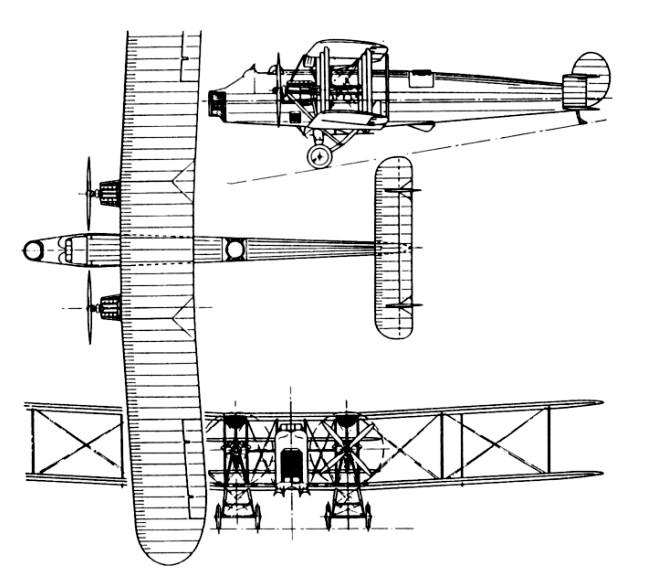
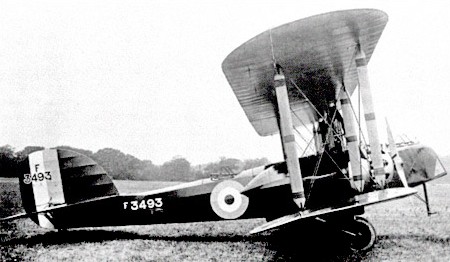
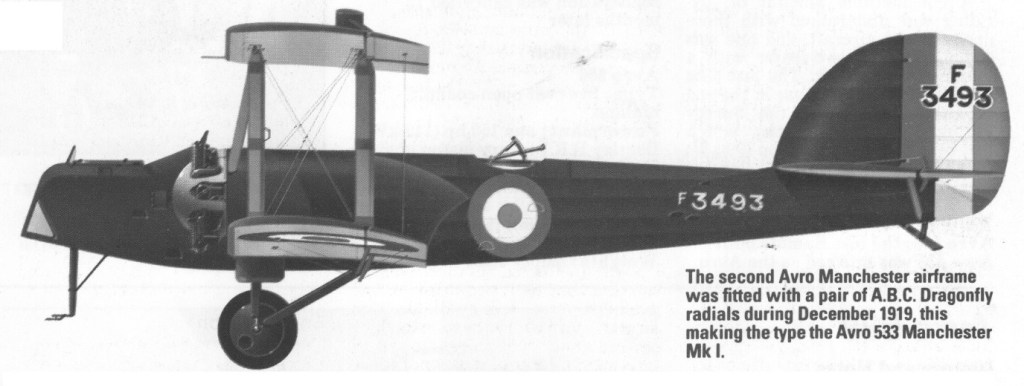
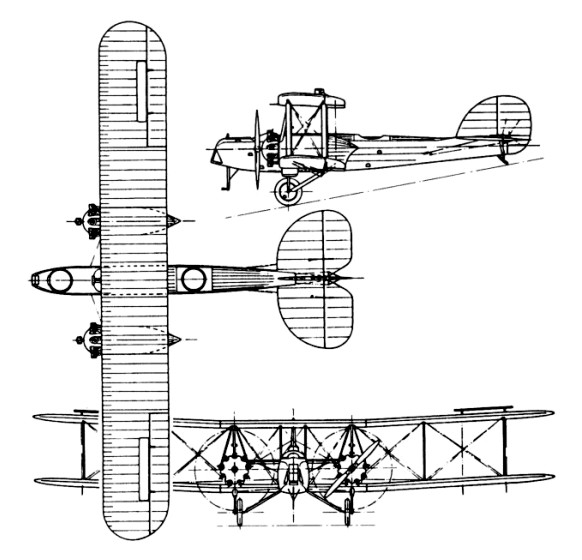
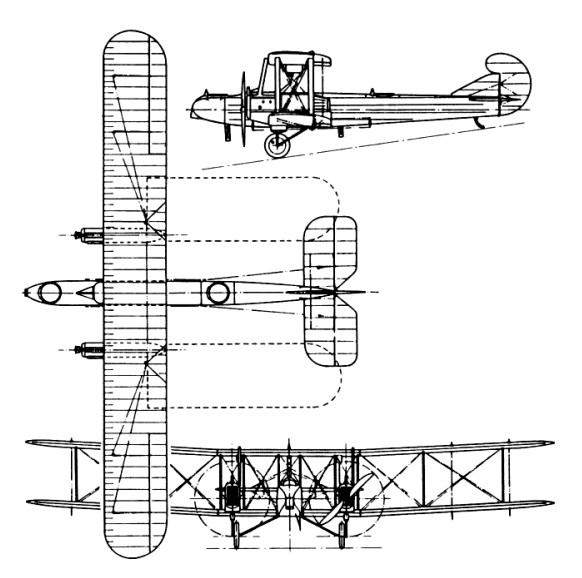
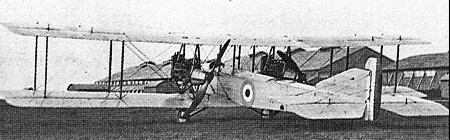
First flown in December 1918, and too late to participate in the war, the Avro 533 Manchester represented a final development of the Avro 523/529 concept. Generally similar to the Avro 529A, with the engines mounted on the lower wing, the design incorporated some refinements including a deeper fuselage, balanced ailerons, and an improved tail unit. The 533 had been designed around the A.B.C. Dragonfly radial engines. When these failed to materialise through development problems, two 300 hp / 224 kW Siddeley Puma were installed, the result being designated Avro 522 Mk.II. Thus, the Mk.II was to fly before the Dragonfly-engined Avro 533 Mk.I.
Both versions flew well in official tests but with the end of the war neither were produced.
A Mk.III was planned with 400 hp / 298 kW Liberty engines, but although the fuselage was completed, the engines were not installed.
Avro 533 Mark I Engine: 2 x 320hp ABC Dragonfly I Wingspan: 18.29 m / 60 ft 0 in Length: 11.28 m / 37 ft 0 in Height: 3.81 m / 13 ft 6 in Wing area: 75.53 sq.m / 813.00 sq ft Take-off weight: 3355 kg / 7397 lb Empty weight: 2219 kg / 4892 lb Max. speed: 209 km/h / 130 mph Climb to 10,000 ft / 3050 m: 14 min 20 sec Ceiling: 5791 m / 19000 ft Endurance: 5 hr 45 min Crew: 3 Armament: 2 x 7.7mm machine-guns, 400kg of bombs
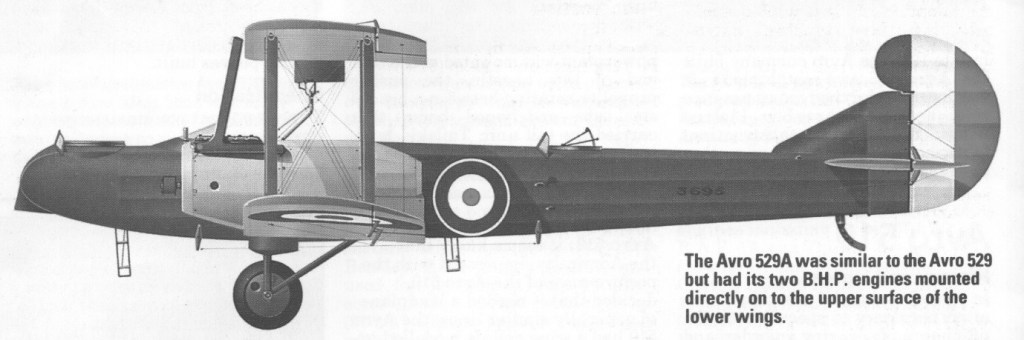
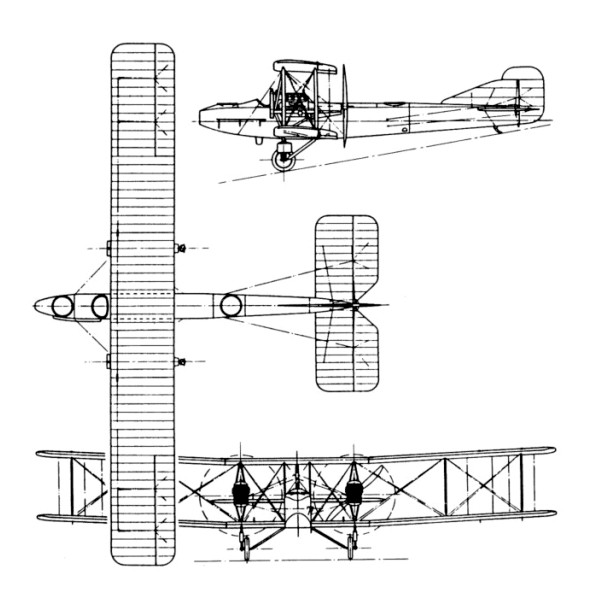
While the Admiralty had not placed an order for the Avro 523 Pike there was some interest in the Potential of the aircraft. During 1916, two prototypes were ordered for evaluation in a long-range bombing role and were in effect slightly larger version of the 523. Apart from dimensional changes, the wings were made to fold, from jus outboard of the engines, the tail unit was revised, and the powerplant of the first completed, as Avro 529, comprised two counter-rotating Rolls-Royce Falcon engines, mounted between the wings and driving tractor propellers. The second prototype, the Avro 529A, was similar except for the installation of two 230 hp / 172 kW Galloway-built B.H.P. inline engines mounted on the lower wing, and a revised fuel system. Forward-looking features of the design provided the front gunner / bomb aimer with dual controls, plus Gosport tube communication with the pilot so that he could guide him during a bombing attack. However, performance was not good enough, and only the two prototypes were built.
Avro 529 Engine: 2 x 190hp Rolls-Royce Falcon I water-cooled in-line Take-off weight: 2864 kg / 6314 lb Empty weight: 2150 kg / 4740 lb Wingspan: 19.20 m / 63 ft 0 in Length: 12.09 m / 40 ft 8 in Height: 3.96 m / 13 ft 0 in Wing area: 85.70 sq.m / 922.47 sq ft Max. speed: 153 km/h / 95 mph Ceiling: 4115 m / 13500 ft Armament: 2 x 7.7mm machine-guns Crew: 3
Avro 529A Engines: 2 x BHP inline piston, 230 hp Length: 39.67ft (12.09m) Width: 62.99ft (19.20m) Height: 12.99ft (3.96m) Empty Weight: 4,736lbs (2,148kg) Maximum Take-Off Weight: 6,310lbs (2,862kg) Maximum Speed: 95mph (153kmh; 83kts) Maximum Range: 360miles (580km) Rate-of-Climb: 715ft/min (218m/min) Service Ceiling: 13,501ft (4,115m) Armament: Standard: 1 x 7.7mm (0.303 caliber) Lewis machine gun on trainable mount in nose cockpit. 1 x 7.7mm (0.303 caliber) Lewis machine gun on trainable mount in rear dorsal cockpit. Optional: 20 x 50lb conventional drop bombs. Up to 1,000lbs of bombs. Accommodation: 3
The Pike three-seat twin-engined biplane was designed primarily to meet an Admiralty requirement for a long-range escort and anti-airship fighter. Of wooden construction with fabric skinning, the first prototype Pike had two 150hp Sunbeam eight-cylinder liquid-cooled engines mounted as pushers driving two-bladed propellers via extension shafts and was flown for the first time in May 1916. The pilot was seated just ahead of the mainplanes with gunners’ cockpits, each with a free-mounted 7.7mm Lewis, fore and aft. A second Pike, the Avro 523A, differed by having two 150hp Green six-cylinder liquid-cooled engines driving tractor propellers and a Scarff-type ring mounting for the forward Lewis gun. No production of the Pike was ordered following completion of official trials.
Avro 523 Engine: 2 x 160hp Sunbeam Nubian Take-off weight: 2751 kg / 6065 lb Empty weight: 1814 kg / 3999 lb Wingspan: 18.29 m / 60 ft 0 in Length: 11.91 m / 39 ft 1 in Height: 3.55 m / 12 ft 8 in Wing area: 75.71 sq.m / 814.93 sq ft Max. speed: 156 km/h / 97 mph
Avro 523 A Engines: 150hp Green six-cylinder liquid-cooled Wingspan: 18.29 m / 60 ft 0 in Height: 3.55 m / 12 ft 8 in Wing area: 75.71 sq.m / 814.93 sq ft
The ATR72, a stretched development of the ATR42 (the fuselage had grown by 4.5 metres to provide space for up to 74 seats), was launched in January 1986 and first flew on 27 October 1988. Significant changes from the ATR-42 (apart from the fuselage stretch) include Pratt and Whitney Canada PW 124-B turbo props with roughly 20 percent more power than the PW 120 of the ATR-42, wingspan extended by 2.48 metres (although the whole of the wing outboard of the nacelles has been simplified and improved), and greater use of composites. French certification was achieved in September 1989, by which time five aircraft were flying. The first customer delivery, to KarAir in Finland, was made exactly a year after the first flight. By May 1995,152 ATR-72’s had been firmly ordered or delivered. Construction of the ATR-42 and ATR-72 is on a common assembly line at Toulouse. The ATR72 fuselage and tail is manufactured in Italy, the wings, undercarriage and engine cowlings in France, the engines in Canada, and propellors in the USA. The ATR72-212A designation being a marketing ploy and rating commonality of Mount Cook Airline for the ATR72-500. The 212A model being certified on 14 January 1997.
ATR72 Engines: 2 x Pratt & Whitney Canada PW 124/2 turboprops , 2,400 shp (1 790 kW). Wing span: 88 ft 9 in (27,05m).
ATR72-212A Engines: 2 x Pratt & Whitney Canada PW127F, 2750 shp. Props: 6 blade Hamilton Standard/Ratier-Figeac 568F composite. Length: 27.166 m. Wing span: 88 ft 9 in (27,05m). Height: 7.65 m. MTOW: 22,500 kg (49,603 lbs). MLW: 22,350 kg (49,273 lbs). Max zero fuel wt: 20,300 kg (44,753 lbs). Max payload: 7450 kg (16,424 lbs). Seats: 66. Range: 942 nm. TO field length: 1290m (4232 ft). Ldg field length: 1067 m (3500 ft). Max cruise: 278 kts. Operating ceiling: 25,000 ft.
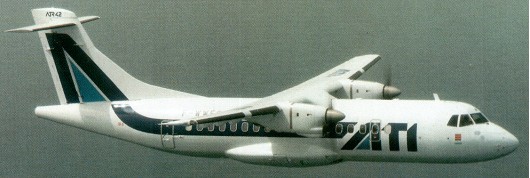
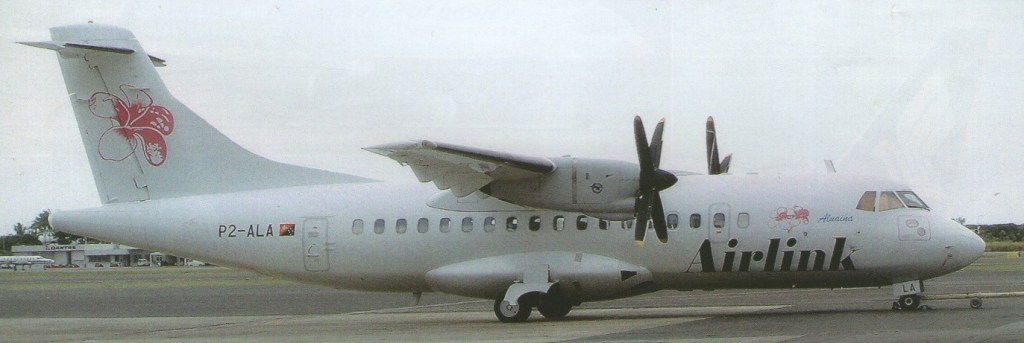
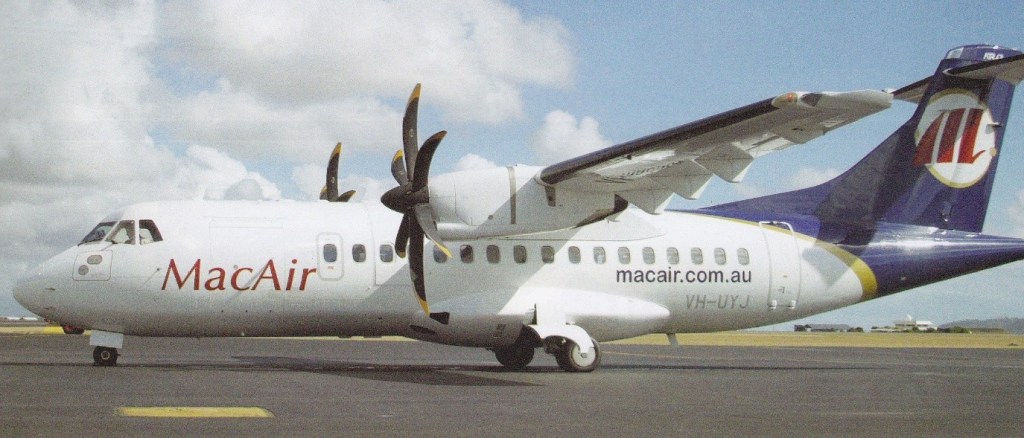
Both Aerospatiale in France, and Aeritalia in Italy, had developed proposals in the late 1970’s for twin turboprop 38/40 seat aircraft. Both companies were looking for partners to further develop the concepts and eventually, in July 1981, a joint venture consortium, ATR, was formed. The new project was designated the ATR 42, the 42 indicating the number of seats at 81 cm pitch. The initials ATR stand for Avion de Transport Regional/ Aereo daTransporto Regionale/ Regional Transport Aircraft. The type made its first flight in August 1984 and was certificated in September 1985. The launch customer was Air Littorial, a French regional opera¬tor, which began operating the type in the following December. The ATR 42 300 (the higher weight version) accommodates a maximum of 50 passengers, but a more typical layout is for 46 passengers. In addition to the generous overhead lockers, baggage compartments are provided both behind the flightdeck and in the rear fuselage. The aircraft is powered by two Pratt and Whitney Canada PW120s, flat rated at 1800shp and driving Hamilton Standard four bladed composite propellors. The ATR 42 structure makes extensive use of composites, particularly Keviar/Nomex sandwich for the wing and tail leading edges, wing and undercarriage fairings, and fuselage tail cone. Carbon/Nomex sandwich is used for the rudder, elevators, flaps, and engine nacelles, and carbon monolithic structure is used for the ailerons and outer wing panels. using experience gained with the Airbus, the flight deck is EFIS equipped. Subsequently the consortium has developed the ATR 72, a stretched version of the ATR 42 which uses the same wings and tail but uprated engines.
As at May 1995, 286 of these aircraft had been ordered or delivered. ATR42F freighter. The ATR42-500 first flew in September 1994.
1998 ATR42-500 VH-UYJ
The ATR 42-600 pre-series aircraft (F-WWLY c/n 811) completed its maiden flight on 4 March 2010 from Toulouse Blagnac Airport in southern France. The two-hour flight included tests of the Pratt & Whitney PW127M turboprops, the balance of the propellers, the new avionics, hydraulic and electrical systems.
The ATR 42-600 will undertake a 75hour flight test campaign. Many of the systems are the same as used in the ATR 72-600, which began its 150-hour flight test programme in July 2009. To March 2010 ATR had orders for five 42-600s and 54 72-600s.
ATR-42R Engine: 2 x P&W PW 120 turboprop. Installed pwr: 2680 kW. Span: 24.6 m. Length: 22.7 m. Wing area: 54.5 sq.m. Height: 7.586m. Empty wt: 9937 kg. MTOW: 15,750 kg. Payload: 4530 kg. Cruise speed: 470 kph. Initial ROC: 490 m / min. Ceiling: 7650 m. T/O run (to 15m): 660 m. Ldg run (from 15m): 560 m. Fuel internal: 5700 lt. Range/payload: 2535 km with 4000 kg. Capacity: 44 pax.