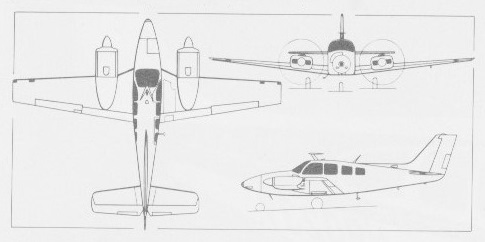
The Beech model-120 of 1962 was a twin turboprop pressurized business aircraft project with two Turbomeca Bastan engines.
2 Engines
Beechcraft 112
The Beech aircraft model 112 of 1957 was a twin turboprop business aircraft project with two Lycoming
T-53 engines.
Beechcraft 100 King Air / U-21F
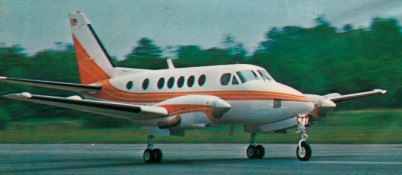
The 100 series was introduced in 1969 when initial deliveries were made in August 1969, and employed the 680-shp Pratt & Whitney turboprop. All have full-feathering, reversible propellers. It differed from the earlier King Airs in reduced wing span, a lengthened fuselage to provide accommodation for a maximum of 15 persons, increased elevator and rudder areas, twin-wheel main landing gear, and more powerful engines. The new wing was generally similar to that developed for the Model 99 Airliner. Their pressurized, three-compartment interior can be maintained at sea level atmosphere pressure to flight levels as high as 10,500 feet.
In October 1971 Beech began deliveries of the improved King Air A100, this variant incorporating detail improvements, and the first five were supplied to the US Army under the designation U-21F, 70-15908/15912. Examples have been procured by the Spanish air force, and a Universal Aircraft Com/Nav Evaluation (UNACE) configured version, for the rapid inspection and calibration of air navigation systems, has been supplied to countries that include Algeria, Belgium, Canada, Indonesia, Malaysia, Mexico, and the USA. Beech also produces specially modified camera-equipped versions of the King Air for aerial survey, and examples are in service in this role in Canada, Chile, France, Jamaica, Saudi Arabia, Thailand, and the USA.
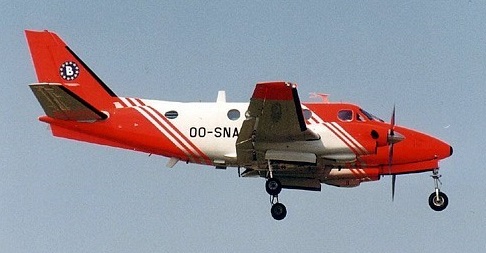
The higher capacity versions are the A100 and B100, with the latter being the first King Air to be outfitted with Garrett turboprops. In parallel with A100 production since late 1975, Beech has produced a complementary King Air B100 offering higher performance. It differs by the installation of 533kW Garrett TPE331-6-252B turboprop engines, and of equipment directly associated with the engine installation. Beech has mated two Garrett AiResearch TPE 331 6 252B 840 shp derated to 715 shp turboprop engines to the A100 airframe. Beech made the move to assure that they would have two sources of engines considering the interruption in deliveries that was caused when United Aircraft of Canada, Ltd. (now known as Pratt & Whitney of Canada) struck for 19 months in 1974 and 1975. The derated TPE 331 turboprop engines affect the pilot’s procedures and the aircraft’s performance more than the handling qualities. The B100’s powerplant thrust line was raised somewhat, to counter the longitudinally destabilizing influence of five percent more horsepower. Because the derated Garrett powerplants are ca-pable of producing 840 shp, their performance in the B100 on hot days and at altitude surpasses that of the MA 28s used on the A100. Thus, the B100 is 16 knots faster than the A100 at 10,000 feet and 27 knots faster at FL 200 (262 knots compared with 235 knots at maximum cruise power). Range for both 100s at maximum cruise power with maximum payload on board and 45 minutes’ reserve is slightly more than 1,200 nm.
Production of the King Air 100 ended in 1983.
A100
Engines: 2 x Pratt & Whitney PT6A-28 free turbine, 680 shp / 507kW.
Wingspan: 14.0 m / 45 ft 11 in
Length: 12.17 m / 39 ft 11 in
Height: 4.7 m / 15 ft 5 in
Gross Wt. 11,568 lbs.
Empty wt: 6754 lb.
Equipped useful load: 4564 lb.
Payload max fuel: 1415 lb.
Wing loading: 40.8 lb/sq.ft.
Pwr loading: 8.46 lb/hp.
Fuel capacity 470 USG/3149 lb.
Ceiling 24,850 ft.
Range max fuel/cruise: 933nm/3.7hr.
Range max fuel /range: 1319nm/6.3hr.
Max cruise: 248 kt.
Max range cruise: 211 kt.
Vmc: 85 kt. Stall: 75-89 kt.
1.3 Vso: 98 kt.
Takeoff distance (50’) 2681 ft.
Landing distance (50’) 2109 ft.
ROC: 1963 fpm.
SE ROC: 452 fpm @ 119 kt.
SE ceiling: 9,300 ft.
Certified Service Ceiling: 24,850 ft.
Seats: 8 to 15.
Pressurisation: 4.6 psi.
8000ft cabin alt: 21,000ft.
BE-B100 King Air
First built: 1976.
Engines: 2 x Garrett TPE 331-6-252B, 715 shp.
Props: Hartzell 4-blade, 90-in.
Seats: 8/15.
Length: 39.9 ft.
Height: 15.4 ft.
Wingspan: 45.9 ft.
Wing area: 280 sq.ft.
Wing aspect ratio: 7.5.
Maximum ramp weight: 11,875 lbs.
Maximum takeoff weight: 11,800 lbs.
Standard empty weight: 7082 lbs.
Maximum useful load: 4793 lbs.
Zero-fuel weight: 9600 lbs.
Maximum landing weight: 11,210 lbs.
Wing loading: 42.2 lbs/sq.ft.
Power loading: 8.3 lbs/hp.
Maximum usable fuel: 3149 lbs.
Best rate of climb: 2139.
Service ceiling: 28,138 ft.
Max pressurisation differential: 4.6 psi.
8000 ft cabin alt @: 21,200 ft.
Maximum single-engine rate of climb: 501 fpm @ 129 kts.
Single-engine climb gradient: 233 ft/nm.
Single-engine ceiling: 12,120 ft.
Maximum speed: 265 kts.
Normal cruise @ 21,000ft: 262 kts.
Fuel flow @ normal cruise: 540 pph.
Endurance at normal cruise: 5.3 hrs:
Stalling speed clean: 93 kts.
Stalling speed gear/flaps down: 83 kts.
Turbulent-air penetration speed: 170 kts.
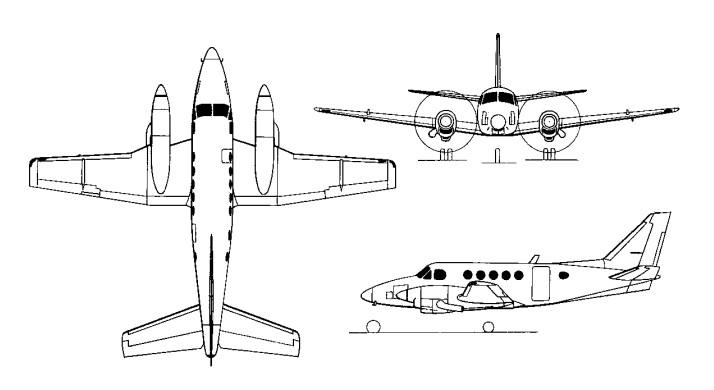
Beechcraft 99 Commuter
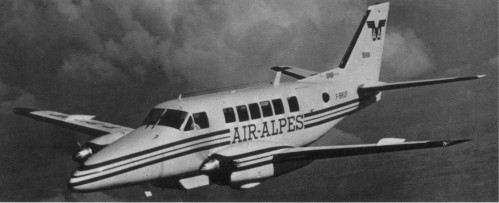
In production until 1978 the Beechcraft 99 Airliner was the first turbine-powered retractable landing gear aircraft to meet FAA approval for commuter air carrier service (regulations requiring a flight attendant for aircraft with 20 or more passengers). The test and development aircraft, which first flew in December 1965, was again a stretched fuselage Queen Air, initially with piston engines but was quickly upgraded to Pratt&Whitney PT6-A-27 turboprops. It was flown in July 1966, with type approval obtained in May 1968. With only capacity for two pilots and 15 passengers, it was less economical than the Twin Otter and required longer runways to operate from.
Beechcraft 99 Commuter Article
First delivered in 1968, the Model 99 was powered by twin 550-shp Pratt & Whitney turboprops driving reversible propellers. These enable the Beechcraft 99 to cruise at more than 250 mph and pull a gross load of 10,200 pounds or more. Introduced in 1969, the 99A Airliner housed 680-shp Pratt & Whitney free-shaft turbines flat rated at 550 shp. Except for the engines, the 99A is identical to the original 99.
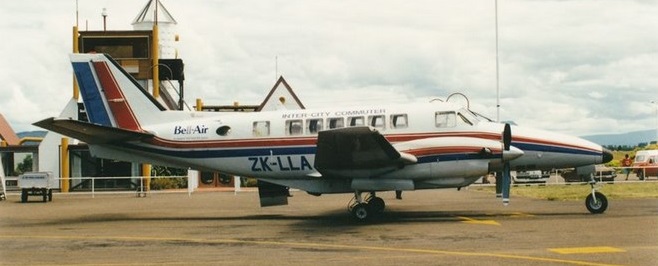
The 99B, announced in 1972, featured engineering improvements for increased reliability, maintainability and passenger comfort. The ship has an air-conditioning unit as an option with its high pressure continuous-flow oxygen system. Also, an optional cargo door and cargo pod, installed beneath the fuselage, in¬creases its cargo capability. Seating can be varied to suit specific needs. After building only 164 Model 99 aircraft, Beech withdrew from this market in 1975. However, with the Air Deregulation Act of 1978 the upgraded Model 99 was brought back into production as the model C99 Airliner powered by the P&W PT-6A-36, with a further 75 of these C99s being built.
99
Engines: 2 x Pratt & Whitney (UACL) PT6A 20 turboprop, 550 shp.
Props: 6 ft 7in (2.02 m) dia 3-blade.
Wing span: 45 ft 10.5in.
Length: 44 ft 6.75in (13.58m).
Wing area: 279.7 sq ft (25.88 sq.m).
Gross Wt. 10,400 lbs (4,717 kg).
Empty Wt. 5675 lbs.
Fuel capacity 374 USG.
Max cruising speed: 254 mph (409 kph) at 10,000 ft (3,050 m).
Range: 1,100 miles (1,770 km) with 1,800 lb (816 kg) payload.
Crew: 2.
Pax cap: 15.
Stall 75 mph.
Initial climb rate 1910 fpm.
Ceiling 25,000 ft.
Takeoff distance (50’) 3200 ft.
Landing distance (50’) 2470 ft.
99A
Engines: 2 x Pratt & Whitney PT6A 27 turboprop, 680 shp.
B99
Engine: 2 x P&WAC PT6A-27, 680 hp.
Seats: 17.
Wing loading: 38.97 lb/sq.ft.
Pwr loading: 8.02 lb/hp.
Gross wt: 10,995 lb.
Empty wt: 5891 lb.
Equipped useful load: 4784 lb.
Payload max fuel: 2318 lb.
Range max fuel/cruise: 749nm/3hr.
Range max fuel /range: 1097nm/5.3hr.
Ceiling: 26,313 ft.
Max cruise: 245 kt.
Max range cruise: 209 kt.
Vmc: 85 kt.
Stall: 75-91 kt.
1.3 Vso: 98 kt.
ROC: 2070 fpm.
SE ROC: 561 fpm @ 117 kt.
SE ceiling: 13,000 ft.
Min field length: 2800 ft.
Fuel cap: 2466 lb.
Takeoff distance (50’) 2480 ft.
Landing distance (50’) 1810 ft.
BE-C99 Airliner
First built: 1981.
Engines: 2 x P&W PT6A-36, 715 shp.
Props: Hartzell 3-blade, 93-in.
Seats: 17.
Length: 44.6 ft.
Height: 14.4 ft.
Wingspan: 45.9 ft.
Wing area: 279.8 sq.ft.
Wing aspect ratio: 7.5.
Maximum ramp weight: 11,380 lbs.
Maximum takeoff weight: 11,300 lbs.
Standard empty weight: 6124 lbs.
Maximum useful load: 5256 lbs.
Maximum landing weight: 11,300 lbs.
Wing loading: 40.4 lbs/sq.ft.
Power loading: 7.9 lbs/hp.
Maximum usable fuel: 2466 lbs.
Best rate of climb: 2221 fpm
Service ceiling: 28,080 ft.
Maximum single-engine rate of climb: 539 fpm @ 119 kts.
Single-engine climb gradient: 270 ft/nm.
Single-engine ceiling: 14,360 ft.
Maximum speed: 226 kts.
Normal cruise @ 8,500 ft: 249 kts.
Fuel flow @ normal cruise: 740 pph.
Endurance at normal cruise: 2.8 hrs:
Stalling speed clean: 94 kts.
Stalling speed gear/flaps down: 83 kts.
Turbulent-air penetration speed: 169 kts.
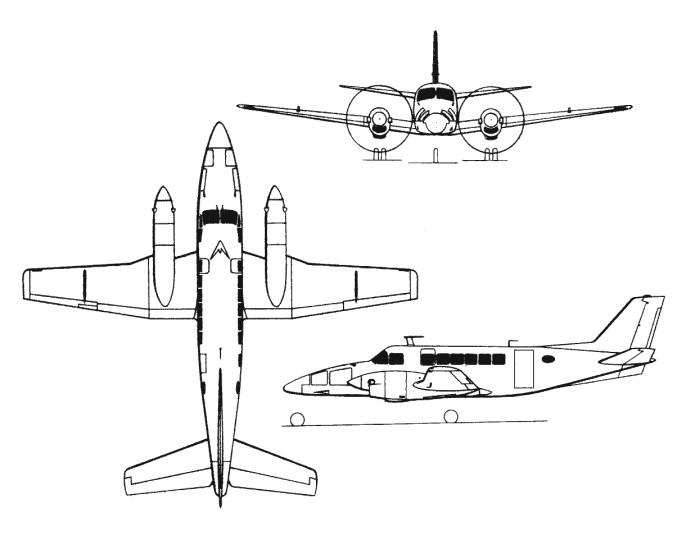
Beechcraft 95 Travel Air
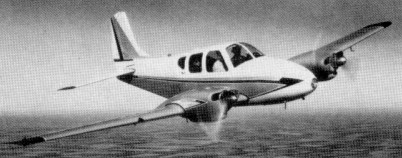
When the Model 95 Travel Air was in its prototype stage in 1956, it was known as the Badger. It entered production in 1958, with a factory list price of $49,500.
The first Beech Travel Air on the British register (1960) was G-APUB.
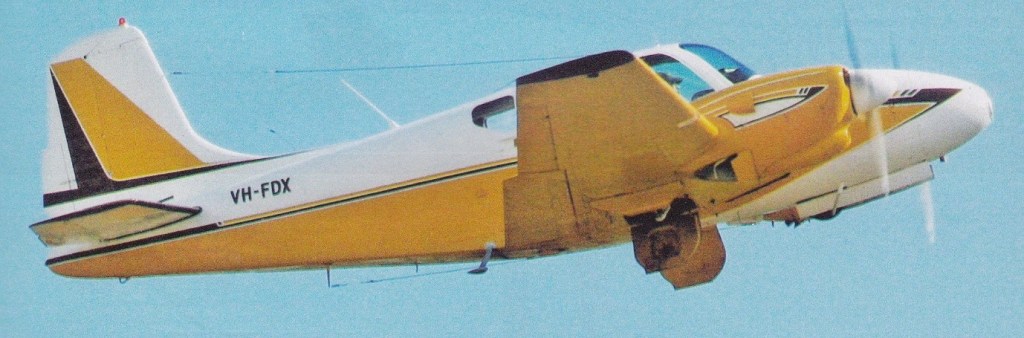
In the 10 following years, the Travel Air was subject to a few major changes. Engine power output remained at 180 on all models, with carburetors being replaced by fuel injectors in 1964. In that same year, the cabin was stretched an additional 20 inches. The factory price rose, in 1968, to $153,500 list, including avionics. Only 14 1968 E95 model were built. In all these years and changes, the basic performance figures of the Travel Air differed only slightly. Top speed varied only by a mile per hour or so, cruise rose from 195 to 200, and range and altitude held constant. A limitation of the Travel Air to some pilots was the low single-engine ceiling of 4400 feet.
1958 Beechcraft Travel Air
Engines: Lycoming O-360-A1A, 180 hp
TBO: 2000 hrs
Fuel type: 80/87
Propeller type/diameter: Hartzell/72 in
Landing gear type: Tri/Retr.
Max ramp weight: 4000 lb
Gross weight: 4000 lb
Landing weight: 4000 lb
Empty weight, std: 2500 lb
Useful load: 1172 lb
Payload, full std. fuel: 548 lb
Usable fuel, std: 112 US gal
Wingspan: 37 ft. 10 in.
Overall length: 25 ft. 4 in.
Height: 9 ft. 6 in.
Wing area:193.8 sq. ft
Wing loading: 20.6 lbs./sq. ft
Power loading: 11.1 lbs./hp
Wheel base: 7 ft.
Wheel track: 9 ft. 7 in.
Wheel size: 6.5 x 8 in (mains), 5 x 5 in (nose)
Seating capacity: 4
Cabin doors: 1
Cabin width: 42 in
Cabin height: 50 in
Baggage capacity: 270 lb front, 270 lb rear
Cruise speed 75% power @ 7,500 ft.: 200 kt
Cruise speed 65% power @ 10,500 ft.: 195 kt
Cruise speed 55% power @ 14,000 ft.: 181 kt
Fuel consumption 75% power: 21.0 USgph
Fuel consumption 65% power: 17.5 USgph
Fuel consumption 55% power: 15.0 USgph
Max range (w/reserve): 1360 nm
Vs: 84 mph
Vso: 70 mph
Best rate of climb @ gross: 1360 fpm
Best rate of climb, 8000 ft. @ gross: 800 fpm
Service ceiling (ft.): 18,100
Takeoff ground roll: 1700 ft (no wind, standard day, sea level)
Takeoff over 50-ft. obstacle: 2000 ft
Landing ground roll: 1100 ft
Landing over 50-ft. obstacle: 2200 ft
Beechcraft 1960 B95 Travel Air
Engine: Lyc. O-360-A1A, 180 hp
TBO: 2000 hr
Propeller: Const. spd.
Landing Gear type: Tri./Retr.
Gross weight: 4100 lb
Empty weight, std: 2860 lb
Useful load, std: 1240 lb
Fuel: 84 US gal
Wingspan: 37 ft. 10 in.
Overall length: 25 ft. 4 in.
Height: 9 ft. 8 in.
Wing area: 199 sq. ft
Seating capacity: 6
Cabin width: 42.5 in
Cabin height: 50 in
Baggage capacity: 270 lb (front.) /400 lb (rear)
Cruise speed, 8,000 ft 75% power: 170 kt
Cruise speed, 8,000 ft 65% power: 167 kt
Max range (w/ reserve) 75% power: 887 nm
Max range (w/ reserve) 65% power: 1008 nm
Fuel consumption 70% power: 21.0 US gph
Fuel consumption 65% power: 17.2 US gph
Stall speed (gear, flaps down): 60 kt
Best rate of climb: 1300 fpm
Service ceiling: 18,100 ft
Takeoff ground roll: 1740 ft
Landing ground roll: 1015 ft
D95A
Engines: 2 x IO 360 B1B.
E95
Engines: 2 x Lycoming O 360-AlA, 180-hp.
Seats 4-5.
Gross Wt. 4200 lbs.
Empty Wt. 2650 lbs.
Fuel capacity 112 USG.
Top speed 240 mph.
Cruise 200 mph.
Stall 75 mph.
Initial climb rate 1250 fpm.
Range 1035 sm.
Ceiling 18,100 ft.
Takeoff distance (50’) 1280 ft.
Landing distance (50’) 1590 ft.
E95 Travel Air
Engines: 2 x 180¬hp Lycoming IO 360 B1B.
Beechcraft 90 King Air / U-21 / VC-6 / T-44 Pegasus / Swearingen Taurus
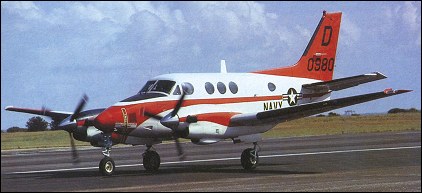
Beech had been working on the model 90 King Air since 1963 (then identified as the Beech Queen Air Model 65-80) utilising the 373kW P&W turboprop PT6 engines. This aircraft was basically a Queen Air fitted with turboprop engines and first flew in January 1964. It proved to be faster than the Twin Otter but still only provided seating for nine passengers. The Model 65-80 designation was confusing as there were Model 65 and Model 80 Queen Airs in production, so the aircraft became known temporarily as the Model 65-90T (T standing for turboprop). In due course, an even better job was made of clarifying the situation by renaming the turboprop-powered Queen Airs as King Airs. In effect, therefore, the Model 65-90T was the prototype for the Beech Model 90 King Air series, but more specifically became the prototype of the unpressurised military Kings Airs.
Beechcraft 90 King Air / U-21 Article
Announced with a basic price of $300,000, first deliveries were planned for the Fall of 1964. Following the first flight of the Model 65-90T, a civil equivalent was produced in parallel with a pressurised cabin, and the first production prototype of this aircraft, designated Model 90 King Air, flew for the first time on 20 January 1964.
The Pratt & Whitney PT6A-6, 550 shp King Air was fully pressurised.
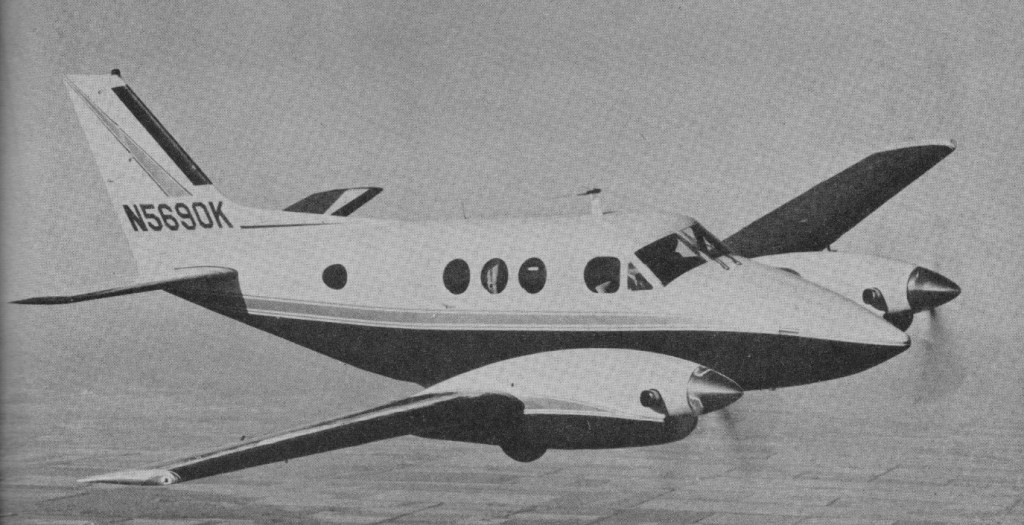
The first overseas tour for Beech’s King Air started 4 September 1965 with a non-stop Gander, Newfoundland, to Paris flight, first for a plane in this category. Bob Oestreicher, Beech pilot, and Pierre Allain, of Neuchtel, Switzerland, landed at Toussus-Le-Noble Airport near Paris 9 hr 50 min after takeoff. Groundspeed for the 2600 mile trip was 264 mph at 17,000 ft. The only squawk was the clock lost 30 sec over the Atlantic.
US Army testing of the Model 65-90T, under the military designation NU-8F, had shown the aircraft to be suitable for the military requirement, so an initial order for 48 aircraft, under the designation U-21A (TC 3A20), was placed. Beech distinguished its military King Airs from civil versions by identifying them as Model 65-A90-1, and began modification of the civil aircraft to provide a utility interior. This accommodates a crew of two and 10 troops, or six to eight command personnel, or three stretchers, and seating can be removed easily for the carriage of up to 1361kg of cargo.
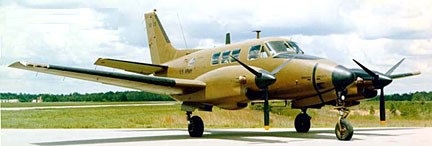
Initial deliveries of production U-21As, which were given the name Ute, began on 16 May 1967, and subsequent contracts resulted in more than 160 being built. These included U-21As and RU-21A/RU-21D variants all with 410kW Pratt & Whitney PT6A-20 turboprops, and RU-21B/ RU-21C/RU-21E variants with 462kW PT6A-29s. The RU-21s were developed especially for operation in an electronic reconnaissance role in South-East Asia, sprouting a strange collection of aerials and sensors, and being equipped internally with related avionics’ systems, plus nav/com systems suitable for all-weather operations. RU-21Bs and RU-21Cs had Beech designations Model 65-A90-2 and Model 65-A90-3 respectively, and the designation U-21G applied to 17 aircraft for the USAF that were similar to the U-21A. Deliveries of the civil Model 90 King Air began in late 1964, this having cabin pressurisation, and accommodating a maximum of 10 persons, including the pilot. It was superseded in early 1966 by the King Air A90, which introduced the more powerful PT6A-20 engines.
The 90, A90 (first flying in 1966) and B90 are all powered by 500 shp.
The A90 was followed by a King Air B90 with detail improvements in 1970, the B90 was fitted with a 550-shp Pratt & Whitney engines.
In September 1970 by the King Air C90 which introduced a more advanced pressurisation and heating system for the cabin, still with 550-shp Pratt & Whitney engines. The C90 was in production in 1982, with a total close to 1,000 having been delivered by the end of the year. One of these, designated VC-6B, also serves with the USAF’s 1,254th SAM Squadron. The single VC-6A operated by the 89th Military Airlift Wing at Andrews AFB, Maryland, was placed in service in early 1966, and retired in 1985.
Since its introduction, the C90 has been the subject of steady improvement, the 1982 powerplant was the PT6A-21. Ten examples of the C90 serve with the Spanish air force and civil aviation school for instrument training and liaison.
The E90 became part of the lineup in 1972 and employed the 680-shp Pratt & Whitney PT6A-28 turboprop, flat-rated to 410kW. All have full-feathering, reversible propellers. Their pressurized, three-compartment interior can be maintained at sea level atniosphere pressure to flight levels as high as 10,500 feet. The E90 is virtually a more powerful version of the C90. This version remains in production in 1990.
An addition to the King Air line in June 1979 is the F90, a fuel-efficient version, thanks in part to the new Pratt & Whitney engines with improved turbine blades which extract more power from the engine, four blade propellers and full deicing equipment. At 300 mph true air speed it burns less than 70 gallons per hour. Slower-turning props also reduce interior noise levels. This combined the pressurised fuselage of the Model 90, with the wings and tail unit of the Models 100 King Air and 200 Super King Air respectively. The dual wheel gear are fitted with brake deice systems. The pressurization differential of 5.0 pounds/sq.in. provides a sea-level cabin at 11,000 feet. The F90 was powered by 750 shaft horsepower Pratt & Whitney PT6A 135 engines and sold for $954,500.
In 1976 the Naval Air Systems Command selected Beech win¬ner of an industry, competition for a three year pur¬chase of new multi engine training aircraft for Naval aviators. The Navy selected an aircraft that combined features of the C90 and E90, designated T 44A. The aircraft is powered by two 550 shp PT6A-34B turbo-prop engines. A total of 15 aircraft purchased by the Navy are to replace piston engine powered TS 2A and TS 2B trainers.
Students selecting the Specialized Undergraduate Pilot Training [SUPT] turboprop track attend T-44 training conducted by the U.S. Navy at Corpus Christi, Texas, and then go on to flying duties in turboprop aircraft. Training includes the Navy common maritime turboprop course followed by an Air Force top-off course. The top-off course consists of single aircraft and formation tactical low level airdrop procedures. Training takes approximately 26 weeks and includes 152 hours ground training, 30 hours in the flight simulator and 111 flying hours in the T-44. The T-44 is equipped with deicing and anti-icing systems augmented by instrumentation and navigation equipment which allows flight under instrument and icing conditions. The interior includes a seating arrangement for an instructor pilot (right seat), a student pilot (left seat), and a second student. Two additional passenger seats are included. A distinguishing feature of the aircraft is the avionics fault insertion capabilities afforded the instructor pilot from the right-seat armrest and the second student/observer audio control panel that allows the second student to monitor all radio communications.
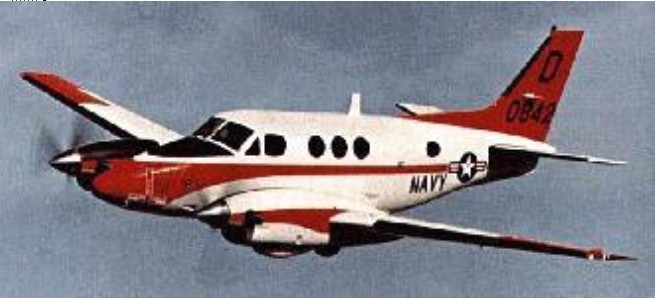
The T-44A aircraft was procured as a commercial-derivative aircraft certified under an FAA Type Certificate. Throughout its life, the aircraft has been operated and commercially supported by the Navy using FAA processes, procedures and certifications. It continues to be maintained commercially at all levels of maintenance, and relies on COTS/NDI components and equipment to support airworthiness. Aircraft modification efforts are “turnkey” projects (procurement and installation) implemented as part of competitively awarded maintenance contracts. Where extensive integration efforts are required, the non-recurring engineering phase, including test and certification, is typically performed by Raytheon Aircraft Company under a sole-source engineering contract with the Navy.
The 3,000th example of the King Air family was delivered to a customer on 17 April 1981.
While production of the F90 ended at 231 aircraft, the C90 continued in production, 1,415 of the low-tailplane variants having been delivered by early 1989.
The Swearingen Taurus was a modified Beech King Air 90 with two 700hp P&W PT6A-135 circa 1986.
B90
Engines two 500-shp Pratt & Whitney turboprops.
Seats 6-10.
Gross Wt. 9650 lbs.
Empty Wt. 5685 lbs.
Fuel capacity 384 USG.
Cruise 260 mph.
Stall 87 mph.
Initial climb rate 1900 fpm.
Ceiling 27,000 ft.
Range 1480 sm.
Takeoff distance (50’) 1420 ft.
Landing distance (50’) 2300 ft.
C90 King Air
First built: 1964.
Engines: 2 x P&W PT6A-21, 550 shp.
Props: Hartzell 3-blade, 93.4-in.
Seats: 6/10.
Length: 35.5 ft.
Height: 14.3 ft.
Wingspan: 50.3 ft.
Wing area: 294 sq.ft.
Wing aspect ratio: 8.6.
Maximum ramp weight: 9705 lbs.
Maximum takeoff weight: 9650 lbs.
Standard empty weight: 5765 lbs.
Maximum useful load: 3940 lbs.
Maximum landing weight: 9168 lbs.
Wing loading: 32.8 lbs/sq.ft.
Power loading: 8.8 lbs/hp.
Maximum usable fuel: 2573 lbs.
Best rate of climb: 1955 fpm.
Service ceiling: 28100 ft.
Max pressurisation differential: 4.6 psi.
8000 ft cabin alt @: 21200 ft.
Maximum single-engine rate of climb: 539 fpm @ 108 kts.
Single-engine climb gradient: 299 ft/nm.
Single-engine ceiling: 15050 ft.
Maximum speed: 224 kts.
Normal cruise @ 18,000ft: 218 kts.
Max range cruise: 197 kt.
Fuel flow @ normal cruise: 432 pph.
Endurance at normal cruise: 5.4 hr
Range max fuel/cruise: 881nm/4.0hr.
Range max fuel /range: 1251nm/6.4hr.
Stalling speed clean: 89 kts.
Stalling speed gear/flaps down: 76 kts.
1.3 Vso: 99 kt.
Turbulent-air penetration speed: 169 kts.
C90A
Cruise: 247 kt.
Seats: 10.
Range 7 POB & res: 1100 nm
E90
Engine: 2 x P&WAC PT6A-28, 550 hp.
TBO: 3500hr.
Seats: 10.
Wing loading: 34.4 lb/sq.ft.
Pwr loading: 9.2 lb/hp.
Gross wt: 10,160 lb.
Empty wt: 5961 lb.
Equipped useful load: 3949 lb.
Payload max fuel: 773 lb.
Range max fuel/cruise: 1004nm/4hr.
Range max fuel /range: 1609nm/7.5hr.
Ceiling: 27,620 ft.
Max cruise: 248 kt.
Max range cruise: 216 kt.
Vmc: 86 kt.
Stall: 77-86 kt.
1.3 Vso: 100 kt.
ROC: 1870 fpm.
SE ROC: 470 fpm @ 111 kt.
SE ceiling: 14,390 ft.
Min field length: 2110 ft.
Takeoff distance (50’) 2024 ft.
Landing distance (50’) 2110 ft.
Fuel cap: 3176 lb / 474 USG.
Cabin pressure: 4.6 psi.
F90 King Air
First built: 1979.
Engines: 2 x P&W PT6A-135, 750 shp / 559kW.
Props: Hartzell 4-blade, 92-in.
Seats: 6/10.
Wingspan: 13.99 m / 45 ft 11 in
Length: 12.13 m / 39 ft 10 in
Height: 4.8 m / 15 ft 9 in
Wing area: 25.98 sq.m / 279.65 sq ft
Wing aspect ratio: 7.5.
Maximum ramp weight: 11,030 lbs.
Maximum takeoff weight: 10,950 lbs.
Standard empty weight: 6549 lbs.
Maximum useful load: 4481 lbs.
Zero fuel wt: 9,600 lbs.
Maximum landing weight: 10,950 lbs.
Wing loading: 39.1 lbs/sq.ft.
Power loading: 7.3 lbs/hp.
Maximum usable fuel: 3149 lbs.
Best rate of climb: 2380 fpm.
Service ceiling: 29,802 ft.
Max pressurisation differential: 5 psi.
8000 ft cabin alt @: 23,120 ft.
Maximum single-engine rate of climb: 600 fpm @ 117 kts.
Single-engine climb gradient: 309 ft/nm.
Single-engine ceiling: 14,419 ft.
Maximum speed: 267 kts.
Normal cruise @ 22,000ft: 257 kts.
Fuel flow @ normal cruise: 538 pph.
Endurance at normal cruise: 5.3 hrs:
Stalling speed clean: 94 kts.
Stalling speed gear/flaps down: 77 kts.
Turbulent-air penetration speed: 169 kts.
U-21A Ute
1967 Staff transport
Engines: two 550hp P&W PT6A-20
Wingspan: 45′ 11 in
Length: 35’6″
Useful load: 4220 lb
Max speed: 265 mph
Range: 1675 mi
Seats: 10
No built: 140, 66-18000/18047, 67-18048/18076, -18078/18084, -18086, -18088, -18090/18092, -18094/18103, -18116/18118
4 for electronic warfare as RU-21A, 67-18112/18115
4 modified for electronic reconnaissance as EU-21A, 66-18000, -10803, -18007, 67-18058
2 for ground instruction as GU-21A, 66-18006, -18012
4 for special development tasks as JU-21A, 66-18008, 67-18063, -18065, -18069
RU-21B
1967 Special military applications
No built: 3 67-18077, -18087, -18093
RU-21C
1967 Staff transport
No built: 2 67-18085, -18089
RU-21D
1967 Modified cockpit
No built: 18 67-18104/18111, -18119/18128, plus 18 U-21A conversions
JRU-21D
No built: 1 unknown modification 67-18125
RU-21E
1971 Staff transport.
No built: 15 70-15875/15890; with 3 modified RU-21D
U-21G
1971 Electronic countermeasures
No built: 17 70-15891/15907
RU-21H
1971 Staff transport
No built: 32
RU-21J
1972 Battlefield surveillance
No built: 20 71-21058/21060
3 modified for a short time from C-12L, then reverted
T-44A Pegasus / H-90
Engines: 2 x P&W-Canada PT6A-34B, 550hp
61 built
Beechcraft 76 Duchess
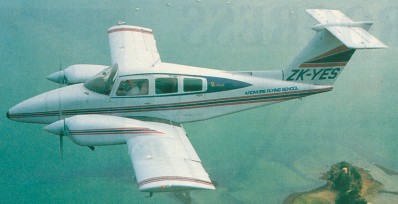
The Beech Duchess 76 was FAA certified in January 1978. The T tail four seater is powered by 180 hp Lycomings. It cruises at 153 knots and has a single engine climb at sea level of 235 feet per minute. Suggested price was $81,950. The twin features doors on both sides of the cabin, and optional avionics are similar to those on the Beechcraft Sierra. The Model 76 makes use of honeycomb-bonded wings for a smoother airfoil design with less drag and a lower manufacturing cost. Outstanding design characteristics of the new Duchess include an aerodynamically advantageous T-tail, which places the horizontal surfaces above the propeller slipstream for better stability and handling, and opposite-rotating propellers to eliminate the ‘critical engine” aspect of multi-engine flying.
Beech’s new Model 76 Duchess was temporarily grounded because the rudder trim tab push-rod became disconnected during a flight. Sixty three of the light twins were affected. Beech designed new, stronger push-rods for both rudder and elevator trim tabs.
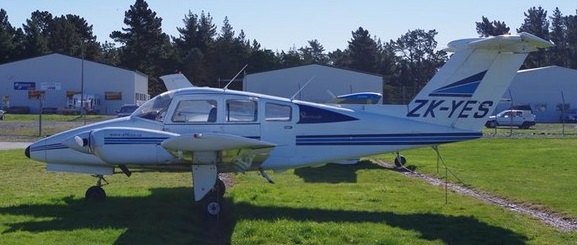
In 1980, a 28-volt electrical system was added to provide increased cranking power in cold weather, more power for avionics and more parts commonality with other Beech products.
A total of 437 produced between 1978 and 1982.
BE-76
Engine: 2 x Lycoming O 360 AlG6D, 180 hp, one counterclockwise rotating Lycoming LO 360 A1G6D, 180 hp.
TBO: 2000 hrs.
Prop: Hartzell 2 blade, constant speed full feathering 76 in.
Seats: 4.
Length: 29 ft.
Height: 9.5 ft.
Wingspan: 38 ft.
Wing area: 181 sq.ft.
Wing aspect ratio: 8.
Max ramp wt: 3916 lbs.
Max take off wt: 3900 lbs.
Empty wt: 2,565 lbs.
Useful load: 1,351 lbs.
Payload with full fuel: 751 lbs.
Max ramp wt: 3,916 lbs.
Zero fuel wt: 3500 lbs.
Max landing wt: 3900 lbs.
Wing loading: 21.5 lbs/sq.ft.
Power loading: 10.8 lbs/hp.
Max useable fuel: 100 USG/600 lbs.
Vyse: 85 kts.
Climb rate: 1248 fpm @ 97 kts.
Climb gradient: 772 ft/nm.
Rate of climb @ 8000 ft: 760 fpm.
Service ceiling: 19,650 ft.
SE rate of climb: 235 fpm @ 85 kts.
SE climb gradient: 162 ft/nm.
SE ceiling: 6170 ft.
Max speed: 177 kts.
Max Speed at 6,000ft; 166 kts.
Cruise @ 65% power @ 8,000ft: 156 kts.
Cruise Speed, 75%, 8,000ft; 164 kts.
Fuel flow @ 65% power @ 8,000ft: 112 pph.
Fuel Flow, 75%, SL; 10.8 gph.
Endurance @ 65% power @ 8,000ft: 5.1 hr.
Max cruise, 75 % pwr at 6,000 ft: 166 kts.
Econ cruise, 55% power at 12000 ft: 151 kts.
Duration at max cruise: 4.9 hrs.
Duration at econ cruise: 6.7 hrs.
Stalling speed clean: 70 kts.
Stall speed gear/flaps down: 60 kts.
Turbulent air penetration speed: 132 kts.
Retractable nose wheel undercarriage.
Beechcraft 65 / 70 / 80 / 88 Queen Air / L-23F / U-8F
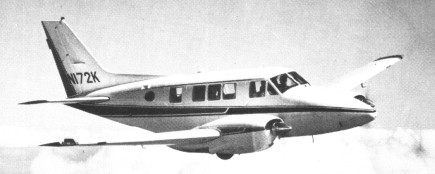
Beech designed the Queen Air in response to suggestions of owners of the Model 50 Twin Bonanza. From the L23F derivative of the Model 50 Twin Bonanza Beech developed the civil Model 65 Queen Air The Queen Air has a separate pilot compartment, individual reclining chairs. Easy entrance without climbing on the wing, a baggage compartment accessible in flight, a snack bar and toilet facilities.
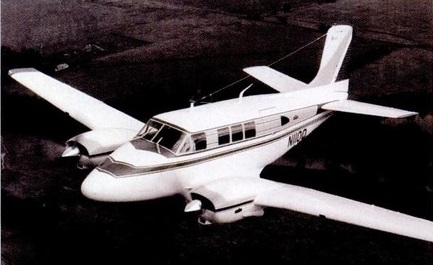
On 28 August 1958 Beech flew the prototype, designed as a seven/nine-seat low-wing monoplane with retractable tricycle landing gear, the 65 Queen Air was powered by two 254kW / 340-hp Avco Lycoming IGSO-480-A1B6 flat-six engines. The airplane had a cruise speed of 200 mph and a maximum range of 1590 miles. A bare aircraft sold for $120,000, and equipped with radios, radar and other accessories, for about $170,000. Full IFR instrumentation was standard, and optionally available equipment included autopilot and navigation and weather-avoidance radar.
In January 1968 Beech flew the first of three Model 65s that were to be used by the US Army for evaluation. This resulted in orders totalling 71 aircraft, under the designation L-23F Seminole, an identification chosen because of the general similarity between the Twin Bonanza and Model 65 Queen Air.
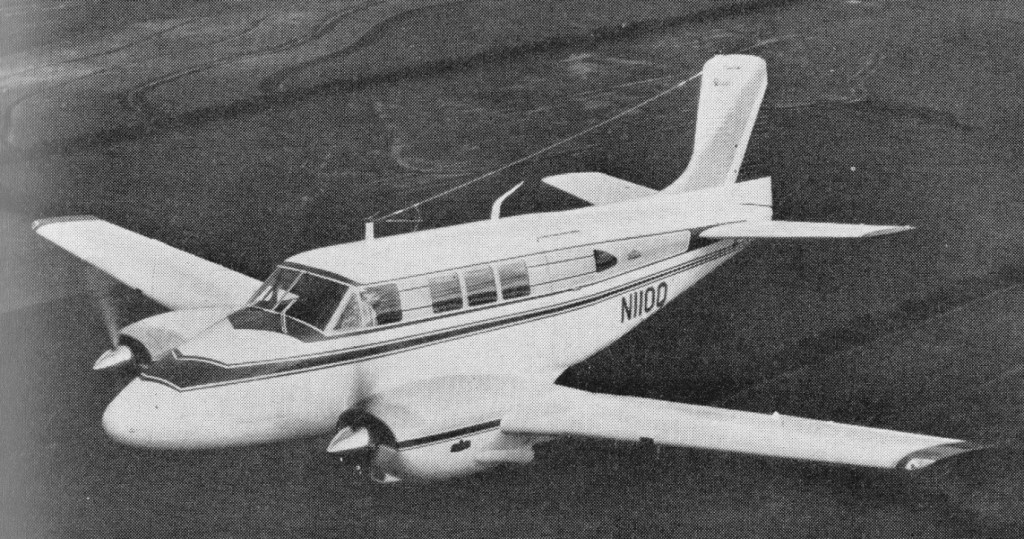
In 1962 the L-23F was redesignated U-8F, and some modified at a later date to provide improved interior accommodation became U-8Gs. A number of commercial Queen Airs were acquired by the Japan Maritime Self-Defence Force, for use in navigation trainer and transport roles, and others went to the air forces of Uruguay and Venezuela.
L-23F, U-8F (Queen Air) TC 3A20
58-1354/1356, 60-3453/3463, -5386/5390, 61-2426/2430, 62-3832/3875, 63-12902 (also as YU-21), -13636/13637, 66-15365, 1 for Pakistan 63-7975, and 3 impounded drug-runners 81-13658/13659, 83-24370, the latter returned to service as QA-65.
Beechcraft Queen Air / L-23F / U-8F Article
An improved Model A65 Queen Air had swept vertical tail surfaces and greater fuel capacity; and a version with a high-density seating arrangement for a crew of one or two, with 10 or nine passengers respectively, was known as the Queen Airliner. A Model 65 Queen Air was provided with two 373kW Pratt & Whitney PT6A-6 turboprop engines. Identified initially by the company as the Model 65-90T Queen Air, this was evaluated by the US Army, from 17 March 1964, as the NU-8F.
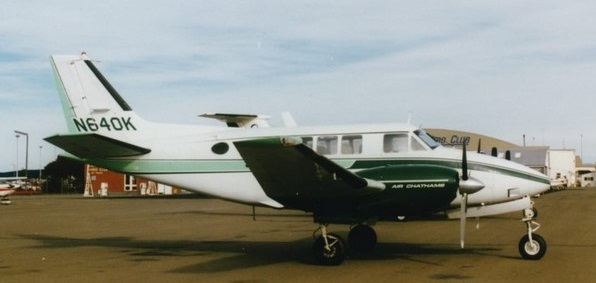
First flown on 22 June 1961, the Model 80 Queen Air had more powerful engines (283kW / 380-hp), but the Queen Air A80, introduced in January 1964, had increased wing span that allowed for operation at a higher gross weight. Final version was the Queen Air B80, incorporating a number of design and equipment improvements, and 11-seat Queen Airliners were available for each of these basic versions.
A pressurised Model 88 Queen Air version of the Model 80 was introduced in August 1965. Generally similar to the Queen Air B80, it had structural modification of the fuselage to cater for pressurisation, and circular cabin windows. It was taken out of production during 1969 after 45 had been built.
The Model 70 Queen Air was introduced in 1968. This was basically an A65 with the increased span wing of the B80.
Manufacture of the Models 65 and 70 was terminated at the end of 1971, at which time production figures totalled 404 (including U-8Fs) and 42 respectively. Production of the Model 80 Queen Airs continued until the end of 1978, at which time approximately 510 had been built.
In 1971 the rights to build and market a modified version were sold to the Excalibur Aviation Company and Swearingen Aircraft. The Excalibur 8800 is a modification replacing the engines with O-720s, low-drag engine nacelles, 3-bladed Hartzell props etc.
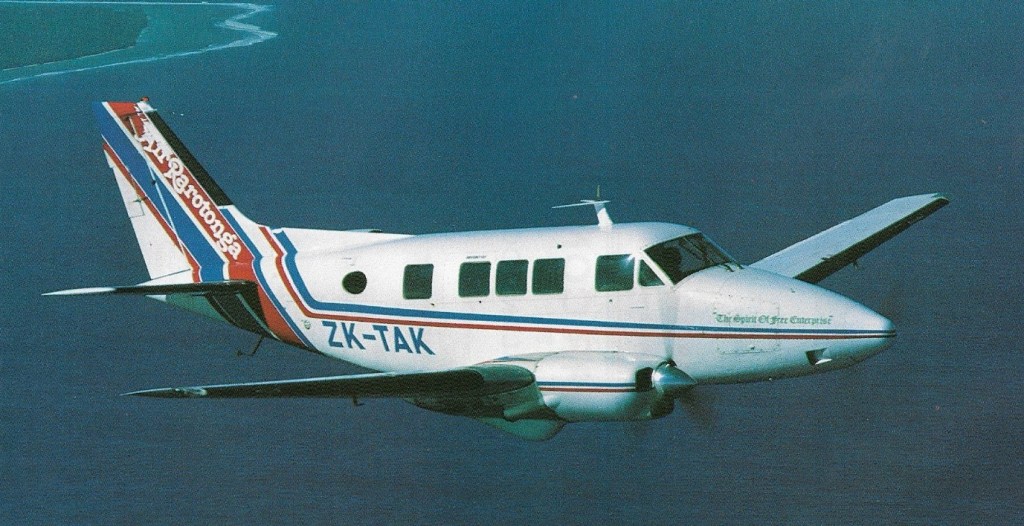
65
Engines: 2 x Lycoming IGSO 480 A1A6, 340-hp.
TBO: 1,400 hour.
Seats 6-7.
Gross Wt. 7700 lbs.
Empty Wt. 4640 lb
Fuel capacity 230 USG.
Top speed 240 mph.
45% power cruise: 171 mph
Range 45%: 1660 miles
Fuel burn 45%: 23 US gph
Stall 80 mph.
In¬itial climb rate 1300 fpm.
Ceiling 27,000 ft.
Single-engine service ceiling: 15,500 ft
Range 1205 sm.
Takeoff distance (50’) 1700 ft.
Landing distance (50’) 1980 ft.
65-70 Queen Air
Seats 7-11.
Gross Wt. 8200 lbs.
Empty Wt. 4995 lbs.
Fuel capacity 214 USG.
Engines two 340-hp Lycomings.
Top speed 240 mph.
Cruise 209 mph.
Stall 79 mph.
Initial climb rate 1375 fpm.
Ceiling 26,800 ft.
Range 1295 sm.
Takeoff distance (50’) 1675 ft.
Landing distance (50’) 2017 ft.
65-B80
Engine: 2 x Lycoming IGSO-540-A1D, 380 hp / 283kW.
Seats: 11.
Wingspan: 15.32 m / 50 ft 3 in
Length: 10.82 m / 35 ft 6 in
Height: 4.33 m / 14 ft 2 in
Wing area: 27.3 sq.m / 293.85 sq ft
Wing loading: 29.9 lb/sq.ft.
Pwr loading: 12.2 lb/hp.
Gross wt: 8855 lb.
Empty wt: 5297 lb.
Equipped useful load: 3278 lb.
Payload max fuel: 1754 lb.
Range max fuel 75% pwr: 1027nm/5.3hr.
Range max fuel /55% pwr: 1348nm/7.8hr.
Service ceiling: 26,800 ft.
Max speed: 247mph.
75% cruise: 193 kt.
55% cruise: 174 kt.
Vmc: 87 kt.
Stall: 70-84 kt.
1.3 Vso: 91 kt.
ROC: 1275 fpm.
SE ROC: 210 fpm @ 102 kt.
SE ceiling: 11,800 ft.
Min field length: 2572 ft.
Landing distance (50’) 2572 ft.
Fuel cap: 1200/1524 lb / 214-264 USG.
88
pressurized
Excalibur Queenaire 800 / Beech Queen Air
Engines: 2 x Lycoming IO-720-A1B, 400 hp.
Seats: 6/11.
Wing loading: 29.9 lb/sq.ft.
Pwr loading: 10 lb/hp.
Max TO wt: 8000 lb.
Empty wt: 5068 lb.
Equipped useful load: 2600 lb.
Payload max fuel: 1220 lb.
Range max fuel/ 75% cruise: 886 nm/4.4 hr.
Range max fuel / 55% cruise: 1156 nm/ 6.3 hr.
Service ceiling: 22,200 ft.
75% cruise: 201 kt.
55% cruise: 185 kt.
Vmc: 74 kt.
Stall: 69-80 kt.
1.3 Vso: 90 kt.
ROC: 1535 fpm.
SE ROC: 360 fpm @ 102 kt.
SE ceiling: 11,800 ft.
Min field length: 2200 ft.
Fuel cap: 1380 lb.
Excalibur Queenaire 8800 / Beech Queen Air
Engines: 2 x Lycoming IO-720-A1B, 400 hp.
Seats: 8/11.
Wing loading: 29.9 lb/sq.ft.
Pwr loading: 11 lb/hp.
Max TO wt: 8800 lb.
Empty wt: 5468 lb.
Equipped useful load: 3000 lb.
Payload max fuel: 1416 lb.
Range max fuel/ 75% cruise: 1047 nm/5.2 hr.
Range max fuel / 55% cruise: 1341 nm/ 7.3 hr.
Service ceiling: 19,800 ft.
75% cruise: 201 kt.
55% cruise: 185 kt.
Vmc: 75 kt.
Stall: 70-86 kt.
1.3 Vso: 91 kt.
ROC: 1490 fpm.
SE ROC: 250 fpm @ 102 kt.
SE ceiling: 9,800 ft.
Min field length: 2250 ft.
Fuel cap: 1584 lb.
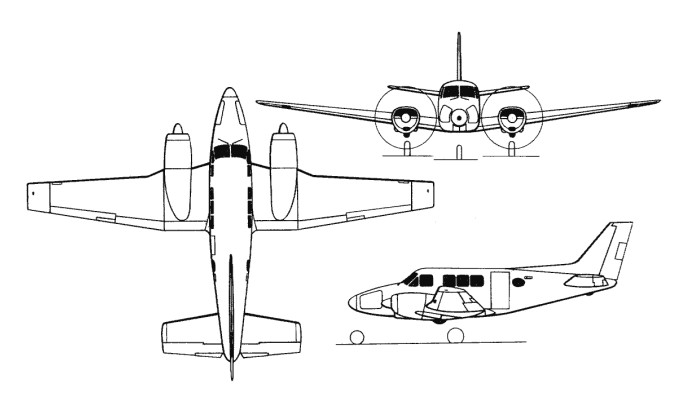
Beechcraft 60 Duke
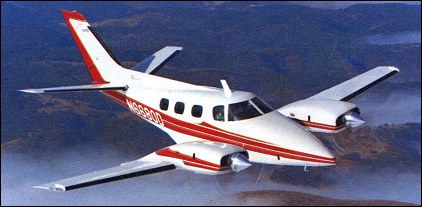
Beech entered the field of pressurised general aviation aircraft following a first flight of the Beech Model 60 Duke on 29 December 1966. The Duke was intended as a luxury four/six-seat aircraft, and overall configuration was similar to other Beech twins. It was intended for operation at higher gross weights and had strengthened landing gear, and much more powerful Avco Lycoming TIO-541-E1C4 380-hp turbocharged engines.
The Duke uses turbo bleed air to obtain 4.6 psi cabin pressure, which will maintain a 10,000-foot cabin altitude all the way to 24,800 feet. Two separate baggage compartments in the nose and aft fuselage handle 500 and 315 pounds of luggage, respectively. The spacious Duke cabin provides a center aisle separating the seats, plus dividers between the flight deck and passenger cabin. A 20 per cent increase in range and new landing lights on the retractable gear were the changes for 1976. As an option, the pressurized twin can hold up to 232 gallons of usable fuel by adding wet wing tips. This boosts the fuel load by 90 gallons over the 142 gallons standard fuel load. The previous option allowed a maximum of 202. In 1977, the Duke advertised a higher cruise speed, improved exterior lighting and a standard Collins avionics package. In 1980, a Hoskins fuel-flow system indicates flow in gallons and pounds per hour, plus fuel remaining. Timing modes calculate flying time remaining and elapsed time since engine start.
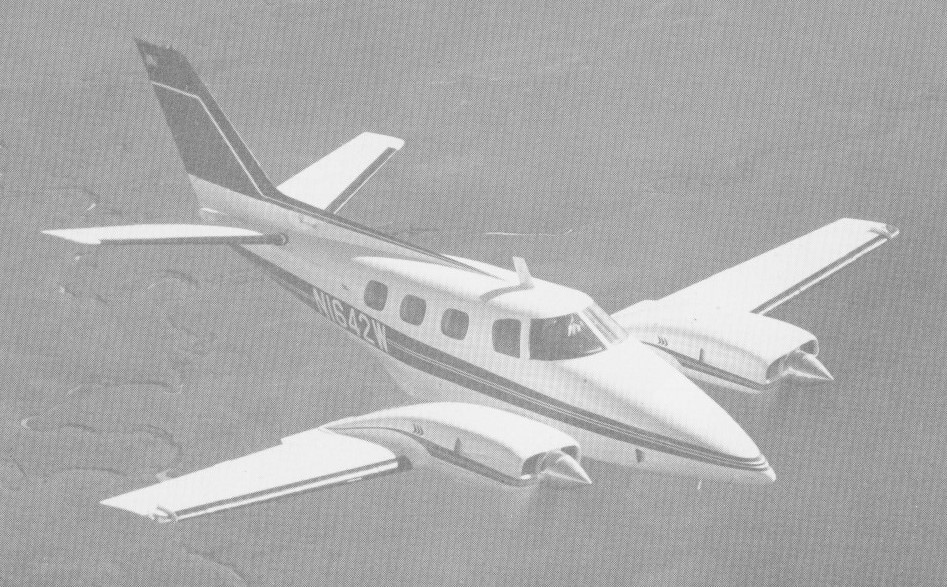
Only two revised versions of the original Model 60 appeared during the production run, the Model A60 and Model B60 introduced in 1971 and 1974 respectively. The first provided a 23kg increase, in maximum take-off weight, the second a slightly larger cabin and increased fuel capacity. Such an aircraft was by no means cheap and, by American standards, was built in comparatively small numbers, with a total of 596 completed by the end of production in 1983.
BE-A60 Duke
Engines: 2 x Lycoming TIO 541 EIA4 6 cylinder turbocharged, 380 hp each.
Length: 33 ft 10 in.
Wingspan: 39 ft 3 in.
Speed: 286 mph.
Ceiling: 31,000 ft.
Range: 973 mls.
BE-B60 Duke
First built: 1968.
Engines: Lycoming TIO-541-E1C4, 380 hp each.
TBO: 1600 hrs.
Props: Hartzell 3-blade, 74-in, constant speed, full feathering.
Seats: 4/6.
Wingspan: 11.97 m / 39 ft 3 in
Length: 10.31 m / 33 ft 10 in
Height: 3.76 m / 12 ft 4 in
Wing area: 19.78 sq.m / 212.91 sq ft
Wing aspect ratio: 7.2.
Cabin length: 11 ft 10 in / 3.61 m
Cabin width: 4 ft 2 in / 1.27 m
Cabin height: 4 ft 4 in / 1.32 m
Maximum ramp weight: 6819 lbs.
Maximum takeoff weight: 6775 lb / 3073 kg
Empty weight equipped: 4235 lb / 1921 kg
Standard empty weight: 4425 lbs.
Maximum useful load: 2394 lbs.
Maximum landing weight: 6775 lbs.
Wing loading: 31.8 lbs/sq.ft.
Power loading: 8.9 lbs/hp.
Maximum usable fuel: 232 USG/1392 lbs.
Best rate of climb: 1,601 fpm @ 120 kts.
Climb gradient: 801 ft/nm.
Rate of climb @ 8,000 ft: 1460 fpm.
Certificated ceiling: 30,000 ft.
Service ceiling: 30,800 ft / 9390 m
8000ft cabin alt @: 21,600.
Maximum single-engine rate of climb: 307 fpm @ 110 kts.
Single-engine climb gradient, sea level: 165 ft/nm.
Single-engine service ceiling: 15100 ft.
Maximum speed: 246 kts.
Max cruise 79% pwr 25,000ft/7620m: 241 kt / 278 mph / 447 kph
Cruise @ 65% pwr @ 8,000ft: 185 kts.
Cruise @ 65% power @ 18,000ft: 201 kts.
Fuel flow @ 65% pwr @ 18,000 ft: 223 pph.
Endurance at 65 % pwr @ 18,000 ft: 6 hrs:
Range 45% 15,000ft/4750m opt fuel 45min res: 1023 nm / 1177 mi / 1893 km
Range 75% 25,000ft/7620m opt fuel 45min res: 837 nm / 963 mi / 1550 km
Stalling speed clean: 81 kts.
Stalling speed gear/flaps down: 73 kts.
Turbulent-air penetration speed: 160 kts.
Nose baggage capacity: 50 lb / 226 kg / 32 cu.ft / 0.91 cu.m
Cabin rear capacity: 315 lb / 143 kg / 28.25 cu.ft / 0.80 cu.m
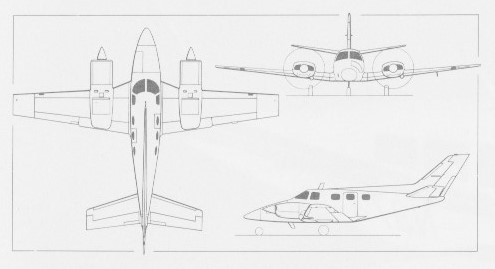
Beechcraft 58 Baron
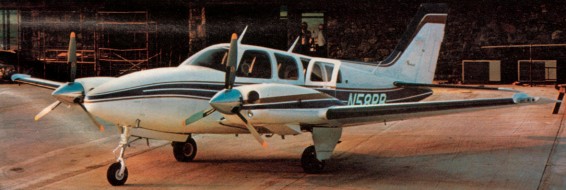
First flown in June 1969, the Baron 58 became a part of the lineup in 1970, replacing the 56TC, and used the 285-hp Continental engine. It had the fuselage lengthened by 0.25m to provide a more spacious cabin, and an extension of the wheelbase. Ready acceptance of this improved Baron, with delivery figures that averaged about two per week for more than 12 years, resulted in the introduction of a pressurised Model 58P, with first deliveries in late 1975. Beechcraft has added two new versions, the 58P for over-the-weather pressurized comfort and the Baron 58TC for high-altitude performance.
The Baron 58P, Continental TSIO 520 L, 310 hp each, was priced at $200,750 (1976), with propeller synchrophasers as standard. Both these additions use the same 310-hp turbocharged Continental engines enabling them to have a service ceiling of 25,000 feet and above. The Model 58P combined the Model 95-B55 wings, Model 58 tail unit, a strengthened Model 58 fuselage to cater for pressurisation, and main landing gear units as developed for the Model 60 Duke.
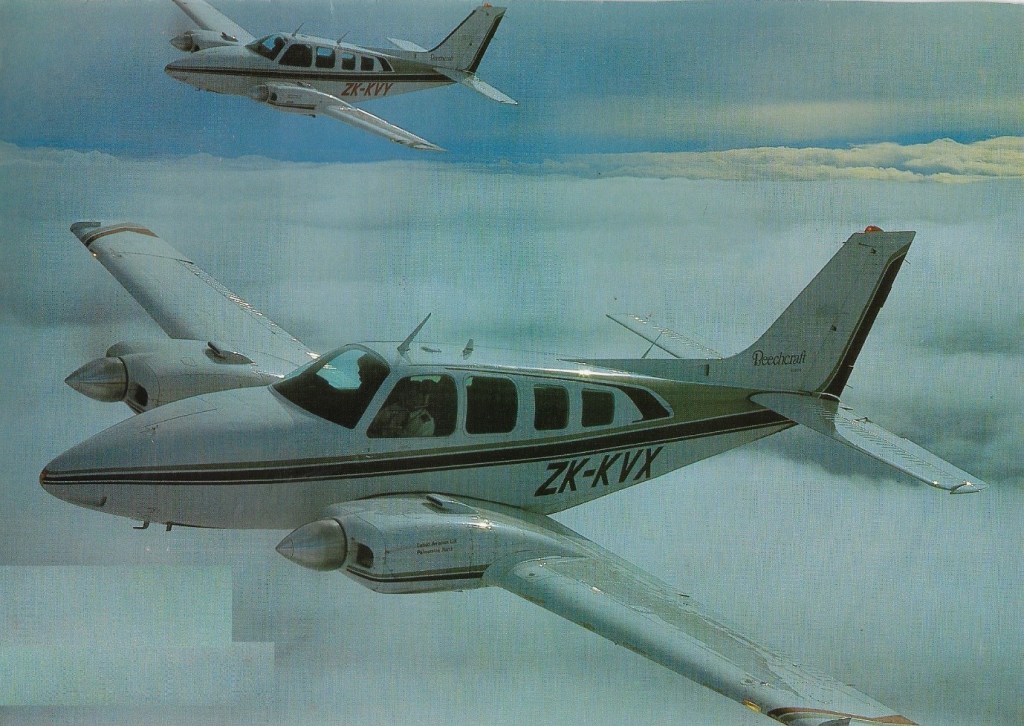
All Baron 58s have accommodations for four to six passengers with optional club seating where the rear two pairs face other.
By mating the turbocharged powerplants and beefier wings of the pressurized Baron with the lighter fuse-lage of the Model 58, Beech has developed a versatile light twin that capitalizes on the performance advan¬tages of turbocharging without adding the cost and weight of pressurization. Everything about the 58TC that doesn’t involve pressurization is identical to the equivalent part of the Baron 58P: its wings and landing gear accept the same increased gross weight of 6,100 pounds, its en¬gines also are 310 hp Continental, and its fuel tanks hold an optional capacity of 190 usable gallons. But the 58TC doesn’t require the extensive pressurization hardware, wider window posts and smaller rear door that characterize the 58P. The standard Baron 58 fuselage with its convenient double rear entry doors has been retained to produce an aircraft with the alti¬tude performance of the 58P but with a considerably lower empty weight, a 35 percent higher floor loading capacity and a lower price tag.
Automatic wastegate turbocharging, which is the type used on the Baron 58TC, allows an engine to deliver its rated horse¬power up to the altitude where the wastegate is fully closed and no more exhaust can be diverted to the turbocharger. For the 58TC, that “critical altitude” is higher than its certif¬icated ceiling of 25,000 feet, which was es¬tablished on the basis of the 58P design re¬quirements, since FAR 23 places additional structural requirements on pressurized air¬craft operating above FL 250. (The 58TC and the 58P share the same type certificate.)
By conditionally restricting the maximum rpm to 2,600, Beech was able to certificate the 58TC to the noise standards that were scheduled to become law in 1980, but that also reduced the normal operating power of each engine from the P Baron’s 310 at 2,700 rpm to 301 hp. The pressurized Bar¬on therefore enjoys slightly better twin en¬gine takeoff performance compared with the 58TC because it has three percent more power available continuously from its en¬gines, but single engine performance and op-erations below 97 percent power are the same for both aircraft whenever they are flown at identical weights.
Unlike earlier Barons, the 58P and 58TC are certificated under FAR Part 23, amend¬ments 1 through 12. The 58P went through an en¬tire certification process (as opposed to a testing of only the things that have been changed). The wings of the P and the TC have been strengthened with heavier spars, thicker leading edge skin and an extra attach point on a stub spar as on the Duke, which is built in the same plant. And while they were at it, Beech’s designers also put Duke landing gear and brakes on the new Barons.
Beechcraft 58P pressurized Baron looks like a Baron 58 but the windows are slightly smaller. A quarter inch comes off all the way around in the process of adding beef to the structure for pressurization. There’s a door at the left rear as well as the standard right front door. Some side mounted airscoops adorn the engine nacelles, and the nacelles are slightly longer than on the other Barons.
Comparing the Pressurized Baron with the regular 58, there are two basic differences: the 58’s engines are not turbocharged, and its cabin is not pressurized. The airplanes have about the same speed down low; the 58P starts to move away up high, where the turbochargers do their thing. However, because climbing time must be considered, the time en route on most trips would be very close, unless the 58P were to find a more favorable wind up high. The cabins are the same, and the useful loads are close. In operational range, the 58 has a rather clear advantage over the 58P. It also has almost twice the single engine rate of climb at sea level, but the 58P’s turbo-chargers turn the tables on that score at altitude.
An increase in structural capacity allows the 58TC to carry 350 pounds more than the Baron 58. In 1977, a new three-blade propeller is standard on the 58P. Two inches shorter, it improves maximum speed and in-creases the climb rate by more than 100 fpm. That year, club seating in all models, simplified fuel management, and increased optional fuel capacities were added.
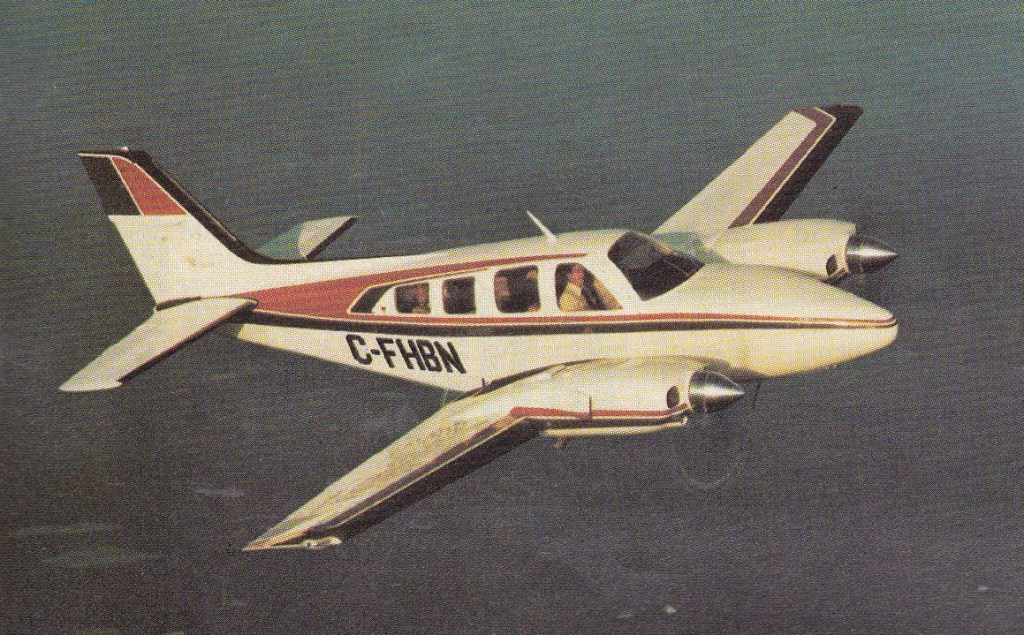
Beech made significant changes in the 58P for 1979. Horsepower increased from 310 to 325 per side, with the Continental TSIO 520 WB replacing the 520 Ls used previously. A heavier crankcase and improved pistons and crankshaft were the main internal changes, allowing the maxi¬mum manifold pressure to be raised from 38 to 39.5 inches. The extra power permitted not only a 100 pound increase in maximum gross weight, but also a higher single engine rate of climb. The cabin pressure differential also went up from 3.7 pounds per square inch to 3.9 psi, giving a cabin altitude of 11,800 feet when the airplane is at its 25,000 foot maximum certificated ceiling. Optional 196 USG fuel tanks (190 usable), comprising four interconnected quick ¬drain cells in each wing.
4700 Barons had been delivered by 1980, by January 1989 2,182 Model 58s had been delivered. Optional equipment on the 58, E55 and B55 are heavy-duty brakes that offer up to 50 per cent greater stopping power. In 1979, the pressurized Baron’s performance was enhanced by an increase in horsepower from 310 to 325 with the Continental TSlO-520-WB six-cylinder engine. Providing a higher degree of performance, the turbocharged, fuel-injected engine is exclusively a Beech powerplant — shared only by the 58TC. With the additional horsepower, the Baron 58P has a top speed approaching 300 mph. The P Baron’s pressurization system fea¬tures a variable rate controller, which allows cabin climb to be adjusted in relation to air¬craft climb: you can smoothly reach maxi¬mum pressure differential (3.7 psi) at the same time you reach cruise attitude. The same is true on letdown.
Maximum cruise speed for the 58TC was increased to 277 mph. Pressurization differential in the 58P was increased from 3.7 psi to 3.9 psi, providing a sea-level cabin up to 8350 feet. At 25,000 feet, the Baron’s service ceiling, the cabin is a comfortable 11,900 feet.
The Baron’s range is increased by as much as 253 miles with optional wet wing tips added to the existing fuel cell system. The Baron 58’s capacity will be increased by 28 gallons and the 58P and 58TC by 24 gallons with the addition of the wet wing tips.
In addition to Beech production Barons, at least two turboprop conversions have been developed by other constructors. These include the SFERMA Marquis, produced in small numbers in France, and combining Beech-built Baron airframes with 328kW Turbomeca Astazou engines; and the American Jet Industries Turbo Star Baron powered by two 298kW Allison 250-B17 turboprops.
Baron 58
Engines: 2 x Continental IO-520-C, 285 hp
Wing span: 37 ft 10 in / 11.53 m
Length: 29 ft 10 in / 9.09 m
Cabin length: 12 ft 10 in / 3.01 m
Cabin max width: 3 ft 6 in / 1.07 m
Cabin max height: 4 ft 2 in / 1.27 m
Cabin volume: 135.9 cu.ft / 3.85 cu.m
Baggage compartment fwd: 18 cu.ft / 0.51 cu.m / 300 lb / 136 kg
Baggage compartment rear: 37 cu.ft / 1.05 cu.m / 400 lb / 181 kg
Extended rear baggage compartment: 10 cu.ft / 0.28 cu.m / 120 lb / 54 kg
Empty weight equipped: 3268 lb / 1482 kg
MTOW: 5400 lb / 2449 kg
Max cruise 75% pwr 7000ft / 2135m: 200 kt / 230 mph / 370 kph
Max ROC SL: 1694 fpm / 516 m/min
Service ceiling: 17,800 ft / 5425 m
Range 65% pwr 11,00ft / 3355m: 1052 nm / 1212 mi / 1950 km +res
Seats: 4-6
BE-58 BARON 58
First year built: 1970.
Engines, Two Continental IO-520-CB @ 285hp each.
TBO: 1700 hrs.
Props: Hartzell 2 blade 78 in.
Seats: 4/6.
Max speed, 208kts.
Cruise speed, 6,000ft: 200kts,
Cruise speed, 8,000ft @ 65% pwr: 190 kts,
Cruise speed, 10,000ft: 195kts,
Cruise speed, 12,000ft: 184kts.
Fuel flow @ 65% pwr @ 8000 ft: 161 pph.
Endurance @ 65% pwr @ 8000 ft: 7 hr.
Cruise range: 1108-1339nm.
Climb rate: 2eng – 1660fpm @ 104 kts,
Climb rate: 2 Eng. @ 8000ft: 960 fpm.
Climb rate: 1eng – 390fpm @ 100 kts.
Climb gradient: 958 ft/nm.
SE climb gradient: 234 ft/nm.
Service ceiling 2 eng – 18,600 ft
Service ceiling 1 eng – 7,000ft.
Stall speed: 84 kts
Stall speed gear/flaps down: 74kts.
Take-off dist: 1336ft – to 50’: 2101ft.
Landing dist: 1439ft, From 50ft: 2498ft.
Empty wt: 3361lbs.
Max ramp wt: 5424lbs.
Max T/O wt: 5400lbs.
Max ldg wt: 5400lbs.
Useful load: 2063lbs.
Wing area: 199.2 sq ft.
Wing span: 37ft 10in.
Wing aspect ratio: 7.2.
Wing loading: 27.1 lbs/sq.ft.
Power loading: 9.5 lbs/hp.
Length: 29ft 10in.
Height: 9ft 6in.
Useable fuel: 136, 166 or 194 gal.
Turbulent air penetration speed: 156 kts.
BE-58P BARON 58P
First year built: 1975.
Engines: 2 x Continental TSlO-520-WB, 325 hp.
TBO: 1600 hrs.
Props: Hartzell 3 blade 78 in.
Seats: 4/6.
Max speed: 261 kts.
Cruising Speed: 65% pwr @ 8000 ft: 191 kts.
Cruising Speed: 65% pwr @ 18,000ft: 211 kts.
Cruising Speed: 75% power @ 20,000 ft: 247 mph,
Cruising Speed: 65% power @ 20,000 ft: 232 mph.
Fuel flow @ 65% pwr @ 18,000 ft: 189 pph.
Endurance @ 65% pwr @ 18,000 ft: 5.8 hrs.
Stall Speed: 84 kts, gear/flaps down: 78 kts.
Vmc: 81 kt.
Rate of Climb: Two engines 1475 fpm @ 115 kts
ROC @ 8000 ft: 1281 fpm, One engine 205 fpm @ 115 kts/SL, 107 fpm @ 115 kts/10,000ft.
Climb gradient: 770 ft/nm.
SE climb gradient: 141 ft/nm.
SE ceiling: 13,490 ft.
Takeoff (50 ft obstacle): 2761 ft.
Takeoff: 1654 ft.
Range: 75% power @ 20,000 ft: 937 mi, 65% power @ 20,000 ft: 1021 mi.
Certificated ceiling: 25,000 ft.
8,000 ft cabin alt @: 19,250 ft.
Turbulent air penetration speed: 170 kts.
Empty Weight 4010 lbs.
Max T/O Weight 6200 lbs
Max useful load: 2230 lbs.
Max landing wt: 6200 lbs.
Wing Loading 32.4 lbs/sq.ft.
Power Loading 9.5 lbs/hp.
Fuel Capacity 166 gals, 1140 lbs.
Wingspan 37 ft 10in.
Length 29 ft 11 in.
Height 9 ft 2 in
Wing Area 188.1 sqft.
Wing aspect ratio: 7.6.
Baron 58P
Engines: 2 x Continental TSIO 520 L, 310 hp.
TBO: 1,400 hrs.
Props: constant speed, full feathering, three blade, 80 in dia.
Length: 29 ft. 11 in.
Height: 9 ft. 2 in.
Wingspan: 37 ft. 10 in.
Wing area: 188.1 sq. ft.
Wing loading: 32.4 lb/sq.ft.
Seats: 6.
Empty wt: 4,374 lbs.
Useful load: 1766 lbs.
Max ramp wt: 6,140 lbs.
Gross wt: 6,100 lbs.
Pwr loading: 9.8 lb/hp.
Fuel cap: 166 USG/996 lbs.
Minimum runway requirement: 2,761 ft.
ROC: 1,424 fpm.
SE ROC: 205 fpm.
Max op alt: 25,000 ft.
SE service ceiling: 13,220 ft.
Max speed: 231 kt.
Cruise (75% power @ 20,000ft): 215 kt.
Cruise (67% power @ 20,000ft): 202 kt.
Range (75% power @ 20,000 ft, 45 min res): 814 nm.
Range (67 % power 20,000 ft, 45 min res): 887 nm.
Duration @ 67 % power, no res: 5.5 hrs.
Stall speed (clean): 80 kt.
Stall speed (gear, flaps down): 76 kt.
BE-58TC Baron TC
First built: 1976.
Engines: Continental TSIO-520-WB, 325 hp each.
TBO: 1600 hrs.
Props: Hartzell 3-blade, 78-in.
Seats: 4/6.
Length: 29.9 ft.
Height: 9.2 ft.
Wingspan: 37.8 ft.
Wing area: 188 sq.ft.
Wing aspect ratio: 7.6.
Maximum ramp weight: 6240 lbs.
Maximum takeoff weight: 6200 lbs.
Standard empty weight: 3793 lbs.
Maximum useful load: 2447 lbs.
Zero-fuel weight: 5700 lbs.
Maximum landing weight: 6200 lbs.
Wing loading: 33 lbs/sq.ft.
Power loading: 9.5 lbs/hp.
Equipped useful load: 2191 lb.
Payload max fuel: 1051 lb.
Range max fuel/cruise: 1077nm/4.4hr.
Range max fuel /range: 1403nm/7.0hr.
Maximum usable fuel: 1140 lbs.
Best rate of climb: 1,475 fpm @ 115 kts.
Climb gradient: 770 ft/nm.
Rate of climb @ 8,000 ft: 1329 fpm.
Certificated ceiling: 25000 ft.
Maximum single-engine rate of climb: 270 fpm @ 115 kts.
Single-engine climb gradient: 141 ft/nm.
Single-engine service ceiling: 13490 ft.
Maximum speed: 261 kts.
75% cruise: 241 kt.
55% cruise: 202 kt.
Vmc: 65 kt.
Vso: 77 kt.
Cruise @ 65% pwr @ 8,000ft: 191 kts.
Cruise @ 65% power @ 18,000ft: 211 kts.
Fuel flow @ 65% pwr @ 18,000 ft: 189 pph.
Endurance at 65% pwr @ 18,000 ft: 5.8 hrs:
Stalling speed clean: 84 kts.
Stalling speed gear/flaps down: 78 kts.
Turbulent-air penetration speed: 170 kts.
BE-58TC
Engines Continental TSIO 520 L, 301 hp @ 2,600 rpm.
TBO: 1,400 hrs.
Propellers Hartzell three blade, 78 in. diameter.
Length: 29 ft. 11 in.
Height: 9 ft. 2 in.
Wingspan: 37 ft. 10 in.
Airfoil NACA 23016.5 root, 23010.5 tip.
Aspect ratio 7.16.
Wing area 188.1 sq. ft.
Wing loading 32.42 lbs./sq. ft.
Power loading 10.13 lbs./hp.
Seats: 6.
Gross weight: 6,100 lbs.
Empty weight: 4,016 lbs.
Useful load: 2,039 lbs.
Payload with full fuel 899 lbs.
Fuel capacity (standard) 116 USG/996 lbs.
Fuel capacity (optional) 190 USG/1,140 lbs.
Baggage area 28 cu. ft.
Baggage capacity 470 lbs.
Minimum runway requirement 2,495 ft.
Rate of climb 1,461 fpm.
Single engine rate of climb 204 fpm.
Service ceiling 25,000 ft.
Single engine service ceiling 14,400 ft.
Maximum level speed 249 knots.
Cruise (74% @ 25,000 ft.) 231 knots.
Economy cruise (55 % @ 25,000ft) 202 knots.
Range @ maximum cruise (optional tanks, 45 min res) 1,020 nm.
Range @ economy cruise (optional tanks, 45 min res) 1,265 nm.
Duration @ max cruise (no res) 5 hrs.
Duration @ economy cruise (no res) 8.25 hrs.
Maneuvering speed 170 knots.
Stall speed (clean) 83 knots.
Stall speed (gear, flaps down) 75 knots.
2008 Beechcraft Baron G58
Engine: Continental IO-550C, 300 hp@SL
TBO: 1700 hr
Fuel type:100LL
Propeller type: CS
Landing gear type: Tri./Retr.
Max ramp weight:5524 lb
Gross weight: 5500 lb
Landing weight: 5400 lb
Maz zero-fuel weight: 5215 lb
Empty weight, std: 4050 lb
Useful load, std: 1450 lb
Payload, full std. fuel: 286 lb
Usable fuel, std: 194 USgal
Wingspan: 37 ft. 10 in.
Overall length: 29 ft. 10 in.
Height: 9 ft. 9 in.
Wing area: 199 sq. ft
Wing loading: 27.6 lbs./sq. ft
Power loading: 9.2 lbs./hp
Wheel size: 6.00 x 6 in
Seating capacity: 6
Cabin doors: 2 (3)
Cabin width: 42 in
Cabin height: 50 in
Cruise speed 75% power: 202 kt
Cruise speed 65% power: 192 kt
Cruise speed 55% power: 177 kt
Max range 75% power: 1052 nm
Max range 65% power: 1101 nm
Max range 55% power: 1388 nm
Vso : 75kt
Best rate of climb, SL: 1700 fpm
Best rate of climb, SE: 390 fpm
Service ceiling: 20,688 ft
Service ceiling, SE: 7284 ft
Takeoff ground roll: 2300 ft
Landing ground roll: 1300 ft