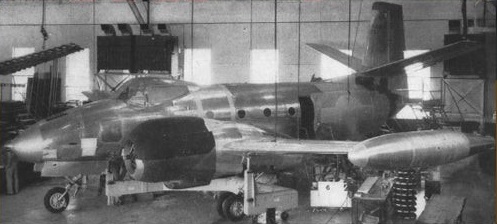
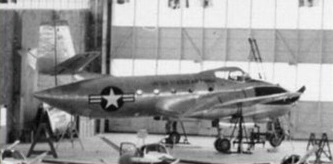
A 4-12 place low wing monoplane with retractable undercarriage, the T-26 was intended to replace C-45s in Air Training Command. A batch of 195 aircraft was ordered, but canceled June 1953 when the first flight of the prototype was a matter of only hours away.
Two were built, as T-36A, but neither was flown.
Engines: two 2300hp P&W R-2800 Wingspan: 70’0″ Length: 52’2″ Est speed: 300+ mph Gross wt: 25,000 lb approx.
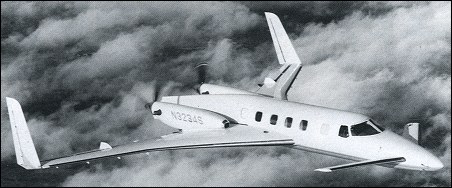
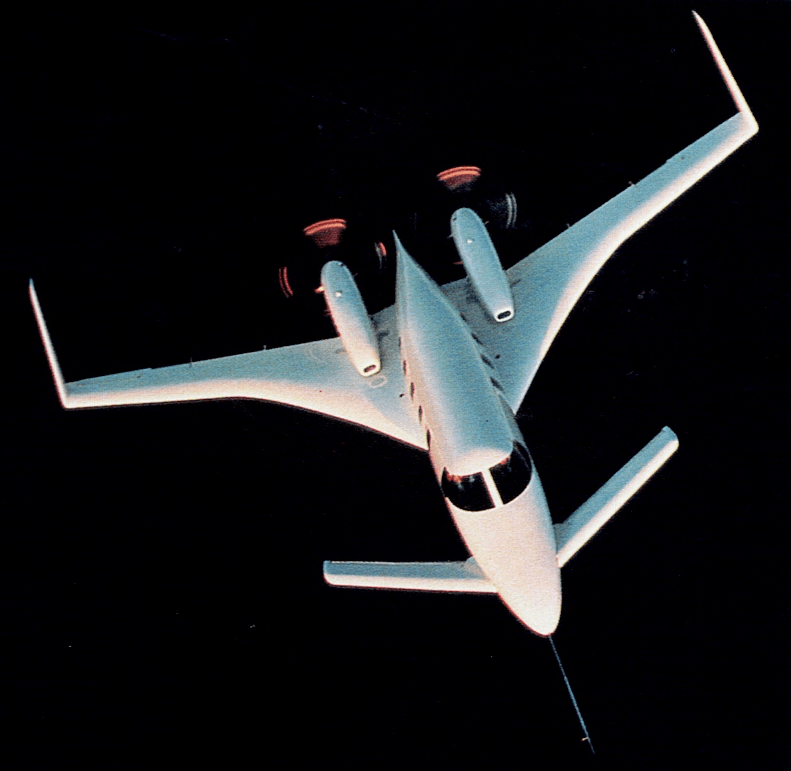
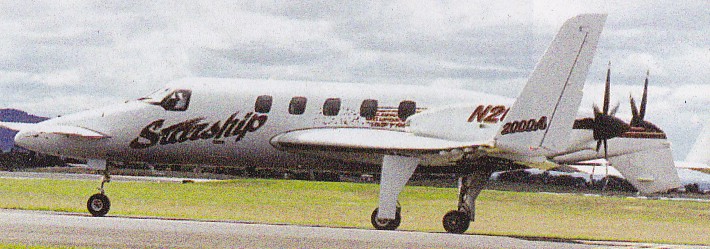
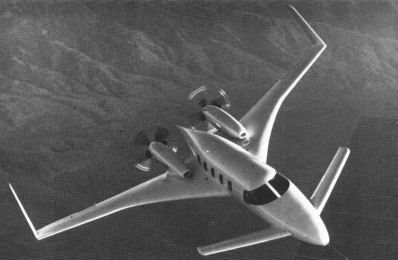
Success in testing the SCAT 1 led to the construction of the Model 2000 Starship 1. The Starship design has compound taper main wings, which mount the two pusher engines. Large endplate fins, known as tipsails, provide longitudinal stability, augmented by two small fins on the wing trailing edge. Additional keel area is provided by a ventral fin under the extreme rear of the slender fuselage. The large canard foreplanes of variable-geometry, sweeping forward by 4 degrees for low-speed flight and 30 degrees back in the cruise.
The Starship is built entirely of composites such as carbon graphite, Kevlar and E-glass, which make for an exceptionally strong and light aircraft that isn’t subject to the same inherent long-term weaknesses found in aluminum airframes. The composite makeup of the airframe doesn’t transmit noise or vibration from its twin 1,200 shp Pratt & Whitney engines, thus keeping interior cabin sound levels extremely low. Because of its canard configuration, the design is virtually impossible to stall. Virtually the entire structure is made of Nomex honeycomb and graphite/epoxy composites, with titanium used in high-stress areas.
The prototype composite construction Starship rolled out at Wichita to begin its certification in 1985. The first of three flying pre-production Starship 1s flew on 15 February 1986. Another three airframes were produced for static, damage tolerance and pressure testing. Basic FAA certification followed on 14 June 1988, and the first production machine flew on 25 April 1989. This has been used for customer demonstration flights, resulting in 40 orders by June of that year.
The tandem wing, twin pusher corporate aircraft is capable of a maximum cruise of 352 knots and a 41,000 foot ceiling. The Starship is the first all-composite, pressurised aircraft to receive FAA type certification. Starship is constructed of layers of graphite fibre surrounding a core of honeycombed nomex, bonded with adhesive resin. The unique Starship entered production in 1988 following first flight of a full-scale prototype on 15 February 1986. Seating eight passengers in a pressurised cabin, the aircraft is powered by two 1,200 shp (895 kW) P & W Canada PT6A-67A turboprops in “pusher” configuration giving a max cruising speed of 335 kts (621 km/h). Composites form a major portion of the Starship’s construction and among its aerodynamic features are variable-geometry foreplanes and large wingtip stabilisers called “tipsails”. Production ceased approximately 10 years after its introduction.
Beech 2000 Starship 1 Engines: 2 x Pratt & Whitney Canada PT6A-67A turboprops, 1,200 shp / 895kW Max take off weight : 14001.8 lb / 6350.0 kg Weight empty : 8917.0 lb / 4044.0 kg Max. weight carried : 5084.7 lb / 2306.0 kg Fuel capacity: 534 US gal Wingspan: 16.6 m / 54 ft 6 in Length: 14.05 m / 46 ft 1 in Height: 3.96 m / 12 ft 12 in Wing area: 26.09 sq.m / 280.83 sq ft Wing load : 49.82 lb/sq.ft / 243.0 kg/sq.m Max. speed : 352 kt / 652 km/h Landing speed : 84 kt / 156 km/h Cruise speed: 621 km/h / 386 mph Initial climb rate : 3346.46 ft/min / 17.0 m/s Service ceiling: 12495 m / 41000 ft Range: 3132 km / 1946 miles Payload : 8-11pax Takeoff distance, 50 ft.: 4,093 ft Landing distance, 50 ft.: 2,630 ft.
To provide a new generation of corporate transports, Beech looked to Burt Rutan’s Scaled Composites Inc. to design and produce the SCAT 1, an 85% scale technology demonstrator of a canard-configured aircraft. Success in testing led to the construction of the Model 2000 Starship 1.
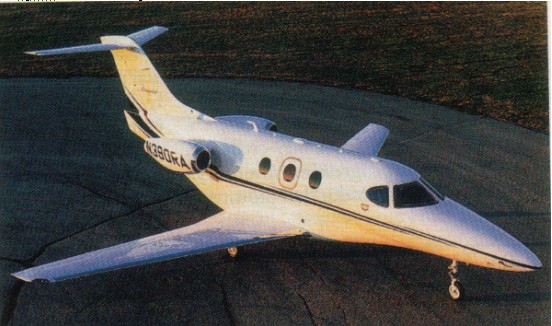
Raytheon developed the composite Premier I entry-level jet with a composite fuselage, empennage and control surfaces built of graphite and epoxy laminates with honeycomb construction, totaling more than a million miles of carbon-fiber filaments. The wings are aluminum.
Premier 1 Engines: two 2,300 lb Williams FJ44-2A Seats: 2+6 Gross weight: 12,500 lb Empty weight: 8,470 lb Fuel capacity: 548 USgals Max cruise: 451 kts Range: 826-1,502 nm Ceiling: 41,000 nm Takeoff distance: 3,792 ft. Landing distance: 3,170 ft.
Premier 1A Engines: (2) Williams FJ44-2A Max Cruise Speed: 451 kt @FL330 Max Range: 1460 nm Max Certified Altitude: 41,000 ft Takeoff Distance: 3792 ft New Price 2009: US$6.4 million
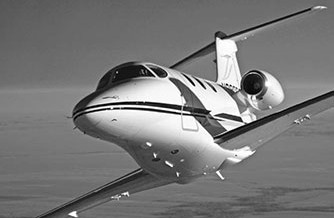
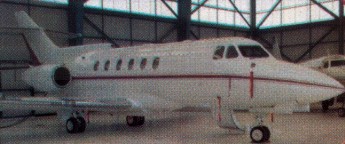
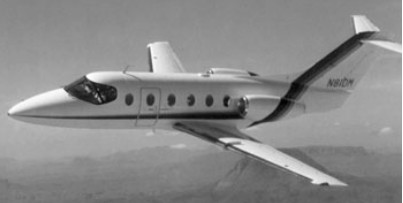
In 1977 Mitsubishi designed and built two prototypes of a twin-turbofan business aircraft designated the MU-300, the first flying on 29 August 1978; a one hour flight. A cantilever low-wing monoplane with a pressurised fuselage and retractable tricycle landing gear, the MU-300 was powered by two JT15D-4 turbofan engines, pod-mounted one on each side of the rear fuselage. Its twin turbofans are rated at 2,500 lbs. s.t. for takeoff and 2,375 lbs. s.t. for maximum continuous operation. Standard accommodation was provided for a crew of two and seven passengers. At the end of the development programme the prototypes were dismantled and shipped to the USA, where they were reassembled by the company’s US subsidiary Mitsubishi Aircraft International Inc. The two Diamond I prototypes underwent 350 hours of test flying in Japan before their arrival in the United States for FAA certification. Redesignated the Diamond I, the two aircraft were used in the US certification programme, which was granted on 6 November 1981. Initial customer deliveries began in July 1982 and 62 were built. The Diamond I wing design, with its advanced flight control system of full-span flaps, wing spoilers, and T-tail empennage, is built for optimum performance.
Mitsubishi developed an improved Model MU300-10 Diamond II, which was approved under FAA type certificate A14SW. Eleven examples were produced before the program was taken over by Beech and the aircraft re-certificated as the Beech Model 400 under new FAA type certificate A16SW. All the MU300-10 were subsequently converted to the Model 400 under Beech Service Bulletin Number 2140.
An improved version, the Diamond IA, fitted with uprated JT15D-4D engines giving overall performance increases, an EFIS cockpit and with maximum take-off weight increased to 7361kg, was announced in 1983 and the first of 27 built, distinguished by the extra port side window, was delivered in 1984. With an MTOW reduced to 7157kg, but with extra fuel, and more powerful JT15D-5 engines, a further eight aircraft were produced as the Diamond II. Model 400 comprised serial numbers RJ-12 through RJ-65.
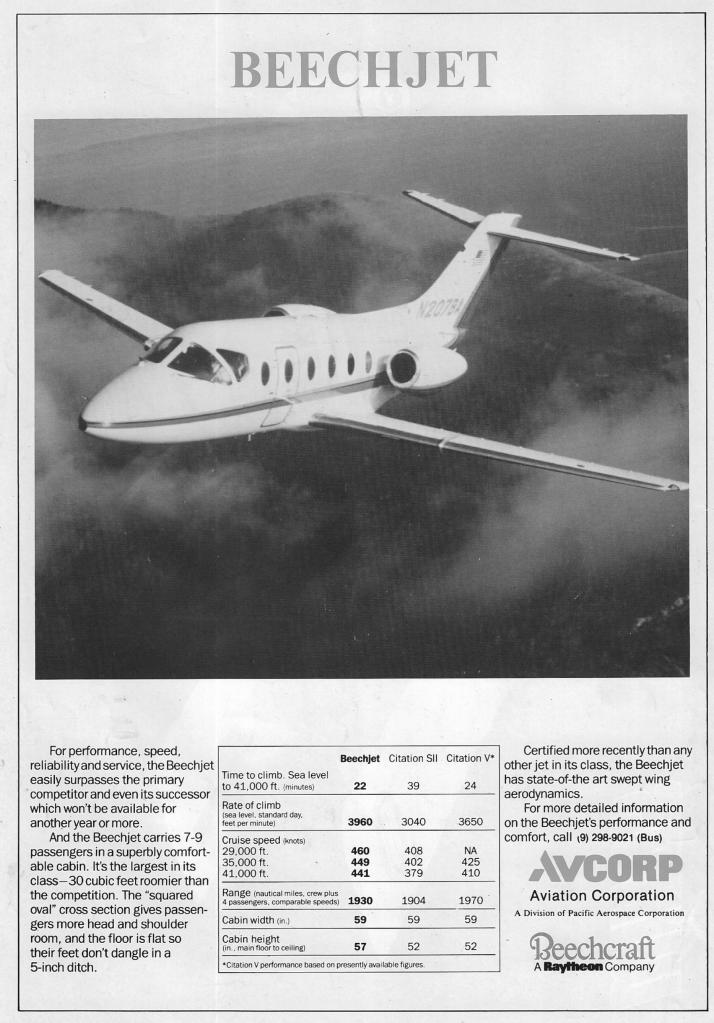
However, in December 1985, Mitsubishi sold the Diamond II design rights to Beech, together with components for 64 aircraft. These were assembled at Wichita and marketed as the Beechjet 400. Beech then initiated full manufacture of the type in 1989. The first Beech-assembled aircraft was rolled out on 19 May 1986 and deliveries began in June. By the beginning of 1989 46 Beechjets had been delivered. Beech is also providing support for previous Mitsubishi products, including the MU-2 and earlier Diamond versions.
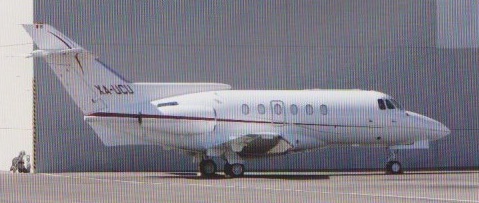
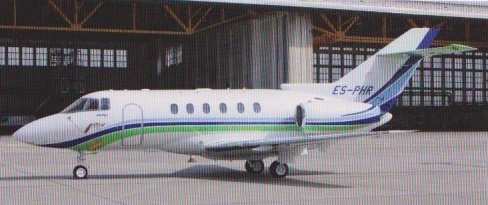
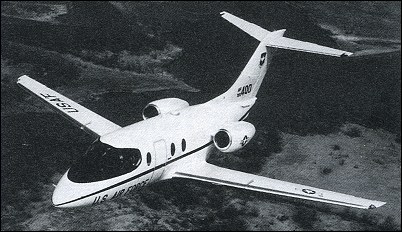
The Beechjet 400A first flew on 22 September 1989. The commercial Model 400A Beechjet was certificated on 20 June 1990, featuring increases in payload and ceiling, greater cabin volume, a rear lavatory and improved soundproofing. A Collins Pro Line 4 EFIS is fitted as standard. Deliveries of this version began in early 1990. By the beginning of 1991 beech had received orders for 113 slightly modified Model 400As In February 1990 the US Air Force chose the type as the airframe element of the Tanker/Transport Training System under the designation Beech 400T T-1A Jayhawk. Powerplants are 2,900 lb st (12.9 kN) P&W Canada JT15D-5 turbofans. The USAF requirement was for 211 aircraft and the first of these was delivered in July 1991 and entered service in March 1992, training KC-135, C-5, KC-10 and C-17 crews. In 2003 its name changed once again to the Hawker 400XP (for ‘extended performance’) for a better fit into the Raytheon family of bizjets.
The Model 400A, serial number RK-1 and on, was a further development. The primary change was the introduction of the Rockwell Collins Proline IV EFIS system, plus other improvements including greater cabin volume, increased max takeoff weight and higher operating ceiling. (From 2003 and serial number RK-354 the aircraft was marketed as the Hawker 400XP.) Production ceased in 2010 with serial number RK-604.
Variation: Nextant 400
Specifications:
MU-300 Diamond I First built: 1981. Engines: 2 x P&W JT15D-4, 2,500 lbs thrust. Seats: 11. Length: 48.3 ft. Height: 13.8 ft. Wingspan: 43.4 ft. Wing area: 241 sq.ft. Wing aspect ratio: 7.5. Maximum ramp weight: 14,200 lbs. Maximum takeoff weight: 14,100 lbs. Standard empty weight: 8600 lbs. Maximum useful load: 5200 lbs. Zero-fuel weight: 10,800 lbs. Maximum landing weight: 13,200 lbs. Wing loading: 58.4 lbs/sq.ft. Power loading: 2.8 lbs/lb. Maximum usable fuel: 4200 lbs. Best rate of climb: 3000 fpm. Certificated ceiling: 41,000 ft. Max pressurisation differential: 9 psi. 8000 ft cabin alt @: 41,000 ft. Maximum single-engine rate of climb: 810 fpm. Single-engine ceiling: 26,500 ft. Maximum speed: 434 kts. Normal cruise @ 37,000ft: 424 kts. Fuel flow @ normal cruise: 1098 pph. Stalling speed clean: 104 kts. Stalling speed gear/flaps down: 91 kts. Turbulent-air penetration speed: 208 kts.
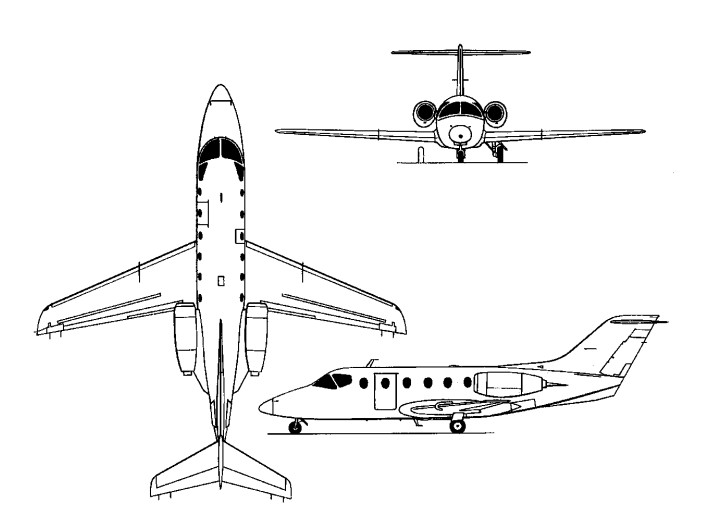
Beechjet 400A Engines: 2 x Pratt & Whitney Canada JT15D-5 turbofans, 1315kg / 2,900 lb st (s/n RK-1 through RK-507) / Pratt & Whitney Canada JT15D-5R (s/n RK-508 and after) MCTOW: 16,100 lb / 16,300 lb. (serial number RK-347 and after, and aircraft with Kit 128-5202-0001 Increased Gross Takeoff Weight.) Weight empty: 10116.5 lbs / 4588.0 kg Wingspan: 13.25 m / 43 ft 6 in Length: 14.75 m / 48 ft 5 in Height: 4.19 m / 13 ft 9 in Wing area: 22.43 sq.m / 241.43 sq ft Wing load: 65.60 lbs/sq.ft / 320.0 kg/sq.m Max. speed: 854 km/h / 531 mph Cruise speed: 828 km/h / 515 mph Landing speed: 87 kts / 161 km/h Ceiling: 13715 m / 45000 ft Service ceiling: 41011 ft / 12500 m Initial climb rate: 4330.71 ft/min / 22.0 m/s Range: 5375 km / 3340 miles Noise Standard: FAR Part 36 Amendment 36-17 Max. No. of Seats: 11
Hawker 400XP Engines two 2,965-lb. Pratt & Whitney JT15D-5 turbofans. Seats 7-9. Gross wt. 16,500 lb. Empty wt. 10,550 lb Fuel capacity 733 US gal. Max cruise 450 kts. Long range cruise 414 kts. Range 874-1,687 nm. Ceiling 45,000 ft Takeoff distance 3,906 ft Landing distance 3,514 ft
In 1975 a decision was made to develop what was to be the model 1900. This was to be a pressurised, high density 19-seater aircraft based on the model 200 Super King Air. Using the model 200 cockpit, tail section, a longer fuselage and a new continuous spar wing was developed. A slightly unusual feature of these aircraft was the “taillets” attached beneath the horizontal tailplane for improved directional stability and an auxiliary horizontal tail (stabilon) on each side of the rear fuselage to extend the aft centre of gravity limits. The first of the three 1900C development aircraft flew (under SFAR part 41C) on 13 September 1982 powered with the PT-6A-65 which was up rated to the 1000-shp -65A on production aircraft. Its type certificate was achieved on 22 November 1983. Production deliveries, fitted with 52-inch by 52-inch cargo doors, began in February 1984 but were phased out in October 1991 when the SFAR part 41 C regulation expired. Some 72 “C” models had been built, followed by around 175 1900C-1 versions with their “wet wings”.
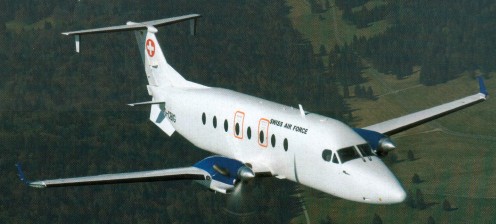
Announced by Raytheon at the US Airlines Association meeting in March 1989 was the Model 1900D, Beech’s answer to the 19-passenger, stand-up, pressurised aircraft for the commuter and regional airline operators. Power chosen was the 1600-shp PT6A-67D flat rated at 1279 shp. Wingspan and area were increased with winglets added. The fuselage was some 28.5% larger, which gives the aircraft the “high forehead” look and “stand-up head room” (of 5 ft 11 in) in the cabin. The aircraft introduced the twin ventral strakes designed to improve the directional stability and turbulence penetration. The wet wing is design fabricated and assembled as a one-piece unit. It is able to hold 2,517 litres in two integral fuel tanks in each wing (the main tanks hold 1621 lbs and the smaller auxiliary tank 621 lbs). The primary controls are mechanically linked and the landing gear is hydraulically actuated with dual main wheels and a single nose wheel. The prototype 1900D (N5584D), a converted 1900C, first flew on 1 March 1990 with FAA certification being achieved in March 1991. Production switched to the 1900D in 1991 and first deliveries began in November 1991.
1900C Engines: 2 x Pratt & Whitney Canada PT6A-65B turboprop.
1900D Engines: 2 x Pratt & Whitney Canada PT6A-67D turboprop, 1279-shp. Props: Hartzell four-blade composite. Wingspan: 57 ft 10 in (17.65rn). Wing area: 303 sq.ft (28.l5sq.m). Length: 57 ft 10 in (17.63m). Height: 14 ft 10 in. (4.54m). Empty weight: 10,400 lb (4,717 kg). MTOW: 16,950 lb (7,688 kg). Wing loading: 54.7 lb/sq.ft (267 kg/sq.m). Power loading: 6.62 lb/hp (3 kg/hp). Max cruise speed 334 mph (537 kph) at 13,000 ft (3,960m). Rate of climb: 2,625 ft/min (800m/min) at sea level. Service ceiling: 25,000 ft (7,620m). SE service ceiling (MTOW): 17,500-ft. Range high cruise power 45 min res: 794 miles (1,278km) at 25,000 ft (7,620m). Pax cap: 19.
The success of the Beech King Air 200 design prompted Beech to explore a jet-powered version. This was the PD.290 Fan Jet 400. The first prototype King Air 200 was re-engined with Pratt & Whitney Canada JT15D-4 turbofans in similar nacelles to the PT6A turboprops.
The aircraft was flown in this configuration for the first time on March 12, 1975. The jet-powered aircraft did not warrant production, and Beech later purchased the Mitsubishi Diamond design.
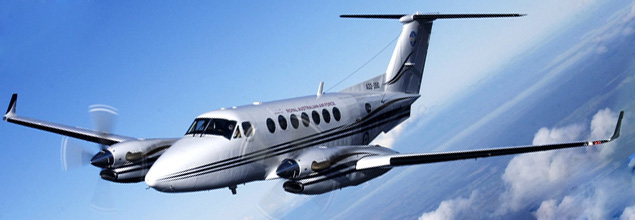
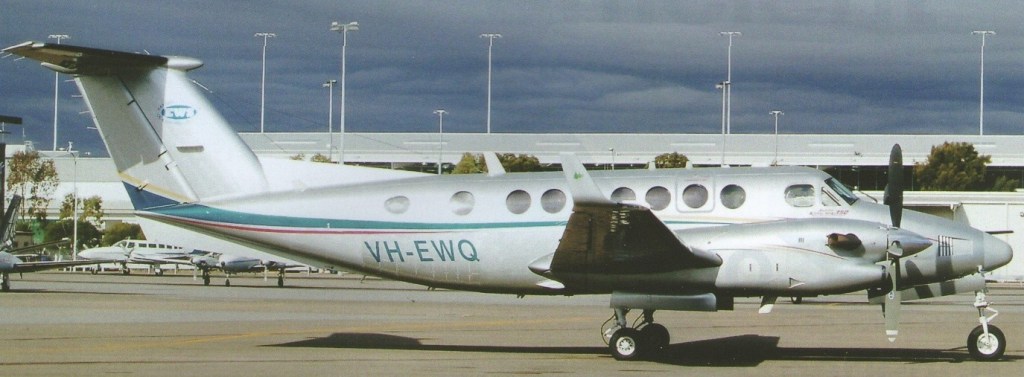
Based on the King Air 300, the Super King Air 350 incorporates a wing of increased span with winglets, and interior changes that increase max seating to 11 plus two crew. The fuselage has been lengthened although the engines remain two 1,050 shp (783 kW) P & W Canada PT6A-60A turboprops. Certificated in 1990, the first King Air 350 was delivered on 6 March 1990.
King Air 350 VH-EWQ
In 2004—the King Air’s 40th anniversary— Raytheon added two 16-cubic-foot wing lockers in the aft portion of the engine nacelles to increase loading flexibilities.
Raytheon Super King Air 350 Engines: Two Pratt and Whitney PT6A-60A turboprops (1050 / 783 kW horsepower each) Propellers: 4-blade Crew: Two pilots, or pilot and navigator/observer, or various crews in training roles Length: 46.654 ft / 14.22m Height: 14.337 ft / 4.40m Wingspan: 57.907 ft / 17.65m Wing area : 310.003 sq.ft / 28.8 sq.m Wing load : 48.38 lb/sq.ft / 236.0 kg/sq.m Max cert TO wt: 6804 kg / 15,100 lb. Max cert ldg wt: 6804 kg. Empty weight: 9,326 lb Payload: 1600kg Fuel capacity: 539 USgals Max. speed : 315 kts / 583 kph Top cruise: 359 kts Initial climb rate: 2,731 fpm Range: 3400km Ceiling: 35,000 feet Takeoff distance: 3,300 ft Landing distance: 2,692 ft Accommodation: Up to six passengers
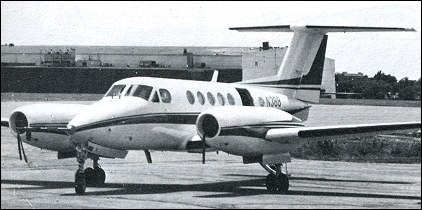
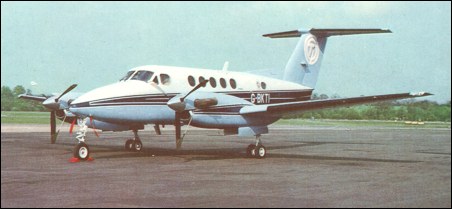
A development of the King Air 90/100, the prototype King Air 200 flew on 27 October 1972. With bigger engines, a bigger wing, more fuel capacity and more useful load, the B200 came along in 1980 with even more efficient Pratt & Whitney PT6A42 engines and another increase in load.
The T-tail Super King Air, with its two 850-shp Pratt & Whitney engines, can be operated from smaller airports; takeoff and landing over a 50-foot obstacle can be accomplished in 2579 and 2845 respectively, without prop reversing.
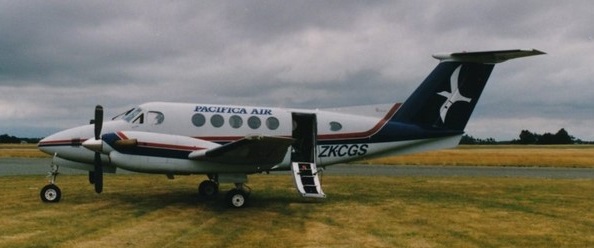
Beechcraft 200 Super Kingair ZK-CGS
First deliveries of Super King Airs were made in early 1974, and the better capability of this aircraft resulted in the company receiving contracts for the supply and support of 34 examples modified for service with the US Army. These are powered by 559kW PT6A-38 turboprop engines, and were allocated the designation C-12A subsequent military orders for the C-12A have to date included 27 and 30 for the US Army and USAF respectively. Other service variants are the UC-12B (66 ordered) for the US Navy/Marine Corps, powered by 634kW PT6A-41 turboprops; the C-12C (14) for the US Army with PT6A-41 engines; the generally similar C-12D (27) for the US Army, but with an added cargo door; and the special-mission RU-21J (three) bristling externally with antennae and equipped for the requirements of the US Army’s ‘Cefly Lancer’ programme. More recent variants are the RC-12D ‘Guardrail V electronic reconnaissance platform, C-12E upgraded transport for the USAF, C-12F transport for USAF and UC-12F for the Navy, RC-12H reconnaissance variant and UC-12M utility transport.
The USAF purchased 40 twin-turboprop Super King Air I 200Cs as C-l2Fs to meet part of its Operational Support Aircraft requirement following an initial period of lease. The cargo door developed for the US Army’s C-12D has been available as an option for civil production since 1979, and in April 1981 Beech introduced a new version, identified as the Super King Air B200. It differs by having PT6A-42 turboprop engines which offer improved cruising performance. A little known but important part of Beech’s product line is the company’s special mission range of aircraft standard models factory modified and certified for aerial survey, photography, specialized training and other unusual purposes. One aircraft developed is a Super King Air with tip tanks, several of which are being built for the French Institut Geographique National for long range photo flights. The tip tanks add about an hour to the KA’s endurance. Other military versions of the King Air series I include the C/UC/RC-12, RU-12, and T-44 for the US forces, together with maritime surveillance variants produced for export customers, for which search radar, low-light TV, Flir, and acoustic processing equipment are optional.
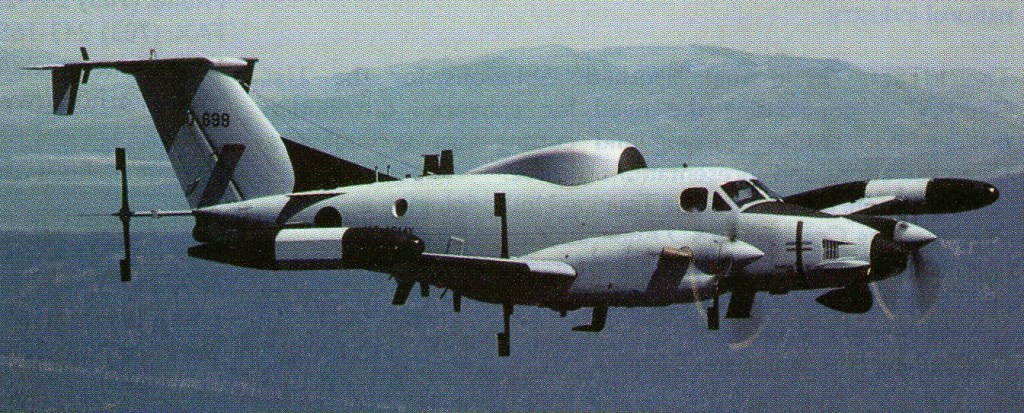
Beechcraft RC-12 Guardrail
In 1995, Raytheon rolled out its 1,500th King Air 200, complete with an EFIS avionics panel.
Variants
Super King Air Model 200T: designation of two specially-equipped aircraft for the French Institut Geographique National for high-altitude photographic and weather observation duties;
Super King Air Maritime Patrol 200T: maritime patrol/multi-mission aircraft, with new outboard wing panels to provide for installation of wingtip fuel tanks, strengthened landing gear, hatch for dropping survival equipment, bubble observation window in aft cabin, and search radar with a 360° scan underfuselage radome; orders include 13 for Japan Maritime Safety Agency, and one for Uruguayan navy;
Super King Air B200C: version of civil B200 with a cargo door as standard;
Super King Air B200CT: version of civil B200 with a cargo door and removable wingtip fuel tank provisions as standard;
Super King Air B200T: version of the civil B200 with removable wingtip fuel tank provisions as standard;
Super King Air 300: improved version with PT6A-60A turboprops each rated at 783kW and corresponding increase in take-off weight. The 300LW is a lightened version optimised for European operations;
1300 Commuter: King Air B200 version for commuter airlines. Accommodates up to 13 passengers with an optional belly luggage pack.
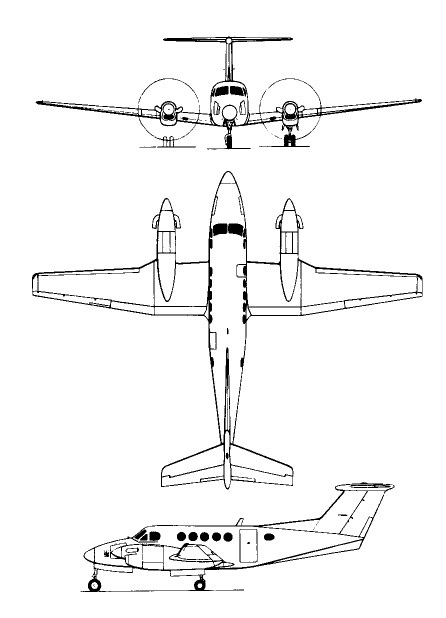
BE-200 Super King Air First built: 1974. Engines: 2 x P&W PT6A-42, 850 shp. Props: Hartzell 3-blade, 98.5-in. Seats: 8/15. Length: 43.8 ft. Height: 15 ft. Wingspan: 54.5 ft. Wing area: 303 sq.ft. Wing aspect ratio: 9.8. Maximum ramp weight: 12,590 lbs. Maximum takeoff weight: 12,500 lbs. Standard empty weight: 7538 lbs. Maximum useful load: 5052 lbs. Maximum landing weight: 12,500 lbs. Wing loading: 41.3 lbs/sq.ft. Power loading: 7.4 lbs/hp. Maximum usable fuel: 3645 lbs. Best rate of climb: 2450 fpm. Service ceiling: 35,000 ft. Max pressurisation differential: 6.5 psi. 8000 ft cabin alt @: 29,742 ft. Maximum single-engine rate of climb: 740 fpm @ 122 kts. Single-engine climb gradient: 364 ft/nm. Single-engine ceiling: 21,735 ft. Maximum speed: 294 kts. Normal cruise @ 27,000 ft: 279 kts. Fuel flow @ normal cruise: 563 pph. Endurance at normal cruise: 5.9 hrs: Stalling speed clean: 99 kts. Stalling speed gear/flaps down: 75 kts. Turbulent-air penetration speed: 170 kts.
A200 Engines two 850-shp Pratt & Whitney reverse flow, free turbines. Seats 6-13. Gross Wt. 12,500 lbs. Emp¬ty Wt. 7437 lbs. Fuel capacity 544 USG. Top speed 333 mph. Cruise 322 mph. Stall 86 mph. Initial climb rate 2450 fpm. Ceiling 31,000+ ft. Range 2022 sm. Takeoff distance (50’) 2579 ft. Landing distance (50’) 2074 ft. Seats: 6-13
Super King Air B200 Engines: 2 x Pratt & Whitney Aircraft Canada PT6A-42 turboprops, 850 shp / 634kW Max Take-off weight: 5670 kg / 12500 lb Empty weight: 8,283 lb Fuel capacity: 544 US gal Std useful load: 5,052 lbs. Wingspan: 16.61 m / 54 ft 6 in Length: 13.34 m / 43 ft 9 in Height: 4.57 m / 14 ft 12 in Wing area: 28.15 sq.m / 303.00 sq ft Max. speed: 545 km/h / 339 mph / 294 kt Cruise speed: 523 km/h / 325 mph Ceiling: 10670 m / 35000 ft Range: 3756 km / 2334 miles Initial climb rate: 2,460 fpm Takeoff distance: 2,579 ft Landing distance: 2,845 ft. Seats: 8
C-12 Huron Engines: 2 x Pratt & Whitney PT6A-21, 550 SHP Maximum Range: 215miles (346km) Rate-of-Climb: 2,010ft/min (613m/min) Service Ceiling: 35,105ft (10,700m; 6.6miles) Accommodation: 1 + 5
C-12D Engine: 2 x P&WAC PT6A. Installed pwr: 1270 kW. Span: 16.6 m. Length: 13.4 m. Wing area: 27.9 sq.m Empty wt: 3655 kg. MTOW: 5670 kg. Payload: 2040 kg. Cruise speed: 510 kph. Initial ROC: 730 m / min. Ceiling: 9450 m. T/O run (to 15m): 1005 m. Ldg run (from 15m): 790 m. Fuel internal: 1160 lt. Range: 3300 km. Capacity: 14 pax.
U-21J US Army version of the Super King Air 200 for battlefield reconnaissance and EW missions