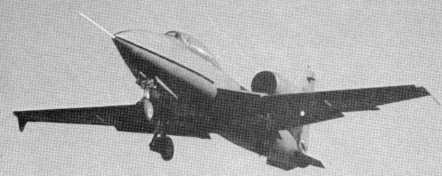
Originally developed by Flight Concepts, the Skyfox twin-turbofan advanced trainer was developed and marketed by the Boeing Military Airplane Company, which holds an exclusive production licence for the aircraft. More than 700 active T-33s, of which the Skyfox is a remanufacture, have been iden¬tified by Boeing, and at least 200 are seen as potential subjects for conversion.
Skyfox N221SF first flew on August 23, 1983, piloted by Skip Holm or Tony LeVier, and has two externally mounted 16.4kN thrust Garrett TFE731 engines in place of the T-33’s single 20.5kN J33 turbojet. The forward fuselage is reprofiled in the absence of air intakes and faired into enlarged leading edge root extensions. Winglets are fitted in place of the T-33’s tip tanks, and internal fuel capacity is increased to compensate. A redesigned, enlarged empennage is fitted. The tandem cockpit is updated with modern avionics, equipment, and Stencel ejection seats. The resulting aircraft retains 70 per cent of the T-33’s original structure, including the wing and landing gear.
The rights to the Skyfox transferred to Boeing as Boeing Skyfox. The registration was cancelled in 1997.
Gemini Engine: 2 x Garrett TFE731-3A, 3700 lb Installed thrust: 33 kN. Span: 11.8 m / 37’10” Length: 14 m / 44’0″ Empty wt: 4665 kg. MTOW: 9070 kg. Warload: 2720 kg. Max speed: 935 kph. Initial ROC: 3050 m / min. Ceiling: 15,240 m / 50,000′ T/O run (to 15m): 670 m. Ldg run (from 15m): 1097 m. Fuel internal: 2950 lt. Range: 5560 km. Hardpoints: 4 Seats: 2
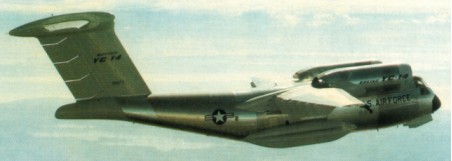
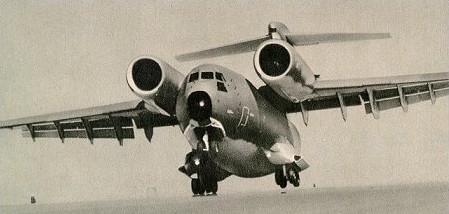
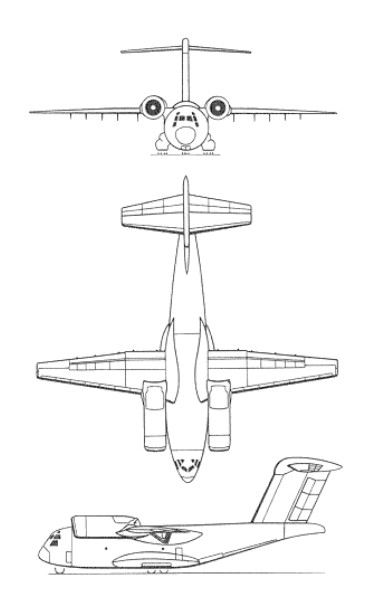
In 1971 the USAF began to put together the specification of a new transport as a possible replacement for its fleet of Lockheed C-130 Hercules aircraft. In early 1972 requests for proposals were sent out to nine US manufacturers, and those of the Boeing Company and McDonnell Douglas Corporation were selected for competitive evaluation under the respective designations YC-14 and YC-15. The Boeing Model 953 design for STOL performance was based on the use of a supercritical wing, developed by NASA from the wind-tunnel research of Dr Richard Whitcomb, which provides highly efficient performance from the wing at high subsonic speeds. To this wing Boeing added an advanced wing upper-surface blowing concept, mounting the twin engines above the wing so that their efflux was exhausted over the wing. With the wing’s leading-edge and Coanda-type trailing-edge flaps extended, the high-speed airflow from the engines tended to cling to the upper surface of the wing/flap system, and was thus directed downwards to provide powered lift.
Designed to carry 27,000 pounds of cargo in and out of short, unimproved airfields, the Boeing YC 14 is powered by two shoulder mounted GE CF6 50 engines The Boeing YC 14 prototype (72-1873) for competitive evaluation against the McDonnell Douglas YC-15 was flown for the first time on 9 August 1976. Maximum payload was 150 troops or 36,742kg of freight in conventional operations, while for STOL operations from an airfield of less than 572m the payload was still a useful 12,247kg. At the completion of testing, in the late summer of 1977, the YC-14 prototype was returned to Boeing for continuing development, if the company so wished, but no further government funding for development or procurement was forthcoming. Boeing’s YC-14 program was aborted after 600 hours of flight testing with two prototypes.
Engines: 2 x GE CF 6-50D, 226.9kN Take-off weight: 97977 kg / 216003 lb Empty weight: 54000 kg / 119050 lb Wingspan: 39.3 m / 128 ft 11 in Length: 40.1 m / 131 ft 7 in Height: 14.7 m / 48 ft 3 in Wing area: 163.7 sq.m / 1762.05 sq ft Cruise speed: 750 km/h / 466 mph Range w/max.fuel: 740 km / 460 miles Crew: 2-3
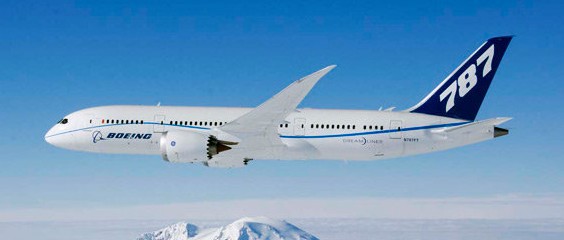
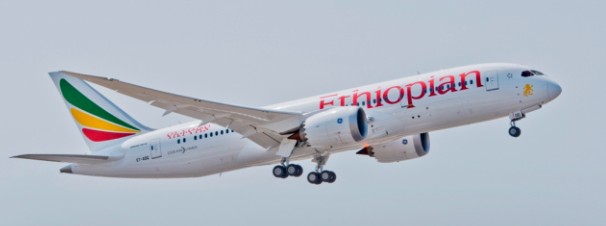
The Boeing 787 Dreamliner is a long range, mid-sized, wide-body, twin-engine jet airliner developed by Boeing Commercial Airplanes. It seats 210 to 330 passengers, depending on the variant. Boeing states that it is the company’s most fuel-efficient airliner and the world’s first major airliner to use composite materials for most of its construction. The 787 was designed to become the first production composite airliner, with the fuselage assembled in one-piece composite barrel sections instead of the multiple aluminum sheets and some 50,000 fasteners used on existing aircraft. Boeing selected two new engine types to power the 787, the General Electric GEnx and Rolls-Royce Trent 1000. The two different engine models compatible with the 787 use a standard electrical interface to allow an aircraft to be fitted with either Rolls-Royce or General Electric engines. This aims to save time and cost when changing engine types.
During the design phase the 787 underwent extensive wind tunnel testing at Boeing’s Transonic Wind Tunnel, QinetiQ’s five-meter wind tunnel at Farnborough, UK, and NASA Ames Research Center’s wind tunnel, as well as at the French aerodynamics research agency, ONERA. The final styling of the aircraft was more conservative than earlier proposals, with the fin, nose, and cockpit windows changed to a more conventional form. By the end of 2004, customer-announced orders and commitments for the 787 reached 237 aircraft. Boeing initially priced the 787-8 variant at US$120 million, a low figure that surprised the industry. In 2007, the list price was US$146–151.5 million for the 787-3, US$157–167 million for the 787-8 and US$189–200 million for the 787-9.
First offered in late 2003, the program was officially launched in April 2004. The aircraft’s initial designation 7E7 was changed to 787 in January 2005. Assembly started in 2006, the first 787 unveiled in a roll-out ceremony on July 8, 2007, at Boeing’s Everett assembly factory, by which time it had become the fastest-selling wide-body airliner in history with 677 orders. First flown in December 2009, by September 2010, 847 Boeing 787s had been ordered by 56 customers. As of 2010, launch customer All Nippon Airways has the largest number of 787s on order.
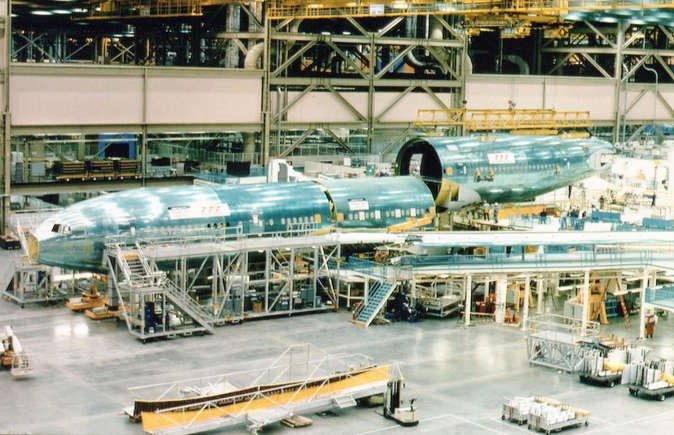
The 787 is being assembled at the Boeing Everett Factory in Everett, Washington. Aircraft will also be assembled at a new factory in North Charleston, South Carolina. Both sites will deliver 787s to airline customers. Originally planned to enter service in May 2008, the project has suffered from repeated delays and is now more than three years behind schedule. The airliner’s maiden flight took place on December 15, 2009. Boeing announced on December 16, 2003, that the 787 would be assembled in its factory in Everett, Washington. Instead of building the complete aircraft from the ground up in the traditional manner, final assembly would employ just 800 to 1,200 people to join completed subassemblies and to integrate systems. Boeing assigned its global subcontractors to do more assembly themselves and deliver completed subassemblies to Boeing for final assembly. This approach was intended to result in a leaner and simpler assembly line and lower inventory, with pre-installed systems reducing final assembly time by three-quarters to three days. Subcontracted assemblies included: wing manufacture (Mitsubishi Heavy Industries, Japan, central wing box) horizontal stabilizers (Alenia Aeronautica, Italy; Korea Aerospace Industries, South Korea) fuselage sections (Global Aeronautica, Italy; Boeing, North Charleston, USA; Kawasaki Heavy Industries, Japan; Spirit AeroSystems, Wichita, USA; Korean Air, South Korea) passenger doors (Latécoère, France) cargo doors, access doors, and crew escape door (Saab, Sweden) floor beams (TAL Manufacturing Solutions Limited, India) wiring (Labinal, France) wing-tips, flap support fairings, wheel well bulkhead, and longerons (Korean Air, South Korea) landing gear (Messier-Dowty, France) power distribution and management systems, air conditioning packs (Hamilton Sundstrand, Connecticut, USA). tail (Alenia).
To speed delivery of the 787’s major components, Boeing modified several used 747-400s into 747 Dreamlifters to transport 787 wings, fuselage sections, and other smaller parts. Japanese industrial participation was very important to the project, with a 35% work share, the first time Japanese firms had taken a lead role in mass production of Boeing airliner wings, and many of the subcontractors supported and funded by the Japanese government. On April 26, 2006, Japanese manufacturer Toray Industries and Boeing announced a production agreement involving US$6 billion worth of carbon fiber, extending a 2004 contract and aimed at easing production concerns.
Boeing had originally planned for a first flight by the end of August 2007 and premiered the first 787 at a rollout ceremony on July 8, 2007, which matches the aircraft’s designation in the US-style month-day-year format (7/8/07). However, the aircraft’s major systems had not been installed at that time, and many parts were attached with temporary non-aerospace fasteners requiring their later replacement with flight fasteners. Although intended to shorten the production process, 787 subcontractors initially had difficulty completing the extra work, because they could not procure the needed parts, perform the subassembly on schedule, or both, leaving remaining assembly work for Boeing to complete as “traveled work”.
The 787 Dreamliner’s first public appearance was webcast live on July 8, 2007. Rolled out on 8 July 2007 with 677 firm orders from 47 operators, the prototype was held together largely with temporary fasteners in order to meet the date. At the time QANTAS ordered 20 more.
On September 5 Boeing announced a three-month delay, blaming a shortage of fasteners as well as incomplete software. On October 10, 2007, a second three-month delay to the first flight and a six-month delay to first deliveries was announced due to problems with the foreign and domestic supply chain, including an ongoing fastener shortage, the lack of documentation from overseas suppliers, and continuing delays with the flight guidance software. Less than a week later, Mike Bair, the 787 program manager was replaced. On January 16, 2008, Boeing announced a third three-month delay to the first flight of the 787, citing insufficient progress on “traveled work”. On March 28, 2008, in an effort to gain more control over the supply chain, Boeing announced that it planned to buy Vought Aircraft Industries’ interest in Global Aeronautica; the company later agreed to also purchase Vought’s North Charleston, S.C. factory.
On April 9, 2008, Boeing officially announced a fourth delay, shifting the maiden flight to the fourth quarter of 2008, and delaying initial deliveries by around 15 months to the third quarter of 2009. The 787-9 variant was postponed to 2012 and the 787-3 variant was to follow with no firm delivery date. On November 4, 2008, the company announced a fifth delay due to incorrect fastener installation and the Boeing machinists strike, stating that the first test flight would not occur in the fourth quarter of 2008. After assessing the 787 program schedule with its suppliers, Boeing confirmed on December 11, 2008 that the first flight would be delayed until the second quarter of 2009.
On June 15, 2009, during the Paris Air Show, Boeing said that the 787 would make its first flight within two weeks. However, on June 23, 2009, Boeing announced that the first flight is postponed “due to a need to reinforce an area within the side-of-body section of the aircraft”. Boeing provided an updated 787 schedule on August 27, 2009, with the first flight planned to occur by the end of 2009 and deliveries to begin at the end of 2010. The company expects to write off US$2.5 billion because it considers the first three Dreamliners built unsellable and suitable only for flight tests.
The first Boeing 787 underwent taxi tests at Paine Field in November and December 2009.
As Boeing worked with its suppliers on early 787 production, the aircraft design had proceeded through a series of test goals. On August 7, 2007, on-time certification of the Rolls-Royce Trent 1000 engine by European and US regulators was received. On August 23, 2007, a crash test involving a vertical drop of a partial composite fuselage section from about 15 ft (4.6 m) onto a 1 in (25 mm)-thick steel plate occurred in Mesa, Arizona. The results matched what Boeing’s engineers had predicted, allowing modeling of various crash scenarios using computational analysis instead of further physical tests. On June 20, 2008, the 787 team achieved “Power On” of the first aircraft, powering and testing the aircraft’s electrical supply and distribution systems On May 3, 2009, the first test 787 was moved to the flight line following extensive factory testing, including landing gear swings, systems integration verification, and a total run through of the first flight. Boeing spent most of May 2009 conducting tests on the first 787 prototype in preparation for the first flight. On March 28, 2010 the 787 completed the ultimate wing load test which requires that the wings of a fully assembled aircraft be loaded to 150% of design limit load and held for 3 seconds. The wings were flexed approximately 25 ft (7.6 m) upward during the test.
On December 15, 2009, Boeing conducted the Dreamliner’s maiden flight with the first 787-8, originating from Snohomish County Airport in Everett, Washington at 10:27 am PST, and landing at Boeing Field in King County, Washington at 1:35 pm PST. Originally scheduled for four hours, the test flight was shortened to three hours because of bad weather.
The third Boeing 787-8 Dreamliner (N7874 c/n 40693 ZA004) joined the test programme in February 2010.
The 787 flight test program is composed of 6 aircraft, ZA001 through ZA006, four with Rolls-Royce Trent 1000 engines and two with GE GEnx-1B64 engines. The second 787, ZA002 in All Nippon Airways livery, flew to Boeing Field on December 22, 2009 to join the flight test program; the third 787, ZA004 joined the test fleet with its first flight on February 24, 2010, followed by ZA003 on March 14, 2010. On March 24, 2010, testing for flutter and ground effects was completed, clearing the aircraft to fly its entire flight envelope.
On April 23, 2010 Boeing delivered their latest 787 to a hangar at Eglin Air Force Base, Florida for extreme weather testing in temperatures ranging from 115 °F to -45 °F (46 °C to -42 °C), with all steps necessary to prepare for takeoff taken once the plane stabilizes at either temperature extreme. Dreamliner ZA005, the fifth 787 and the first with General Electric GEnx engines began ground engine tests in May 2010. ZA005 made its first flight on June 16, 2010 and joined the flight test program. In June 2010, gaps were discovered in the horizontal stabilizers of test aircraft, due to improperly installed shims; all aircraft produced then were to be inspected and repaired. The 787 made its first appearance at an international air show at the Farnborough Airshow, UK on July 18, 2010.
Boeing 787-8
As of November 8, 2010, the six 787 test aircraft had flown 2,290 hours in 735 flights combined.
On November 9, 2010, Boeing 787, ZA002 made an emergency landing after smoke and flames were detected in the main cabin during a test flight over Texas. A Boeing spokeswoman said the airliner landed safely and the crew was evacuated after landing at the Laredo International Airport, Texas. The electrical fire caused some systems to fail before landing. Following this incident, Boeing suspended flight testing on November 10, 2010. Ground testing has been performed instead. On November 22, 2010, Boeing announced that the in-flight fire can be primarily attributed to foreign object debris (FOD) that was present in the electrical bay. After electrical system and software changes, 787s returned to company flight testing on December 23, 2010.
The 787 features lighter-weight construction. Its materials (by weight) are: 50% composite, 20% aluminum, 15% titanium, 10% steel, 5% other. The craft will be 80% composite by volume. Each 787 contains approximately 35 short tons of carbon fiber reinforced plastic, made with 23 tons of carbon fiber. Aluminum is used on wing and tail leading edges, titanium used mainly on engines and fasteners, with steel used in various places.
The 787-8 is the base model of the 787 family with a length of 186 feet (57 m) and a wingspan of 197 feet (60 m) and a range of 7,650 to 8,200 nautical miles (14,200 to 15,200 km) depending on seating configuration. The 787-8 seats 210 passengers in a three class configuration. The variant will be the first of the 787 line to enter service. Boeing is targeting the 787-8 to replace the 767-200ER and 767-300ER, as well as expand into new non-stop markets where larger planes would not be economically viable. The bulk of 787 orders are for the 787-8.
In August 2011 the 787 received FAA certification for commercial operations. The first customer, All Nipon Airways was scheduled to receive the first delivery at Tokyo on 28 September, 2011 (about three years behind schedule), and orders stood at 827 aircraft (at US$185 million).
The Boeing 787-9 made its inaugural flight on 17 September 2013 at Paine Field in Everett, WA. The stretched 787 took off at 11:02 AM and completed a 5 hour and 16 minute flight, landing at Boeing Field in Seattle. During the flight, 787-9 Senior Project Pilot Mike Bryan and 787 Chief Pilot Randy Neville departed to the north, reaching an altitude of 20,400 feet and an airspeed of 250 knots, customary for a first flight. While captains Bryan and Neville tested the airplane’s systems and structures, onboard equipment transmitted real-time data to a flight-test team on the ground in Seattle.
Boeing 787-9
Powered by two Rolls-Royce Trent 1000 engines, the first 787-9 was to be joined in flight test by two additional airplanes, one with General Electric GEnx engines.
Boeing 787-3 Dreamliner Engines: 2 x General Electric OR Rolls Royce Trent 1000 turbofan, 53,000lbs thrust Length: 186.02ft (56.7m) Width: 170.60ft (52.00m) Height: 55.45ft (16.90m) Maximum Speed: 587mph (945kmh; 510kts) Maximum Range: 3,511miles (5,650km) Service Ceiling: 42,979ft (13,100m) Accommodation: 2 + 290 Empty Weight: 222,667lbs (101,000kg) Maximum Take-Off Weight: 374,786lbs (170,000kg)
787-8 Dreamliner Engines: 2 x General Electric Genx, 64,000 lbf (280 kN) or Rolls-Royce Trent 1000, 71,000 lbf (320 kN) Cockpit crew: Two Seating: 210-290 Length: 186 ft (56.7 m) Wingspan: 170 ft 6 in (52.0 m) Wing area: 3,501 sq ft (325 m2) Wing sweepback: 32.2 degrees Height: 55 ft 6 in (16.9 m) Fuselage Width: 18 ft 11 in (5.77 m) Fuselage Height: 19 ft 7 in (5.97 m) Maximum cabin width: 18 ft (5.49 m) Cargo capacity: 4,822 cu ft (137 cu.m) 28× LD3 or 9x (88×125) pallets or 8x (96×125) pallets + 2x LD3 Maximum takeoff weight: 502,500 lb (228,000 kg) Maximum landing weight: 380,000 lb (172,000 kg) Operating empty weight: 242,000 lb (110,000 kg) Cruising speed: Mach 0.85 (567 mph, 490 knots, 913 km/h at 35,000 ft/10,700 m) Maximum speed: Mach 0.89 (593 mph, 515 knots, 954 km/h at 35,000 ft/10,700 m) Range, fully loaded: 7,650–8,200 nmi (14,200–15,200 km; 8,800–9,440 mi) Maximum fuel capacity: 33,528 US gal (126,920 L) Service ceiling: 43,000 ft (13,100 m)
787-9 Dreamliner Engines: 2 x General Electric Genx, 64,000 lbf (280 kN) or Rolls-Royce Trent 1000, 71,000 lbf (320 kN) Cockpit crew: Two Seating: 210-290 Length: 206 ft (62.8 m) Wingspan: 197 ft 3 in (60.1 m) Wing area: 3,501 sq ft (325 sq.m) Wing sweepback: 32.2 degrees Height: 55 ft 6 in (16.9 m) Fuselage Width: 18 ft 11 in (5.77 m) Fuselage Height: 19 ft 7 in (5.97 m) Maximum cabin width: 18 ft (5.49 m) Cargo capacity: 6,086 cu ft (172 cu.m) 36× LD3 or 11x (88×125) pallets or 11x (96×125) pallets Maximum takeoff weight: 545,000 lb (247,000 kg) Maximum landing weight: 425,000 lb (193,000 kg) Operating empty weight: 254,000 lb (115,000 kg) Cruising speed: Mach 0.85 (567 mph, 490 knots, 913 km/h at 35,000 ft/10,700 m) Maximum speed: Mach 0.89 (593 mph, 515 knots, 954 km/h at 35,000 ft/10,700 m) Range, fully loaded: 8,000–8,500 nmi (14,800–15,700 km; 9,210–9,780 mi) Maximum fuel capacity: 33,428 US gal (126,540 L) Service ceiling: 43,000 ft (13,100 m)
In 1985, studies were centered around a 21ft (6.4m) stretch of the 767-300, dubbed the 400 (the 777 designation was first publicized in 1978, linked to proposed tri-jet versions of the 767), with the same fuel capacity, engines, and gross weight of the 767 300. A longer range development was possible, but would require “some wing work,” said Boeing. Market assessment for the derivative began late in 1986 and proceeded at a rather leisurely pace. The launch of the MD 11, followed by the A330/A340, stimulated Boeing’s efforts and by the third quarter of 1988, the manufacturer was discussing a wide range of derivatives of the 767 with airlines, grouped in three categories under the 767-X nomenclature. The least expensive proposal was a slightly stretched 767 300 which retained the existing wing, but resulted in only a modest capacity increase. A ‘maximum change’ 767 would have wing tip extensions and winglets, plus the additional of a wing root insert. The most expensive suggestion featured a completely new wing (called 767RW, or Re Wing) that would allow a significant fuselage stretch as much as 539in (44ft llin/13.69m) although the span would be such that it could pose airport gate compatibility problems. The dozen different studies included several designs with second decks, including one 9ft (2.74m) stretch with a partial upper deck aft of the wing. All of the 767 X designs would have required powerplants with increased thrust over existing 767 engines, although at the time Boeing stated that they would not need a re fanned engine, proposed by all three engine manufacturers General Electric, Pratt & Whitney, and Rolls Royce to meet the 67,500 71,000 lb st (300.2 315.8kN) requirements of Airbus for the A330. Boeing’s market research indicated that the 767 X would have to satisfy three different markets. The A Market aircraft, intended for US transcontinental, Europe Asia, and intra Asia routes, would be a 300-seater with a range of 4,000nm (7,400km). Next in significance was the B Market, aimed at the evolving North Atlantic extended-range twin jet segment (then known by the acronym EROPS, for Extended Range OperationS). The 250 seat air¬craft would have a range of 5,500nm (10,200km) and be capable of flying between secondary US and European destinations, such as Dallas Frankfurt. Finally, there was a future C Market proposal, for twin jet operations between the US West Coast and Asia, and between Europe and the Orient. This 230 seat aircraft (about the same size as a 767 300) would have a range of 7,000nm (13,000km). Boeing which traditionally had only consulted with one or two prospective launch customers invited representatives of eight airlines (All Nippon Airways, American Airlines, British Airways, Cathay Pacific Airways, Delta Air Lines, Japan Airlines, QANTAS, and United) to form a steering committee. The ‘Gang of Eight’ met regularly in Seattle, and helped to define the 767-X Several driving forces for the 767 X emerged by spring 1989, including serious interest from All Nippon and United. By then, enthusiasm for the double deck proposals had waned in favor of a new nine abreast design, retaining only the nose and tail of the 767. Re fanned engines would be a necessity, and the designation 787 was linked briefly to the aircraft which would be available from mid 1995.
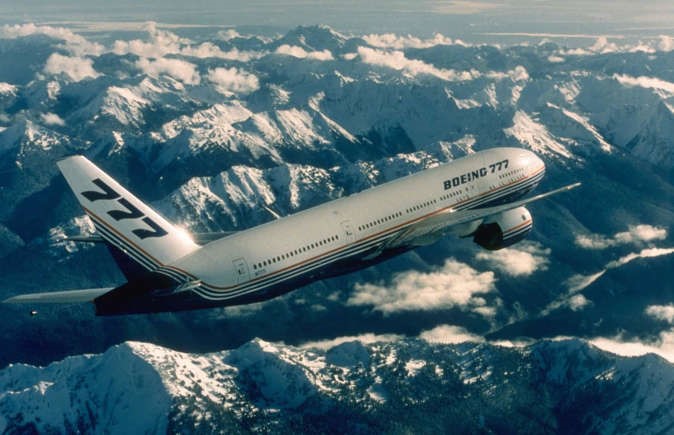
On December 8,1989, Boeing’s board of directors authorized the company’s salesmen to make firm offers of a 767 X design which, when formally launched, would become the 777. The basic configuration was a wide body twin with a twin aisle cabin “wider than the 767, A330, or MD 1l,” to seat around 350 passengers in a two class layout with a range of 4,200nm (7,800km). Its wing span was considerably greater than that of the 767 300, and only slightly less than that of the 747 400. One option under study was the incorporation of folding wing tips. While the chosen design involved the highest development costs, it also allowed for the most growth in the future. This aircraft was the first fly-by-wire passenger aircraft for Boeing and many other firsts were incorporated in this aircraft, including an advanced glass cockpit, the large-scale use of composite materials, extremely powerful engines, and Boeing also used computers to design and electronically preassemble the entire airplane. The cockpit has five large 200-mm liquid-crystal, multi-function display (MFD) screens, with an additional screen on the central console panel. This MFD, along with the centre display on the panel, is used for the aircraft’s engine indication and crew alerting system (EICAS), while each pilot has two main screens in front of them which are used as primary flight displays (PFD) and the navigation displays (ND). The B777 is a true fly-by-wire aircraft. The primary flight-control system (PFCS) has two types of computers in its system: the actuator control electronics (ACE) which is primarily an analogue device, and the primary flight computer (PFC) which is digital. There are four ACEs and three PFCs and, furthermore, the PFCs have three channels for operation. The four ACEs receive the data from multiple transducers on the pilot controls and those on the primary surface actuators. This is then converted to digital and sent over the “triplex hi-directional buses” to the PFCs. These are then returned over the same buses (hi-directional remember) for the ACEs to convert these signals back into analogue commands for each actuator. The aircraft systems then operate the flight controls.
Three engine types have been offered to power the B777: the Rolls-Royce Trent 800, the Pratt & Whitney PW4000 and the General Electric GE 90. The fan diameters are incredibly large with the largest, the GE 90, measuring 3.12 metres. These engines have been rated from 74,000 lbs for the original P&W PW4074, to the largest, 98,000 lbs, of the P&W PW4098. Although a 239in (19ft llin/6.07m) cross section was studied, eventually the fuselage diameter was set at 244in (20ft 4in/6.2m), compared to 237in (19ft 9in/6.02m) for the MD 11 and 222in 08ft 6in/5.64m) for the A330/A340. Consequently, Boeing claims that the 777 offers more interior options and greater flexibility than the competition, from a six abreast first class layout with 21in (53cm) wide seats to a ten abreast economy section with ‘industry standard comfort levels’ (which translates to 17in (43cm) wide seats with a 32in (81cm) pitch). Originally, the new aircraft was to retain considerable systems commonality with the 767, but in the event only some of the cockpit structure was retained. Because of customer preference the layout of the 777’s two person flight deck is similar to that of the 747 400. However, instead of CRT (Cathode Ray Tube) screens, six flat panel Liquid Crystal Displays (LCDs) show flight, engine, and navigation information. In addition to saving space, LCDs weigh less, require less power, and generate less heat than CRT displays. Even the three standby gauges are LCDs; a compass is the only ‘dial’ survivor from previous generation cockpits. The aircraft’s total fuel capacity is accommodated entirely within the wing and structural centre section. Although Boeing had indicated it would prefer to have at least 100 orders for its new design, the 777 200 (there was no 100) was launched on October 29, 1990, following on the heels of an initial order for 34 (plus 34 options) from United. All Nippon took the plunge (for 15 plus 10 options) that December, the same month that a revised memorandum of understanding (MOU) was signed by Boeing, Fuji, Kawasaki, and Mitsubishi for the Japanese to assume responsibility for 20% of the airframe along with a corresponding share in the market risk and the potential rewards. The first 200 B Market order came from French charter airline Euralair the following June. The 777 is the subject of Boeing’s most extensive flight testing program ever, with no less than nine aircraft and three different engines involved. At its conclusion in June 1996, Boeing expected the test fleet to have logged 7,000hr and 4,900 cycles. The first 777 200 (registered N7771 and named Working Together) PW4077 powered made its maiden flight on June 12, 1994, in the hands of John Cashman, 777 chief pilot, and Ken Higgins, director of flight test. It has conducted aerodynamic, stability, and control testing to basic certification and will continue follow on testing until June 1996, then be refurbished for sale.
Four PW powered 222s for United had joined in the flight testing by October 1994 and have been followed by two 236s with CE90 engines for British Airways. The first two 267s for Cathay Pacific, completed in April and June 1995, respectively, were assigned to complete certification of the Rolls Royce Trent.
The initial British Airways order was for 15, plus 15 options, was placed on 21 August 1991, and at least 8 options were converted to firm commitments.
The 777-200IGW with 7230nm/8325mi/13,400km range with 267 passengers, went into British Airways service on the London-Boston route on 9 February 1997.
British Airways operated 777-200s on long-haul routes. The type was troubled with problems with the GE90-76B engines before delivery, delaying service introduction until 17 November 1995.
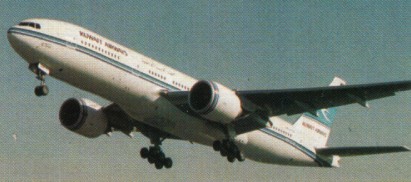
United accepted its first 777, appropriately registered N777UA, also the first of the type to be delivered, on May 15 1995, and this aircraft was the centerpiece of a formal delivery celebration two days later. United placed the three class 292 seat 777 into service on June 7 with a London (Heathrow) Washington (Dulles) flight. Two versions of the 777 were available: the basic -200 and the increased gross weight -2001GW, which has since been renamed the -200ER. The first Boeing 777-200 flew on 12 June 1994, and was awarded FAA and JAA certification on 19 April 1995. This longer range B777-200ER can fly more than 7,200 nm. The PW4074 powered aircraft was awarded the 180-minute ETOPS (extended twin-engine operations) in May of 1995. Ten metres longer than the 777-200, the 777-300 has dimensions that all but match the 747; seating around 550 passengers in a single class, or 368-386 passengers in three classes, with a range of over 8,500 nm. Both the -200 and -300 series have a wing span of 60.9 m, nearly identical to that of the Boeing 747-100 and -200. The -300 was rolled out on 8 September 1997, first flew on 16 October 1997 and has since gained 180-mm ETOPS approval and JAA/FAA certification. The 777-300ER first flew on 24 February 2003. As part of the test programme, the 737-300ER set a MTOW record of 774,600 lb.
In October 2005 Air New Zealand took delivery of its first 777-200ER after a delay caused by a Boeing Machinists’ strike. Air NZ had eight 777-200ERs on order.
First flying on 8 March 2005, the 777-200LR, called Worldliner, was to travel up to 9420nm / 17,450 km with 301 passengers if fitted with maximum auxiliary fuel tankage. First delivery is to Pakistan International in January 2006.
In November 2005 a 777-200LR established a new world record for distance travelled non-stop by a commercial aircraft – 11,664 nm / 21,605 km between Hong Kong and London Heathrow flying eastbound. The flight took 22 hr 42 min.
American Airlines Boeing 777-300ER
Compared to the 747-400, as ER cruises at similar speeds (0.84 Mach as compared with the 747’s 0.85 Mach) and can carry only slightly less passengers. The 777-300ER has a range of more than 7,400 nm. The aircraft has an advanced fly-by-wire flightdeck featuring lightweight liquid crystal displays, and Jeppesen’s “Electronic Flight Bag” the latest advance towards the paperless flightdeck. The B777-300ER is powered by two General Electric GE90-115B1 engines, which are capable of 115,000 lbs of thrust each. These engines include composite fan blades instead of the typical titanium blades, and the blade’s swept-design is reported to add 2,000 lbs to the engine thrust. Two prototypes undertook the 1500 hours of flight testing required for certification. The new 777-346ER has a MTOW of 759,600 lbs (344,555 kg), a range of 7,430 nautical miles (13,760 km), and two GE90-115B engines of 115,000 lbs thrust each – the world’s most powerful commercial jet engine. Differences over the standard 777 include; the wings extended by 6.5 feet, with raked tips; strengthened wings and empennage; strengthened nose undercarriage, with a new upgraded main landing gear installed; supplementary electronic tail-skid added and the nacelle struts modified to accommodate the higher thrust engines.
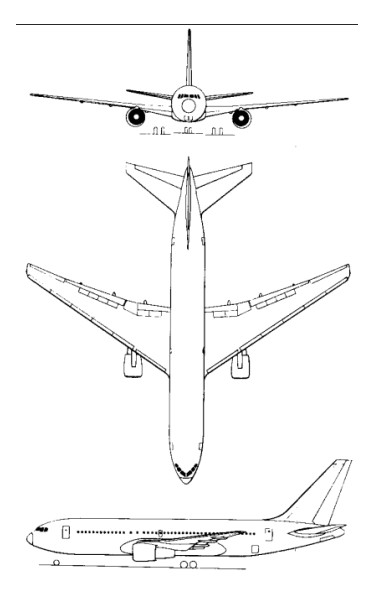
Announced simultaneously with the Model 757, the Boeing Model 767 introduced a completely new fuselage structure which is 1.24m wider, providing seven- or eight- abreast seating with two aisles. The go-ahead for the Model 767 programme was announced on 14 July 1978, following receipt of an order for 30 from United Airlines. By March 1990 orders and options totalled 483. Computer Aided Design (CAD) was used to speed the preparation of drawings for much of the principal structure, their high accuracy being of great benefit when, as in this case, a large amount of the construction is being carried out by other companies. These include Aeritalia, Canadair, Grumman and Vought, plus a Japanese consortium, Civil Transport Development Corporation, that comprises Fuji, Kawasaki and Mitsubishi. Together, 28 companies are manufacturing assemblies and components which, in terms of value, represent some 45% of the total cost. Wing design differs from the Model 757, and features increased sweepback, and greater span and wing chord, to provide approximately 53% increase in wing area. The tail unit and landing gear are similar in configuration, and the Model 767 shares with the Model 757 twin turbofan engines pod-mounted beneath the wings. The 767 has alternative Pratt & Whitney JT9D-7R4D and General Electric CF6-80A powerplants, each in the 21,772kg thrust class, being specified by early airlines.
Boeing planned initially to offer two versions: a Model 767-100 with a shorter fuselage and accommodation for approximately 180 passengers, and the basic Model 767-200. It was then decided not to build the shorter-fuselaged Model 767-100, and instead the Model 767-200 is available at alternative gross weights. Thus the version which was ordered initially by United Airlines for US domestic service has a maximum take-off weight of 127,913kg. That, with a gross weight of 140,614kg, can carry 211 passengers over a range of up to 6013km, making it suitable for non-stop transcontinental services, and also for many international routes. With an optional flight crew of two or three, provided with the same avionics equipment as the Model 757, the new fuselage also offers significant air freight capacity, with a cargo hold able to accept up to 22.LD-2 containers, or LD-3/-4/-8 containers to similar volume. With the inclusion of an optional forward cargo door measuring 1.75m by 3.4m, Type 2 pallets can be loaded. The first Model 767 was rolled out at Everett, Washington, on 4 August 1981, and made a 2 hour 4 minute maiden flight there on 26 September, which was a few days ahead of the target date set when the programme was launched in 1978. Taking off at a weight of 240,000 lb (108 864 kg), the 767 was airborne after a 3,000 ft (915 m) run and reached 17,000ft (5182 m) and 260 mph (418 kph) during the 2 hr 4 min flight, in which handling characteristics and minimum flying speeds were assessed and landing gear, speed brake and flap operation were checked. The Boeing 767 embarked upon a 1,100 hr flight test programme to achieve FAA certification. Certification of the 200 with Pratt and Whitney JT9D 74 power was accomplished by July 1982 and approval of a General Electric CF6 80A engine fit followed after tests with a fifth B.767 200. Air New Zealand announced an order for three of the extended range variant of the Boeing 767 in July 1984, three years after the type’s maiden flight from Everett. The first orders had been placed in 1978 when United Airlines signed for 30. The Boeing 767-200ER, 50,000 lb thrust GE CF6 80A2 powered, were delivered and in service by September 1988. The Boeing 767-200ER can fly at 41,000 feet and gain height faster due to a better thrust to weight ratio. Other economics are gained from requiring 9 cabin crew, and no third flight crew member required with the departure of the flight engineer. In February 1983 Boeing announced the 767-300, first flying on 30 Januaray 1986. Both -200 and -300 are offered in ER (Extended Range) variants, with increased fuel capacity and take-off weight for long-range operations. B.767-300ER – 11,600 km range 300ERs incorporate a fuselage stretch of 6.48 metres on the 200, and an increased takeoff weight of 184.6 tonnes. The later variant has beefed up nose and main landing gear as well as additional fuselage and wing strengthening. Accompanying the fuselage stretch is an increase in thrust from the CF6 80 engines, the new C2 model providing an extra 11,500 lbs a side. Less obvious are a number of potentially useful features such as a retractable tail skid which lowers with the undercarriage, an additional two over wing exits to a total of four, and fuel jettison system. The centre wing tankage has been increased by 11,000 kg to 36,500 kg and a nozzle fitted to the trailing edge of the port wing to provide for jettison. The 767 300 program was initiated by Boeing in September 1983, with the ER variant being announced in August 1985. The first 300ER rolled out for certification flying in November 1986 with the General Electric engines. FAA approvals came in May 1987.
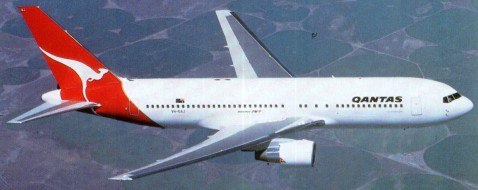
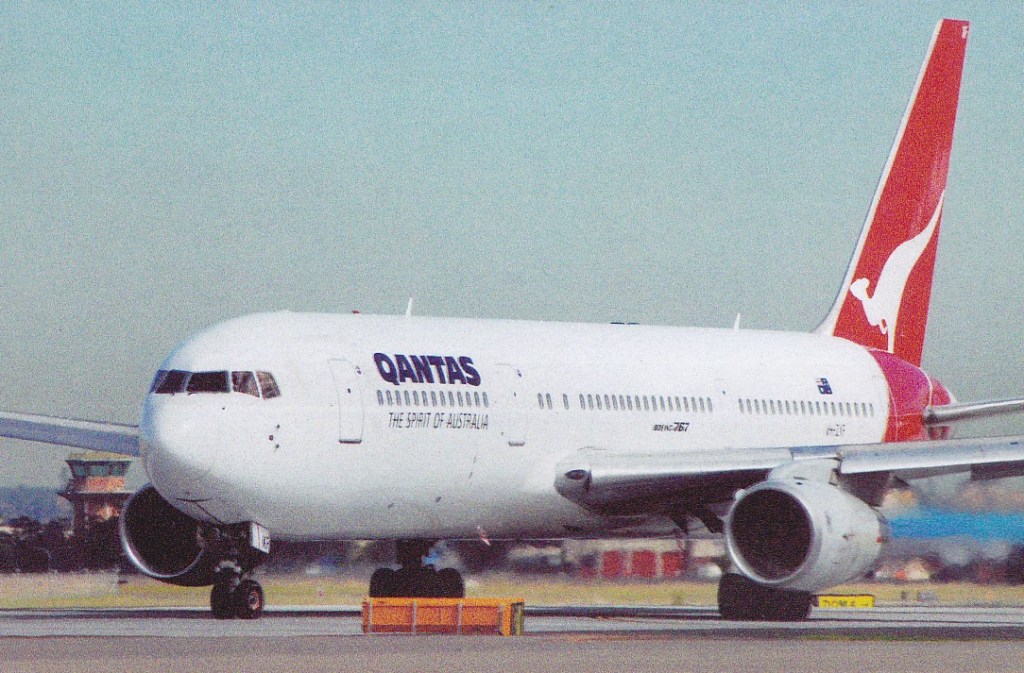
767-300ER VH-ZXF Sydney, Australia May 2007. One of 7 ex-British Airway acquired by Qantas in 2000
The first Rolls-Royce RB.211 powered 767 flew on 23 May 1989.
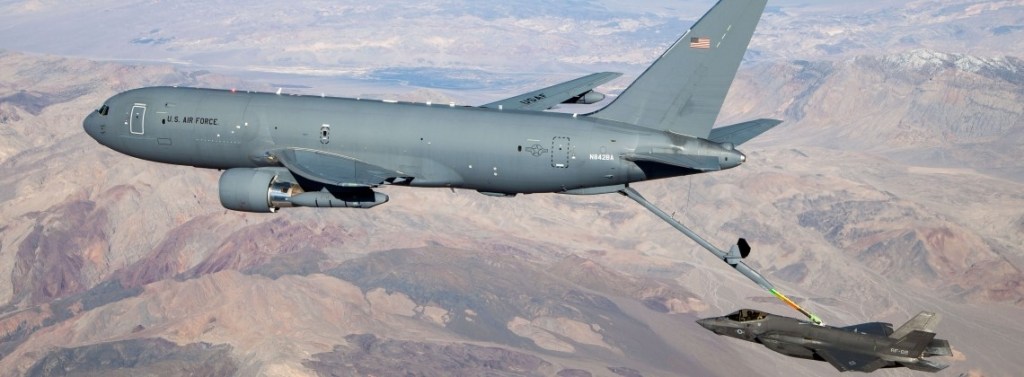
The 767-400ER has been stretched by 6.4m (21 ft), which enables a three class for 245 or a single class 410 passengers. The model also features 2.4 m (7 ft 8 in) swept back wing tip extensions, and first flew on 9 October 1999. In the case of a standard 767, most of the fuel is contained in two main tanks located in the wings, with a ‘center’ auxiliary in the wing roots. Extended Range 767s (either 200/300 variants) may have either one or two additional tanks placed in the wing center section. The 92nd Air Refueling Wing at Fairchild AFB, Wash, is to be the first base to operate the new KC 767s, when deliveries begin to the Air Force in 2006.
Boeing KC-46 Pegasus
The first KC-767 tanker for Italy made its maiden flight post-conversion on 21 May 2005.
Boeing 767-200 Engines: 2 x Pratt & Whitney JT9D-7R4D turbofans, 213.4kN Take-off weight: 136078 kg / 300002 lb Empty weight: 81230 kg / 179082 lb Wingspan: 47.57 m / 156 ft 1 in Length: 48.51 m / 159 ft 2 in Height: 15.85 m / 52 ft 0 in Wing area: 283.35 sq.m / 3049.95 sq ft Max. speed: 952 km/h / 592 mph Cruise speed: 930 km/h / 578 mph Ceiling: 11885 m / 39000 ft Range: 5150 km / 3200 miles Crew: 2-3 Passengers: 211-289
In the early months of 1978 Boeing announced that it proposed to develop a new family of advanced technology aircraft. Retaining the 7X7 designation formula, these three new designs carried the identifications Model 757, Model 767 and Model 777. The first of the three differing by retaining the same fuselage cross-section as the Model 727, whereas the Models 767 and 777 have a fuselage cross-section that is virtually mid-way between that of the Models 727 and 747.
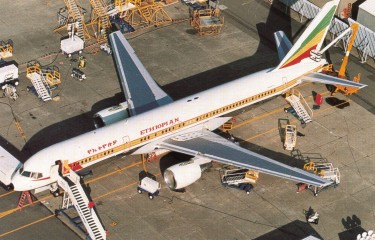
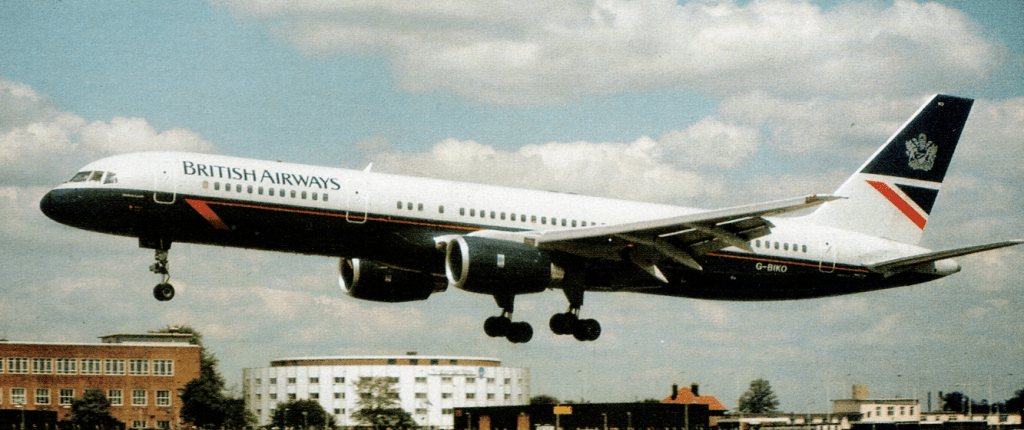
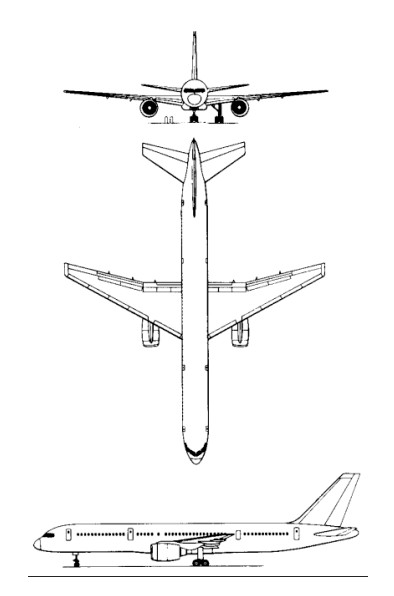
A short/medium-range airliner, having a typical capacity of 178 mixed-class, or 196 tourist-class, or a maximum high-density seating arrangement for 224 passengers, the Model 757 is a turbofan-powered airliners in the short/medium-range category, with an advanced-technology wing, and high by-pass ratio turbofan engines. Initial orders for the designation Model 757-200, were announced on 31 August 1978, comprising 19 and 21 respectively for British Airways and Eastern Air Lines, and after contract finalisation in early 1979, the company announced a production go-ahead on 23 March 1979. The development programme of the Model 767 was some five months in advance of that of the Model 757, principally because the go-ahead for its construction was given some eight months before that of the Model 757. The five-month gap between the programmes was essential for Boeing’s management and control of the almost simultaneous development of two new major aircraft, but the Model 757 enjoyed the benefits of work already completed on the 767, for there is a considerable degree of commonality between the two aircraft. However, some 53%, by value, of the Model 757 is being manufactured by outside companies, and major sub-contractors include Avco Aerostructures (wing centre section and fuselage keel), Fairchild Industries (overwing cabin section and wing leading-edge slats), Rockwell International (forward and aft fuselage sections) and Vought Corporation (fuselage tail cone, tailplane and fin).
RB211-535C engines
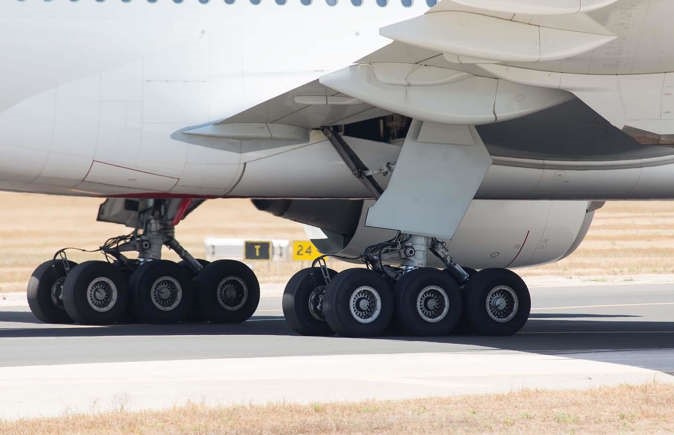
Power is provided by two Rolls-Royce RB211-535C or Pratt & Whitney PW2037 turbofan engines in underwing pods, but the two launching airlines opted for Rolls-Royce engines, and this was the first time that Boeing had introduced a new airliner with a non-American powerplant. The new-technology wing has less sweep-back than that of the Model 727, and the Model 757’s fuselage is 5.97m longer. Landing gear is of tricycle type, each main unit having a four-wheel bogie, with twin wheels on the nose gear. The Model 757 is operated by a flight crew of two, or three optionally, and the advanced avionics available to them include an inertial reference system incorporating laser gyroscopes, a flight management computer system, and a digital air data computer. These integrate to provide optimum fuel efficiency when linked to automatic flight control and thrust management systems. This new generation avionics control is capable of handling an entire flight from shortly after take-off, including the landing if desirable, with the flight crew functioning as systems managers. The first flight of a Model 757 took place in February 1982, and orders and options for 632 aircraft had been received by the end of March 1990. A 757-200M Combi version is available, as is the 757-200PF Package Freighter and a corporate version.
The first 757-300 flew on 2 August 1998. The Pratt & Whitney PW2040 powered 757-300 first flew on 20 February 2002.
For Boeing to call an aircraft an ER, it must have additional tanks. As there is no such option for the 757 (whose wing center section is an active part of the center fuel tank), those aircraft used for ETOPS are not called ERs by Boeing.
In May 2005 the 1050th and last Boeing 757 was delivered, China’s Shanghai Airlines receiving the final aircraft.
Boeing 757-200 Engines: 2 x Rolls-Royce RB211-535C turbofans, 166.3kN Take-off weight: 104326 kg / 230001 lb Empty weight: 59430 kg / 131021 lb Fuel capacity: 43,490 lt. Max payload: 32,755kg. Wingspan: 37.95 m / 124 ft 6 in Length: 47.32 m / 155 ft 3 in Height: 13.56 m / 44 ft 6 in Wing area: 181.25 sq.m / 1950.96 sq ft Max. speed: 944 km/h / 587 mph Cruise speed: 900 km/h / 559 mph Ceiling: 11700 m / 38400 ft Range: 3985 km / 2476 miles Crew: 2 3 flight crew Passengers: 228.
757-2K2 Engines: 2 x Rolls-Royce RB211-535E4, 40,100 lb. Length: 155 ft 3 in (47.3 m) Height: 44 ft 6 in (13.6 m) Cabin Width: 139.3 in (3.54 m) Max Payload: 49,516 lb. (22,460 kg) Range: 3,900nm (7222km) MTOW: 116 tonne. Seating: 90 Economy – 24 Business – 12 First
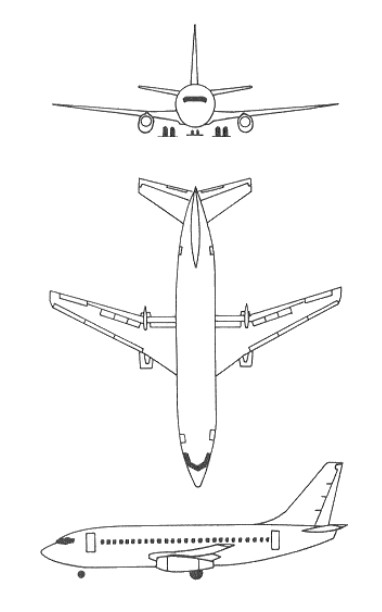
As originally conceived, the Boeing 737 series 100 could accommodate sixty to eighty-five passengers but after talks with Lufthansa this was increased to around 100 seats. The newly designed wing was required to give good lift and have excellent low speed characteristics for short-field operations, around 870nm. The engines selected were two Pratt & Whitney JT8D-1 turbofans, each of 14,000 pounds thrust, but following negotiations with Lufthansa the more powerful JT8D-7 turbofan was chosen for it could maintain the same thrust at higher ambient temperatures. The aircraft has almost the same fuselage cross-section as the longer 707 and 727, designed so that maximum use could be made of 727 tooling and components to keep initial costs low. The aircraft is powered by the JT8D turbofan engine developed for the 727, and has the 727’s high-lift system. The 737 utilised the same nose and fuselage section as the 727. Wing sweepback on the 737 is 25 degrees. The prototype 737-100 first flew on 9 April 1967 and was so successful that by 15 December 1967 FAA certification was complete and Lufthansa took delivery of their first machine on 28 December 1967. They made their first scheduled 737 passenger flight on 10 February 1968. Only 30 of the -100 series were built.
United Airlines launched the 737-200 with a 1.82m fuselage stretch, first flown on 8 August 1967. The -200 was added to the 737-100 type certificate on 21 December 1967, and first delivery to United Air Lines on 29 December 1967.
In production from 1966 to 1988 (1114 aircraft), the 737-100 offered 85 – 90 seats and a maximum take-off weight of 110,000 lb initially with two JT8D-7 of 14,000 lb thrust. The Dash 9 engine of 14,500-lb thrust was also available. The -200 Series offered a maximum take-off weight of 115,500 lb, rising to 128,100 lb for the Advanced version. Engine types available were the Dash 7, the 9A with 14,500 lb, the l5A with 15,500 lb and the l7A with 16,000 lb thrust.
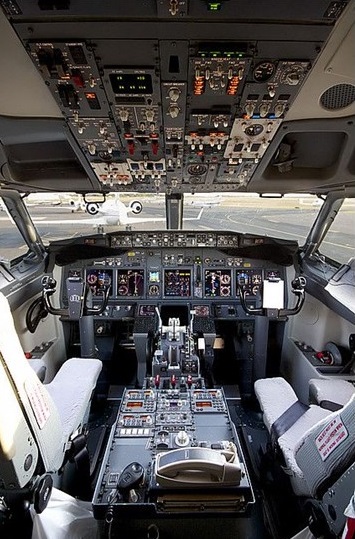
The T-43As being navigation trainers and the C-40A being the 737-NG model 700. Boeing has delivered the 19th and final T-43 Navigator Trainer aircraft to the USAF’s Air Training Command in 1974. The aircraft, a military derivative of the 737-200 twinjet, flew to Mather AFB, Sacramento, California. Boeing says the T-43 programme was completed on schedule and within the $81.7m contract which Boeing won in May 1971. Deliveries began in 1973.
In 1978 British Airways ordered 19 737-200 Advanced, which entered service in February 1980. More followed in 1980/1981, and another batch of 16 was ordered in Autumn 1983, with the last delivered in spring 1985, bringing the fleet to 44 aircraft. In October 1988 new orders were announced, which included firm placements for 24 737s, with built in flexibility to choose from the 737-300, or the new -400 or -500 models. British Airways eventually opted for the larger -400. Eleven options were also included and soon taken up, with the new type introduced into service in October 1991.
A maritime surveillance version of the 737-200, the Surveiller is equipped with a Motorola side-looking modular multi-mission radar (SLAMMR), linked to two 5m-long antennae mounted on each side of the upper rear fuselage. The radar has a typical range of 185km on each side of the aircraft at a patrol height of 9,150m (30,000ft). B737-219 is a quick change variant, from freight to passengers.
Boeing 737-2A6 ZK-NEE
The last of 1,114 Boeing 737-200s (and 30 737-100s) was delivered in August 1988. The total includes 19 T-43A navigation trainers for US Air Force (subsequently redesignated CT-43A) and three Surveillers for Indonesian Air Force.
In the end it was the rather noisy JT8D-15 engines that prompted Boeing to look for a replacement for the 737-200 advanced. Already operators throughout the world were turning to Europe for replacement jets such as Airbus and the Hawker Siddeley 146 both of which offered quieter and more fuel efficient engines. Initial design analysis showed that the new high by-pass ratio turbofans were all too big and Boeing prompted the development of the smaller diameter CFM-56 which offered 20,000 lbs thrust. The new aircraft retained about 70 percent commonality with the previous 737-200. The biggest changes, apart from the engines, were the increased fuselage length and minor changes to the wing tip. The larger turbofans did need new pylons and Boeing, with the help of CFM, redesigned the arrangement of auxiliary units inside the pod so that instead of fitting them symmetrically around the engine they were arranged on the sides giving the 737-300 engine pods that characteristic squashed look.
Production go-ahead for the Series 300 was given in March 1981 at the first flew on 24 February 1984, the 737-300 powered by CFM56-3 engines was FAA certified on 14 November 1984 and Boeing made the first delivery to USAir on 28 November 1984.
Boeing 737-341 PP-VOO
On 8 January 1989, a newly-delivered 737-400 belonging to British Midland crashed onto the M1 motorway at Kegworth, UK, during an emergency landing attempt, killing 32 people. The crew believed that an engine was on fire, but incorrectly wired cockpit systems may have given them false information.
Approval for 120-minute ETOPS given November 1986, but withdrawn July 1989 due to concerns related to operation in heavy rain and hail; approval restored 14 September 1990. Commonwealth of Independent States Interstate Aviation Committee certified the Boeing 737 family with P&W or CFM engines 18 January 1993 and the first delivery for Russian Federation and Associated States (CIS) registration (737-300 to National State Aviacompany Turkmenistan) was on 12 November 1992. A 737-300 for Ansett Worldwide (and subsequent lease to British Midland Airways) rolled out at Renton on 19 February 1990 (as 1,833rd 737); 737 orders passed 3,000 when Southwest Airlines ordered 34 in third quarter 1992. The 2,500th 737 rolled out 16 June 1993; 3,000th Classic’ 737, a 737-400 for Alaska Airlines (N793AS) first flew on 16 January 1998. Production of Classic’ averaged 9.5 per month during 1998.
Further developments at Boeing resulted in the even larger 737-400 which was first announced in June 1986 and the first example flew on 19 February 1988. Considerably longer than the 737-300 (3.05 metres). Announced June 1986, the first rolled out on 26 January 1988 and first flew on 19 February 1988.
Certified for up to 188 passengers on 2 September 1988, the first delivery (to Piedmont Airlines) was on 15 September 1988.
A high gross weight structure variant rolled out on 23 December 1988; certified by the FAA and delivered to first customer 21 March 1989. ETOPS approval was granted on 14 September 1990. Russian Federation and Associated States (CIS) certification with CFM engines was on 18 January 1993, as for the 737-300.
Initially known as 737-1000 and then announced as the 737-500 on 20 May 1987, the -500 first flew on 20 June 1989; certified 12 February 1990 after 375 hour test programme; and first delivery (to Southwest Airlines) 28 February 1990. ETOPS approval was given on 14 September 1990. Russian Federation and Associated States (CIS) certification with CFM engines was given on 18 January 1993, as for 737-300 and -400. Smallest, and exactly the same size as the original 737-200, is the turbofan powered 737-500. Capable of carrying 108 passengers in comfort, the 737-500 consumes up to 20 percent less fuel per seat-mile than a comparably loaded 737-200. The 737-500 went into regular service in March 1990 with SouthwestAirlines.
Boeing 737s up to and including -500 are known as Classic' series to differentiate them from ‘Next-Generation’ variants beginning at -600.
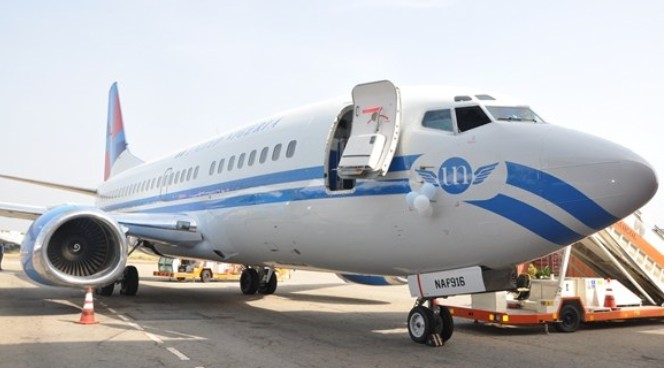
United Nigeria – B737-500 – NAF 916
In 1996 the Lufthansa fleet included 89 Boeing 737 and 26 Boeing 747s.
The 737-700 first flew on 9 February 1997, was delivered to Southwest and entered service on 18 January 1998.
Boeing 737-700BBJ M53-01
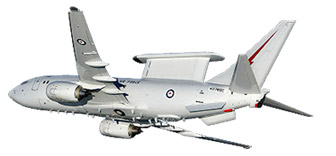
In 2003, the Australian Defence Force’s first 737-700 “Wedgetail” aircraft had installed a multi-role electronically scanned array antenna, 35.5 ft long and weighing over 3 tonnes, the antenna was described a “the critical sensor aboard the aircraft”. The Royal Australian Air Force Wedgetail airborne early warning and control (AEW&C) aircraft entered service in 2009. Six Boeing 737 NGs were modified to accommodate sophisticated mission systems and radars that will increase Australia’s surveillance and air combat capability, provide air defence support for the naval fleet, and assist in civil operations such as border protection and search and rescue. The Wedgetail AEW&C aircraft were operated by No 2 Squadron from RAAF Base Williamtown, near Newcastle.
The first two Wedgetails were modified in the United States of America, with the remaining four modified at RAAF Base Amberley, near Brisbane.
In February 2006 Boeing delivered the 5000th 737, a 730-700 for Southwest Airlines and 38 years after the first example was delivered. At the time of handover 541 operators were flying over 4100 737s and total sales exceeded 6150.
In January 2007 the first 737-700ER was rolled out, this available in normal airliner form or as in 48-seat all business class configuration with a maximum range of 5510 nm / 10,200 km if fitted with maximum fuel.
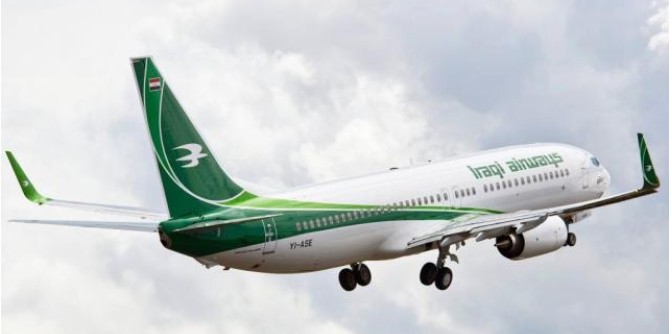
The B737-800, essentially a stretched version of the earlier B737-400 seating up to 189 passengers, earned its type certification from the FAA on 13 March 1998. The 737-800NG was launched by Boeing on 5 September 1994. The first delivery of the type was to Hapag-Lloyd on 22 April 1998. Boeing announced on 18 February 2000 that it would offer the blended winglet version of the B737-800NG to customers – a new, advanced technology winglet that has become a standard option. First deliveries of the winglet jet commenced in May 2001. The winglets can be retrofitted and, because of commonality through the 737 range, the blended winglet will be an option for other models that have the B737-800 wing, including the B737-700C/QC and the B737-900. A winglet-equipped 737 is able to fly further, burn less fuel and carry additional fuel than one without winglets. Each winglet is 2.5m long and 1.2m in width at the base, narrowing to approximately 0.6m at the tip. They add approximately 1.5m to the airplane’s total wingspan taking it to 35.8m (all next-generation 737 models have the same wingspan of 34.3m). Each winglet weighs about 60 kg and the overall increase is about 170 kg. Structural modifications to accommodate the winglet include strengthening of the wing’s centre section.
Boeing 737-800
On 26 July 1993 Boeing delivered the 2000th 737NG family example – a 737-700 to Southwest Airlines, eight years after the first one was delivered to the same airline. Total 737NG orders were about 3400, eclipsing the combined total of the first two 737 generations.
The B737-BBJ is a high performance derivative combining the fuselage of the 737-700, strengthened in the aft section, with the centre-section, wing and landing gear of the 737-800. The 737-BBJ is operated by the USAF as the C-40C. The BBJ combines the fuselage of the Boeing 737-700 aircraft with a strengthened aft section, and the centre-section, wing and landing gear of the 737-800 aircraft. Winglets are standard, affording 5 to 7 per cent reduction in cruise drag, resulting in 4 to 5 per cent increase in range. The BBJ features the same panel as the Boeing 777 and also adds a heads-up display. A variety of fuel tank configurations allow the BBJ to have a more than 6,000 nm range. With a customized interior, some of which feature a conference room and a gymnasium, the BBJ approaches a $50 million total acquisition cost. Increased fuel capacity is provided by the installation of between three and nine auxiliary tanks in the underfloor baggage holds, providing a maximum range of 6200 nm / 11,485 km.
With the minimum number of three auxiliary tanks installed, range is reduced to 5025 nm / 9310 km but payload increases, allowing about 50 passengers to be carried with full fuel. The first BBJ flew on 4 September 1998, joint FAA/JAA certification was awarded the following month and the first delivery was made in November 1998 to General Electric. The 100th 737-based BBJ – for the Indian Government – flew in November 2006.
A stretched version (19 feet longer) of the original BBJ, the BBJ2 offers 25% more cabin space and 100% more baggage space. First delivery of the larger Boeing Business Jet was in early 2001. Two Boeing 737 BBJ (Boeing Business Jet) special purpose aircraft are operated by the Royal Australian Air Force’s No 34 Squadron, based at Defence Establishment Fairbairn in Canberra. Both BBJs are permanently converted to VIP configuration, comprising two conference tables and seating for 30 passengers. The BBJs joined the VIP fleet in July 2002. The 737-900 first flew on 3 August 2000, from Boeing Field. The 900 retains the same wing and engines (CFM56-7s) as the 600, 700, and 800 models. Two fuselage plugs, ahead and aft of the wing box increase the fuselage length by 8ft 8in (2.6m) over that of the 800, for 177 passengers in a two-class configuration, 15 more than the 800. Because of emergency exit requirements, the maximum seating number of 189 is the same as for the 800. Two aircraft were used for FAA and JAA certification. The launch customer being Alaska Airlines with an order for ten placed in November 1997.
Boeing 737-900
On 5 September 1993 the 180-215 seat 737-900ER recorded its maiden flight. Boeing delivered the first 737-900ER to Indonesia’s Lion Air on 27 April 2007. The airline had 60 on order. By June 2007 Boeing had received 7000 orders for all 737 models.
The P-8A Poseidon for the US Navy is the third military derivative of the 737NG airliner after the 737-700BBJ based C-40 clipper cargo and personnel transport and the 737 AEW&C Wedgetail/Peace Eagle. Chosen by the Navy in 2004 to replace the bulk of its P-3C Orions, the airframe is based on the 737-800 mated with the strengthened wings of the 737-900. The P-8A is powered by two 27,300 lb (122kN) thrust CFM56-7E engines fitted with 180kVa generators. Boeing has changed 75% of the –800s primary structure maily through stronger gauge materials for the expected flight loads. Other changes include a refuelling receptacle in the forward upper fuselage, an integral fuel tank in the aft third of the fuselage, and an internal weapons bay. The weapons bay has five hard points each rated for 650 kg, and two hard points on each wing, outboard of the engines are rated for 1360 kg, and two hard points in tandem on the centre forward fuselage are rated for 650 kg. Raked wingtips are developed from those of the 767-400.
Boeing 737 RAT55
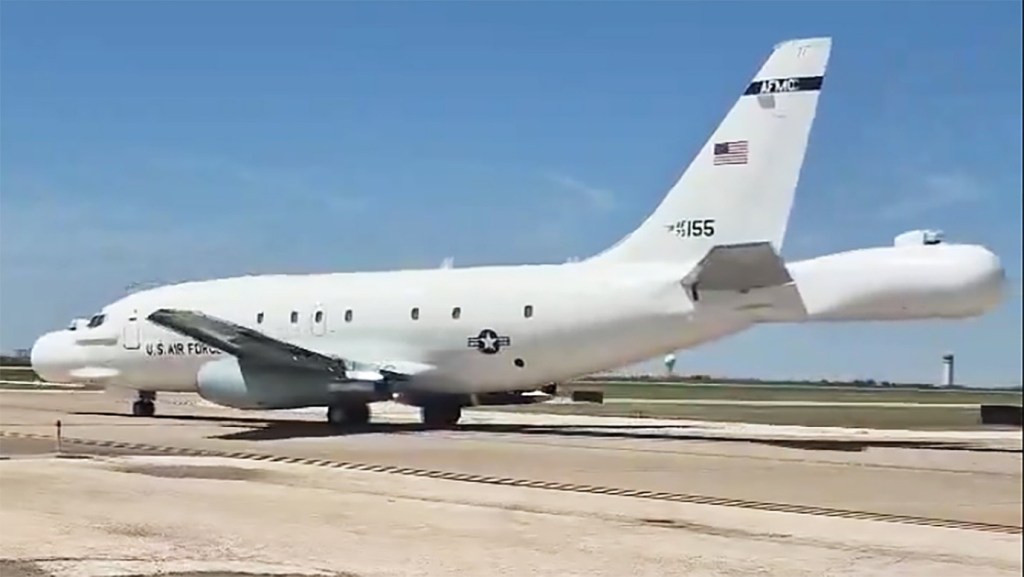
The “RAT” in the name stands for Radar Airborne Testbed, while the “55” refers to the last two digits in its tail number. RAT55 spends most of its flying life in the vast and remote range complexes that span South-Central California and Southern Nevada. The aircraft seems to live at the high-security Tonopah Test Range Airport (TTR) and spends time in the skies near Area 51 and Edwards Air Force Base. While the one-off NT-43A has ventured beyond its usual protected operational confines — it needs major servicing just like any other 737 — usually these trips seem to be planned to expose the aircraft to minimal public eyeballs. That is clearly no longer the goal.
RAT55 is critical to the development and sustainment of America’s aerial stealth technology. Simply put, RAT55 uses its two huge radar arrays — one front and one back — to take fine measurements of the radar signatures of stealthy aircraft while flying through the air near them. It does this to validate low-observable designs and skin treatments. It also has electro-optical/infrared capabilities above its radomes and can be fitted with dorsal fairings for other systems. While there are facilities on the ground that can take similar measurements of aircraft flying through the air, doing it from another specially-equipped aircraft in the air allows the target to be measured from every angle, including from overhead aspects, and continuously.
Even when B-2 Spirits come out of depot maintenance, they usually spend time in the sky with RAT55 to validate that the work done fits established design goals and parameters. That is the most visible of the NT-43A’s work, but the aircraft is also involved with the most advanced and secretive stealth aircraft development programs in the Pentagon’s portfolio, many of which we don’t know about and likely never will.
737-700 Engines: 2 x CFM 56-7, 24,000 lb Wing span: 34.32m Wing area: 1340 sq.ft. Length: 33.63m MTOW: 70,080 kg Empty wt: 37,971 kg Zero fuel wt: 54,657 kg Fuel cap: 26,136 lt Pax cap: 126-149
737-800 Engines: 2 x CFM56-7B24 (24,000 lb) MTOW: 74,990 kg (165,325 lb) Empty wt: 41,554kg (91,610 lb) Max ldg wt: 66315 kg (144,000 lb) Fuel cap: 20800 kg Max cruise: 0.82 mach Max cruise alt: 41,000 ft Wing span: 33.41m (112 ft 7 in) Wing area: 1345.5 sq.ft (125 sq.m) Fuel cap: 26,025 lt (51,562 lb) Max payload range: 1900 nm Pax cap: 162-189 Length: 39.47m (129 ft 6 in) Height: 12.55m (41 ft 2 in) T/O dist: 7400 ft (2256m) Ldg dist: 5250 ft (1600m)
737-8Q8 Engines: 2
Boeing 737 MAX 8 Length: 129 ft 6 in (39.47 m) Height: 40 ft 4 in (12.29 m) Cabin Width: 139 in (3.53 m) Max Payload: 46037 lbs (20882 kg) Range: 3,800nm (7000km) Maximum seating: 178
737-900 Engines: 2 x CFM56-7 Length: 138 ft 2 in (42.1m) Wing area: 1340 sq.ft Fuel cap: 26,136 lt Pax cap:177-189
Boeing 737 BBJ (Boeing Business Jet) Role: Special purpose passenger and VIP transport Crew: Two pilots and up to four crew attendants Engines: Two CFM International CFM56-7 turbofans (118.4kN (27,300 lbs) each) Length: 33.6m Height: 12.5m Wingspan: 35.8m (including winglets) Max take-off weight: 77,565kg Max landing weight: 60,781kg Gross weight: 171,000 lbs Empty weight: 94,570 lbs Speed: 630km/h normal operations Range: 11,390km Ceiling: 41,000 feet Accommodation: 30 passengers in VIP configuration
BBJ2 Engines: two 26,400 lb. CFM International CFM 56-7 turbofans Seats: 63 Gross weight: 174,200 lbs Empty weight: 100,815 lbs Max cruise: Mach 0.82 Long-range cruise: Mach 0.79 Range: 4,935-6,200 nm Ceiling: 41,000 ft
CT-43 / T-43A Engines: 2 x Pratt & Whitney JT8D-9A turbofans. 14,500 lbs thrust Wingspan: 92.85ft (28.30m) Length: 100.07ft (30.5m) Height: 37.07ft (11.30m) Empty Weight: 61,050lbs (27,692kg) Maximum Take-Off Weight: 128,100lbs (58,105kg) Maximum Speed: 586mph (943kmh; 509kts) Maximum Range: 2,187miles (3,520km) Rate-of-Climb: 3,760ft/min (1,146m/min) Service Ceiling: 36,745ft (11,200m) Accommodation: 5
Boeing 737 NG Wedgetail AEW&C Role: Airborne early warning and control Crew: Pilot, co-pilot and airborne electronics analysts and mission specialists (10 mission consoles) Engines: Two CFM International CFM56-7 turbofans (118.4kN (27,300 lb) thrust each) Length: 33.6 m Height: 12.6 m Wingspan: 34.3 m Maximum take-off weight: 77,565 kg Maximum landing weight: 60,782 kg Maximum speed: 870 km/h Cruise speed: 760 km/h Endurance: 10 hours (without air-to-air refuelling) Ceiling: 12,500 m (41,000 feet) Equipment: Multi-role electronically scanned array (MESA) radar with range in excess of 400 km Electronic warfare self-protection measures including directed infra-red counter-measures , chaff and flares Communication systems including HF, VHF, UHF, Link-11, Link-16, UHF SATCOM and ICS
By the early 1990s, the three leading airframe manufacturers became aware of the demand for a smallerjet airliner. In particular, over the next two decades there is a market requirement for approximately 2,600 aircraft having a nominal seating capacity for 100 passengers.
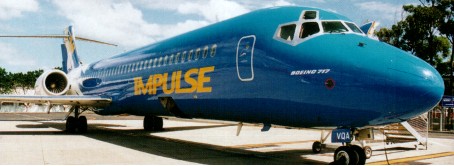
To meet these requirements Boeing announced its new generation 737 600; Airbus the A319 and McDonnell Douglas the MD 95, all smaller derivatives of highly successful medium haul airliners. The B737 600 was given the build go ahead in March 1995, with entry into service scheduled for mid 1998 and the MD 95 was shown the green light six months later in October 1995. At that stage the A319 was ahead of the field, the lead aircraft configured in 116 seat layout being readied for delivery to Swissair in April 1996. Launched in October 1995, by the end of 1999, the first of a 100 MD-95 contract (50 firm, plus 50 options) to AirTran Airlines (formerly ValueJet) was signed. With the merger of Boeing and McDonnell Douglas, commercial pressure resulted in the B717. The B717 200 has changed little from the McDomell Douglas concept for the MD-95. Similar in size to the DC 9 30, with a wingspan of 28.45m (93ft 3.5in) and overall length of 37.8m (124ft 0in). The BMW Rolls Royce BR715 turbofan engine was developed specifically for it. First flew on 2 September 1998 and certified on 1 September 1999. The Boeing 717-200 received simultaneous joint certification from the US FAA and European JAA on 1 September 1999. Five teat aircraft flew over 2000 hrs in more than 1900 flights. On September 23, 1999, the first production 717-200 (N717XD, to be re-registered N949AT) was handed over to launch customer AirTran Airways at Long Beach, California.
On 23 May 2006 the last ‘Douglas Commercial’ airliner, a Boeing 717, was handed over to Air Tran at Long Beach, California.
B717-100 Seats: 86.
B717-200 Engines: Two BMW Rolls Royce BR715 turbofans, 82.2kN (18,500 lb) take off thrust with options available up to 93.4kN (21,000 lb). Total fuel capacity 13,892 litres (3,056 Imp gal). Max cruising speed, 0.76 Mach; 438kts (811 km/h). FAA take off field length, (MTOW, SL, Temp = 30 degC) 1,950m (6,400ft). FAA landing field length, (MLW, SL) 1,445m (4,740ft), Range (domestic reserves, 106 passengers and baggage), 2,867km (1,547nm Weights: Space limited payload, 12,220kg (26,940 lb). Design gross maximum ramp weight, 52,163kg (115,000 lb). Maximum take off weight, 51,710kg (114,000 lb). Maximum landing weight, 46,266kg (102,000 lb). Maximum zero fuel weight, 43,545kg (96,000 lb). Operator’s empty weight, 30,785kg (67,870 lb). Wingspan, 28.45m (93ft 43/4in). Wing area, 305 sq.m (1,000.7 sq.ft). Length, 37.81 m (1 24ft 0in). Height, 8.92m (29ft 1 in). Cargo hold, 26.5 sq.m(935 sq.ft). Accommodation: Two crew and up to a maximum of 106 passengers in typical two class configuration. Total cargo volume: 26.33 cu.m (930 cu.ft).
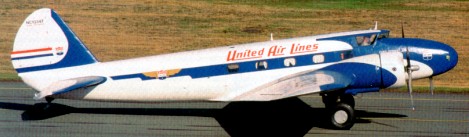
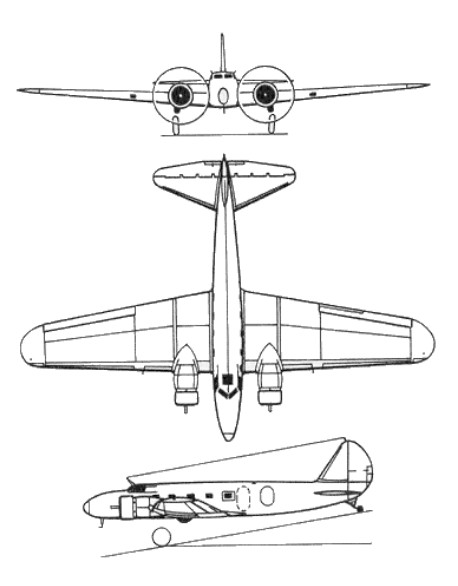
Derived via the design of the Model 200 Monomail and Model 215 bomber, each of which had a cantilever monoplane wing, Boeing flew the prototype of a new civil airliner which was identified by the company as the Boeing Model 247 on 8 February 1933. A streamlined low wing monoplane, powered by two 550 hp Pratt & Whitney radial engines, it had retractable landing gear and was the first transport aircraft to have a de icing system for wings and tail unit. Variable pitch propellers gave maximum efficiency for take off and cruising flight, and control surface trim tabs enabled the pilot to ‘balance’ the aircraft so that an automatic pilot could control the machine for long periods. It was also the first twin-engined monoplane airliner able to climb with a full load on the power of only one engine. With accommodation for a pilot, copilot, stewardess and 10 passengers, sixty examples of the Model 247 were ordered ‘off the drawing board’ to re-equip the Boeing Air Transport System, shortly to become a major limb of United Air Lines, and another 15 were ordered subsequently for companies or individuals.
The Boeing 247 entered service with United Air Lines in March 1933, with a trans-continental flight time of under 20 hrs. The Boeing 247 entered service with National Air Transport (one of the companies under the United Air Lines umbrella) on June 12, 1933. United took delivery of 59 of the 61 247s built, plus 10 of the 13 improved 247-Ds; earlier 247s were modified to this standard. The sole 247-A was used by the United Aircraft Corp as an executive aircraft.
United bought the 60 Boeing 247’s for $4,500,000.
One built for Roscoe Turner and Clyde Pangborn (to compete in the England-Australia ‘MacRobertson’ air race of 1934) was provided with fuselage fuel tanks instead of the standard airline cabin equipment, and introduced NACA engine cowlings (to reduce drag) and controllable-pitch propellers with optimum settings for take-off and cruising performance. These improvements were incorporated retrospectively on most airline Model 247s, thus elevating them to Model 247D standard.
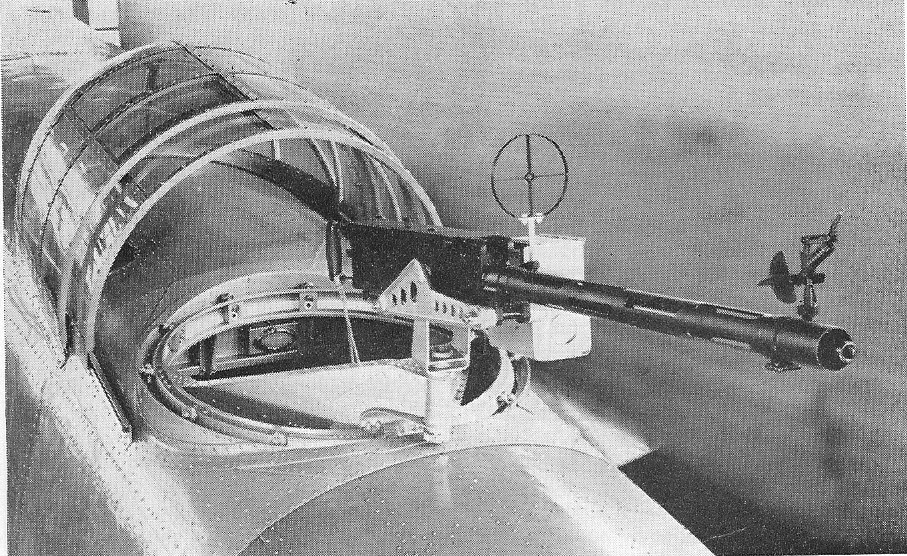
In the 1936 a Chinese Purchasing Commission approached Boeing for a variant of the Boeing 247D to be built. Designated Model 247Y, the militarised variant had an upper rear gunner position, forward-firing guns in the nose, plus under wing bomb carriers. Kept highly secret, only the one is believed built.
Boeing 247-Y 12 Feb 1937 at Boeing Seattle
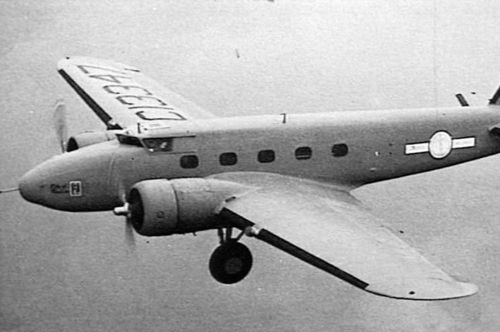
When the USA became involved in World War II in late 1941, these Model 247Ds remained in airline use, and 27 of them were impressed for service with the USAAF under the designation C-73. It had been anticipated that they could be used for the carriage of cargo and troops, but it was discovered that the cabin doors were too small for this purpose. Instead, they were deployed to ferry aircrew and, later in the war, were used for training. In service they were provided with 447kW Pratt & Whitney R-1340-AN-1 Wasp radials. When no longer required in late 1944, they were returned to civil airline service.
NC13347 Boeing 247D, serial n°1729 of United Air Lines
247 Engines: 2 x 550 hp Pratt & Whitney Wasp Length: 51.3 ft / 16.25 m Wing span: 74 ft / 22.6 m Weight empty: 8,340 lb / 3,780 kg Crew: 2 Pax cap: 10 Max cruise: 171 mph / 275 kph Ceiling fully loaded: 18,500 ft / 5,650 km
247D Engines: 2 x Pratt & Whitney R-1340 Wasp S1H1-G, 550 hp, 410kW Props: Hamilton Standard hydromatic Wing span: 74 ft 0 in / 22.56 m Wing area: 77.6 sq.m / 835.28 sq ft Length: 51 ft 4 in / 16.25 m Height: 12 ft 1.75 in / 3.7 m) Empty weight: 4148 kg / 9145 lb Max TO wt: 13,650 lb / 6197 kg Max level speed: 202 mph / 324 kph Cruise speed: 304 km/h / 189 mph Ceiling: 7740 m / 25400 ft Range: 1199 km / 745 miles Crew: 3 Pax cap: 10
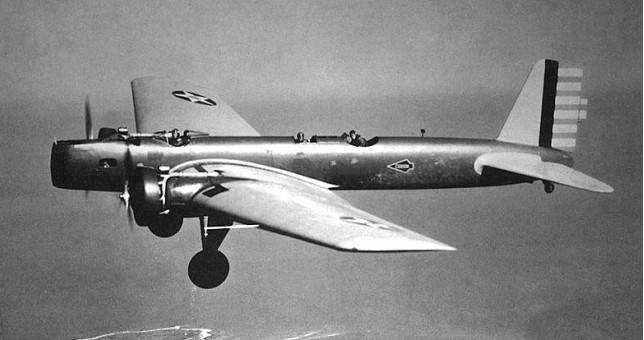
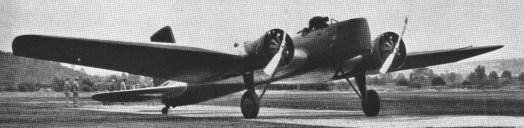
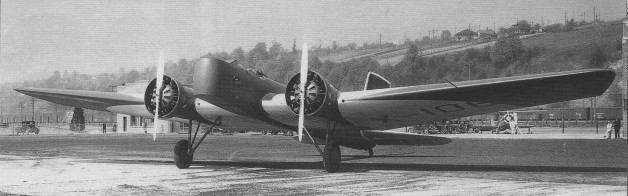
In 1930 Boeing began the private-venture development of a bomber aircraft based on the Model 200 Monomail. The resulting prototypes and service evaluation bombers were scaled-up versions of this aircraft. They differed by having twin-engines, installed in nacelles at the wing leading edge, and by adaptation of the fuselage to cater for the crew and weapons.
Y1B-9A
To provide the crew accommodation, the fuselage was extended forward of the wing. A bomb-aimer/gunner was accommodated in the nose and immediately behind him, within the fuselage, was a radio operator’s position. Aft of the radio operator were two cockpits in tandem, for pilot and co-pilot, with a fourth open cockpit, just aft of the wing trailing edge, for the rear gunner. A bombload totalling 1025kg could be divided between an internal bomb bay and underwing racks.
Y1B-9
First flying, on 13 April 1931, was the Boeing Model 215, powered by two 429kW Pratt & Whitney R-1860-13 Hornet radials. This was tested by the USAAC under the initial designation XB-901 (Experimental Bomber), and satisfactory conclusion of testing resulted in the procurement of this aircraft under the designation YB-9. At the same time the then incomplete Boeing Model 214 was contracted under the designation Y1B-9, plus five additional service test aircraft with the designation Y1B-9A (Model 246). The Model 214, powered by 447kW Curtiss V-1570-29 Conqueror inline engines, was flown for the first time on 5 November 1931, and following further tests, the Model 214 was re-engined with a supercharged version of the Pratt & Whitney Hornet. This power-plant was chosen also for the Y1B-9As, the first of which was flown on 14 July 1932. The Y1B-9A differed externally from the earlier prototypes in having modified vertical tail surfaces, and had internally a number of equipment and structural changes to meet service requirements. Subsequent testing, and evaluation against the Martin Model 123, resulted in the Martin aircraft entering service as the B-10. This came as a great disappointment to the Boeing company, which had produced this bomber with performance superior to most contemporary fighter aircraft.
Boeing 215 / XB-901 / YB-9 Engines: 2 x Pratt & Whitney R-1860-13 Hornet radials, 429kW
Boeing 214 / Y1B-9 Engines: 2 x Curtiss V-1570-29 Conqueror inline, 447kW re-engined with 2 x 447kW Pratt & Whitney SR-1860-11 Hornet supercharged radial piston
Boeing 246 / Y1B-9A Engine: 2 x Pratt & Whitney SR-1860-11 Hornet, 447kW / 600 hp Take-off weight: 6495 kg / 14319 lb Empty weight: 4056 kg / 8942 lb Wingspan: 23.42 m / 76 ft 10 in Length: 15.77 m / 51 ft 9 in Height: 3.66 m / 12 ft 0 in Wing area: 88.63 sq.m / 954.00 sq ft Max. speed: 299 km/h / 186 mph / 163kt Cruise speed: 266 km/h / 165 mph Ceiling: 6325 m / 20750 ft Rate-of-Climb: 900ft/min (274m/min) Range: 869 km / 540 miles Armament: 2-4 x 0.30 caliber machine guns Bombload: 2,260lbs Accommodation: 4 or 5