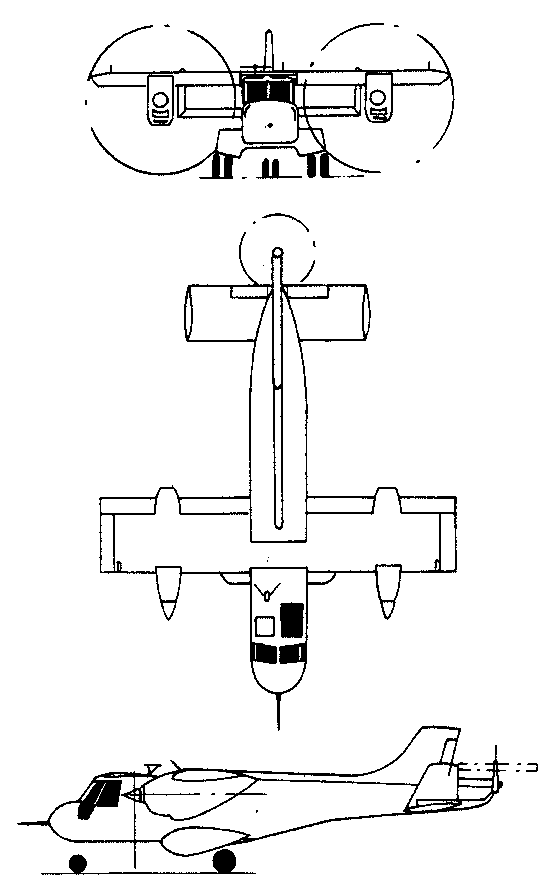
A twin-engined medium bomber/transport powered by 840-h.p.Isotta-Fraschini Asso Xl R.C.15 engines. Five prototypes of the Z.1011 were built, but the bomber was under-powered and inadequate performance led to the abandonment of further development in favor of the Z.1007.
2 Engines
CANSA F.C.20
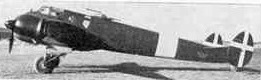
In 1941 C.A.N.S.A. produced the F.C.20 reconnaissance bomber powered by two 840-h.p. Fiat A.74 R.C.38 radials, and the F.C.20bis, which was intended for ground attack and carried a 37-mm. cannon in the nose. The final development of the design was the F.C.20quater of 1943, which was similar to its predecessor apart from the engines, which were two 1,150-h.p. Daimler-Benz DB 6O1s. These increased maximum speed from 261 m.p.h. to 311 m.p.h.
Canaero Dynamics Toucan
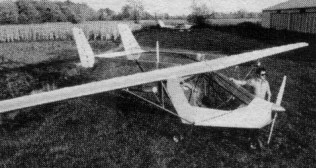
Designed by Peter Corley, the Toucan is a twin-engined, centreline thrust aircraft with twin tail booms.
Engine: 2 x Rotax 277
Empty wt.: 393 lbs
Max wt.: 900 lbs
Wing span: 38.5 ft
Wing area: 182 sq.ft
Wing loading: 5 lbs/sq.ft
Power loading: 16 lbs/hp
Max speed: 80 mph
Cruise: 65 mph
Stall: 25 mph
Vne: 90 mph
Canadair 540
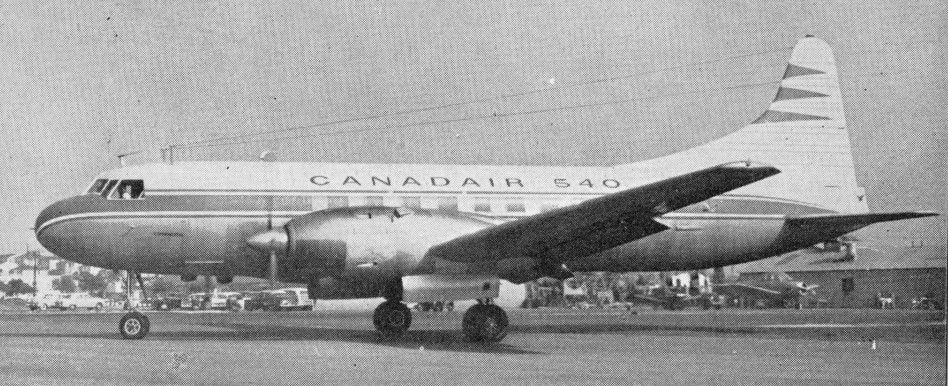
The Canadair 540, in production at Montreal in 1959, combines a Convair 440 with Napier Eland engines. The pre-prototype was a Convair 440 converted by PacAero of Santa Monica and first flown on 11 October 1959.
Canadair CRJ 700 / CRJ 900

The CRJ 700 (originally known as the CRJ X) was a stretched 70 ¬seater, launched with a firm order for four aircraft from the French company Brit Air.
Compared to the CRJ100/200 re¬gional jets from which it’s descended and with which it shares Collins ProLine 4 avionics, the CRJ700 features a fuselage stretch of 186 inches, new General Electric CF34 8C1 engines, a larger horizontal tail, leading edge slats and an APU in the tail cone instead of the equipment bay. Other changes in¬clude raising the passenger windows by 4.5 inches, lowering the floor an inch, and expanding the interior cabin by an inch to a total width of eight feet, five inches. The airplane’s commonality with the CRJ100s and 200s allow operators with both types an advantage in spares as well as pilot training. The GE engines are capable of 13,790 pounds of thrust with Automatic Power Reserve
On May 27, 1999, the evening before its official rollout, Bombardier’s CRJ700, new 70 passenger Canadair Regional Jet airliner, made its first flight. The CRJ700 took off from Montreal, Canada’s Dorval Airport at 6:18 in the evening with test pilots, Craig Tylski and Chuck Ellis, on a test flight that lasted two hours and eight minutes.
The public debut was at Farnborough International Air Show on 23 July 2000, and Transport Canada certification achieved 22 December 2000.
The first customer delivery, to Brit Air of France, was in February 2001, followed by deliveries to Horizon Air and Lufthansa CityLine in May 2001.
The CRJ900 was originally CRJ700 Msn 10001, and the airframe was converted with two plugs of 90in (2.28m) and 62in (1.57m).
The prototype retained the CRJ-700 wings, landing gear and engines, and was first flown on 21 February 2001, from Montreal-Mirabel, piloted by Chuck Ellis, Craig Tylski and Jeff Hyde.
The public debut was at the Paris Air Show on 14 June 2001, and first production aircraft first flown on 20 October 2001. Transport Canada certification was achieved on 9 September 2002, followed by FAA approval 25 October 2002 and JAA certification 23 December 2002.
The first customer delivery, to Mesa Air, was on 3 February 2003.

VERSIONS
CRJ-700
68-seat version in standard and extended range (ER) weight options.
Engine: 2 x General Electric CF 34 8C1, 61313 N
Length: 106.66 ft / 32.51 m
Height: 24.836 ft / 7.57 m
Wingspan: 76.247 ft / 23.24 m
Wing area: 738.733 sq.ft. / 68.63 sq.m
Max take off weight: 51255.2 lb / 23245.0 kg
Weight empty: 30109.3 lb / 13655.0 kg
Max. speed: 464 kt / 860 km/h
Cruising speed: 442 kt / 818 km/h
Service ceiling: 41011 ft / 12500 m
Wing load: 69.5 lb/sq.ft / 339.0 kg/sq.m
Range: 1701 nm / 3150 km
Crew: 2
Payload: max. 8527kg
CRJ-701
70-seat version in standard and extended range (ER) weight options.
CRJ-900
Standard version.
Length : 106.60 ft / 32.51 m
Height: 24.836 ft / 7.57 m
Wingspan: 76.247 ft / 23.24 m
Wing area: 738.733 sq.ft. / 68.63 sq.m
Max take off weight: 51255.2 lb / 23245.0 kg
Weight empty: 30109.3 lb / 13655.0 kg
Max. speed: 464 kt / 860 km/h
Cruising speed: 442 kt / 818 km/h
Service ceiling: 41011 ft / 12500 m
Wing load: 69.5 lb/sq.ft / 339.0 kg/sq.m
Range: 1701 nm / 3150 km
Engines: 2 x General Electric CF 34 8C1, 61313 N
Crew: 2
Payload: 70 pax (max. 8527kg)
900ER
Extended-range version.
900ER European
As 900ER but with maximum T-O weight limited to 36,995kg to minimise weight-related charges when operating in European airspace.
900LR
Long-range version.
900LR European
As 900LR hut with maximum T-O weight limited to 37,995kg.

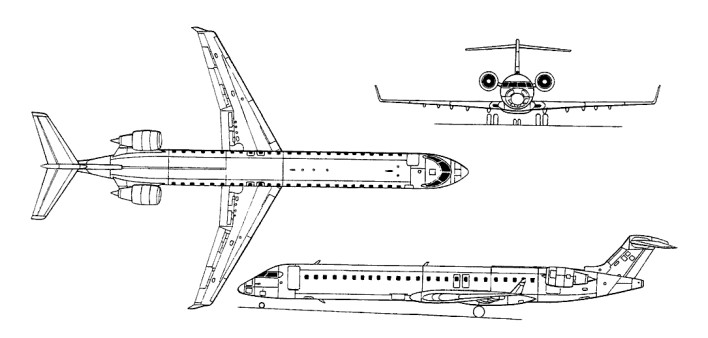
Canadair RJ 400
CRJ-440
Engines: 2 x General Electric CF34-3B1 Turbofans, 9220 lb thrust.
Canadair CRJ / RJ 100 / RJ 200

The CRJ concept evolved from a stretched design of the Challenger business jet. Stretched versions of this aircraft go back to 1981 with the 24-seat CL-600. Bombardier then looked at a stretch of the CL-601 Challenger in 1987, which lead to the formation of the Regional Jet programme on 31 March 1989; the world’s first 50-seat jet airliner.
Canadair CRJ / RJ 100 / RJ 200 Article
The fuselage cross-section of the Challenger formed the basis and advanced design commenced in November 1987, the basic configuration frozen in June 1988, and the RJ (Regional Jet) Programme launched in March 1989.
The new airliner is based on the CL-601 3A version of the Challenger (first introduced in September 1986). The wing has been re configured to reduce drag at the Mach 0.8 max cruising speed, increased by span by 1.8 metres, but retains the CL601 winglets. The fuselage is stretched 6.1 metres by plugs both forward and aft of the wing, and additional emergency exits have been introduced. The 50 seat layout features 4 abreast seating, two each side of the aisle. The cockpit wind¬screen area is strengthened and the baggage compartment door enlarged. The undercarriage is beefed up and larger tyres are fitted. Simplified avionics and navigation systems have been introduced, reflecting the lesser requirements of short haul service. Power plants remain the same two General Electric CF34 3A turbo fans delivering 9220 lb thrust, although thrust reversers have been fitted to reduce stopping distance. While the original idea was to have maximum commonality with the Challenger, this has not quite worked out in practice. Because of the tougher environment the RJ will have to work in, most items in the structure have strengthened. Assembly takes place in Montreal alongside the Challenger.
An extended-range CRJ100ER announced September 1990. Three development CRJ Series 100 aircraft were built, plus a static test airframe and forward fuselage test article. The first aircraft rolled out on 6 May 1991 and first flew on 10 May 1991.
Transport Canada type approval (CRJ100 and CRJ100ER) was granted on 31 July 1992, and the Japanese Civil Aviation Bureau certification on 23 May 2000.
As at February 1993, the company had firm orders for 36 aircraft, condi¬tional orders for another two, and 34 options. In addition, Memorandums of Understanding for a further 74 aircraft were held. Production rate was two per month, and deliveries had been made of six aircraft (five to launch customer Lufthansa City Line and one to Xerox as a corporate shuttle). The first delivery aircraft flew on 4 July 1992, and was delivered to Lufthansa Cityline of Germany on 29 October 1992. Lufthansa operations commenced in November 1992.
European JAA and US FAA certification were received on 14 and 21 January 1993 respectively, with the long-range CRJ100LR certified on 29 April 1994.
The CRJ200 with CF34-TB1 engines was announced in 1995, replacing the CRJ 100 in production after 226 CRJ100had been delivered. The CRJ’s wing is an advanced airfoil that is manufactured as a single unit. Each wing has one fuel tank and, together with the centre tank, hold a total of 8230 lt. Atlantic Southeast Airlines ordered 30 in April 1997 (with options for 60 more), joining other Delta Connection operators Comair, SkyWest and Mesa.
The CRJ 200ER is an extended range derivative, customers for which include Atlantic Coast Airlines, which has ordered 12 aircraft and held options on 36 more.
Up to May 1999, Bombardier had delivered 306 of the 50-passenger CRJ-200 jets, having received 549 firm orders, as well as options for 254 of the aircraft.

200th aircraft delivered (to Lufthansa) 24 October 1997; 300th to Atlantic Coast Airlines in April 1999. 400th to Delta Connection/Sky West in July 2000. 500th to Atlantic Coast Airliners 26 April 2001, and 600th to Atlantic Southeast Airlines 29 January 2002, and 700th to Air Nostrum 30 October 2002. Production of CRJ200 running at 9.5 per month in 2000, rising to 12.5 per month by late 2001, and 14.5 per month by 2003.
Bombardier sought to sell the CRJ program to further reduce their debts and focus on their profitable side of aviation business – Business aircraft. In 2019 Mitsubishi Heavy Industries purchased Bombardier’s CRJ program for $550 million and was liable to pay Bombardier’s CRJ program debts, which stood at an approximate amount of $200 million. At the same time, Bombardier’s Learjet, Challenger and Global brands will be united under Bombardier Aviation.
VERSIONS
CRJ –100
Original standard aircraft.
Engineering designation CL-600-2B19.
Engines: 2 x General Electric CF34-3A1.
Seats: 50.
Cruising speed 424kts (786km/h).
Range with 50 passengers 1,815km (980nm).
Weight empty 13,236kg (29,180 lb).
Maximum take off weight 21,523kg (47,450 lb).
Span 21.21m (69ft 7in).
Length 26.77m (87ft 10in).
Wing area 54.0 sq.m (581.1 sq.ft).
CRJ-100ER
Replaced by CRJ200ER.
CRJ-100LR
Announced March 1994
Launch customer, Lauda Air of Austria
Replaced by CRJ200LR.
CRJ-200
Standard aircraft; designed to carry 50 passengers over 1,824km range; CF34-3B1 engines with 2.8 per cent lower specific fuel consumption than CF34-3A1 of CRJ100, increasing initial cruise altitude by 213m, cruising speed by 4.5km/h, and range typically by 1.5 per cent; Class C baggage compartment as standard.
First delivery to Tyrolean Airways, 15 January 1996.
CRJ-200B
With optional hot-and-high CF34-3B1 engines.
CRJ-200ER
Extended-range capability with optional increase in maximum TO weight to 23,133kg and optional additional fuel capacity, for range of 3,046km.
Engines: 2 x General Electric CF34-3B1 Turbofans, 9220 lb thrust.
Seats: 50.
Max cruise: 0.81M.
Range: 1645nm @ 0.74M.
Ceiling: 41,000 ft.
Length: 26.77m.
Height: 5.84m.
Width: 21.24m.
Max ramp wt: 23.24 tonne.
MTOW: 23.13 tonne.
CRJ-200B ER
With optional hot-and-high CF34-3B1 engines.
CRJ-200LR
Longer-range version of CRJ200ER (more than 3,713km; maximum T-O weght increased by 907kg to 24,040kg.
Engines: 2 x General Electric CF34-3A1.
Seats: 50.
CRJ-200B LR
With optional hot-and-high CF34-3B1 engines.
CRJ-440
Engineering designation CL-600-2B19.
Version seating 44 passengers in standard configuration.
Launch customer Northwest Airlines has ordered 75.
CRJ-700
Corporate Jetliner
Company shuttle version with more spacious cabin accommodation for 18 to 30 passengers. One delivered June 1993 to Xerox Corporation. Five ordered by the People’s Republic of China in January 1997. Supplanted from September 2002 by corporate version of Challenger 800.
Challenger 800
Corporate version developed in consultation with launch customer TAG Aeronautics Ltd to meet requirement for non-stop flights, London to Jeddah or equivalent, with three crew and five passengers; or between Middle East city pairs with 15 passengers.
First flown 26 May 1995 and formally announced at Paris Air Show in the following month; initially designated Canadair Special Edition; first delivery to TAG during Dubai International Aerospace Show in November 1995.
Accommodation for up to 19 passengers in customised cabin; additional 1,814kg of fuel carried in two auxiliary tanks behind main cabin, extending range to more than 5,556km and maximum T-O weight 24,040kg
First aircraft powered by standard CF34-3A1 turbofans, but subsequent examples are equipped with CF34-3B1s increasing range to 5,778km. Manufactured to special order only. Customers include Poly Technologies lnc, which ordered two on 16 August 2001 for operation by China Ocean Aviation Group.

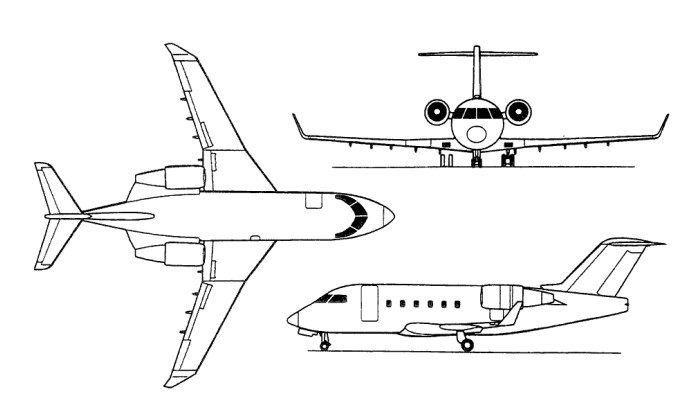
Canadair Learstar 600 / CL-600 Challenger
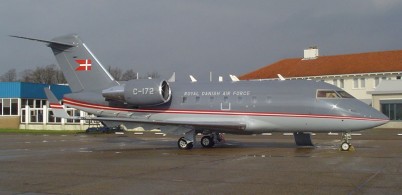
Lear’s brief collab¬oration with Canadair led to the LearStar 600, subsequently re¬named Challenger 600 after Canadair bought the manufacturing rights.
The initial Challenger 600, of which 83 were built, had Avco Lycoming ALF 502s and, on retro-fitted aircraft, winglets, and was flown for the first time on 8 November 1978, near Montreal. During the 50 minute first flight, the air¬plane climbed to 9,500 feet, the gear was cycled and various basic maneuvers were performed. The Challenger began certification flight testing in March 1979 with Lycoming ALF 502s of 7,500 pounds thrust (up from 6,700 pounds) and reduced elevator span to discourage flutter.
Canadair CL-600 Challenger Article
The second and third prototypes flew in March and July 1979.
On 3 April 1980, a test flight with the first prototype above the Mojave Desert ended in a disaster, with the airplane crashing due to a deep stall. In August 1980, certification was granted with temporary restrictions. Deliveries of the CL-600, powered by two Lycoming ALF-502L turbofans started on 30 December 1980, first flown on 21 September 1979.
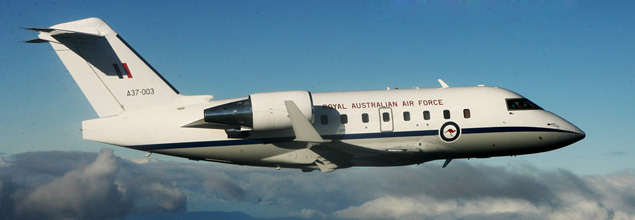
The design was developed further and on 10 April 1982 the Challenger 601, a refined version with the more powerful General Electric CF-34 engines and winglets, made its maiden flight. In 1983, the CL-601 replaced the CL-600 in production.
Sales to 1990 exceeded 140.
The first 601-1A delivered on 6 May 1983.
The first 601-3A flew on 6 May 1987 and the first 601-3A/ER on 19 May 1989.
The Canadair CL-601 Challenger 3A completed Canadian certifica¬tion on 21 April 1987, less than 10 months after its roll-out on 18 July 1986. FAA cer¬tification was confirmed on 30 April and the first delivery was made on 6 May, to TAG Aeronautics. The first production aircraft made its public debut at the Paris Air Show in June.
Based on the CL-601 — the version of the Challenger that introduced General Electric CF34 turbofans in the original CF-600 air¬frame — the Challenger 601-3A incorporates four significant developments. These are the improved CF34-3A engines to provide better climb and hot day take-off performance; a fully integrated digital avionics suite with higher reliability and improved diagnostics; a power-assisted passenger door and two land¬ing lights mounted in the nose. A “glass’ cockpit features dual Sperry flight guidance systems, a five-tube, four-colour Sperry FF15 with multi-functional display and four-colour digital weather radar; dual Sperry flight management systems; dual Honeywell laser IRS and a comprehensive Collins Pro Line II communications/navigation package.
In 1986, Bombardier Aerospace bought Canadair. The Bombardier Challenger became a family of business jets. A number of models entered production including in 1989 the CL-601-3R, an extended range version with an extra fuel tank added to the aircraft’s tail, a 2 crew and up to 19 passengers.
The number of models in 1989 included the CL-600-2B16 or Challenger 604 powered by CF-34-3B engines. First flight with these engines was on 17 March 1995, with Transport Canada certification granted that September. First delivery was in January 1996.
The first 601-3R flew on 14 July 1993, and the first 604 on 25 January 1996.
The Royal Australian Air Force Challenger CL-604 special purpose VIP transports are operated by the Royal Australian Air Force’s No 34 Squadron, based at Defence Establishment Fairbairn in Canberra. The Challenger has a crew of three (pilot, co-pilot and attendant) and carries up to nine passengers.
The Challenger CL-604 is fitted with a high-tech wing, high bypass CF34-3B engines, and a Collins ProLine 4 glass cockpit. The Challengers joined the RAAF VIP fleet in July 2002.
Challenger certified for operation in 40 countries by 1998. 500th Challenger rolled out 25 May 2000 and handed over 1 September 2000; 600th was undergoing interior outfitting in March 2003.
CL-600 Challenger
First built: 1978.
Engines: 2 x Lycoming ALF-502L, 7500 lbs thrust.
Seats: 11/28.
Length: 68.4 ft.
Height: 20.7 ft.
Wingspan: 61.8 ft.
Wing area: 450 sq.ft.
Wing aspect ratio: 8.5.
Maximum ramp weight: 40,550 lb
Maximum takeoff weight: 40,400 lb
Standard empty weight: 18,600 lb
Maximum useful load: 21,950 lb
Zero-fuel weight: 27,500 lb
Maximum landing weight: 36,000 lb
Wing loading: 89.7 lbs/sq.ft.
Power loading: 2.69 lbs/lb.
Maximum usable fuel: 16,725 lbs.
Best rate of climb: 3600fpm.
Certificated ceiling: 45,000 ft.
Max pressurisation differential: 9.3 psi. 8000 ft cabin alt @: 45,000 ft.
Maximum single-engine rate of climb: 1045 fpm @ 170 kts.
Single-engine climb gradient: 368 ft/nm.
Single-engine ceiling: 29,000 ft.
Maximum speed: 480 kts.
Normal cruise @ 43,000ft: 425 kts.
Fuel flow @ normal cruise: 2105 pph.
Stalling speed clean: 137 kts.
Stalling speed gear/flaps down: 113 kts.
Turbulent-air penetration speed: 280 kts.
Range : 4017 nm / 7440 km
Canadair CL-601 Challenger
light airliner, corporate jet, transport, Canada, 1986
Engine: 2 x CF 34 A1, 39829 N / 4060 kp
Length: 68.57 ft / 20.9 m
Height: 20.669 ft / 6.3 m
Wingspan: 64.304 ft / 19.6 m
Wing area: 519.901 sqft / 48.3 sq.m
Max take off weight: 43107.8 lb / 19550.0 kg
Weight empty: 19955.3 lb / 9050.0 kg
Payload: 23152.5 lb / 10500.0 kg
Max. speed: 460 kts / 851 km/h
Cruising speed: 442 kts / 819 km/h
Initial climb rate: 4527.56 ft/min / 23.00 m/s
Service ceiling: 41011 ft / 12500 m
Wing load: 83.03 lbs/sq.ft / 405.00 kg/sq.m
Range: 3440 nm / 6370 km
Crew: 2
Payload: 19 Pax
Challenger CL-601-3A
Power Plant: Two x General Electric CF34-3A turbofans each flat-rated at 9,140 lb St (4 146 kgp) including automatic power reserve (five-minute limit), up to 70 deg F at sea level.
Cascade-type fan air thrust reversers.
Fuel capacity, 2,451 US gal (9 278 1).
High speed cruise, 459 kts (850 km/h) or Mach = 080
Normal cruise, 442 kts (819 km/h) or M =077
Long-range cruise, 424 kts (786 km/h) or M = 074
Time to climb to initial cruise altitude, 23 mm
Max operating altitude, 41,000 ft (12 497 m)
Single-engine ceiling, 24,000 ft (7 315 m)
Take-off balanced field length, 5,400 ft (1 646 m)
Landing dis¬tance, 3,300 ft (1 006 m)
Max range, (NBAA IFR reserves, long-range cruise), 3,430 naut mls (6 352 kin) with five passengers.
Typical operating weight empty, 24,685 lb (11197 kg)
Max fuel load, 16,665 lb (7 559 kg)
Payload with max fuel, 1,900 lb (862 kg)
Max payload, 4,815 lb (2 184 kg)
Max take-off weight, 43,100 lb (19 550 kg)
Max zero fuel weight, 29,500 lb (13 381 kg)
Max landing weight, 36,000 lb (16 329 kg).
Wing span, 64 ft 4 in (19,61 m)
Overall length, 68 ft 5 in (20,85 m)
Overall height, 20 ft 8 in (6,30 m)
Wing area, 450 sq ft (41,81 sq.m)
Wing sweepback at quarter chord line, 25 deg
Undercarriage track, 10 ft 5 in (3,18 m)
Wheel¬base, 26 ft 2½ in (7,99 m).
Flight crew: two
Accommodation: 12 – 15.
Cabin length, 28 ft 3 in (8,61 m)
Max height, 6 ft 1 in (1,85 m)
Max width, 8 ft 2 in (2,49 m)
Cabin volume: 1,150 cu ft (32,56 cu.m)
Bombardier Challenger CL-604
Engines: Two General Electric CF34-3B turbofans (9,220 lbs thrust each)
Length: 20.86m
Height: 6.3m
Wingspan: 19.61m (including winglets)
Max takeoff: 21,863kg
Max landing: 17,236kg
Normal ops Speed: 870km/h
Range: 5,600km (with max fuel and reserves)
Ceiling: 41,000 feet
Crew: Two pilots and one crew attendant
Accommodation: 9 passengers
Canadair CL-215 / CL-415
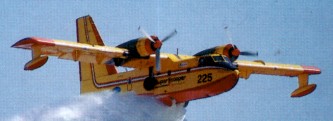
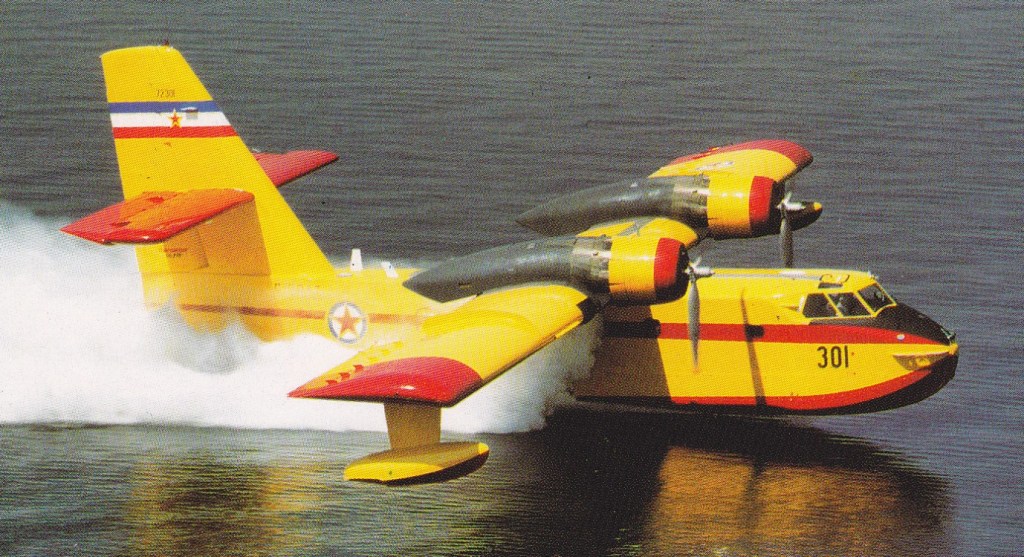
Designed principally for firefighting duties, the CL-215 twin-engined general-purpose amphibian also has military applications, including search and rescue and coastal patrol, Spain and Thailand use their CL-215s in both of these roles. The first prototype flew on October 23, 1967.
The CL-215’s two fuselage tanks hold 1412 USG / 5345 lt of water which can be scooped up in 10 seconds from a lake or sea surface, and can be dumped in one second.
Canadair offers a number of special military configurations, including flight inspection, maritime surveillance using an ALL AN/APS-128 search radar, electronic warfare support and training, cargo transport, and airborne early warning (AEW).
Production of the basic CL-215 was completed with delivery in 1990 of the 126th airframe, having been exported to France, Greece, Spain, Italy, Yugoslavia, Thailand and Venezuela.
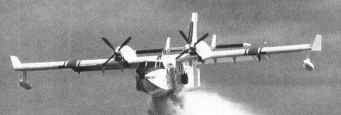
In September 1986 Canadair announced the CL-215T turboprop development. Designed as a retrofit package for existing operators of the piston-engined aircraft and – if sufficient new orders were received – for full production, the CL-215T has two 2,380 shp (1 175 kW) PW123AF engines driving four-bladed propellers. As a water-bomber (its primary mission) the CL-215T will carry 6,132 litres (1,620 US gal).
The first CL-215T flew on 8 June 1989 powered by two 2380 shp / 1775 kW Pratt & Whitney Canada PW123AF turboprops, and could carry 1620 USG / 6132 lt of water.
Canadair CL-415 Operation 1996
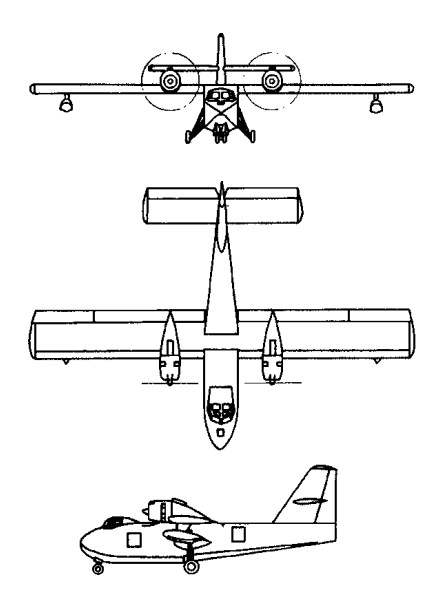
CL-215
Engines: 2 x Pratt & Whitney R-2800-CA3, 1566kW, 2100hp
Wingspan: 28.6 m / 93 ft 10 in
Wing area: 100.33 sq.m / 1079.94 sq ft
Length: 19.82 m / 65 ft 0 in
Height: 8.92 m / 29 ft 3 in
Max Take-off weight: 17100-19731 kg / 37699 – 43500 lb
Empty weight: 12161 kg / 26811 lb
Max level speed: 172 mph (293 kph) at 10,000ft/3050m
Cruise speed: 291 km/h / 181 mph
Initial ROC: 1000 fpm / 305 mpm
Range: 2095 km / 1302 miles
Payload: 5453kg 12,000 lb of water, 3864 kg / 8518 lb freight, or 26 passengers
Canadair CL-84
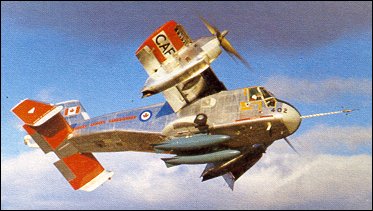
With a research and development period from 1958 to 1963 before the first prototype was constructed, the design incorporated a number of innovations including a large chord wing which was to be covered by the propeller slipstream, all engines, rotors, and the tail rotor which were connected together by intricate shafts and gear boxes, and a stability augmentation system for reduction of pilot workload in low-speed flight conditions. There was considerable scale model testing in Canadian wind tunnels to ensure the design.
The CL-84 had a maximum height of 14 feet, seven inches, and a rotor tip-to-tip length of over 4.2m. The wings had a total area of 21.6sq.m with the trailing and leading edge flaps having of 4.7sq.m. The empty weight of the plane was 3380kg. In a maximum payload configuration, the plane could be loaded to 675kg for a pure VTOL mission, with 1620kg of payload available in a STOL or conventional mission.
The prototypes weighed about 3600kg, and the wings were 10m in length Mounted on the underside were a pair of Lycoming T53-LTCIK-4A turboprop engines with 4.3m-diameter propellers.
The horizontal tail was relatively low so that it was below the wing wake during cruising flight and always within the slipstream of the wing-tilt angle. The placement within the slipstream was to prevent abrupt changes in pitching moment as a function of wing-tilt angle.
Pitch control was provided by a pair of horizontally-mounted two-bladed propellers mounted on the rear of the aircraft. When in conventional flight, the props were stopped to minimize drag.
Roll control was maintained by differential thrust from the main engines while ailerons accomplished yaw control. A so-called mixing box brought all the control forces together to act as one as it linked the elevators, rudder, ailerons, and propeller blade angles together.
The first of four prototypes was built in two years, with the first vertical flight achieved in May 1965, followed by its first conventional flight seven months later.
The first total transition flight was accomplished on January 17, 1966, at the company’s Montreal facility. Transition was made from hover to forward flight and back. Flights were made in light snow with wind gusting to 25 miles per hour. The flight, with company pilot W.S.Longhurst at the controls, came seven months ahead of schedule.
The CL-84 was able to lift 2930kg of fuel and payload in a STOL take-off, or 1850kg of fuel and payload in a VTOL mode. It was found a 65km/h wind could double the VTOL payload capability.
An advantage of the CL-84 came from the pilot’s seat where it was piloted pretty much like a conventional aircraft. The pilot sat in the left seat, but dual controls were fitted. Even with its complex control mechanisms, the control stick and rudder pedals produced the desired control functions. A new flying technique wasn’t necessary. The pilot could fly the plane without knowing the wing angle.
Significant flying maneuvers were accomplished during the test program, including forward flight from hover (wing tilt 88 degrees) to 60km/h (wing tilt 48 degrees) and return to hover mode, demonstration of adequate control in winds gusting to 45km/h, rearward, sideward, and turning flight in and out of ground effect, and sustained flight with hands free of the controls.
By April 1966, the CL-84 began investigation into the high-speed regime followed undercarriage retraction tests, with speeds up to 370km/h in 60-degree banked turns being achieved. Other significant test accomplishments occurred during low-speed maneuvers. For example, the CL-84 easily completed 2G turns at only 165km/h, followed by 60m radius turns at 90km/h.
The plane also demonstrated exceptionally stable hovering flights, including hands free flight, and the CL-84 was hovered and landed vertically with the stability augmentation system not operating.
The first prototype was flown for two years by 16 pilots for a total of 145 flying hours. A number of military applications were tested, including dropping of external stores, mini-gun firing, simulated rescues from hover, use of a cargo sling, joint operations with a helicopter at seas, and hover downwash tests. A number of United States teams also evaluated the plane.
The first prototype was lost in a reliability test accident in September 1967, both pilots ejecting safely from the plane. The aircraft was flying at 980m at 280km/h in a forward velocity mode when the plane yawed to the left and quickly pitched downward. The investigation that followed identified the probable cause as a propeller failure. The plane was on its 306th test flight when the incident occurred.
The program continued with the construction of the three additional versions which incorporated a number of design changes from the original. Only two of them would actually fly. Two of the planes would be involved in non-fatal accidents due to mechanical problems.
The additional prototypes were built between February 1968 and February 1970. The testing of them would continue until 1974, over 20 years since the design work had started.
The CL-84 was demonstrated to the US Navy and the USS Guam also hosted a number of both STOL and VTOL flights from its deck. A flying demonstration took place off a hundred-square-foot pad at the Pentagon.
Neither the United States or the Canadian government showed enough interest to bring the program into production.
The second of the three prototypes produced is on permanent display at the National Aviation Museum of Canada in Ottawa. This particular plane made 196 flights with almost 170 flight hours. The plane was donated to the museum by Canadair in 1984.
Canadair CL-84
Engine: 2 x Lycoming LTC1K-4C turboshaft, 1119kW
Wingspan: 10.16m
Length: 14.41m
Height with wing in horizontal position: 4.34m
Height with a wing in 90deg position: 5.22m
Take-off weight vertical start: 5715kg
Take-off weight with a shortened run: 6577kg
Empty weight: 3827kg
Max speed: 517km/h
Cruising speed: 497km/h
Range: 547km